

Aqua Play: A Portable Bathroom That Fits Inside a Cabinet
A freestanding modular washroom stacks toilet, basin, and shower into one relocatable unit for space-starved urban apartments.


What if your entire bathroom could slide open from a single freestanding cabinet? Aqua Play collapses the water closet, washbasin, and shower into a vertically stacked, independently operable unit that can be installed, relocated, or removed without touching a wall. It is not a prefab pod bolted to plumbing risers; it is a piece of furniture that happens to contain every sanitary function a person needs.
Designed by Shashank Pawar and Shruti Somani, Pawar, the project was shortlisted at the International Product Design Awards 2019. The brief invited designers to rethink product architecture for contemporary constraints, and this entry responded with a compact sanitary unit sized for studios, micro-apartments, and temporary housing where a dedicated bathroom footprint is a luxury.
Three Functions, One Vertical Stack
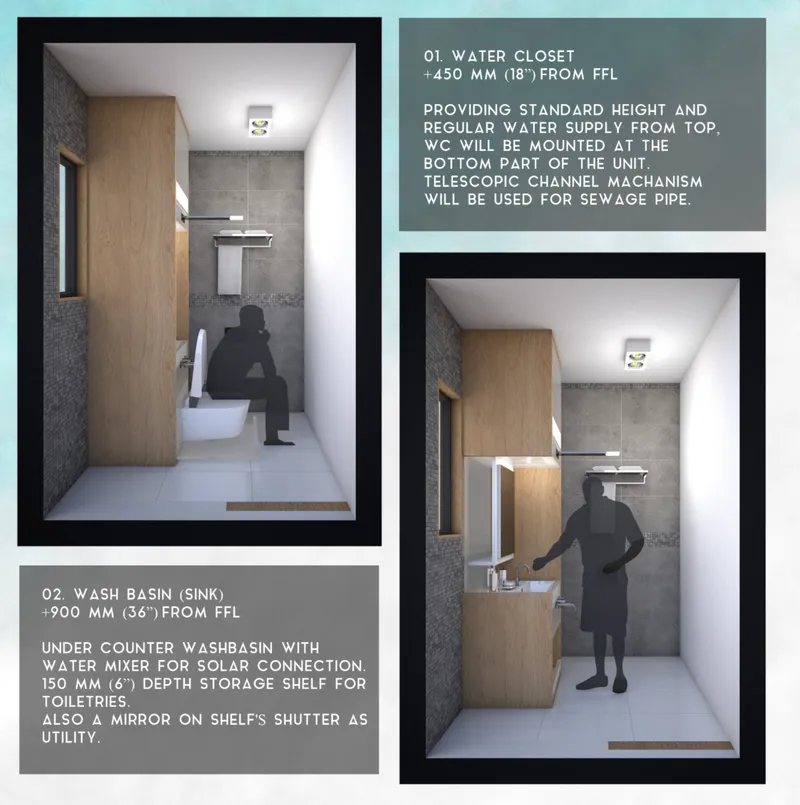
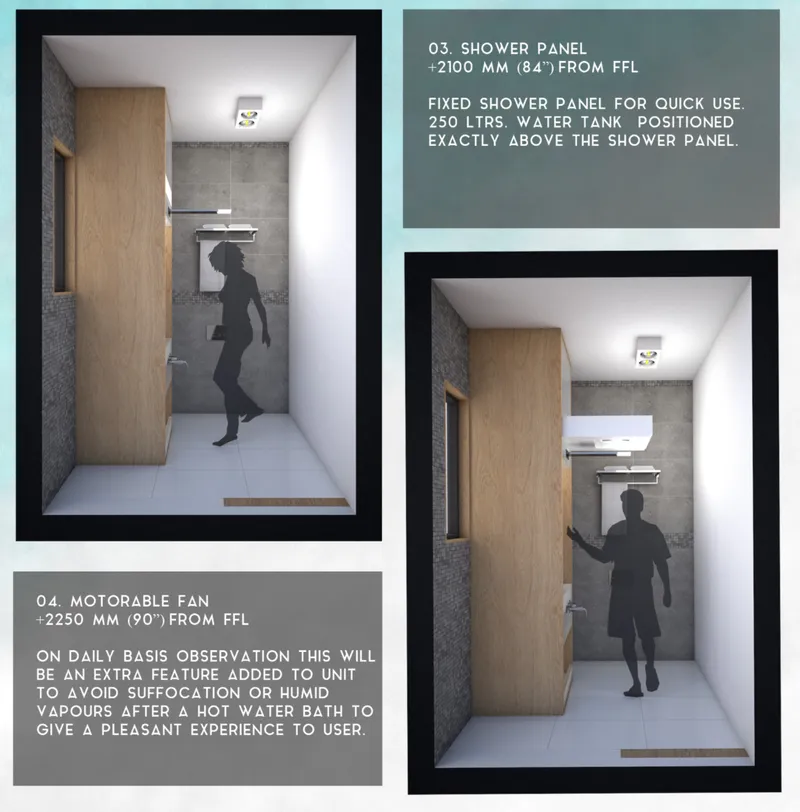
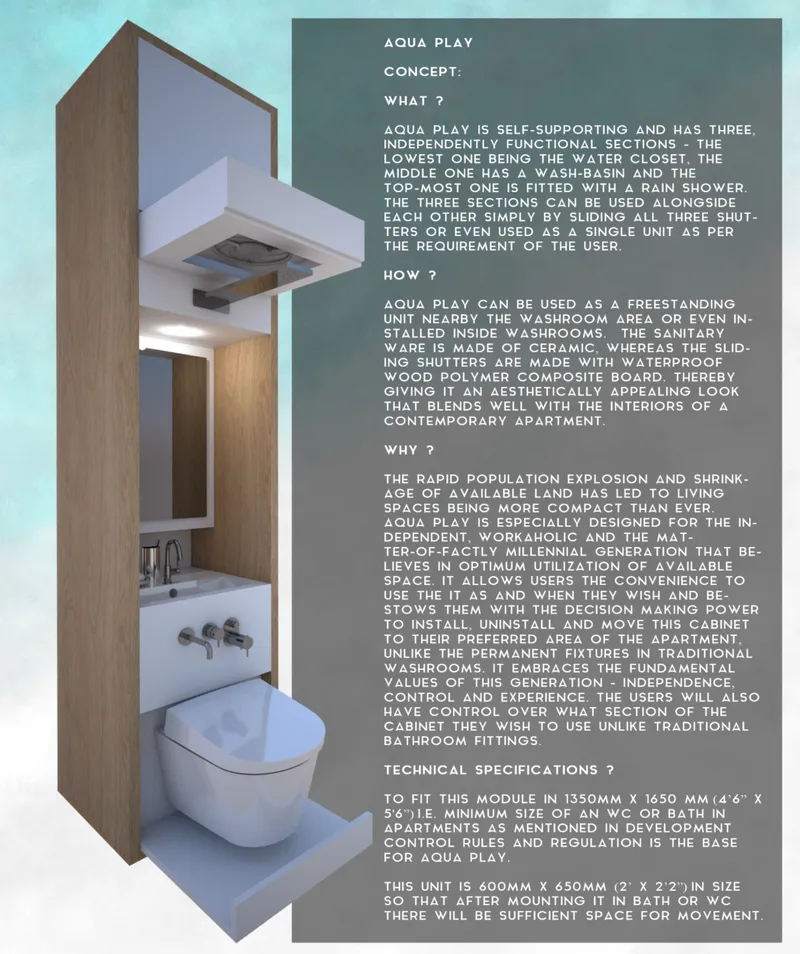
The cabinet divides into three independently operable vertical sections controlled by sliding shutters. At the base, a water closet sits at +450 mm from finished floor level, mounted on a telescopic channel mechanism that handles sewage connections while keeping the entire unit mobile. The middle zone, at +900 mm, houses an under-counter washbasin with integrated mixer, a 150 mm deep storage shelf for toiletries, and a mirror built into the sliding shutter itself, eliminating the need for separate wall-mounted fittings. At the top, a fixed shower panel at +2100 mm draws from a 250-litre water tank positioned directly above it, exploiting gravity to feed water pressure without a pump.
The sliding shutters are the key interaction layer. Users can open one section while the others remain closed, meaning the basin can serve morning routines without exposing the WC or shower. This granular control over which function is active at any moment gives the unit a spatial economy that a conventional bathroom, where everything is always visible and always consuming floor area, simply cannot match.
Ventilation and Vertical Ergonomics
Enclosed modular bathrooms invite obvious concerns about humidity and air quality. Aqua Play addresses this with a motorized exhaust fan positioned at +2250 mm, the highest point of the cabinet, where warm, moisture-laden air naturally rises. The fan prevents condensation buildup on the waterproof wood polymer composite shutter boards, which are chosen precisely because they resist swelling and delamination in wet conditions. Every height in the unit tracks ergonomic standards: the WC at a standard seated height, the basin at a comfortable standing wash height, and the shower head at a clearance that accommodates adult use without wasted vertical space.
Material Logic: Ceramic, Composite, and Neutral Finish
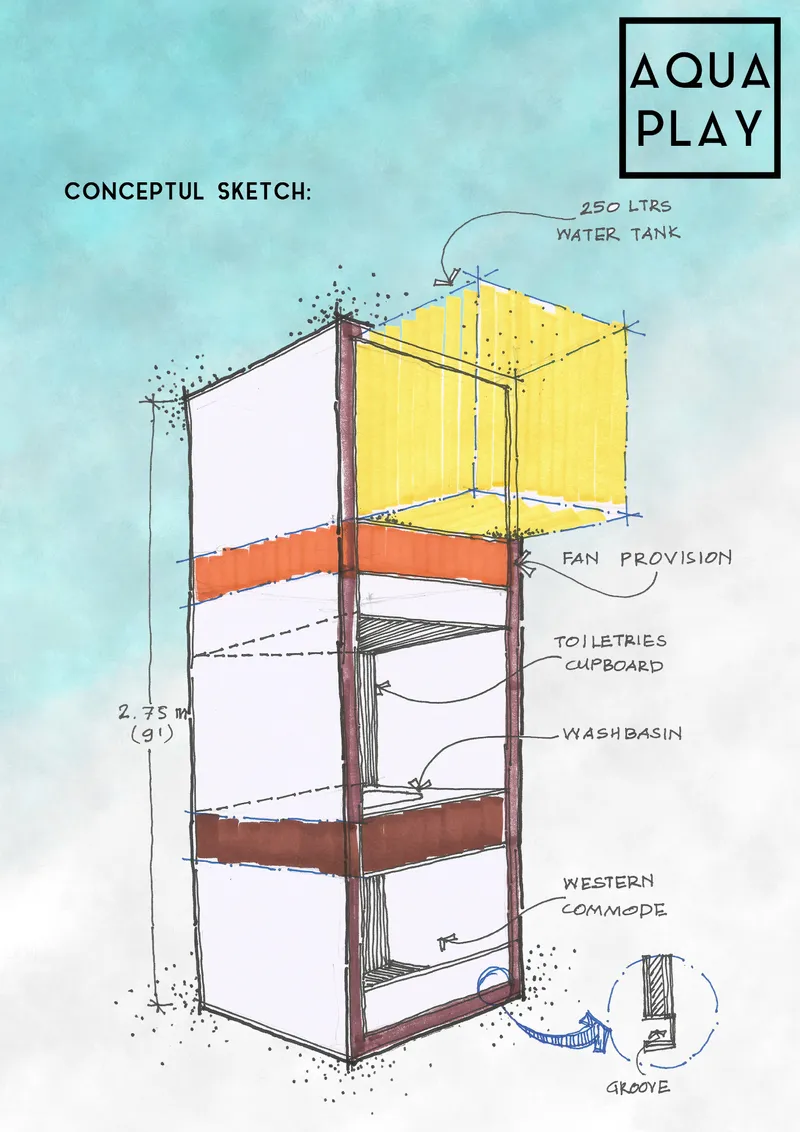
The annotated section sketch reveals how tightly the material choices follow functional logic. Ceramic sanitary fixtures handle hygiene and durability at the points of water contact. The cabinet body uses waterproof wood polymer composite boards that can take repeated splash exposure without degrading, while maintaining the warm timber appearance visible in the renderings. The neutral tone palette is a deliberate decision: the unit is meant to dissolve into modern apartment interiors rather than announce itself as a piece of bathroom hardware. It reads as cabinetry until a shutter slides open.
This dual identity, utility product and interior element, is what separates Aqua Play from typical portable sanitation. It belongs in a living space, not beside a construction site. The designers have clearly thought about the social dimension of the product: a bathroom that looks like furniture removes the stigma of living in a home small enough to need one.
Mobility as a Design Principle
The unit's defining attribute is relocatability. It can sit adjacent to an existing washroom to add capacity, occupy a corner of a studio apartment as a standalone facility, or serve temporary housing where permanent plumbing infrastructure does not exist. The telescopic sewage channel and self-contained water tank mean the unit needs minimal fixed-service connections. For renters who cannot modify their apartments, or for developers seeking to maximize leasable area by reducing wet-zone footprints, the proposition is straightforward: place it where you need it, move it when you don't.
Why This Project Matters
Urban residential footprints are shrinking faster than building codes are adapting. Micro-apartments, co-living units, and adaptive reuse projects all face the same bottleneck: wet zones are expensive, plumbing-dependent, and permanent. Aqua Play proposes that the bathroom does not have to be a room at all. By consolidating sanitary functions into a 250-litre-tank-topped cabinet with sliding shutters and a compact vertical footprint, the project reframes bathroom design as product design, subject to the same logics of portability, user control, and lifecycle flexibility that govern furniture.
What Pawar and Somani have produced is less a finished consumer product and more a provocation with real dimensions and real material specifications. The ergonomic rigor, the gravity-fed water strategy, and the shutter-based zoning all suggest that the idea has been tested against practical constraints, not just rendered for effect. As density pressures intensify and housing typologies continue to fragment, solutions like Aqua Play will move from competition shortlists to production lines faster than most architects expect.
View the Full Project
About the Designers
Designers: Shashank Pawar, Shruti Somani, Pawar
Enter a Design Competition on uni.xyz
uni.xyz runs architecture and design competitions year-round that reward proposals with spatial conviction and real site intelligence.
Project credits: Aqua Play by Shashank Pawar, Shruti Somani, Pawar International Product Design Awards 201 (uni.xyz).


Popular Articles
Popular articles from the community


Cloaked Colonization: A Mobile Underwater Habitat That Moves Like a Fish
Micah Abaya's shortlisted EHC Pacific entry reimagines ocean settlement as a dispersed network of self-sustaining architectural organisms.

Opera on the Sea: Driftwood Logic Shapes a Timber Opera House on Estonia's Coast
Trevor Orgill's opera house translates the entangled drift of floating timber into a civic building where wood, water, and music converge.
Faces of the Soviet Avant-Garde: Turning Moscow's Street Names into an Open-Air Museum
A network of sculptural installations across a Moscow residential district transforms forgotten architect names into spatial encounters with cultural memor
Opera by the Sea Estonia: Three Shells Dissolving Architecture into Tallinn's Coastline
A winning opera house proposal replaces monumental form with interconnected shells that blur the boundary between building, park and Baltic Sea.

Similar Reads
You might also enjoy these articles

The Amber Palace Opera: A Geological Fiction Surfaces on Tallinn's Baltic Waterfront
Pierre Brillard reimagines a Baltic legend as a public landscape, opera house, and waterfront promenade rooted in Tallinn's coastal identity.
Dynamic Modules Shelter: A Telescopic Ring for Mountain Pilgrimage
A circular modular framework of steel, bamboo, and fabric grows vertically with demand, wrapping communal ground in adaptable shelter.

Singing Woman: Contemporary Architecture Inspired by Estonia’s Voice and the Sea
Singing Woman turns Estonia’s song culture into flowing opera house architecture, blending public life, landscape, sea, and national memory.
HYPERBLOCK: Flexible Urban Design for Barcelona’s Future City
HYPERBLOCK reimagines Barcelona as flexible urban design, layering density, daylight, public space and adaptable housing above Cerdà’s grid.

Explore Aqua Module Competitions
Discover active competitions in this discipline

Design challenge to equip cities with modern furniture

Packaging challenge - Design meets sustainability
Comments (0)
Please login or sign up to add comments
No comments yet. Be the first to comment!