

ARCHcoop Nestles a White Villa into Armenia's Wine Country Hillside at Rind Village
A 797-square-meter residence in Armenia's Vayots Dzor region steps down a rocky plateau above ancient vineyards and stone terraces.


Rind village sits on a high plateau in the Vayots Dzor region, one of Armenia's oldest wine-producing landscapes. The terrain is dry, rocky, and dramatic: stone-walled terraces descend from scrubby highlands toward vineyard plots, and the light has a clarity that flattens distance and sharpens every edge. It is the kind of site where a building either fights the land or surrenders to it. ARCHcoop Architectural Studio, led by Garegin Yeghoyan, chose a third path: they broke the house into a series of low white volumes and stepped them down the slope, so the architecture simultaneously occupies the hill and defers to its profile.
What makes this 797-square-meter villa interesting is not its whiteness or its minimalism, both of which are easy to default to. It is the way the building uses section. The house is organized as a linear bar that negotiates a significant grade change, tucking a garage and service spaces below grade on one end while opening living spaces to terraces and a reflecting pool at the other. The result reads as a single-story pavilion from the valley below, while from the upper approach road it reveals itself as a multi-level composition deeply embedded in the topography. The house does not sit on the hill; it is part of the hill.
Reading the Site from a Distance
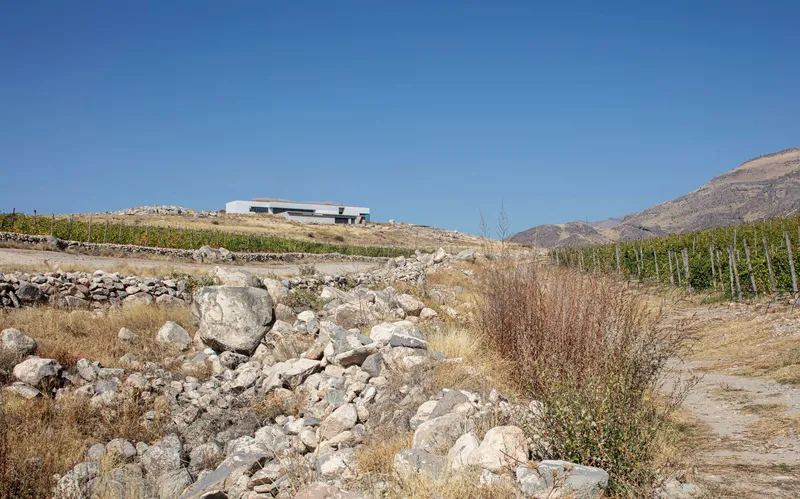
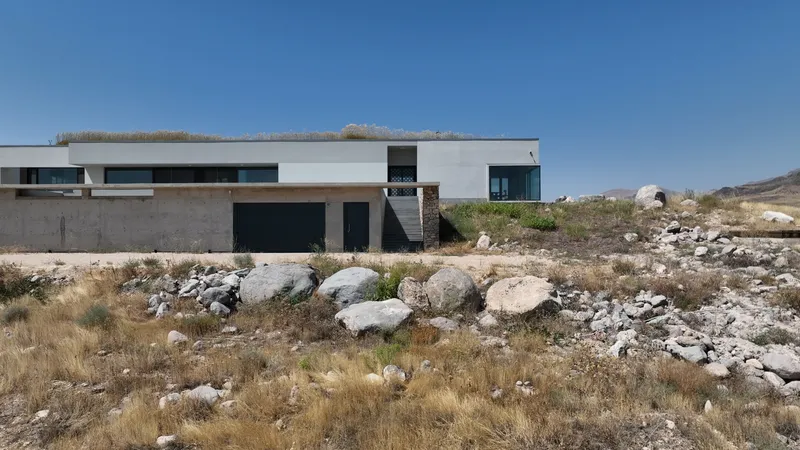
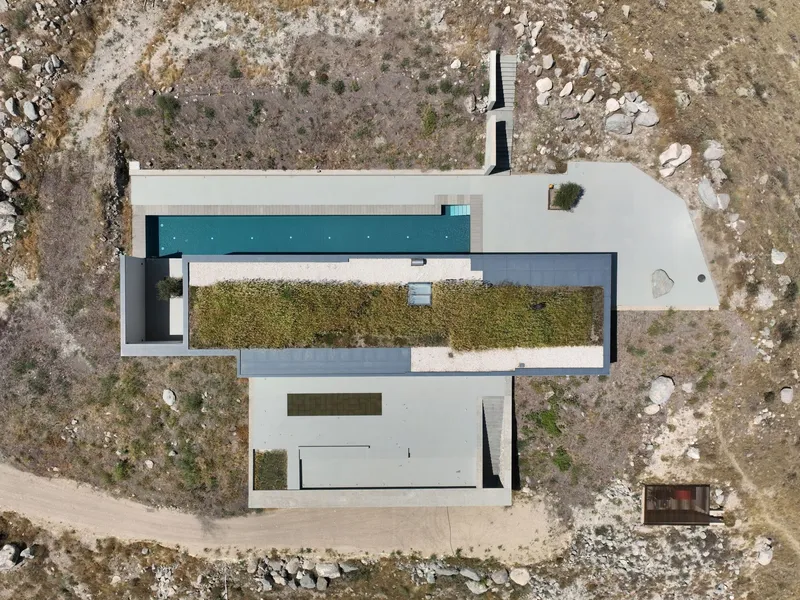
From the valley floor, the villa appears as a thin white stroke against the tawny hillside, hovering just above the vineyard terraces that define this landscape. The rendered surfaces catch the Armenian sun and throw it back as a crisp horizontal line. ARCHcoop clearly understood the power of restraint here: a taller or more articulated mass would compete with the geology, while this low-slung profile simply marks human presence without dominating. The aerial view confirms the strategy. The building's flat roof, planted courtyard, and pool form a composite footprint that reads almost like another terrace cut into the rocky terrain, echoing the agricultural platforms below.
Facades that Negotiate Exposure and Shelter
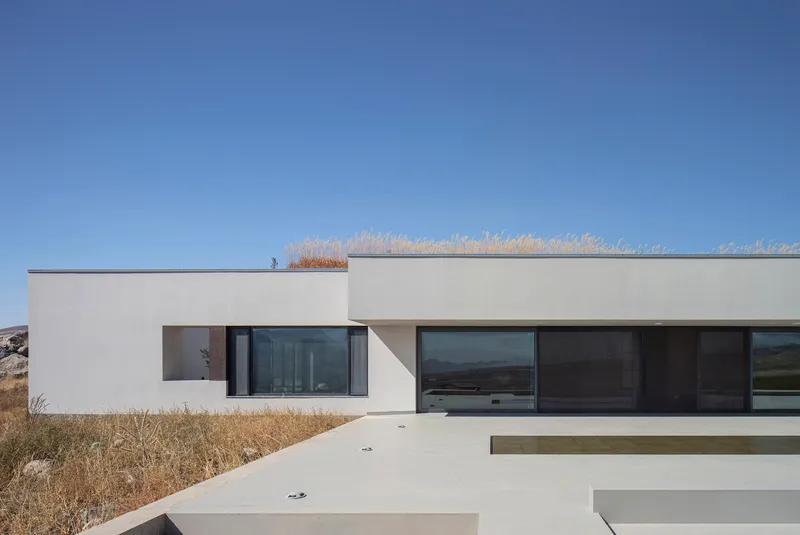
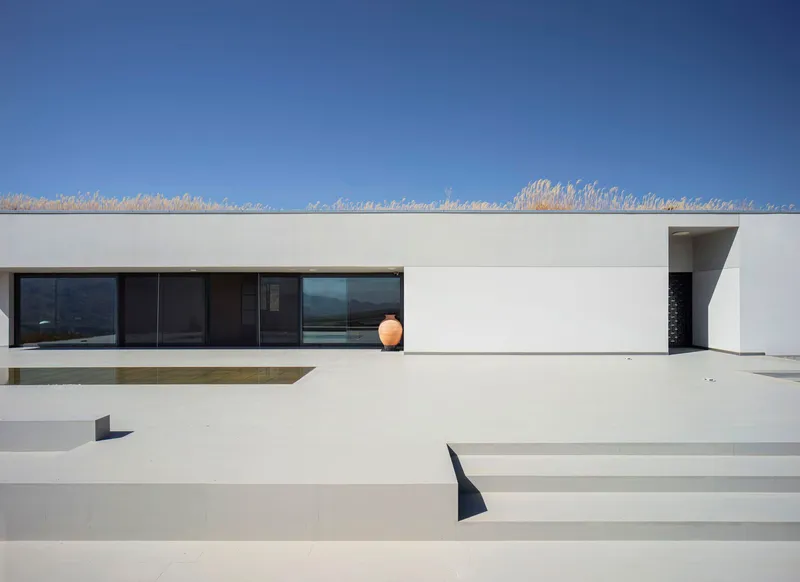
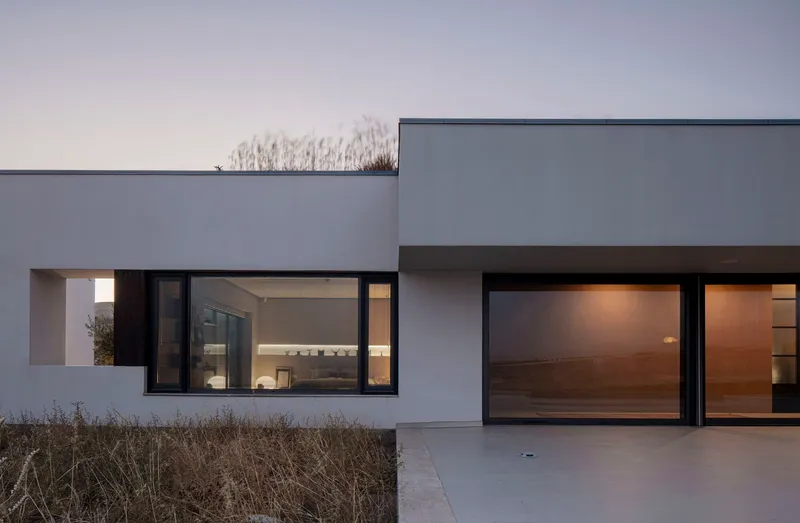
The villa's white stucco facades are deliberately austere, punctuated by horizontal window bands that frame the surrounding landscape rather than exposing the interior indiscriminately. On the uphill side, concrete terraces step up in broad, clean planes toward a narrow glazing strip, creating a fortress-like solidity that shields the house from wind and the occasional harsh winter. The downhill facades are more generous: black-framed sliding glass doors open entire rooms to the air, and at dusk the interiors glow behind the glazing like lanterns set into the hillside.
There is a tonal tension at work in the material palette. The white render is smooth and almost chalky, while the concrete of the terraces and steps is left raw, with visible board-formed texture in places. The contrast is subtle but intentional: the house belongs to two registers, the refined domestic interior and the rugged geology it occupies.
The Pool Terrace as a Landscape Room
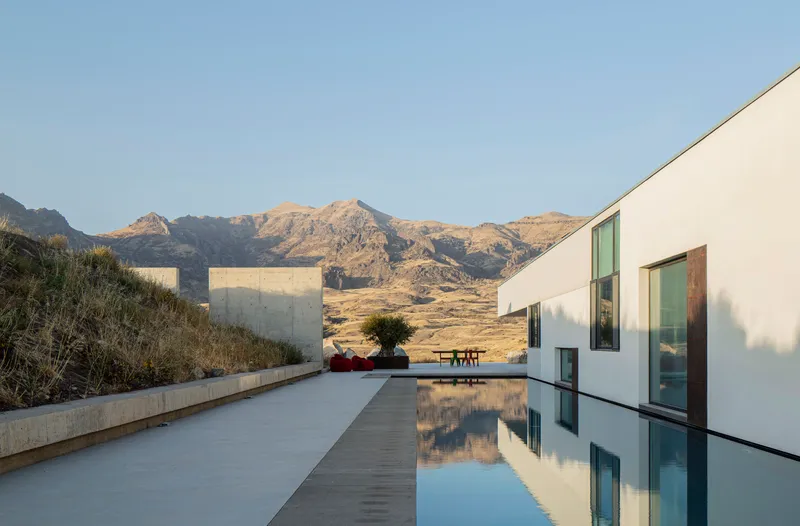
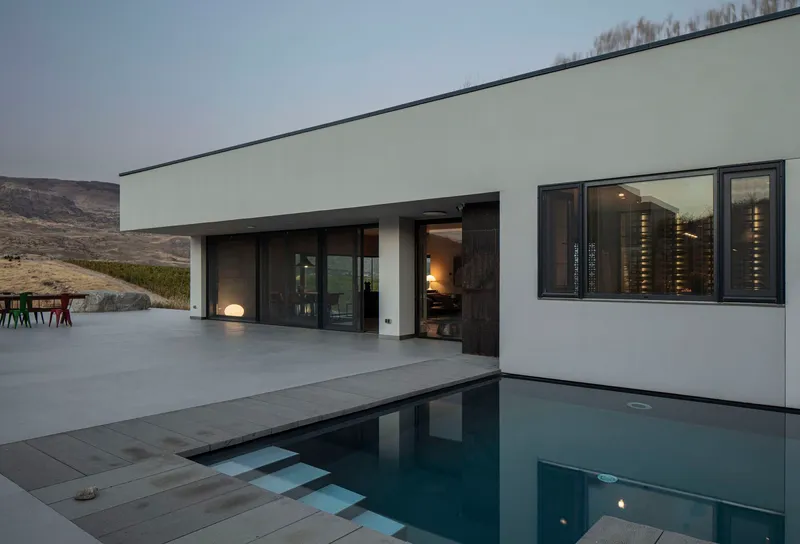
The reflecting pool and its concrete deck function as the villa's primary outdoor room, positioned to capture both the mountain panorama and the warm evening light that bathes the plateau. At dusk, the still water doubles the interior glow from the living spaces, pulling the architecture into a dialogue with itself. This is not a pool designed primarily for swimming; it is a device for slowing time, for anchoring attention to the horizon line and the play of reflected color.
The proportions of the terrace are generous relative to the building footprint, suggesting that ARCHcoop conceived the outdoor spaces as equal partners to the interior program rather than afterthoughts. The parched grasses that press in from all sides reinforce the sense that this platform is carved from an unyielding landscape, a pocket of calm wrested from dry rock.
Interior Character: Warmth Against Minimalism
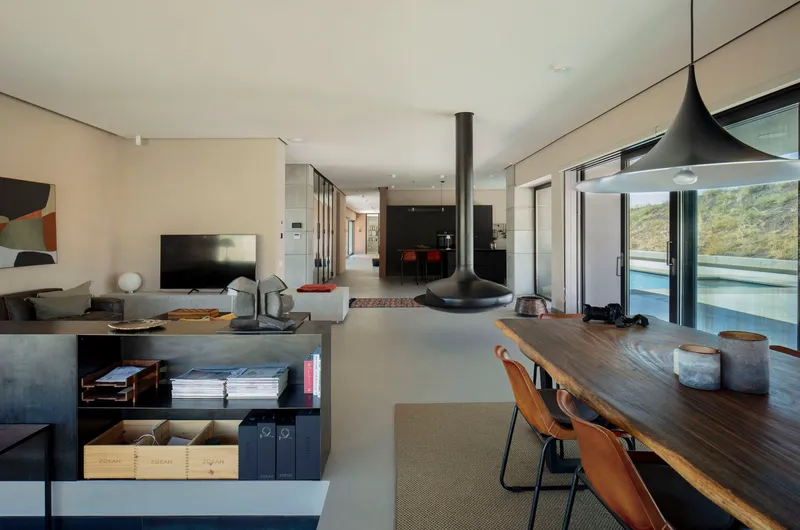
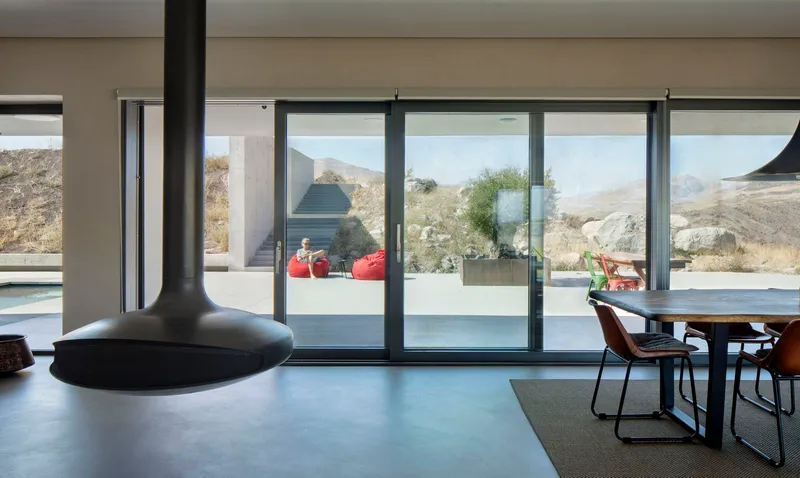
Inside, the villa pivots from the exterior's austerity toward warmth. A suspended conical fireplace anchors the main living space, hanging above a solid timber dining table and drawing the eye down from the exposed ceiling. The fireplace is a centerpiece that organizes social life in the room, and its sculptural form gives the space a focal point that the panoramic views alone would not provide. Sliding glass doors dissolve the boundary between the interior and the terrace beyond, so the fireplace competes with the mountains for your attention.
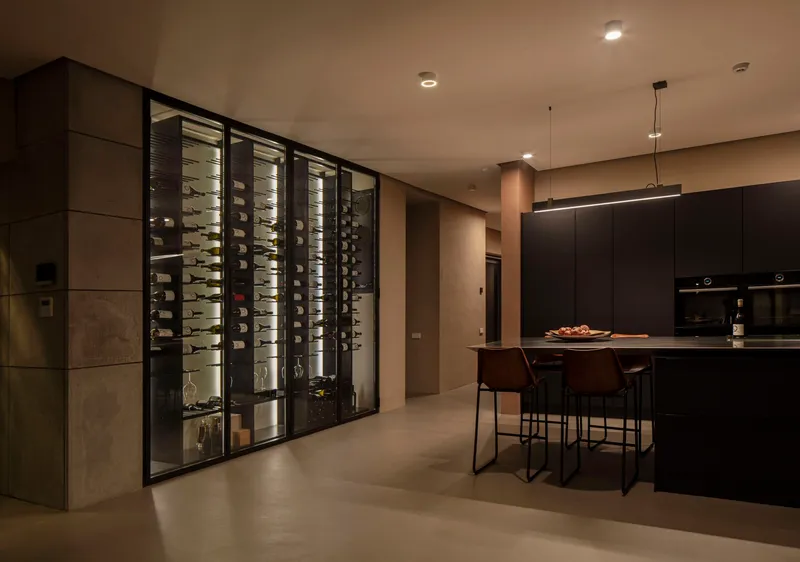
The kitchen takes a different approach to atmosphere. A backlit wall of wine storage nods directly to the Vayots Dzor terroir, turning the region's viticultural identity into an interior feature. Dark cabinetry and warm evening lighting give this space an intimacy that contrasts with the openness of the living room. It is a smart move: in a house this open, you need rooms that contract as well as rooms that expand.
Corridors and Private Rooms
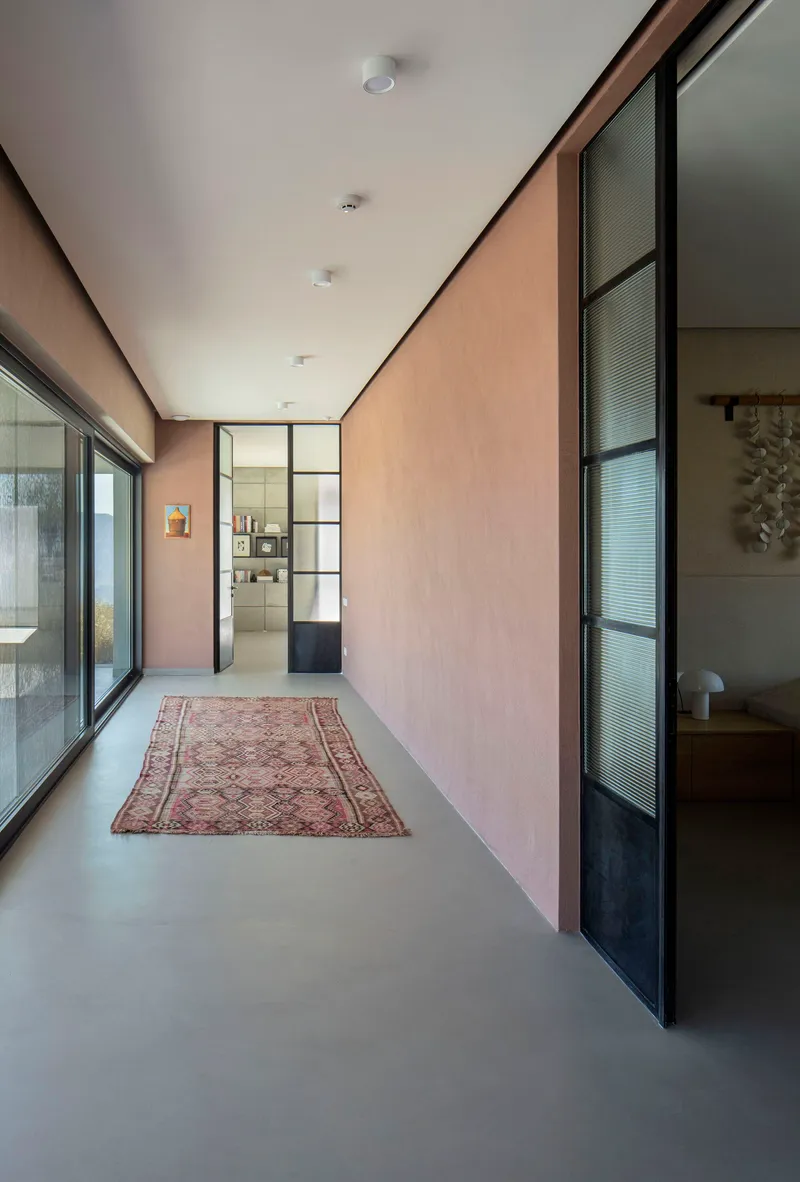
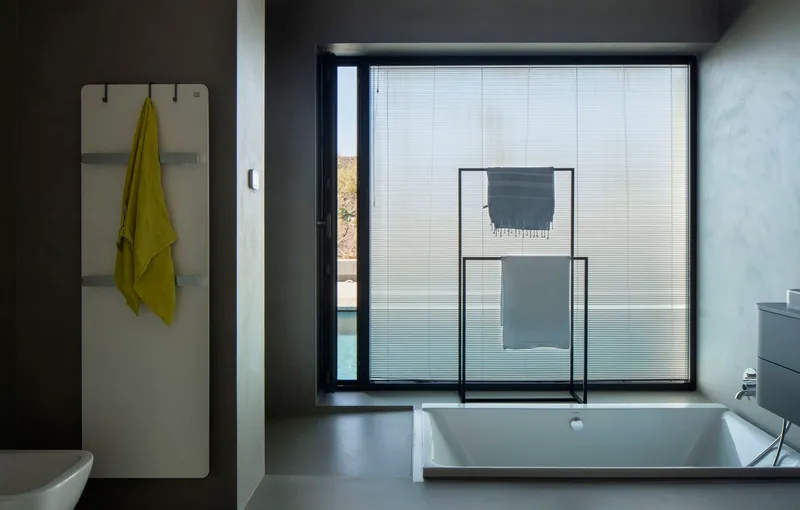
The circulation spine is handled with quiet precision. Pale plaster walls and polished concrete floors line a corridor punctuated by steel-framed glass partitions that admit light without sacrificing privacy. A vintage rug on the concrete floor introduces pattern and color in a way that keeps the minimalism from tipping into coldness. In the bathroom, a recessed tub sits beside a window fitted with translucent pleated blinds, offering a calibrated measure of daylight and seclusion. These are not showy spaces, but they demonstrate a care for everyday comfort that separates a well-designed house from a merely photogenic one.
Plans and Drawings
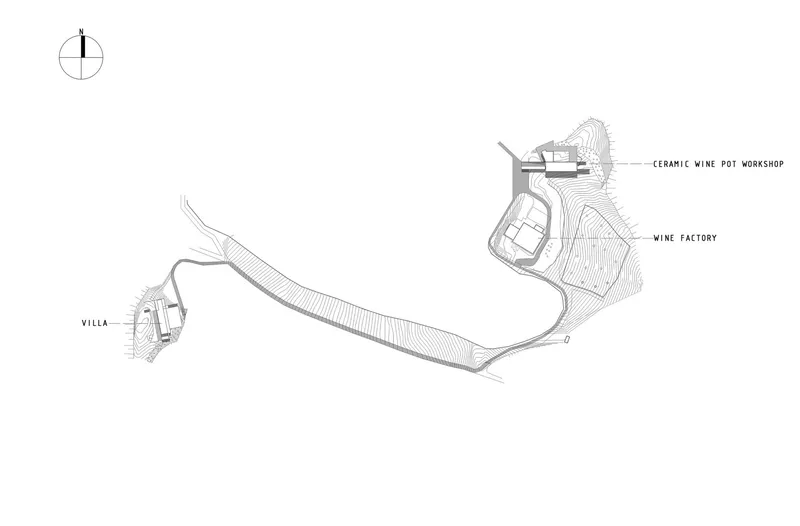
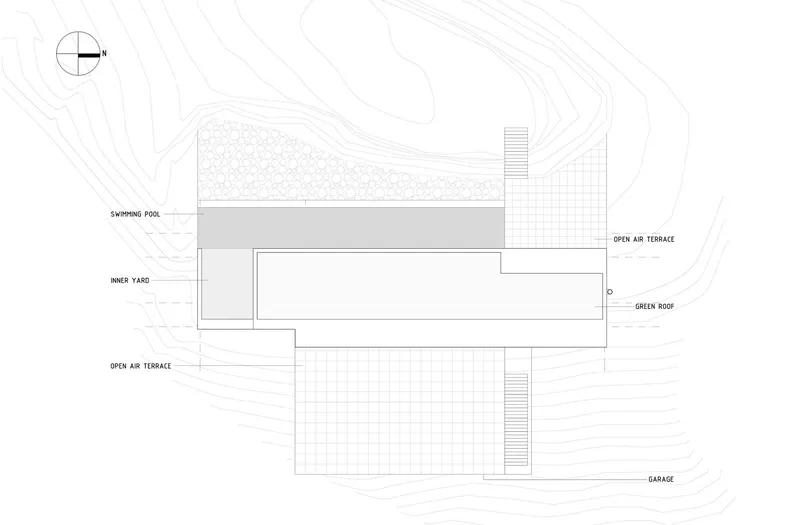
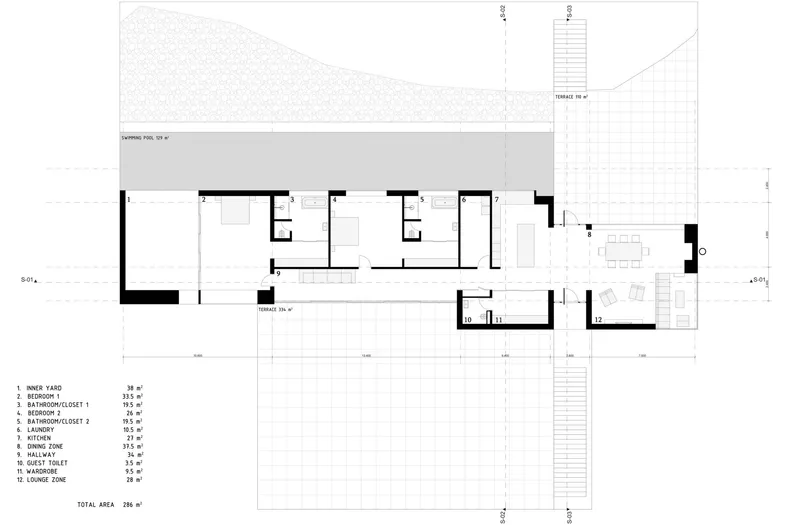
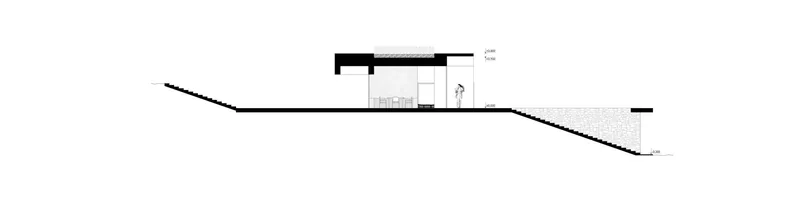

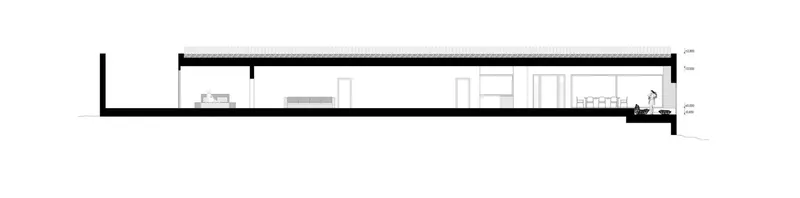
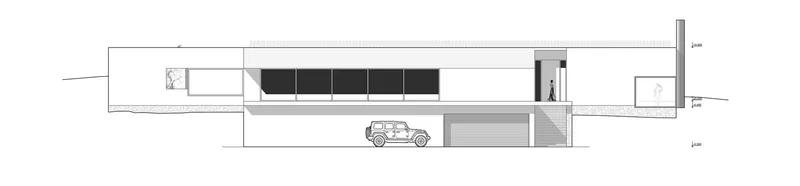

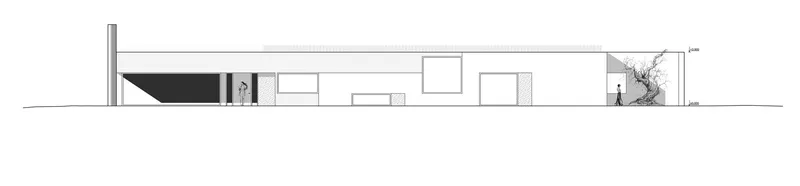
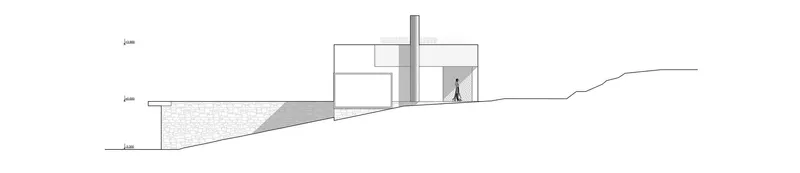
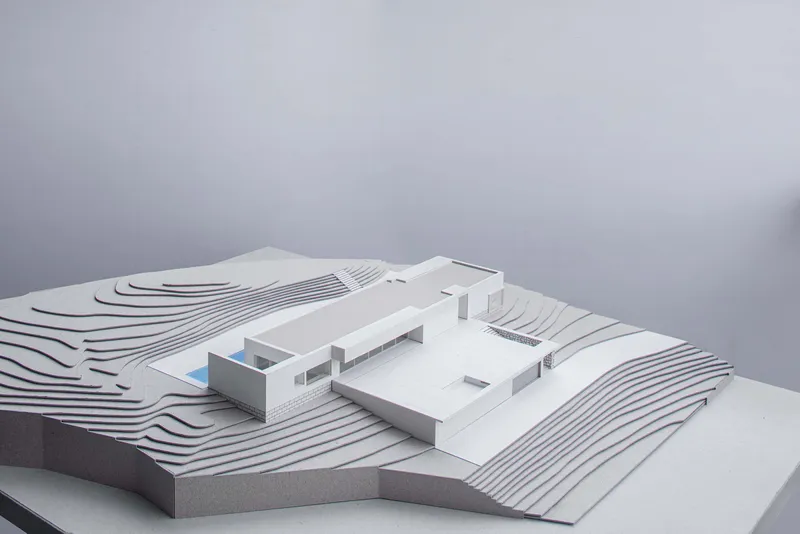
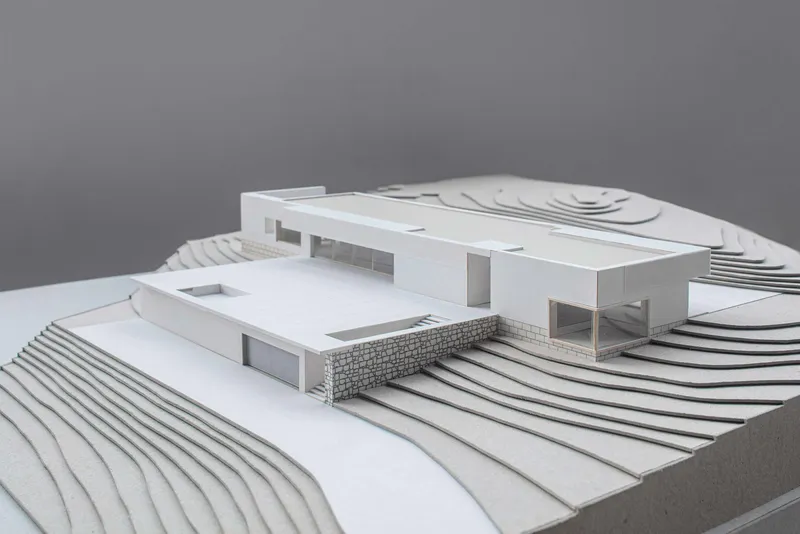
The site plan reveals three buildings connected by a curving pathway that navigates the slope, suggesting the villa is part of a small compound rather than a single isolated object. The floor plan shows a linear bar arrangement: three bedrooms, a living area, and terraces strung along the contour, maximizing views while keeping the building's footprint narrow and respectful of the grade. The sections are where the design's intelligence becomes most legible. The house steps down in half-levels, slotting the garage below the living spaces and using the hillside itself as a thermal and structural buffer. A tall boundary wall on the uphill side anchors the composition and provides wind protection, while the downhill elevations remain low and transparent.
The physical models confirm what the drawings suggest: the villa's terraced platforms mirror the contour lines of the site, so the architecture and the topography share a common geometric language. The pool courtyard, visible in the model as a flat void surrounded by stepped platforms, acts as the organizational hinge between the public and private wings. It is a clear, legible diagram executed with material discipline.
Why This Project Matters
Armenia's contemporary architecture scene does not receive the international attention it deserves, and projects like this one help correct that. ARCHcoop's villa in Rind Village demonstrates that building in a culturally loaded, topographically demanding landscape does not require either pastiche or spectacle. The house is modern without being imported; it belongs to its site without pretending to be vernacular. The sectional strategy, in particular, offers a model for how to build on steep terrain without scarring it: tuck the mass into the hill, step with the grade, and let the roofline disappear into the horizon.
There is also a quieter lesson here about program and place. The backlit wine wall, the generous outdoor terrace, the pendant fireplace gathering a room around it: these are not generic luxury gestures. They are calibrated to a specific way of living in a specific region, where wine is heritage, where evenings on the plateau are long and warm, and where fire matters when winter arrives. A house that understands these things is a house worth studying.
Villa in Rind Village by ARCHcoop Architectural Studio, led by Garegin Yeghoyan. Rind, Vayots Dzor, Armenia. 797 m². Completed 2024. Photography by Sona Manukyan & Ani Avagyan.
About the Studio
Share Your Own Work on uni.xyz
If projects like this are the kind of work you want to make, uni.xyz is a place to publish your own, find collaborators, and enter design competitions.


Popular Articles
Popular articles from the community

Opera by the Sea Estonia: Three Shells Dissolving Architecture into Tallinn's Coastline
A winning opera house proposal replaces monumental form with interconnected shells that blur the boundary between building, park and Baltic Sea.

Cloaked Colonization: A Mobile Underwater Habitat That Moves Like a Fish
Micah Abaya's shortlisted EHC Pacific entry reimagines ocean settlement as a dispersed network of self-sustaining architectural organisms.

Opera on the Sea: Driftwood Logic Shapes a Timber Opera House on Estonia's Coast
Trevor Orgill's opera house translates the entangled drift of floating timber into a civic building where wood, water, and music converge.
Extended Shell: Retrofitting Kolkata's Balconies as Living Urban Thresholds
A modular retrofit system recovers the social and environmental intelligence of Kolkata's historic verandas for contemporary Park Street residents.

Similar Reads
You might also enjoy these articles

Bao Huynh Watercolor Atelier: A Serene Art Retreat in Hội An
Bao Huynh Watercolor Atelier in Hội An blends multifunctional art spaces, sustainable design, local materials, and family-friendly living in a serene environment.

Atelier Macri Concept Store Interior Design by CASE-REAL
Atelier Macri store features a "ko" counter, walnut wood details, cork displays, blending retail, gallery, and seamless customer experiences.

Manuel Vargas Izquierdo Stadium and High-Performance Sports Center: Architectural Excellence in Jalpa de Méndez
The Manuel Vargas Izquierdo Stadium blends sustainable design, inclusive sports facilities, and cultural-inspired architecture, revitalizing Jalpa de Méndez’s public spaces.

KAKR Buluh Awar Hall: Revitalizing Community and Ecology Through Bamboo Architecture
Community built bamboo hall revitalizes Buluh Awar village, empowering youth, restoring ecology, celebrating vernacular craftsmanship through sustainable architecture and culture.


Comments (0)
Please login or sign up to add comments
No comments yet. Be the first to comment!