

Archermit Scatters Five Concrete Petals Across a Chinese Hillside to Form the Feixue Pavilion
At the entrance to Lihua Village in Luzhou, a 672 square meter tourism pavilion reimagines pear blossoms as layered concrete canopies.


Pear blossoms and giant rocks define the valley entrance to Lihua Village in Luzhou, and Archermit has answered that context with a building that reads less like architecture and more like a geological event. The Feixue Pavilion, completed in 2025, is a 672 square meter tourism structure composed of five independent concrete slabs, each shaped like a pear petal, stacked and staggered at different heights and cantilevers down a forested hillside. From above, the building resembles a windblown flower settling into the canopy. From the ground, it is a series of hovering planes that frame views, catch light, and dissolve the distinction between built mass and landscape.
What makes this project worth paying attention to is not the floral metaphor itself, which could easily become decorative kitsch, but how literally and structurally Archermit commits to it. Each petal operates as an independent structural element. The gaps between them are not cosmetic: they break the building into fragments that let light, air, and vegetation pass through, preventing the 672 square meters from ever reading as a single heavy object. The result is a pavilion that earns its name. Feixue means "flying snow," and the layered slabs genuinely appear to be mid-drift.
A Roofscape That Reads as Landscape
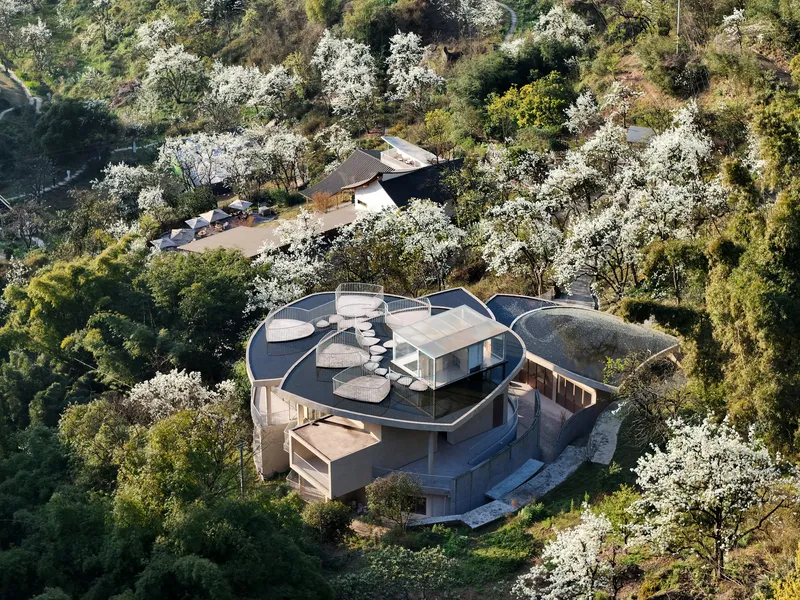
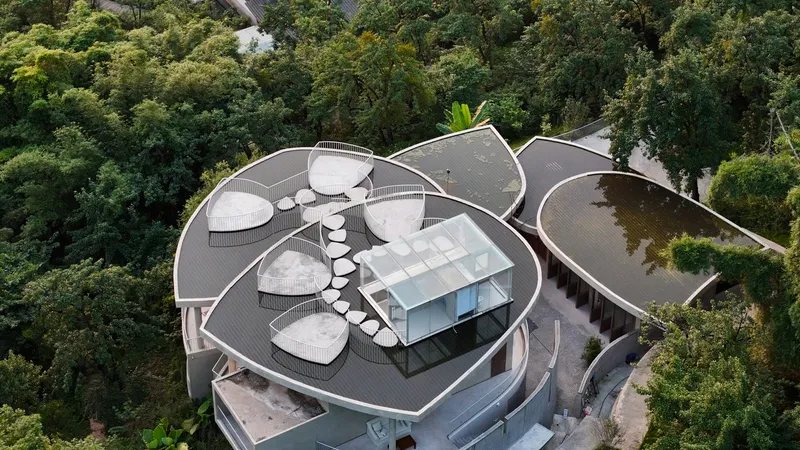
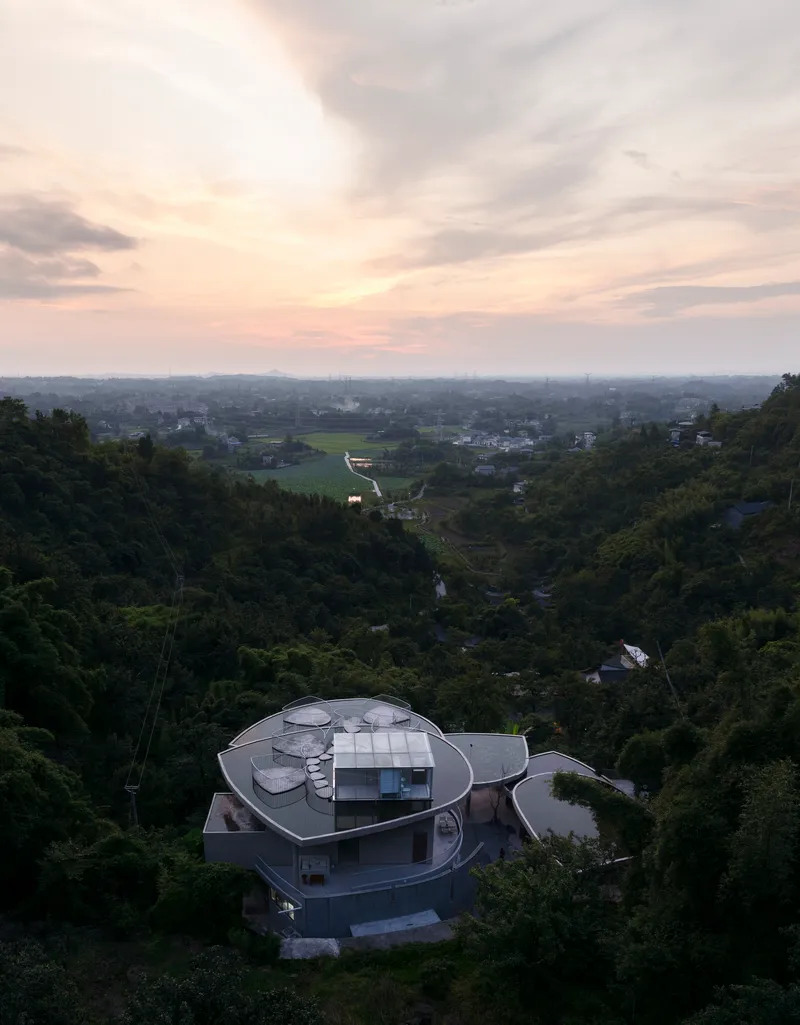
Seen from the air, the Feixue Pavilion is almost entirely roof. The five petal-shaped concrete canopies fan outward from a central glazed core, their ribbed surfaces catching shadow in a way that gives them texture and grain at a distance. At dusk, the glazed pavilion at the center glows while the dark lobed platforms recede into the hillside, reversing the daytime hierarchy. The roofscape is the primary architectural gesture, and it works because Archermit treats the top of the building as its true facade. In a project embedded in dense forest and viewed primarily from elevated vantage points, this is the right call.
The ribbed finish on the concrete slabs is a quiet but effective detail. Rather than presenting smooth monolithic surfaces, the ribs introduce a directional quality to each petal. They trace the curve of the form, reinforcing the radial logic, and they give the concrete a tactile scale that prevents the canopies from looking poured and generic. It is formwork doing double duty as ornament.
Terraces as Thresholds
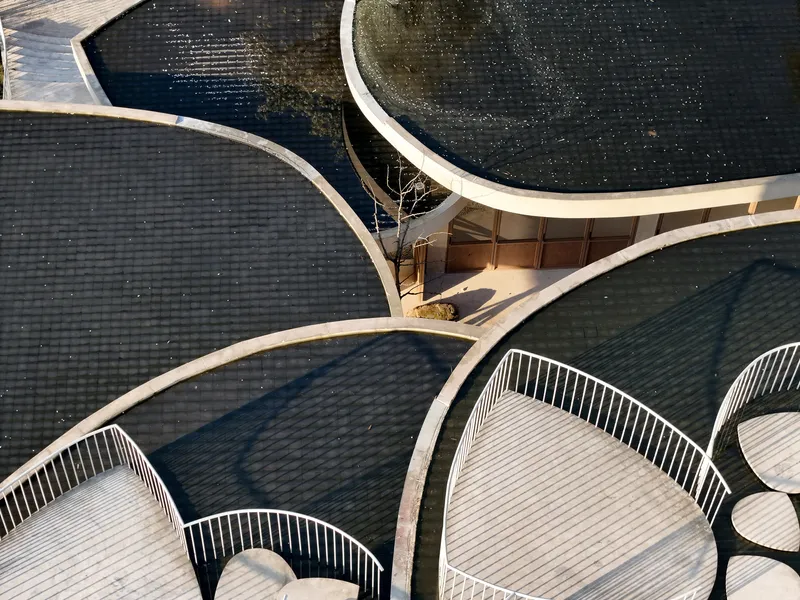
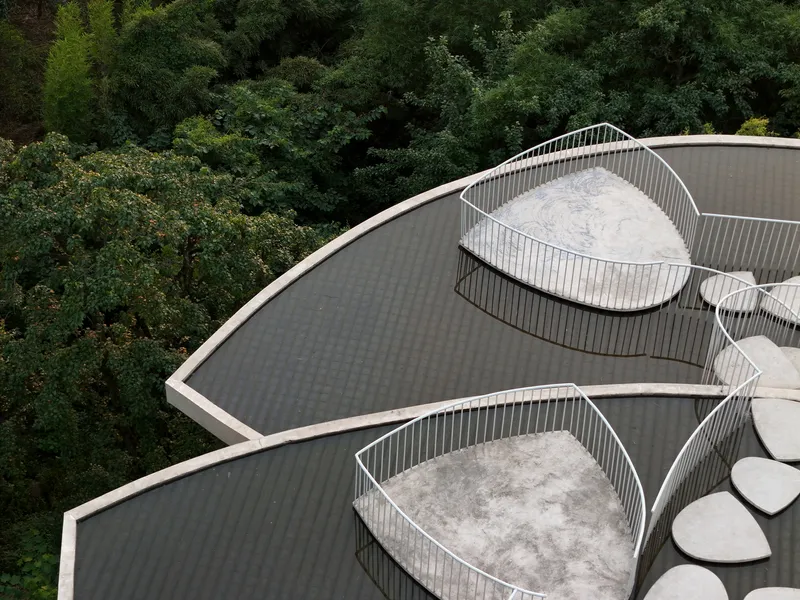
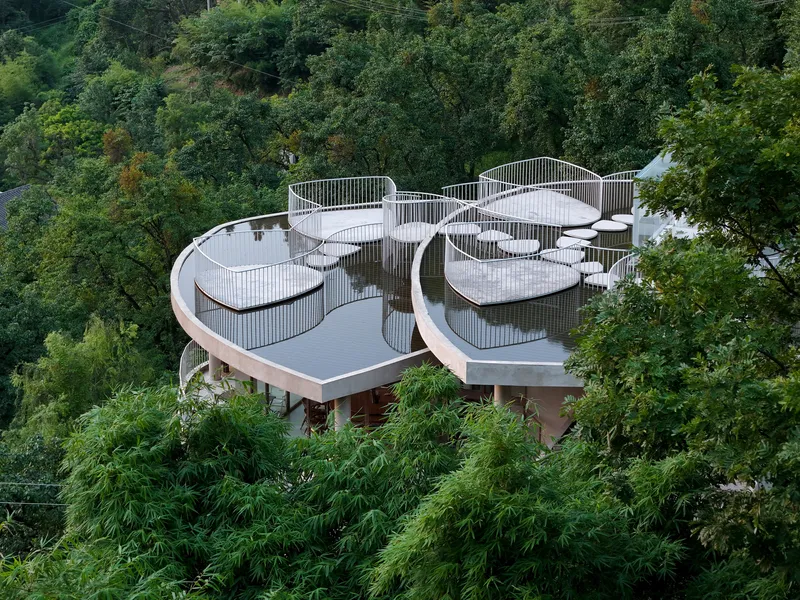
The petal slabs do not simply shelter interior rooms. They extend outward as terraces, creating a continuous gradient from enclosed space to open deck to forest. The tiled terrace surfaces are edged with white metal railings and vertical slat screens that curve in plan, following the petal geometry. The effect from above is of interlocking lily pads, each at a slightly different level, connected by stairs and ramps that navigate the hillside's slope.
The staggered heights matter. Because the petals are not coplanar, the terraces offer genuinely different relationships to the surrounding tree canopy. Some sit below the treetops, enclosed by green. Others rise above, providing panoramic views. This vertical variation means that the experience of moving through the building is not repetitive despite the uniform formal logic. Each petal is shaped the same way, but each one occupies a different altitude and orientation, which gives it a distinct character.
Concrete Curves Meet Forest Edge
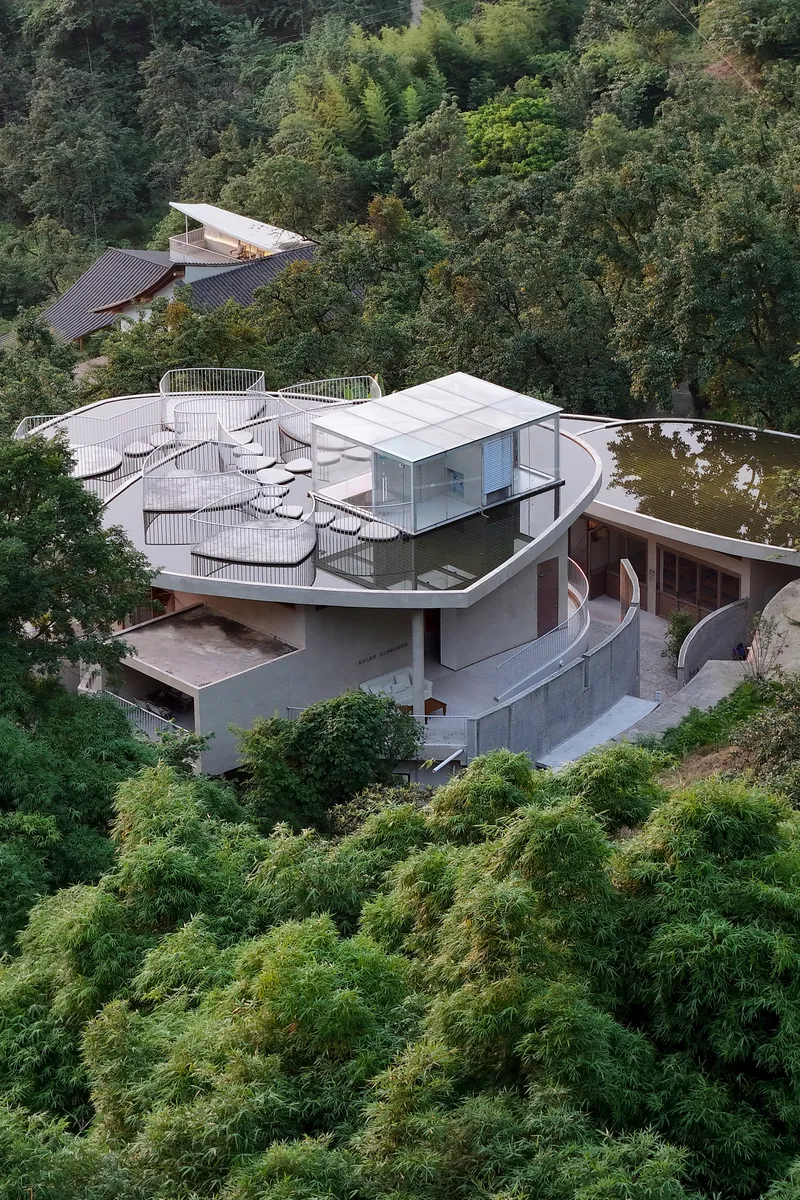
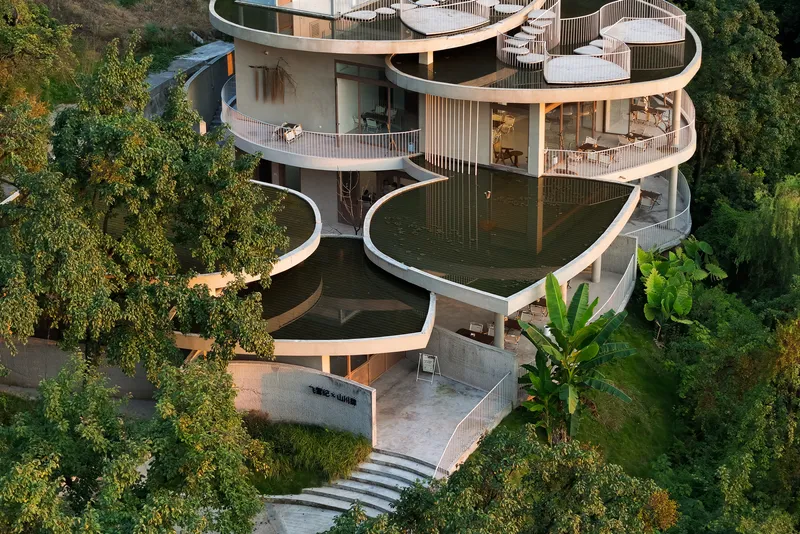
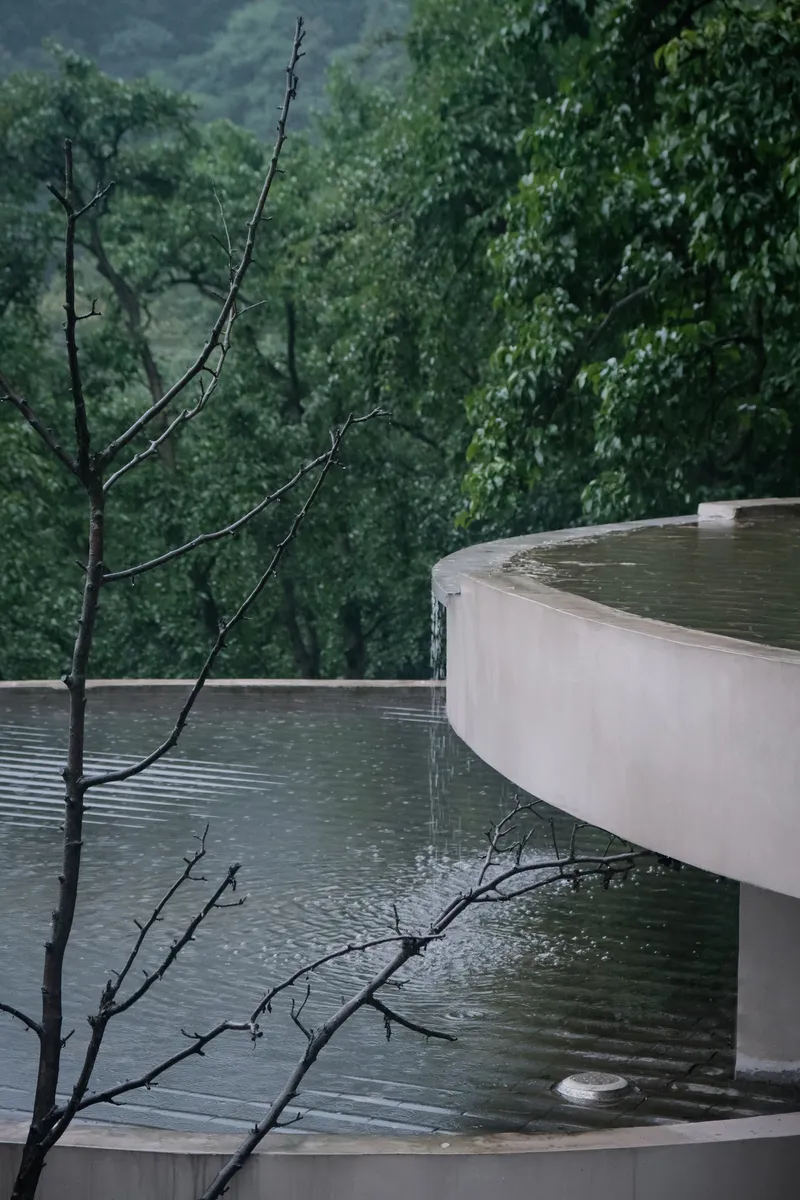
At eye level, the pavilion sheds its aerial elegance and becomes something heavier and more tactile. The curved concrete balconies descend the hillside in layers, their ribbed undersides casting deep shadows. Entry steps cut through the terraces, and the vertical railings create a rhythmic screen that mediates between the open decks and the dense vegetation beyond. The material palette is restrained: exposed concrete, white metal, timber, and glass. There is no applied color. The pear blossoms and forest provide that.
One detail that registers strongly from close range is the treatment of the terrace edges. Where the curved concrete decks meet the slope, rainwater overflows the edge in a controlled sheet, visible in the image of the bare tree branches framing the terrace lip. It is a small functional moment, but it reinforces the idea that the building is not sealed off from its environment. Water, light, and air move through the gaps between petals, and the building accepts that rather than resisting it.
Circular Openings and Interior Light
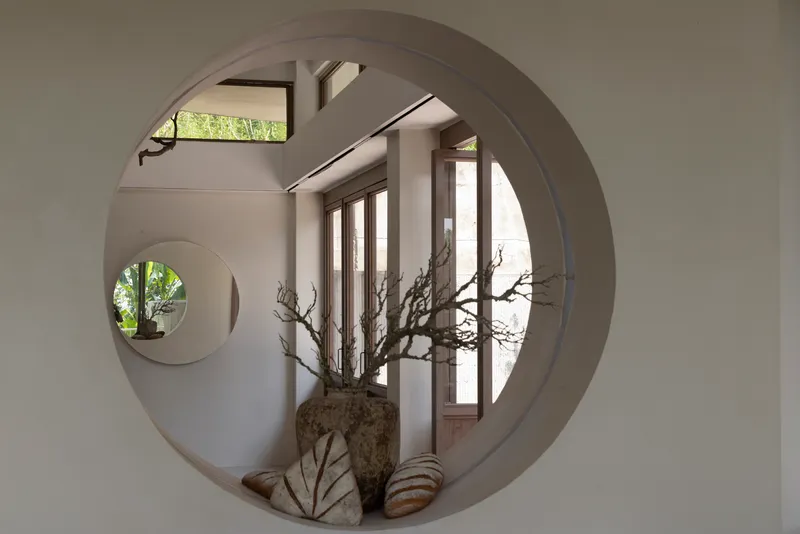
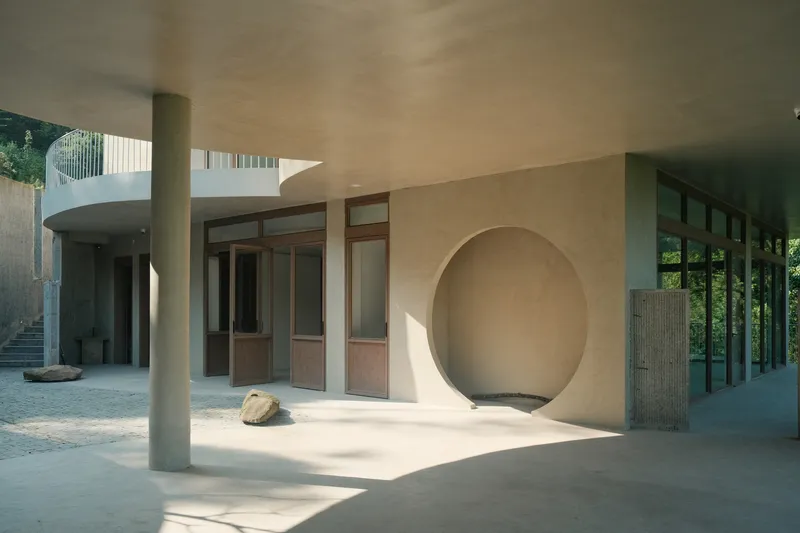
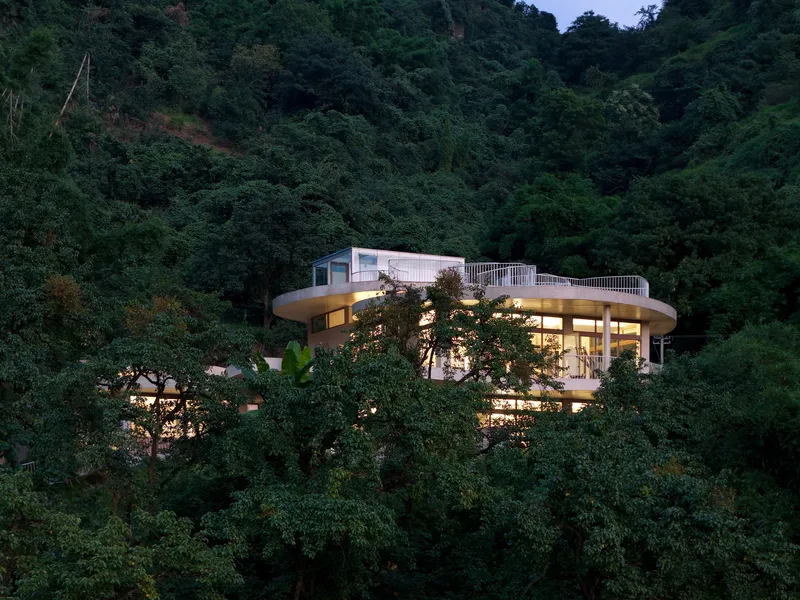
Inside, Archermit introduces a secondary geometric motif: the circle. Circular openings are cut through interior walls, framing views through multiple layers of space and creating a telescoping depth that the curvilinear plan alone would not achieve. Natural light enters obliquely through these apertures, and the plaster walls glow with reflected daylight. The circular openings also function as connective tissue, linking rooms that might otherwise feel isolated within their respective petal volumes.
The covered courtyard spaces, with their cylindrical columns and timber-framed glazing, operate as the social heart of the pavilion. These semi-outdoor rooms sit beneath the overlapping canopies, protected from rain but open to air. At dusk, the glazed facade tucked into the hillside glows warmly, drawing visitors inward. The interplay between the massive concrete overhead and the delicate glass enclosures below gives the interior a compressed, grotto-like quality that contrasts sharply with the expansive terraces above.
Ground-Level Gathering
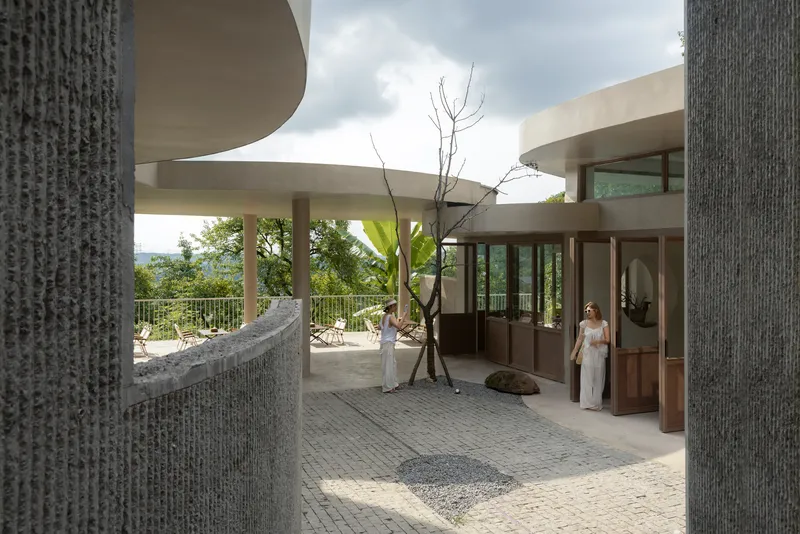
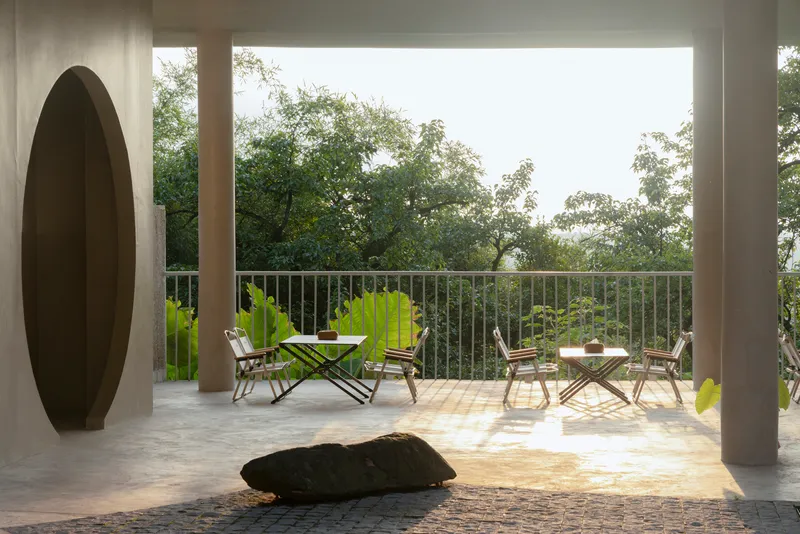
The courtyard terrace is where the architectural ambition meets everyday use. Outdoor furniture is arranged beneath the overhanging roof lobes, cylindrical columns punctuate the space with a structural rhythm, and tropical vegetation pushes in from the edges. The cloudy skies visible in several images suggest a humid subtropical climate, and the deep overhangs and open sides make sense as a passive cooling strategy. The building breathes because it has to.
Archermit's decision to keep the ground level porous, with colonnaded terraces rather than sealed rooms, is the move that saves the project from becoming an exercise in sculptural indulgence. The petals shelter rather than enclose, and the spaces they create are flexible enough to accommodate the unpredictable rhythms of a tourism venue. People linger here because the architecture invites it, not because it traps them.
Plans and Drawings
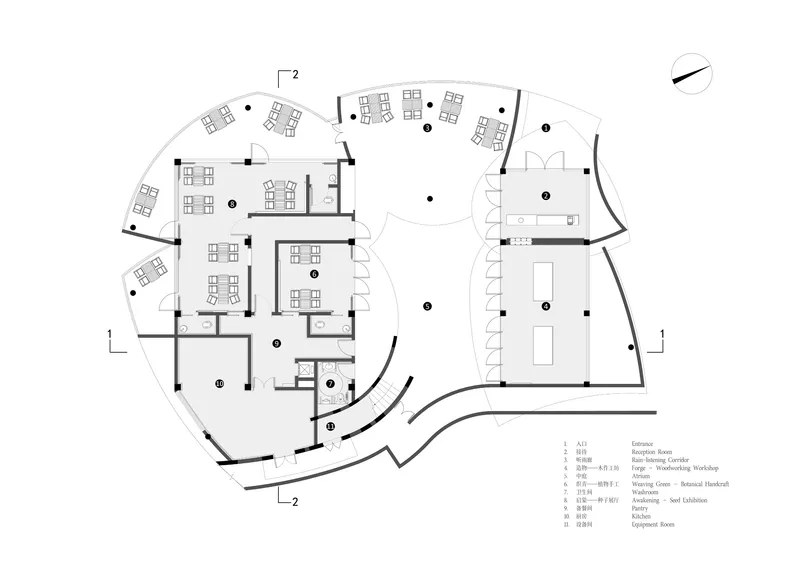
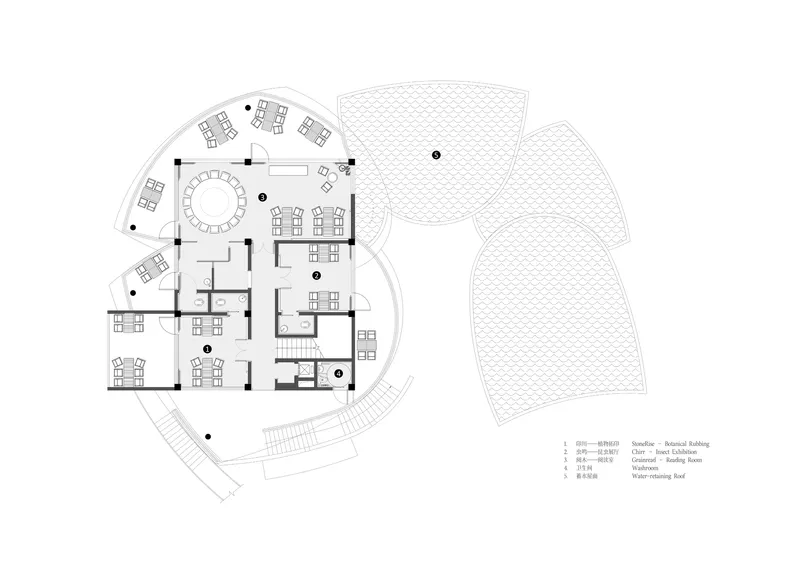
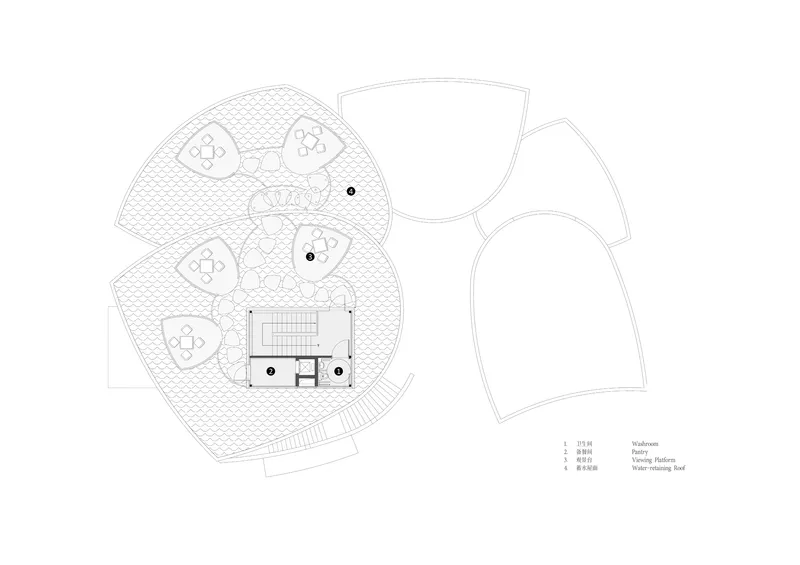
The floor plans reveal the organizational logic that the aerial photographs hint at. The lower level concentrates dining areas and service zones within the petal volumes, while the upper level opens into broader interior spaces with direct terrace access. The central service core acts as the hinge around which the five petals rotate, and the roof plan confirms what the drone views suggest: the terraces are the building's primary spatial offering, with interior rooms occupying a relatively modest footprint.
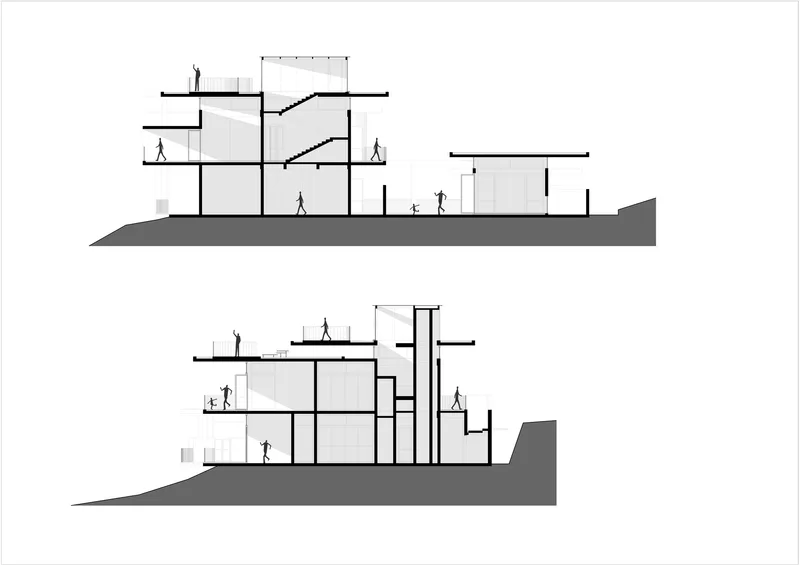
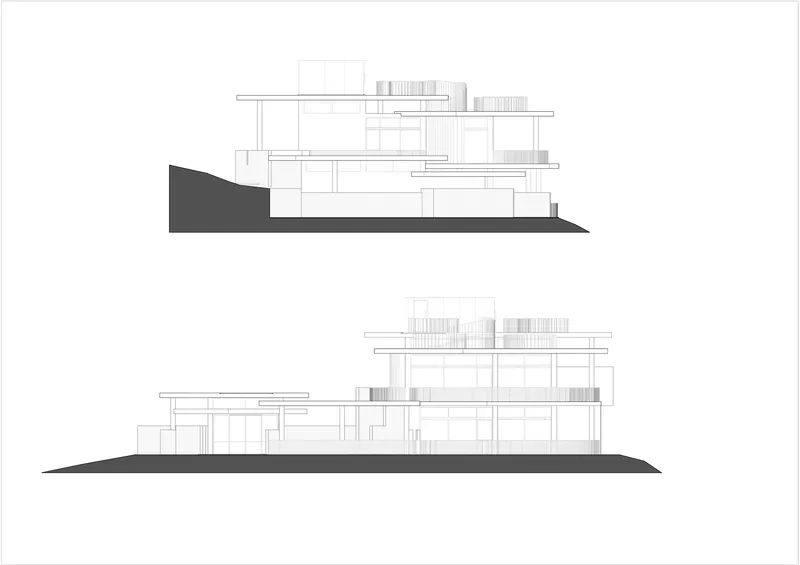
The sections are where the project's ambition becomes clearest. The sloping site allows each petal to land at a different elevation, creating a cascading profile that steps down the hillside. The cantilevers are substantial, with the concrete slabs projecting well beyond their supports to create the sheltered terraces below. Human figures in the section drawings reveal the generous floor-to-floor heights and the dramatic scale of the overhanging canopies relative to the people beneath them. The elevation drawings, depicting the layered horizontal volumes in profile, confirm that the building reads as a stack of geological strata rather than a conventional structure.
Why This Project Matters
Tourism architecture in rural China has produced more than its share of photogenic follies that look extraordinary from a drone and offer nothing at ground level. The Feixue Pavilion could easily have fallen into that trap. A petal metaphor, a forested hillside, five concrete canopies: the ingredients are all there for a project that exists primarily as content. What distinguishes Archermit's work here is the structural honesty of the approach. Each petal is genuinely independent. The gaps between them are real, not decorative grooves in a monolithic shell. The building fragments itself in order to fit into the landscape, and the result is a series of sheltered outdoor rooms that work as well for a rainy afternoon tea as they do for an aerial photograph.
The deeper lesson is about scale. At 672 square meters, the Feixue Pavilion is not a large building, but the five-petal strategy makes it occupy a much larger territory on the hillside. It spreads rather than rises, and in doing so it engages the topography, the tree canopy, and the valley entrance as active participants in the architecture. Archermit calls their approach "Imagery Architecture," and while the label is their own, the ambition behind it, to make buildings that operate at the register of landscape rather than object, is a serious one. The Feixue Pavilion is a convincing demonstration of what that can look like when the structure backs up the poetry.
Buzzy Sunny · Feixue Pavilion by Archermit, Luzhou, China. 672 m², completed 2025. Photography by Arch-Exist.
About the Studio
Share Your Own Work on uni.xyz
If projects like this are the kind of work you want to make, uni.xyz is a place to publish your own, find collaborators, and enter design competitions.


Popular Articles
Popular articles from the community


Faces of the Soviet Avant-Garde: Turning Moscow's Street Names into an Open-Air Museum
A network of sculptural installations across a Moscow residential district transforms forgotten architect names into spatial encounters with cultural memor
Extended Shell: Retrofitting Kolkata's Balconies as Living Urban Thresholds
A modular retrofit system recovers the social and environmental intelligence of Kolkata's historic verandas for contemporary Park Street residents.
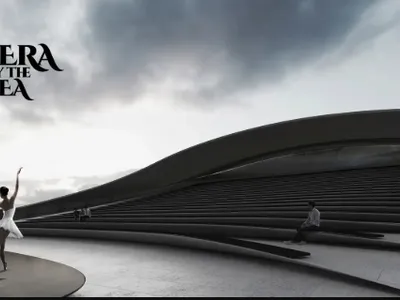
Opera by the Sea Estonia: Three Shells Dissolving Architecture into Tallinn's Coastline
A winning opera house proposal replaces monumental form with interconnected shells that blur the boundary between building, park and Baltic Sea.

Cloaked Colonization: A Mobile Underwater Habitat That Moves Like a Fish
Micah Abaya's shortlisted EHC Pacific entry reimagines ocean settlement as a dispersed network of self-sustaining architectural organisms.

Similar Reads
You might also enjoy these articles

Bao Huynh Watercolor Atelier: A Serene Art Retreat in Hội An
Bao Huynh Watercolor Atelier in Hội An blends multifunctional art spaces, sustainable design, local materials, and family-friendly living in a serene environment.

Atelier Macri Concept Store Interior Design by CASE-REAL
Atelier Macri store features a "ko" counter, walnut wood details, cork displays, blending retail, gallery, and seamless customer experiences.

Manuel Vargas Izquierdo Stadium and High-Performance Sports Center: Architectural Excellence in Jalpa de Méndez
The Manuel Vargas Izquierdo Stadium blends sustainable design, inclusive sports facilities, and cultural-inspired architecture, revitalizing Jalpa de Méndez’s public spaces.

KAKR Buluh Awar Hall: Revitalizing Community and Ecology Through Bamboo Architecture
Community built bamboo hall revitalizes Buluh Awar village, empowering youth, restoring ecology, celebrating vernacular craftsmanship through sustainable architecture and culture.

Explore Pavilion Competitions
Discover active competitions in this discipline

Challenge to design a portable theatre

Challenge to design a portable music platform

Challenge to design an open learning module for the elderly
Comments (0)
Please login or sign up to add comments
No comments yet. Be the first to comment!