

Archigrest Tucks a Timber Gable House into a Masurian Birch Grove
A 163-square-meter family home in Grom, Poland, lifts its living spaces into the canopy of a lakeland forest clearing.


Masuria is the kind of landscape that punishes overconfident architecture. Flat meadows, shallow hills, birch groves with papery white trunks, and a sky that stretches wider than any facade can compete with. When Archigrest principals Maciej Kaufman and Marcin Maraszek set out to build a single-family home in the village of Grom, they clearly understood the assignment: make the house a guest of the site, not its owner.
The resulting 163-square-meter house, completed in 2023, is a steep-gabled timber volume that reads almost as a natural extension of the birch forest wrapping around it. Its proportions are deliberately modest, its material palette limited to wood cladding, terracotta tile, and glass, and its plan organized to funnel every sightline outward. What makes the project worth studying is not a single dramatic gesture but a careful accumulation of decisions about framing, enclosure, and exposure that give the house an unusually honest relationship with its terrain.
A Gable That Earns Its Pitch
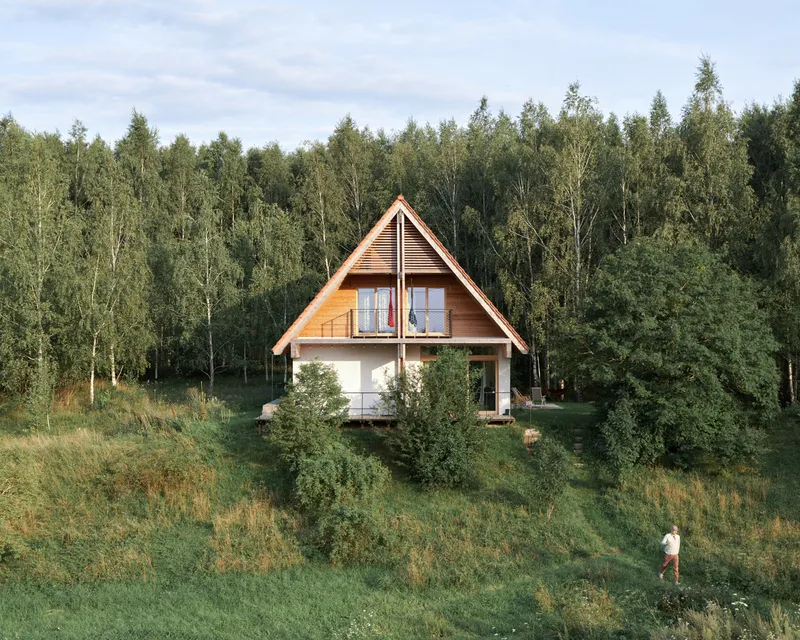
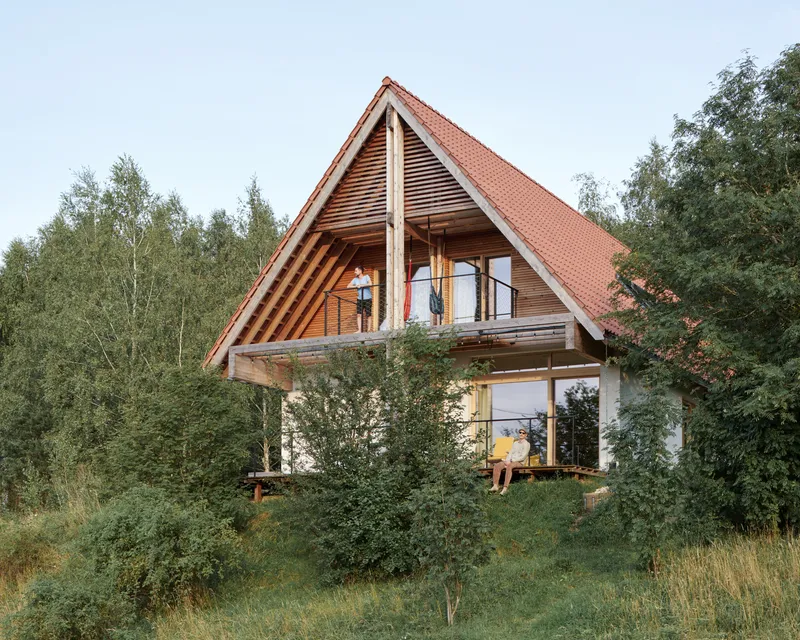
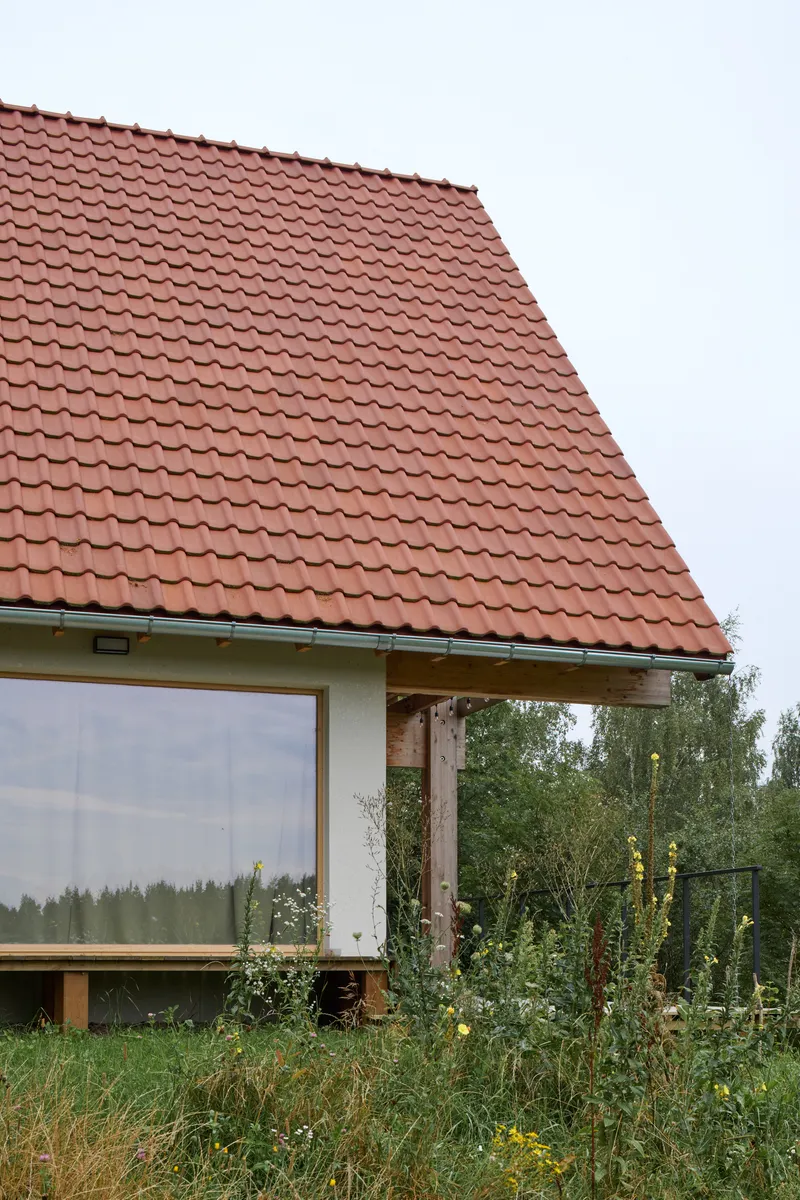
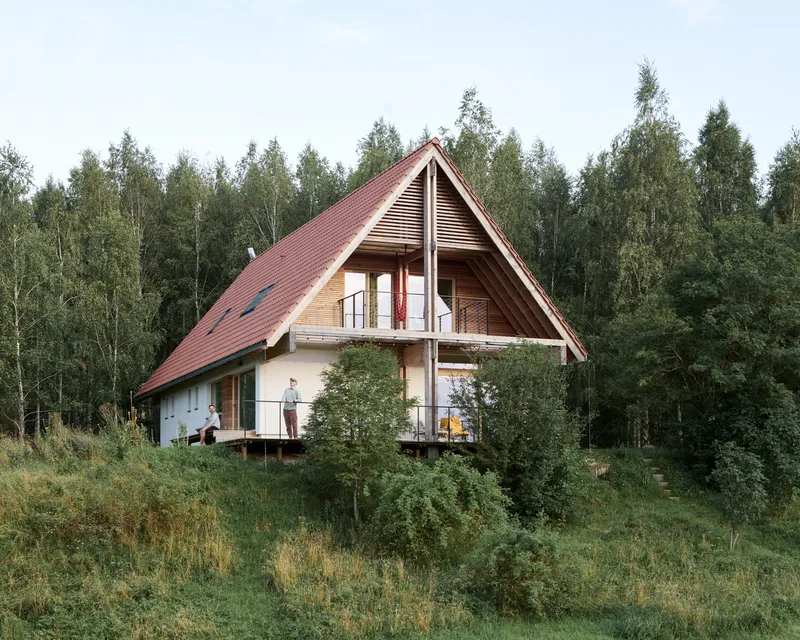
The steeply pitched roof is the project's most visible formal choice, and it is not decorative. In Masuria, heavy winter snowfall and frequent rain demand a roof profile that sheds quickly, and the steep gable does exactly that. Clad in terracotta-colored metal tile, the roof draws the eye upward and compresses the wall surface below into a narrow band of timber and glass. The result is a silhouette that feels more barn than villa, which in this context is the right call.
From certain angles, the gable end almost disappears behind the birch trunks, its vertical proportions echoing the trees rather than opposing them. The red tile roof provides the only strong color note in the composition, grounding the structure against the greens and whites of the forest while signaling warmth and domesticity.
Living Among the Birches
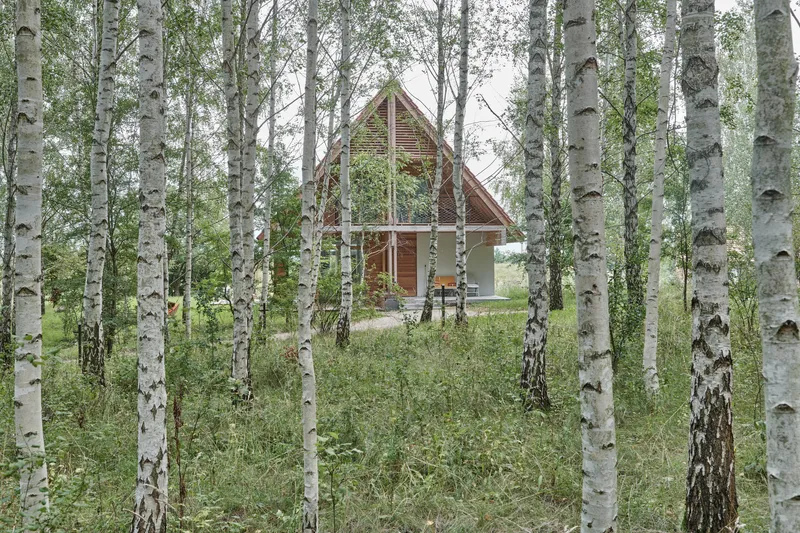
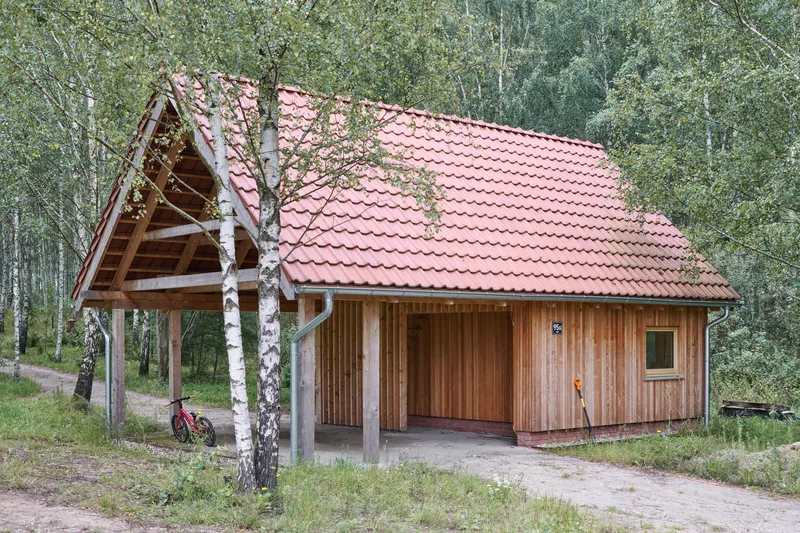
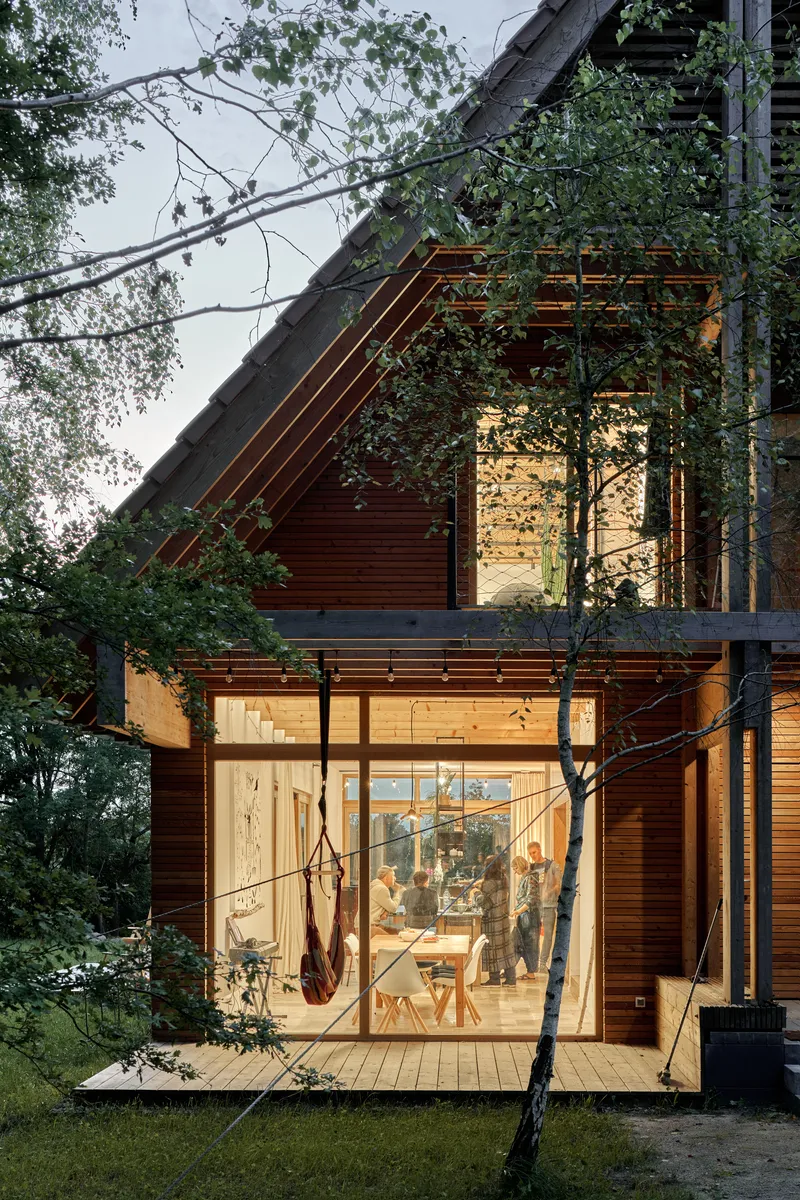
The siting strategy is critical. Rather than clear the grove and plant the house in an open field, Archigrest kept the birch trees close enough that they participate in the architecture. The white trunks function almost as a natural colonnade, filtering light and screening views. From the rear, looking through the grove toward the timber-clad gable end, the house seems to hover just below the canopy, partially obscured and entirely at ease.
A gravel clearing organizes the approach, with an open carport structure using the same vertical slat language as the main house. The landscape design by topoScape maintains the wild meadow character of the site, avoiding any impulse toward a manicured garden. Tall grasses and wildflowers press right up to the base of the glazing, blurring the threshold between building and ground.
Timber Structure as Interior Atmosphere
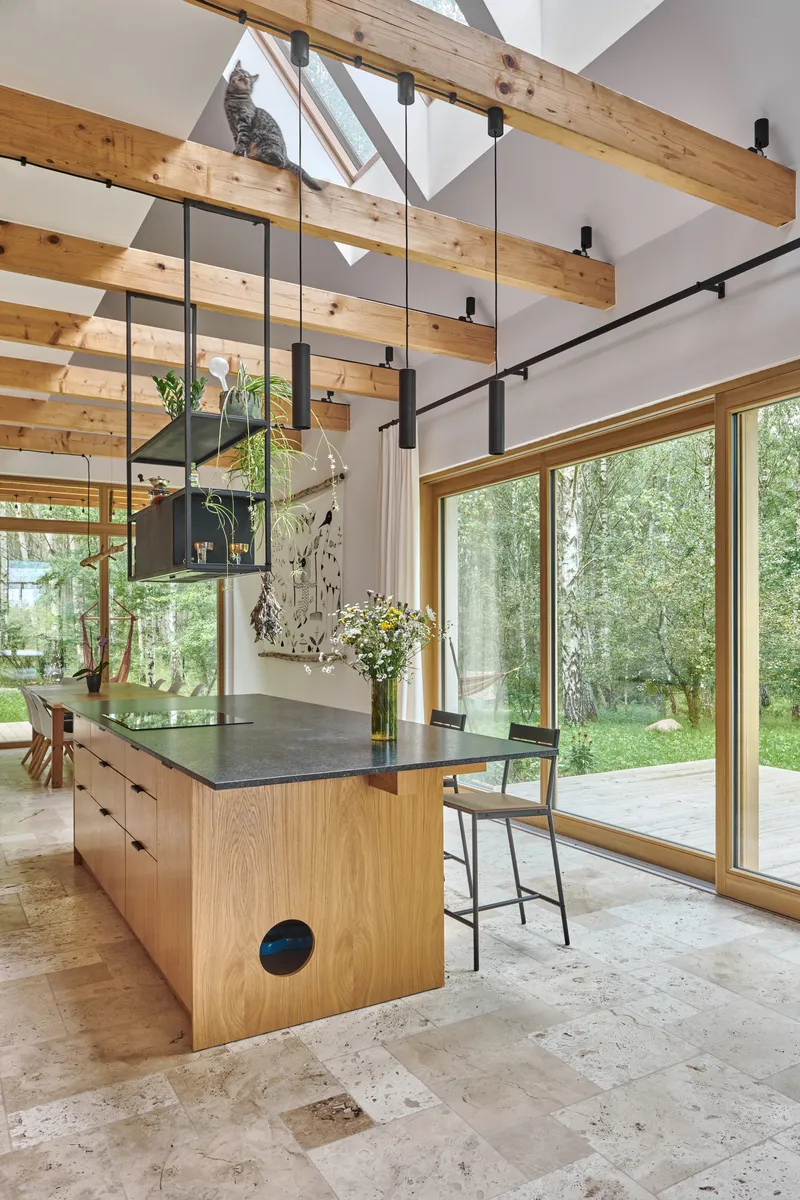
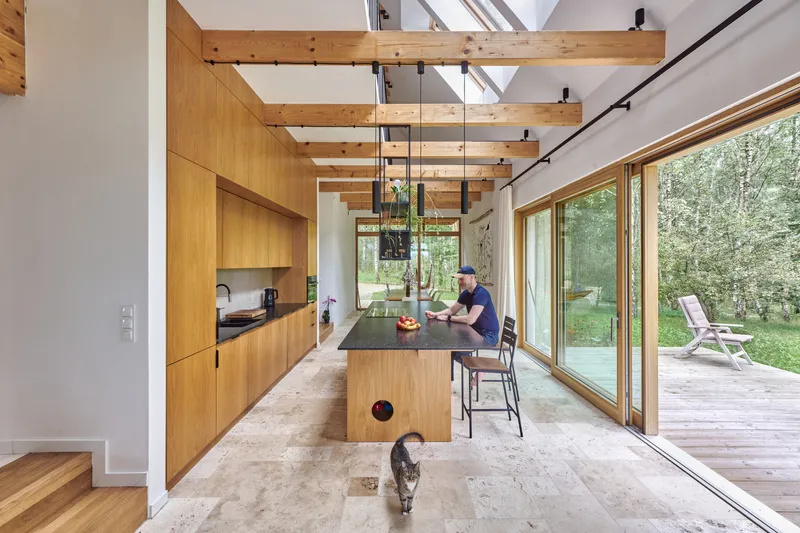
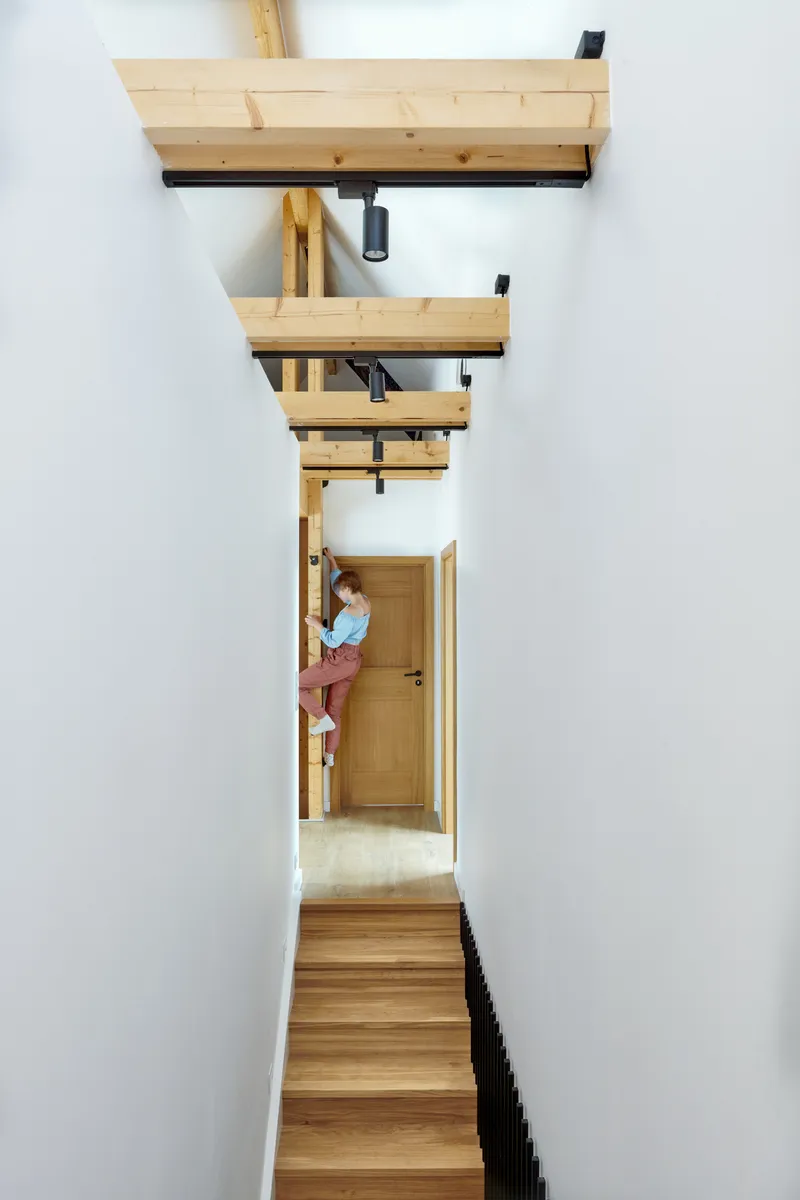
Inside, the exposed timber frame does the heavy atmospheric lifting. The double-height kitchen and living space is organized around an oak island, with heavy glulam beams and floor joists left fully visible overhead. The structural logic is legible and honest: you can trace the load path from rafter to beam to column without guesswork. This kind of structural transparency gives the interior a workshop quality that suits a forest house far better than finished drywall ever would.
The stairwell, captured in a striking vertical view, reinforces this legibility. Exposed beams frame the ascent, and natural light from upper-level skylights washes down through the timber matrix. The palette stays tight: warm oak, natural larch or pine cladding, and the occasional flash of white plaster to bounce light into darker corners. Manufacturers like FAKRO contributed the roof windows that make the upper volume so luminous, while SDS Domy Szkieletowe handled the timber frame construction.
Thresholds That Dissolve
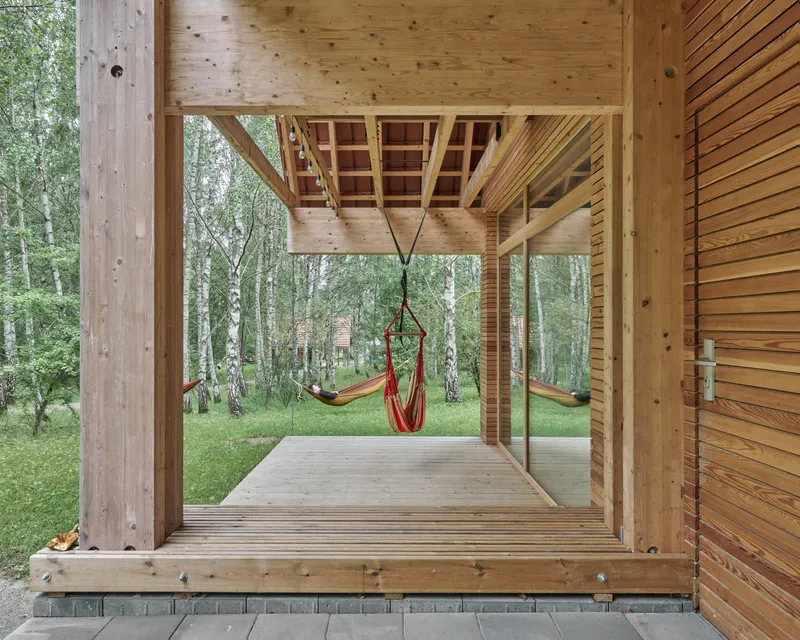
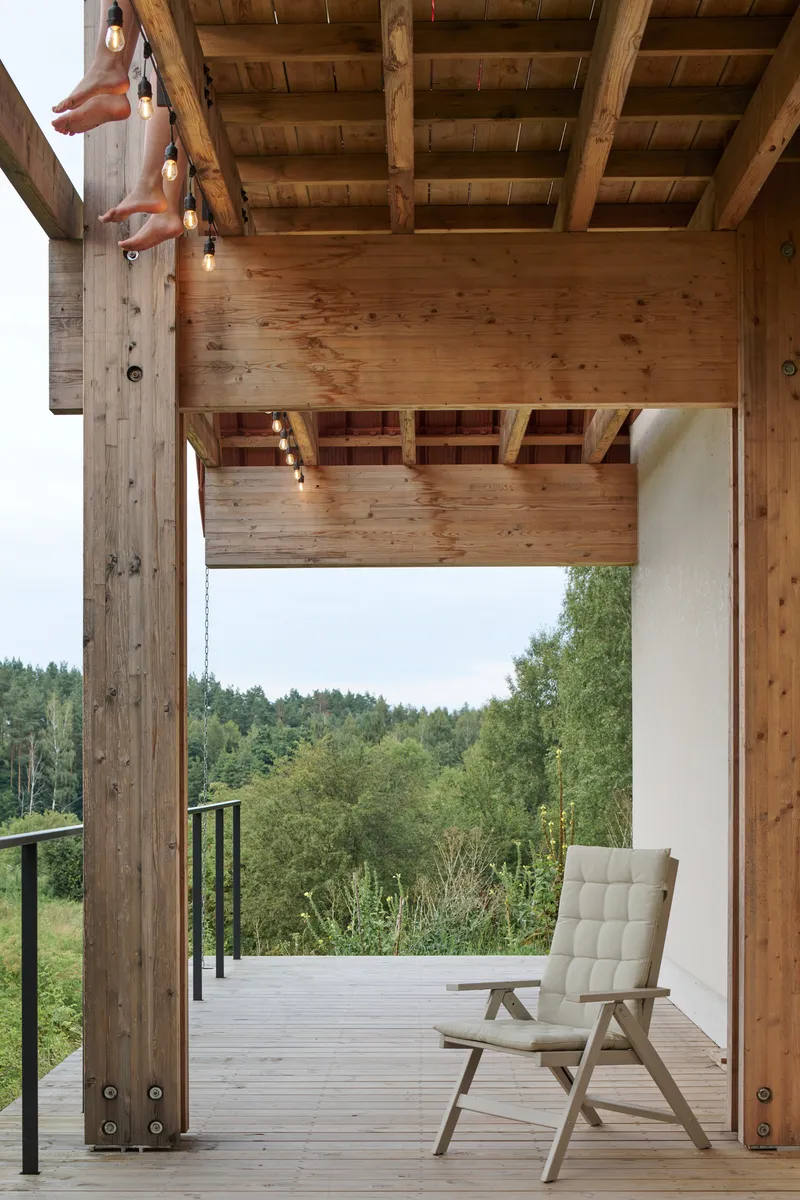
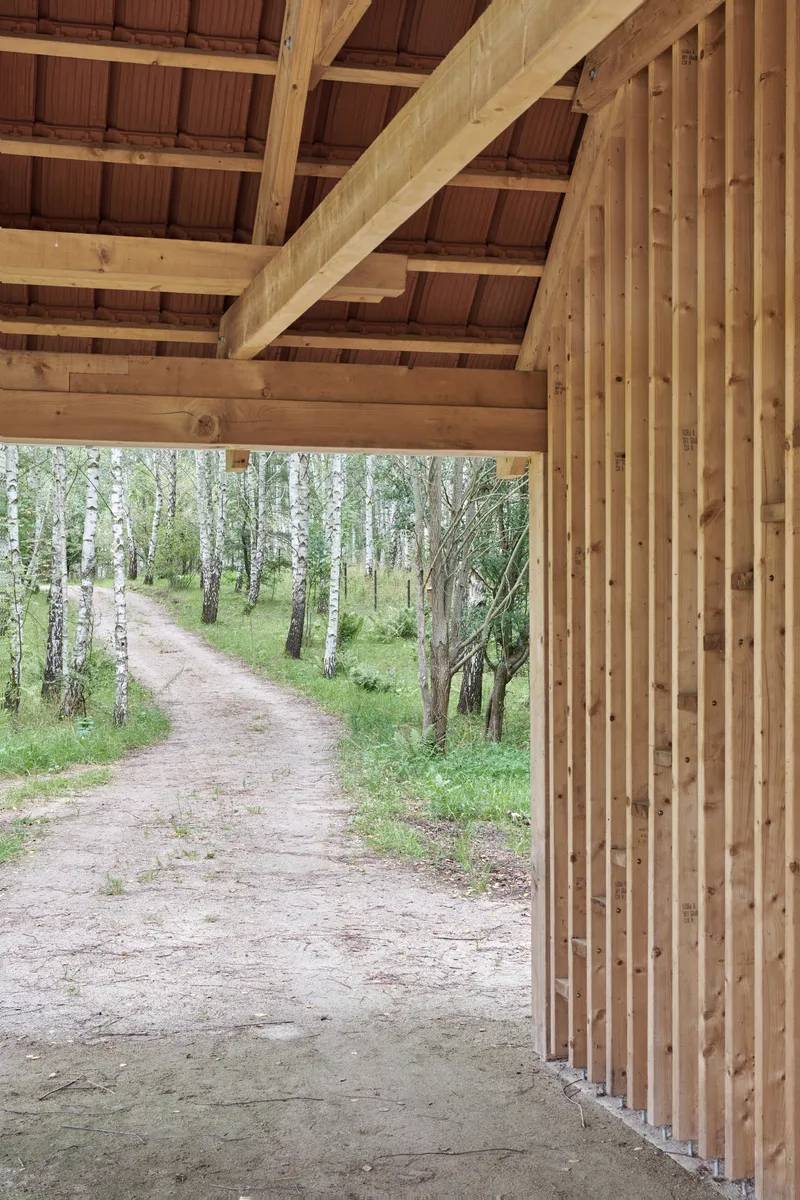
The most compelling architectural moves happen at the edges of the house, where interior and exterior negotiate their boundary. A timber deck extends from the ground floor into the birch grove, with exposed joists overhead creating a pergola-like canopy. A hanging chair suspended among the tree trunks makes the point explicitly: this is not a terrace attached to a house but a room that happens to have no walls.
The covered terrace with its heavy timber columns and exposed ceiling joists offers a more formal version of the same idea, framing distant forested hills like a landscape painting. On the opposite side, a porch with vertical wood slat screens opens to a dirt path winding through the birches. Each threshold condition is distinct, calibrated to a different degree of enclosure and a different relationship with the surroundings. The house does not have one connection to the landscape; it has several, each tuned to a specific moment and mood.
Upper Level and the View from Above
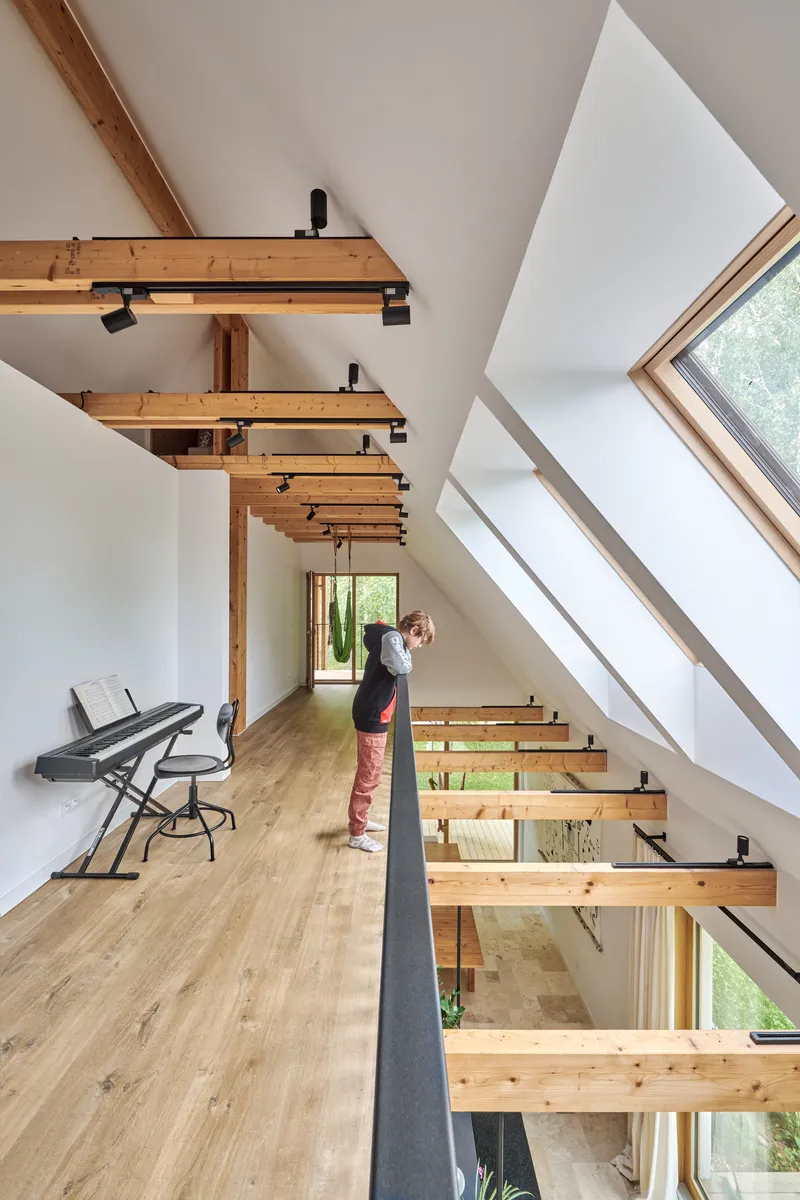
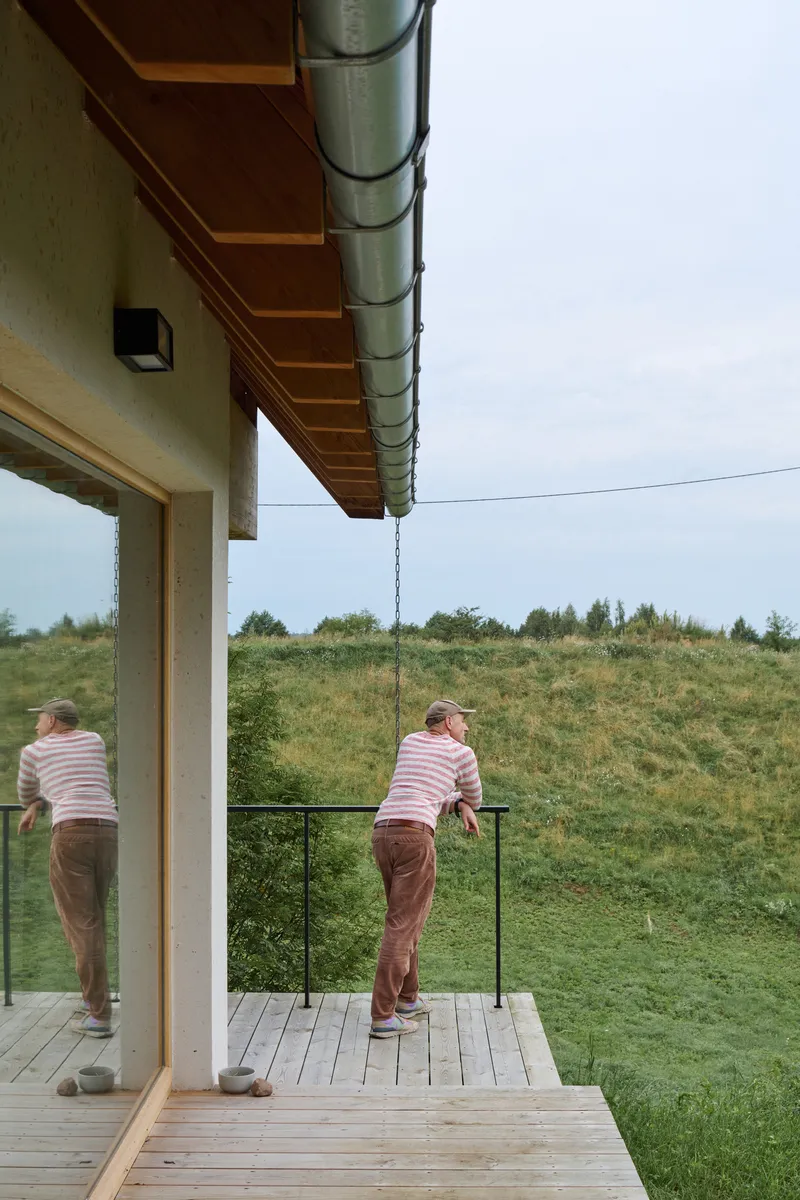
The upper level lifts the inhabitants into the tree canopy. Skylight windows slice through the steep roof, flooding the loft space with overhead light and framing patches of sky and leaf canopy. The exposed timber floor joists at this level reinforce the sense of being inside a constructed nest rather than a conventional second story.
An exterior balcony projects from the upper gable wall, offering an elevated vantage point over the grassy slope below. Two figures standing at the railing give scale to the composition and underscore the house's proportional modesty. Even at its highest point, the building stays below the birch crowns, maintaining the forest's visual dominance. The red tile roof, the wood cladding, and the metal ductwork at the eave are all visible from this vantage, revealing a pragmatic honesty in detailing that the house never tries to hide.
The Carport as Architectural Echo
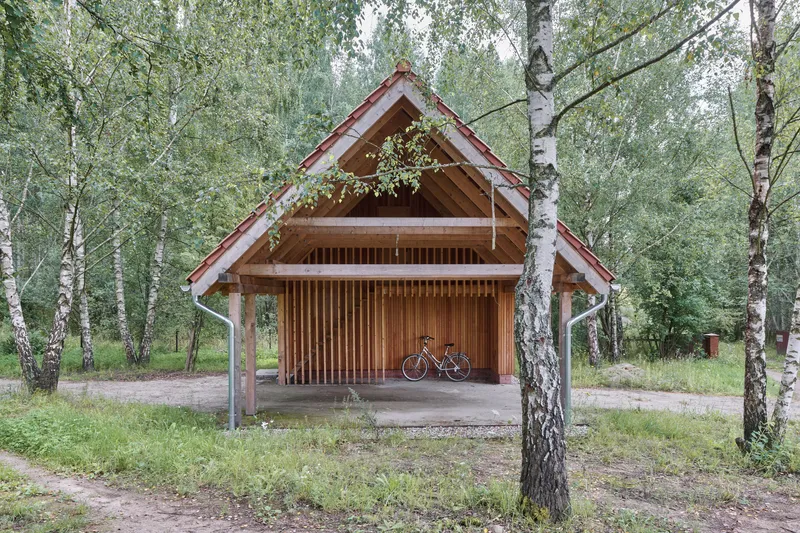
A small detail worth noting: the open carport structure uses the same gabled profile and vertical slat cladding as the main house, creating a miniature echo on the site. The two gabled forms, visible in the site plan, establish a loose compound logic rather than a single monolithic presence. This is a smart move in a landscape where scattered agricultural outbuildings have always defined the built environment. The house does not stand alone; it creates a small cluster, which makes it feel settled rather than dropped in.
Plans and Drawings
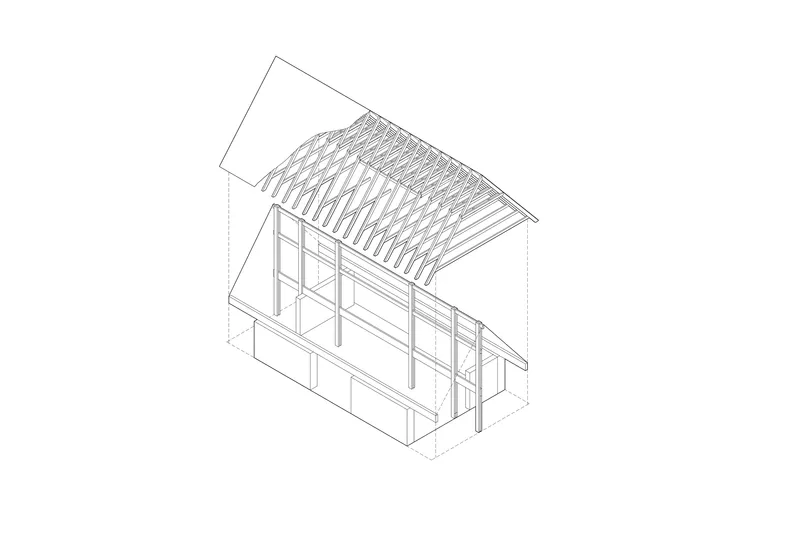
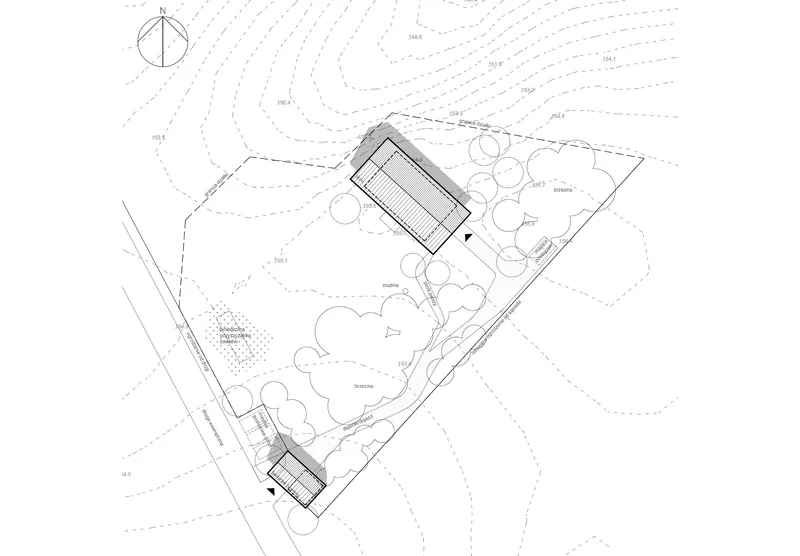
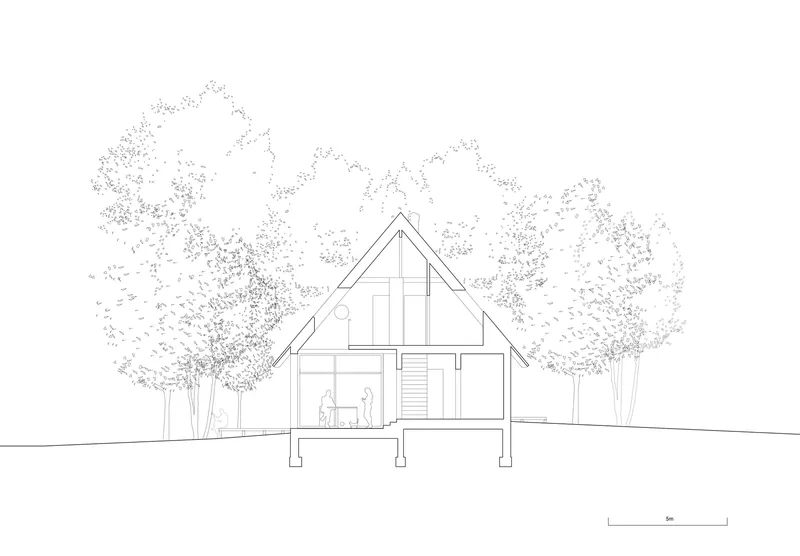
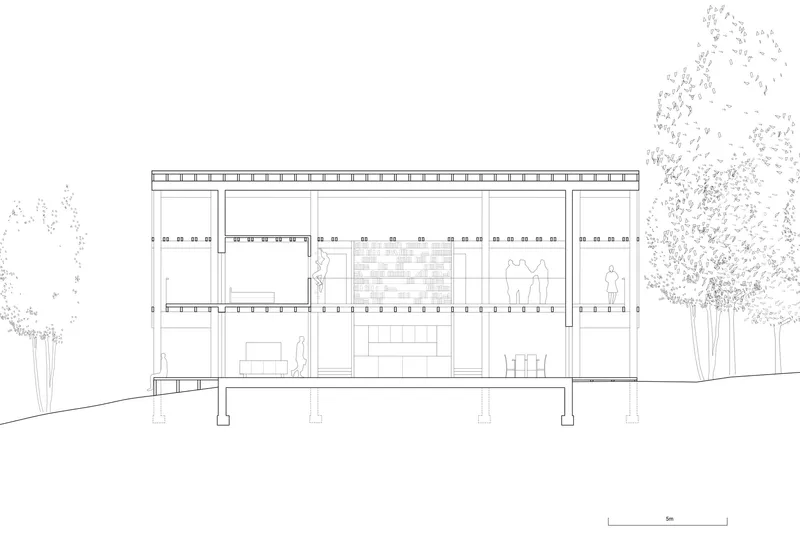
The axonometric drawing reveals the structural strategy most clearly: a gable roof framework of exposed rafters sits above a more open, glazed lower volume, with the structure doing double duty as spatial definition. The site plan confirms the two-pavilion arrangement on a gently sloping site, with existing trees preserved and integrated into the composition.
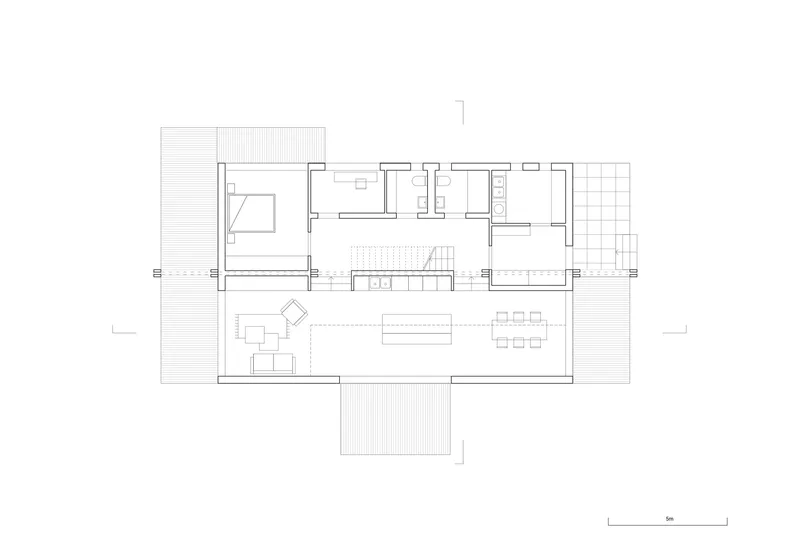
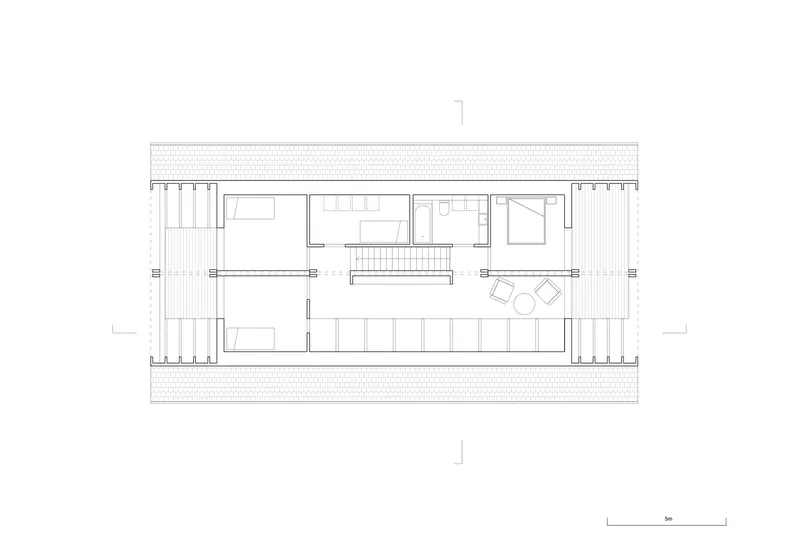
The ground floor plan shows a linear layout where bedrooms and service spaces flank a central living and dining zone, maximizing the continuous interior length and placing the social heart of the house at the widest point of glazing. The upper floor plan is more spartan, organized around a central stair opening with surrounding terraces that push the inhabitants out toward the views. The two section drawings confirm the house's raised posture: living spaces are elevated on columns, and full-height glazing beneath the roof canopy ensures that light and landscape penetrate deep into the plan. Structural engineering by IKON Michał Dyszkiewicz and MEP by IMEK supported this open, column-borne approach.
Why This Project Matters
There is a growing category of residential projects in Northern and Central Europe that aim to be "at one with nature," and most of them fail because they confuse large windows with genuine integration. The Masurian House succeeds because its relationship with the landscape is spatial, not just visual. The birch trees are not scenery viewed through glass; they are structural companions that shape the approach, filter the light, and define the thresholds. The decision to maintain the wild meadow, to cluster two gabled forms rather than extend one, and to keep the ridge below the treetops all demonstrate a design sensibility rooted in observation rather than imposition.
For Archigrest, this is a project that proves a modest brief and a tight budget can produce architecture of real intelligence. At 163 square meters, the house is not large, but it lives larger than its footprint because every transition between inside and outside has been carefully considered. In a region where tourism development threatens to overwhelm the very landscape that draws people in, the Masurian House offers a persuasive alternative: build less, build carefully, and let the forest do the work.
Masurian House by Archigrest (Maciej Kaufman, Marcin Maraszek). Grom, Poland. 163 m². Completed 2023. Photography by Kuba Rodziewicz.
About the Studio
Share Your Own Work on uni.xyz
If projects like this are the kind of work you want to make, uni.xyz is a place to publish your own, find collaborators, and enter design competitions.


Popular Articles
Popular articles from the community


Jaramillo Van Sluys Arquitectura and Urbanismo Turn a Demolished Registry Lot in Quito into an Orchard Plaza
In Quito's Centro Histórico, a 2,800 m² plaza exposes the San Agustín convent wall and redraws its lost Augustinian orchard in volcanic stone.

Architekt Andreas Gruber Scatters 23 Dark Timber Chalets Across a South Tyrolean Forest Edge
In Molini di Tures, Amonti Chalets breaks a resort into a hamlet of gabled timber houses, with parking, storage and services pushed into the slope.

Cube Design Draws an Ecological Corridor Between Two Shenzhen Hills with the Nankai Building
Beside Shenzhen's container docks, the Nankai Building pairs stacked balconies with a climbing green screen to connect two hillsides across its height.

LT2A and OPEN Architectes Thread a Brick and Glass High School Through a Wooded Belgian Campus
In Braine-l'Alleud, a 3,000 m² wing for Collège Cardinal Mercier pairs pale brick with a glazed colonnade, deferring to a small chapel and a dense wood.

Similar Reads
You might also enjoy these articles


LAVA Architecten Gives Vocational Education a Sawtooth-Roofed Face on a Mechelen School Campus
In Mechelen, Belgium, a 2,053 m² STEM school on a 6×6 m grid turns workshops and classrooms into rooms that can be rearranged as teaching changes.

KEMA Studio Turns a Derelict Marvila Attic into a 60 m² Lighthouse Apartment Above Lisbon
In Lisbon's Marvila district, a rebuilt roof, four skylights and two plywood volumes turn an unlivable attic into a bright home facing the Tagus.

Pixel Gardens: One Repeated Module Stacked Into a Terraced Social Housing Tower for Famagusta
Salem Bader's shortlisted housing tower builds a vertical neighbourhood from one repeated module, offsetting units to carve terraces, light and air.

Bao Huynh Watercolor Atelier: A Serene Art Retreat in Hội An
Bao Huynh Watercolor Atelier in Hội An blends multifunctional art spaces, sustainable design, local materials, and family-friendly living in a serene environment.

Explore Residential Building Competitions
Discover active competitions in this discipline

Challenge to design mud housing for contemporary communities

Challenge to reimagine the Iron Throne

Photograph architecture without architects

Illustrate the lost glory of Angkor Wat - Render Challenge
Comments (0)
Please login or sign up to add comments
No comments yet. Be the first to comment!