
ARCHIKON Architects Turns a 1911 Budapest Apartment Building into a Warm Plywood Playworld
PannKa Part Play and Community Center occupies the ground floor of Palatinus House, offering children views of the Danube and Margaret Island.


A children's play center is one of the hardest programs to get right. The temptation is to drown every surface in primary colors and cartoon motifs, producing spaces that patronize kids and exhaust adults in equal measure. ARCHIKON Architects took the opposite path with PannKa Part, a 353 square meter play and community center for children aged zero to six, inserted into the ground floor of Palatinus House, a landmark residential building from 1911 in Budapest's 13th district. The architecture stays quiet so the children themselves become the color.
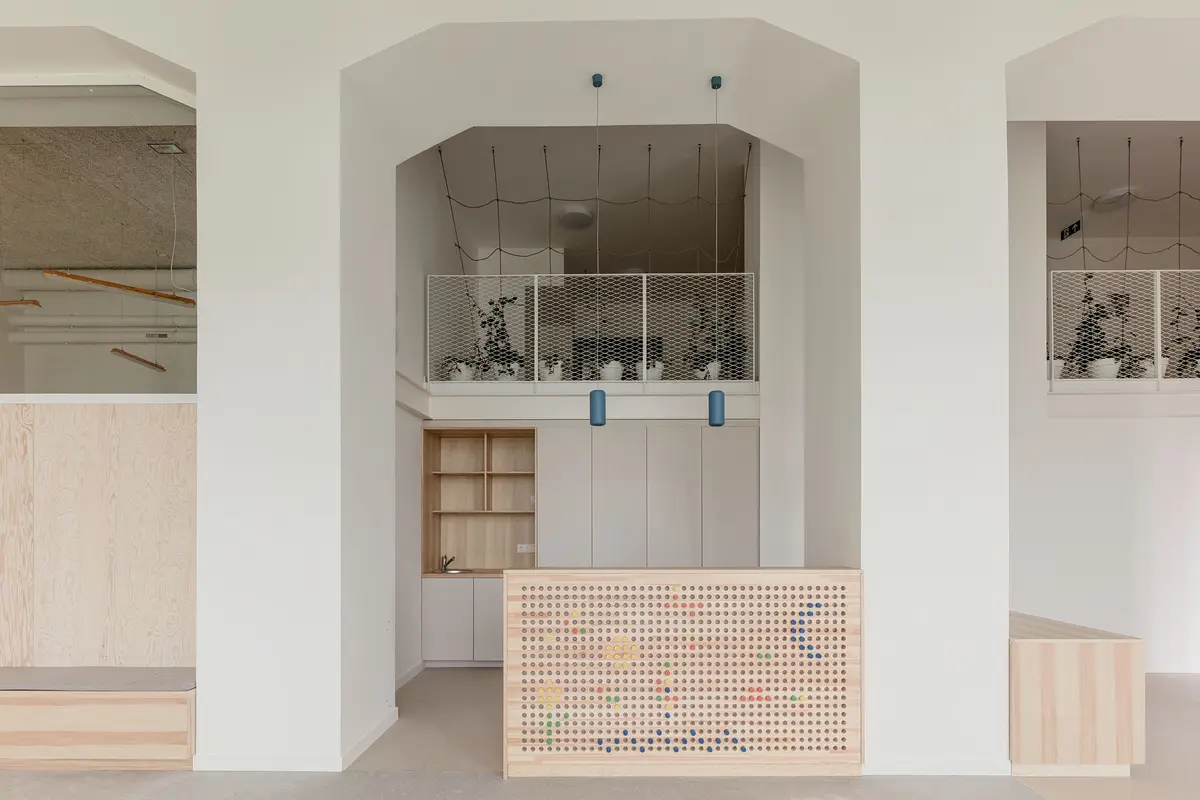
What makes this project compelling is its discipline. Pine plywood lines nearly every new partition and piece of furniture, creating a single warm tone that wraps the interior in a continuous material language. The existing load-bearing masonry walls are replastered white, establishing a dialogue between old structure and new insertion. Color appears only in two deliberate bursts: the coral-tiled bathrooms and the playful pegboard reception desk studded with bright pegs. Everything else is background, a stage set waiting for small bodies, wooden blocks, and scattered toys to animate it.
A Historic Shell, Gently Occupied
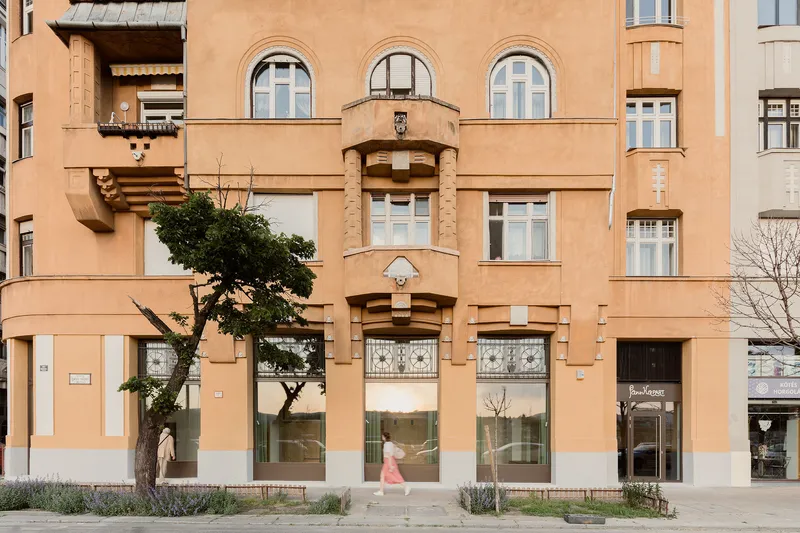
Palatinus House was considered one of Budapest's most modern and luxurious residential buildings when it was completed in 1911. Its street facade, with peach stucco, arched windows, and rounded bay balconies, signals Secession-era grandeur without shouting about it. The decision by the local council in 2020 to convert a dilapidated ground-floor area into a children's facility could easily have resulted in a gutting of the original character. ARCHIKON avoided that trap.
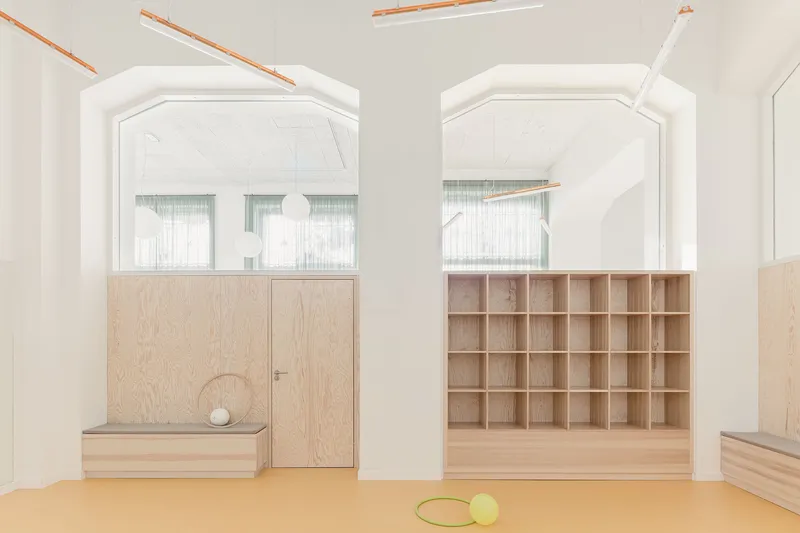
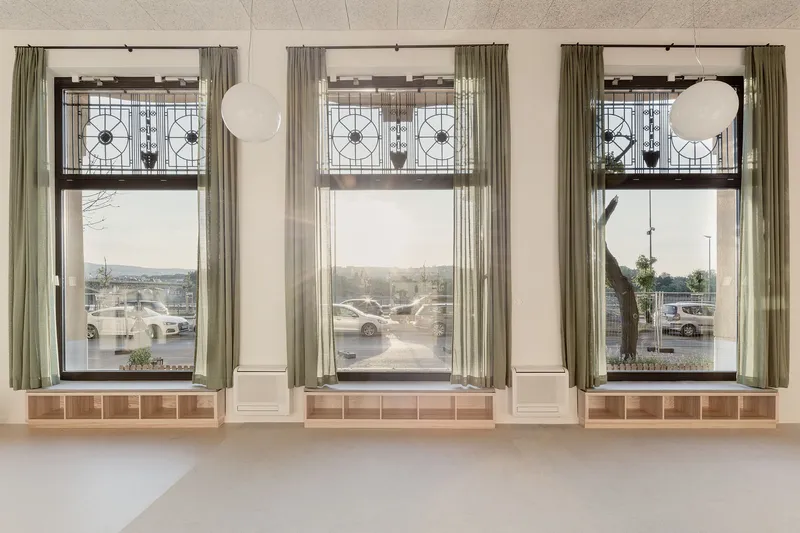
The tall arched portals and generous ceiling heights are preserved, and in several places they become the project's best feature. Arched white openings frame plywood doors and cubby shelving, treating the historic geometry as a found ornament rather than an obstacle. Tall windows with geometric transom panels bring daylight deep into the plan and offer views toward the Danube, Margaret Island, and the Buda hills, a panoramic backdrop that most purpose-built nurseries can only dream of.
Pine Plywood as a Unifying Skin
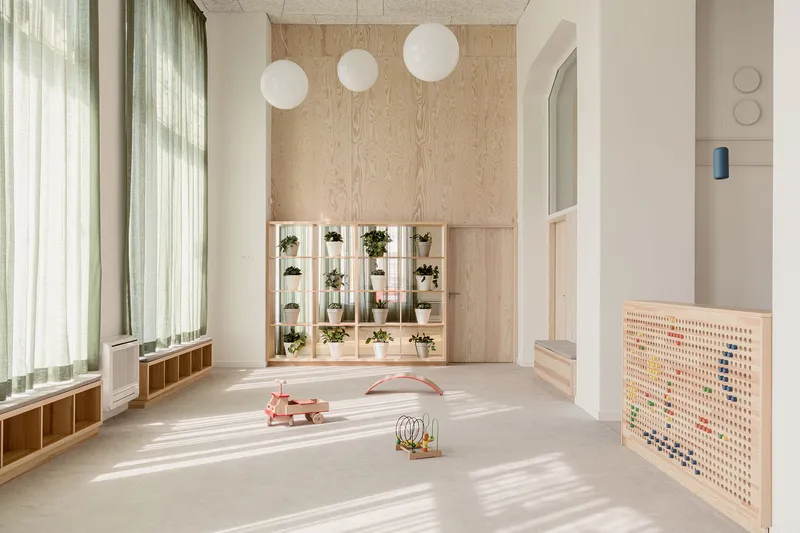
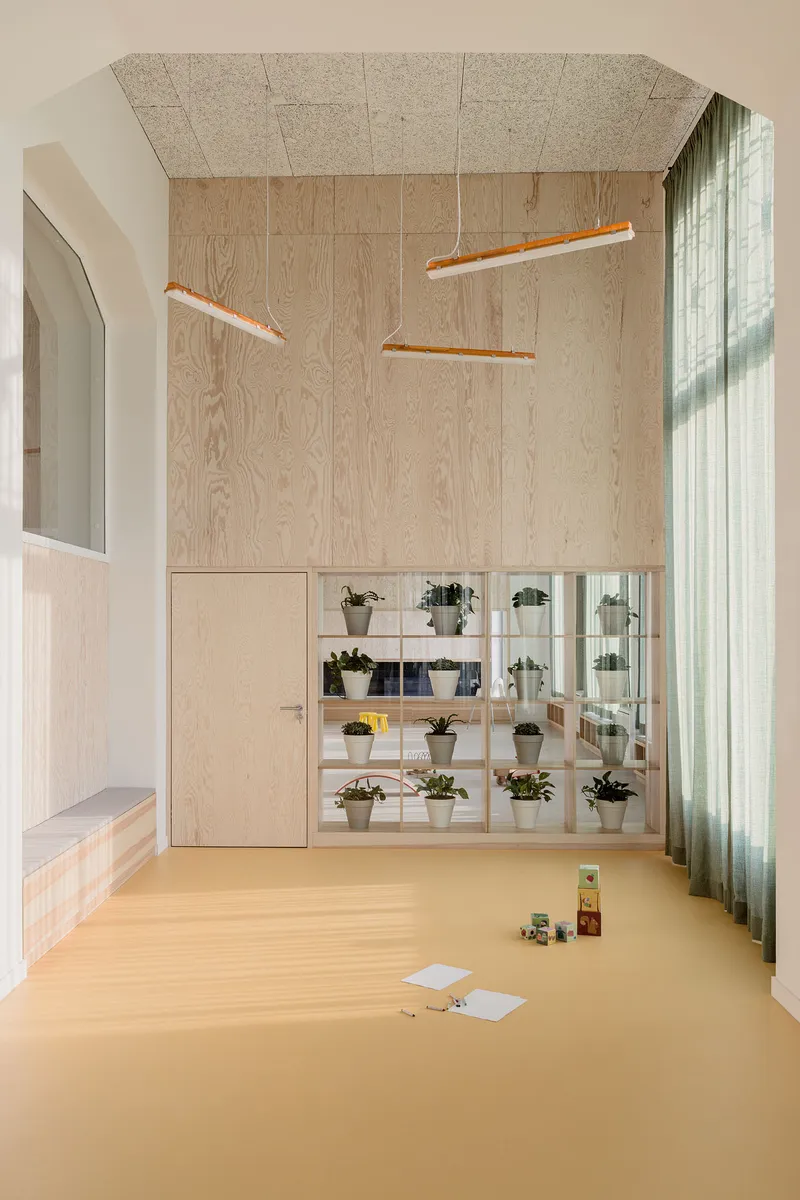
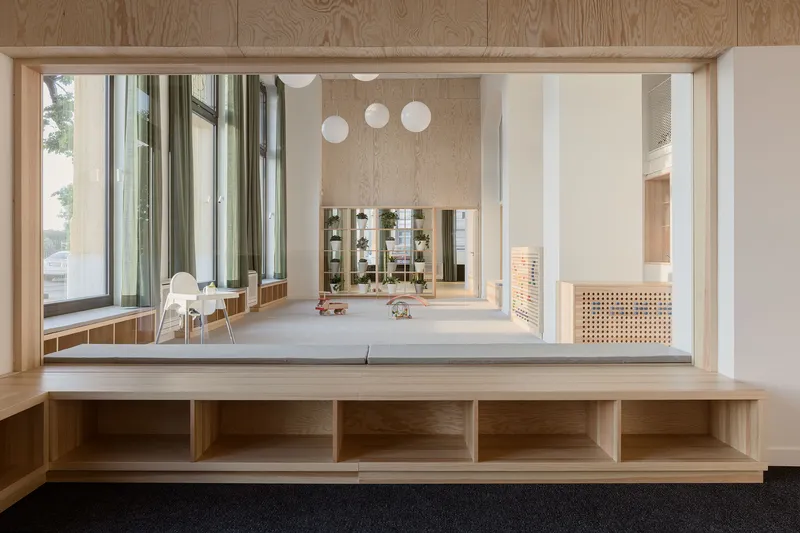
The interior reads almost like a timber insert slipped inside a masonry box. Pine plywood covers every new partition wall, and pine veneer wraps every piece of custom furniture, from storage cubbies to built-in benches to the reception desk. The effect is monolithic without being monotonous. Variations in grain direction, panel scale, and the play of light across open shelving keep the surfaces alive.
A double-height playroom sits at the heart of the plan, its plywood plant wall and floor-to-ceiling windows creating a greenhouse-like atmosphere. Sphere pendant lights float overhead like oversized soap bubbles. From the mezzanine above, an oak-framed opening lets adults look down into the room, maintaining visual supervision without physical intrusion. Glazings above partitions push borrowed light into inner activity rooms, reducing the need for artificial lighting and keeping the spatial flow legible even in deeper zones of the plan.
The Pegboard Reception and Controlled Bursts of Color
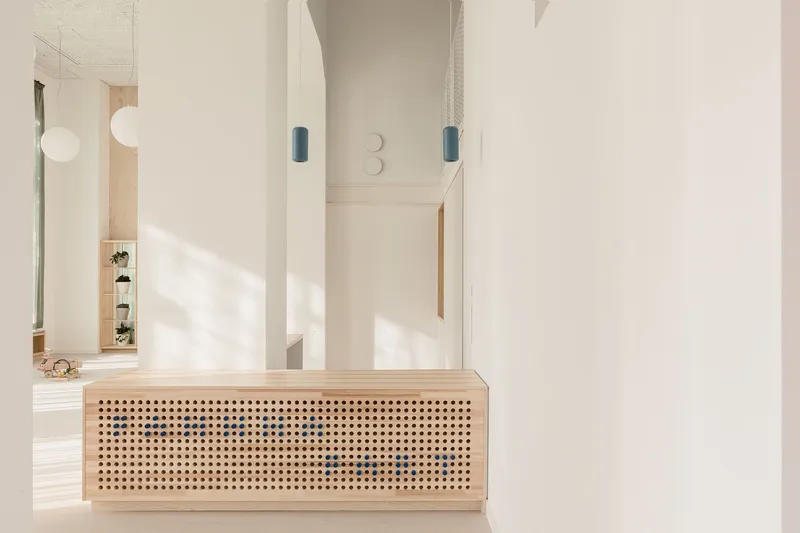
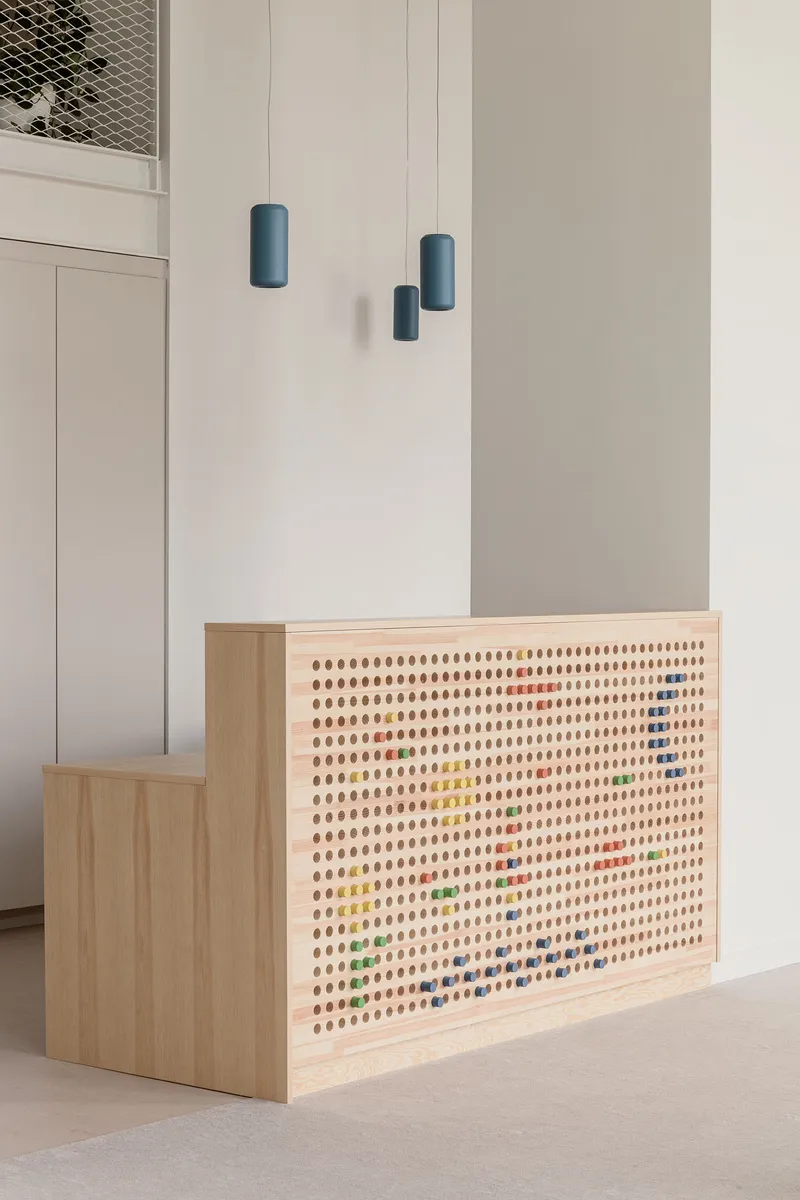
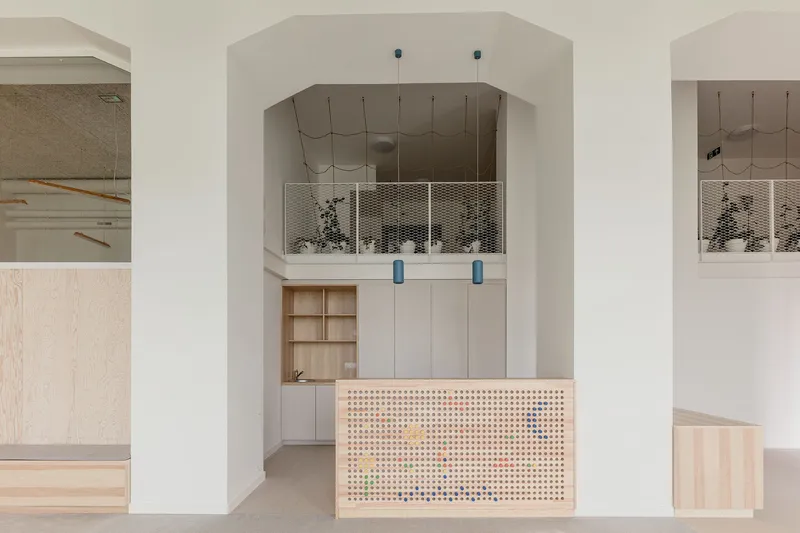
If the rest of the project is a study in restraint, the reception desk is the moment where ARCHIKON lets playfulness take center stage. Designed as a large pegboard, its perforated plywood screen accepts brightly colored pegs that children (and parents) can rearrange at will. It is architecture as toy, a piece of furniture that doubles as a participatory installation. Blue cylindrical pendant lights overhead push the palette slightly further, marking the threshold between the public entrance corridor and the main play spaces.
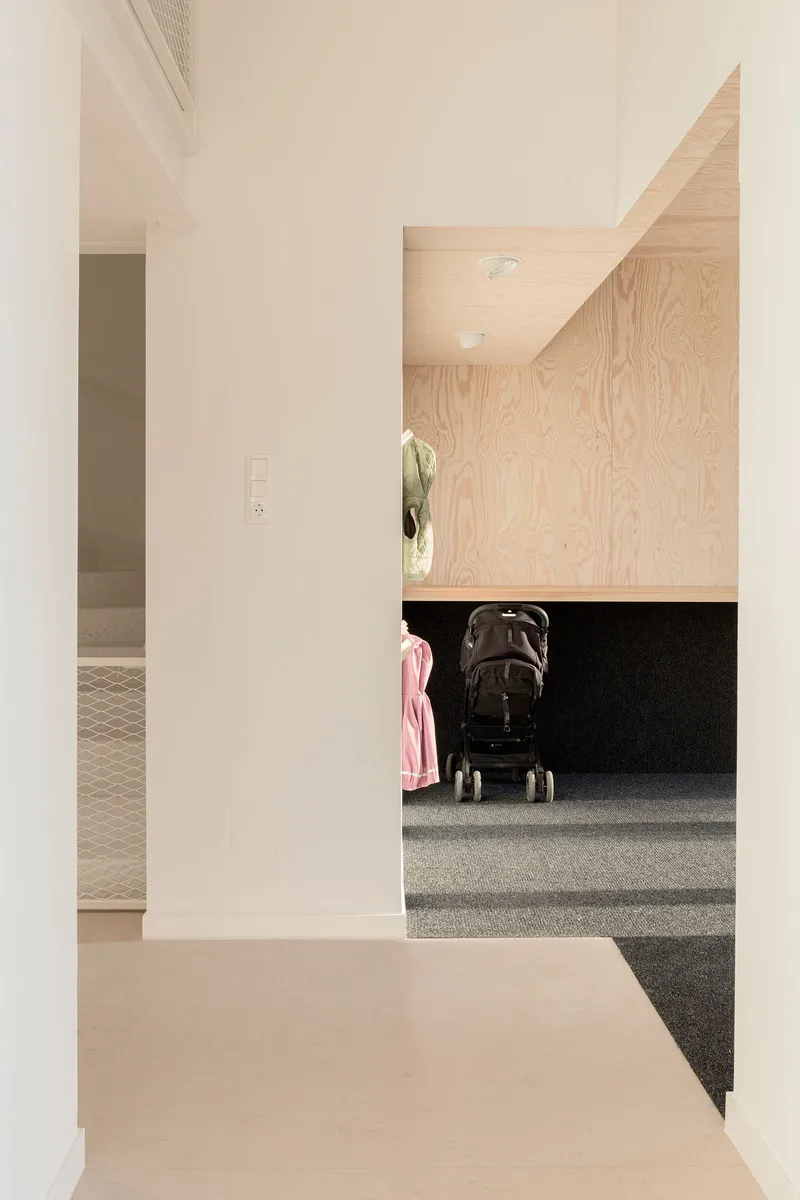
The entry corridor itself is smartly programmed. A white peg wall holds bags and strollers, keeping the clutter of family life organized without hiding it. From here, sightlines extend through to the coral-tiled bathroom beyond, giving the first glimpse of the project's second color event.
Coral Bathrooms as a Chromatic Counterpoint
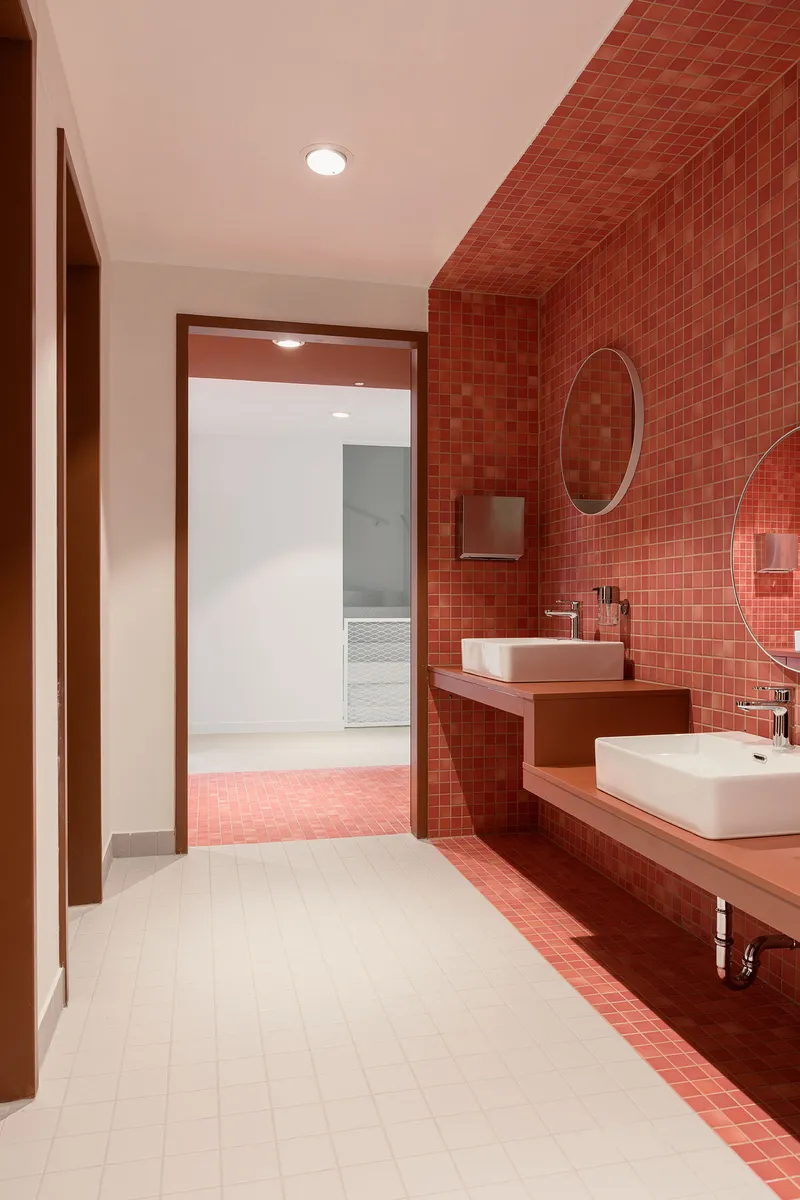
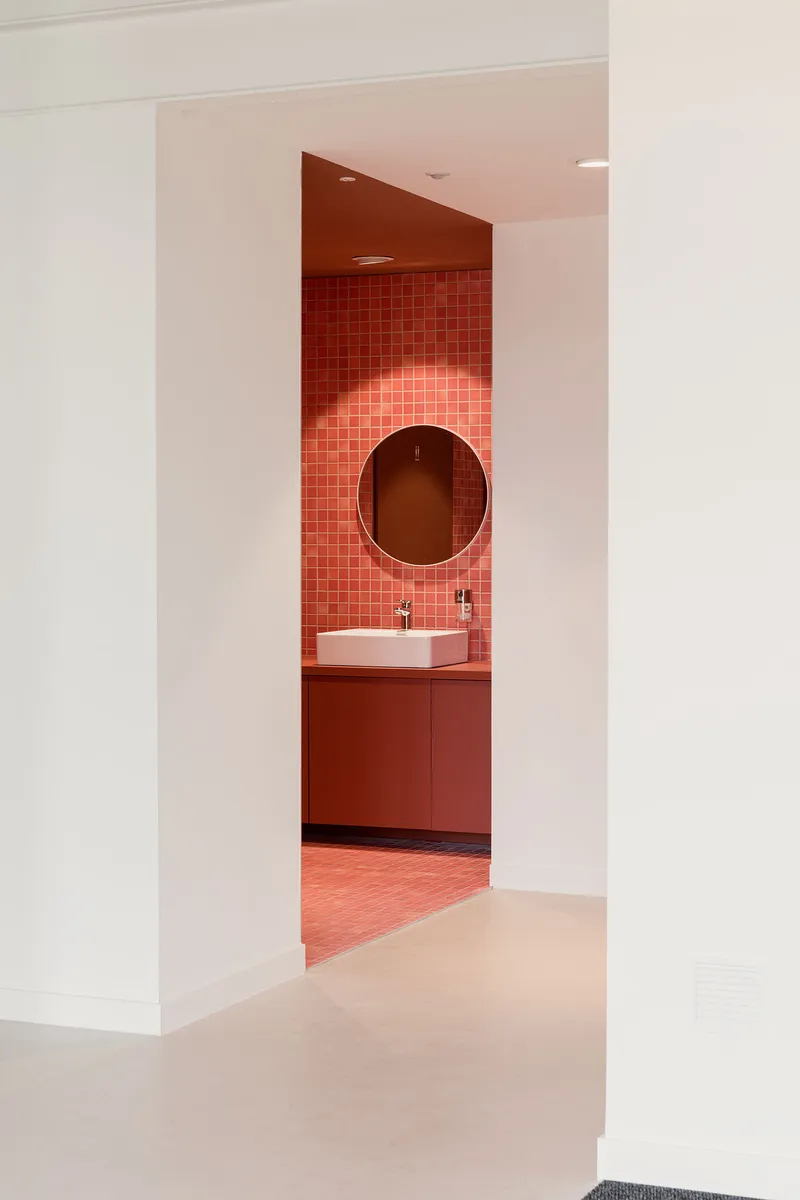
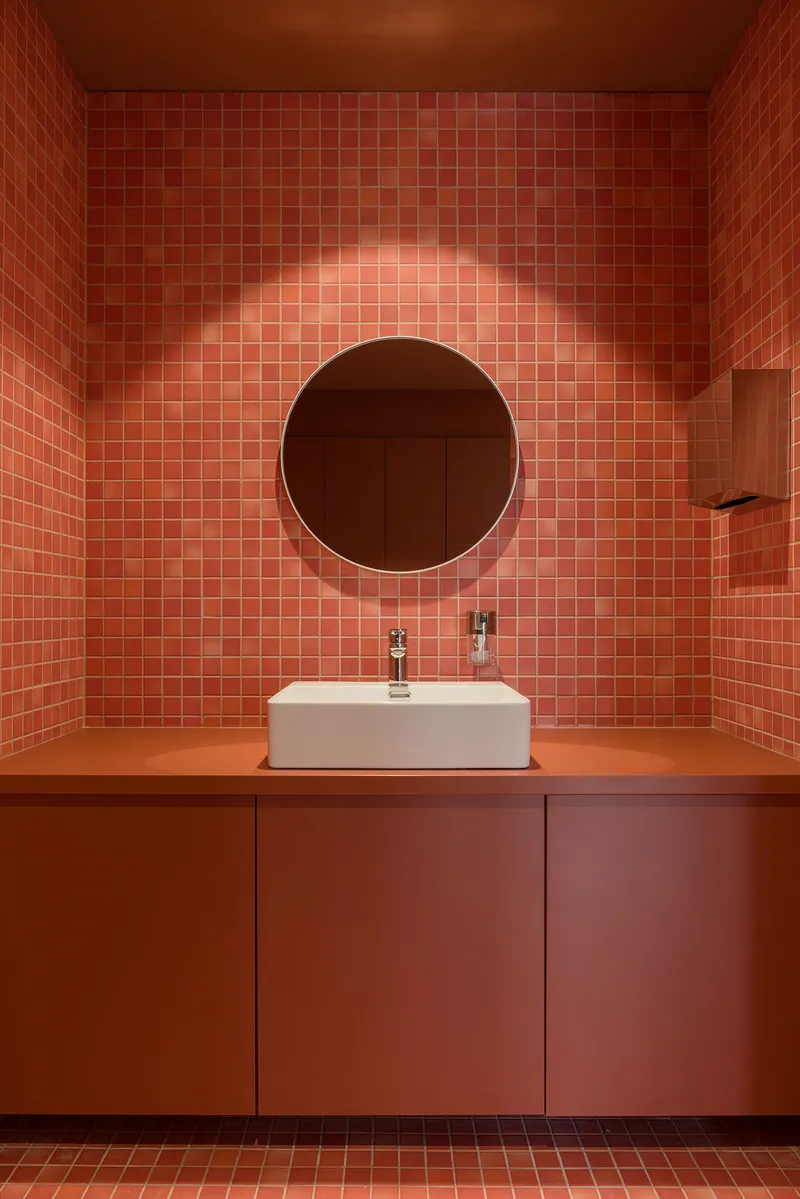
The bathrooms are where the project's otherwise neutral palette breaks open. Agrob Buchtal ceramic tiles in a coral-red mix, at just five by five centimeters, coat walls and even the ceiling, creating an immersive chromatic volume. White vessel sinks sit on orange countertops, and backlit circular mirrors carve clean geometry into the tile field. It is a warm, almost womb-like space that feels entirely appropriate for very young children while avoiding anything saccharine.
The decision to concentrate color in the bathroom rather than distributing it everywhere is a smart one. It gives children a legible spatial landmark, a room they can identify by hue alone, and it makes the transition from the neutral pine zones feel like a small adventure rather than just another doorway.
Activity Rooms and Alcoves
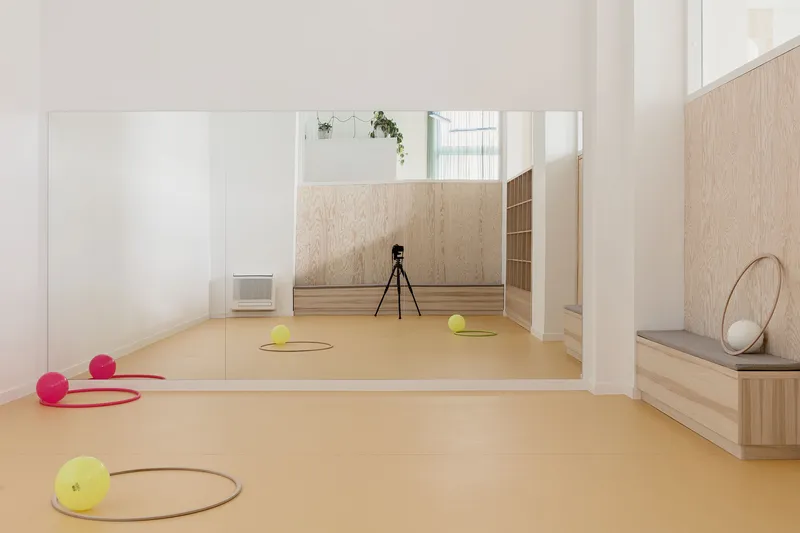
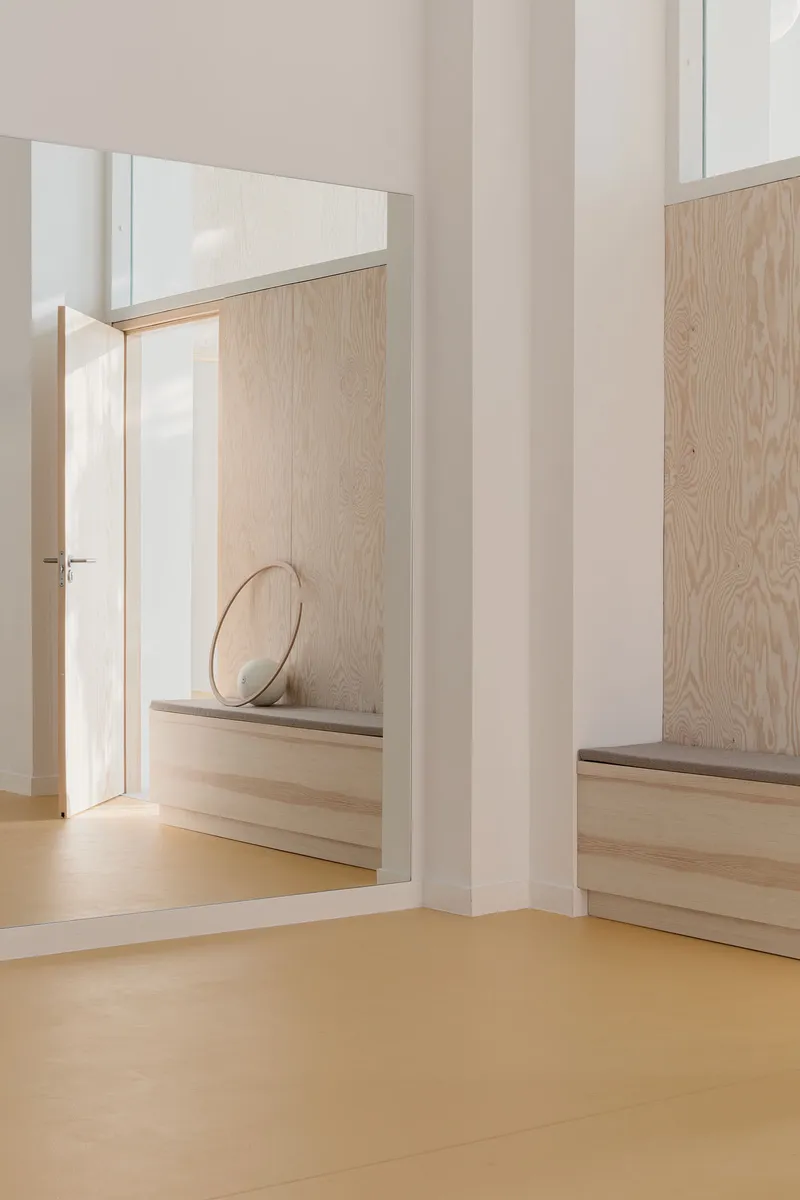
Two dedicated activity rooms supplement the central free-play area. One features amber Tarkett rubber flooring and a full-height mirrored wall, creating a space suited to movement classes, dance, or simply the hypnotic spectacle of toddlers discovering their reflections among brightly colored balls. The yellow flooring reads as sunshine underfoot, energizing the room without overwhelming it.
Elsewhere, built-in plywood alcoves with integrated benches and round mirrors offer quieter corners for reading or solo play. These nooks are scaled to small bodies, low ceilings tucked beneath the mezzanine, proportioned so that an adult has to stoop slightly but a child feels perfectly at home. A rope climbing installation in a white corridor adds a vertical dimension to the play experience, framed by potted plants that soften the institutional edges.
Circulation and the Stairwell
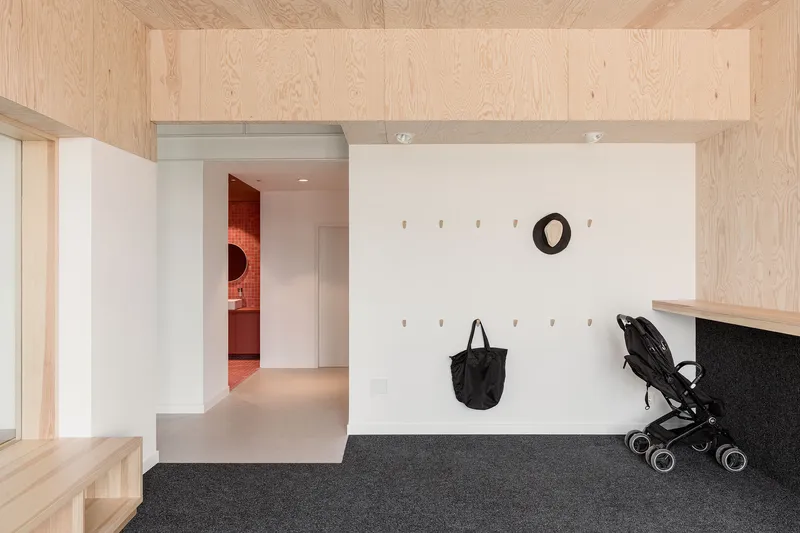
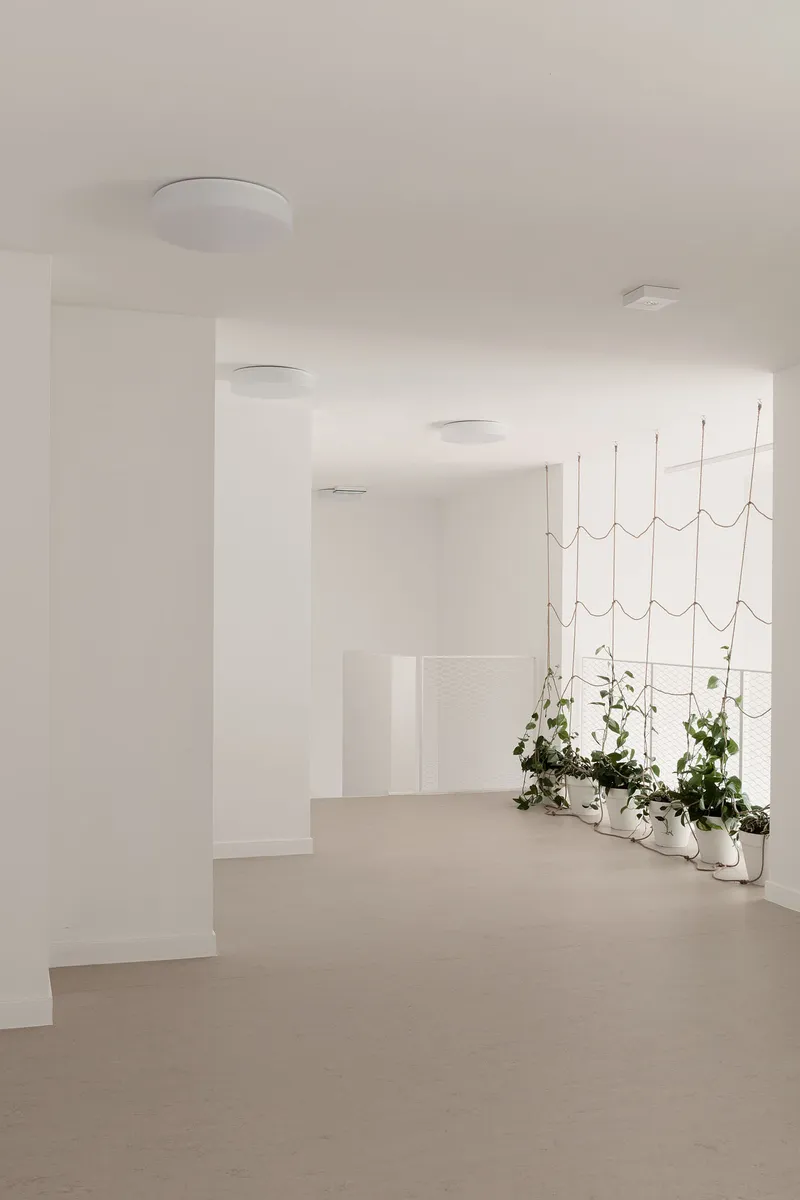
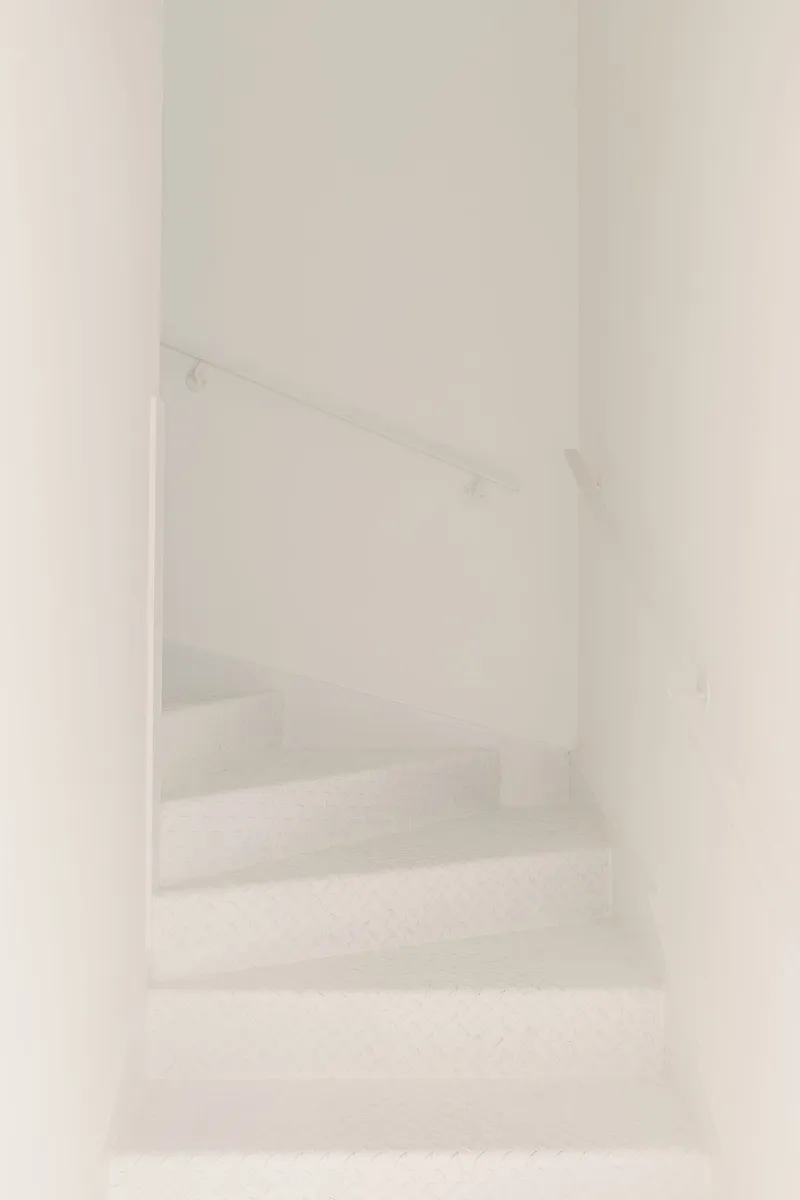
The spatial sequence from entrance to deep interior is carefully choreographed. The plywood-ceilinged entry corridor leads past the peg wall and stroller parking, through the reception, and into the open play area. From there, the mezzanine is reached via a narrow enclosed stairwell with replastered white walls and a thin metal handrail, a deliberately understated moment of vertical transition that contrasts with the generous volumes of the main rooms.
ARCHIKON uses the thickness of the existing masonry walls to create moments of compression and release. The reception desk slots neatly between two structural walls, and arched openings become framing devices that control views and build anticipation. It is a simple strategy, but in a 353 square meter plan that needs to accommodate entrance, dining, reception, play, activity rooms, kitchenette, office, and storage, that legibility matters enormously.
Plans and Drawings
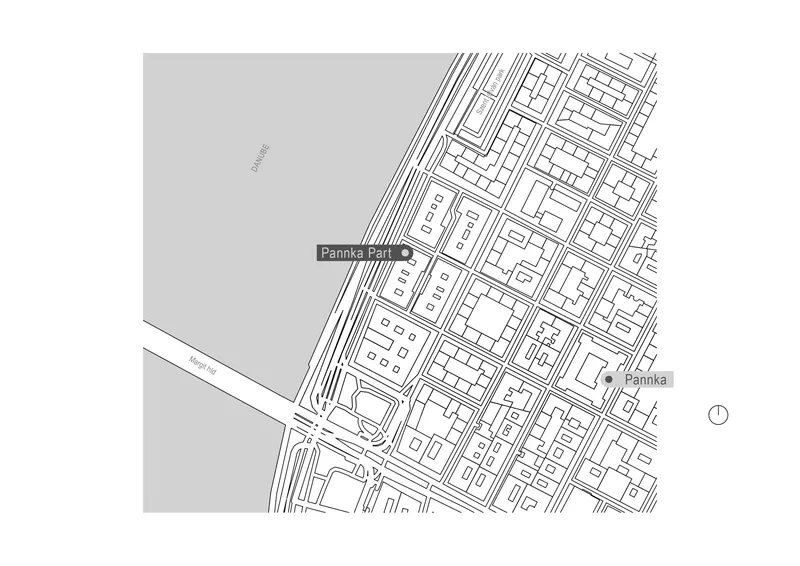
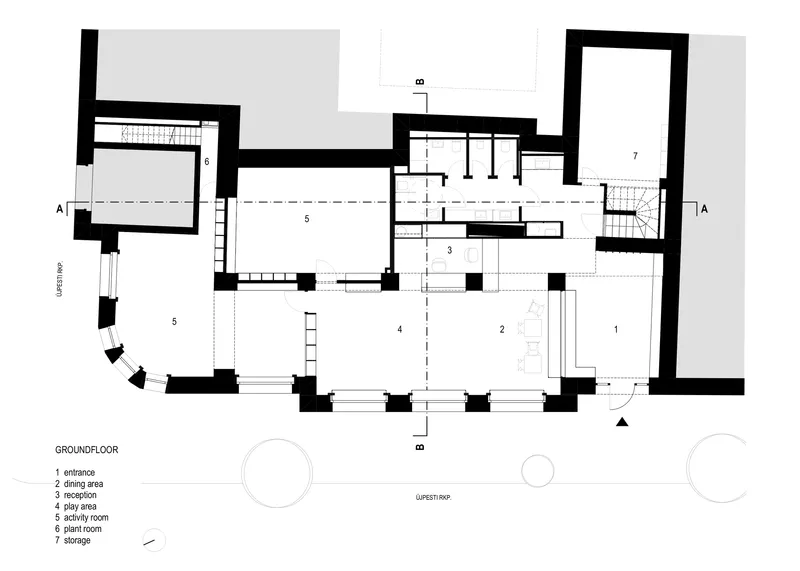
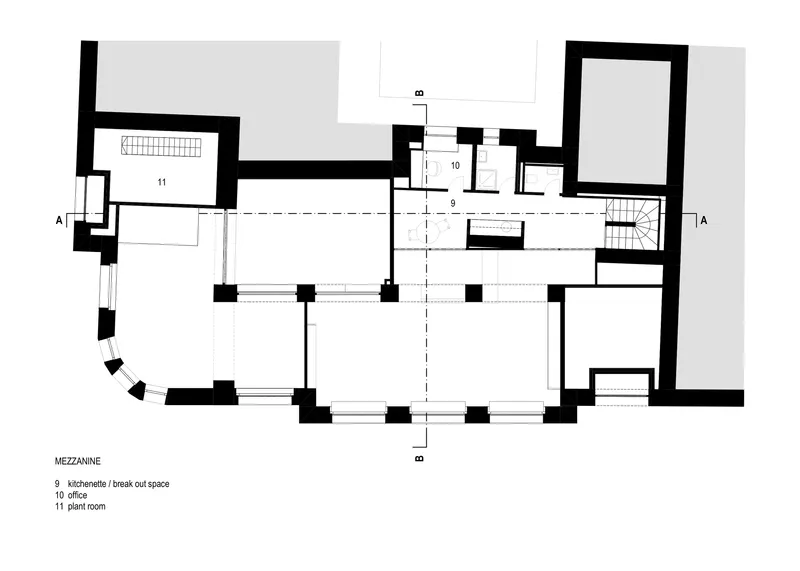
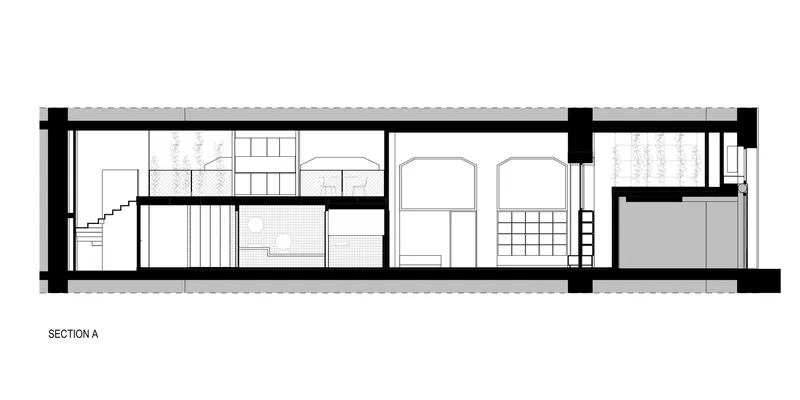
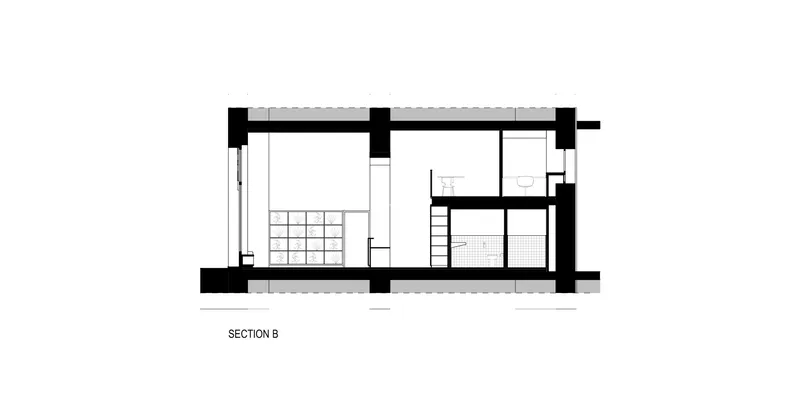
The site plan reveals Palatinus House's triangular footprint wedged into a dense urban block adjacent to railway lines, an unlikely location for a children's center that the architects have turned into an advantage by exploiting the building's generous street-facing windows. The ground floor plan shows how the program wraps around thick masonry walls, with the free-play area occupying the largest contiguous space and activity rooms branching off to either side. The mezzanine plan exposes a central void that preserves the double-height volume of the play area while carving out office space above. Two section drawings illustrate the stair connections and the dramatic effect of the tall window openings, confirming that the extreme interior heights are not incidental but foundational to the spatial experience.
Why This Project Matters
PannKa Part demonstrates that designing for very young children does not require abandoning architectural intelligence. By treating the existing structure with respect, deploying a single dominant material, and concentrating color in moments of deliberate intensity, ARCHIKON has produced a space that is warm, legible, and genuinely enjoyable to be in. The pegboard reception desk alone is worth the visit: a piece of architecture that invites touch and transformation, exactly what a space for zero-to-six-year-olds should do.
More broadly, the project is a quiet argument for the adaptive reuse of historic urban fabric for civic purposes. Palatinus House was never designed to host a community center, but its tall ceilings, thick walls, and generous portals have proved to be ideal containers for one. In a city full of underused ground-floor spaces in early twentieth-century apartment buildings, PannKa Part offers a replicable model: insert a plywood world, let the old walls do the heavy lifting, and trust the children to bring the rest.
PannKa Part Play and Community Center by ARCHIKON Architects, Budapest, Hungary. 353 m², completed 2022. Photography by Balázs Danyi.
About the Studio
Share Your Own Work on uni.xyz
If projects like this are the kind of work you want to make, uni.xyz is a place to publish your own, find collaborators, and enter design competitions.


Popular Articles
Popular articles from the community


Conexión: Biophilic Design Reimagines High-Rise Living in Hong Kong
Conexión reimagines high-rise living in Hong Kong through biophilic design, green facades, shared spaces, daylight, water and nature within.

The Musturak Paradise: Senior Living Architecture for a Connected Future in Temara, Morocco
The Musturak Paradise reimagines senior living architecture in Temara via private homes, social spaces, culture, community, and shared care.

The Ocean Hive: Sustainable Architecture for a Self-Sufficient Civilization at Sea
The Ocean Hive imagines sustainable architecture at sea, where modular habitats, algae, wave power and ocean waste sustain a growing colony.

ALGAL REALM: A Bio-Integrated Lunar Habitat Design for Life Beyond Earth
ALGAL REALM reimagines lunar habitat design with algae-powered life support, 3D-printed regolith, and vertical living for a lunar future.

Similar Reads
You might also enjoy these articles

Bao Huynh Watercolor Atelier: A Serene Art Retreat in Hội An
Bao Huynh Watercolor Atelier in Hội An blends multifunctional art spaces, sustainable design, local materials, and family-friendly living in a serene environment.

Atelier Macri Concept Store Interior Design by CASE-REAL
Atelier Macri store features a "ko" counter, walnut wood details, cork displays, blending retail, gallery, and seamless customer experiences.

Manuel Vargas Izquierdo Stadium and High-Performance Sports Center: Architectural Excellence in Jalpa de Méndez
The Manuel Vargas Izquierdo Stadium blends sustainable design, inclusive sports facilities, and cultural-inspired architecture, revitalizing Jalpa de Méndez’s public spaces.

KAKR Buluh Awar Hall: Revitalizing Community and Ecology Through Bamboo Architecture
Community built bamboo hall revitalizes Buluh Awar village, empowering youth, restoring ecology, celebrating vernacular craftsmanship through sustainable architecture and culture.

Comments (0)
Please login or sign up to add comments
No comments yet. Be the first to comment!