

Illusory Space: Architecture That Moves Without Moving
Black and white vinyl strips leap from wall to floor, generating shifting Moiré patterns that rewrite depth perception with every step.


Stand still and the room is a grid of black and white stripes. Take one step sideways and the entire surface ripples, lines colliding and separating in ways that suggest motion where none exists. That perceptual sleight of hand is the engine of Illusory Space, an installation that weaponizes the Moiré effect to dissolve the boundary between flat graphic and built form. Vinyl strips applied to walls extend into physical space through carefully fabricated black and white wooden structures, turning a simple corner of a gallery into a shifting optical field.
Designed by Dorothy Chou and published on uni.xyz, the project sits at the intersection of parametric design and perceptual psychology. Chou treats architecture not as a fixed container but as a medium for visual interference, using nothing more than contrasting strips to produce an experience of fluid motion within a wholly static structure.
Nine Frames of a Pattern That Never Repeats

A sequence of nine photographs captures the installation from a series of viewpoints, and no two frames look alike. The black and white striped tape adhered to a white wall produces different interference patterns depending on the camera's position, proving that the Moiré effect here is not a digital trick but a genuine spatial phenomenon. Each frame reads like a distinct composition: dense bands compress into apparent curvature in one shot, then separate into clean parallels in the next. Collectively, the sequence operates as a storyboard of perception itself, documenting how a single static arrangement can generate an infinite number of visual experiences.
Where Wall Meets Floor: Folding the Pattern Into Three Dimensions
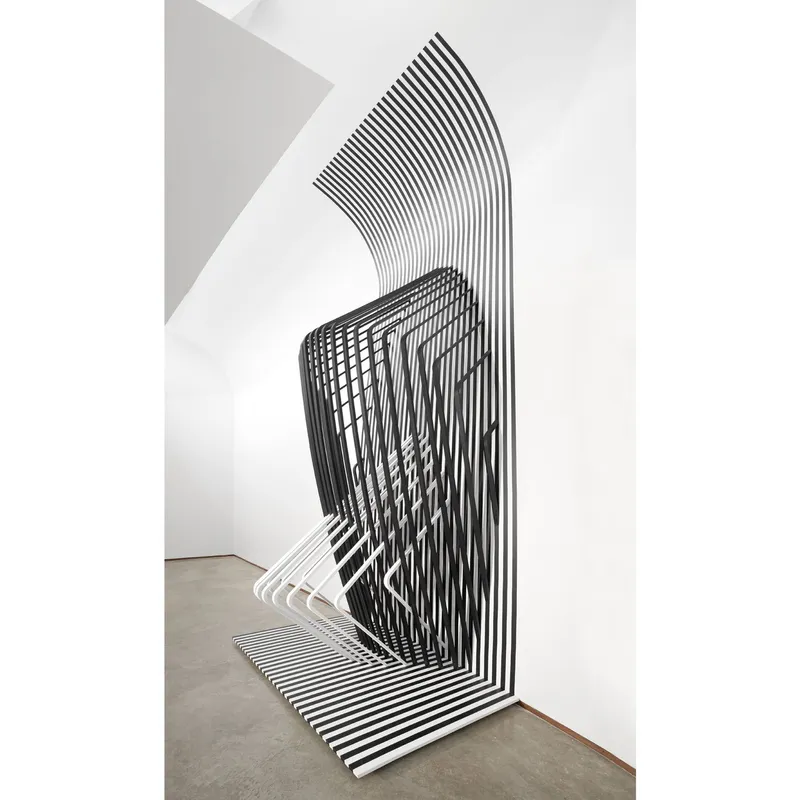
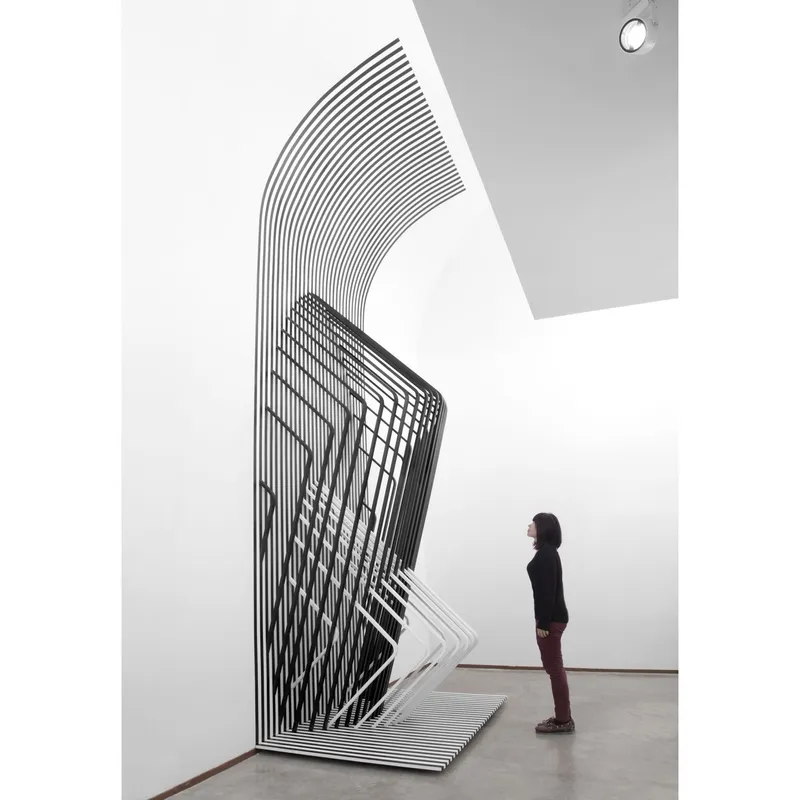
The most striking spatial move in the installation is the fold. Black and white striped tape travels continuously from wall surface down onto the floor, wrapping a corner into a single graphic plane that denies the room's orthogonal geometry. Viewed head-on, the fold flattens; viewed obliquely, it pops into sharp relief, making the room's corner seem to advance or recede depending on the observer's position. It is a precise demonstration of how 2D pattern and 3D structure can become indistinguishable.
A gallery visitor standing beside the folded installation provides a crucial sense of scale. The stripes are clearly body-sized, not miniature, which means the perceptual distortion operates at an architectural register rather than an object-design one. The human figure also underscores the interactive premise: this is work that requires a moving body to activate its full range of effects.
Building the Illusion by Hand
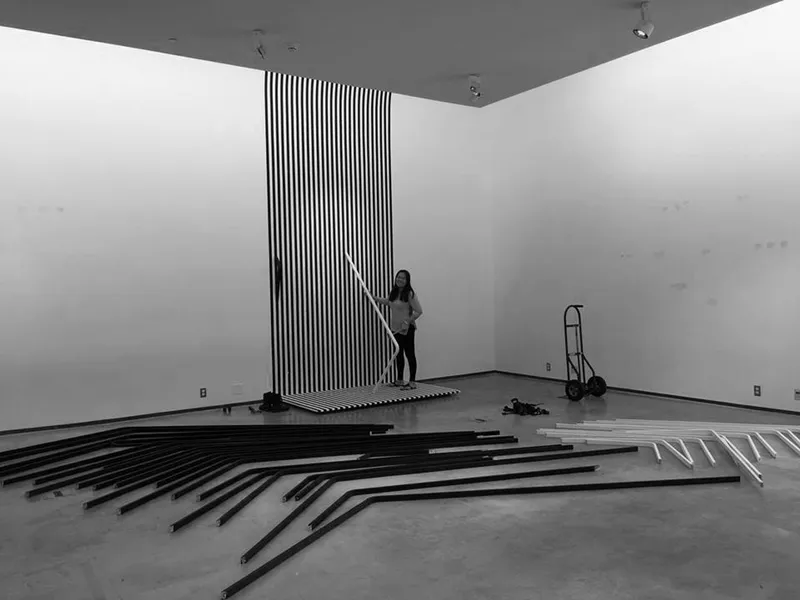
A process photograph shows Chou assembling the black and white striped elements inside an empty gallery space. The image reveals a deliberately low-tech construction method: individual wooden structures and vinyl strips aligned by hand, one edge at a time. There is no CNC router or robotic arm in sight. That material honesty matters because it makes the resulting optical complexity feel even more improbable. The gap between the simplicity of the means and the sophistication of the effect is where the project's intelligence lives.
Audience as Activator

During an exhibition opening, visitors cluster around a freestanding version of the striped sculpture. The crowd's movement through the space is not incidental to the work; it is the work. As bodies circulate, each person sees a different pattern at any given moment, making the collective experience inherently social and impossible to reproduce in a single photograph. Chou's installation converts passive spectators into active participants whose shifting sightlines continuously regenerate the design.
Why This Project Matters
Illusory Space is a compact argument for something architecture often forgets: that visual perception is not a fixed condition but a dynamic negotiation between surface, structure, and the moving body. By exploiting the Moiré effect at full architectural scale, Chou demonstrates that complex spatial experiences do not require complex technology. Vinyl tape, painted wood, and a white room are sufficient to produce an environment that rewrites itself with every step a visitor takes.
For designers interested in interactive or perceptual architecture, the project offers a useful provocation. It suggests that interactivity need not depend on sensors, screens, or computation. The oldest optical phenomena, patiently translated into physical form, can create environments as responsive and unpredictable as any algorithm. That insight alone makes Illusory Space worth studying closely.
View the Full Project
About the Designers
Designer: Dorothy Chou
Enter a Design Competition on uni.xyz
uni.xyz runs architecture and design competitions year-round that reward proposals with spatial conviction and real site intelligence.
Project credits: "Illusory Space by Dorothy Chou.


Popular Articles
Popular articles from the community


Singing Woman: An Opera House That Performs Before the Curtain Rises
Ovidiu Cristian Pavel's conceptual opera house translates Estonia's choral identity into a sculpted waterfront landmark facing the Baltic Sea.

Faces of the Soviet Avant-Garde: Turning Moscow's Street Names into an Open-Air Museum
A network of sculptural installations across a Moscow residential district transforms forgotten architect names into spatial encounters with cultural memor
Temporary Home for Dogs: A Reversed Zoo Rethinks Animal Shelter Architecture
In Bucharest, a sinuous corridor and freed landscape flip the logic of containment, designing a shelter that works to make itself unnecessary.

Opera on the Sea: Driftwood Logic Shapes a Timber Opera House on Estonia's Coast
Trevor Orgill's opera house translates the entangled drift of floating timber into a civic building where wood, water, and music converge.

Similar Reads
You might also enjoy these articles

Shakur's House: Exposed Brick as an Interior Organiser in a 168 m² Mashhad Residence
Brick moves indoors in this Mashhad residence, where masonry walls, glass partitions and teal planes sequence a compact home without closing it off.

Day and Night Park: A Time-Based Urban Newsstand in Beijing
A temporary urban newsstand in Beijing blending travel, light, and reading through poetic colors, compact form, and community-focused design.

Modernist Patio Renovation in El Masnou, Barcelona by Oliver Segura Arquitectura + Cebrià Arquitectura
Modernist patio renovation blending tradition and innovation with a movable pool, leveled floors, and Catalan materials in El Masnou.

Alto Residencial Coop: Cooperative Housing Development in Santiago de Compostela by Carbajo Barrios Arquitectos
A linear cooperative housing complex blending white volumes and perforated metal façades, enhancing community living, natural light, privacy, and urban integration.

Comments (0)
Please login or sign up to add comments
No comments yet. Be the first to comment!