
Philipp Weinberger Converts Austria's First Steel Skeleton Warehouse into a Cultural Center in Linz
A 230-meter-long tobacco magazine by Peter Behrens gets a second life as co-working studios, galleries, and museum depot.


Magazin 1 at the Linz Tabakfabrik is not just any warehouse. Designed by Peter Behrens and Alexander Popp around 1920, it was the first Neue Sachlichkeit steel skeleton construction in Austria, a nearly 230-meter-long, gently curving volume built to dry pipe tobacco. When Philipp Weinberger took on its conversion into the Art Magazin Cultural Center, completed in 2021, the challenge was clear: how do you fill 5,000 square meters of rigid industrial logic with the loose, unpredictable energy of creative work?
The answer lies in what Weinberger chose not to do. Utility lines stay exposed. Old building materials are preserved or restored rather than concealed. New insertions follow the color palette Behrens himself established: machine green, traffic yellow, and the signature "Behrensblau" that turns up on door frames and the building's central spiral staircase. The design is deliberately rough, a flexible framework that hands agency back to its users. The result is one of the most convincing industrial conversions in Central Europe, not because it spectacularizes heritage, but because it treats heritage as still operational.
The Ribbon Facade and the Space Between Buildings


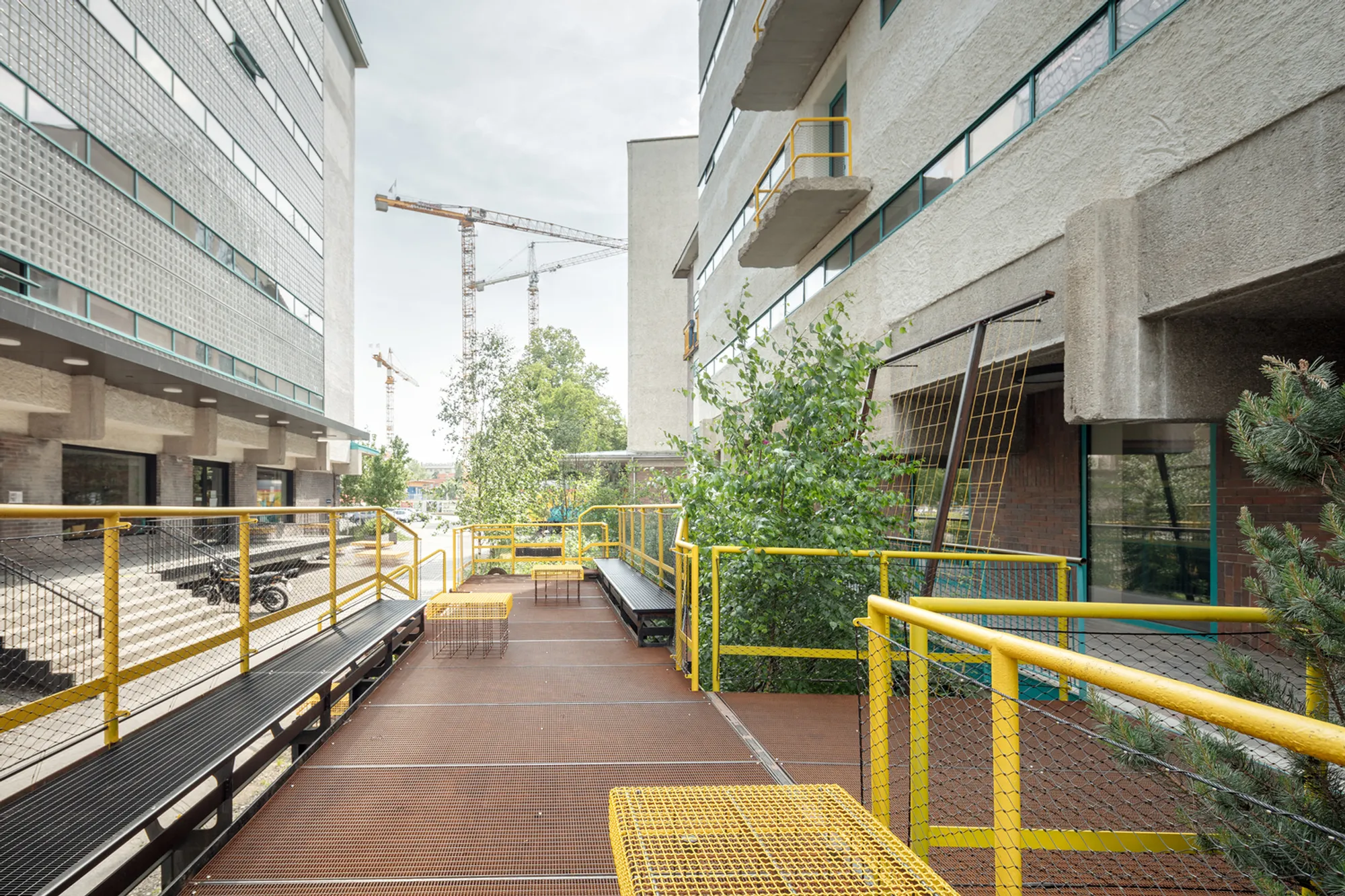
In the 1960s, the gaps between the three parallel magazines were filled with intermediate structures. Weinberger's renovation stripped these additions away, restoring the original ribbon windows along the southeast facade and reopening the interstitial landscape. The move is surgical: by subtracting later accretions, the building regains the generous light and air that Behrens originally intended. Newly added balconies occupy the void left by the demolished infill, providing outdoor access for artists while creating a building-historical reference to what was removed.
Between the magazines, the old railroad tracks that once delivered tobacco bales remain in place, now framed by wild planting and gravel in a deliberate railway wasteland aesthetic. A discarded railroad car, fitted with steel grating and railings, has been repurposed as the main building entrance. It is a gesture that could easily tip into nostalgia, but the execution is too blunt and functional for that. The car is simply the most logical threshold between an industrial landscape and an industrial interior.
Co-Working Under a Concrete Grid Ceiling


Approximately 1,800 square meters across three floors are given over to co-working and studio space. The rooms are low, pressed under the concrete grid ceiling of the original warehouse structure. Plywood partitions subdivide the floor plates into units of varying size without pretending to be permanent walls. Black rubber flooring absorbs noise and wear. Orange chairs and warm timber surfaces provide just enough domestic warmth to offset the raw overhead structure.
A critical detail running through all of these spaces is the "DARF" luminaire, a bespoke lighting element Weinberger developed specifically for the building. Suspended below the heavy concrete grid, it produces a uniform carpet of light that resolves the problem of low ceiling height without competing with the structural expression above. It is the kind of design decision that rarely makes the photographs but fundamentally determines how a building feels to occupy.
The Behrensband: A Staircase as Institutional Spine
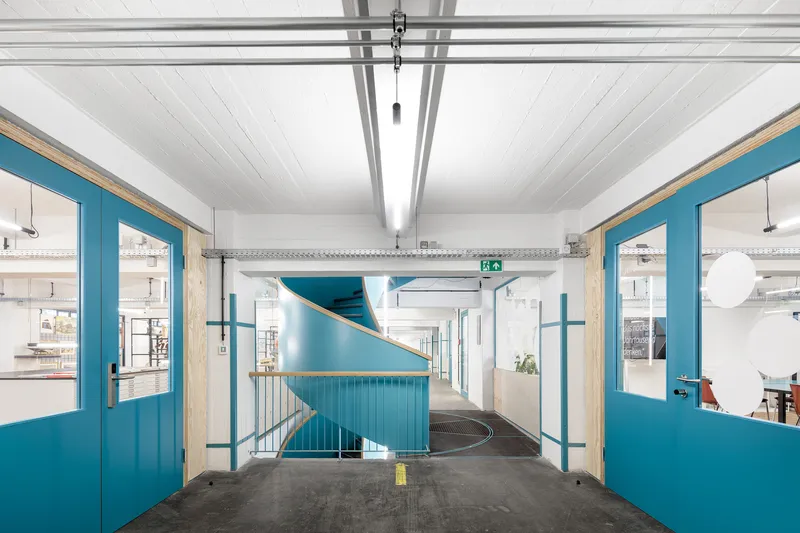
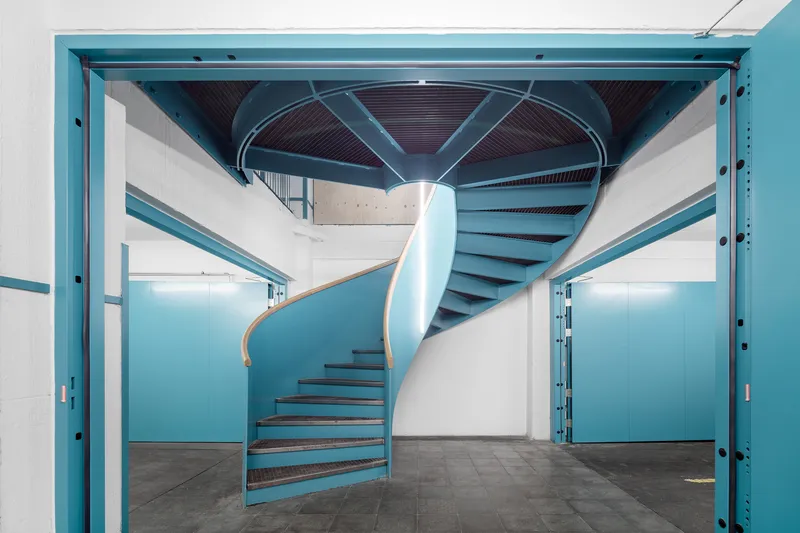
The most visually arresting element in the building is the large steel spiral staircase that Weinberger calls the "Behrensband." Painted in Behrensblau, a deep turquoise that Behrens used across the original factory complex, the staircase connects the first through third floors and traces the path of the old logistics belt. Its generous diameter and the cheek-mounted construction give it a sculptural presence that reads against the white atrium walls like an industrial totem.
What elevates it beyond spectacle is its programmatic function. The Behrensband doubles as a visitor tour route, drawing the public vertically through the building's layers. It is a connector in the most literal sense, stitching together studios, exhibition spaces, meeting rooms, and the depot of the Linz City Museums into a single navigable sequence. The color choice is not arbitrary decoration but a continuity claim, linking the new intervention to Behrens's original chromatic logic.
Gallery, Depot, and the Color Code


The gallery spaces and museum depot operate at the same level of material frankness as the rest of the building. Metal shelving lines the walls, displaying collections, such as the hat molds visible in one space, with the openness of a working archive rather than the preciousness of a curated gallery. Timber flooring provides acoustic warmth and a scaled-down domestic register beneath the industrial shell.
Elsewhere, Weinberger's fidelity to the Behrens color code surfaces in unexpected rooms. A changing area is clad entirely in blue square tile, walls and floor unified in a single saturated field, with plywood benches and coat hooks supplying the minimum necessary furnishing. It is a small room, but it captures the ethos of the entire project: preserve the character of functional architecture by continuing to think functionally. New fixtures adapt to the existing palette. Nothing is added for its own sake.
Why This Project Matters
Adaptive reuse projects often face a binary trap: either the old building is embalmed as a museum piece, or it is gutted to the point where the heritage claim becomes hollow. The Art Magazin Cultural Center sidesteps both by treating modernist functionalism as a living design language rather than a historical style. Weinberger's interventions, from the spiral staircase to the bespoke luminaire to the railroad-car entrance, are legible as new elements but share the pragmatic DNA of the Behrens original. The color scheme alone carries more design coherence than most renovation projects manage with ten times the budget.
More importantly, the project delivers a genuine creative infrastructure for Linz. Five thousand square meters of flexible, rough, well-lit workspace is not a symbolic gesture toward the arts. It is a real economic and social asset. By keeping the design deliberately incomplete, by giving users a framework rather than a finished product, Weinberger ensures the building can evolve with its community. That is the most faithful interpretation of Neue Sachlichkeit you could ask for: architecture that stays useful.
Art Magazin Cultural Center, Linz, Austria. Architect: Philipp Weinberger. Original building by Peter Behrens and Alexander Popp, c. 1920. Renovation completed 2021. Approximately 5,000 m². Photographs by Kurt Kuball.
About the Studio
Share Your Own Work on uni.xyz
If projects like this are the kind of work you want to make, uni.xyz is a place to publish your own, find collaborators, and enter design competitions.




Popular Articles
Popular articles from the community


Co-life: Sustainable Architecture for Age-Friendly Community Living
Co-life reimagines sustainable architecture for seniors through courtyards, rammed earth, shared gardens, and spaces designed for belonging.

The Musturak Paradise: Senior Living Architecture for a Connected Future in Temara, Morocco
The Musturak Paradise reimagines senior living architecture in Temara via private homes, social spaces, culture, community, and shared care.

Play: Fragments of Their World
Familiar architecture becomes modular playground design, creating safe spaces where displaced children can learn, connect, imagine and play.

The Earth Pod: 3D Printed Homes for Resilient Refugee Communities
The Earth Pod reimagines refugee housing through 3D printed homes made from clay, combining resilience, self-sufficiency, and rapid shelter.

Similar Reads
You might also enjoy these articles


Hodi-Mandai Geram
Project Function: Preservation and revitalization of the Intangible heritage and socio-spatial identity of the Hodi by Housing, Cultural Memory Center, Sacred Grove, landscape, local tourism economy


Olio Towers: A Mid-Rise for Performers That Fuses Housing, Rehearsal, and Stage
Located blocks from Houston's Theater District, this modular tower stacks living units around a central performance atrium.

Oasis: Modular Green Housing Carved into Dhaka's Urban Fabric
A shortlisted Plugin Housing entry reclaims unauthorized settlements in Dhaka with stepped concrete volumes, green roofs, and ventilation-driven design.

Black Hole: A Floating Megastructure for the Post-Physical Era
Emiliano Mazzarotto envisions a spherical, self-scaling arena where e-sports, digital hotels, and holographic stadiums replace traditional public space.

Explore Cultural Architecture Competitions
Discover active competitions in this discipline



Challenge to reimagine the Iron Throne


Photograph architecture without architects


Illustrate the lost glory of Angkor Wat - Render Challenge

Bring back Drive In's
Comments (0)
Please login or sign up to add comments
No comments yet. Be the first to comment!