

ASAS arkitektur Floats a Glass Pavilion on Top of a World War II Bunker in Norway
On the Fosen peninsula, a former German military bunker becomes a luminous gathering space above harvested wheat fields.


A German cannon once sat here, pointed at the Atlantic horizon. Now a glass box hovers above the same concrete walls, open on all sides to the landscape it was once built to surveil. Pavilion Brekstad, completed in 2022 by ASAS arkitektur, is a 137 m² transformation of a World War II military bunker on the Fosen peninsula in Mid-Norway, repositioned as a flexible events space for a nearby farm. The inversion is total: a structure designed around concealment and defense becomes one organized around visibility and welcome.
The project's animating idea, developed collaboratively with the client, is simple and potent: "to see and be seen." Where the bunker was heavy, buried, and opaque, the addition is light, elevated, and transparent. Two horizontal slabs, a floor deck and a roof plane, hover above the existing concrete mass on a recessed, largely glazed base, creating a pavilion that reads as a levitating volume when approached across the flat agricultural landscape. The tension between old and new, between mass and transparency, is legible at every scale, from the distant silhouette against the hills to the junction where board-formed concrete meets frameless glass.
A Silhouette Lifted from the Landscape
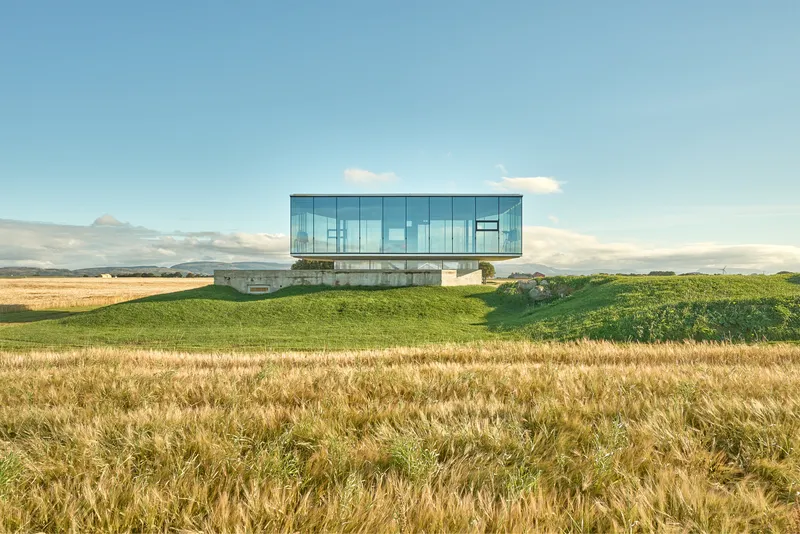
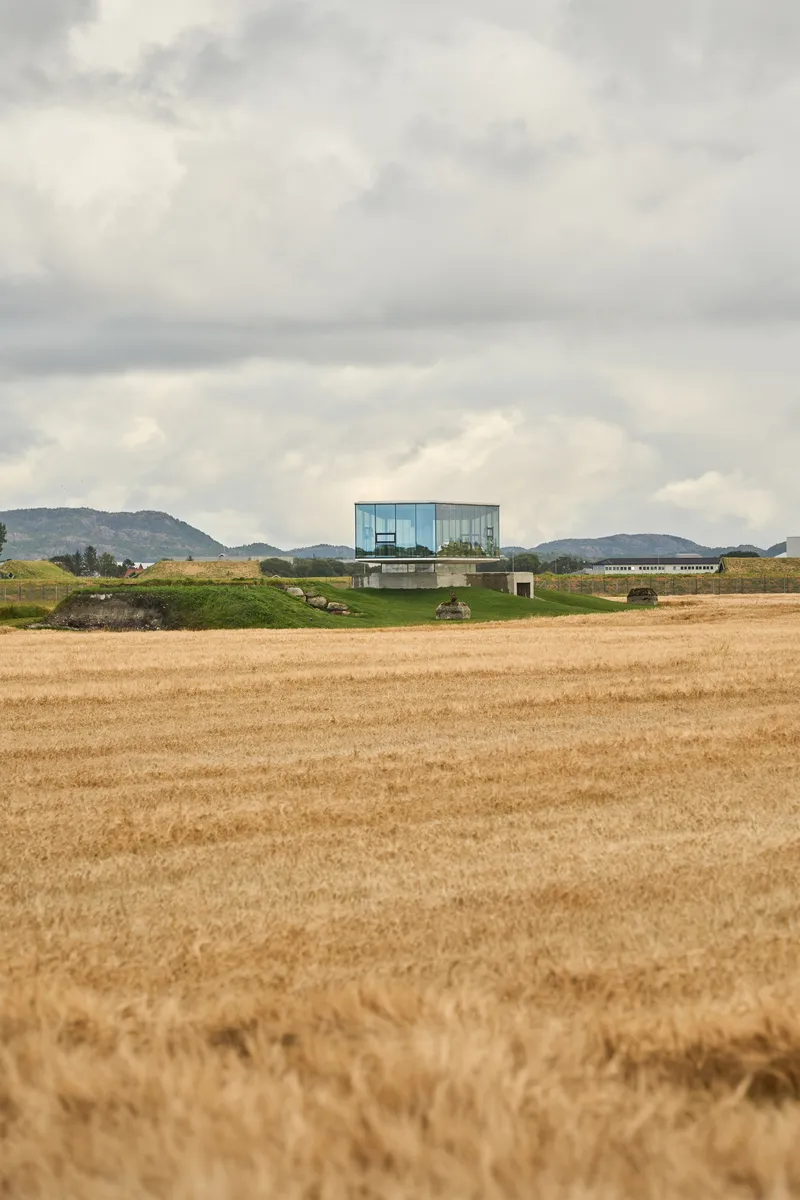
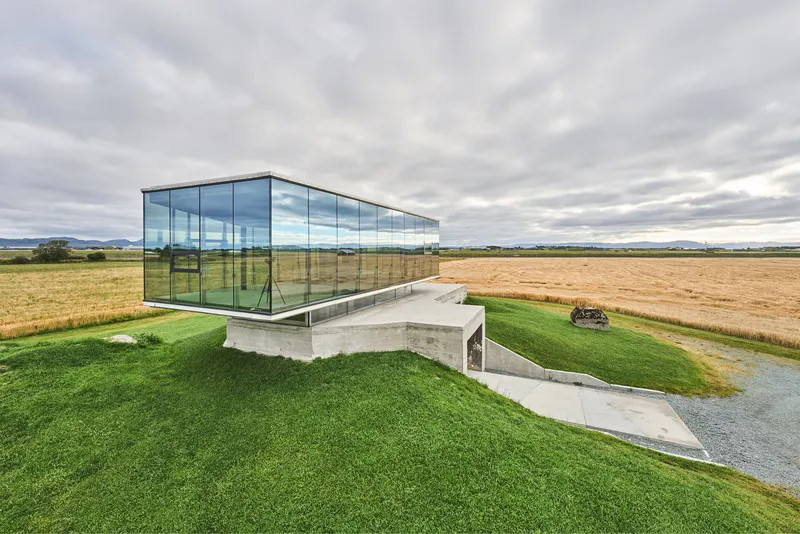
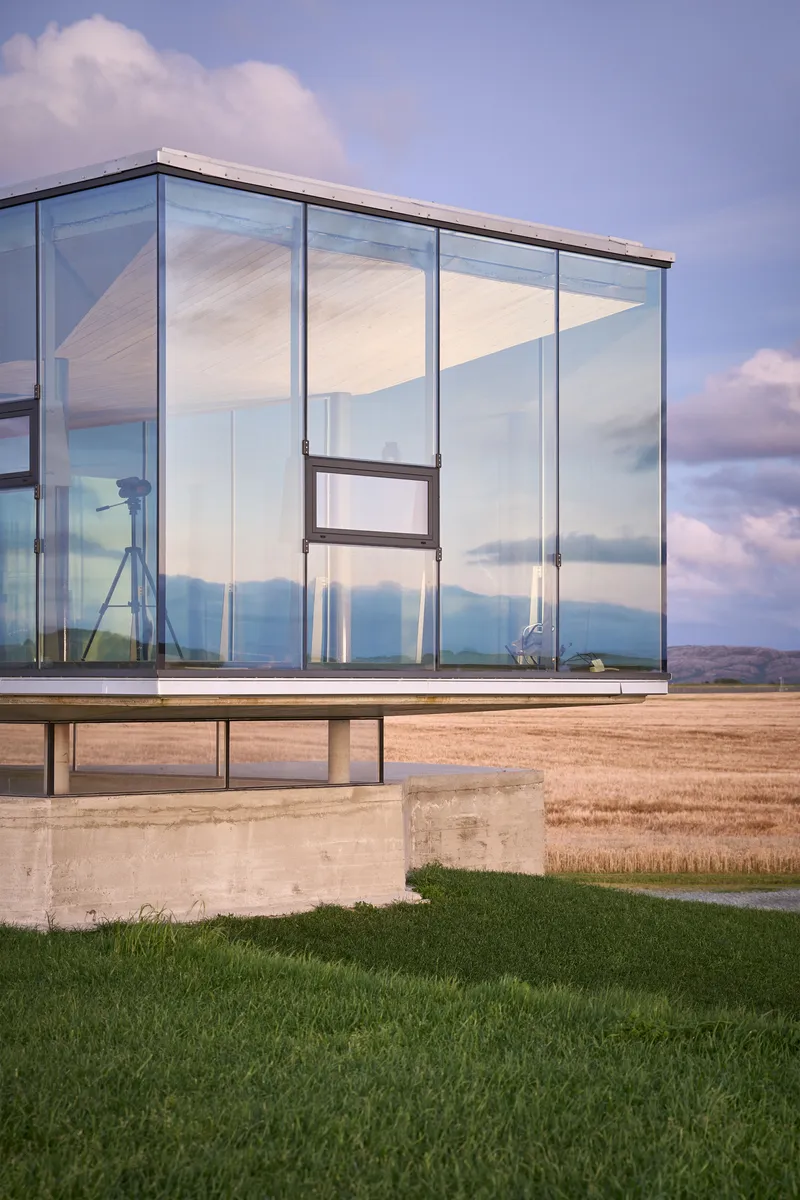
Seen from a distance, the pavilion barely registers as architecture. It sits in a sea of harvested wheat, a thin horizontal line catching light above a grass-covered berm. The proportions are carefully tuned: the glass volume is wide enough to assert itself as a built object but slender enough that it reads as a controlled gesture rather than an imposition. The cantilever over the berm is the key formal move, pulling the pavilion out into space beyond its heavy base and reinforcing the sense that the new volume is tethered to, but fundamentally different from, its substrate.
Under heavy cloud cover, the building becomes almost spectral, a faint luminous band above the agricultural plain. At dusk, it glows. The landscape here, caught between the Norwegian Sea to the west and the Trondheimsfjord to the east, is expansive and flat, and the architects wisely refused to compete with it. The building's power lies in its restraint.
The Bunker Below
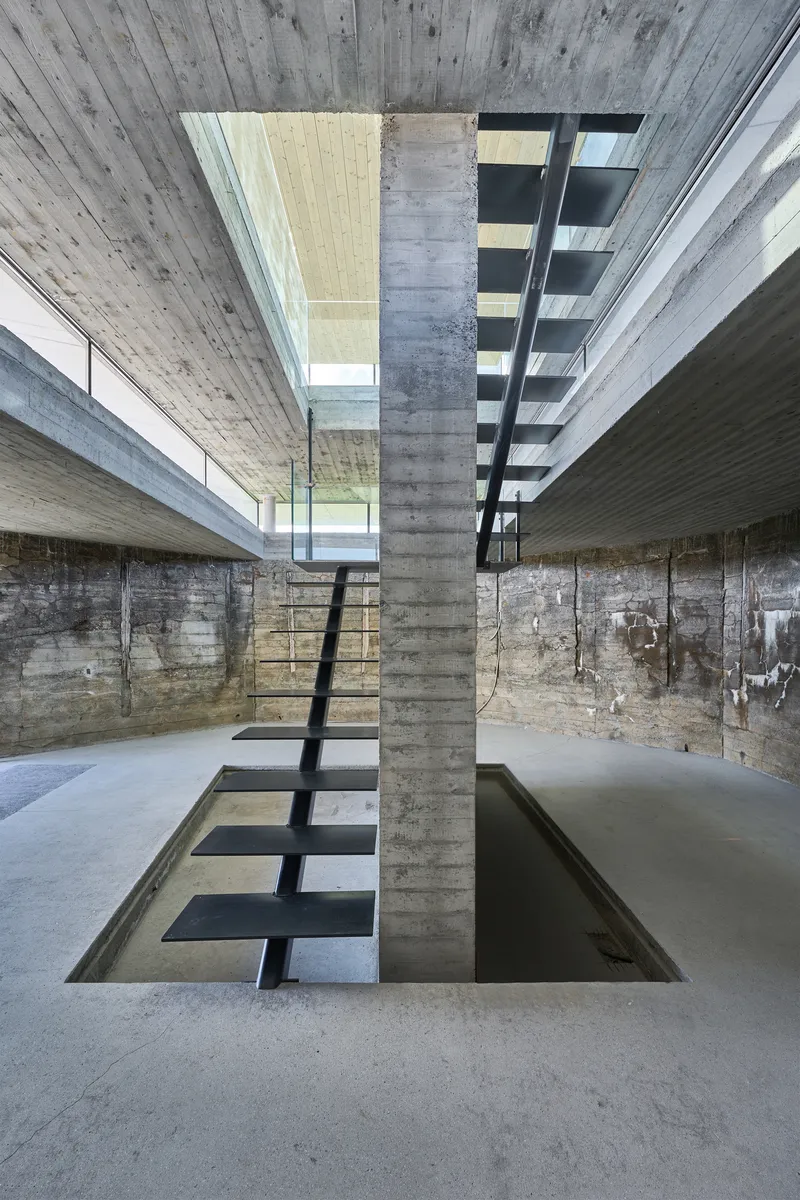
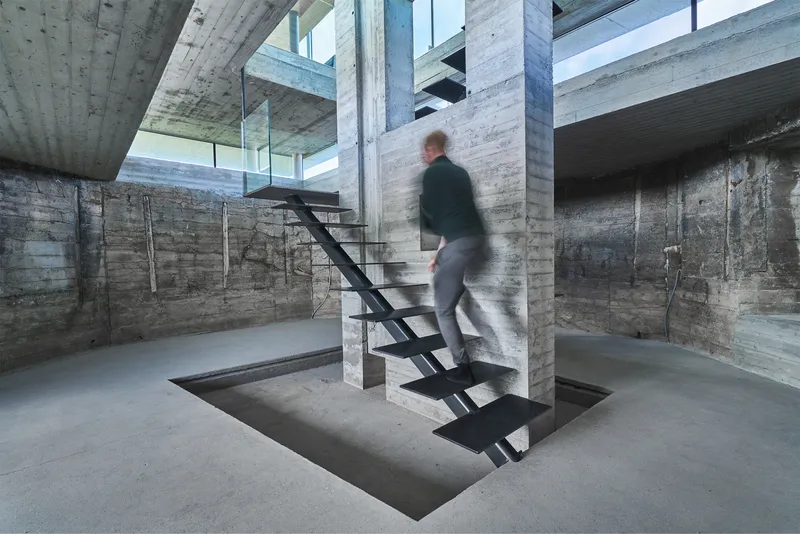
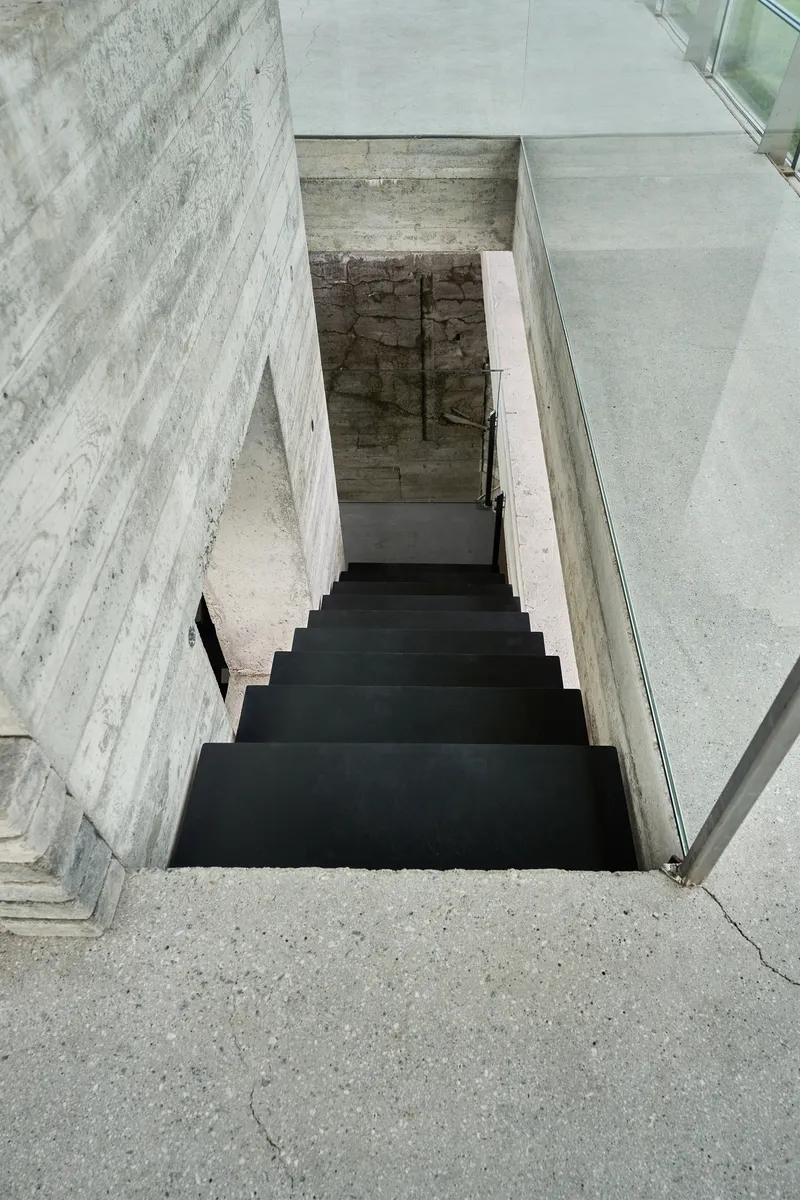
Descending into the lower level is like entering a different building, and in a real sense, you are. The original bunker's board-formed concrete walls have been preserved with their raw texture intact, creating a subterranean atmosphere that is dense, haptic, and deliberately solemn. A black steel staircase wraps around a column, connecting the levels with a sculptural precision that contrasts with the rough walls enclosing it. Water fills a void at the base of one stair run, introducing a reflective element that softens the military austerity without erasing it.
The decision to leave these surfaces largely untreated is critical. Too many adaptive reuse projects sand down their predecessors until the original character is merely decorative. Here, the weight and texture of the concrete are allowed to speak. The bunker was a serious structure built for serious purposes, and the lower level respects that without fetishizing it.
Glass, Timber, and the 360-Degree View
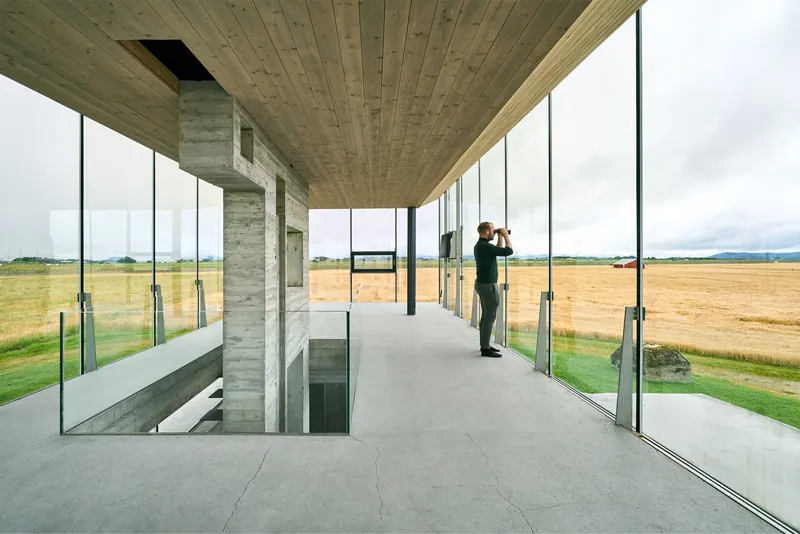
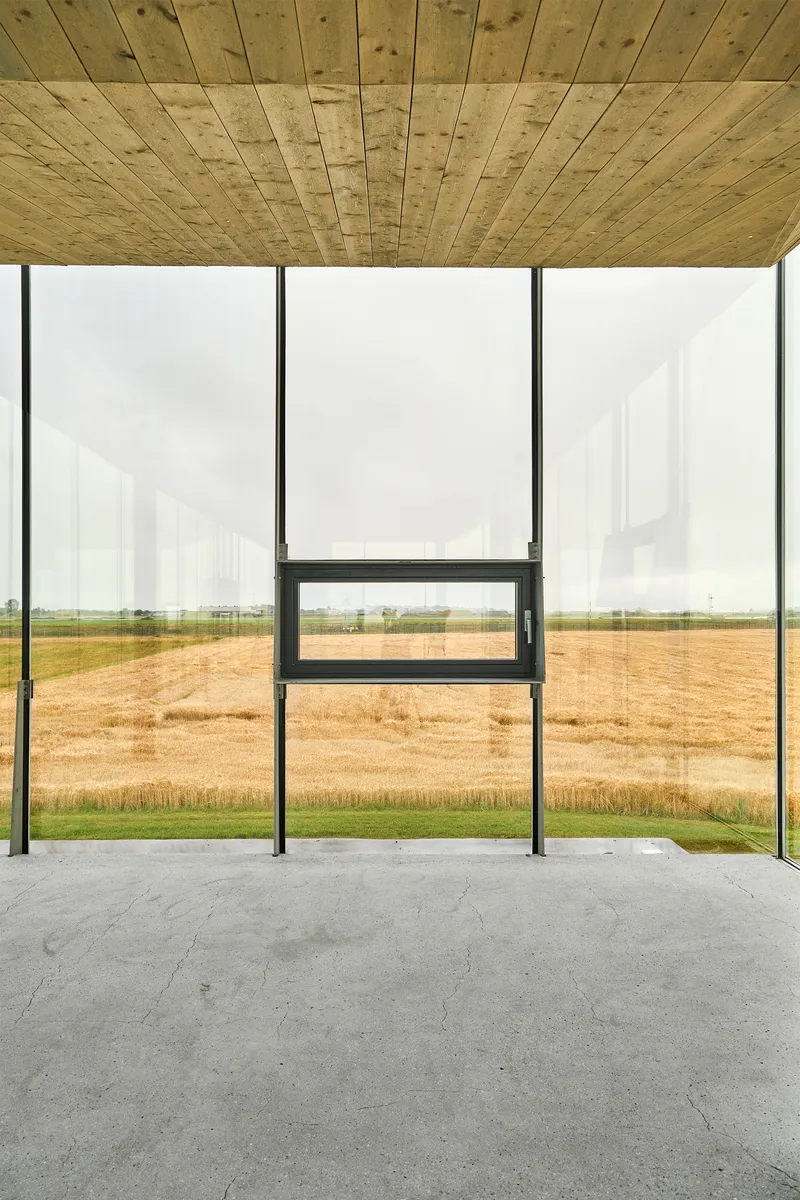
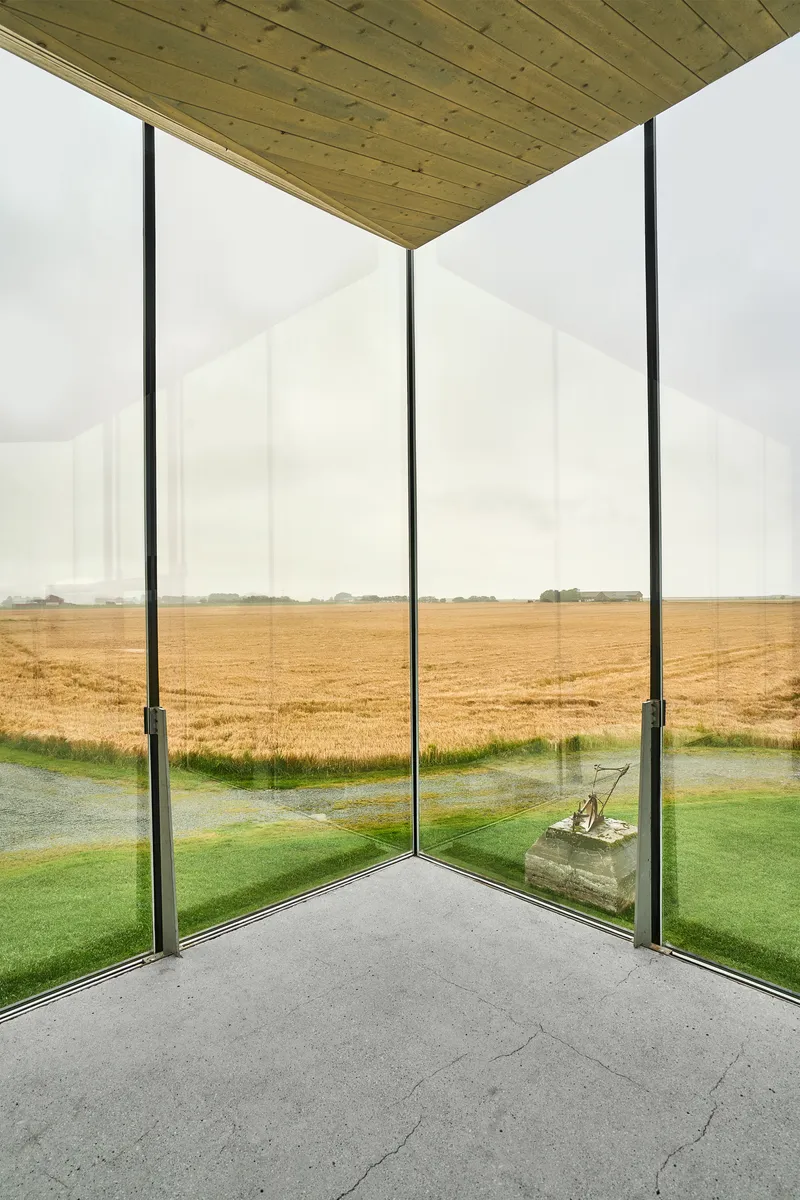
The upper pavilion is everything the bunker is not. Floor-to-ceiling glass wraps the perimeter, offering an unbroken 360-degree panorama of farmland, wildlife, and the distant air base. A timber plank ceiling introduces warmth overhead, its natural grain and color moderating what could otherwise feel clinical. The plan is open and deliberately non-prescriptive: the space is designed to accommodate lectures, social events, and private gatherings with minimal reconfiguration.
What sells the interior is the relationship between the timber ceiling and the glass walls. The ceiling plane compresses the vertical dimension just enough to frame the landscape as a continuous horizontal band, pulling your eye outward. A figure standing at the glass reads almost as a silhouette against the fields beyond, reinforcing the project's central duality of observation and exposure.
Detailing the Transition
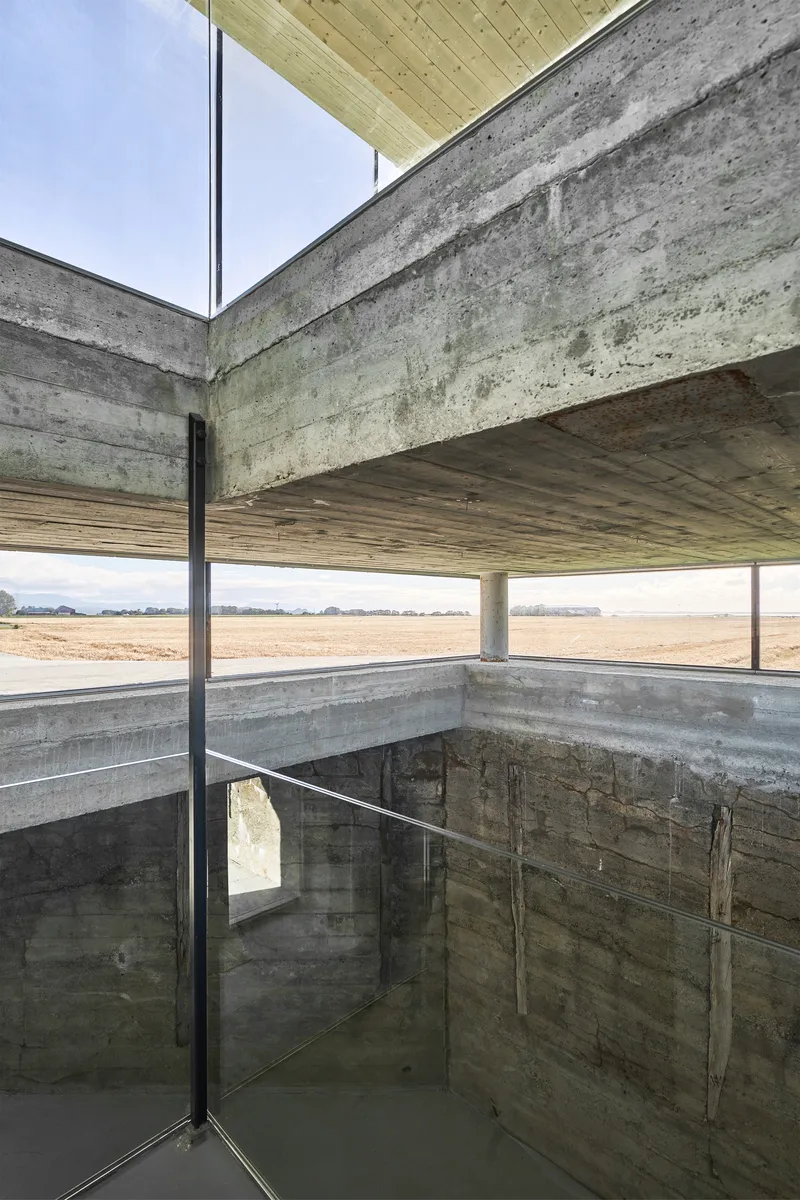
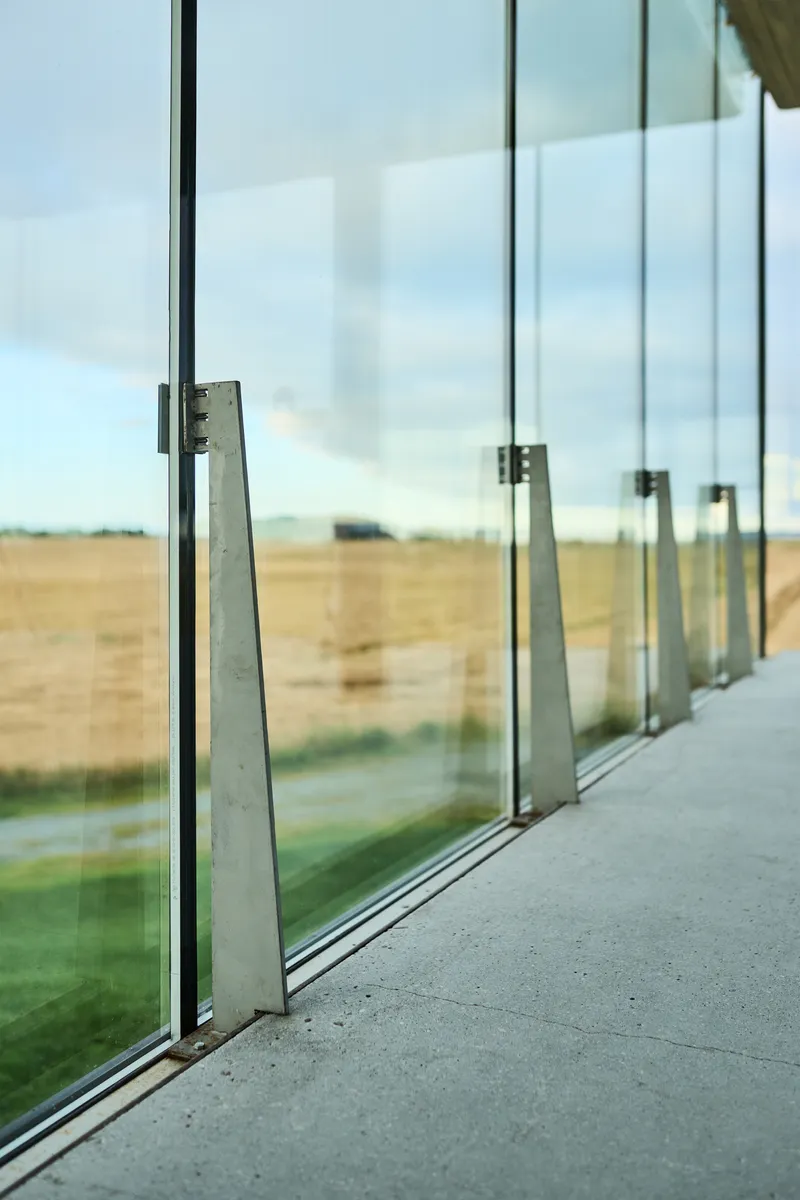
The most architecturally demanding moments in any adaptive reuse project are the joints: the places where new meets old, where one material system hands off to another. ASAS arkitektur handles these transitions with admirable clarity. At the corner glazing junctions, frameless glass meets board-formed concrete and timber ceiling with minimal framing, allowing each material to maintain its own logic. Angled steel brackets at the floor track support the curtain wall with a legible, almost didactic honesty about how the loads are transferred.
The steel column at the corner, where two glass planes meet above the golden landscape and a reflecting pool below, is a moment worth pausing on. It concentrates the project's structural and conceptual ambitions into a single detail: transparency, lightness, and the precise engineering required to achieve both.
Dusk and the Inverted Fortress
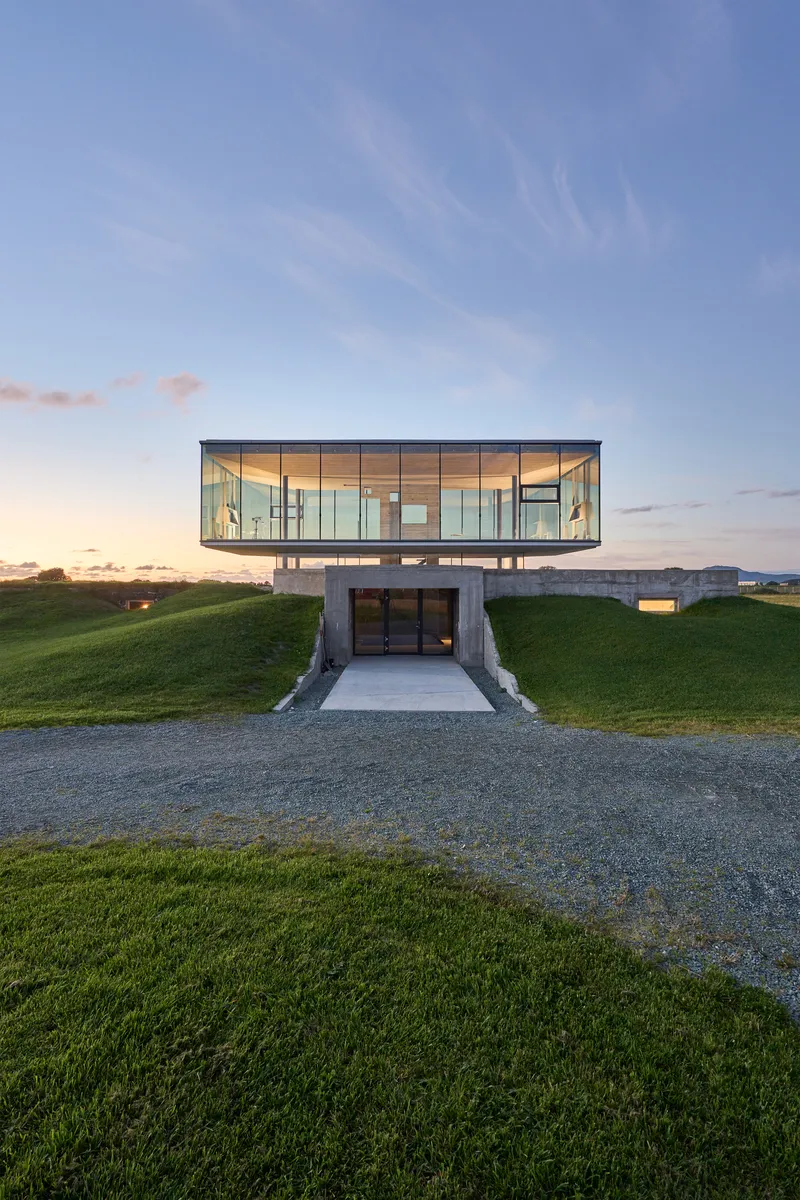
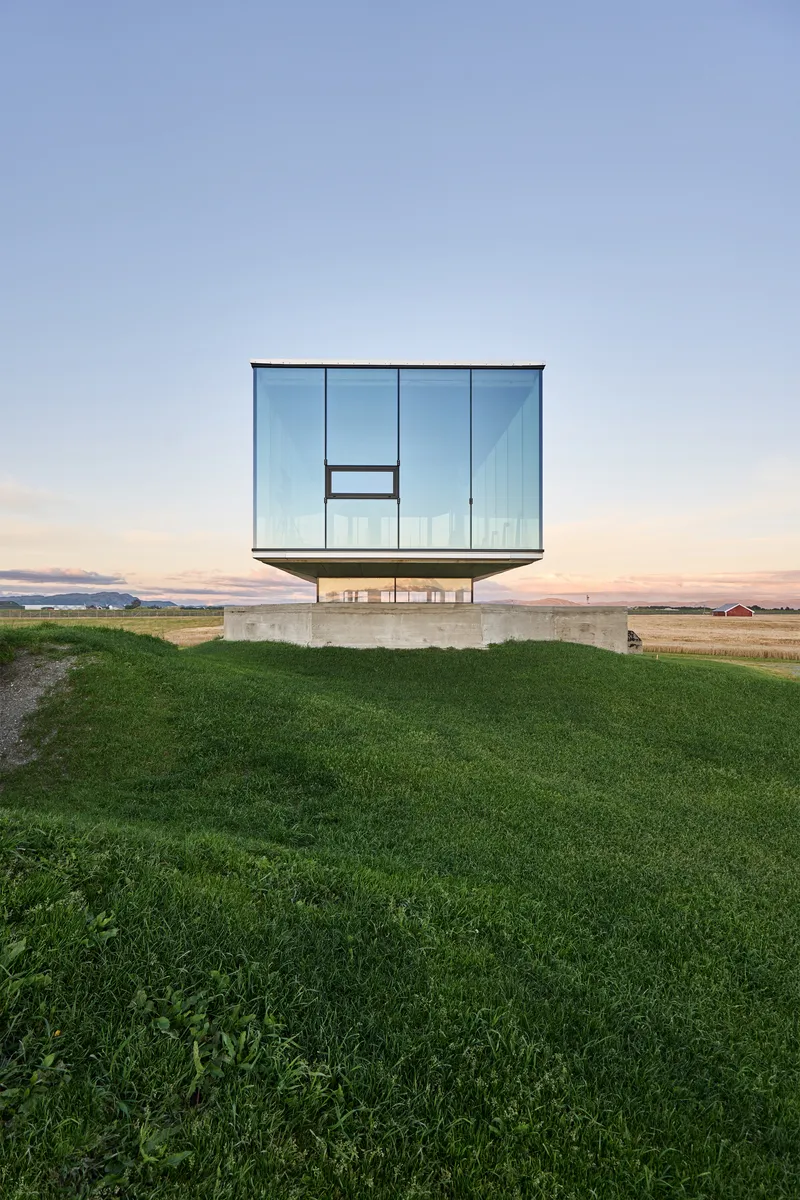
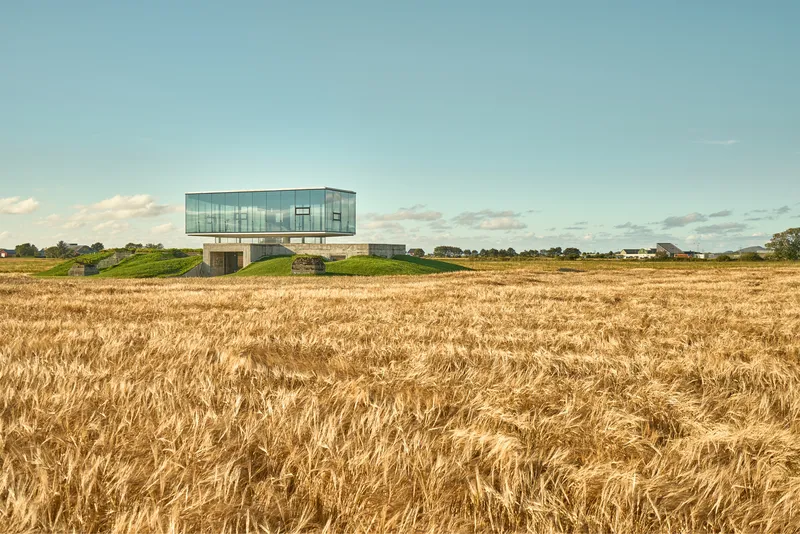
The building is most powerful at dusk. As natural light drains from the sky, the glass volume begins to emit its own, turning the pavilion into a lantern above the recessed concrete entrance. The pilotis supporting the glass box become visible as discrete structural elements, and the cantilever reads with maximum drama against the darkening berm. The frontal view is almost totemic: a luminous rectangle floating above a slit of shadow.
There is a deliberate irony here. The bunker was built to be invisible, to disappear into the landscape and project force outward through a concealed cannon. The pavilion inverts that logic entirely. It announces itself, draws the eye, and invites approach. The transformation is not just functional but symbolic: a closed fist opened into an outstretched hand.
Plans and Drawings
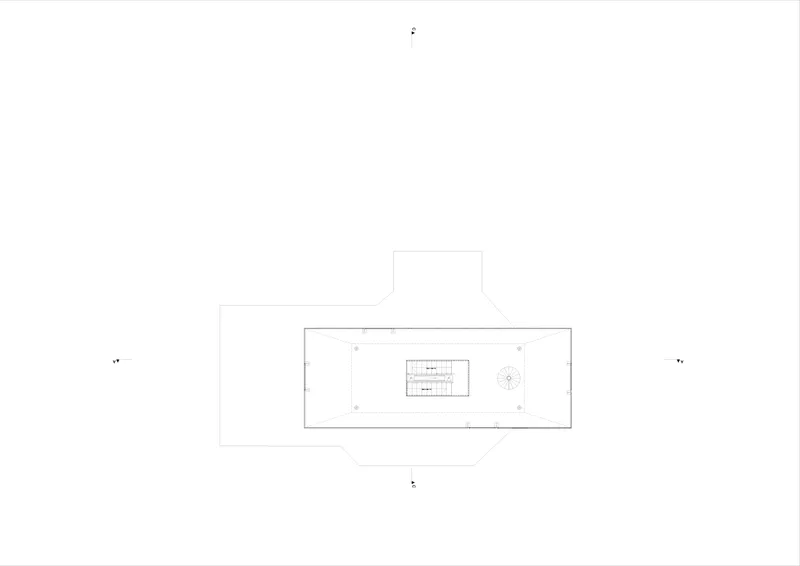
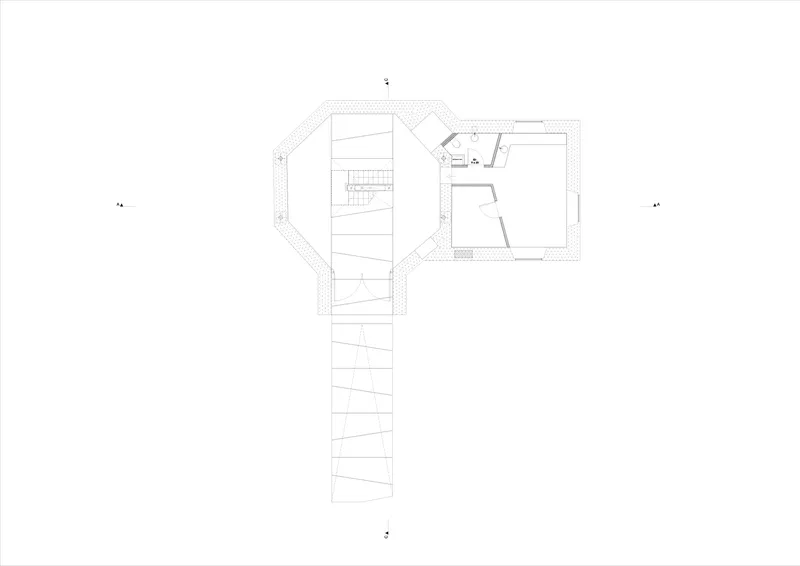
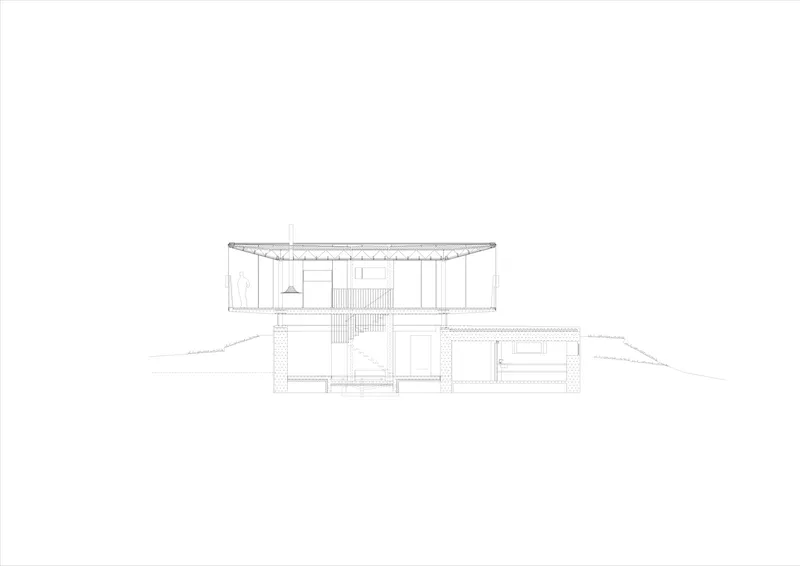
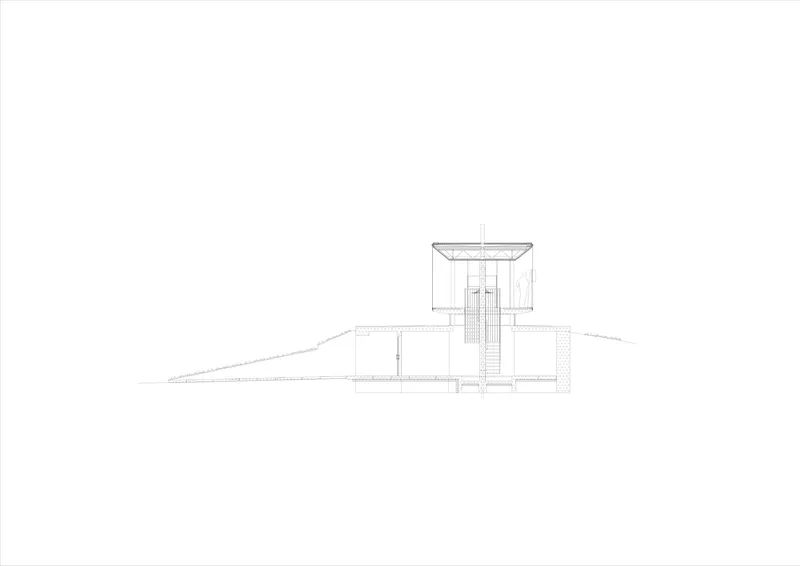
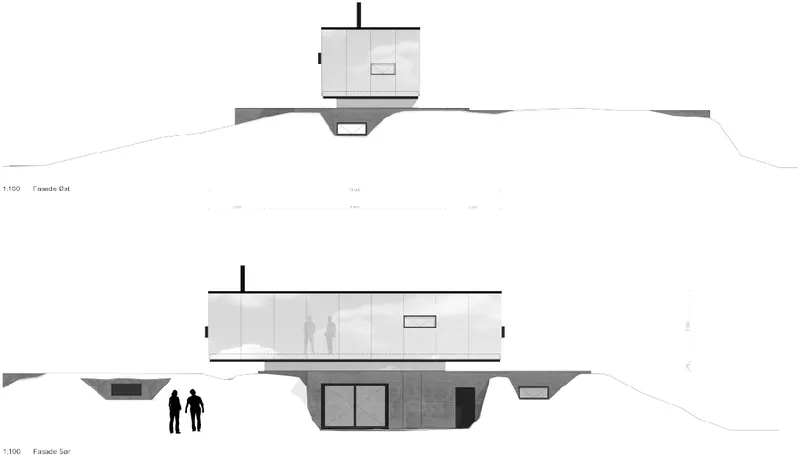
The site plan reveals the bunker's footprint as a rectangular volume with a central courtyard and entrance tower, the new pavilion floating above like a displaced lid. The floor plan shows a linear arrangement that separates circulation (stair core) from two distinct spatial zones on the upper level, keeping the flexible events space as uninterrupted as possible. The sections are the most revealing drawings: the split-level relationship between the buried bunker and the elevated glass box becomes legible, as does the way the building nestles into the sloping terrain on the east and west sides while projecting boldly from the north and south.
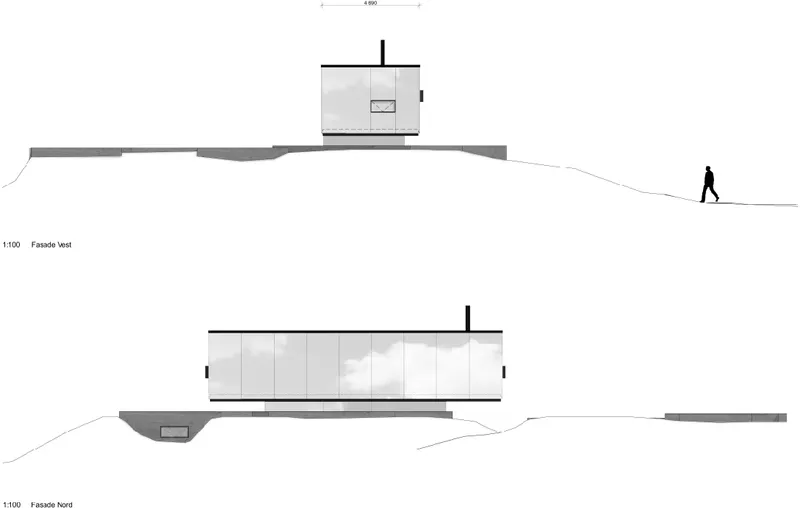
The elevation drawings confirm the formal strategy. From the north and south, the building reads as a precise cubic volume with a chimney providing a vertical accent. From the east and west, the hillside integration becomes the dominant story, with the glass box appearing to slide out from the landscape. The human figures in scale reinforce just how compact the 137 m² footprint is, making the building's visual presence across the open terrain all the more remarkable.
Why This Project Matters
Pavilion Brekstad succeeds because it takes a clear conceptual position and executes it without equivocation. The bunker is preserved as bunker, the pavilion is asserted as pavilion, and the dialogue between the two is conducted through material contrast, spatial inversion, and the careful management of weight and light. In a field crowded with adaptive reuse projects that either erase their predecessors or treat them as stage sets, this building maintains the dignity of both eras.
It also demonstrates that powerful architecture does not require a large footprint. At 137 m², the pavilion punches far above its size, commanding an entire landscape through proportion, siting, and the audacity of placing the most transparent possible volume atop the most opaque possible base. For ASAS arkitektur, this is a project that crystallizes a set of ambitions, about history, visibility, and the relationship between architecture and the land it occupies, into a single, legible built statement.
Pavilion Brekstad by ASAS arkitektur (Lead architects: Ola Spangen, Grimur V. Magnusson, Dag Spangen, Katrine Aursand, Tove E. Andersen, Elisabeth Krogh). Located in Brekstad, Norway. 137 m². Completed 2022. Photography by Kristoffer Wittrup.
About the Studio
Share Your Own Work on uni.xyz
If projects like this are the kind of work you want to make, uni.xyz is a place to publish your own, find collaborators, and enter design competitions.


Popular Articles
Popular articles from the community


FCC Arquitectura Expands a Portuguese Granite House with a Board-Marked Concrete Wing
In Portugal, JV House pairs a cleaned-up whitewashed and granite dwelling with a timber-shuttered concrete extension, courtyards and a garden pool.


The Amber Palace Opera: A Geological Fiction Surfaces on Tallinn's Baltic Waterfront
Pierre Brillard reimagines a Baltic legend as a public landscape, opera house, and waterfront promenade rooted in Tallinn's coastal identity.

Opera on the Sea: Driftwood Logic Shapes a Timber Opera House on Estonia's Coast
Trevor Orgill's opera house translates the entangled drift of floating timber into a civic building where wood, water, and music converge.

Cube Design Draws an Ecological Corridor Between Two Shenzhen Hills with the Nankai Building
Beside Shenzhen's container docks, the Nankai Building pairs stacked balconies with a climbing green screen to connect two hillsides across its height.

Similar Reads
You might also enjoy these articles

LAVA Architecten Gives Vocational Education a Sawtooth-Roofed Face on a Mechelen School Campus
In Mechelen, Belgium, a 2,053 m² STEM school on a 6×6 m grid turns workshops and classrooms into rooms that can be rearranged as teaching changes.

KEMA Studio Turns a Derelict Marvila Attic into a 60 m² Lighthouse Apartment Above Lisbon
In Lisbon's Marvila district, a rebuilt roof, four skylights and two plywood volumes turn an unlivable attic into a bright home facing the Tagus.

Pixel Gardens: One Repeated Module Stacked Into a Terraced Social Housing Tower for Famagusta
Salem Bader's shortlisted housing tower builds a vertical neighbourhood from one repeated module, offsetting units to carve terraces, light and air.

Bao Huynh Watercolor Atelier: A Serene Art Retreat in Hội An
Bao Huynh Watercolor Atelier in Hội An blends multifunctional art spaces, sustainable design, local materials, and family-friendly living in a serene environment.

Explore Pavilion Competitions
Discover active competitions in this discipline

Challenge to design a portable theatre

Challenge to design a portable music platform

Challenge to design an open learning module for the elderly
Comments (0)
Please login or sign up to add comments
No comments yet. Be the first to comment!