
aste arquitectura Restores a Century-Old Granite House in a Portuguese Hill Village
In Vale de Cambra, a careful refurbishment strips back decades of clumsy alterations to reveal a domestic architecture of stone, timber, and pale green.


Villages in northern Portugal's hilly interior are made of granite. The stone is everywhere: in retaining walls, in barn floors, in the faces of houses that have stood for a century without fuss. When one of those houses needs saving, the temptation is either to gut it entirely or to freeze it in amber. aste arquitectura's Gueira House, completed in 2021 in the parish of Felgueira near Vale de Cambra, does neither. It addresses the structural damage left by careless 1970s additions, reorganizes a 134-square-meter interior across two split levels, and introduces a restrained material palette that feels neither nostalgic nor alien.
What makes the project worth studying is its discipline. The original early-twentieth-century house sits at the southern edge of its plot, its two floors following the gradient of the street. Rather than expand the footprint or compete with the granite envelope, the architects worked inward: new timber floors, new stairs, a skylit kitchen, and a courtyard with a small pool. The exterior remains a village house. The interior becomes something quieter and more precise.
A Granite Face on a Village Street
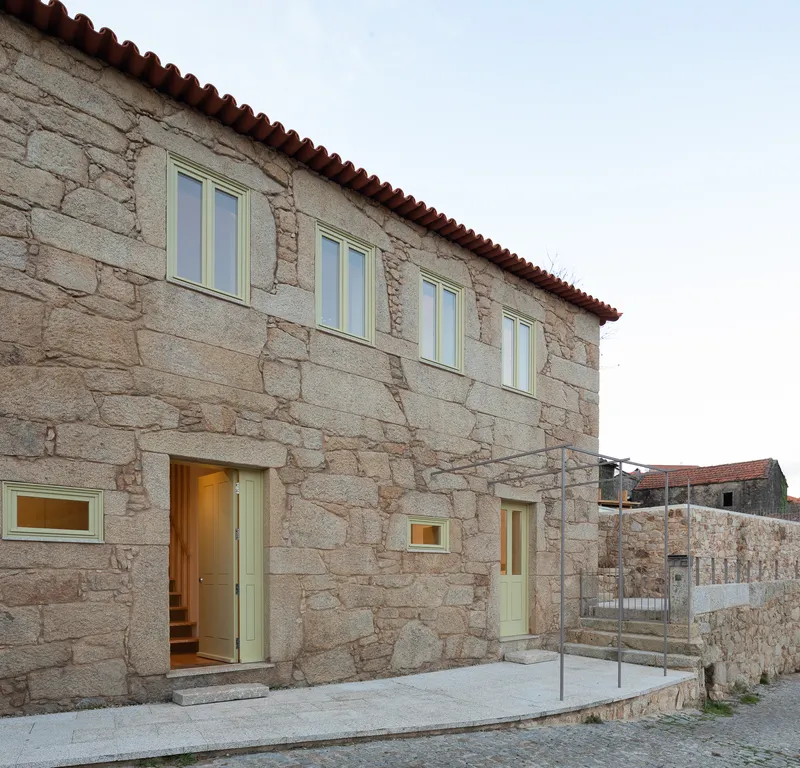


The street facade is the project's public argument. Thick granite masonry, red clay roof tiles, and pale green timber windows compose a front that is unmistakably local. Cows wander past on cobblestones. The palette of stone and muted color lets the house sit among its neighbors without drawing attention to itself. That reticence is the point: refurbishment here means returning a building to its street, not extracting it from context.
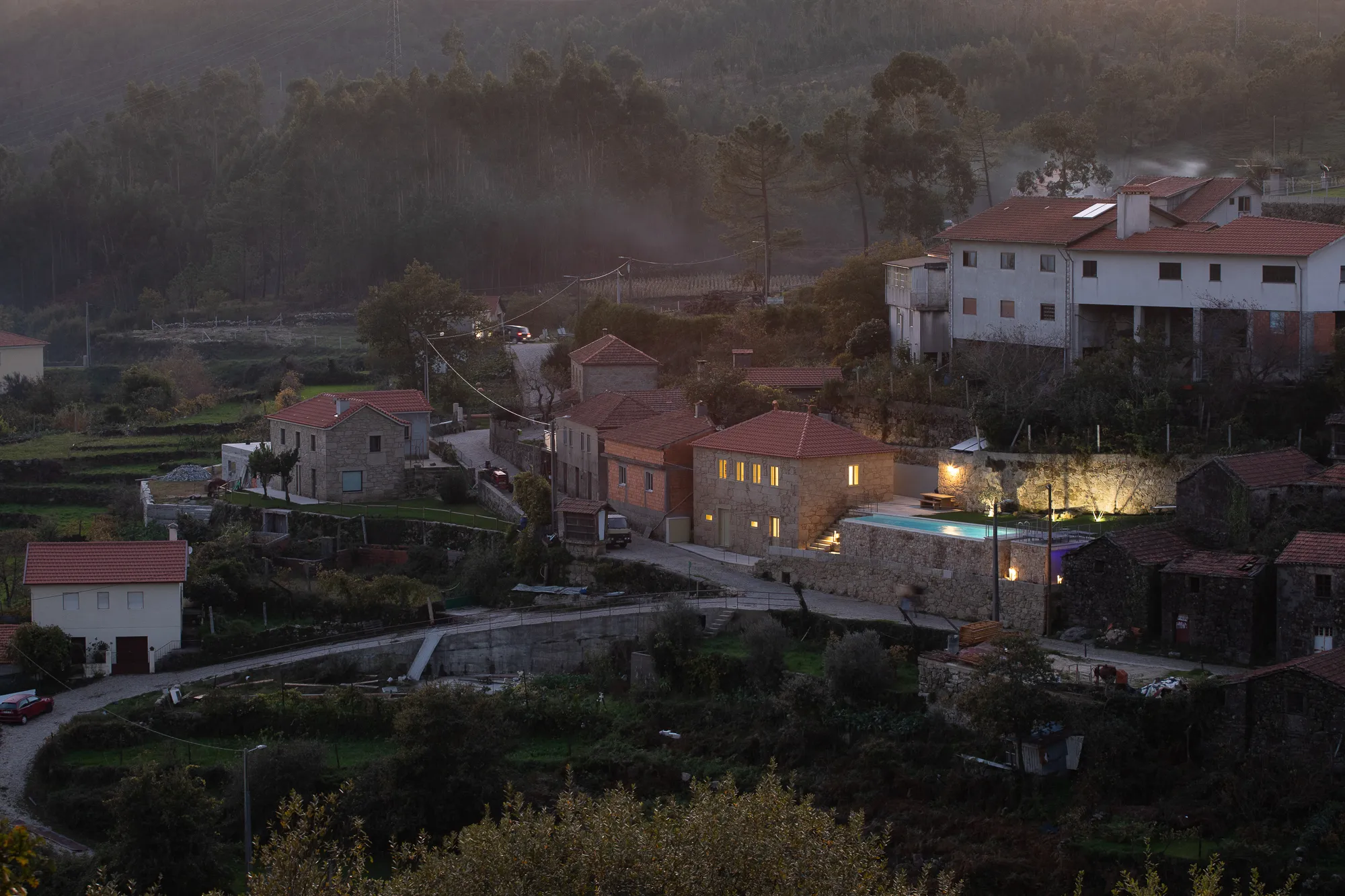
At dusk, the warm interior light behind those green frames reveals the depth of the stone walls, a thickness that speaks to a construction logic predating insulation boards and cavity walls. The 1970s alterations that expanded the house to the northwest at the second floor introduced structural pathologies. aste arquitectura's task was partly surgical: remove the damage, stabilize the masonry, and let the original proportions breathe again.
The Village as Context
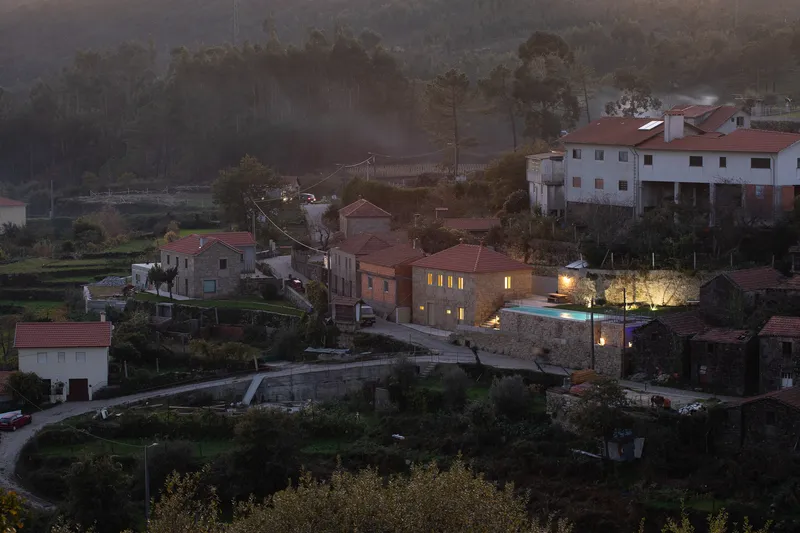

A dusk photograph from across the valley shows Gueira House glowing among a cluster of stone buildings on a misty hillside. It is a useful reminder that this is not a standalone object. The house belongs to a fabric of shared walls, terraced gardens, and narrow lanes. Any intervention that ignored that proximity would fail.
The entry sequence reinforces the relationship to the street. A pale green timber door is set flush into the granite wall, reached by stone steps with a simple metal railing. There is no grand gesture, no cantilevered canopy. You step off the cobblestones and you are inside. The threshold is matter-of-fact, as it should be in a village house where the boundary between domestic and civic life has always been thin.
Timber, Light, and the Pale Green Palette


Inside, the material register shifts cleanly from stone to timber. The open-plan kitchen and dining area is lined in warm timber cabinetry and flooring, with a white ceiling that bounces light from a generous skylight. The palette never shouts. Natural wood grain, white plaster, and that recurring pale green in the window frames and joinery hold the rooms together without the need for ornament.
The living area feels generous for a 134-square-meter house, thanks to the open plan and to the architects' restraint with partitions. A grey sofa, a timber dining table, warm artificial lighting at night: these are rooms designed for occupation, not photography. The bedroom, by contrast, is deliberately compact, its single green-framed window opening onto hillside vegetation. The view is the only decoration the room needs.
A Staircase as Spatial Connector
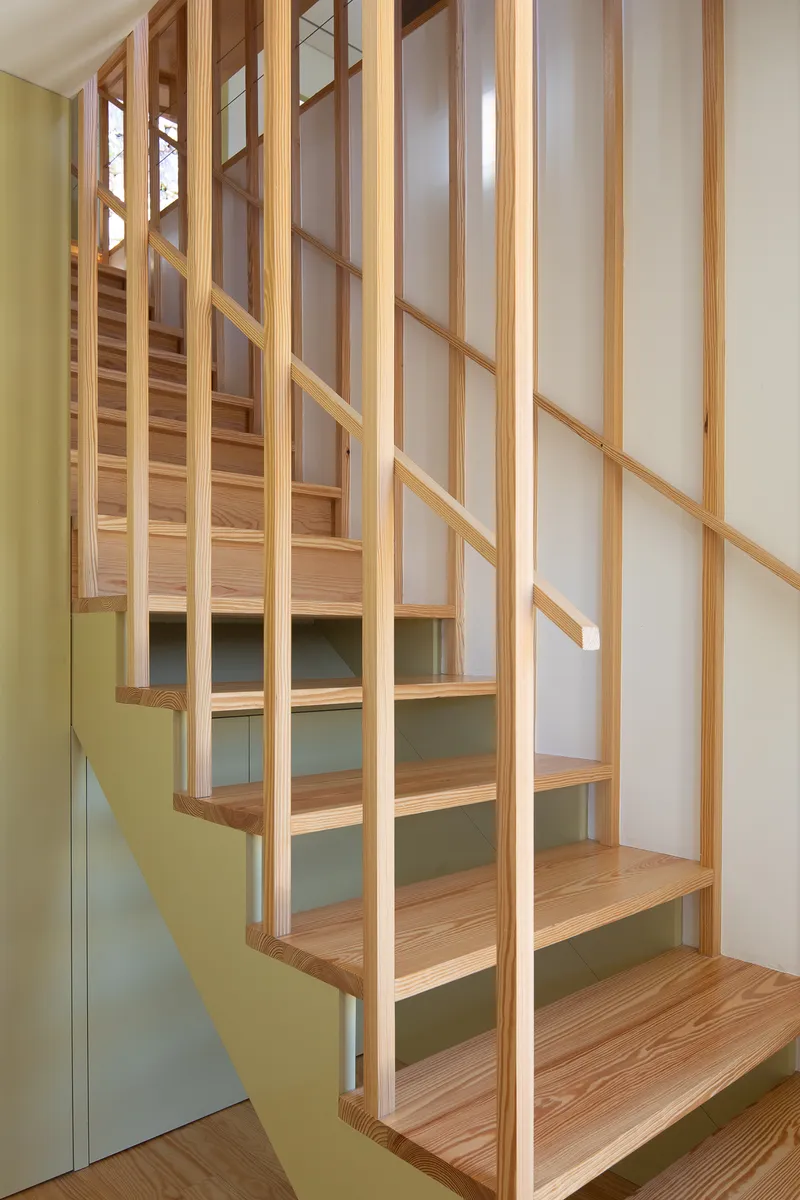


The new staircase is the most architecturally assertive element in the house, and even it is quiet. Open timber treads with vertical slatted balustrades thread between the two levels, allowing light and air to pass between floors. The slats echo the rhythm of the exterior shutters, a subtle formal consistency that ties inside to outside.
Beneath the treads, a pale green built-in cabinet and wall panel turn the residual space into something useful and composed. From above, looking down through the floor opening, the stair reads as a piece of furniture inserted into the stone shell. It is precise joinery rather than architectural bravado, and it sets the tone for the whole project.
Detail and Domesticity

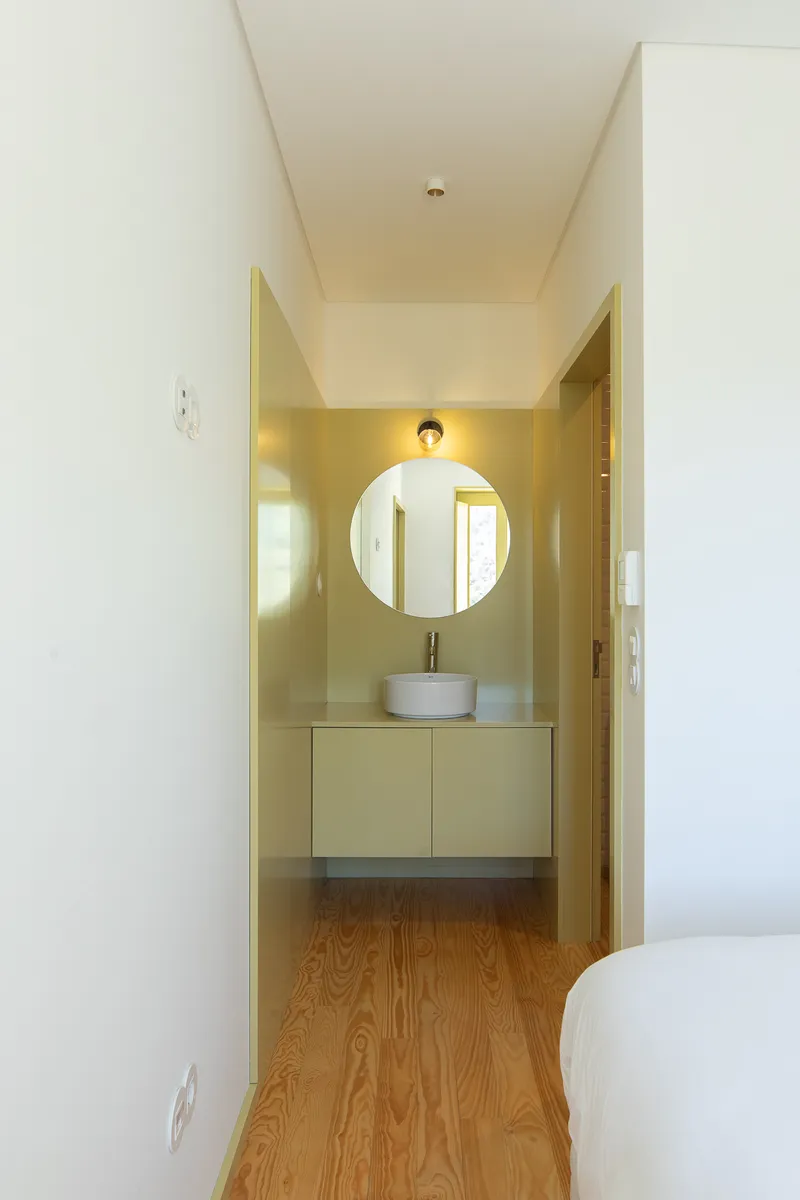
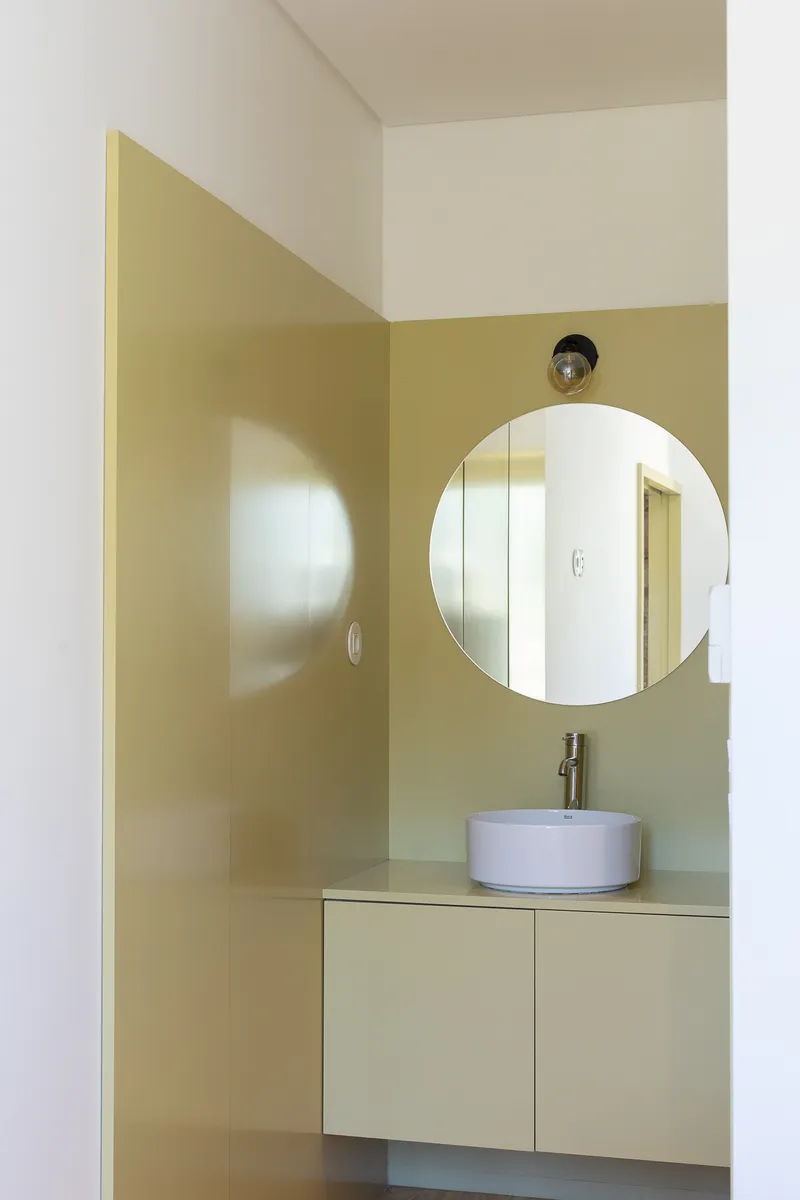
The details confirm the care. A framed photograph on the stairwell wall, a round mirror above a vessel sink, pale green tiles in the bathroom: each element is chosen, not defaulted to. The bathroom, accessed through a narrow corridor, is compact but not cramped. The circular mirror and simple basin lend the room a deliberate geometry.
Domesticity here is not an afterthought bolted onto an architectural concept. It is the concept. aste arquitectura seems to understand that a house in a village like Felgueira will be lived in for decades, passed between generations, and judged by whether the kitchen works and the bedroom stays warm. The pale green palette will age with the stone. The timber will patina. The architecture is designed to last, not to trend.
Plans and Drawings

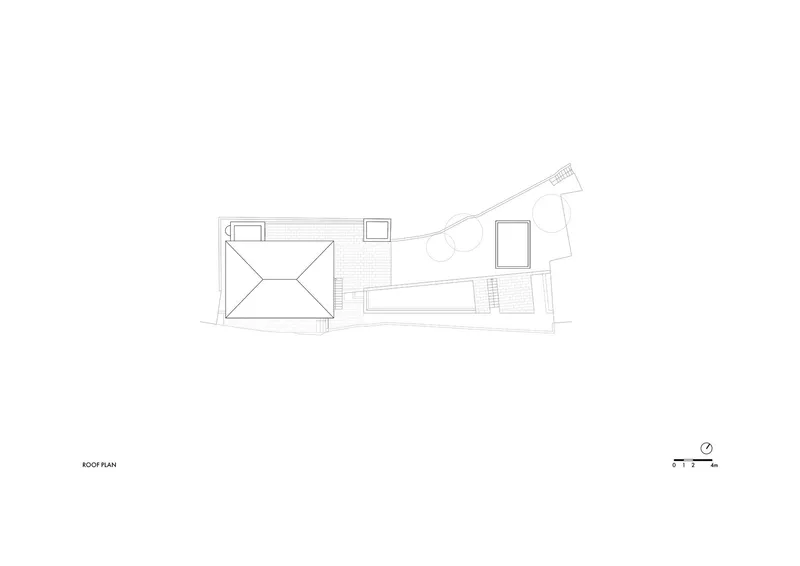
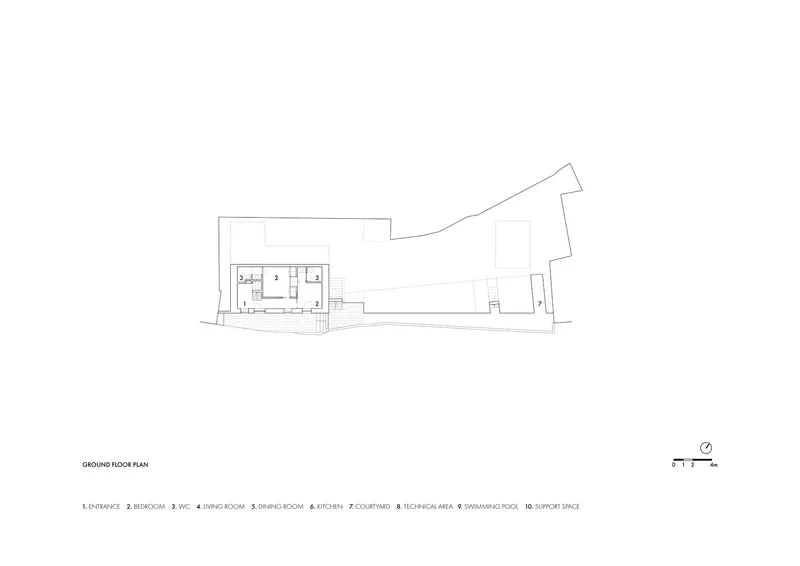

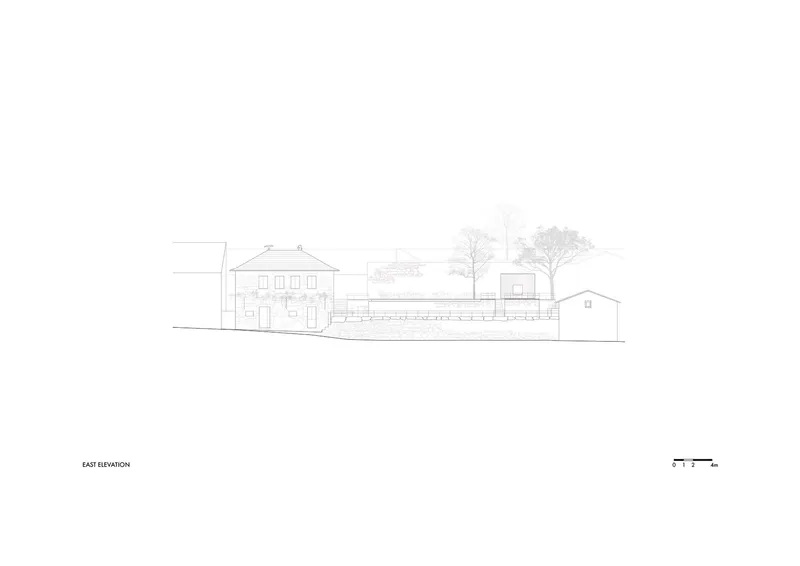
The plans reveal the spatial logic behind the split-level arrangement. The ground floor holds a bedroom, living room, dining room, kitchen, and a courtyard with a pool at the rear. The first floor repeats the living and kitchen program alongside an additional bedroom and water closet, reflecting the two-entrance, two-level organization dictated by the sloping street. The site plan shows the house embedded among adjacent structures, its footprint compact and irregular.
The east elevation drawing is instructive. It shows a two-story house flanked by lower adjoining volumes, with trees drawn to scale. The roofline steps modestly, and no element projects beyond the village silhouette. The pyramid roof and flat-roof areas visible in the roof plan suggest a pragmatic approach to drainage and structural clearance rather than any formal ambition.
Why This Project Matters
Portugal's interior villages are losing population. The houses that remain are often altered without care or left to collapse. Projects like Gueira House demonstrate that sensitive refurbishment can return a building to use without erasing its history or inflating its ambitions. The 1970s additions caused structural damage; the 2021 intervention repaired it and reorganized the interior for contemporary life. That is a modest but essential service.
aste arquitectura's achievement is one of calibration. The pale green is distinctive without being eccentric. The timber interiors are warm without being rustic. The granite walls are preserved without being fetishized. In a discipline that often rewards spectacle, Gueira House reminds us that architecture can be effective precisely when it refuses to shout.
Gueira House by aste arquitectura, Vale de Cambra, Portugal. 134 m², completed 2021. Photography by José Campos.
About the Studio
Share Your Own Work on uni.xyz
If projects like this are the kind of work you want to make, uni.xyz is a place to publish your own, find collaborators, and enter design competitions.



Popular Articles
Popular articles from the community


Conexión: Biophilic Design Reimagines High-Rise Living in Hong Kong
Conexión reimagines high-rise living in Hong Kong through biophilic design, green facades, shared spaces, daylight, water and nature within.

AL-JANNAH: Sustainable Architecture and Permaculture for Afghan Widows
AL-JANNAH uses sustainable architecture and permaculture to create resilient oasis of housing, learning, work and renewal for Afghan widows.

The Musturak Paradise: Senior Living Architecture for a Connected Future in Temara, Morocco
The Musturak Paradise reimagines senior living architecture in Temara via private homes, social spaces, culture, community, and shared care.

Co-life: Sustainable Architecture for Age-Friendly Community Living
Co-life reimagines sustainable architecture for seniors through courtyards, rammed earth, shared gardens, and spaces designed for belonging.


Similar Reads
You might also enjoy these articles

Bao Huynh Watercolor Atelier: A Serene Art Retreat in Hội An
Bao Huynh Watercolor Atelier in Hội An blends multifunctional art spaces, sustainable design, local materials, and family-friendly living in a serene environment.

Atelier Macri Concept Store Interior Design by CASE-REAL
Atelier Macri store features a "ko" counter, walnut wood details, cork displays, blending retail, gallery, and seamless customer experiences.

Manuel Vargas Izquierdo Stadium and High-Performance Sports Center: Architectural Excellence in Jalpa de Méndez
The Manuel Vargas Izquierdo Stadium blends sustainable design, inclusive sports facilities, and cultural-inspired architecture, revitalizing Jalpa de Méndez’s public spaces.

KAKR Buluh Awar Hall: Revitalizing Community and Ecology Through Bamboo Architecture
Community built bamboo hall revitalizes Buluh Awar village, empowering youth, restoring ecology, celebrating vernacular craftsmanship through sustainable architecture and culture.


Explore Vernacular Architecture Competitions
Discover active competitions in this discipline


Challenge to design luxury tourism on rails


VR headsets Storefront design competition


Designing a staircase for a client
Comments (0)
Please login or sign up to add comments
No comments yet. Be the first to comment!