
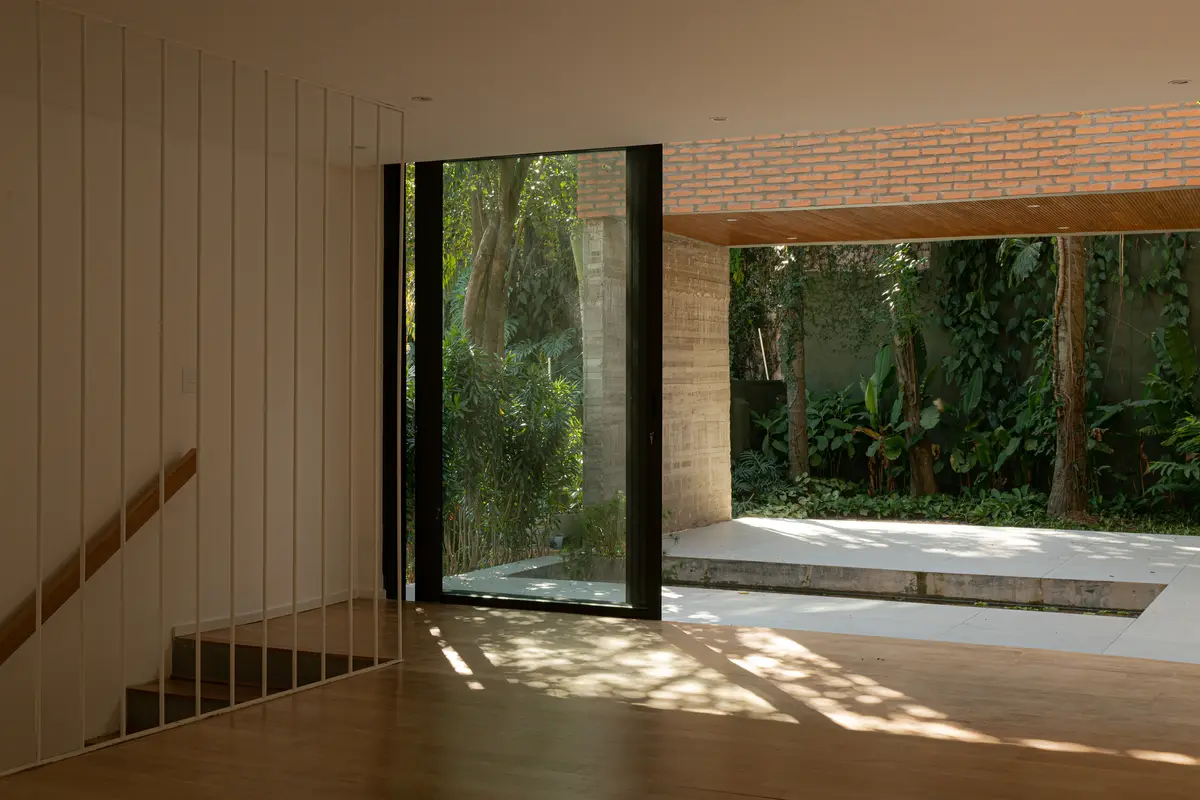
Ateliê Amanhã Carves Precise Voids into a São Paulo Hillside House to Frame Its Fruit Trees
Tamanás House uses strategic cuts through brick and timber volumes to weave 490 square meters of living space into a sloped, tree-filled lot.


Most houses on sloped lots treat the grade change as a problem to solve. Ateliê Amanhã treats it as the entire premise. Tamanás House, a 490 square meter residence completed in 2025 on a tree-lined hillside in São Paulo, distributes its program across four stacked floors not to maximize square footage but to position each room at the precise altitude where it meets the canopy, the garden floor, or the sky. The fundamental design move is a series of surgical cuts through the built volume, openings that function less as windows and more as curated frames through which the existing fruit trees, planted ground, and shifting light become the architecture's actual finish material.
What makes the project genuinely compelling is its refusal to clear the site. The mature trees were kept, and the house wraps around and between them. The result is a building that looks, from the street, like a measured composition of brick and timber, but from inside operates as a sequence of outdoor rooms connected by enclosed passages. It is a house designed from the landscape inward rather than the plan outward.
A Street Face That Earns Its Privacy
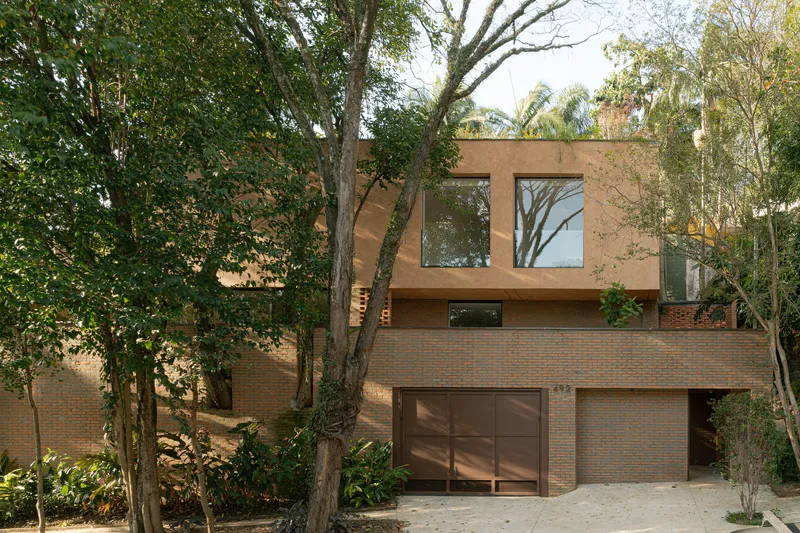
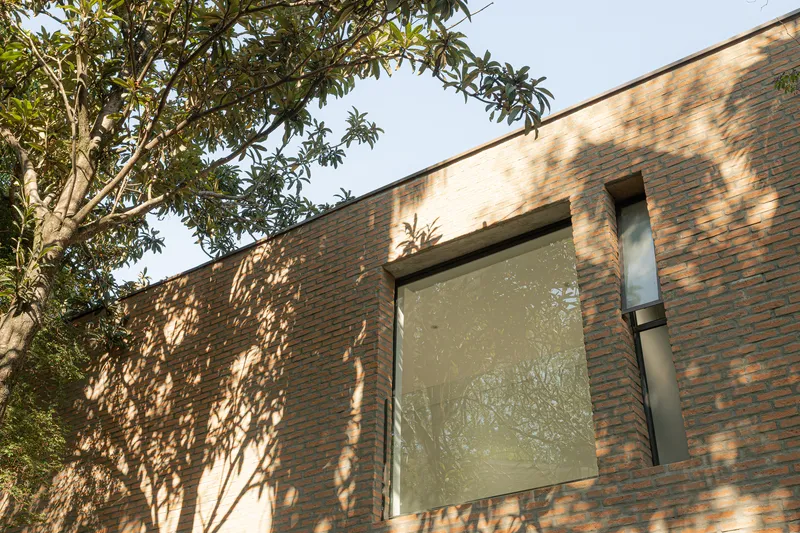
From the street, Tamanás House presents a quiet double register: a solid brick base anchors the building to the slope while a timber-clad upper volume sits above, slightly recessed. The brick is left exposed, its warm tones picking up the color of the São Paulo earth, while the timber cladding introduces a finer grain at the residential floors. Window openings are few and deeply recessed, punched into the masonry wall with enough shadow depth to read as deliberate voids rather than standard fenestration.
Afternoon light, filtered through the mature trees along the street edge, throws dappled shadows across the facade. The architects clearly anticipated this effect. The brick surface, with its subtle texture, catches those moving patterns in a way that smooth render never could. It is a building that changes complexion over the course of a day without any architectural gymnastics.
Courtyards as the Real Circulation
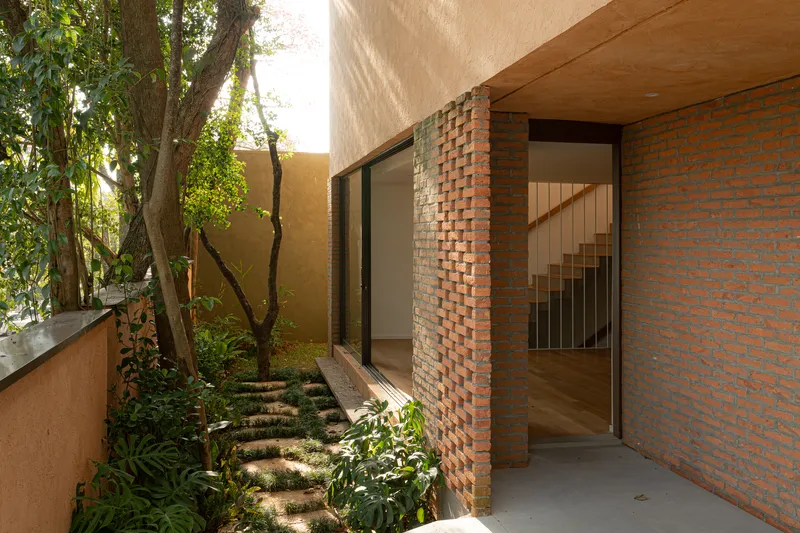
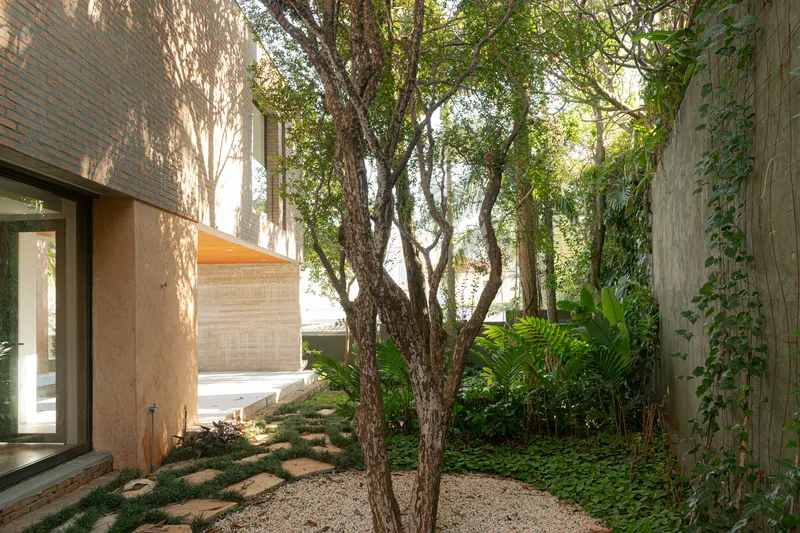
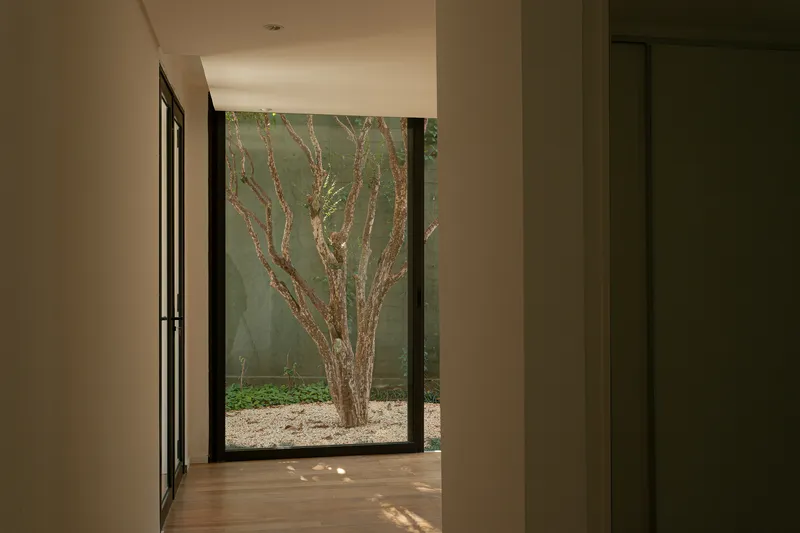
Step past the street facade and the house inverts. Interior corridors give way to outdoor courts paved in stepping stones, framed by brick walls, and shaded by the very trees the site was designed to preserve. One courtyard entry, lined with a timber soffit and planted ground cover, operates less like a threshold and more like a decompression chamber between the city and domestic life. Another court features a striking multi-trunk tree rising between stone pavers, surrounded by low planting and flanked on both sides by the building's brick volumes.
The courtyards are not decorative. They are the connective tissue. Movement through the house means moving through exterior space repeatedly, a pattern that collapses the distinction between indoors and out. A glazed door at the end of a corridor opens not to another room but to a gravel garden with a bare winter tree, framing a view that changes entirely with the season.
Living Spaces That Open on Two Fronts
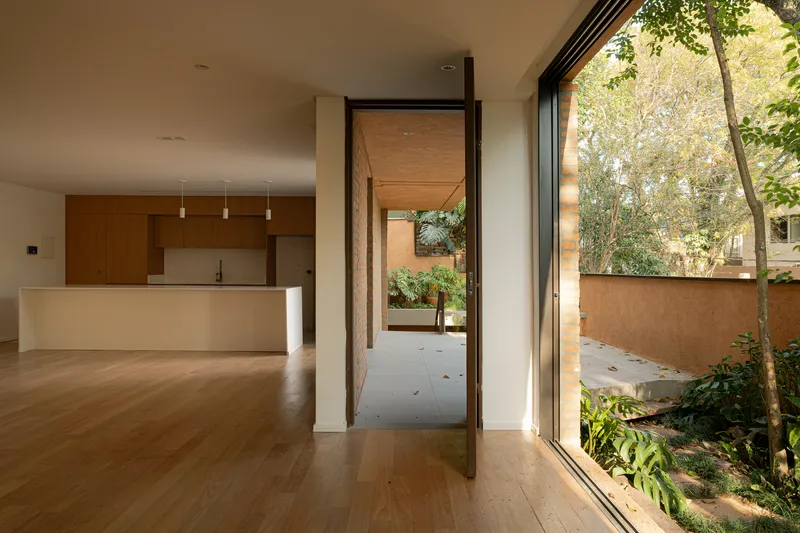
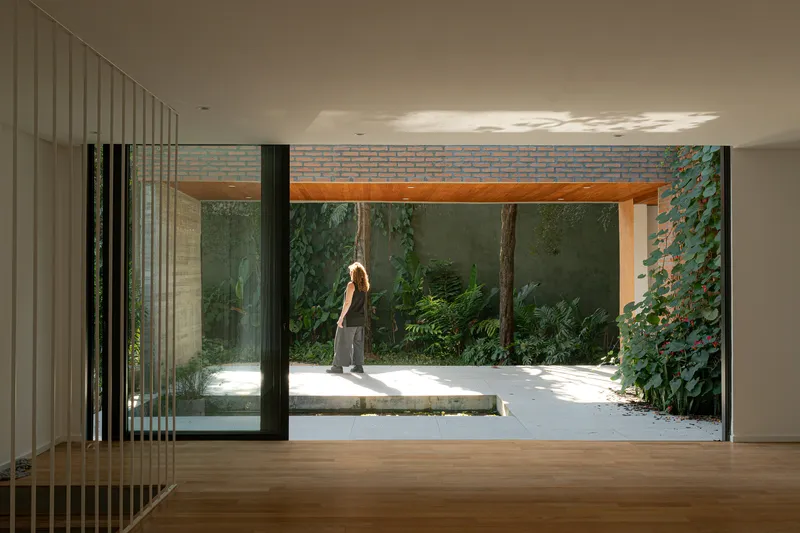
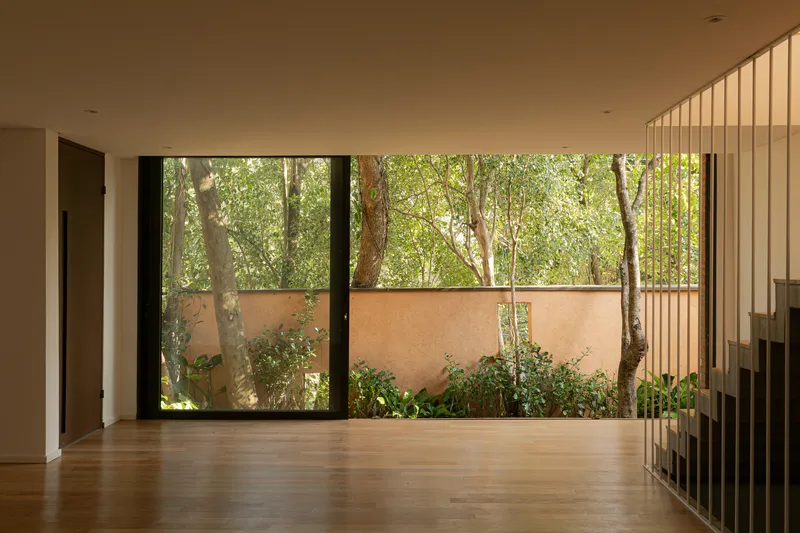
The open kitchen and living areas on the first floor are positioned to face planted courtyards on opposing sides. A large pivoting timber door swings open to connect the cooking zone directly with a courtyard garden, turning meal preparation into something that happens half outdoors. On the other side, sliding glass panels retract to merge the living room with a second court, where dappled sunlight falls on a figure walking through the space. The effect is of a room that breathes in two directions.
Full-height glazing in adjacent rooms overlooks planted zones screened by vertical metal elements, introducing a layer of visual filtration that tempers the openness without blocking it. The material palette inside stays disciplined: timber floors, timber cabinetry, and white walls let the landscape do the heavy lifting of providing color and texture.
Brick, Timber, Concrete: A Material Grammar of Three
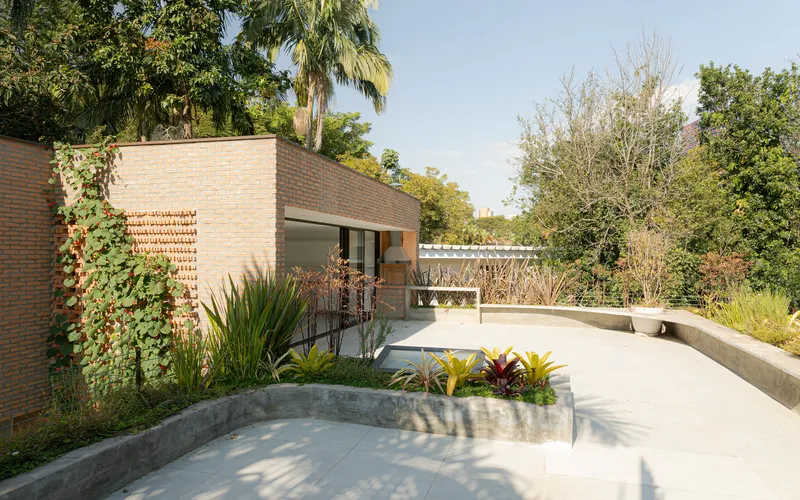
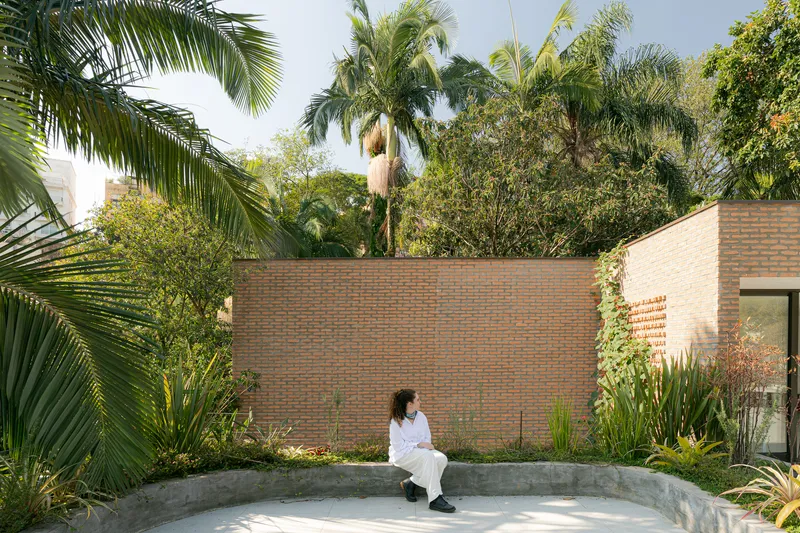
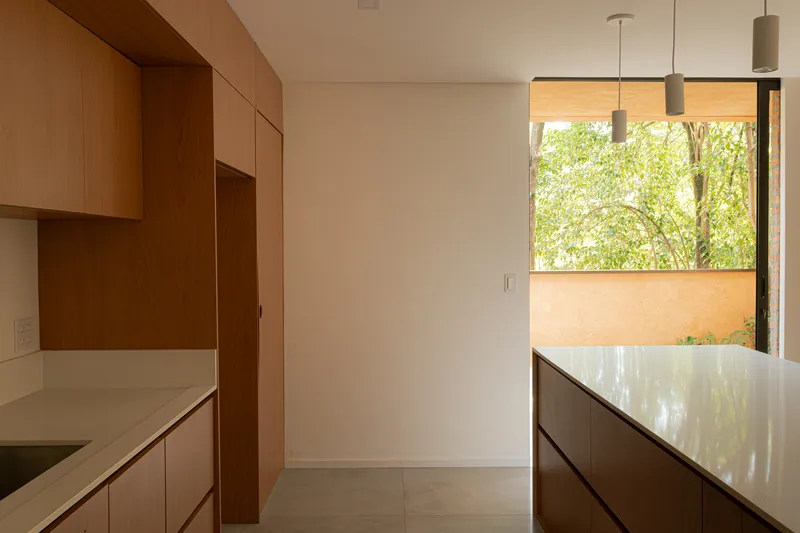
The material vocabulary is tight and consistent. Brick forms the primary enclosure, appearing both outside and inside as an unfinished, load-bearing surface. Timber handles the warmer, human-scaled elements: ceilings, cabinetry, stair treads, cladding. Concrete takes on the structural and landscape roles, showing up as planters, benches, and the building's primary horizontal slabs. The three materials rarely compete. Each has a clear job, and the architects maintain that discipline across every floor.
A curved concrete planter on the terrace level, paired with the brick wall behind it and a timber pergola overhead, summarizes the entire strategy in a single corner. The kitchen window frames a view of trees beyond a low courtyard wall, its timber surround acting as a picture frame for the garden. A concrete bench in one of the courtyards sits against a brick backdrop and tropical palms, creating a resting point that feels considered rather than furnished.
Vertical Sequence and the Staircase
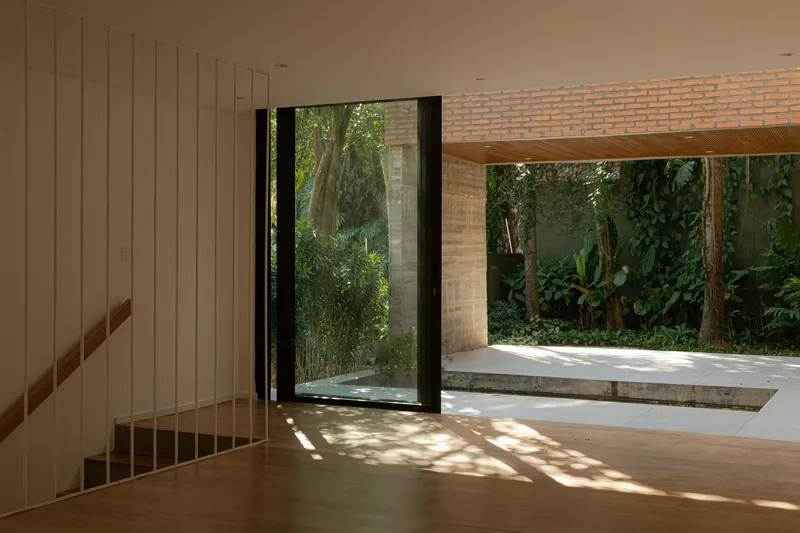
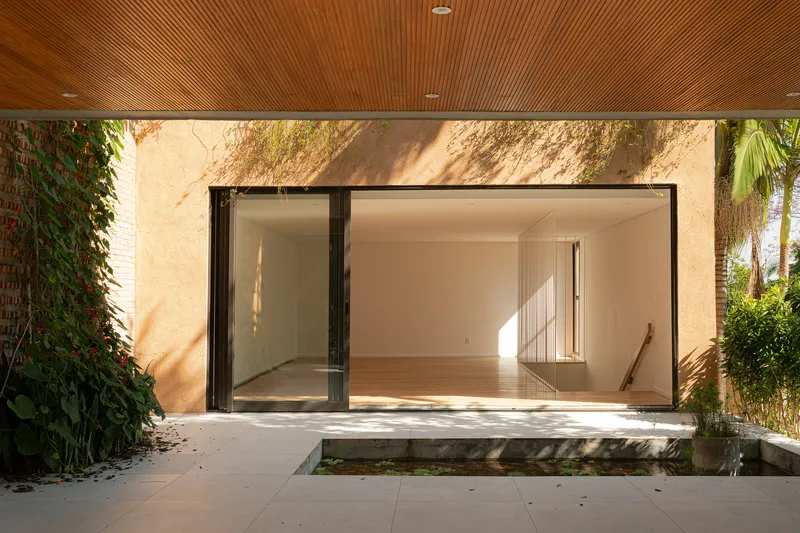
The timber staircase running alongside full-height glazing is the house's vertical spine and its most photogenic moment. As you climb, the view shifts from the planted patio at ground level to the exposed brick ceiling of the floor above, and then out to the tree canopy as you reach the upper levels. The stair is bathed in sunlight, and the glass wall beside it ensures that ascent through the house is also ascent through the landscape.
At the upper level, a covered terrace with a timber slat ceiling extends the interior outward. Sliding glass doors retract completely, making the distinction between terrace and room academic. The slat ceiling filters overhead light into stripes, producing an interior quality of shade that mirrors the dappled tree canopy just outside. It is a controlled echo, indoor light performing an impression of the forest.
Plans and Drawings
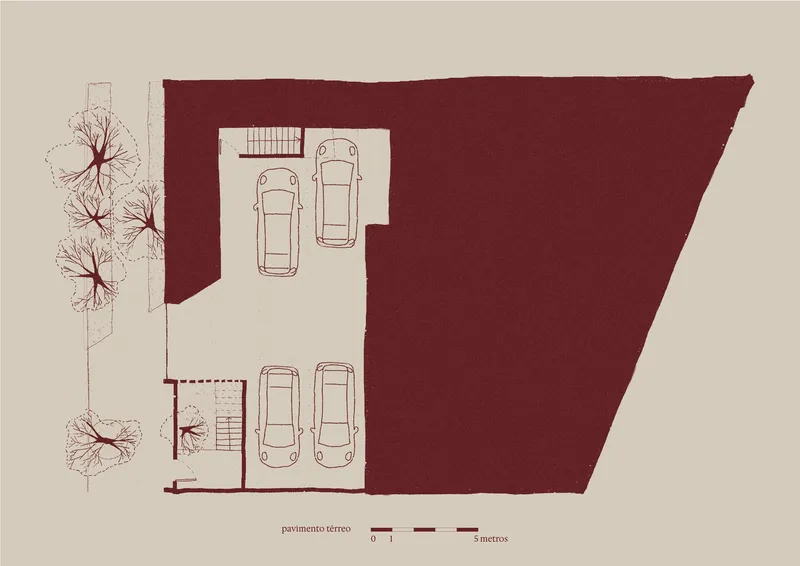
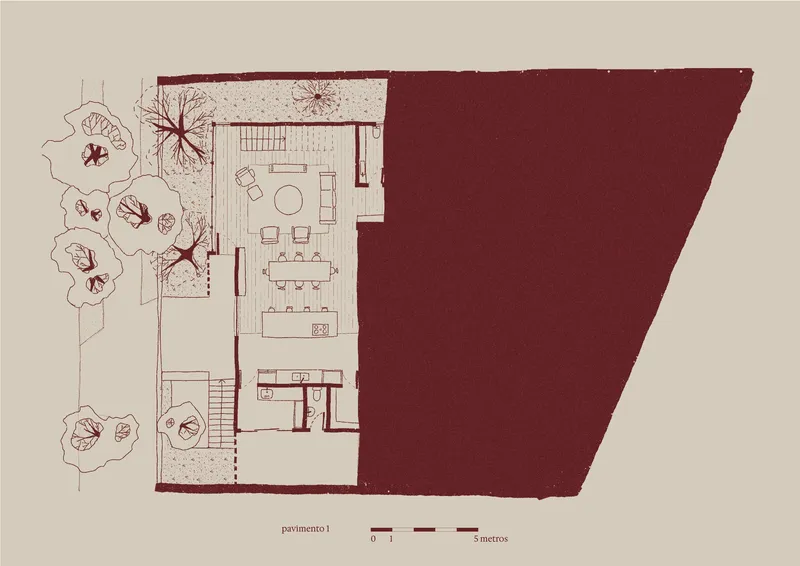
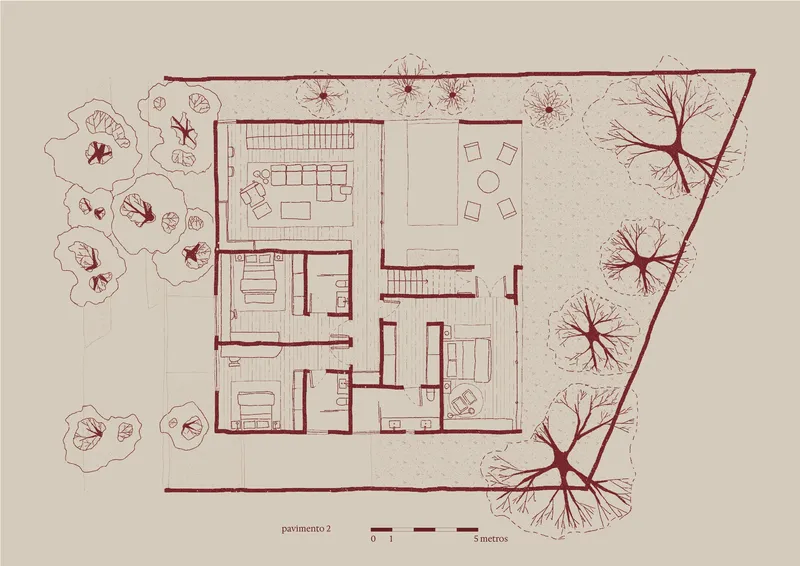
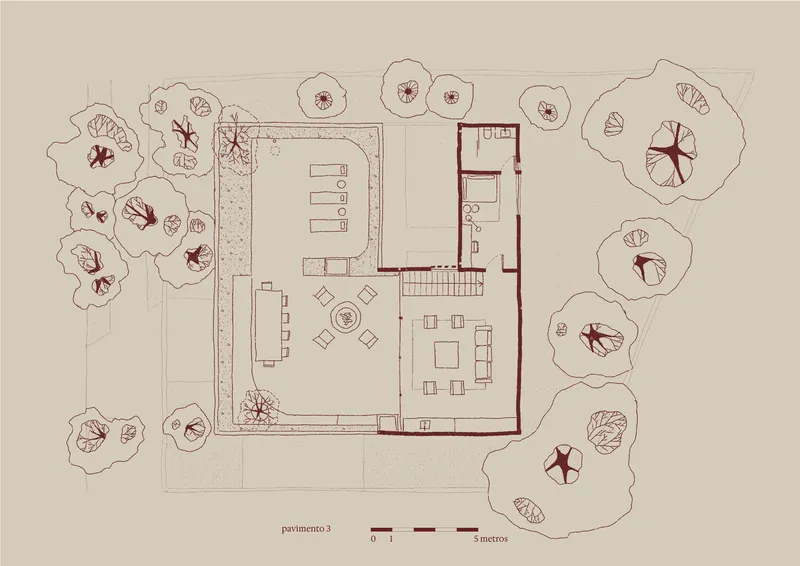
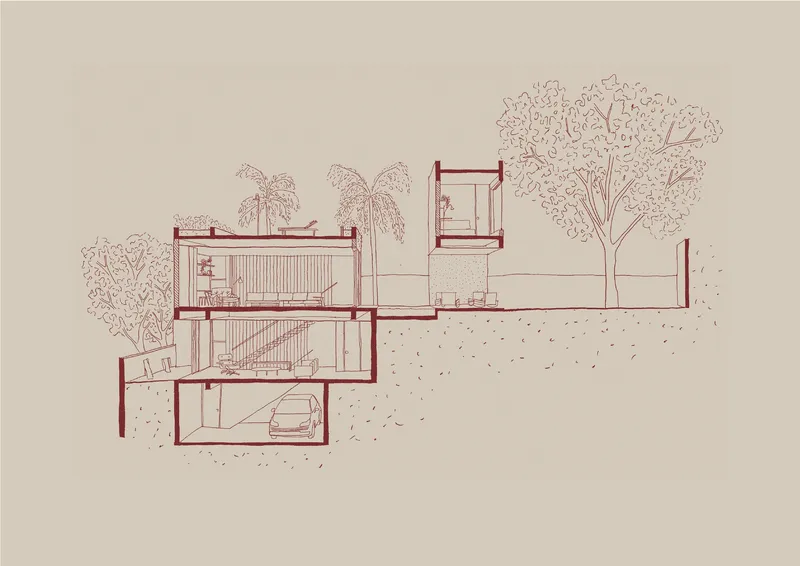
The floor plans reveal how much of the house's footprint is actually open air. At ground level, a two-bay garage and pedestrian entrance occupy the slope's base, surrounded by drawn tree canopies that indicate the site's existing vegetation. The first floor opens into generous living and dining zones with landscaped terraces pressing into the plan from both sides. Bedrooms on the second floor maintain the same courtyard adjacency, with a roof terrace extending the private realm outdoors. The third floor introduces the pool deck, positioned at canopy height and framed by the very trees that were the starting point of the project.
The section drawing is the most telling document. It shows the house as a stack of inhabited platforms stepping up the hillside, each floor engaging a different stratum of the site. The garage sits below grade, the social spaces align with the garden, bedrooms reach the mid-canopy, and the pool floats among the treetops. The slope is not negotiated; it is occupied, floor by floor.
Why This Project Matters
Tamanás House is a quiet argument against two common tendencies in São Paulo residential architecture: flattening a sloped site to create a neutral platform, and clearing vegetation to make room for the building's ego. Ateliê Amanhã did neither. By keeping the existing fruit trees and using the topography to organize the program vertically, they produced a house whose daily experience is fundamentally shaped by landscape rather than merely decorated by it. The series of precise cuts through the volume, framing canopy, garden, and sky at each level, turns passive views into active spatial relationships.
The lesson here is one of restraint applied strategically. The material palette is limited to three elements. The architectural gestures are limited to cuts and openings. The site intervention is limited to what was already there. Within those constraints, the house achieves a richness that comes not from adding complexity but from amplifying what the land already offered. It is a house that will only improve as the trees grow taller and the gardens fill in, which is the best thing you can say about any piece of residential architecture.
Tamanás House by Ateliê Amanhã. São Paulo, Brazil. 490 m². Completed 2025. Landscape architecture by Trevo Trevi. Coordination by Luiza Tripoli. Photography by Camila Alba.
About the Studio
Ateliê Amanhã
Official website of Ateliê Amanhã, one of the studios behind this project.
instagram.comShare Your Own Work on uni.xyz
If projects like this are the kind of work you want to make, uni.xyz is a place to publish your own, find collaborators, and enter design competitions.


Popular Articles
Popular articles from the community


Play: Fragments of Their World
Familiar architecture becomes modular playground design, creating safe spaces where displaced children can learn, connect, imagine and play.

Hill & Cross Opera: Sculptural Opera House Architecture Shaped by Tallinn’s Landscape and Identity
Hill & Cross Opera reimagines opera house architecture in Tallinn through its sculptural hill, civic plaza, glass wave and a luminous cross.

Co-life: Sustainable Architecture for Age-Friendly Community Living
Co-life reimagines sustainable architecture for seniors through courtyards, rammed earth, shared gardens, and spaces designed for belonging.

Little Red Riding Hood: Architectural Design as a Journey Through Fear, Light, and Storytelling
Little Red Riding Hood reimagines the fairy tale through architectural design shaped by fear, light, scale, memory, uncertainty, and choice.

Similar Reads
You might also enjoy these articles

Bao Huynh Watercolor Atelier: A Serene Art Retreat in Hội An
Bao Huynh Watercolor Atelier in Hội An blends multifunctional art spaces, sustainable design, local materials, and family-friendly living in a serene environment.

Atelier Macri Concept Store Interior Design by CASE-REAL
Atelier Macri store features a "ko" counter, walnut wood details, cork displays, blending retail, gallery, and seamless customer experiences.

Manuel Vargas Izquierdo Stadium and High-Performance Sports Center: Architectural Excellence in Jalpa de Méndez
The Manuel Vargas Izquierdo Stadium blends sustainable design, inclusive sports facilities, and cultural-inspired architecture, revitalizing Jalpa de Méndez’s public spaces.

KAKR Buluh Awar Hall: Revitalizing Community and Ecology Through Bamboo Architecture
Community built bamboo hall revitalizes Buluh Awar village, empowering youth, restoring ecology, celebrating vernacular craftsmanship through sustainable architecture and culture.


Comments (0)
Please login or sign up to add comments
No comments yet. Be the first to comment!