
MOBIO Arquitetura Turns a Protected 1950s House Near Praça da Liberdade into a Ceramics Gallery
A heritage restoration in Belo Horizonte reopens a midcentury house as a gallery, café, and shop celebrating Brazil's ceramic arts tradition.

Most preservation projects earn their praise by keeping things intact. The Ateliê de Cerâmica Gallery, led by MOBIO Arquitetura and architect Gabriel Castro, earns its praise by removing something: a solid wall that had hidden a 1952 house from public view for decades. With that wall gone and replaced by a lightweight metal fence, the building near Belo Horizonte's Praça da Liberdade finally addresses the street again. It is a simple gesture, but it reframes the entire relationship between a protected heritage structure and the neighborhood around it.
Originally built as the residence of physician Milton Machado Mourão and artist Gilda Antonina Maria Falci Mourão, the house now functions as a ceramics gallery, shop, and café within the Protected Complex of Praça da Liberdade. The 387 square meter restoration, completed in 2023 and recognized with the 2025 Sylvio de Vasconcellos Award from IPHAN/MG and CAU/MG, treats the building not as a frozen artifact but as an active participant in Belo Horizonte's cultural life. The program is deliberately informal: a place where art, coffee, and commerce coexist under vaulted ceilings and peroba-do-campo timber, channeling the midcentury Brazilian impulse to dissolve the boundary between art and everyday life.
A Facade Recovered
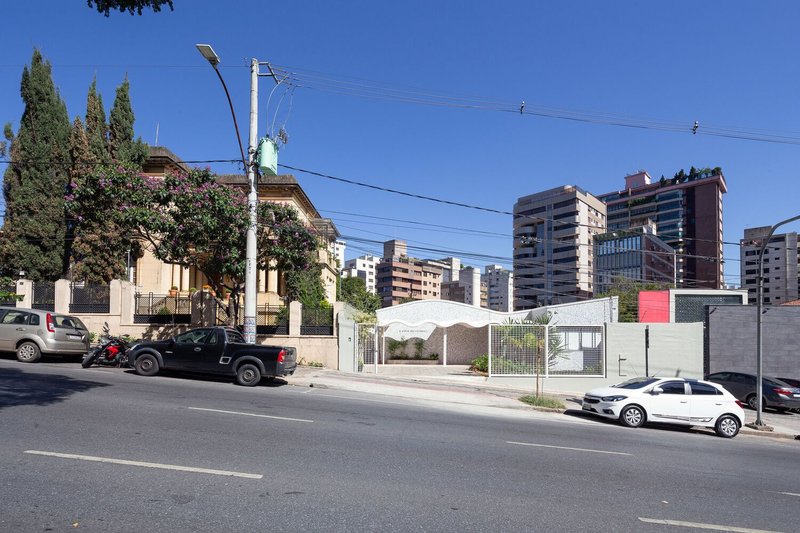
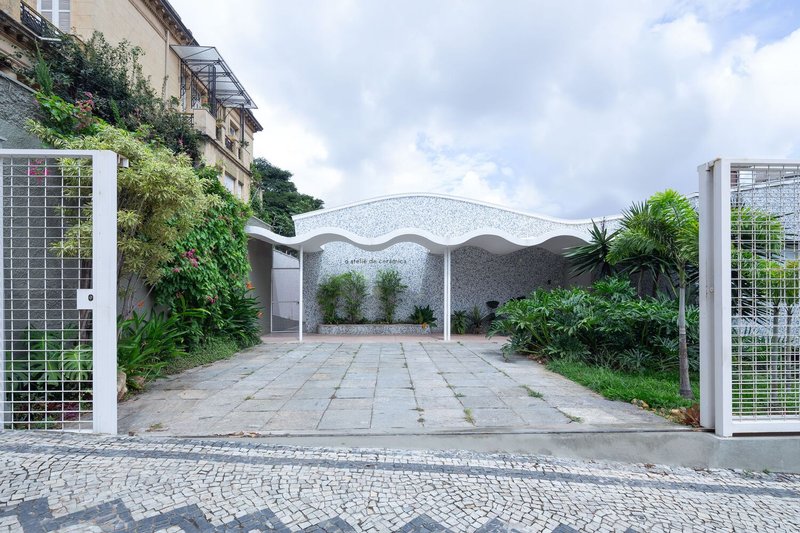
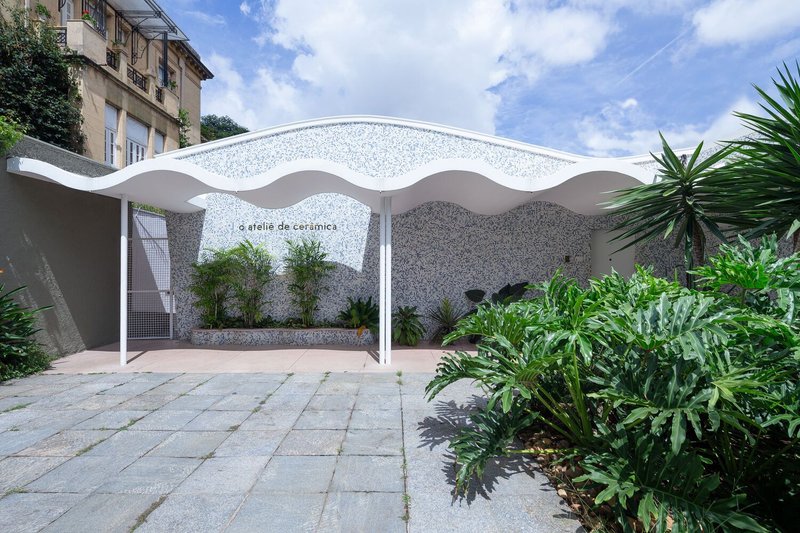
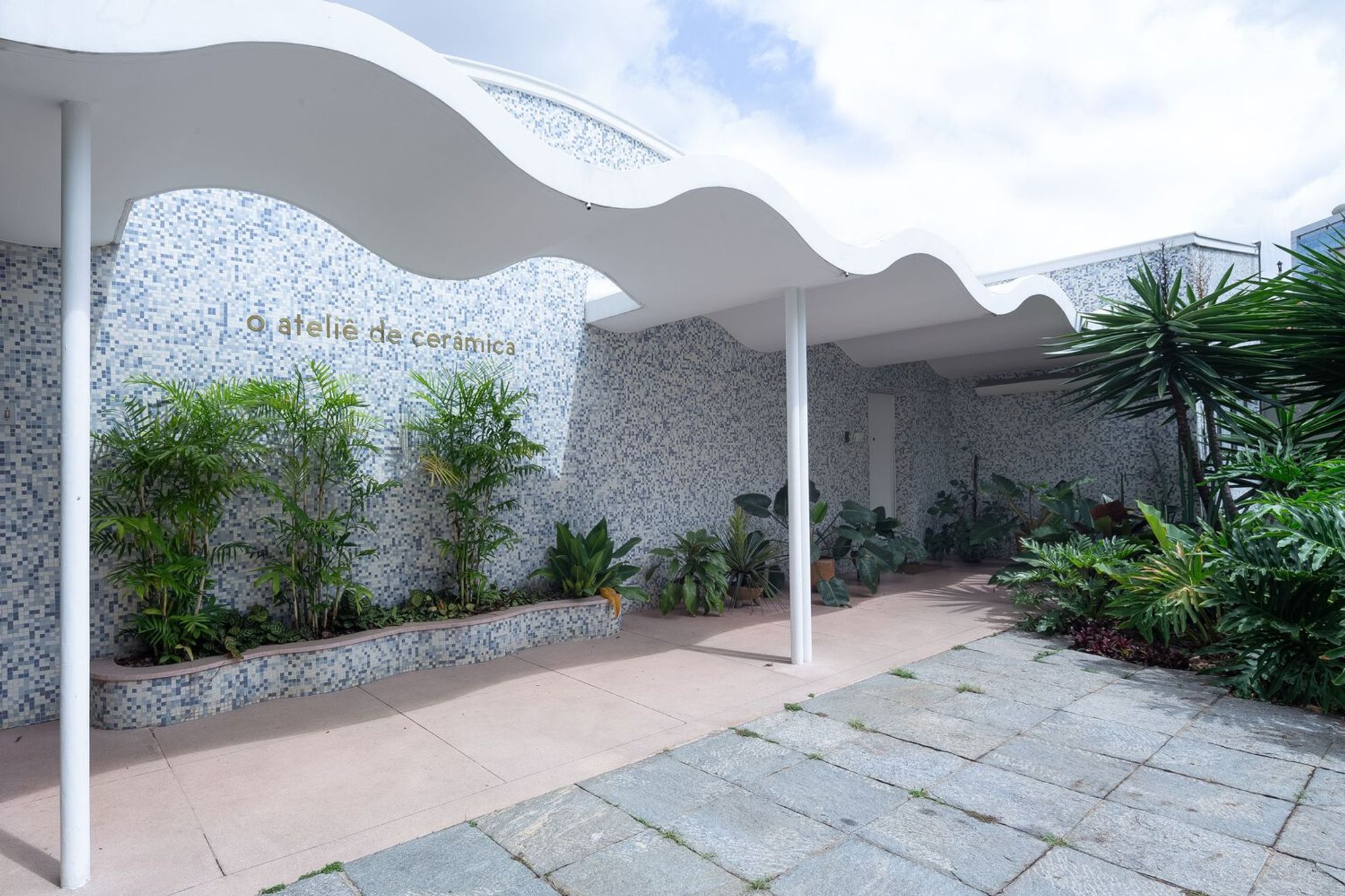
From the street, the building reads as a quiet counterpoint to its residential neighbors. The corrugated metal enclosure, white and deliberately restrained, gives way to an entry sequence that unfolds under a wavy canopy, a hallmark of Brazilian Modernism that MOBIO chose to preserve and celebrate rather than compete with. The undulating form overhead is echoed in the terrazzo facade walls and concrete pavers below, establishing a material language that feels both historical and freshly considered.
The new mesh gates at the entry maintain visual transparency while securing the compound. This permeability is the project's central thesis: heritage architecture should not be locked behind walls. Pedestrians now see into the courtyard, catch a glimpse of the canopy, and are invited to step inside. It is an urban act as much as an architectural one.
Glass Block and Steel: The Courtyard Interface
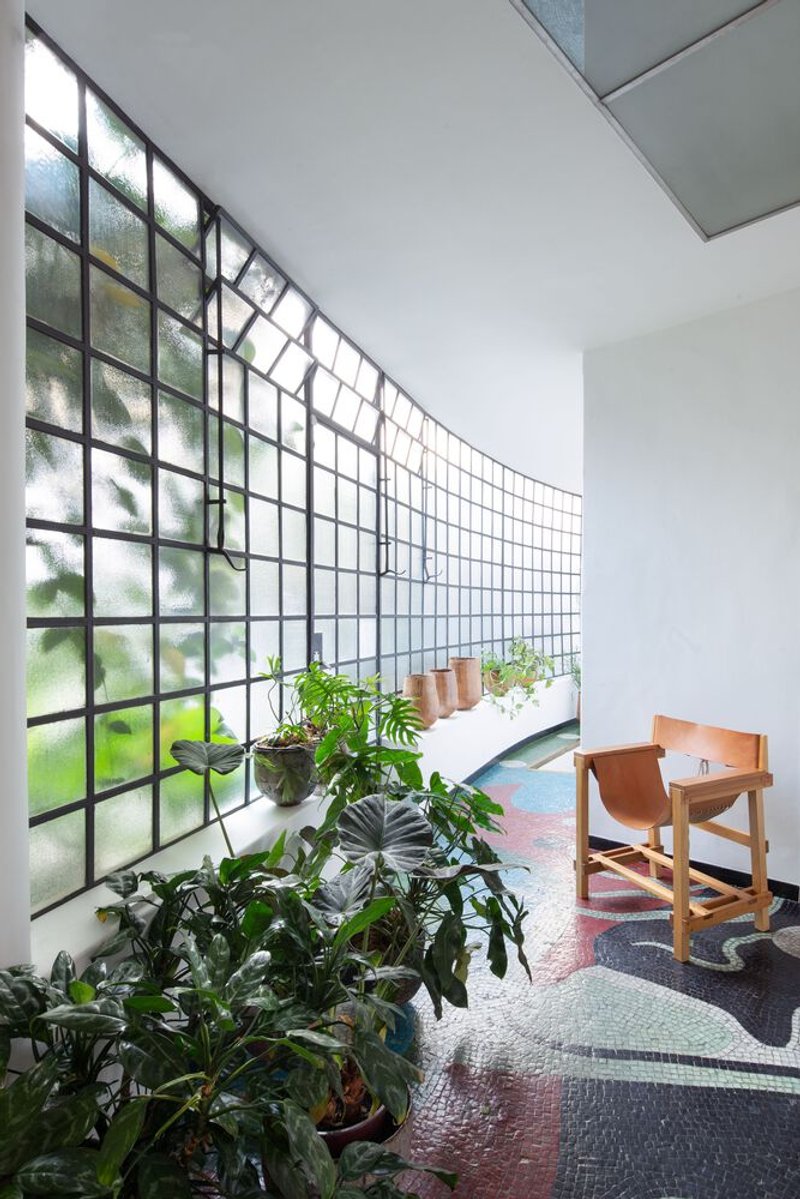
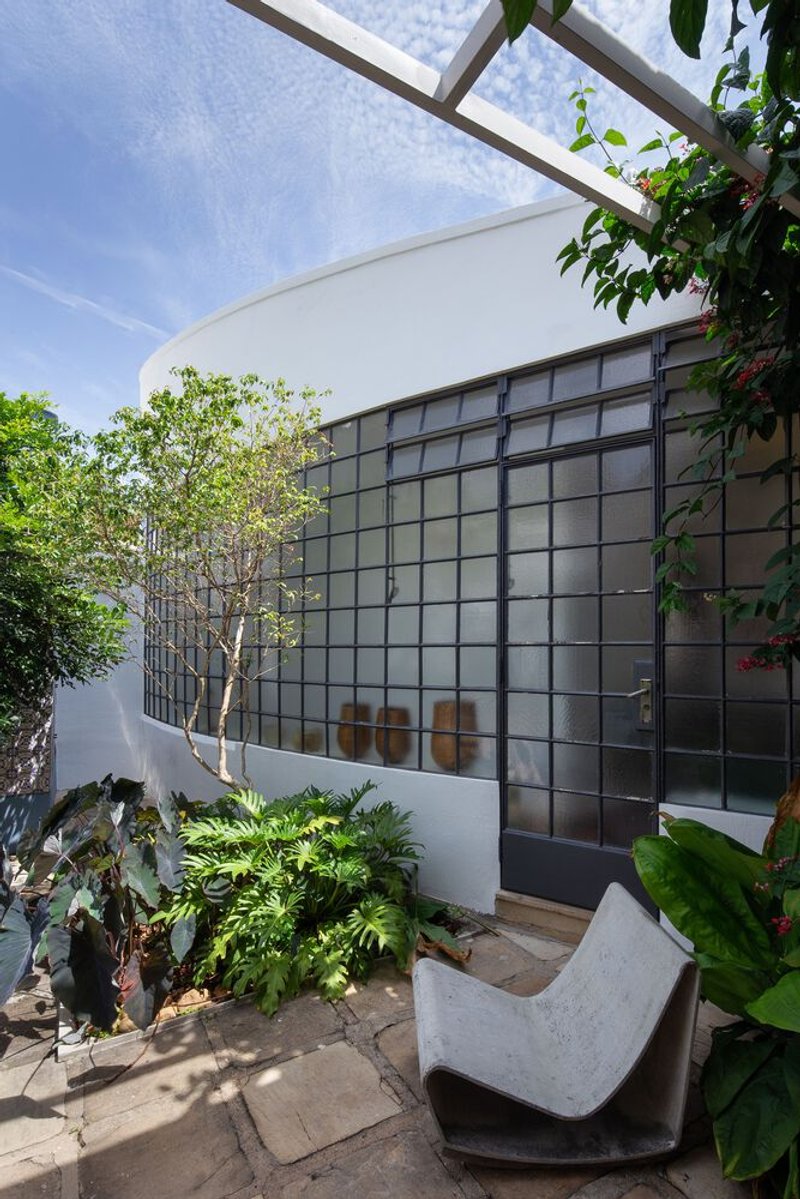
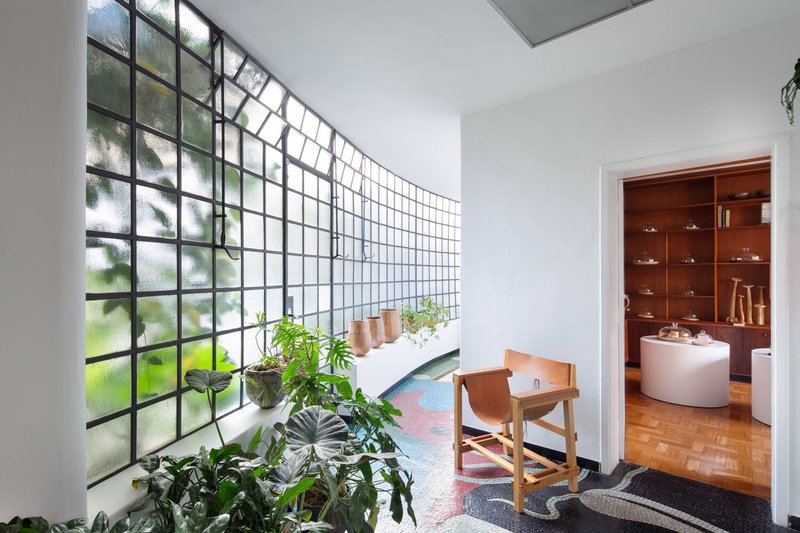
A curving glass block wall is the building's most distinctive interior element, threading daylight deep into the plan while creating a soft visual barrier between gallery spaces and the planted courtyard. The steel framing that holds these blocks is slender and honestly expressed, a restoration detail that acknowledges the original construction without pretending to be seamless. You can read the logic of the building's structure in every joint.
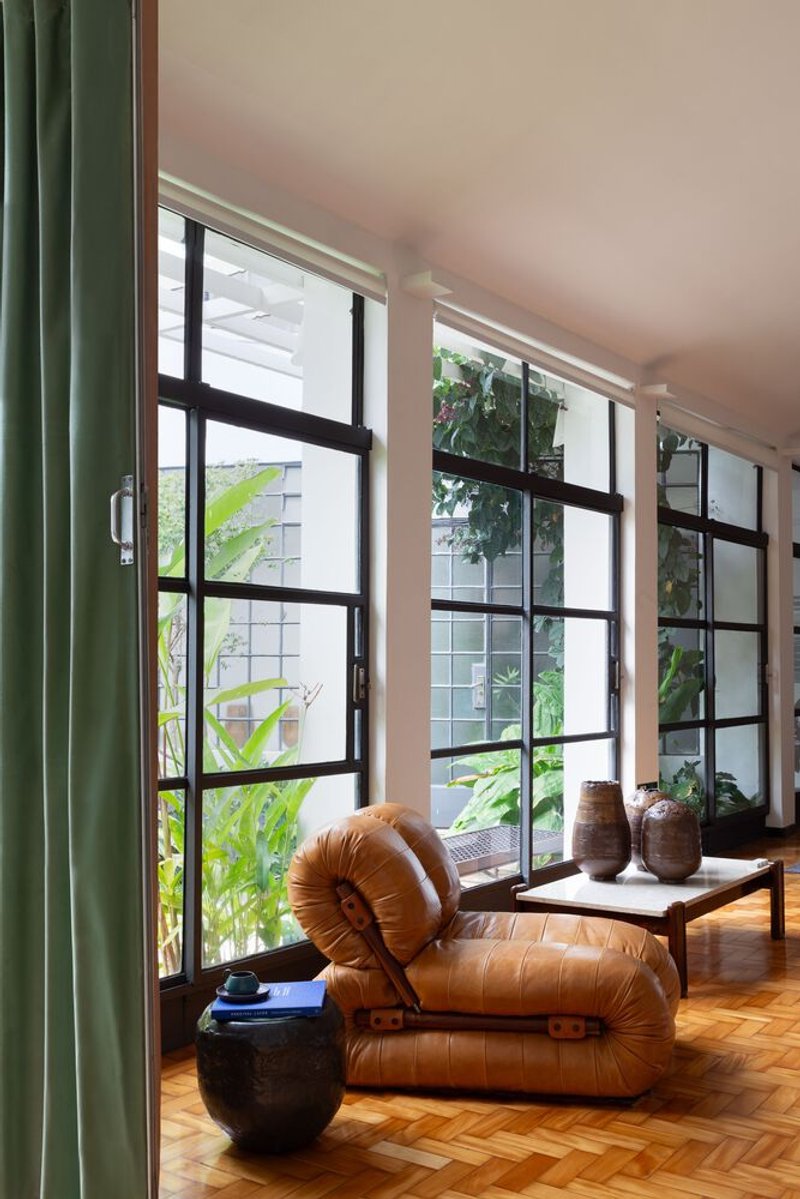
From the interior corridor, the full-height glass block wall turns the garden into a luminous backdrop. Potted plants on the terrazzo floor extend the courtyard's greenery inside, blurring the threshold. The effect is atmospheric without being theatrical: light arrives diffused and warm, exactly the quality you want for displaying ceramic surfaces.
Gallery as Living Room
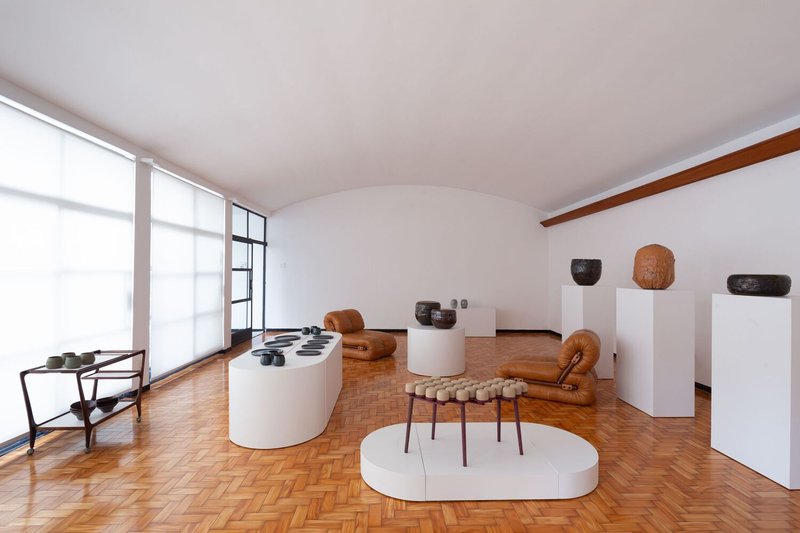
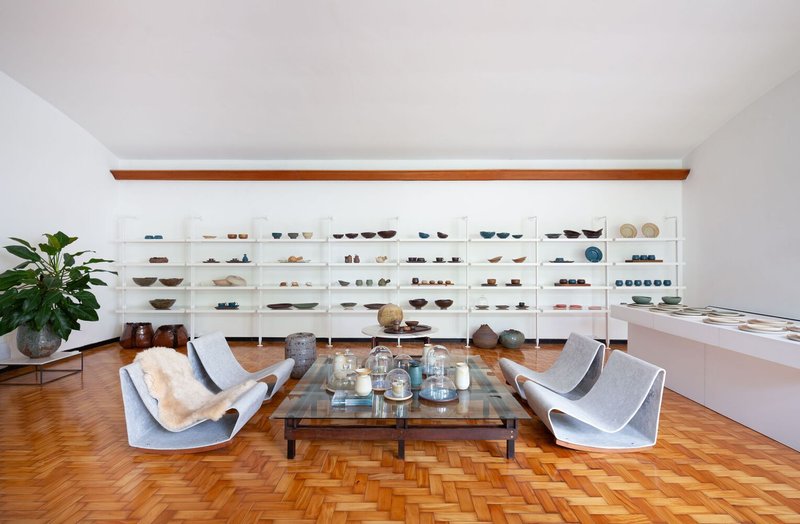
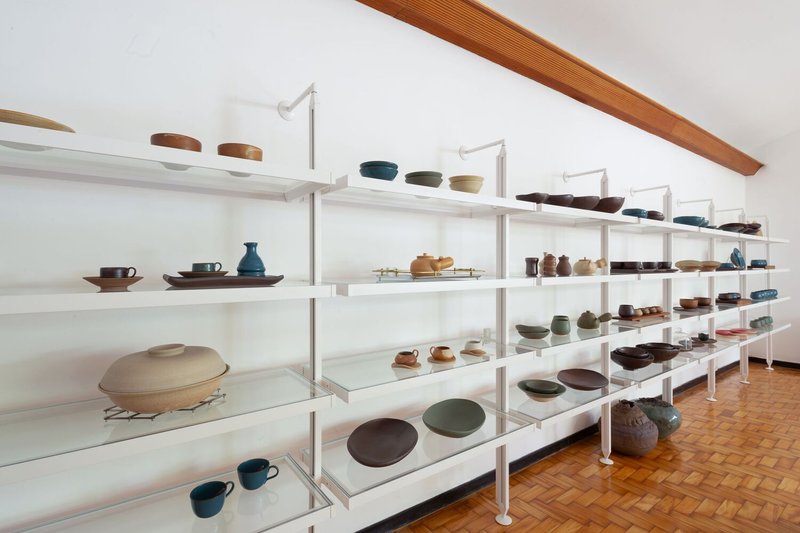
The gallery rooms avoid the white cube formula. Herringbone parquet floors, leather armchairs, and exposed timber beams establish an atmosphere closer to a collector's apartment than to a commercial showroom. Ceramic vessels sit on white pedestals and modular shelving systems that can be reconfigured for different exhibitions, but the spatial character remains domestic. This is intentional: the project's artists, Flávia Soares, Daniel Romeiro, and Luiza Soares, see ceramics as objects that belong in lived spaces, not on distant plinths.
Adjustable task lamps on the shelving units let curators fine-tune lighting for individual pieces, a practical touch that elevates the display quality without requiring a full track-lighting system. The result is a gallery that feels warm, inhabited, and specific to its medium.
The Shop, the Café, and the Multi-Use Logic
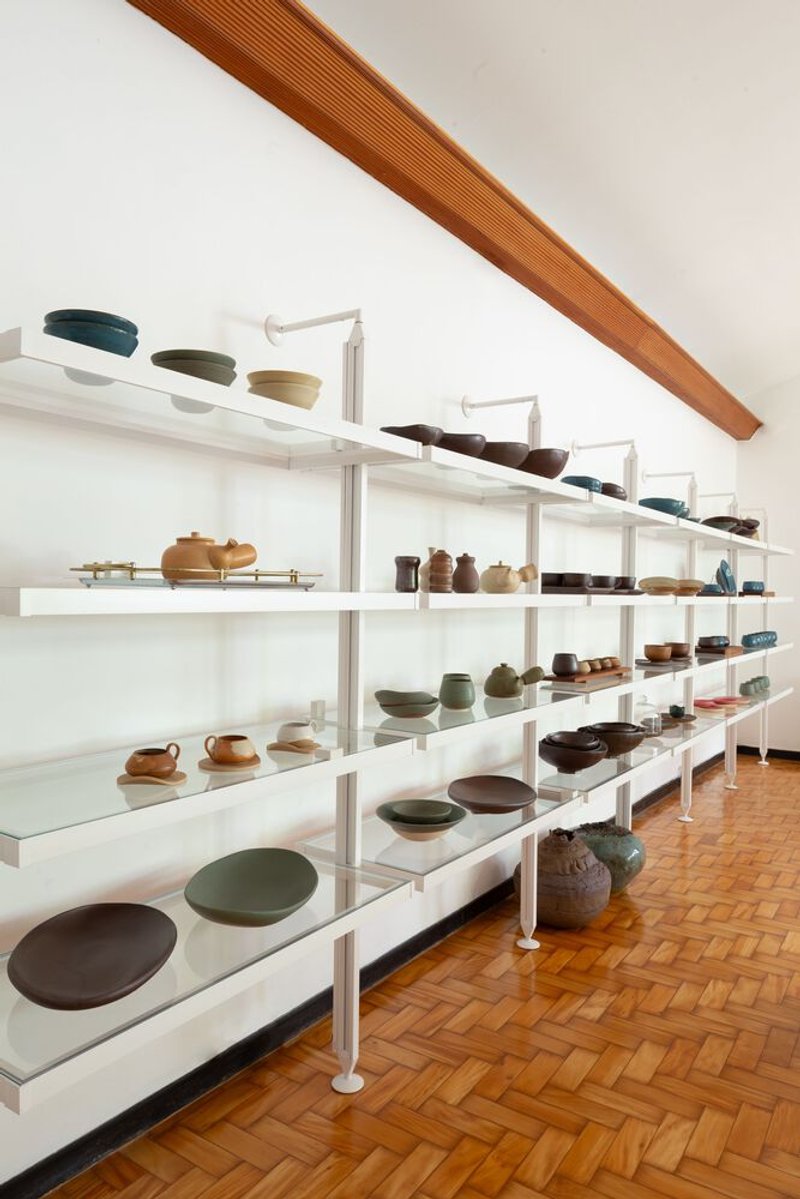
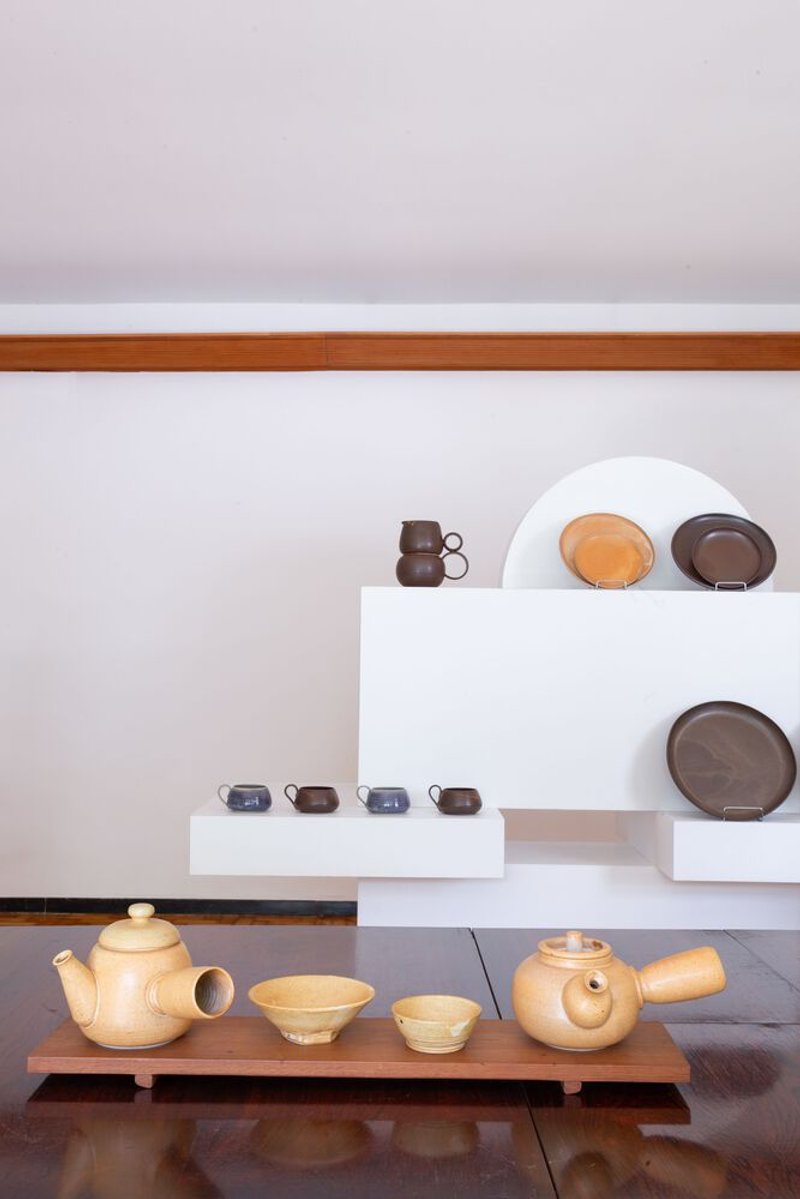
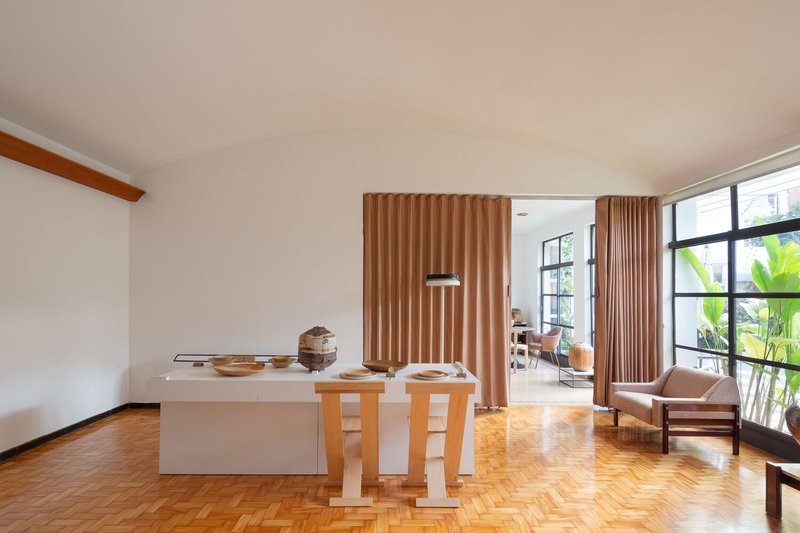
Stepped display platforms near the shop area present ceramic teapots, plates, and cups at a scale and proximity that encourages handling. The timber trim and white volumes keep the retail environment cohesive with the gallery, and the transition between the two programs is almost invisible. A fluted room divider near the café counter creates spatial separation without closing off sightlines, maintaining the open plan that the original house offered.
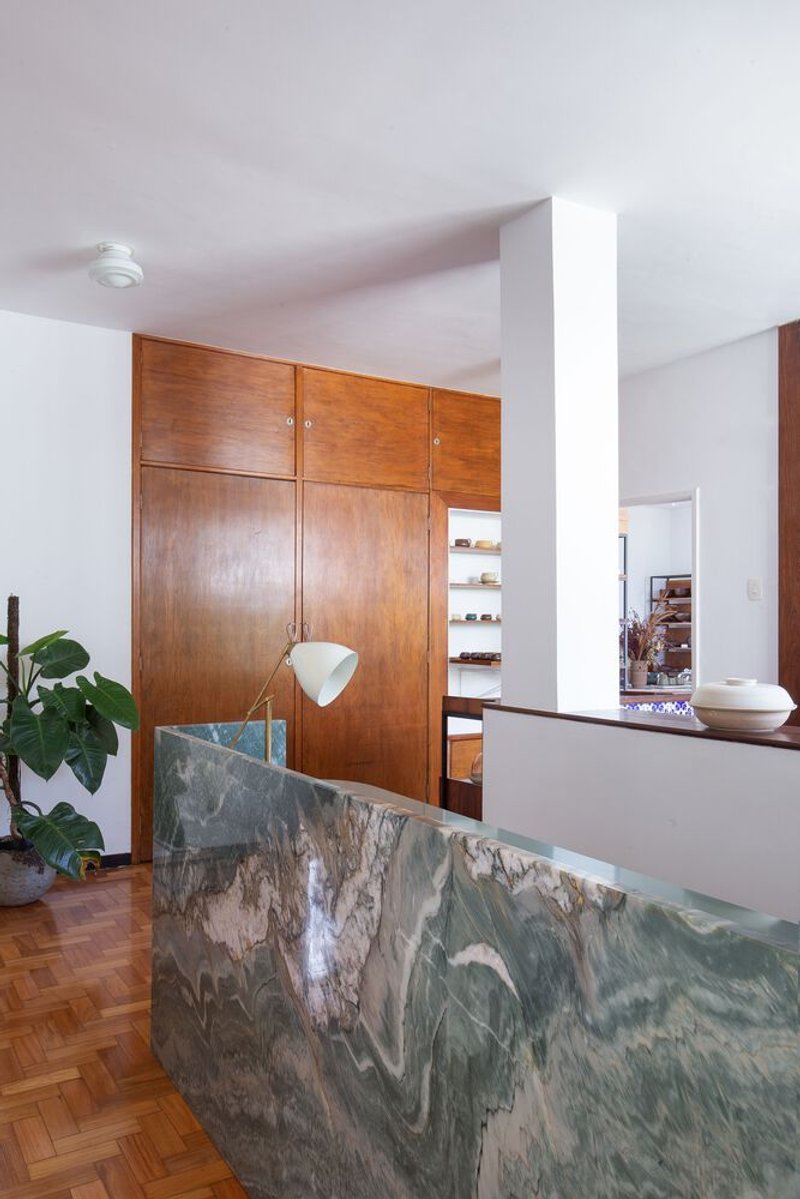
The café area, with its green marble counter, timber cabinetry, and timber stools, doubles as a reception point. MOBIO Arquitetura also uses the building as its own headquarters, an arrangement that keeps the space active during off-exhibition hours and ensures daily oversight of a heritage asset. It is a pragmatic solution that more preservation projects should consider.
Furnishings and Material Continuity
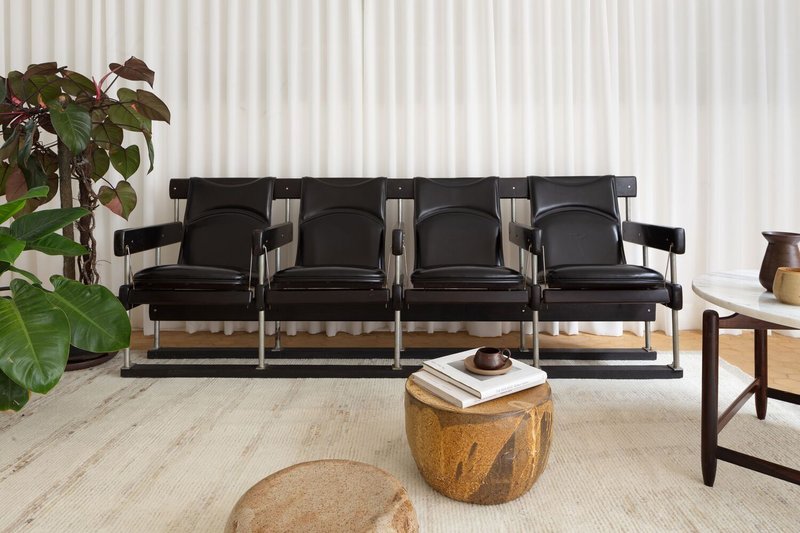
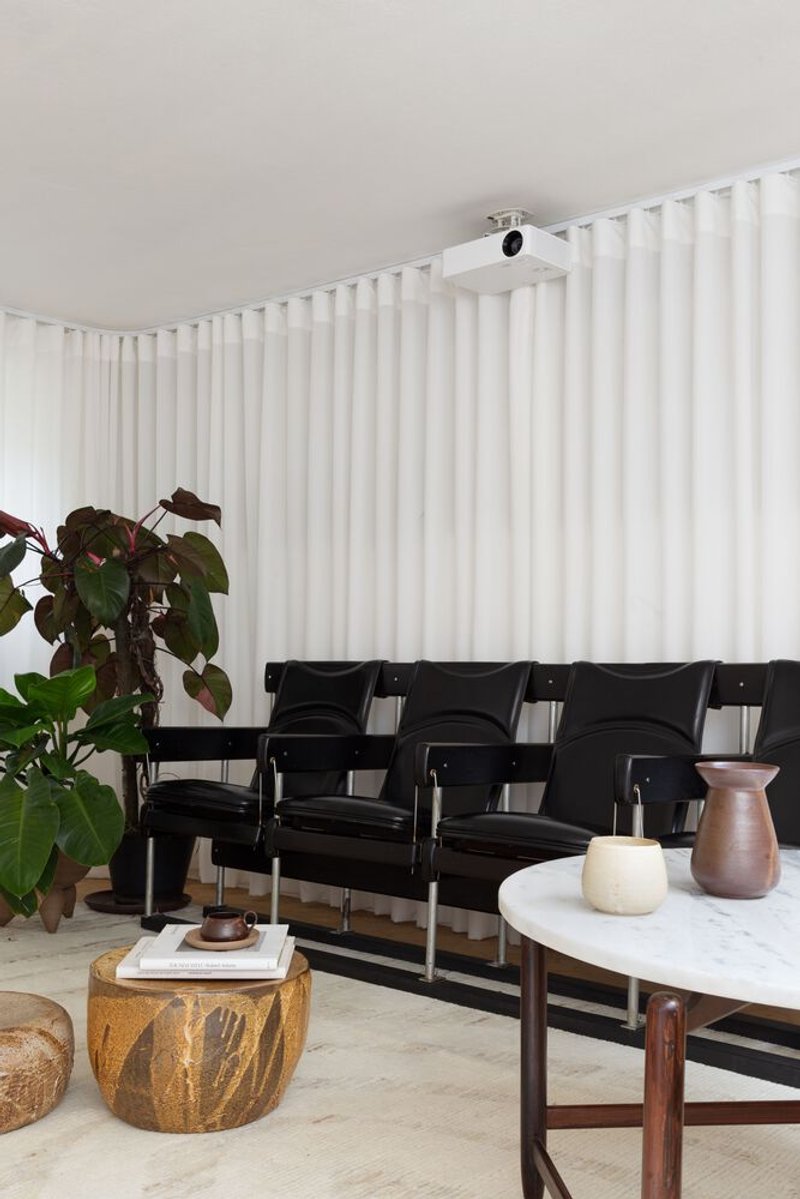
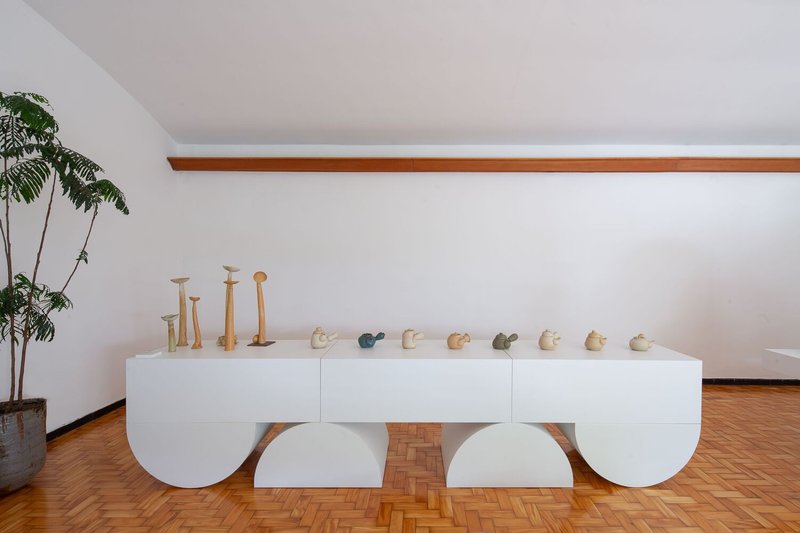
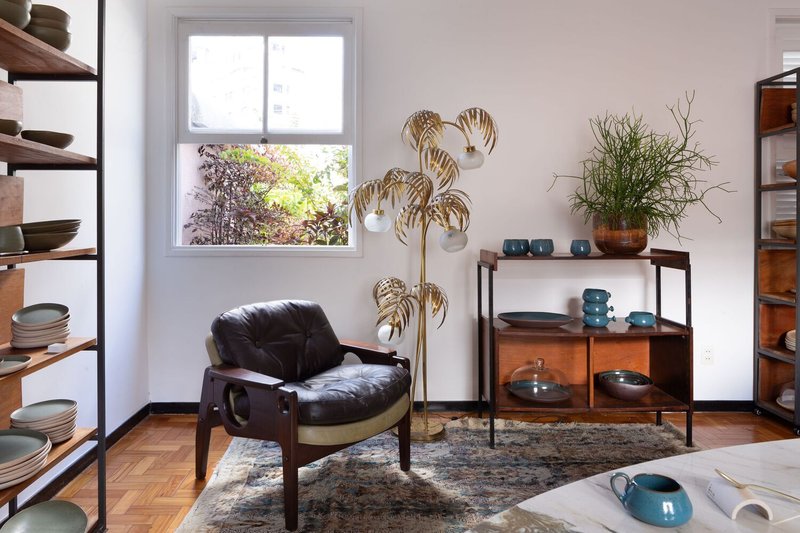
The furniture selections work hard to hold the line between midcentury spirit and contemporary comfort. Black leather armchairs with metal frames, round marble coffee tables, and a sculptural white credenza with a curved base all speak to Brazilian modernist design traditions without being literal reproductions. A brass palm sculpture in one reading nook pushes the decorative register further, hinting at the tropical iconography that animated Brazilian art in the 1950s.
The herringbone parquet, restored from the original house, ties every room together. Against this warm, rhythmic floor, the white walls and shelving systems recede, letting the ceramic objects and the architectural bones of the building do the talking.
Courtyard and Landscape as Program
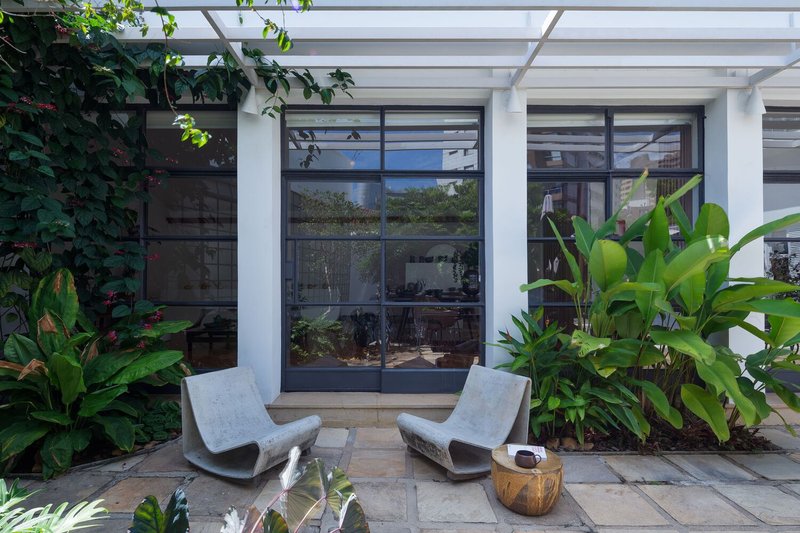
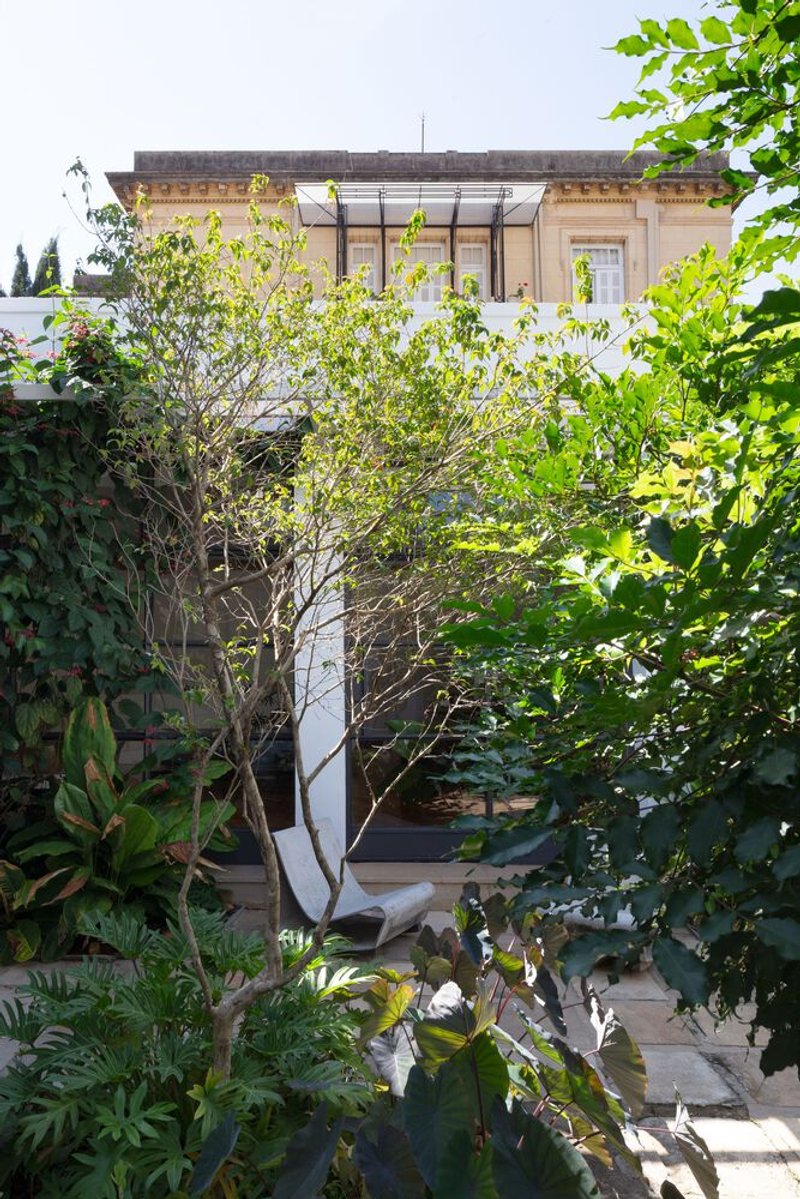
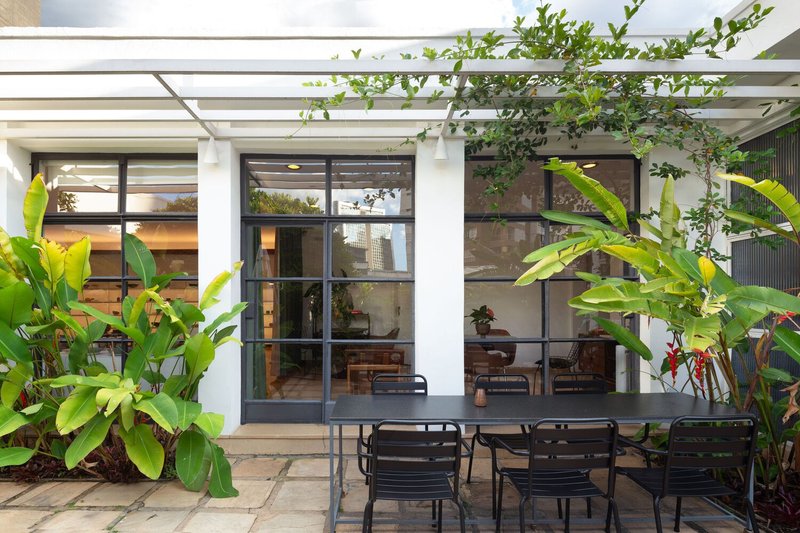
The courtyard is not residual space; it is a room. A metal pergola supports climbing vines that will thicken over time, providing shade and softening the boundary between architecture and garden. The existing swimming pool was deactivated and a timber deck was installed in its interior, converting a defunct amenity into a usable platform for events and gatherings.
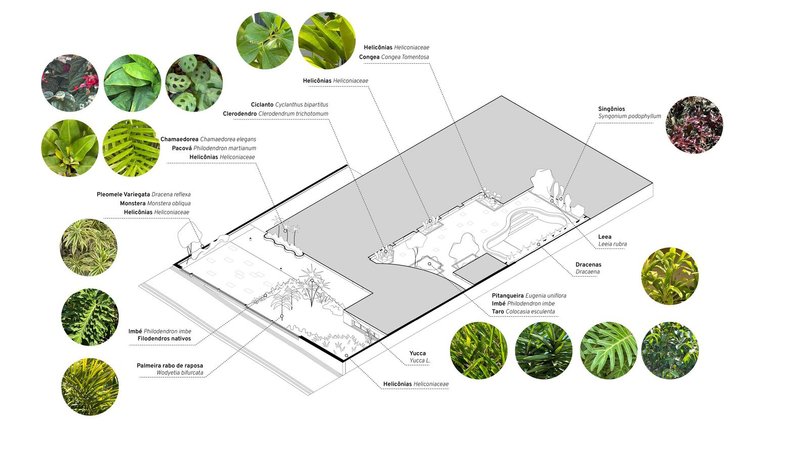
Banana palms, heliconias, monsteras, and philodendrons were placed strategically according to sunlight conditions, functioning as both ornamentation and passive sun protection. The landscaping was conceived by the same ceramic artists who animate the gallery, giving the planting a deliberate artistic sensibility rather than a generic botanical treatment. A multi-stemmed tree anchors the courtyard composition, framed by vines and broad-leaved tropicals that filter light and create microclimatic pockets throughout the day.
Timber, Terrazzo, and the Staircase
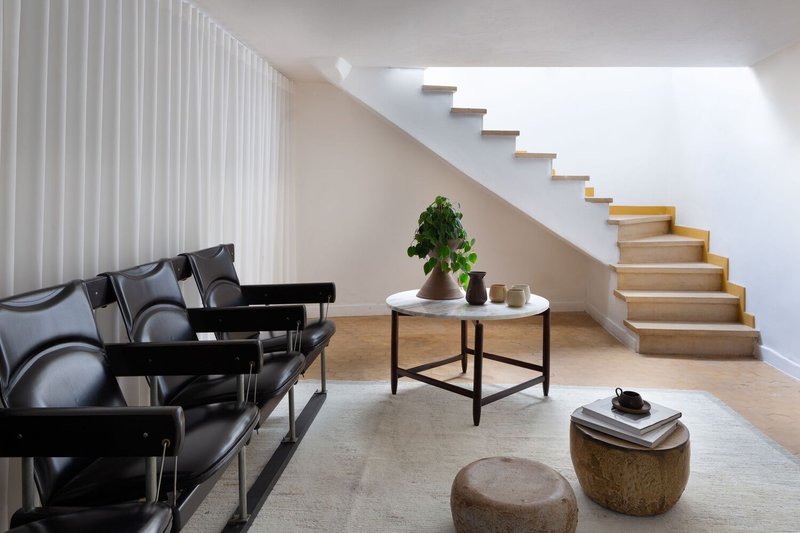
A floating timber staircase rises along a white wall in the main living area, its minimal steel supports and open risers treating the vertical circulation as furniture rather than infrastructure. Below, leather chairs and a rug suggest a salon atmosphere. This room captures the project's essential ambition: to restore a domestic space so carefully that it can absorb a public program without feeling converted.
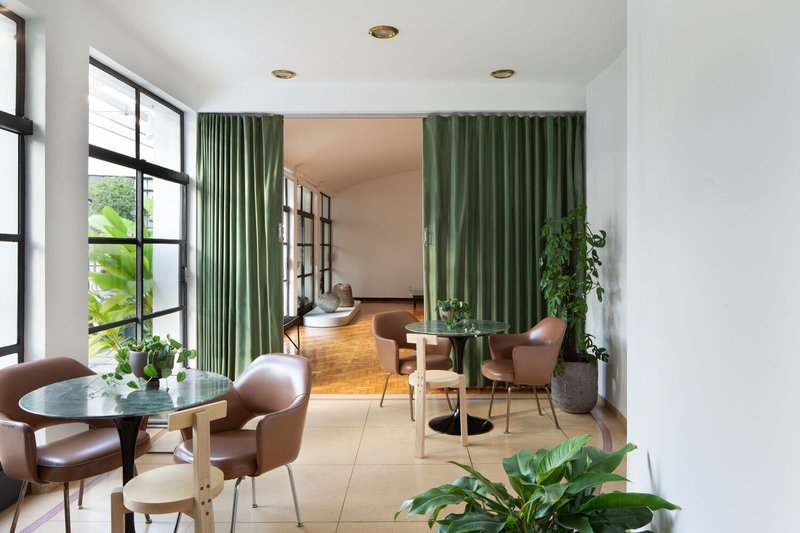
The dining area, framed by green curtains and opening toward the gallery beyond, reinforces the layered transparency that runs through the plan. Black steel-framed windows overlook the glass block wall and banana palms outside, creating composed views that reward slow looking. The iron frames throughout the house were rehabilitated rather than replaced, and the original woodwork was restored, preserving the material continuity that gives the building its character.
The Curved Deck and Outdoor Details
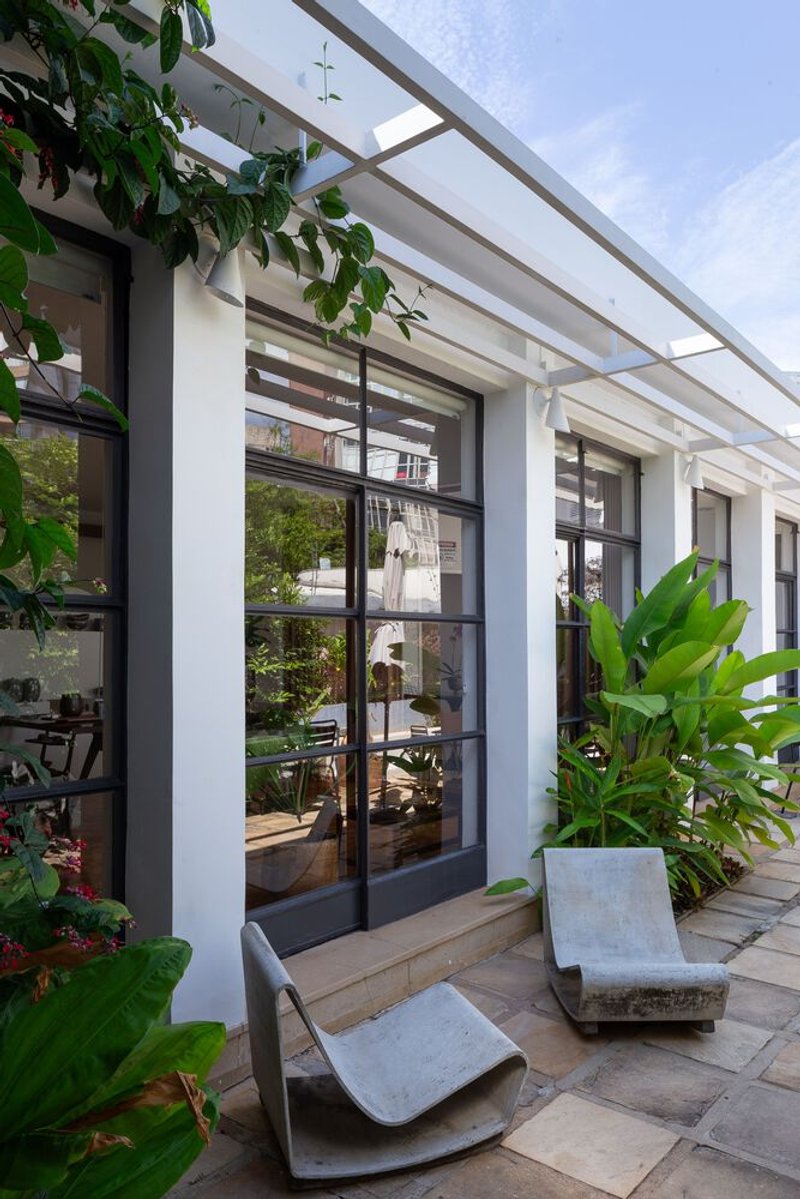
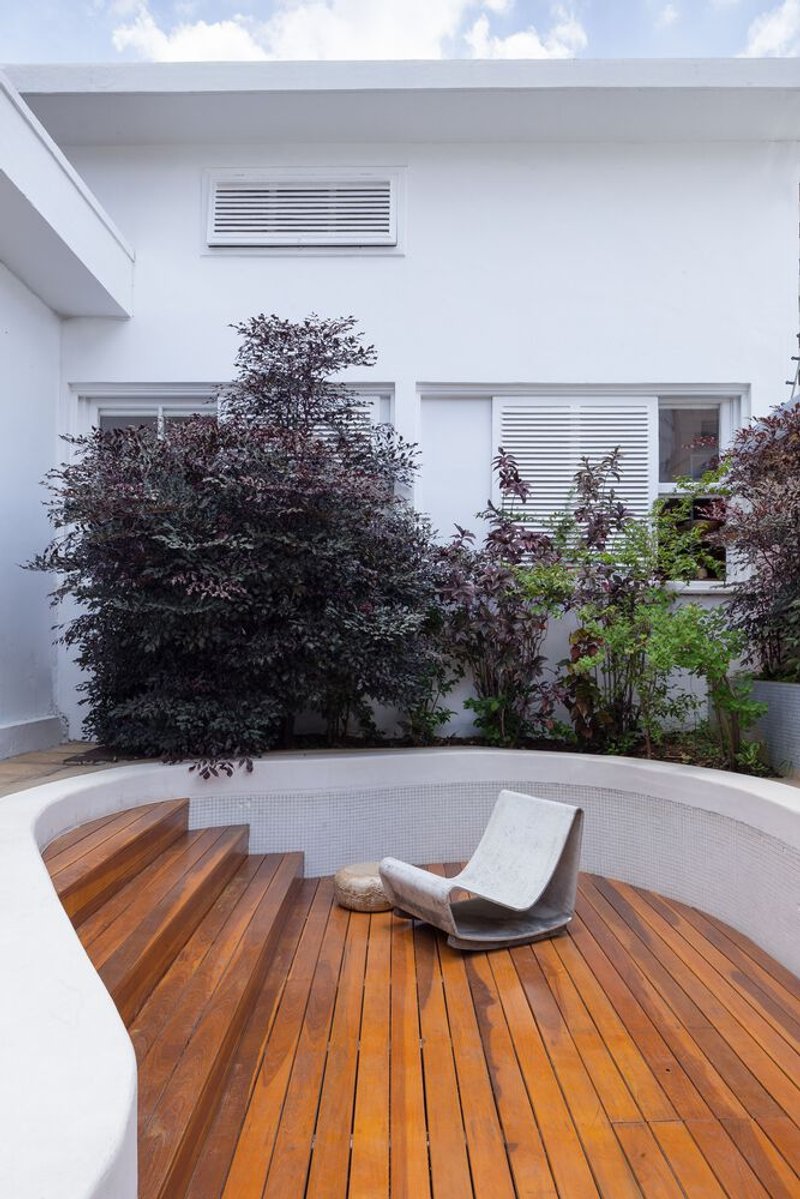
The curved timber deck installed where the pool once stood introduces a contemporary geometry into the garden, its dark-leaved shrubs and horizontal wall vents creating a layered composition. Nearby, a timber and polycarbonate pergola over gridded glass doors extends the covered space outward, mediating between the controlled interior and the open courtyard.
Small moments carry weight: a corner reading nook with a window framing rooftop greenery, a concrete lounge chair positioned beside the curved glass block wall. These details suggest a building that was not simply restored to a fixed historical state but tuned for present-day occupation, where sitting, reading, and observing the garden are considered legitimate architectural programs.
Plans and Drawings
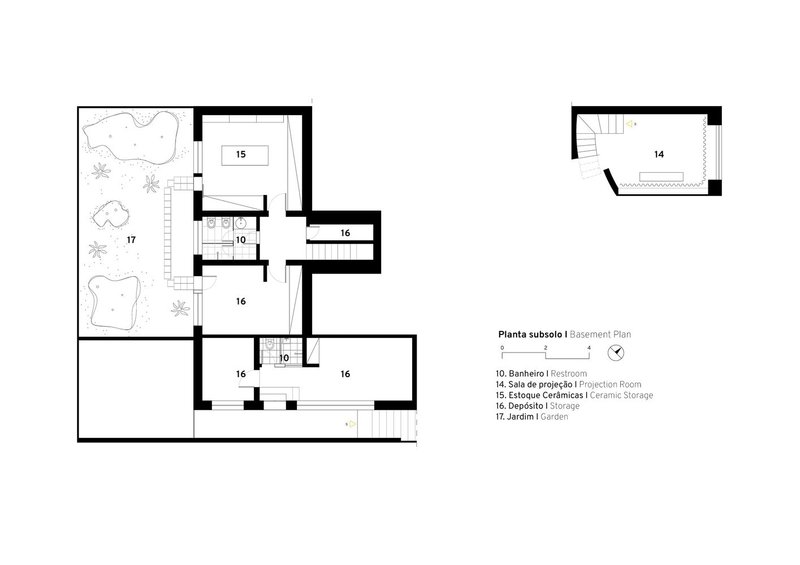
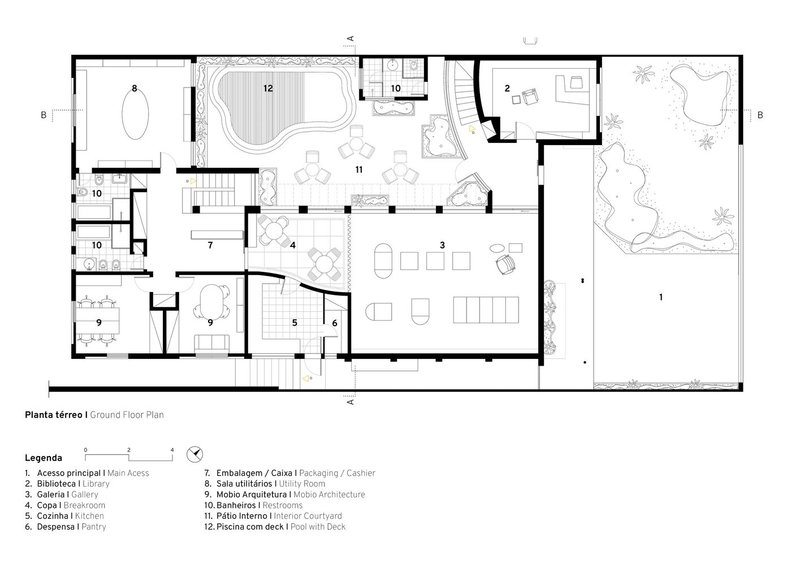
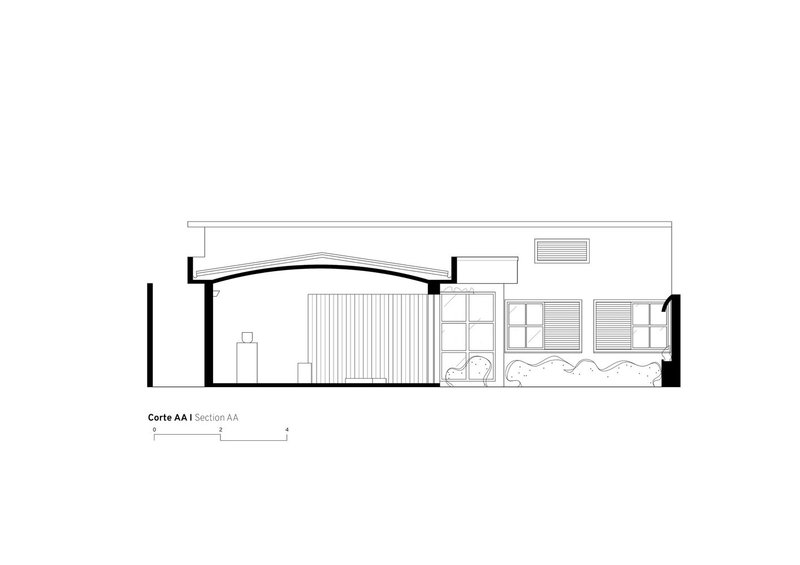
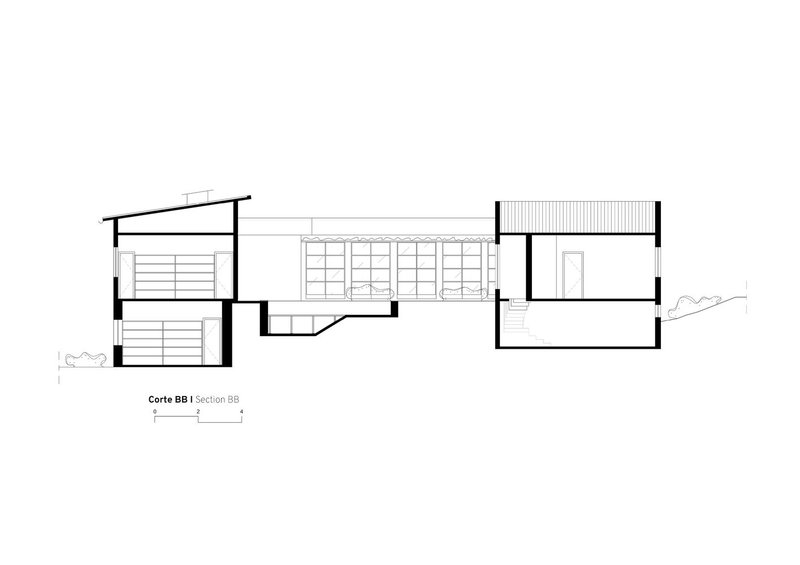
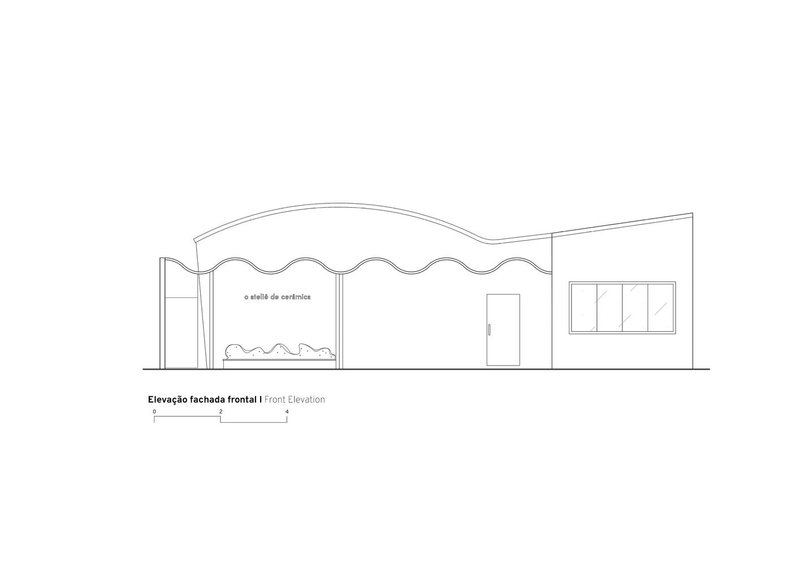
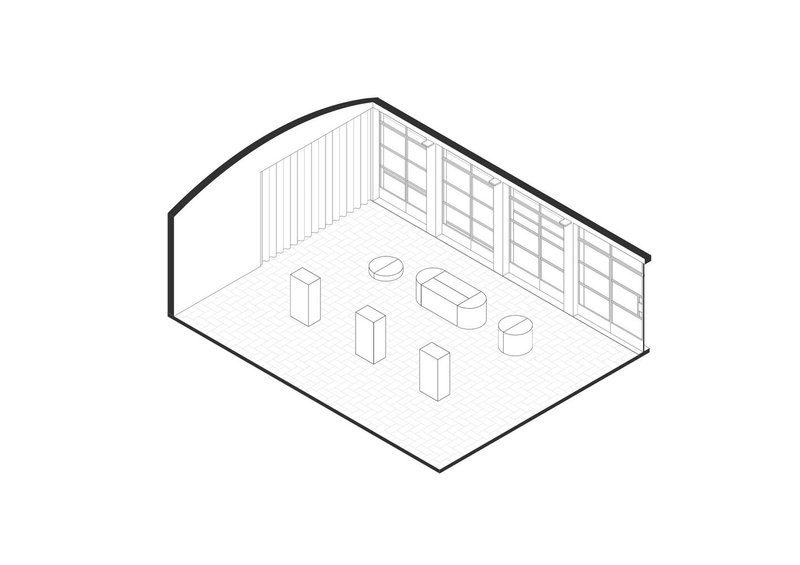
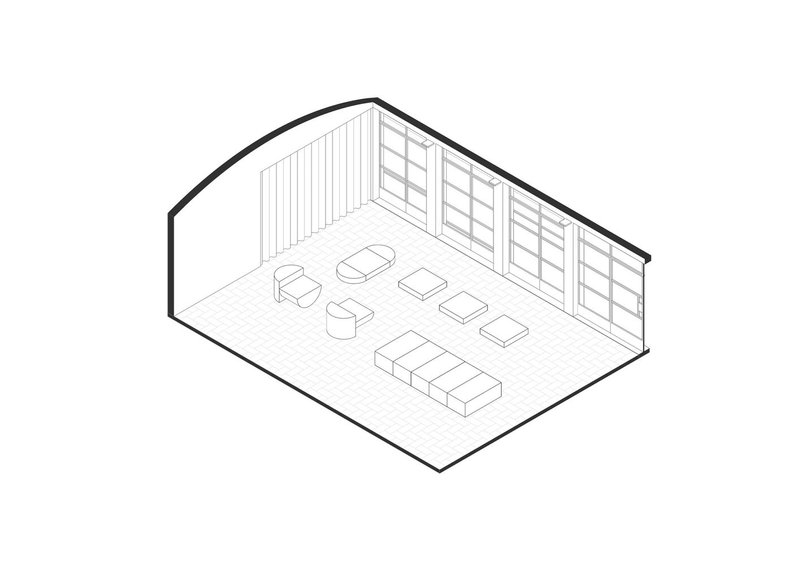
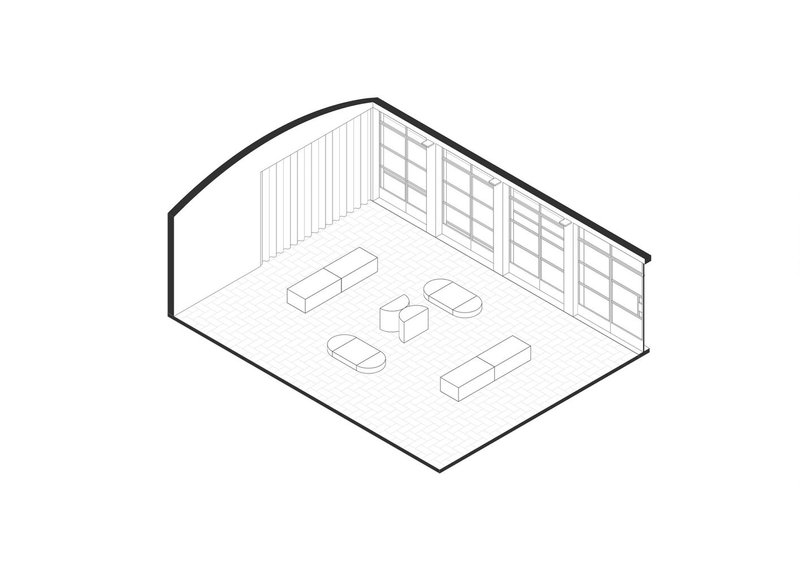
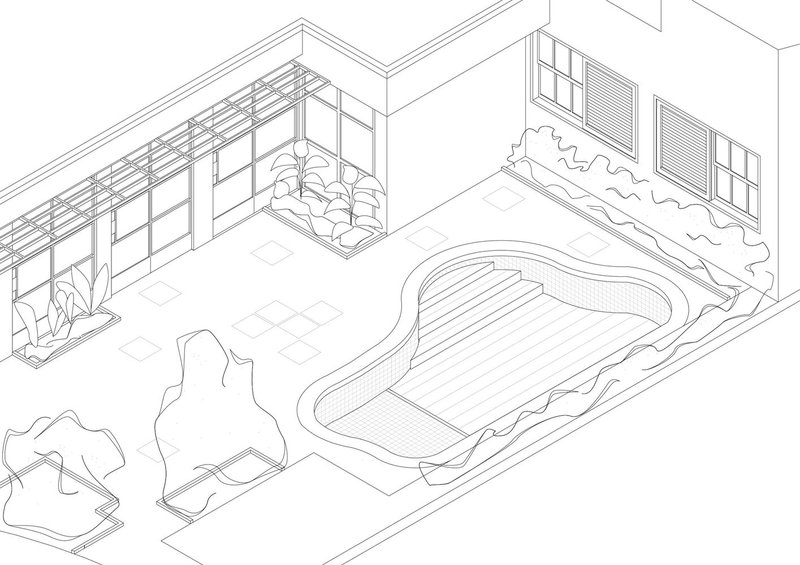
The floor plans reveal the split-level organization of the house, with the ground floor accommodating the open gallery, library, kitchen, and the deactivated pool converted to a decked platform. The basement level holds a projection room, storage, and a garden courtyard, giving the gallery a secondary event space below grade. Sections through the building expose the arched ceiling over the former pool area and the double-height glass block wall, clarifying how daylight penetrates deep into the plan.
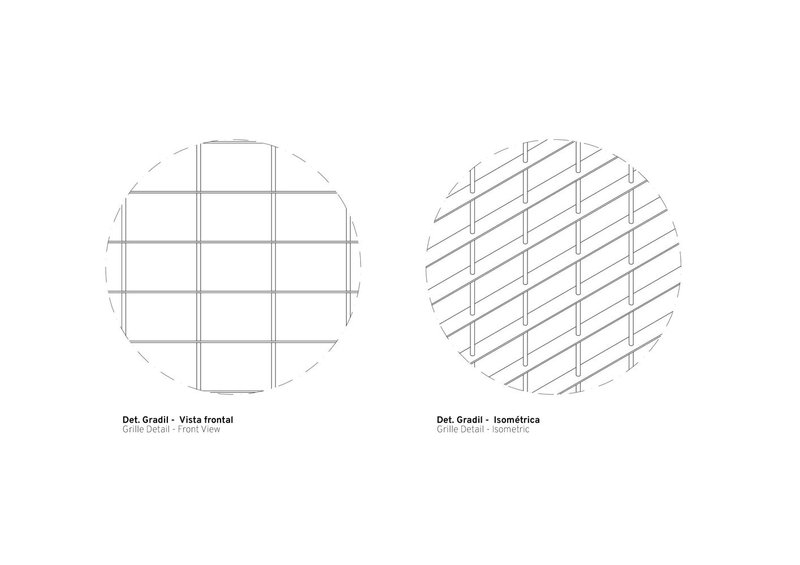
The isometric and axonometric drawings are particularly revealing. They show flexible furniture configurations within the vaulted gallery room, demonstrating how the space adapts for exhibitions, talks, and casual use. The landscape axonometric maps native plant species to specific positions around the courtyard, illustrating the horticultural logic behind what might otherwise read as informal tropical planting. The detail drawings of a circular lattice grille, shown in front view and isometric projection, document the care taken with individual elements that would be easy to overlook.
Why This Project Matters
Heritage preservation in Latin America too often oscillates between two poles: either a building is embalmed as a museum piece, or it is gutted for commercial use with a thin veneer of historical sensitivity. MOBIO Arquitetura's approach here charts a third path. By layering a gallery, shop, café, and office into a 1952 house without erasing its domestic character, the project demonstrates that adaptive reuse can be genuinely additive. The building gained a public life it never had, starting with the simple removal of a wall that had kept it hidden.
The 2025 Sylvio de Vasconcellos Award recognized what is evident in the work itself: that the most respectful thing you can do with a heritage building is fill it with activity. The ceramics, the café, the landscape, and the architecture all participate in the same cultural argument. Art belongs in everyday spaces, and everyday spaces deserve the care that preservation demands. In a city like Belo Horizonte, where midcentury modernism is both a civic identity and an endangered resource, this project sets a standard worth replicating.
Ateliê de Cerâmica Gallery by MOBIO Arquitetura. Belo Horizonte, Brazil. 387 m². Completed 2023. Photography by Reverbo.
About the Studio
Share Your Own Work on uni.xyz
If projects like this are the kind of work you want to make, uni.xyz is a place to publish your own, find collaborators, and enter design competitions.




Popular Articles
Popular articles from the community

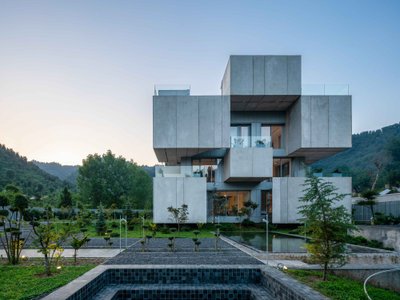
Bood Design Bureau Splits a Gilan Residence in Two to Let the Forest In
Double Side House negotiates privacy and openness through interlocking concrete volumes and planted courtyards in northern Iran's humid Caspian lowlands.
Guangzhou's Twin Towers Interiors Move Like Water
DuShe Architectural Design shapes the lobbies of a massive Guangzhou transit hub with undulating ceilings and deep geological materiality.

CTA | Creative Architects Designs Triangular Floating Shelters for Vietnam's Flood-Ravaged Communities
A timber-louvered triangular shelter rises on concrete pontoons to keep Vietnamese families safe and together when floodwaters come.
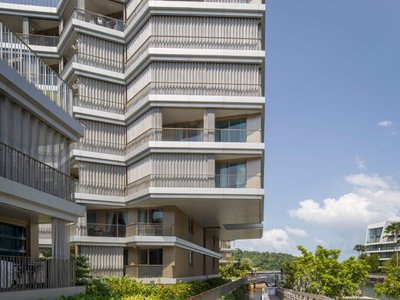
KCAP and DCA Architects Build a Stepped Urban Village on Singapore's King's Dock Waterfront
A 26,000 square meter residential development in Singapore trades tower isolation for terraced courtyards and a planted promenade along the harbor.


Similar Reads
You might also enjoy these articles

Filtering Space: A Gradual Spatial Experience
From urban intensity to spatial calm.


The Ken Roberts Memorial Delineation Competition (Krob)
As the most senior architectural drawing competition currently in operation anywhere in the world, it draws hundreds of entries each year, awarding the very best submissions in a series of medium-based categories.

Waterfront Redevelopment and Urban Revitalization in Mumbai: Forging a New Dawn for Darukhana
A transformative waterfront redevelopment project reimagining Darukhana’s shipbreaking heritage into an inclusive urban future.

OUT-OF-MAP: A Call for Postcards on Feminist Narratives of Public Space
Rhizoma Design and Research Lab invites artists, designers, architects, researchers, and students to reflect on how feminist perspectives can reshape public space. Selected works will be exhibited in Barcelona, October 2026. Submissions open until 15 April 2026.


Explore Architecture Competitions
Discover active competitions in this discipline




The International Standard for Design Portfolios


The Global Benchmark for Architecture Dissertation Awards


The Global Benchmark for Graduation Excellence


Challenge to reimagine the Iron Throne
Comments (0)
Please login or sign up to add comments
No comments yet. Be the first to comment!