
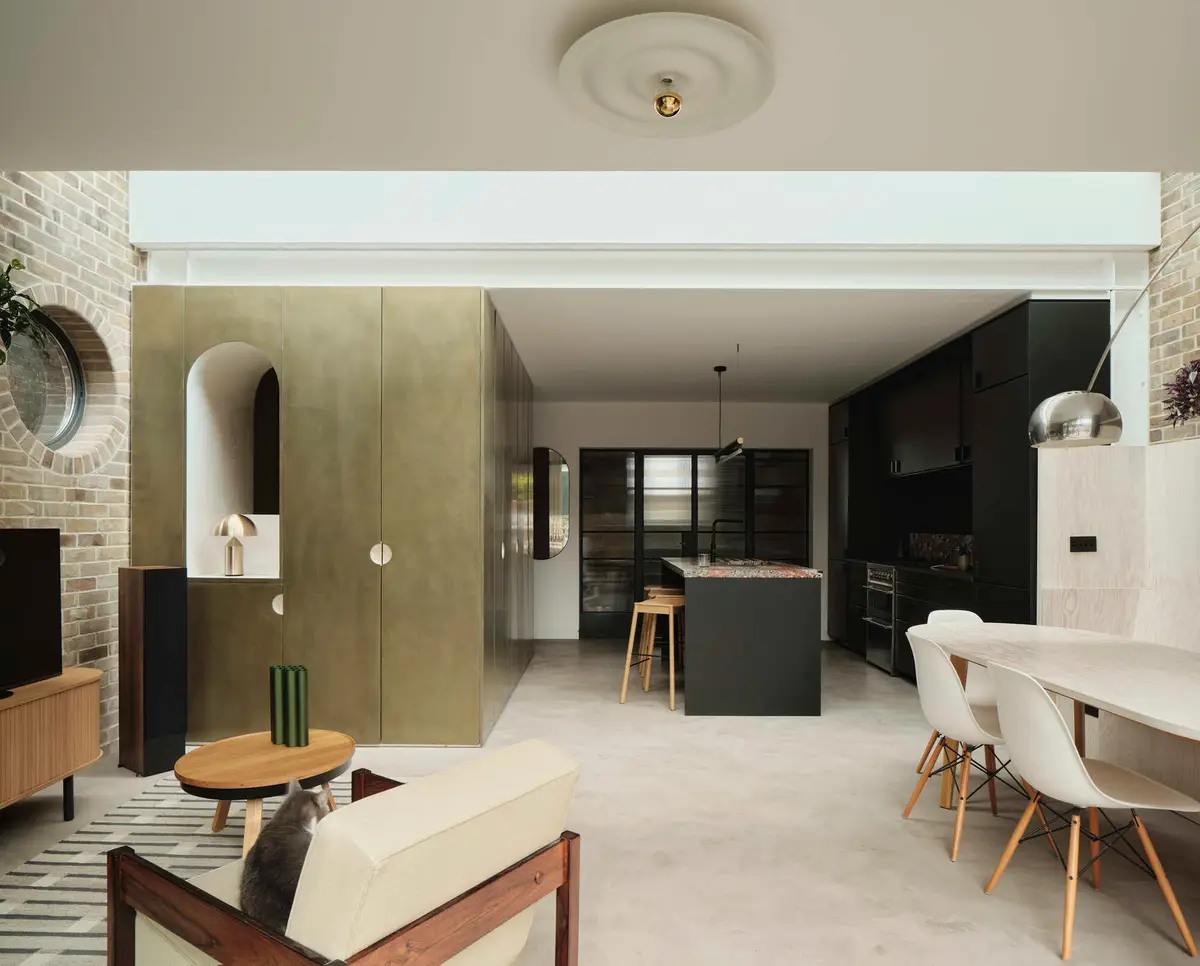
Atelier Baulier Wraps a 20 Square Meter Islington Extension Around a Brass-Clad Core
A compact rear addition to a Victorian flat in Canonbury East uses salvaged materials, screw piles, and natural brass to punch above its weight.


Twenty square meters is less than a generous bedroom. It is the footprint of many garden sheds, and it is roughly the size of the extension that Atelier Baulier has added to the rear of an early Victorian house in Islington's Canonbury East Conservation Area. Yet this modest addition, completed in 2021, has fundamentally reorganized the lower-ground floor flat it serves, turning a cramped one-bedroom layout into a home that breathes outward toward its garden and upward through a carefully placed roof light.
What makes Rotherfield Street worth studying is not the extension itself but the strategy that drives it. The entire plan revolves around a single brass-clad storage volume that doubles as the spatial hinge of the flat. A new staircase is carved through this volume, an aperture is cut to pull garden views into the hallway, and the reflective brass surface bounces daylight deep into the floor plate. The material palette, mixing secondhand Crittall doors sourced from eBay, grey clay skim floors, and timber structure in place of steel, treats resourcefulness not as a constraint but as a design language.
The Brass Hinge
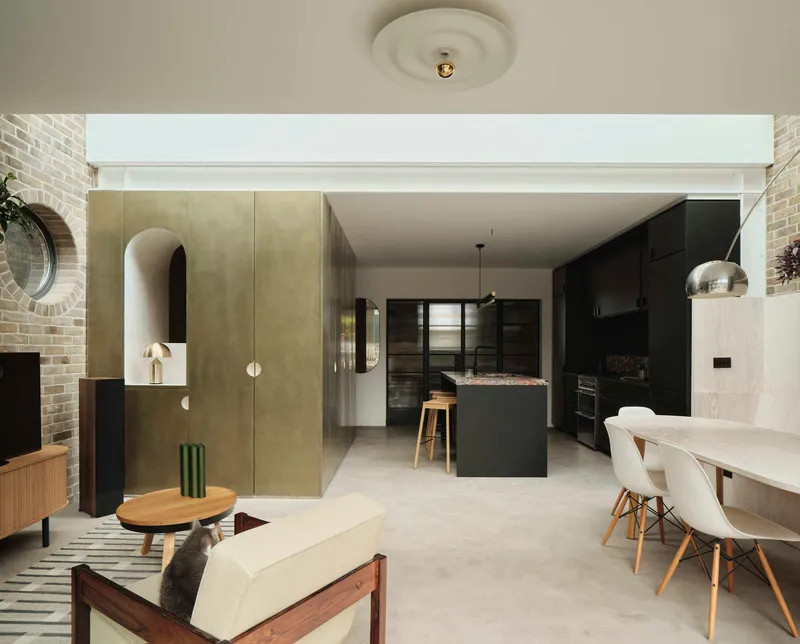
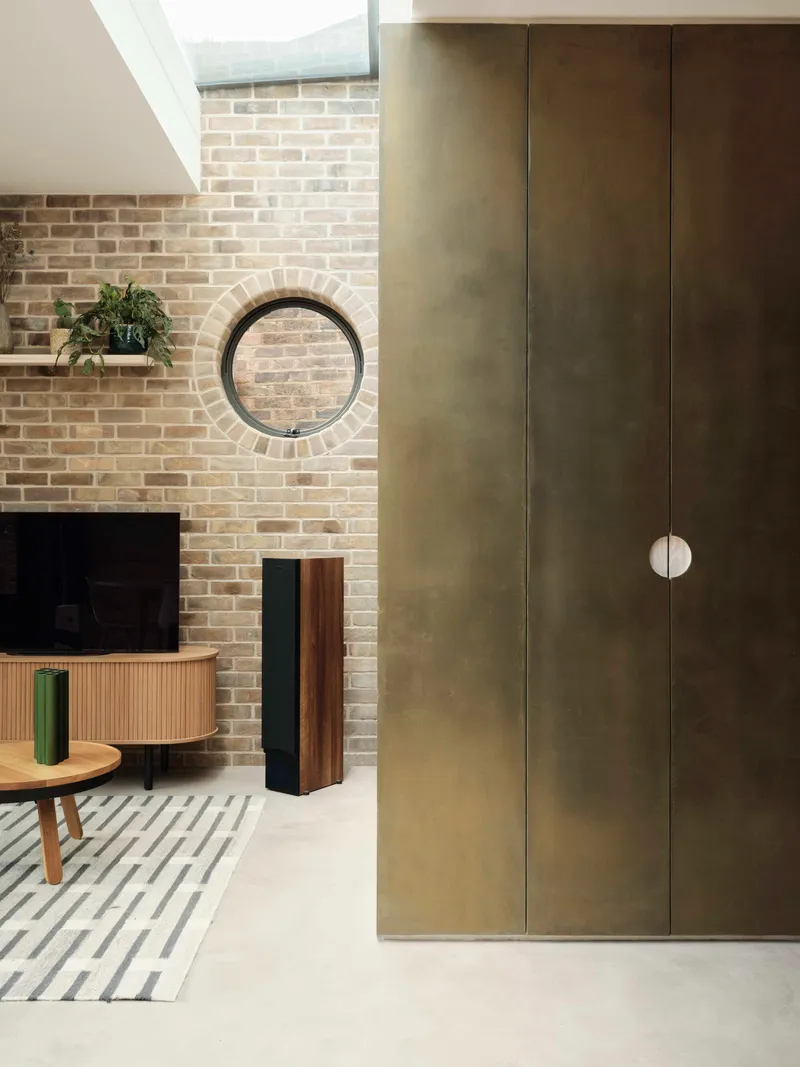
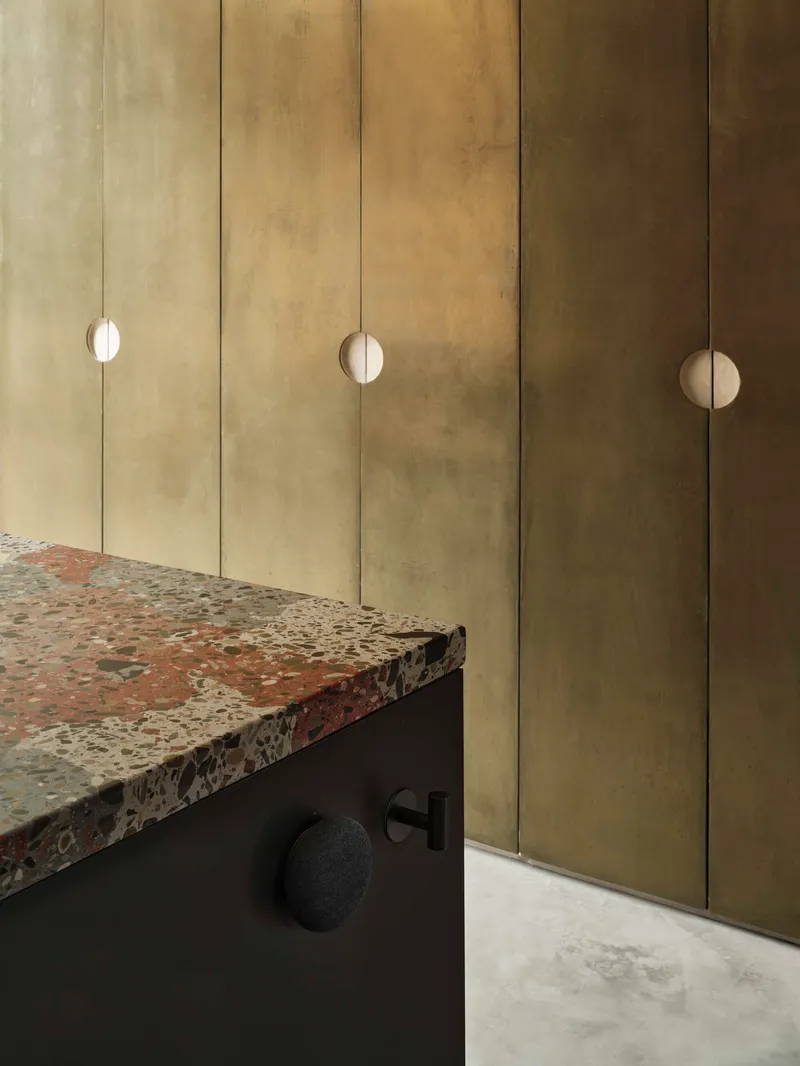
The brass-clad volume is the organizational engine of the plan. It houses storage, wraps the staircase, and separates the front sitting room from the open kitchen-living space at the rear. Its surface is natural brass rather than lacquered, chosen specifically because it will tarnish and develop a patina that records the life of the house over decades. Circular recessed pulls in the cabinetry keep the surface planes clean, letting the material do the talking.
More than decorative, the brass works thermally and optically. Its reflectivity distributes indirect light from the roof light and rear glazing deeper into what would otherwise be a dark Victorian floor plate. Against the buff brickwork of the existing fireplace wall, the warm metal reads as both contemporary intervention and something that has always belonged.
Dissolving the Rear Wall
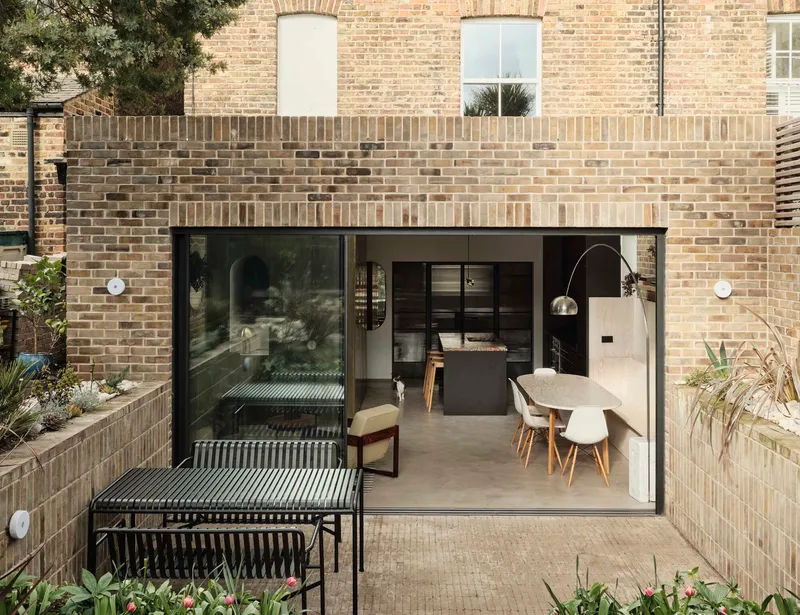
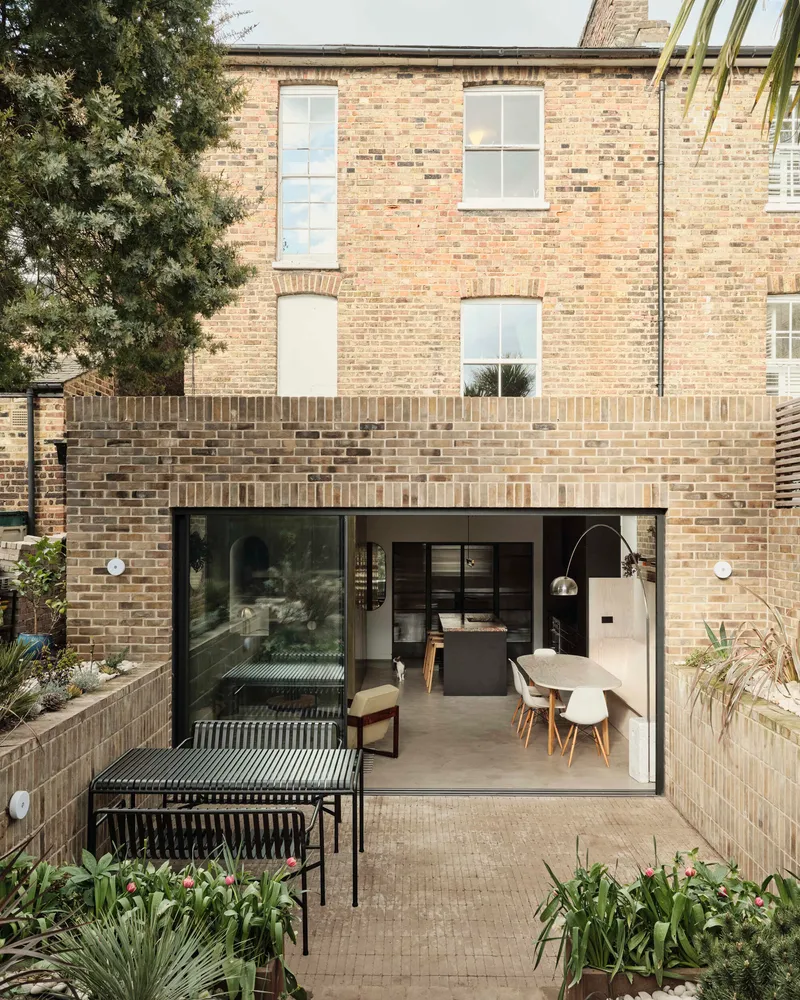
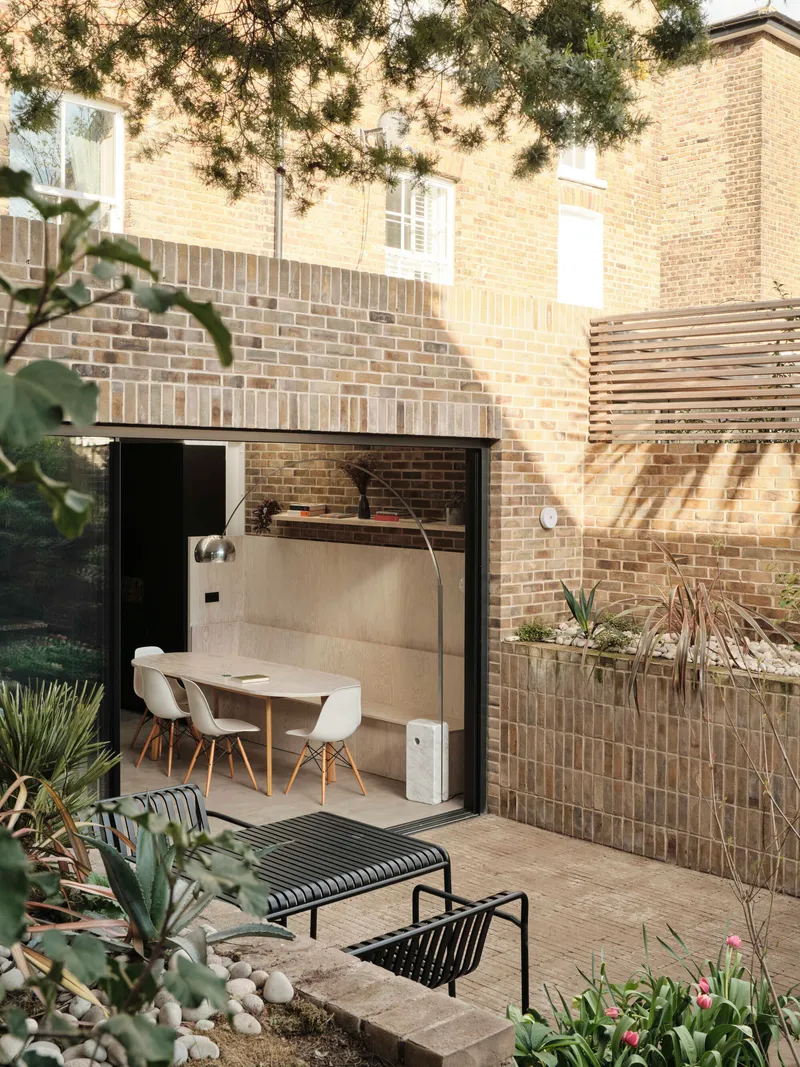
The original rear facade at the lower ground floor was removed entirely, replaced by full-width sliding glass doors with a flush threshold. On warm days the kitchen-living room simply extends into the courtyard without a step or a sill to mark the transition. Brickwork continues from the interior out into the patio, reinforcing the idea that inside and outside are not separate zones but a single continuous surface.
From the garden, the extension reads as a restrained single-storey volume tucked beneath the original three-storey gabled house. The proportions are deliberately quiet. Nothing shouts about the newness of the addition; instead, the buff brick and generous glazing suggest a garden room that has always been part of the property.
Kitchen as Social Center
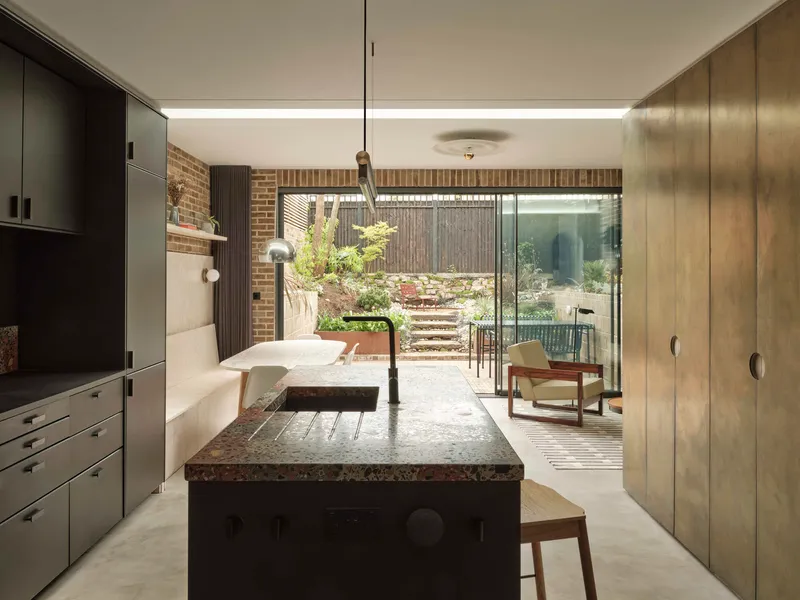
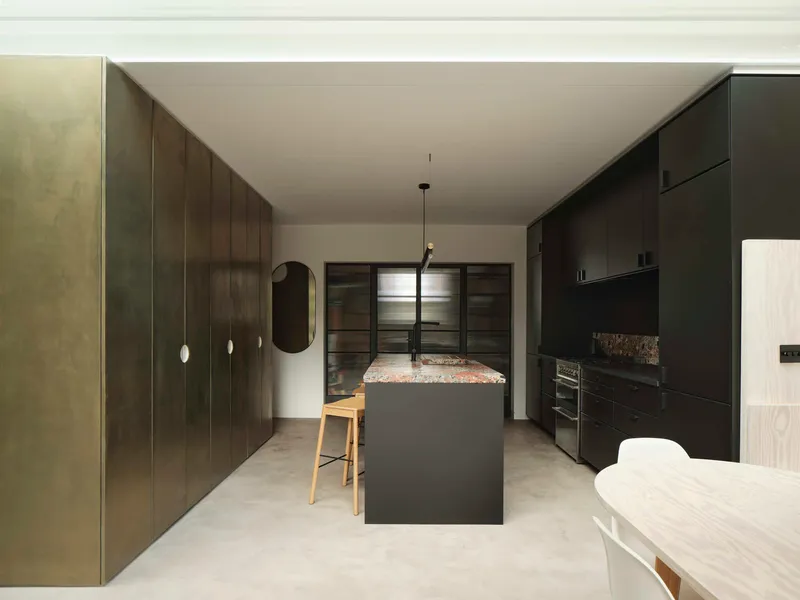
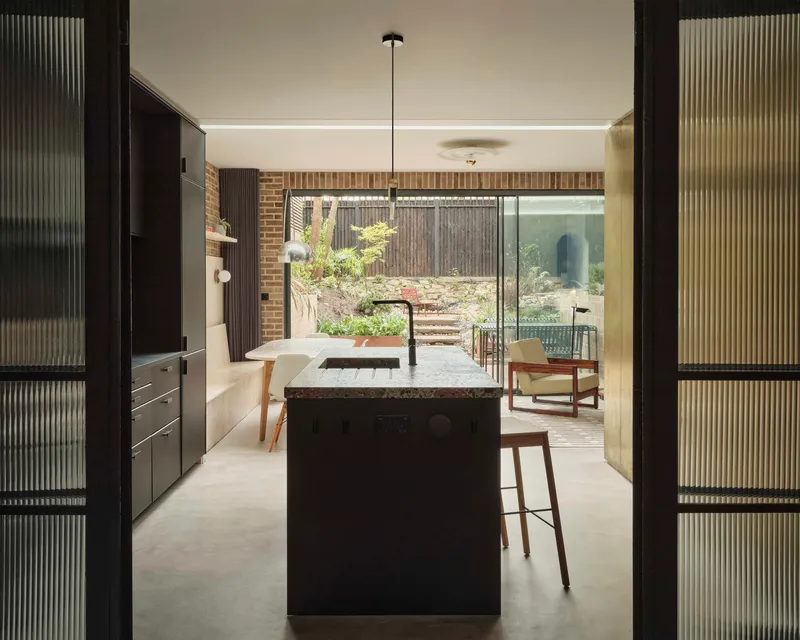
The enlarged kitchen occupies the heart of the new plan. A terrazzo-topped island bench anchors the space, with dark timber cabinetry lining the walls. The terrazzo reappears as a splashback elsewhere in the flat, threading a material connection through rooms that were previously disconnected. Views from the island run straight through the sliding doors to the planted rear garden, making cooking a social act oriented toward daylight and greenery.
Refurbished Crittall doors, sourced secondhand and restored, separate the front sitting room from the open-plan rear. Their fluted glass panels filter light between rooms while maintaining acoustic separation. It is the kind of detail that reveals the project's ethic: why specify new steel-framed glazing when perfectly good Crittall exists on the secondhand market, complete with the patina and proportions that suit a Victorian house?
Brick Arches and Borrowed Light
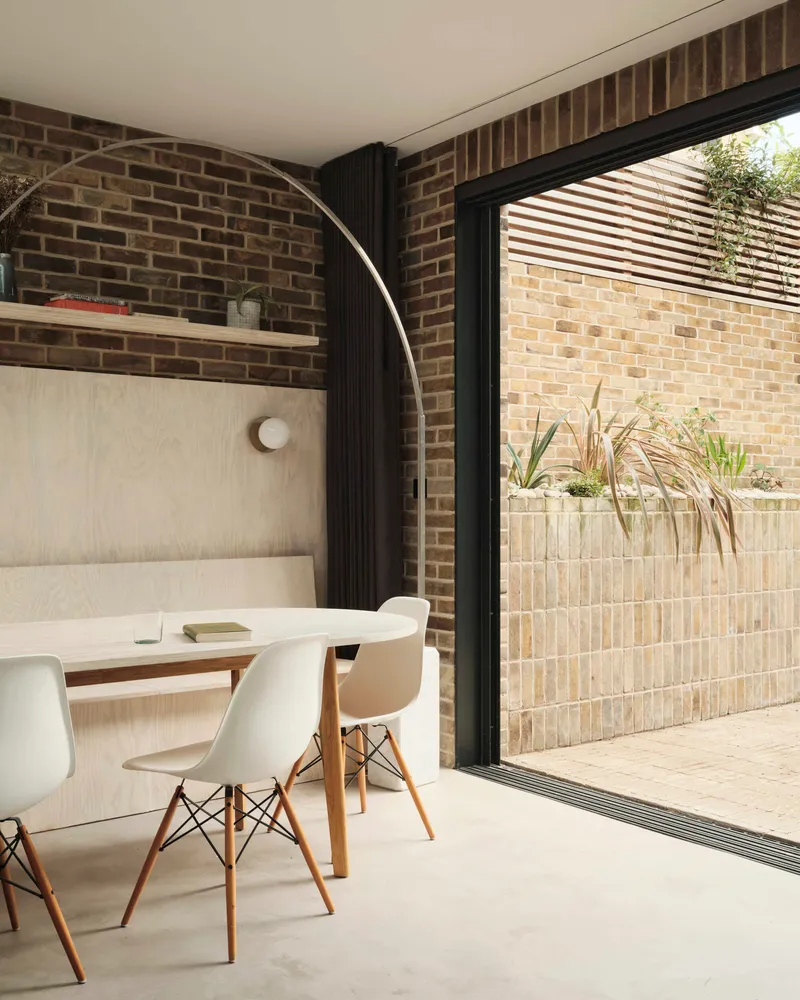
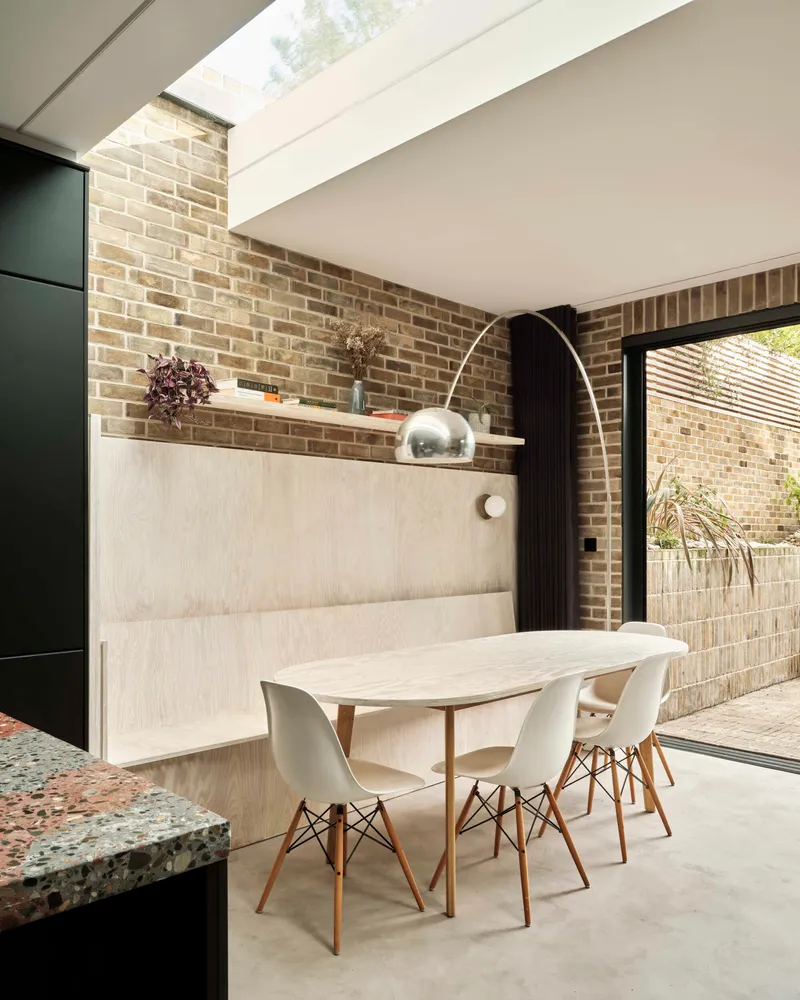
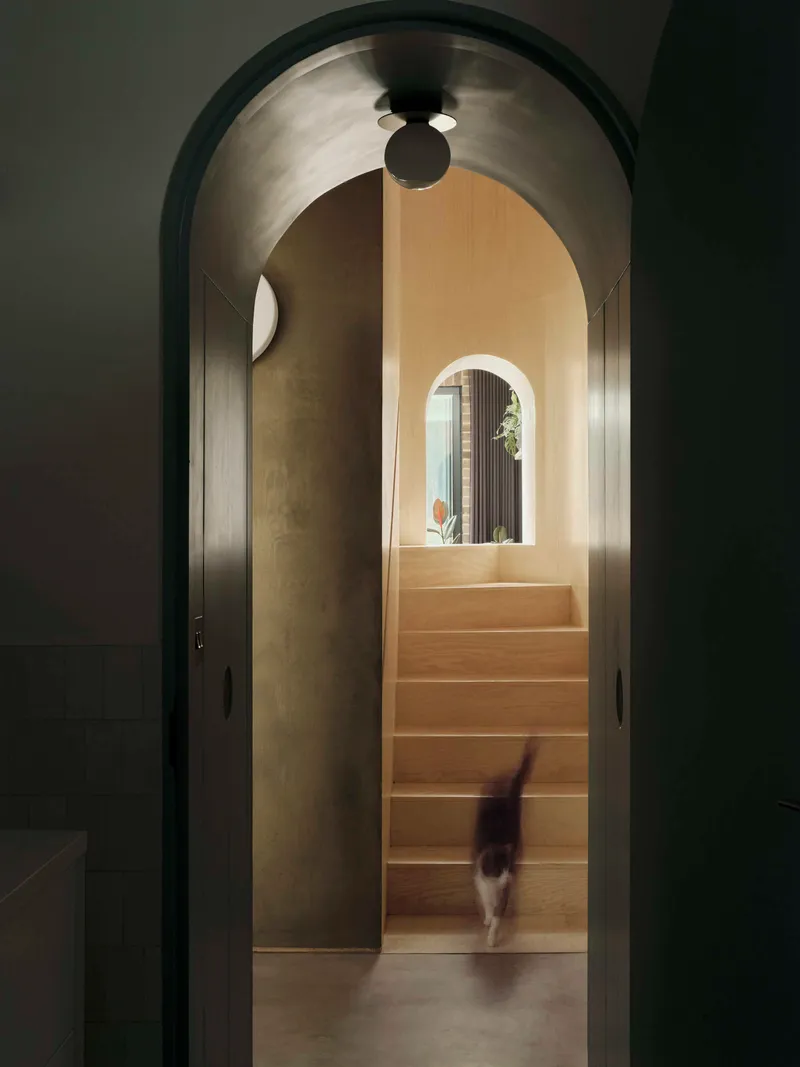
Arched brick recesses appear throughout the flat, some original, some reinterpreted. In the dining area, an arched opening frames a view to the courtyard planting while a linear skylight slices through the extension roof above, pulling a band of daylight into the deepest part of the interior. The roof light also increases the ceiling height locally, giving the dining zone a vertical generosity that the compact plan does not have on paper.
An arched doorway with a black frame leads to the bathroom, and another frames the timber staircase where the architects carved a new opening through the brass volume. A salvaged fireplace, relocated from the original bedroom to the sitting room, sits within one of the existing brick arches. These moments of reuse are not sentimental; they are acts of economy that happen to enrich the spatial experience.
Staircase and Circulation
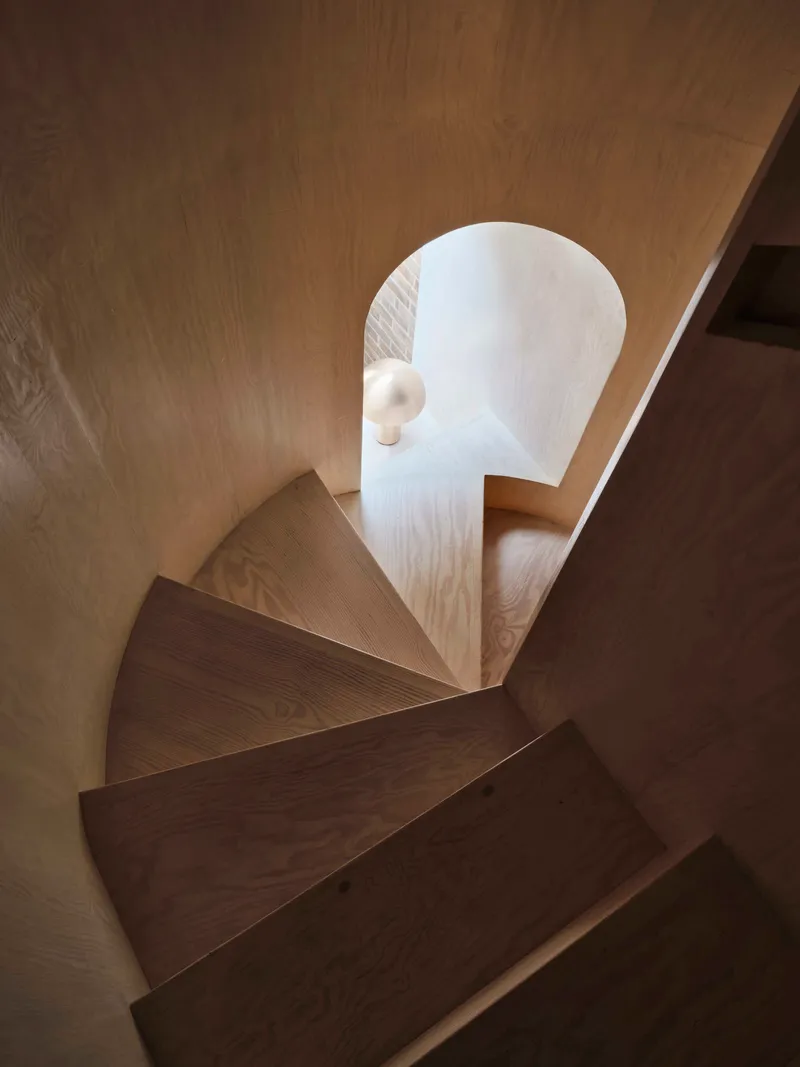
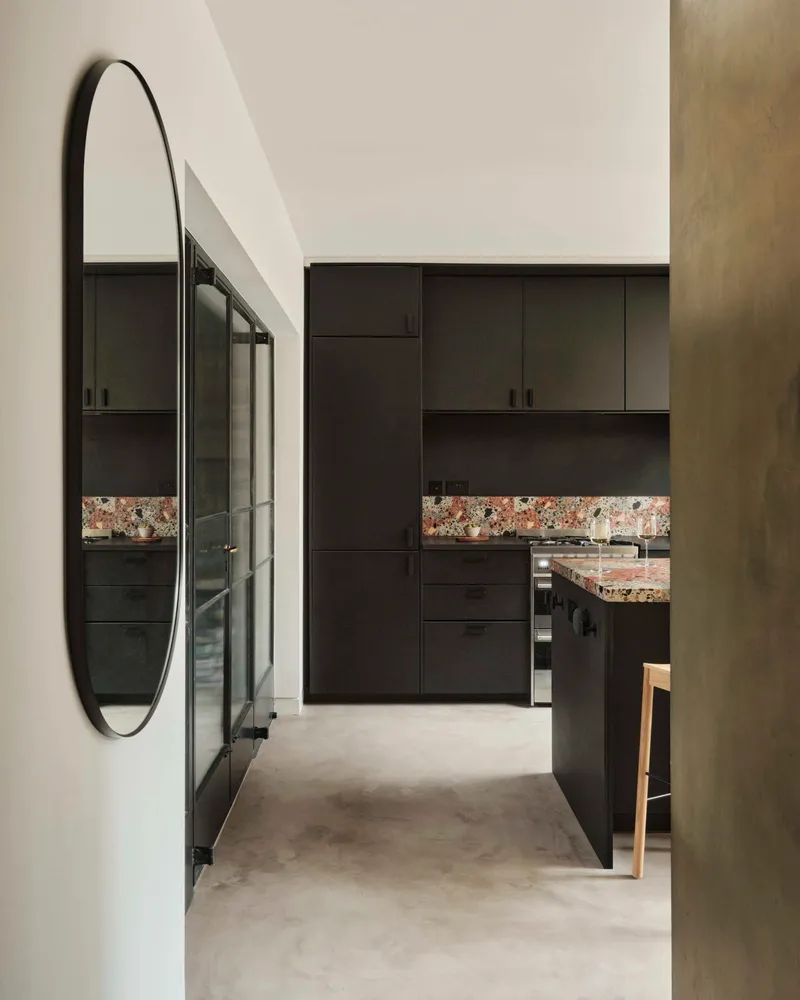
The new staircase wraps around a white plaster core, its curved timber treads and wooden handrail providing a warm, tactile counterpoint to the brass and brick elsewhere. Viewed from above, its geometry is tight and efficient, occupying minimal floor area while connecting the lower ground to the floors above. The hallway that leads to it is marked by an oval mirror and multicoloured terrazzo splashback that signals the transition from public to private zones.
An aperture carved from the stair enclosure pulls a slice of garden view into the hallway, a simple move that prevents the circulation space from feeling like a leftover. Light and sightlines flow through the volume rather than stopping at its walls.
The Bathroom as Quiet Resolution
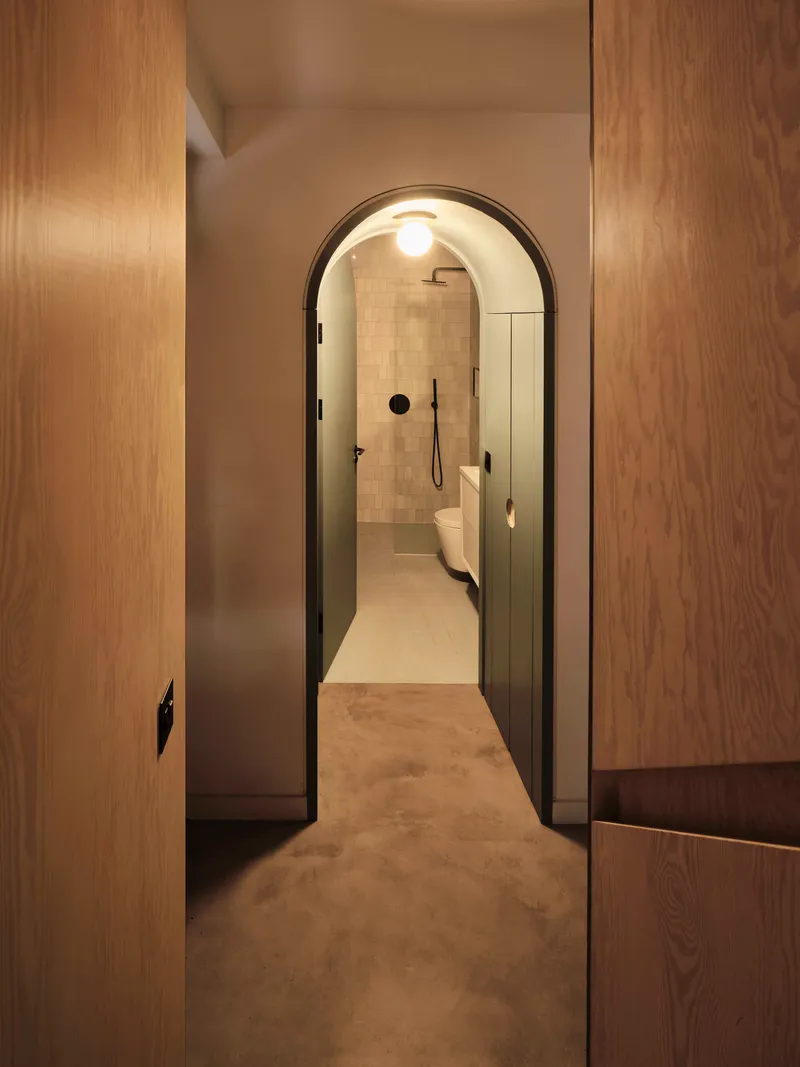
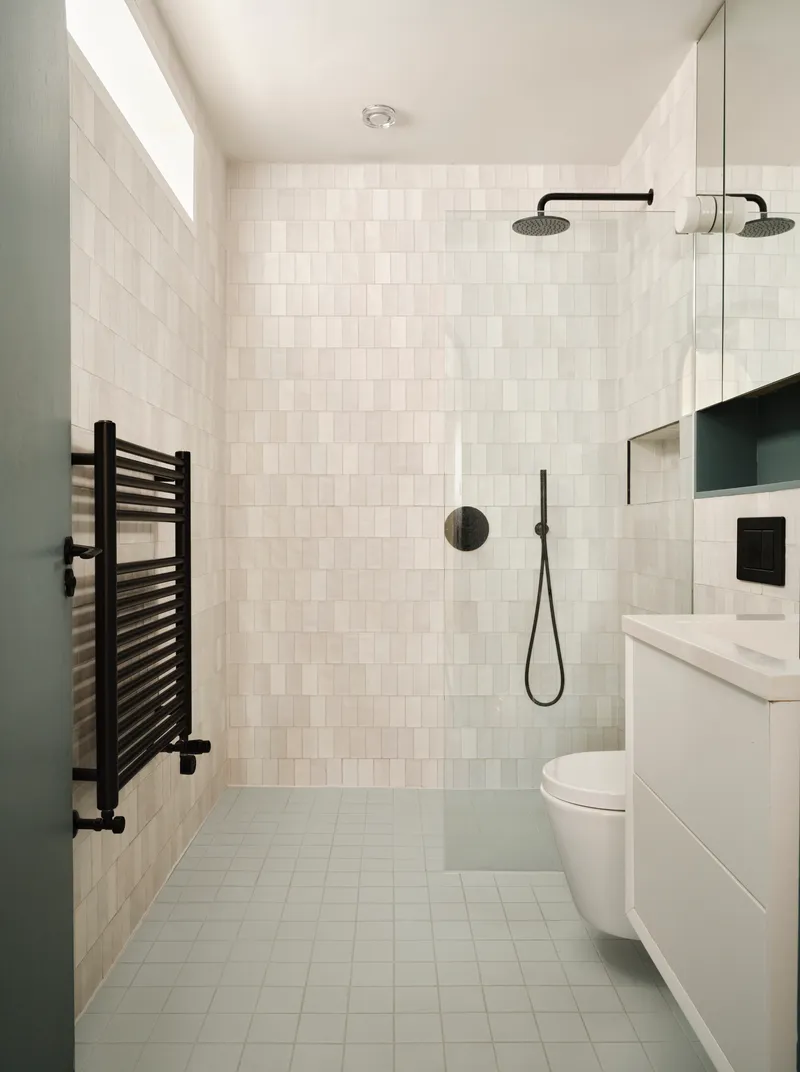
The bathroom is compact and unapologetic about it. White square tiles cover the walls, black fixtures provide contrast, and a skylight above the shower area means artificial light is rarely needed during the day. A towel radiator doubles as the room's only visible piece of hardware. The arched doorway that frames the entry gives the room a sense of occasion that its size alone would not warrant.
Plans and Drawings
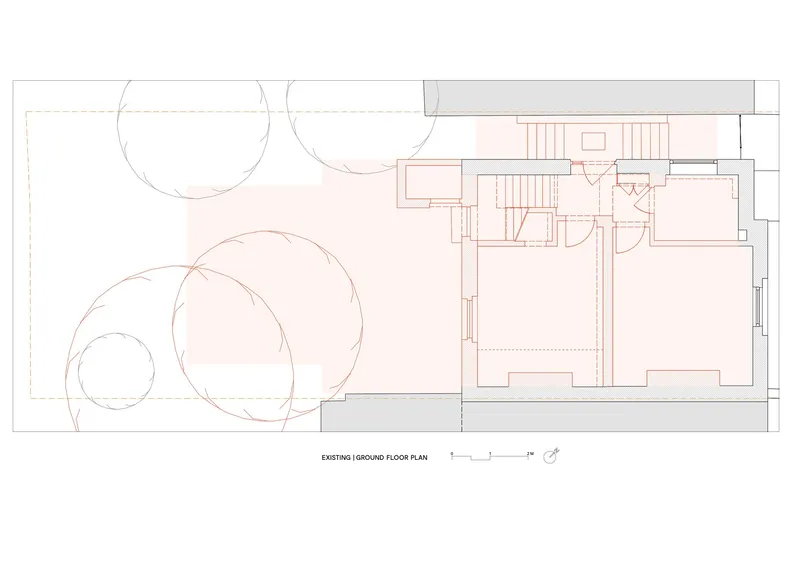
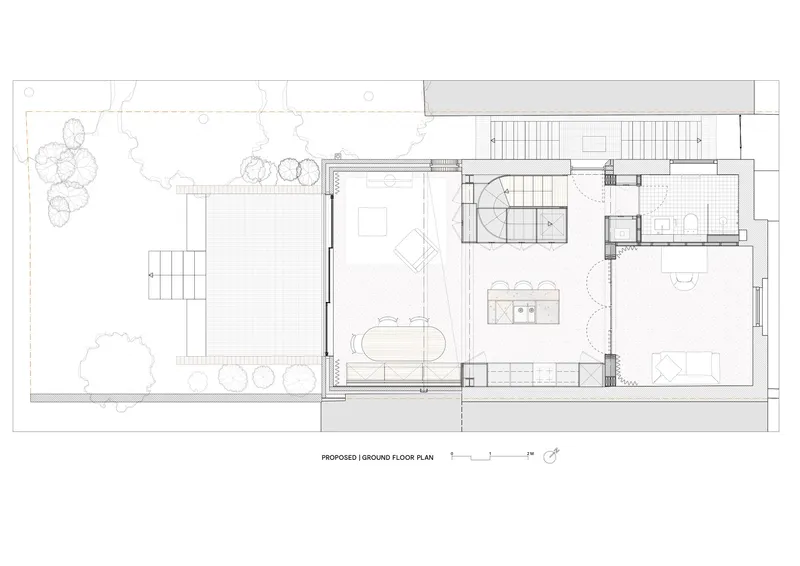
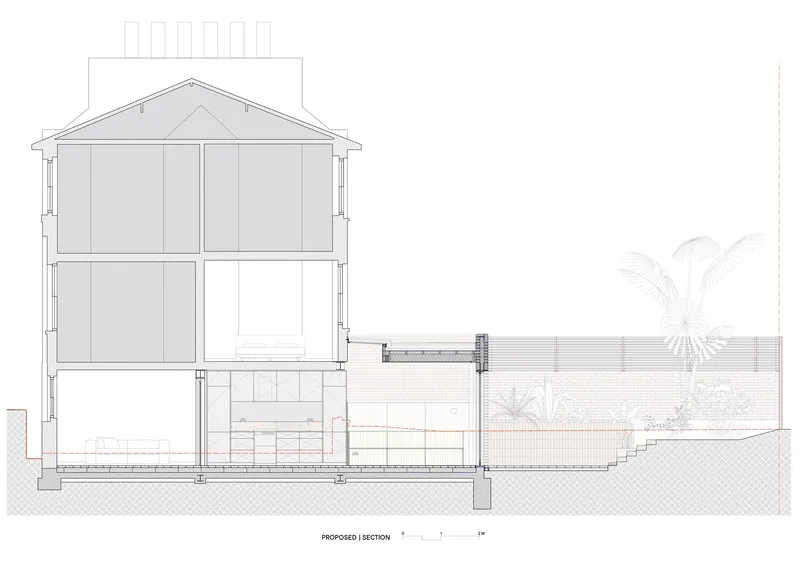
Comparing the existing and proposed floor plans makes the scale of the reorganization legible. The existing layout isolates rooms behind solid partitions, with a narrow corridor running alongside the staircase. The proposed plan opens the rear half of the flat into a single kitchen-dining-living volume, repositions the staircase within the brass volume, and extends the full width of the rear elevation into the garden. The section drawing reveals how the single-storey extension sits below the three-storey gabled house, its roof light and planted landscaping establishing a new relationship between the lower ground and the sky.
Screw pile foundations, chosen over concrete for their lower embodied carbon and faster installation, support the extension. Timber replaces steel in the structural frame. These are not headline-grabbing sustainability gestures but the kind of quiet, cumulative decisions that actually reduce a project's environmental impact at a domestic scale.
Why This Project Matters
Rotherfield Street is a reminder that ambition in domestic architecture is not measured in square meters. At 20 square meters, the extension is barely a room. But Atelier Baulier has used it as the catalyst for a complete rethinking of how the flat works, how it connects to its garden, and how daylight reaches its deepest corners. The brass volume is the kind of strong organizational idea that turns a renovation into a project worth publishing: one move that resolves circulation, storage, light distribution, and spatial sequence simultaneously.
The material strategy is equally instructive. Secondhand Crittall, salvaged fireplaces, screw piles instead of concrete, timber instead of steel. None of these choices are conspicuous, and none require a sustainability label to justify themselves. They simply make sense for a project that is honest about its means and precise about its intentions. In a city where Victorian flat conversions are practically a genre, Rotherfield Street sets a quiet standard for how they should be done.
Rotherfield Street by Atelier Baulier. Islington, United Kingdom. 20 m². Completed 2021. Photography by Henry Woide.
About the Studio
Share Your Own Work on uni.xyz
If projects like this are the kind of work you want to make, uni.xyz is a place to publish your own, find collaborators, and enter design competitions.


Popular Articles
Popular articles from the community


The Ocean Hive: Sustainable Architecture for a Self-Sufficient Civilization at Sea
The Ocean Hive imagines sustainable architecture at sea, where modular habitats, algae, wave power and ocean waste sustain a growing colony.

Co-Life: Senior Housing Design That Reconnects Older Adults With the City
Co-Life reimagines senior housing design through healing gardens, shared streets, workshops, and a sustainable community across generations.

The Musturak Paradise: Senior Living Architecture for a Connected Future in Temara, Morocco
The Musturak Paradise reimagines senior living architecture in Temara via private homes, social spaces, culture, community, and shared care.

Little Red Riding Hood: Architectural Design as a Journey Through Fear, Light, and Storytelling
Little Red Riding Hood reimagines the fairy tale through architectural design shaped by fear, light, scale, memory, uncertainty, and choice.

Similar Reads
You might also enjoy these articles

Bao Huynh Watercolor Atelier: A Serene Art Retreat in Hội An
Bao Huynh Watercolor Atelier in Hội An blends multifunctional art spaces, sustainable design, local materials, and family-friendly living in a serene environment.

Atelier Macri Concept Store Interior Design by CASE-REAL
Atelier Macri store features a "ko" counter, walnut wood details, cork displays, blending retail, gallery, and seamless customer experiences.

Manuel Vargas Izquierdo Stadium and High-Performance Sports Center: Architectural Excellence in Jalpa de Méndez
The Manuel Vargas Izquierdo Stadium blends sustainable design, inclusive sports facilities, and cultural-inspired architecture, revitalizing Jalpa de Méndez’s public spaces.

KAKR Buluh Awar Hall: Revitalizing Community and Ecology Through Bamboo Architecture
Community built bamboo hall revitalizes Buluh Awar village, empowering youth, restoring ecology, celebrating vernacular craftsmanship through sustainable architecture and culture.


Comments (0)
Please login or sign up to add comments
No comments yet. Be the first to comment!