
Atelier Central Arquitectos Slides a Concrete House Beneath the Pines of Southern Portugal
Between two nature reserves on the Algarve coast, a board-formed concrete residence dissolves into a wind-sculpted pine forest.


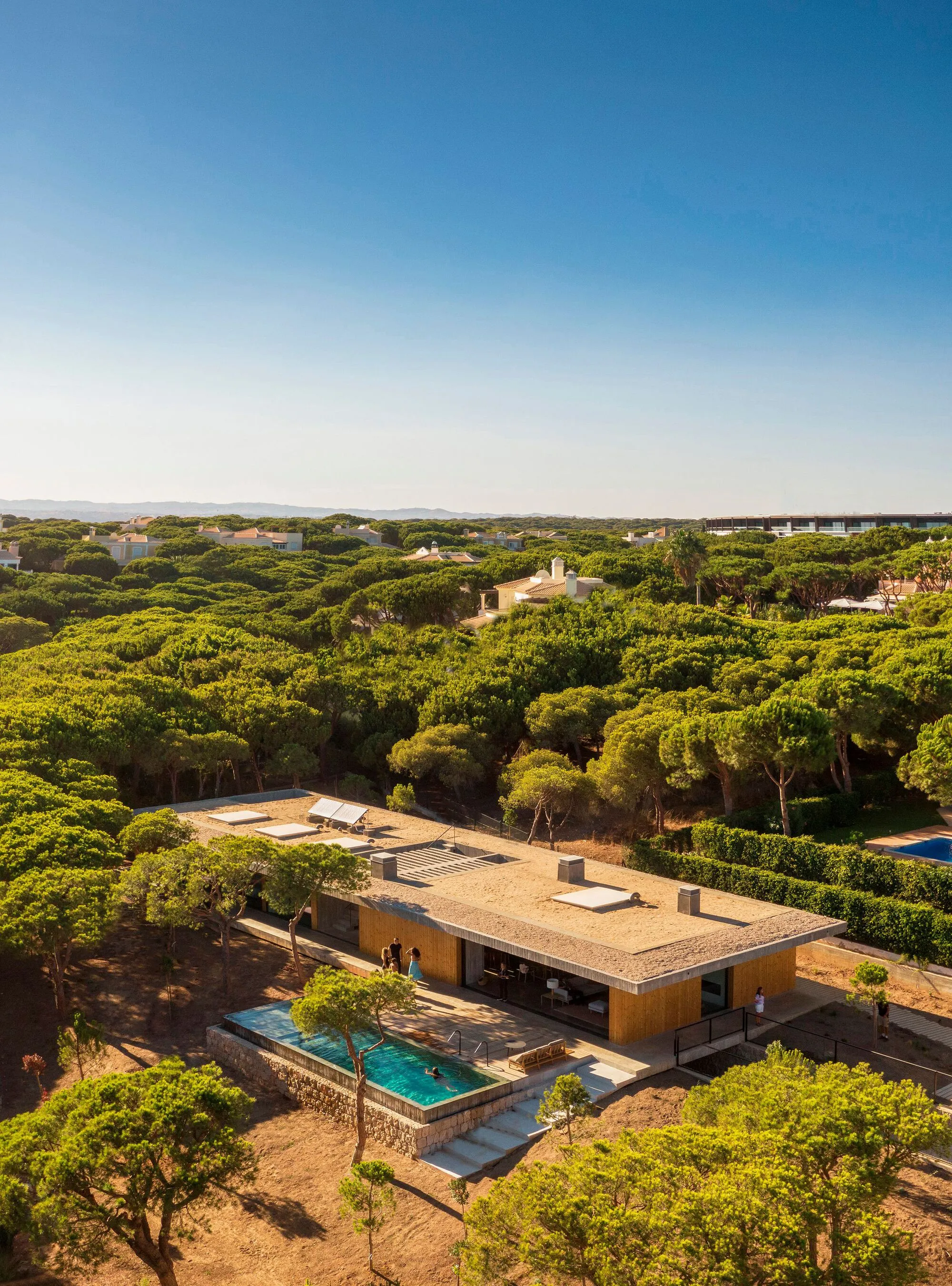
Somewhere between the Ria Formosa Nature Park and the Castro Marim Marshland Nature Reserve, a property holds an immense spontaneous pine forest shaped by decades of Atlantic wind. The trees lean, stretch, and twist their way toward a river at the site's southern edge, and the house that Atelier Central Arquitectos completed here in 2022 treats that canopy not as backdrop but as co-author. Two horizontal planes of exposed concrete, one a floor slab resting lightly on the ground and the other a protective roof canopy, frame the dwelling so that its profile never rises above the treeline. The result is a building that you could miss from the air, its planted roof blending into the green until only the mirror of a swimming pool gives it away.
What makes the House in Praia Verde genuinely compelling is its refusal to perform. The concrete is textured by aged wooden slats used as formwork, giving every surface a grain that ages alongside the bark of the surrounding pines. Window frames are concealed inside walls, so the glazed openings read as voids rather than as assemblies. A central patio cleaves the program in two, separating living spaces from bedrooms while unifying them under the same deep porch. The house follows sensation, texture, light, and shadow rather than any desire to announce itself, and that restraint produces something far more memorable than spectacle.
Disappearing into the Canopy
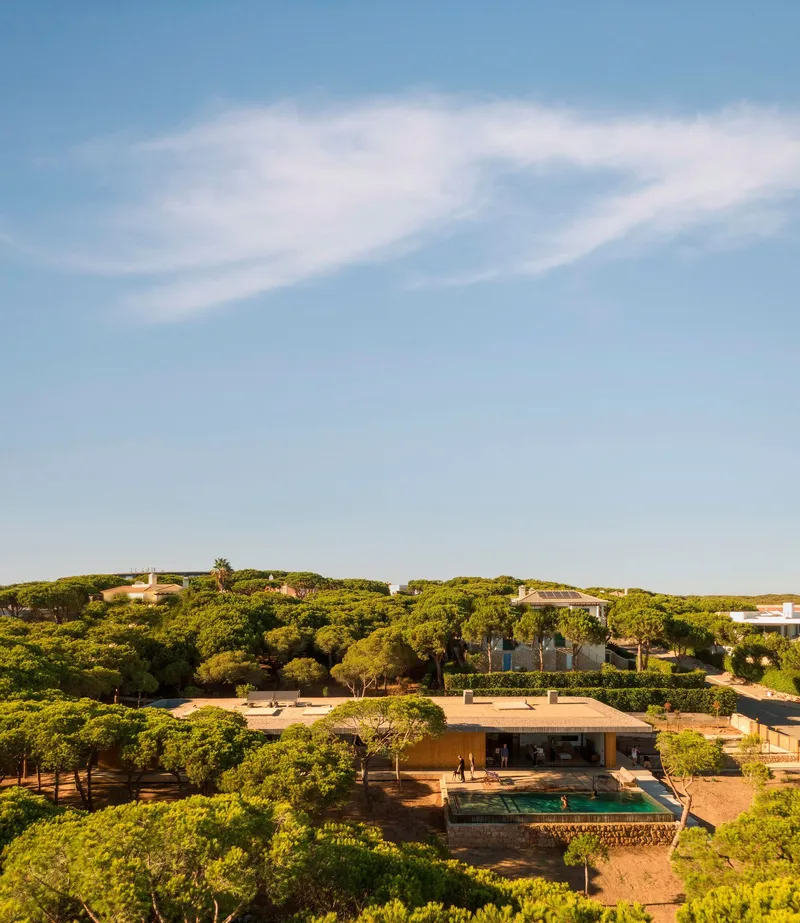


Seen from above, the residence reads as a long, thin slot cut into the pine forest. Its planted roof, layered with extruded polystyrene, expanded clay, river sand, and a growing medium that supports native species, encourages spontaneous vegetation to colonize the surface. At night, the roof also collects moisture from the coastal air, feeding the plants without irrigation. The effect is camouflage by ecology rather than by paint or cladding.
At ground level, the flat roofline sits well below the sculptured pine crowns, and the concrete canopy's edge was shaped in response to the tree canopy above it. Agave plants and sandy earth establish a buffer between the building's timber-clad walls and the surrounding forest floor. There is no formal garden, no hedge, no lawn. The landscape strategy is simple: keep what is already there and let the house defer to it.
Two Planes of Board-Formed Concrete
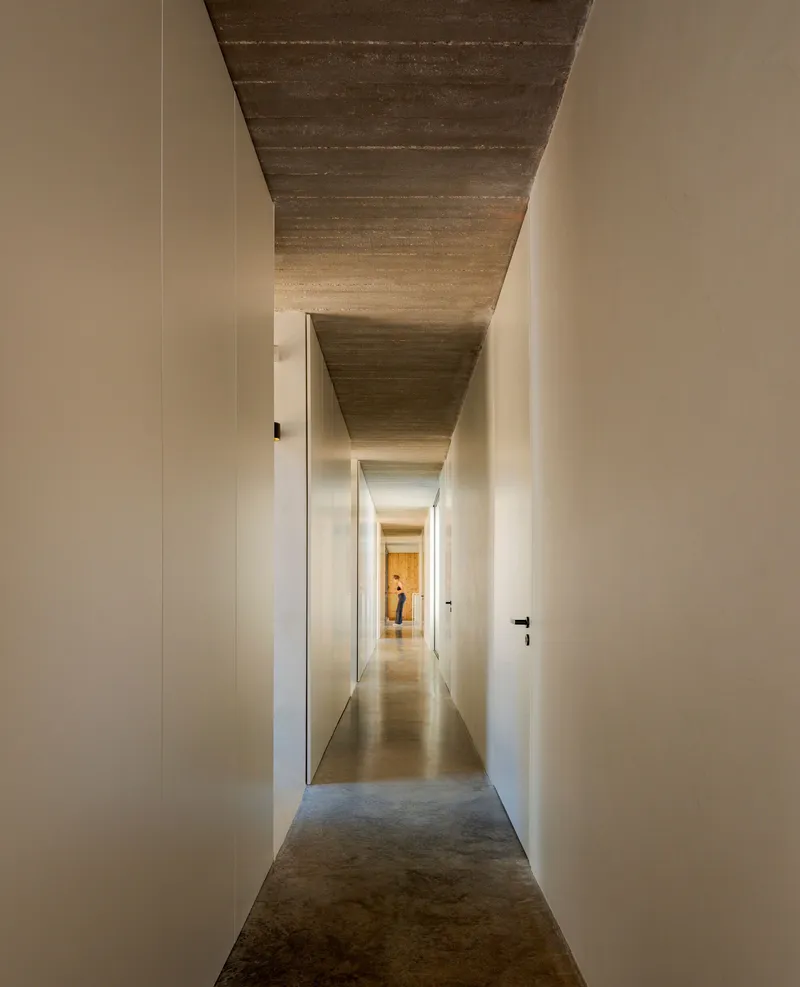


The structural idea is legible everywhere you look. A floor slab and a roof plane define the inhabitable space between them, while board-formed concrete walls subdivide rooms and carve out narrow courtyards. The formwork technique uses aged wooden slats, and the resulting imprint gives the concrete a warm, directional texture that softens what could otherwise be a brutalist interior. In the bathrooms, the same concrete wraps around integrated stone sinks and frames glazed doors to private outdoor decks. In the corridors, it creates compressed passages that heighten the release into open rooms.
The detail discipline is consistent: window frames vanish inside wall thicknesses, pendant lights hang from flush ceiling planes, and transitions between interior and exterior happen at the same floor level. When a material palette is this restrained, craft has nowhere to hide, and here the construction quality holds up.
Living Between Inside and Out
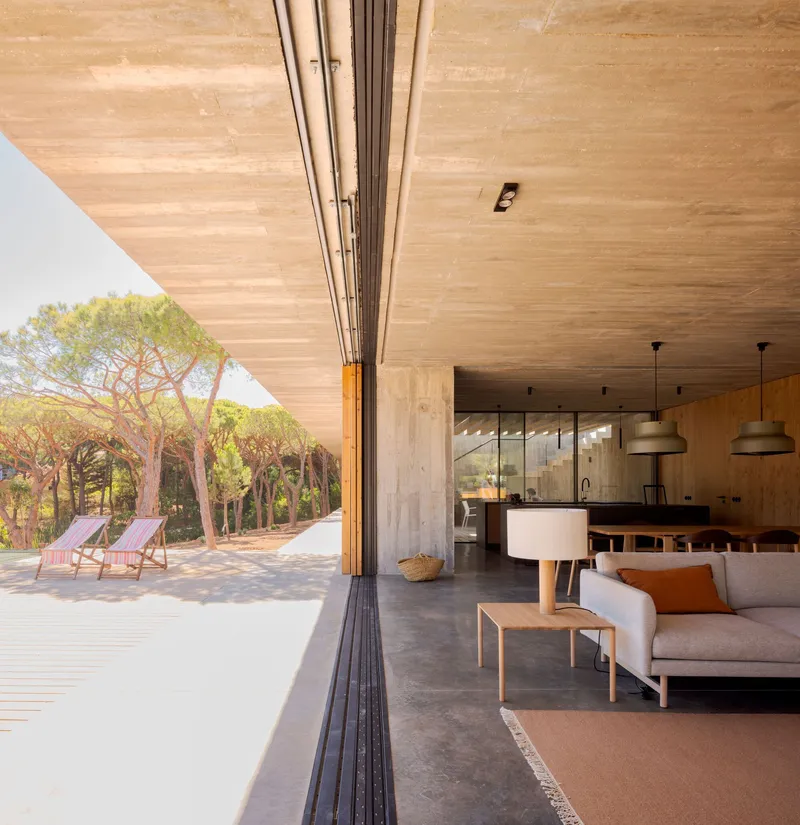


The open-plan living area demonstrates the payoff of concealing window frames. Full-height folding glass walls retract to merge the timber-ceilinged interior with a covered terrace, and because there is no visible mullion or threshold, the polished concrete floor and the timber deck outside sit in near-continuous alignment. Afternoon light enters from the south, filtered first by the pine canopy and then by an interior concrete pergola that tempers excessive solar gain.
A timber plank ceiling runs uninterrupted from the living room to the terrace soffit, binding the two zones into a single spatial experience. Furnishings are deliberately low and sparse, keeping sight lines open toward the forest. The architecture does the work that curtains and furniture usually have to do: controlling light, directing views, and defining zones through section rather than partition.
Kitchen and Dining as Inhabited Threshold

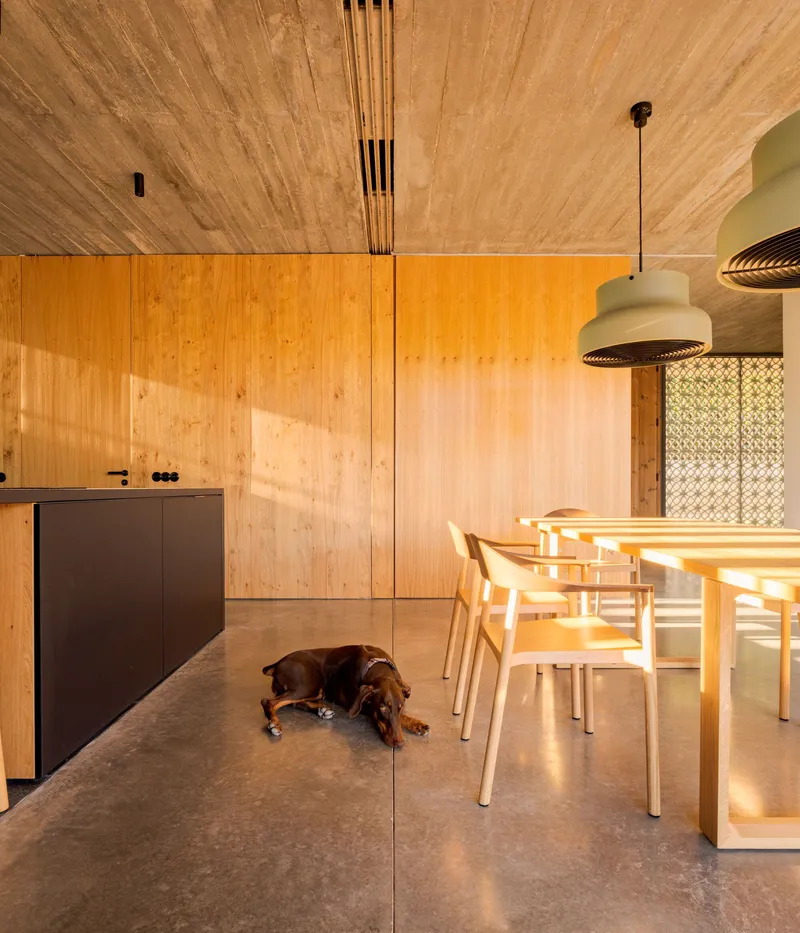
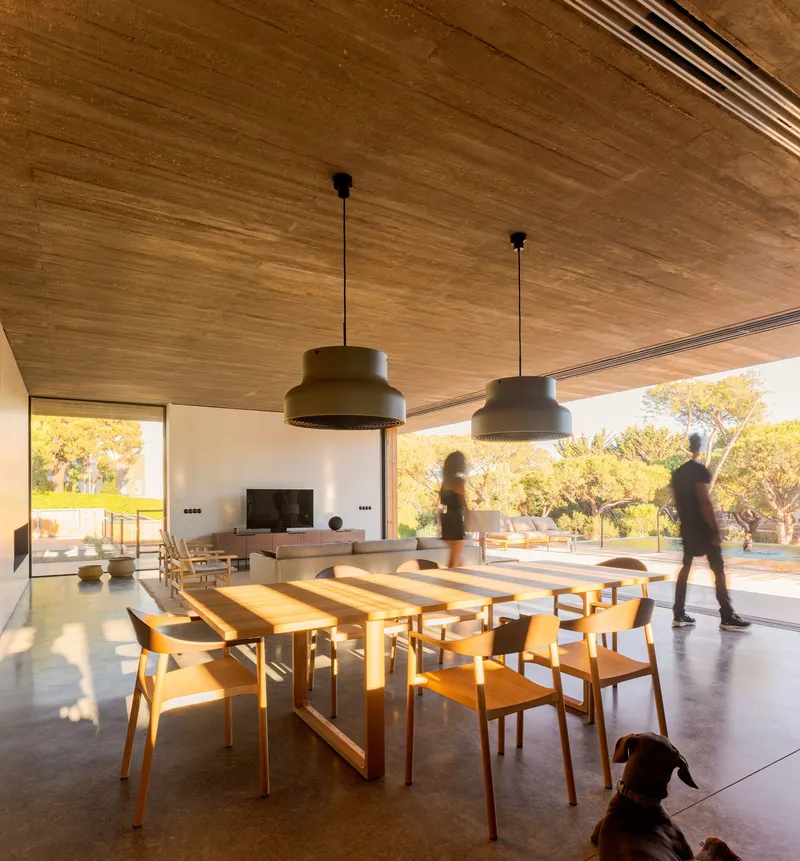
The kitchen sits at the hinge between the social and private wings, a galley lined with blonde wood cabinetry by Movimar. A breakfast bar faces south, catching afternoon sun, while pendant lights hang low over a timber dining table that seats the household without ceremony. The spatial sequence from kitchen to dining to terrace is entirely open, encouraging the kind of casual drift that holiday houses depend on.
Countertop materials remain warm and tactile. Combined with the board-formed concrete ceiling overhead, they create an honest material dialogue between processed wood and poured stone. A dog resting on the concrete floor in one view is the kind of incidental detail that tells you more about the house's inhabitation than any rendering ever could.
Screens, Corridors, and Filtered Light
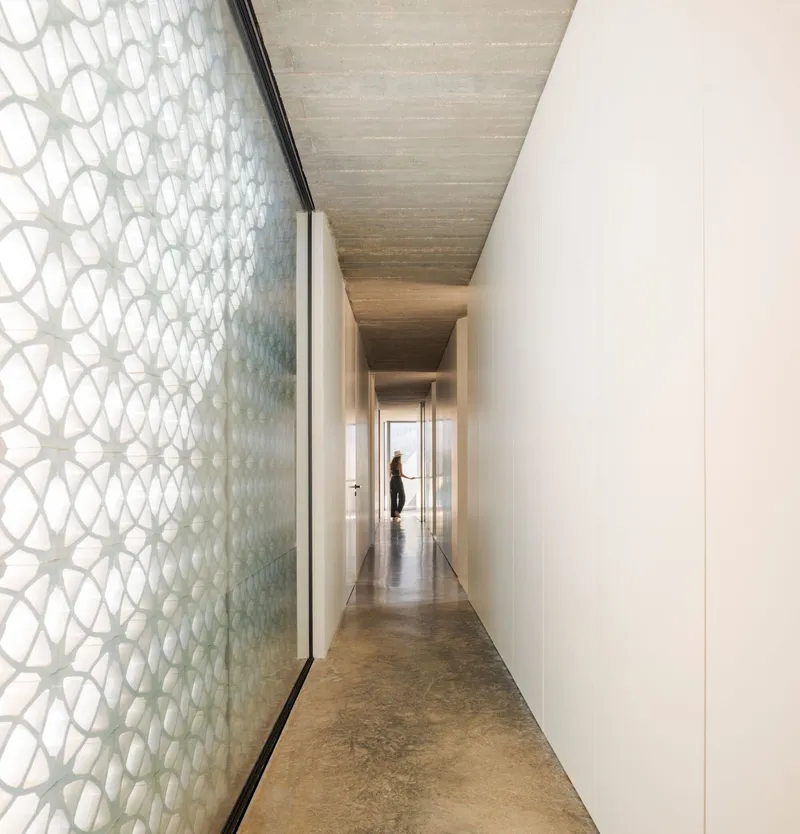


A series of patterned screens, some in glass and some in terracotta, punctuate the house's corridors and thresholds. The diagonal lattice at a doorway opening to the terrace throws sharp geometric shadows onto the timber deck, while a patterned terracotta screen along a covered walkway glows amber at sunset. These elements serve a dual role: they provide privacy and ventilation without closing off the visual connection to the landscape.
Transverse ventilation is built into the plan. The scattered courtyards that illuminate bathrooms and the laundry room also function as air channels, pulling cooler air through the house during the Algarve's hot summers. Combined with the south-facing orientation and the deep roof overhang that blocks high-angle summer sun while admitting low winter light, the passive environmental strategy is coherent and integrated rather than applied as an afterthought.
The Pool as Landscape Mirror
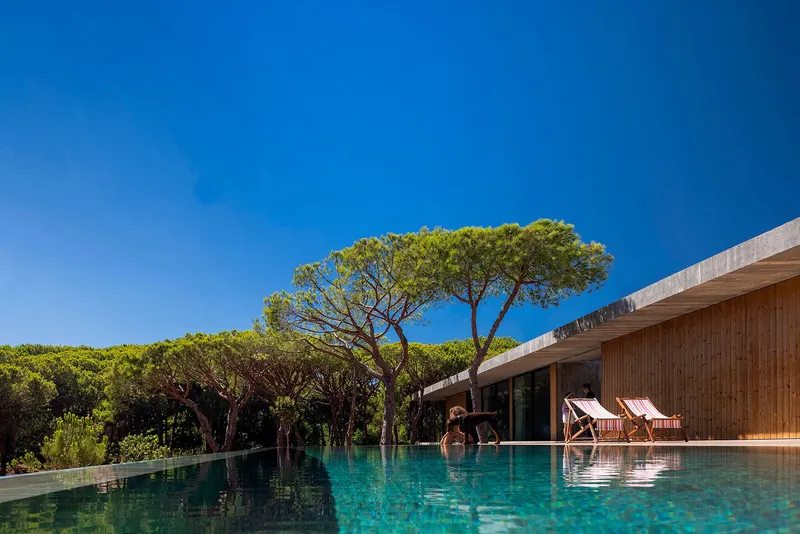


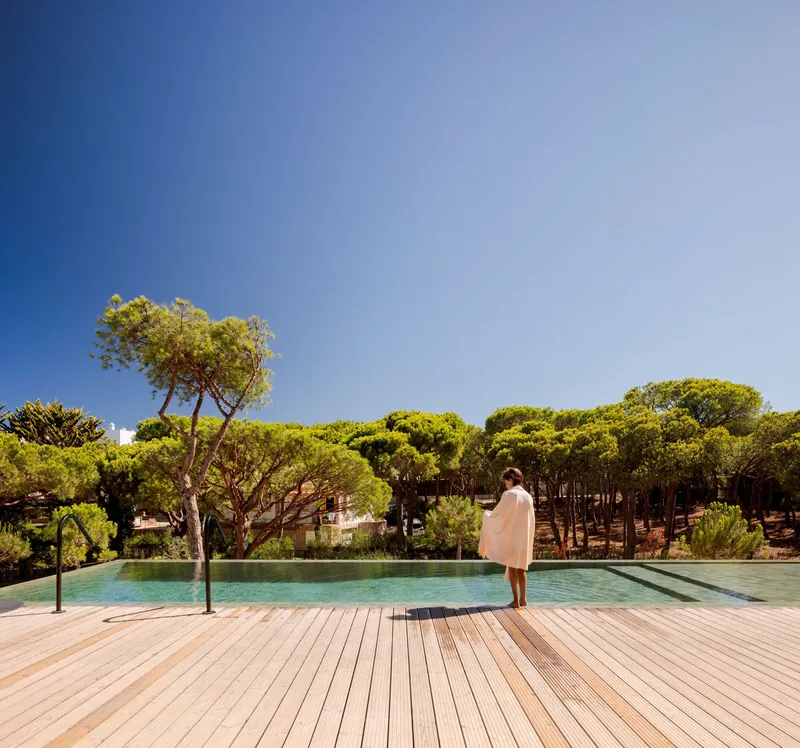
The swimming pool is not merely a pool. Positioned to act as a large mirror of water, it reflects the pine canopy above and extends the landscape into the architecture's horizontal datum. At golden hour, four figures cast long shadows across the timber deck, and the water surface doubles the leaning trunk of a single pine tree into a symmetrical composition. At dusk, the flat-roofed pavilion, the reflecting pool, and the silhouetted trees create a scene that is more land art installation than luxury amenity.
An infinity edge on the pool's far side reinforces the reading of water as continuous surface rather than contained volume. Striped loungers sit at the concrete lip, low enough to keep the tree canopy in frame from a reclining position. The pool terrace, raised on a stone wall base, mediates between the house's floor level and the sloping terrain, turning a grade change into an opportunity for framing.
Private Rooms and Intimate Courtyards

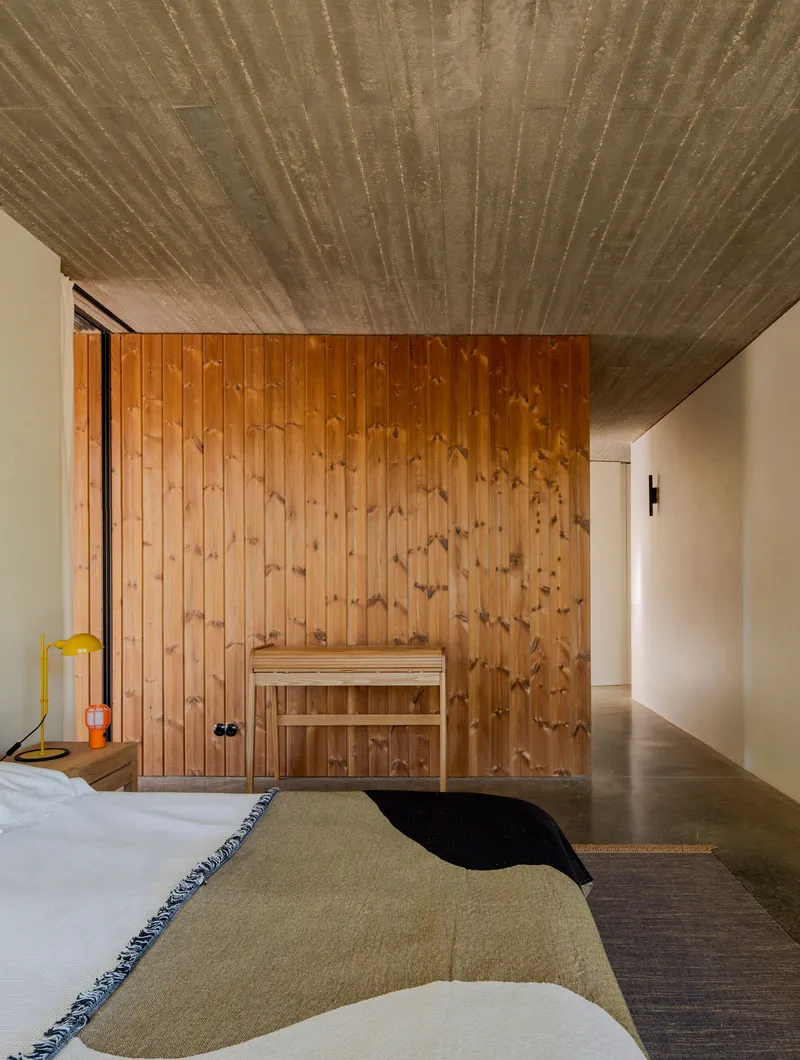

The bedroom wing maintains the same material vocabulary: board-formed concrete ceilings, polished floors, and timber elements that define functional zones. A sliding timber door reveals an ensuite bathroom, while a vertical timber wall panel encloses a sauna, inserting a wellness element without disrupting the room's spatial clarity. Floor-to-ceiling glazing frames a view of the pine forest, with sheer roller blinds as the only concession to privacy.

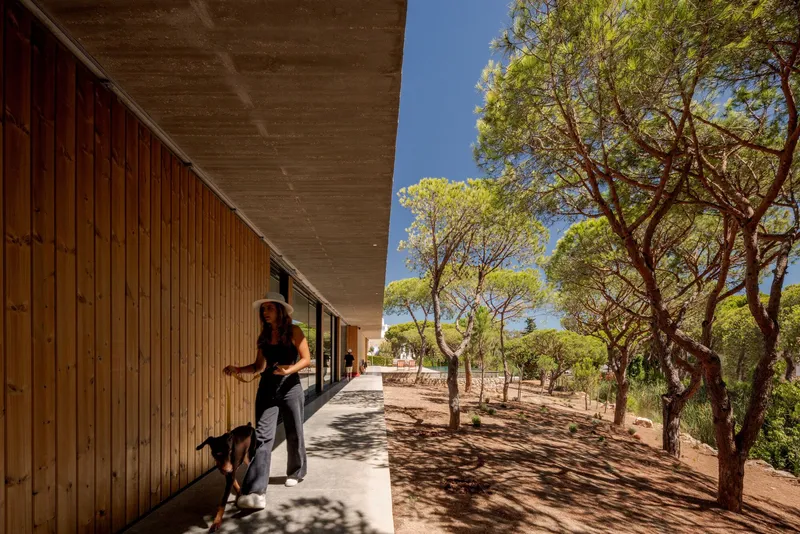

Outside the bedrooms, narrow courtyard passages and outdoor shower enclosures create pockets of intense sunlight and shadow. These small-scale spaces are among the house's most atmospheric: bright timber decking, a rainfall showerhead, and tall board-formed concrete walls produce a compressed vertical experience that contrasts sharply with the horizontal sweep of the main living areas. As twilight falls, a silhouetted figure in a doorway frames the concrete volumes and patterned screens against a deep blue sky, collapsing the house into a composition of pure geometry and atmosphere.
Dusk and the Architecture of Atmosphere
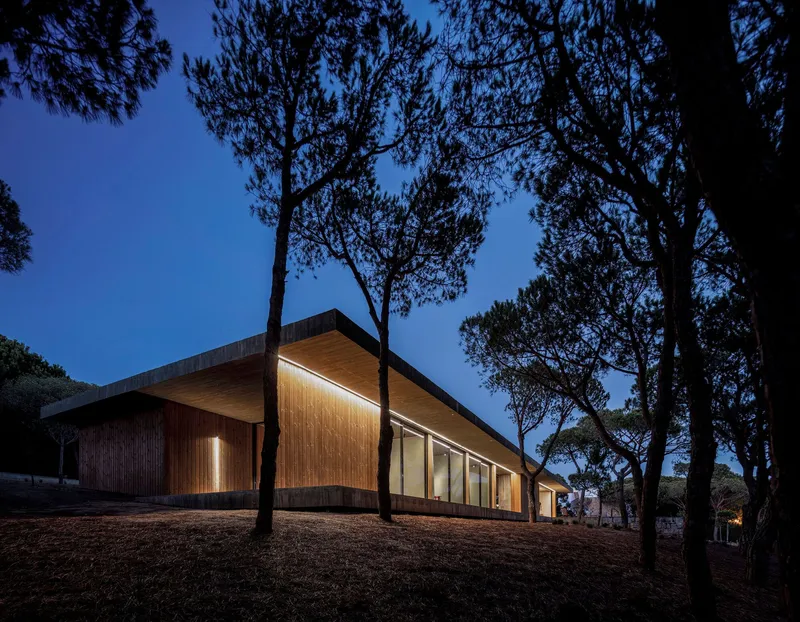

The house reveals a second identity at dusk. Underlit eaves cast a warm glow upward into the pine canopy, and the timber-clad walls become lanterns framed by dark trunks. The architecture, which during the day defers entirely to the forest, at night gently asserts its presence. It is a well-calibrated reversal: the building hides in daylight and glows in darkness, borrowing its drama from the trees that surround it.
Plans and Drawings


The floor plan and elevation drawings confirm what the photographs suggest: the house is organized as a single linear bar, with terraced volumes stepping in response to topography and program. The patio divides the plan into two apparently independent volumes joined by the continuous porch, and the basement level accommodates vehicle parking, technical services, and storage without disturbing the ground-level reading of a building that barely touches the earth.
Why This Project Matters
The House in Praia Verde is a reminder that the most responsible thing architecture can do in a sensitive landscape is not to invent a new ecology but to protect the one that already exists. Atelier Central Arquitectos have compressed a full domestic program, including a basement garage, sauna, and pool, into a building that sits below the treeline and camouflages itself with the very plants it was careful not to uproot. The environmental strategy is not performative: it is structural, embedded in the orientation of walls, the depth of overhangs, and the thermal mass of concrete.
What elevates the project beyond competent contextualism is the quality of its interior atmosphere. The board-formed concrete, the concealed window frames, and the timber ceilings produce spaces that feel both raw and precise, warm and rigorous. Between two nature reserves, in a forest shaped by wind, the house offers a model for how luxury residential architecture can proceed without ego: by listening to the site, building with restraint, and letting the trees do the talking.
House in Praia Verde by Atelier Central Arquitectos. Located in Praia Verde, Portugal. Completed in 2022. Photography by Fernando Guerra | FG+SG.
About the Studio
Share Your Own Work on uni.xyz
If projects like this are the kind of work you want to make, uni.xyz is a place to publish your own, find collaborators, and enter design competitions.


Popular Articles
Popular articles from the community


Co-life: Sustainable Architecture for Age-Friendly Community Living
Co-life reimagines sustainable architecture for seniors through courtyards, rammed earth, shared gardens, and spaces designed for belonging.

The Ocean Hive: Sustainable Architecture for a Self-Sufficient Civilization at Sea
The Ocean Hive imagines sustainable architecture at sea, where modular habitats, algae, wave power and ocean waste sustain a growing colony.

Riyadh For All: Intergenerational Urban Design for Active Aging in Rabat
Riyadh For All reimagines urban design in Rabat with intergenerational co-living, adaptive courtyards, and Moroccan cultural exchange today.

Co-Life: Senior Housing Design That Reconnects Older Adults With the City
Co-Life reimagines senior housing design through healing gardens, shared streets, workshops, and a sustainable community across generations.


Similar Reads
You might also enjoy these articles

Bao Huynh Watercolor Atelier: A Serene Art Retreat in Hội An
Bao Huynh Watercolor Atelier in Hội An blends multifunctional art spaces, sustainable design, local materials, and family-friendly living in a serene environment.

Atelier Macri Concept Store Interior Design by CASE-REAL
Atelier Macri store features a "ko" counter, walnut wood details, cork displays, blending retail, gallery, and seamless customer experiences.

Manuel Vargas Izquierdo Stadium and High-Performance Sports Center: Architectural Excellence in Jalpa de Méndez
The Manuel Vargas Izquierdo Stadium blends sustainable design, inclusive sports facilities, and cultural-inspired architecture, revitalizing Jalpa de Méndez’s public spaces.

KAKR Buluh Awar Hall: Revitalizing Community and Ecology Through Bamboo Architecture
Community built bamboo hall revitalizes Buluh Awar village, empowering youth, restoring ecology, celebrating vernacular craftsmanship through sustainable architecture and culture.


Explore Residential Building Competitions
Discover active competitions in this discipline


Challenge to design mud housing for contemporary communities


Challenge to reimagine the Iron Throne


Photograph architecture without architects


Illustrate the lost glory of Angkor Wat - Render Challenge
Comments (0)
Please login or sign up to add comments
No comments yet. Be the first to comment!