
Atelier cnS Stacks a Running Track Above Flexible Classrooms in a Dense Pearl River Delta School
A Foshan primary school doubles its capacity by building vertically and reopening its campus to a forgotten canal.


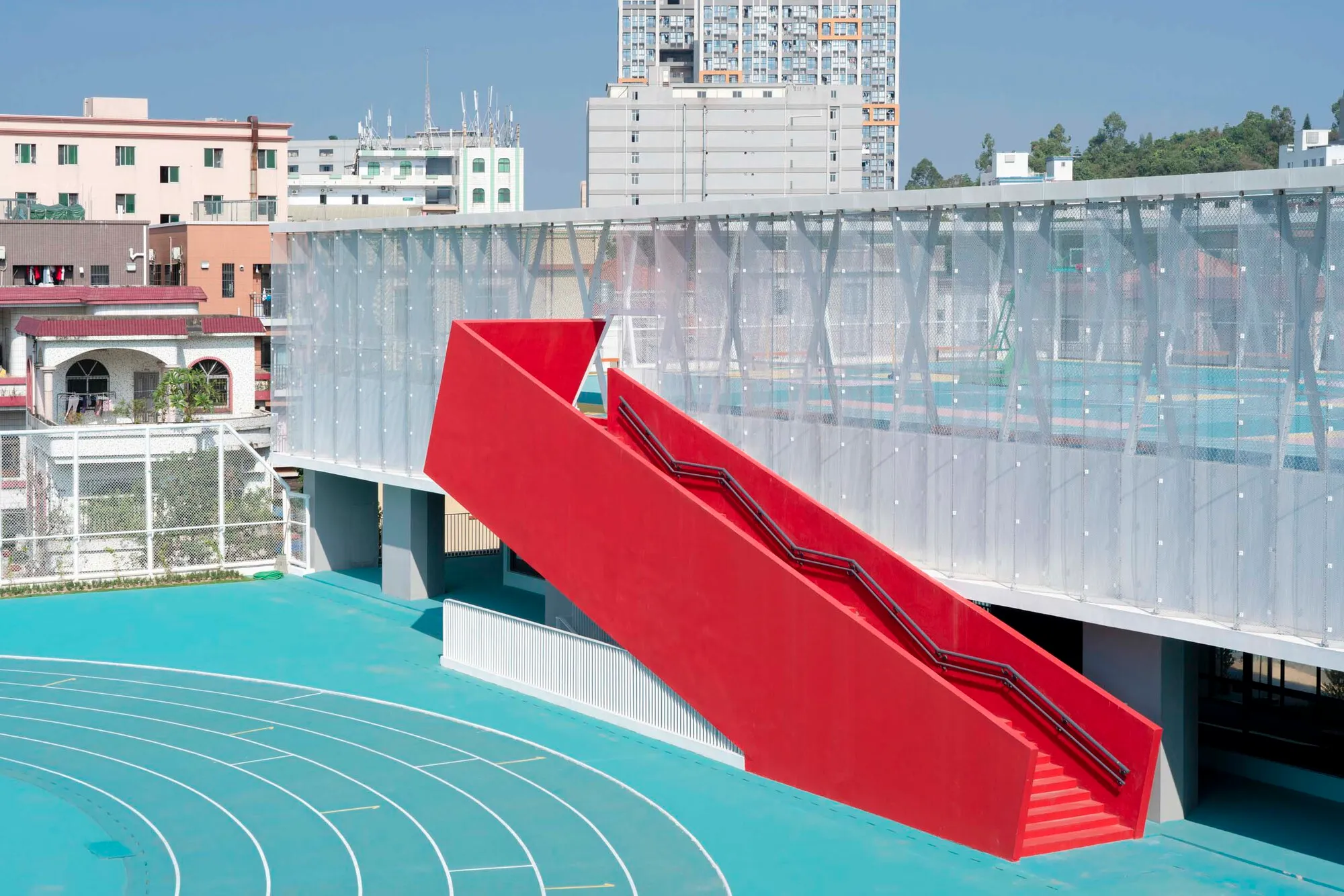
Land is scarce in Longjiang, a furniture-manufacturing hub in Shunde where dense villages press up against factory parks and narrow canals. When the Primary School Affiliated to Longjiang Foreign Language School needed to grow from 22 classrooms to 42, Atelier cnS had almost no horizontal room to expand. The answer was to go up: a 300-meter running track sits at the first elevated level, a full sports field occupies the second, and the ground plane beneath both is given over to flexible program rooms, event spaces, and shaded corridors. The result is a campus that nearly doubles its teaching capacity on the same footprint.
What makes this 19,210 square meter renovation genuinely interesting is not just the vertical stacking, which is increasingly common in land-starved Chinese school design. It is the way the architects treat the residual spaces, the gaps between structure and ground, as the most important rooms in the building. A system of red tubular structures supports the elevated library while doubling as circulation spines and light wells. A translucent facade of steel cable and aluminum mesh replaces the old perimeter wall, pulling the adjacent canal back into the daily experience of the school. The campus no longer hides from its context; it absorbs it.
Vertical Stacking on a Tight Urban Site


Seen from above, the logic is legible. The turquoise running track and green soccer pitch sit atop a white plinth of classrooms and support spaces, elevated 4.65 meters off the ground. That datum line frees the entire ground level for covered play, circulation, and the kind of informal gathering space that primary schools desperately need and rarely get. The aerial views also reveal how tightly the campus is bounded by residential blocks and the canal, confirming that vertical expansion was less a design preference than a planning necessity.
The Red Tubes: Structure as Space

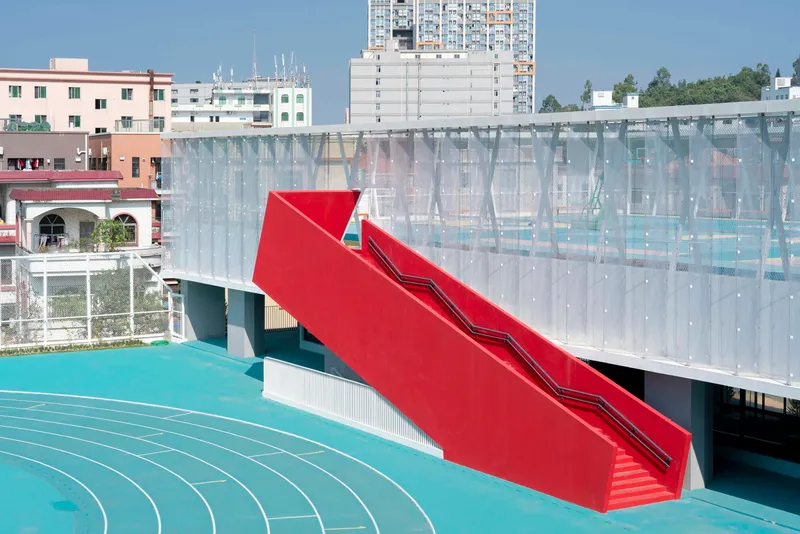

The most distinctive formal move is the network of red-painted tubular structures that punctuate the campus. They perform triple duty: they carry structural loads for the elevated library and sports levels, they organize vertical circulation with angular stairways, and their open tops function as skylights, pulling daylight and fresh air deep into the building section. At dusk, lit from within, they read as lanterns along the streetscape, giving the school a civic presence that the old walled compound never had.
The red tubes also give children a sense of architectural event. Rather than a single monolithic stair core, the campus distributes vertical movement across several of these sculptural elements, each one framing a different view of the track, the courtyard, or the canal. It is a small decision with outsized pedagogical impact: movement through the school becomes exploration, not routine.
Ground Level: The Space Beneath the Field
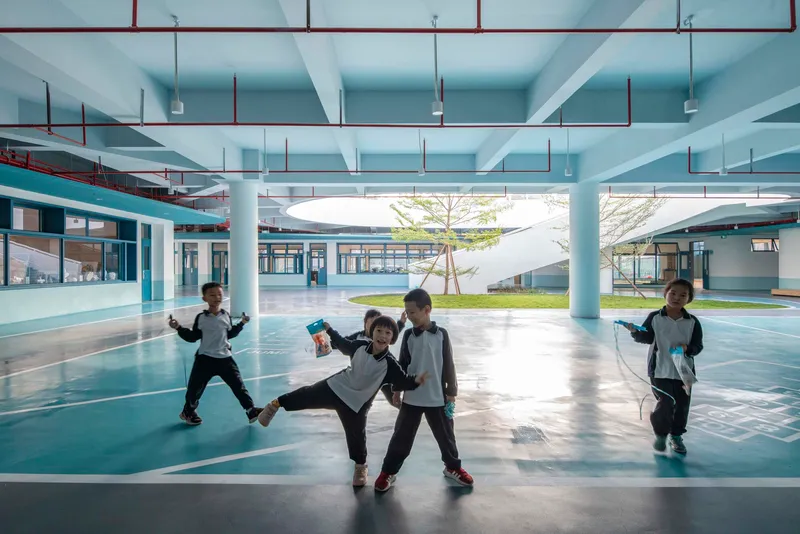
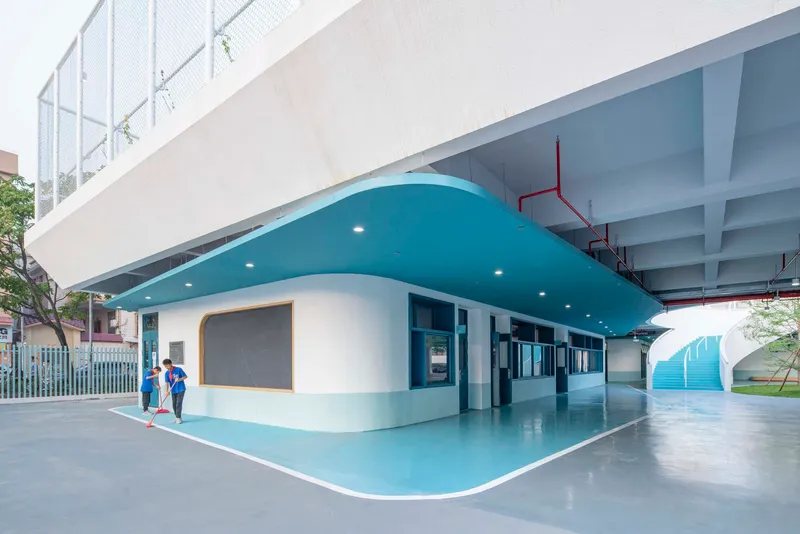
Raising a sports field creates an engineering challenge and a spatial opportunity in equal measure. The challenge is ventilation and natural light; the opportunity is a sheltered public ground plane that stays cool in Foshan's subtropical climate. Atelier cnS addresses both with a continuous soffit structure that curves overhead, painted in turquoise to match the track above, with openings calibrated to draw cross-ventilation through the corridors. A covered courtyard with exposed blue-painted beams and a retained tree becomes an informal amphitheater, the kind of space where children gather without being told to.
The architects describe the interior organization as a series of "floating islands" linked by a corridor that extends toward the waterfront. Along this spine, micro-spaces appear: display walls, painting surfaces, small podiums, and book corners. These are not programmed classrooms; they are thresholds that encourage pause. In a school designed for 42 classes, this kind of distributed informality prevents the corridors from becoming mere throughput.
The Disappearing Wall and the Canal

Before renovation, a solid fence wrapped the campus, severing any visual or physical connection to the canal that runs along one edge. Shunde is historically known as a "Town of Water," and the irony of a school that turned its back on the river was not lost on the design team. The new perimeter replaces the fence with a steel cable and aluminum mesh screen, selected for its tensile strength against typhoon-force winds while remaining translucent enough to frame the river from within. An open platform at the water's edge doubles as a protective barrier and a place of gathering, what the architects call a "disappearing wall."
The canal-side elevation at twilight is the project's most persuasive image. Red accents glow against white volumes, birch trees line the track, and the mesh facade catches just enough light to register as a surface without blocking the view. It is a controlled performance of transparency that signals openness to the neighborhood while maintaining the security a primary school requires.
Facade and Materiality
The facade palette is deliberately restrained: white rendered volumes for the classroom blocks, red-painted steel for the structural tubes and accent panels, and the translucent aluminum mesh for the perimeter screen. The architects describe the mesh as being "as light as voile," and at a distance, the comparison holds. The diamond-weave chain link fence used in the sports field atrium adds a fourth texture, one that is industrial in origin but playful in application, curving with the geometry of the elevated track.
Material choices here are driven by climate and maintenance as much as aesthetics. Foshan sits in the humid subtropical belt, and any school facade must resist monsoon rain, high UV exposure, and salt-laden air from the Pearl River Delta. The aluminum mesh weathers gracefully, the steel cable resists deformation under wind load, and the red-painted steel tubes, while requiring periodic recoating, give teachers and children a legible wayfinding system: follow the red to go up.
Plans and Drawings


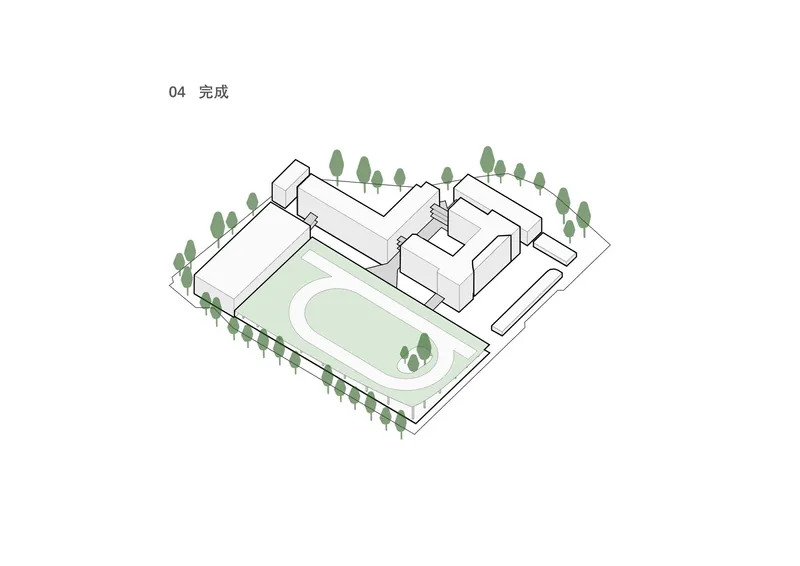
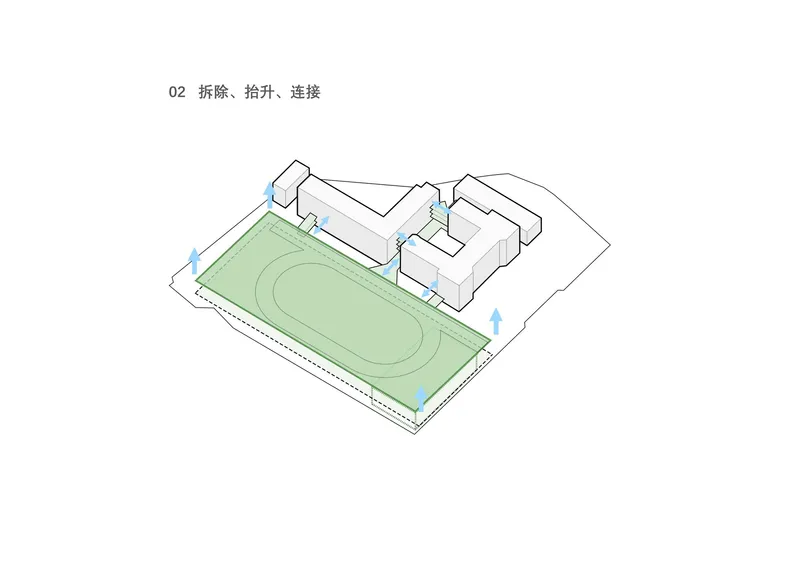
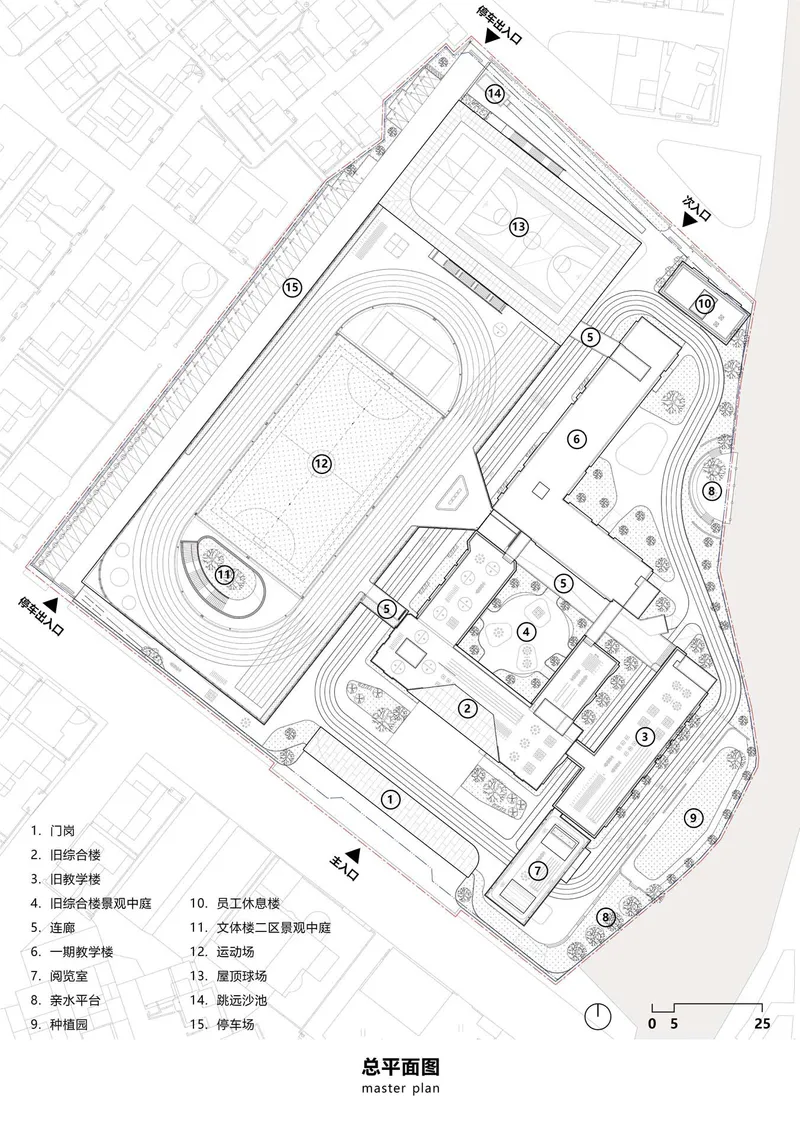

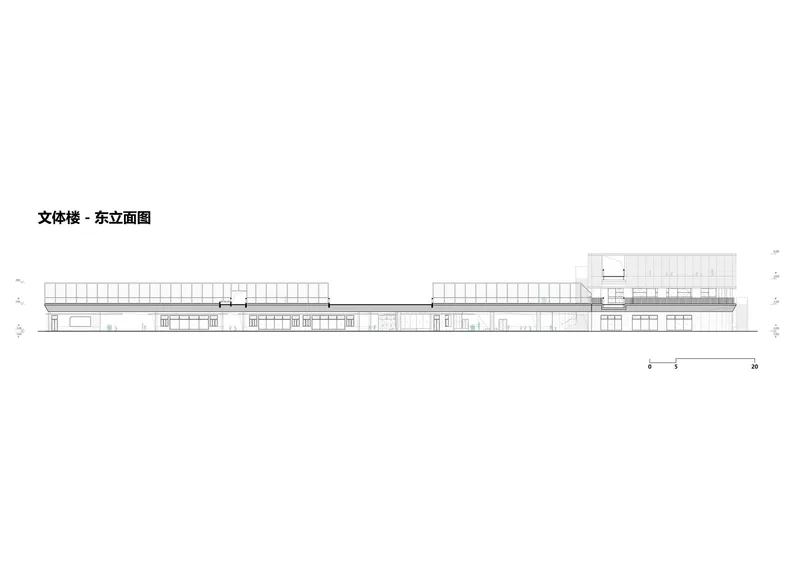
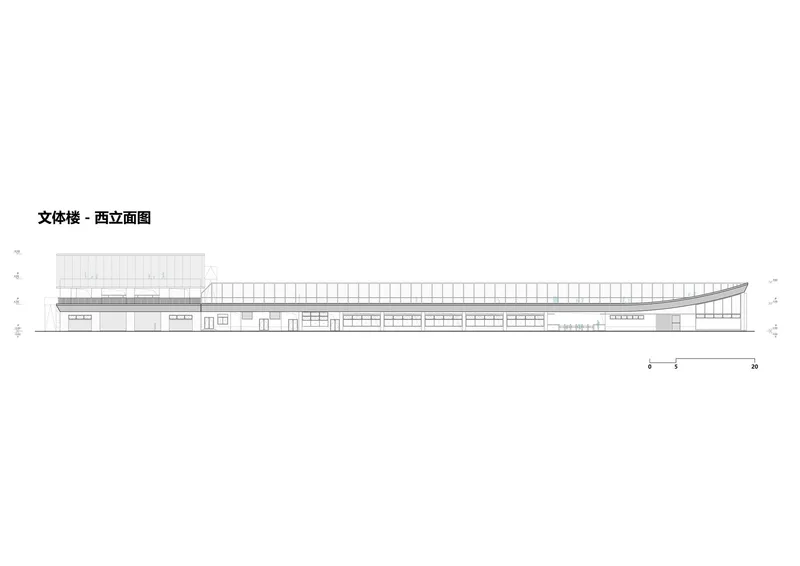


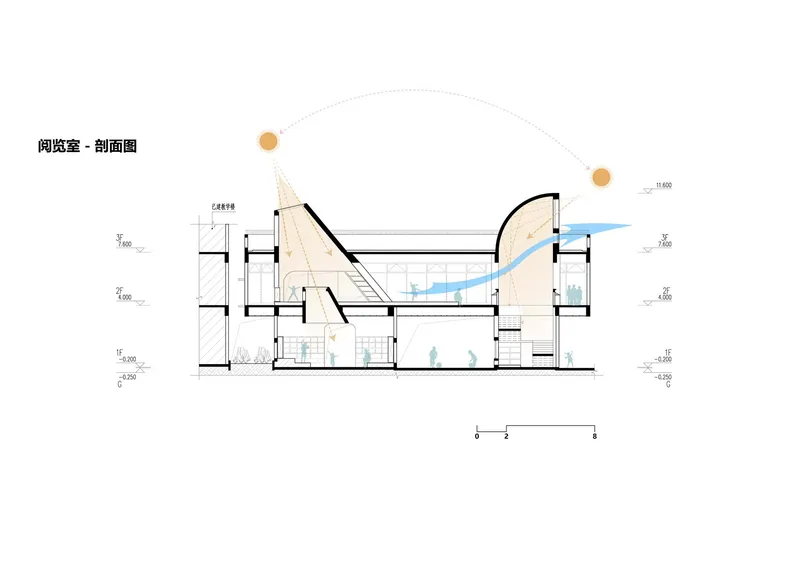


The drawing set tells the full story of the vertical strategy. Early isometric diagrams compare existing and proposed massing, showing how new volumes and green courts are inserted between retained structures. The axonometric breakdowns reveal the layered program: rooftop pool, elevated sports field, classroom floors, and the continuous ground-level corridor. Sections confirm the 4.65-meter datum of the raised field and illustrate how the red tubes punch through multiple levels, bringing light and air from the skylit tops down to the shaded ground plane.
The wall section detail is worth studying closely. It shows the curtain wall assembly, steel primary structure, and the relationship between the mesh screen and the occupied interior. Child-scaled figures populate every level, a reminder that the building's dimensional logic is calibrated to six-year-olds, not adults. The east and west elevation drawings reveal the campus as a long, low horizontal bar punctuated by the tower element and gentle roof slopes, a profile that defers to the residential scale of Longjiang rather than asserting institutional monumentality.
Why This Project Matters
China's Pearl River Delta is one of the most densely built urban regions on the planet, and its schools face a common dilemma: enrollment demand grows while available land does not. The standard response is to build taller and pack tighter, often producing oppressive corridors and airless classrooms. Atelier cnS offers a counter-model here, one where vertical density generates spatial generosity rather than compression. By lifting the sports program off the ground, the architects create a sheltered public layer that gives children room to breathe, play, and stumble into learning outside the classroom.
The project also demonstrates that school renovation in dense urban contexts is as much about reconnecting to surroundings as it is about adding square meters. Removing the perimeter wall, framing the canal, and introducing translucent facades turns the campus from an introverted compound into a participant in neighborhood life. For a town built on water, that shift is not merely aesthetic. It is an act of cultural restitution, returning a generation of students to the landscape that defines their home.
Renovation of the Primary School Affiliated to Longjiang Foreign Language School by Atelier cnS. Located in Foshan, China. 19,210 m². Completed in 2022. Photography by Siming Wu.
About the Studio
Share Your Own Work on uni.xyz
If projects like this are the kind of work you want to make, uni.xyz is a place to publish your own, find collaborators, and enter design competitions.




Popular Articles
Popular articles from the community


The Musturak Paradise: Senior Living Architecture for a Connected Future in Temara, Morocco
The Musturak Paradise reimagines senior living architecture in Temara via private homes, social spaces, culture, community, and shared care.

Co-life: Sustainable Architecture for Age-Friendly Community Living
Co-life reimagines sustainable architecture for seniors through courtyards, rammed earth, shared gardens, and spaces designed for belonging.

Hill & Cross Opera: Sculptural Opera House Architecture Shaped by Tallinn’s Landscape and Identity
Hill & Cross Opera reimagines opera house architecture in Tallinn through its sculptural hill, civic plaza, glass wave and a luminous cross.
EW PARK: Sustainable Architecture Reimagines the Future of Urban Parking
EW PARK reimagines city parking as a modular wooden tower combining automation, solar energy, electric mobility, and adaptable urban design.


Similar Reads
You might also enjoy these articles

Bao Huynh Watercolor Atelier: A Serene Art Retreat in Hội An
Bao Huynh Watercolor Atelier in Hội An blends multifunctional art spaces, sustainable design, local materials, and family-friendly living in a serene environment.

Atelier Macri Concept Store Interior Design by CASE-REAL
Atelier Macri store features a "ko" counter, walnut wood details, cork displays, blending retail, gallery, and seamless customer experiences.

Manuel Vargas Izquierdo Stadium and High-Performance Sports Center: Architectural Excellence in Jalpa de Méndez
The Manuel Vargas Izquierdo Stadium blends sustainable design, inclusive sports facilities, and cultural-inspired architecture, revitalizing Jalpa de Méndez’s public spaces.

KAKR Buluh Awar Hall: Revitalizing Community and Ecology Through Bamboo Architecture
Community built bamboo hall revitalizes Buluh Awar village, empowering youth, restoring ecology, celebrating vernacular craftsmanship through sustainable architecture and culture.

Explore Renovation Competitions
Discover active competitions in this discipline



Challenge to design public laboratory


Challenge to design luxury tourism on rails


VR headsets Storefront design competition

Designing a staircase for a client
Comments (0)
Please login or sign up to add comments
No comments yet. Be the first to comment!