
Atelier Deshaus Carves a Meditation Cloister into an Abandoned Coal Mining Valley Near China's Great Wall
A 615-square-meter monastery in Chengde steps down a mountainside, borrowing scenery from ancient ruins and distant peaks.


The valley at the southwest foot of the Great Wall in Chengde was once carved open for coal mining and terrace farming. Retaining walls built by villagers still hide beneath overgrown weeds, and the remains of a handmade coal kiln mark the site where Atelier Deshaus has placed the Upper Cloister in Aranya Golden Mountain: 615 square meters of contemplative space that descends a 1.6-meter stepped landscape, converting the scarred terrain into a sequence of rooms for meditation, reading, writing, and worship.
What makes this project genuinely interesting is not the spiritual program itself but the material and structural logic that separates it from both nostalgic pastiche and generic minimalism. The meditation hall's roof is a 3.5-centimeter-thick prefabricated carbon fiber shell, installed in a single day, supported by two concentric rings of slender steel columns. The outer ring adjusts in height to absorb the terrain's irregularity, turning topographic data into architectural form. Meanwhile, concrete enclosure walls, locally quarried stone, and exposed mountain rock in the Buddhist hall anchor the project firmly in its geology. The result is a building that reads as both ancient and impossibly thin, creating what the architects describe as a deliberate distance in time between itself and the Great Wall visible across the valley.
Descending Into the Mountain
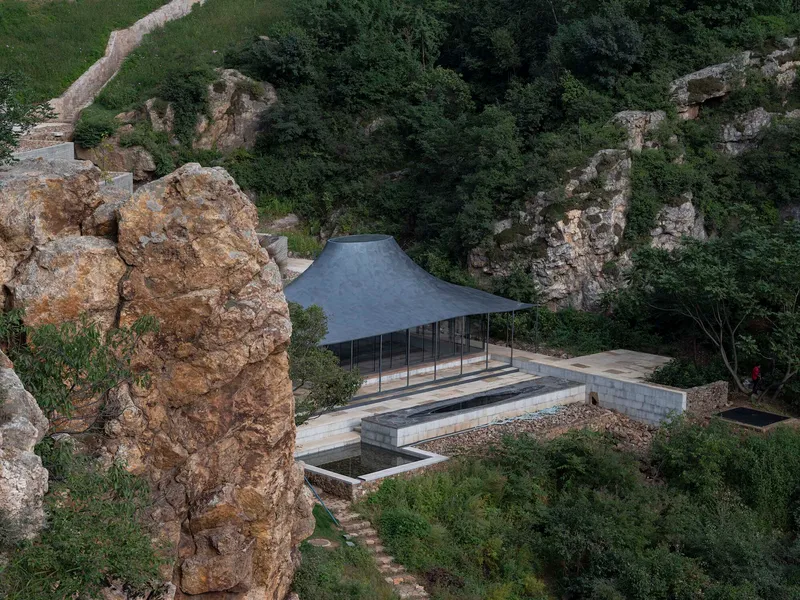
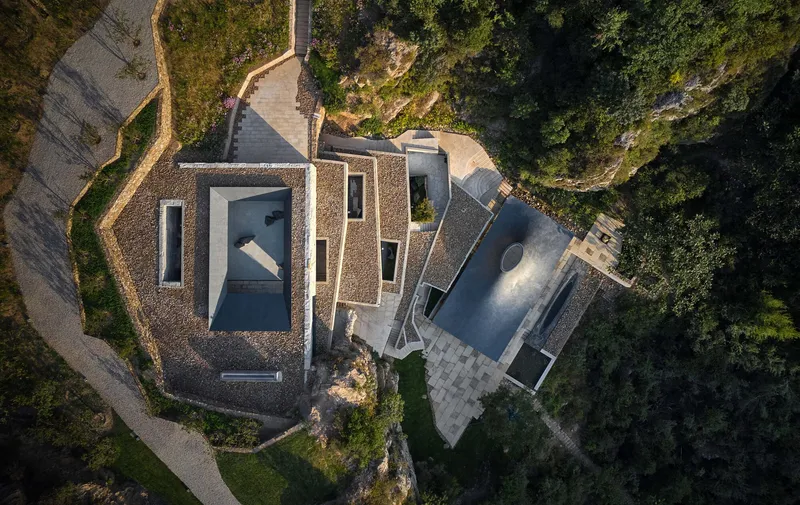
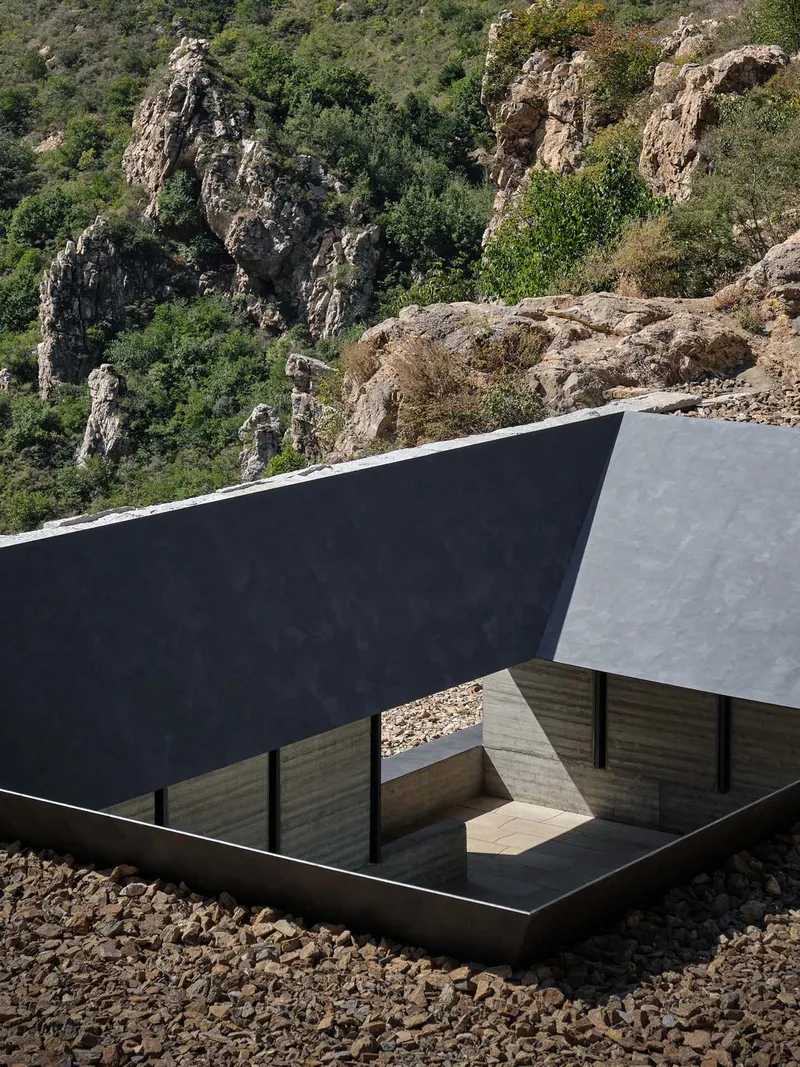
From the air, the cloister barely registers as a building. Gravel-covered rooftops, dark metal planes, and sunken courtyards nestle among rocky outcrops, following the slope's contour rather than imposing a datum. The spatial sequence descends from the stone courtyard (named Endless Meaning) through the Omniscience Hall, meditation room, reading room, and writing room, before arriving at the lowest point: the Aranya meditation hall. Each space attaches directly to the terrain, opening and closing between interior and landscape.
The 1.6-meter stepped section is not arbitrary. It translates the existing geomorphology of the mining terraces into a usable architectural dimension, preserving the land's memory while transforming its purpose. Where villagers once retained soil for agriculture, Atelier Deshaus retains space for contemplation.
Stone Courtyards and Borrowed Scenery
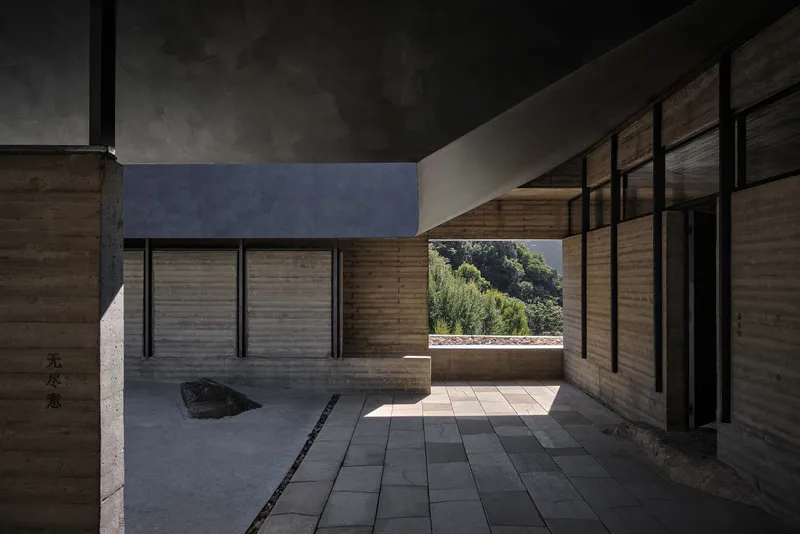
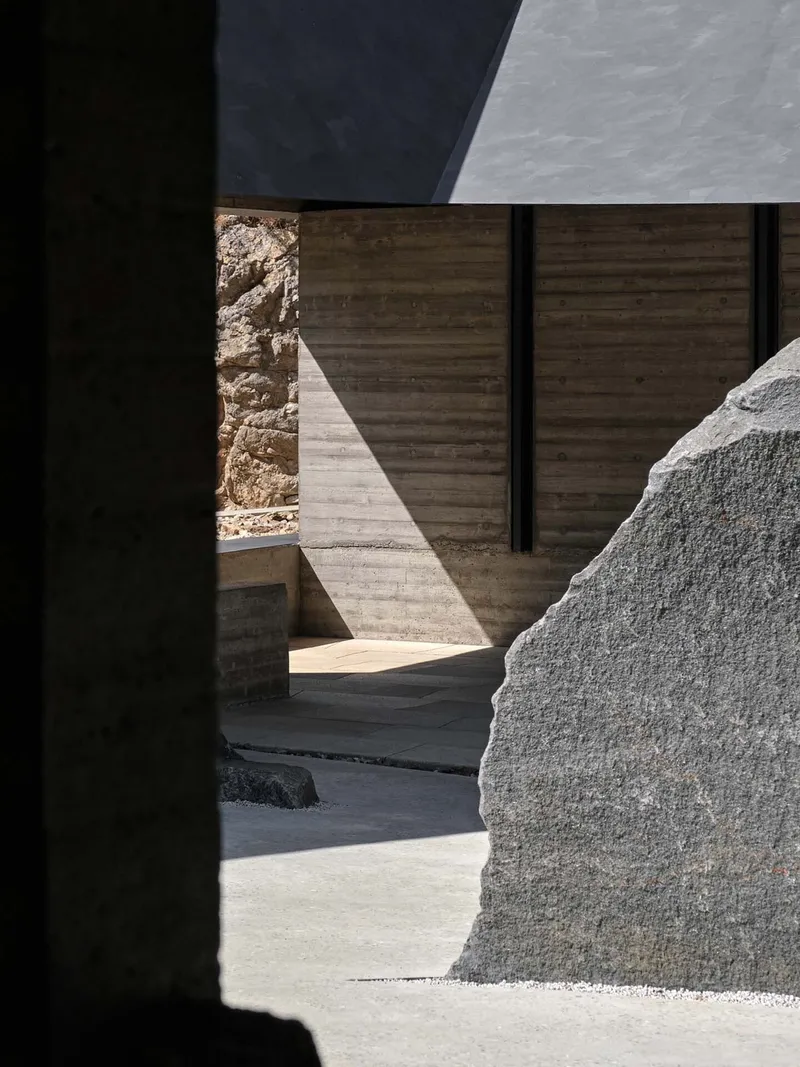
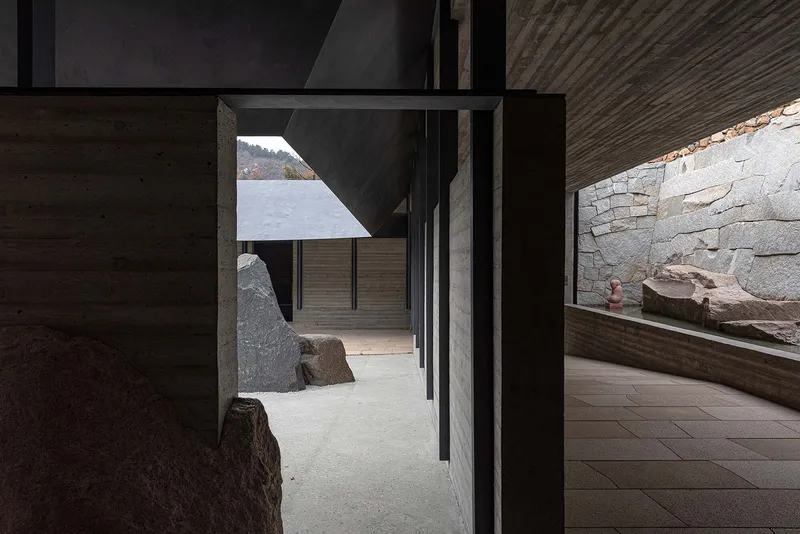
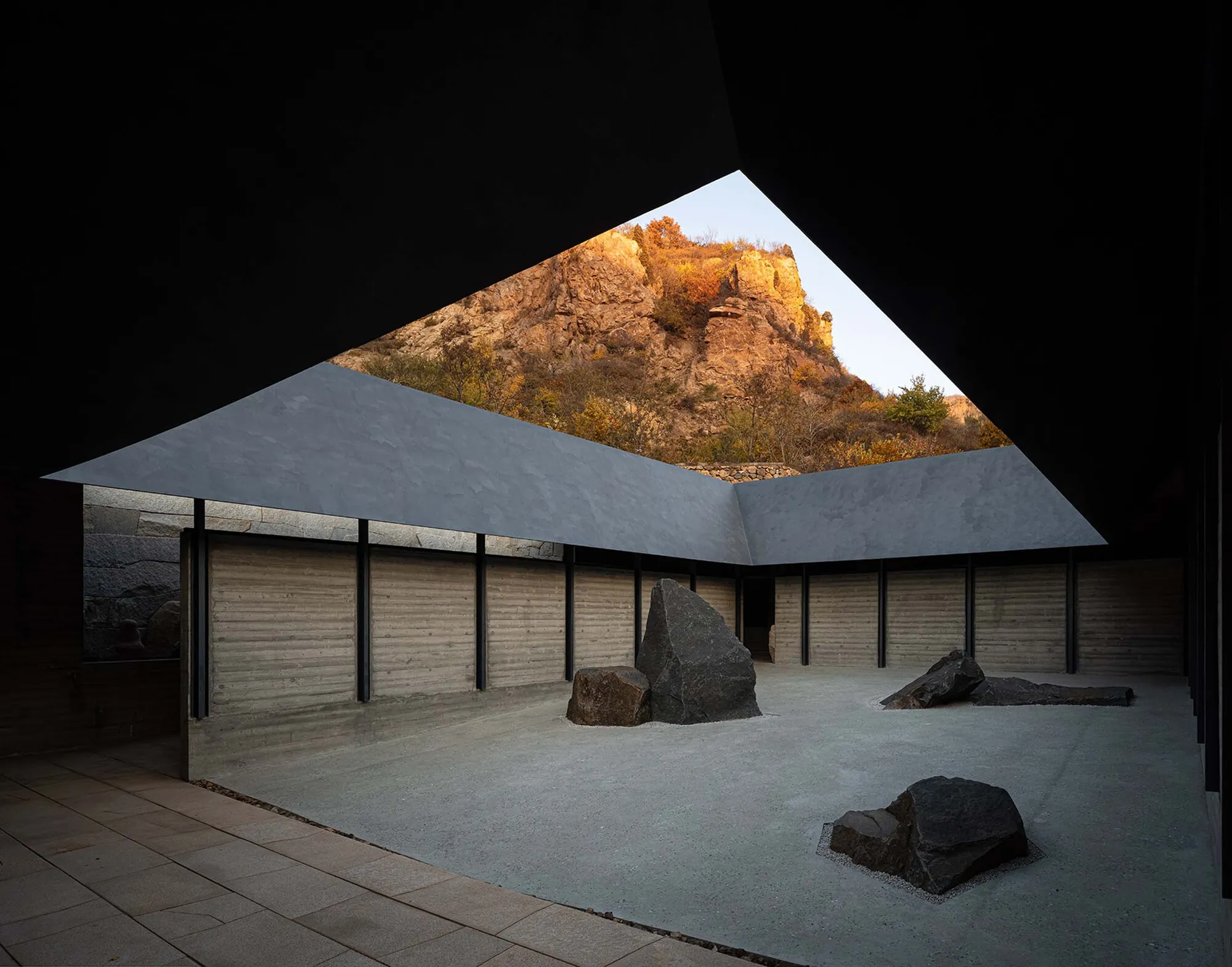
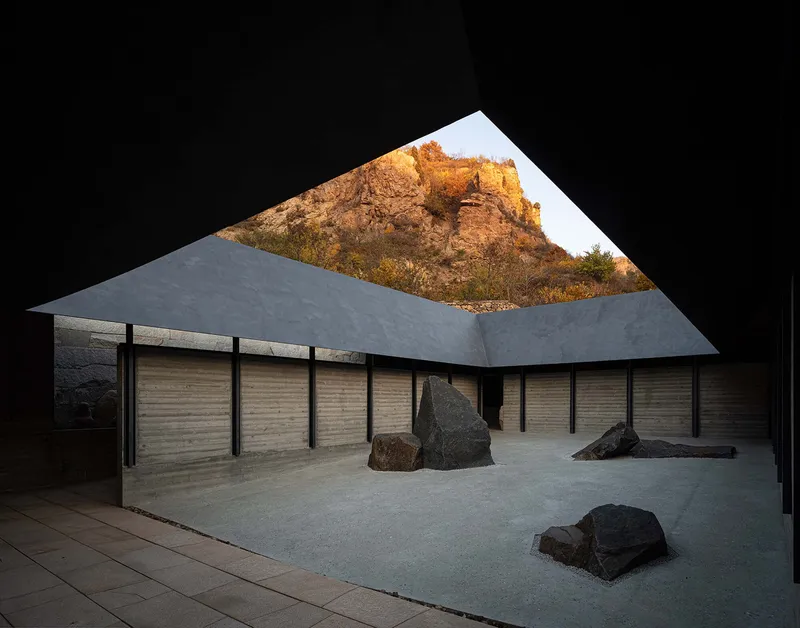
The entrance courtyard sets the tone immediately: five natural rocks of different shapes sit within a space of chiseled concrete ground, rammed earth walls, and filtered daylight. The upward opening frames the sky. The horizontal opening on the west side frames the ancient Great Wall and a natural stone formation. This is borrowed scenery in the classical Chinese tradition, but deployed with a restrained palette that owes more to concrete construction than garden aesthetics.
Inner gardens of various scales, designed by Shunmyō Masuno (a landscape architect who is also a Zen monk), punctuate the sequence. Boulders emerge from dark paving; passages framed by steel doorways open onto stacked stone walls. The spatial atmosphere recalls the traditional corridor courtyard without replicating its ornament. Each threshold compresses and then releases the visitor's field of vision, a choreography that makes the 615-square-meter footprint feel far more expansive than its numbers suggest.
The Carbon Fiber Canopy
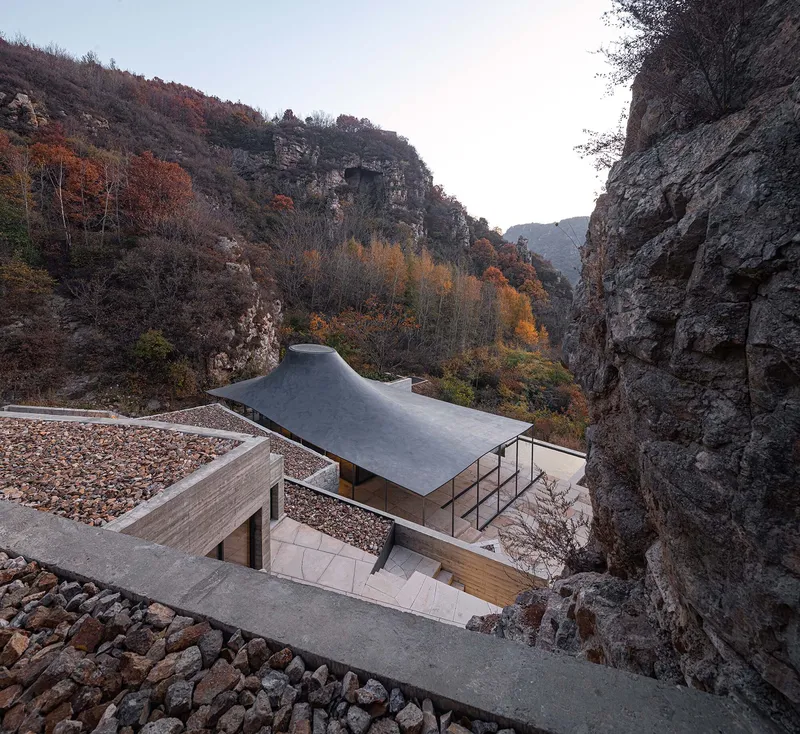
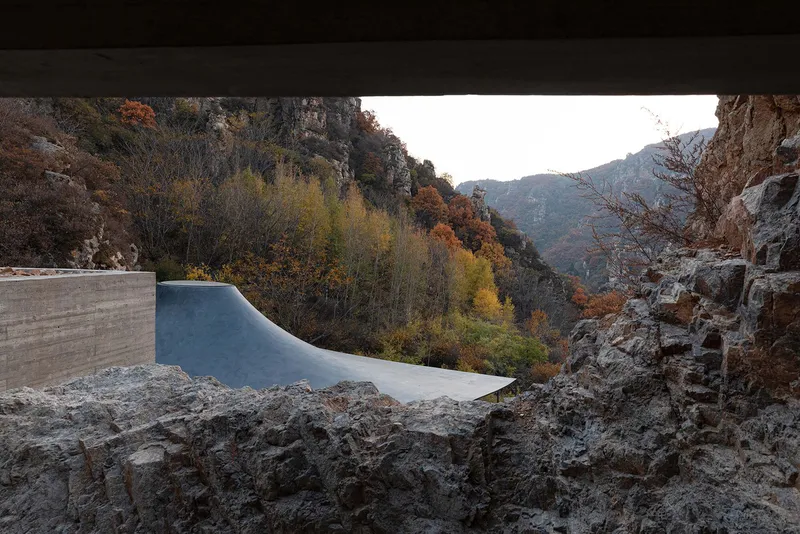
The meditation hall's curved roof is the project's most technically ambitious element. At just 3.5 centimeters thick, the prefabricated carbon fiber shell was CNC-carved with polyurethane insulation and lifted into place in a single day. Two concentric circles of slender steel columns carry the load: the inner ring holds a consistent height while the outer ring varies, absorbing the slope. The result is a sweeping canopy that hovers over the valley, its lightness a deliberate counterpoint to the massive geology surrounding it.
Atelier Deshaus describes the meditation hall as a pictographic reconstruction of the Chinese character "舍," which carries connotations of shelter, letting go, and dwelling. Whether or not you read that symbolism, the spatial effect is undeniable: sitting beneath the thin shell, with a reflecting pool in front mirroring mountains and sky, the boundary between constructed enclosure and open landscape dissolves almost entirely.
Light, Rock, and the Buddhist Hall
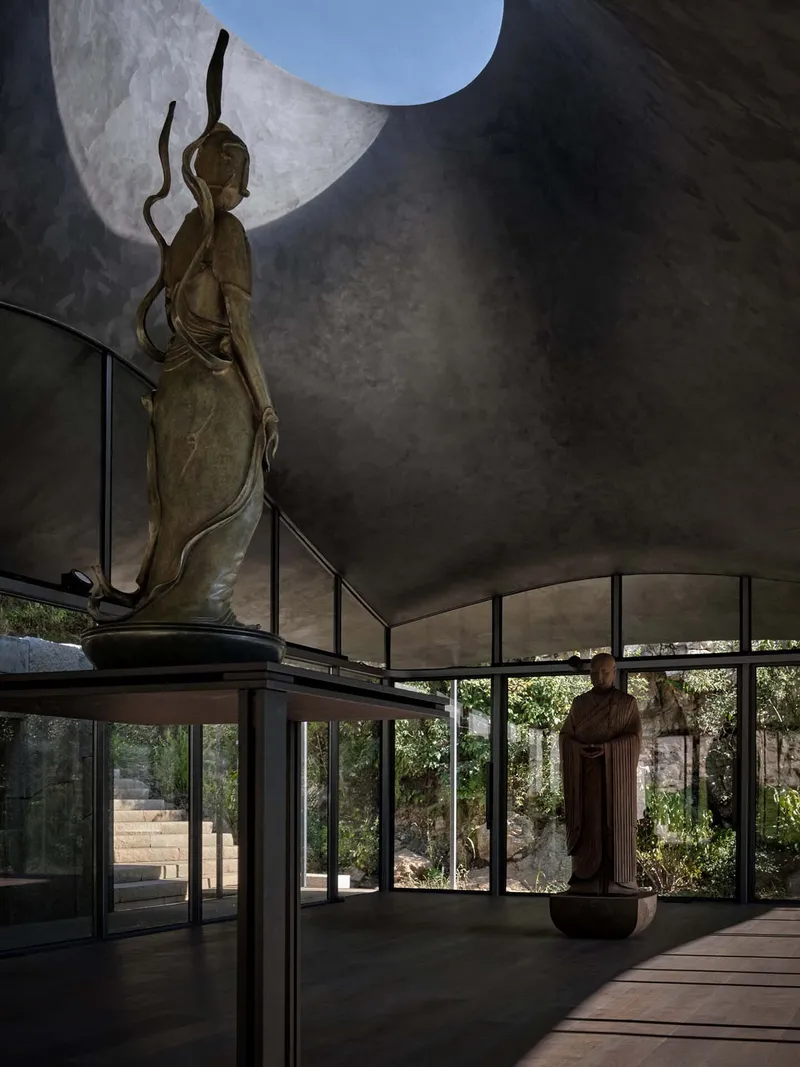
Inside the Omniscience Hall, natural mountain rock is left exposed, erupting through the floor plane as though the building simply grew around it. A bronze Buddha statue sits beneath a curved ceiling oculus, glazed walls opening the room to the landscape beyond. The angular roof cuts a sharp opening above, channeling afternoon light onto the weathered rock face in a way that transforms the interior throughout the day.
The project draws a deliberate spatial analogy to the Fo Guang Temple in Shanxi's Wutai Mountain, whose Great East Hall faces a valley. Here too, the building turns its back to the mountain and opens only toward the valley below, where fruit trees and herbs grow among winding stone paths that eventually lead to the Great Wall. The col on either side becomes the enclosure, so walls are needed only where the mountain cannot serve.
Plans and Drawings
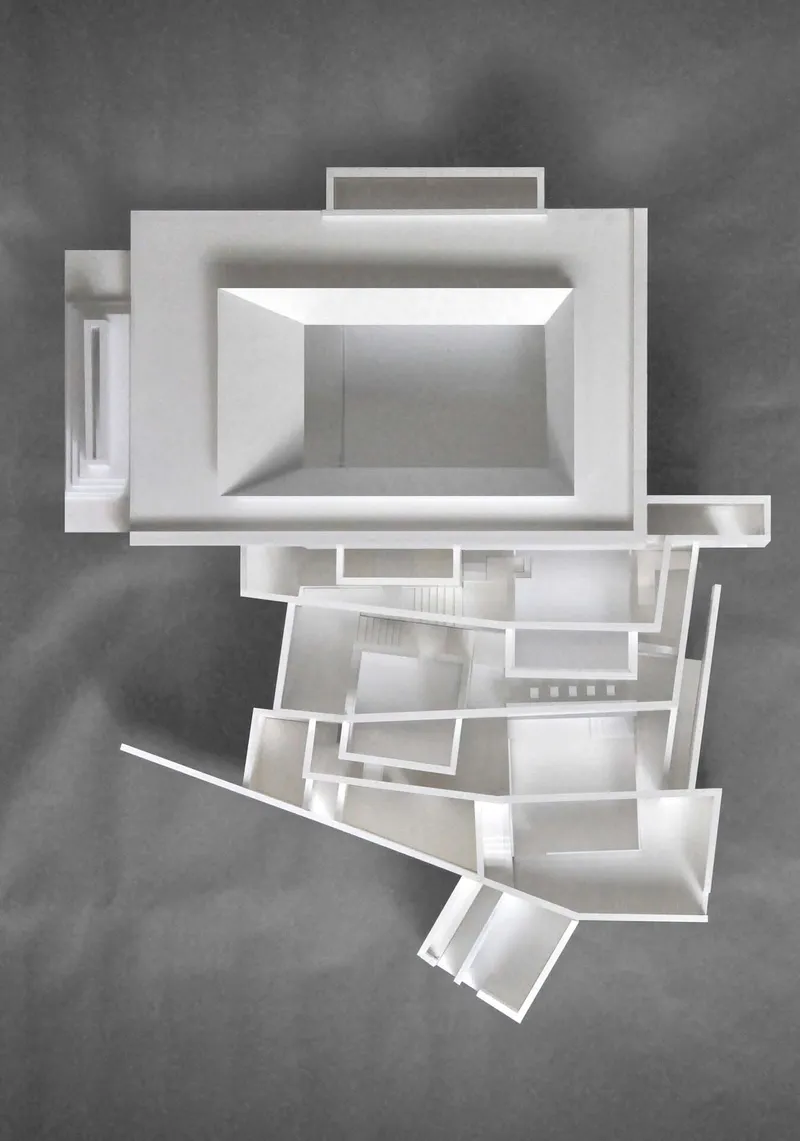
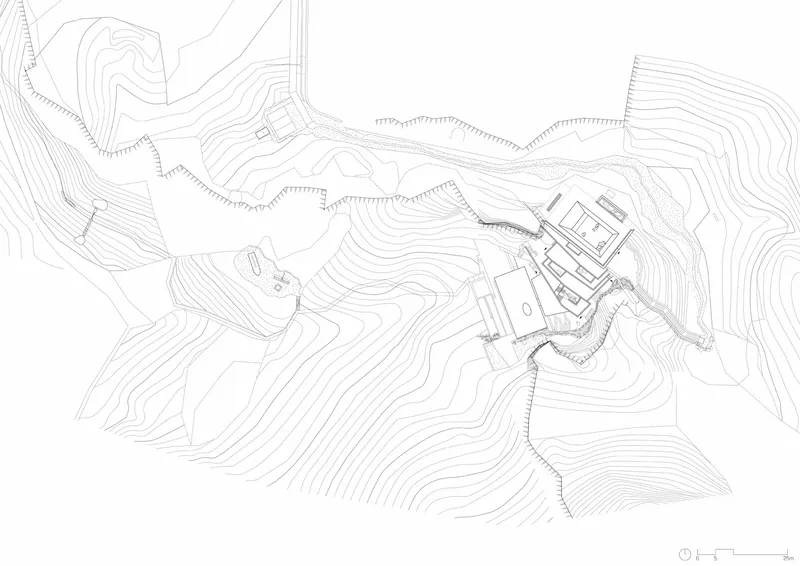
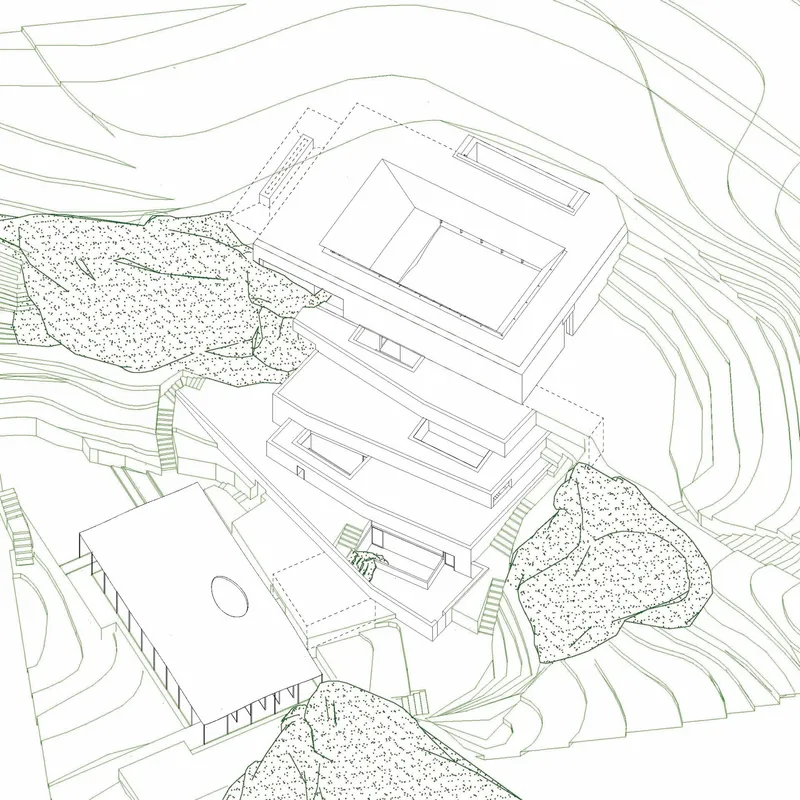
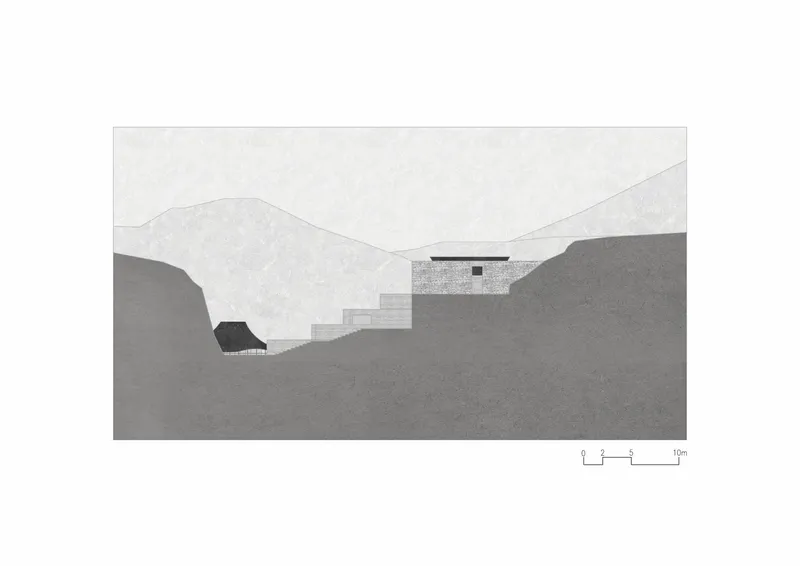
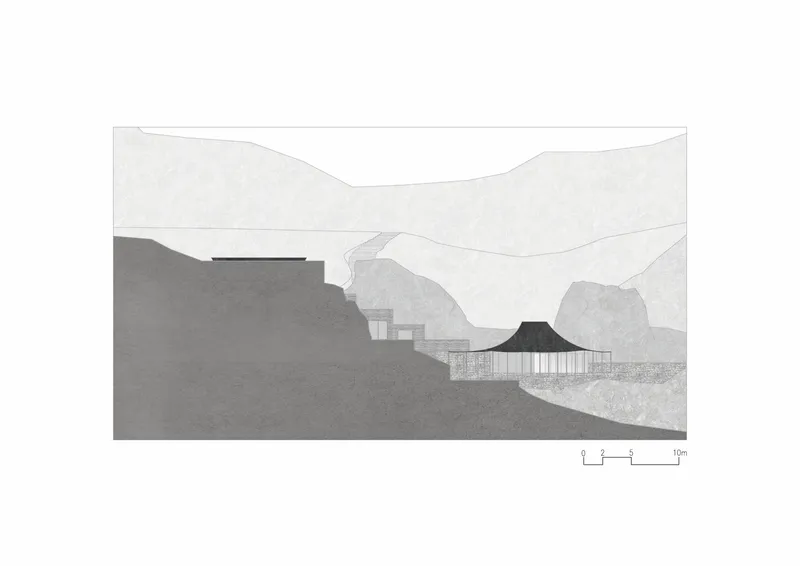
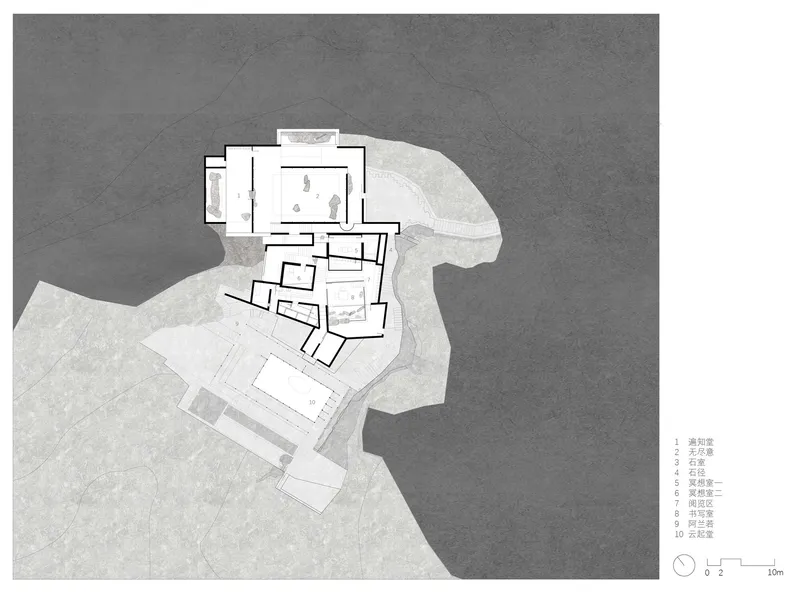
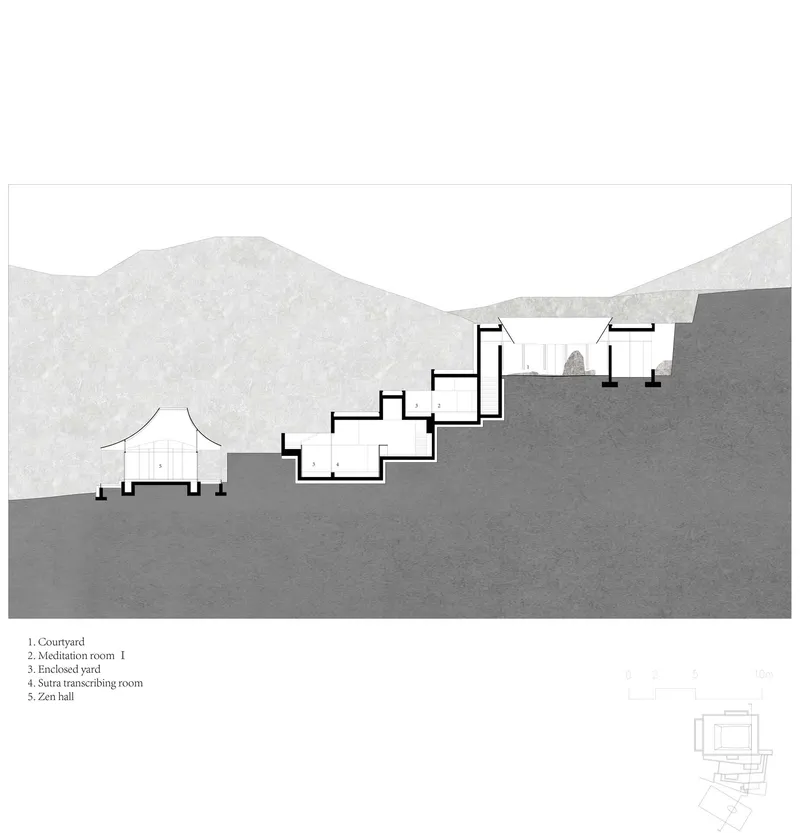
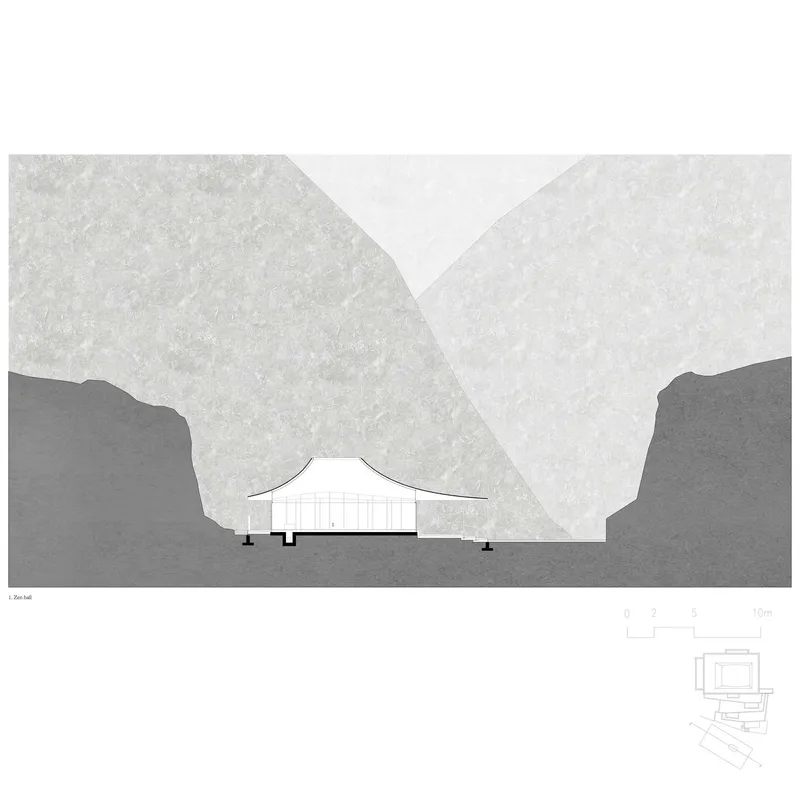
The sectional drawings are where this project reveals its full ambition. Each section shows how the building steps down the slope, the carbon fiber canopy of the meditation hall appearing at the lowest point like a thin line drawn between two mountain profiles. The axonometric makes legible what the photographs sometimes obscure: planted courtyards interlock with terraced volumes, and the contour lines of the existing topography pass through the building uninterrupted. The site plan confirms just how tightly the footprint hugs the terrain, occupying the narrow col without sprawling beyond it.
The physical sectional model is particularly revealing. It shows the central courtyard as the organizational spine from which angled volumes radiate, each calibrated to the terrain's geometry. The elevation drawing of the meditation pavilion, set between mountain silhouettes, distills the project's core proposition: a structure so slim that it reads as a horizon line rather than a mass.
Why This Project Matters
Religious and contemplative architecture in China faces a persistent tension between the pressure to reproduce historical forms and the desire to invent new ones. Atelier Deshaus sidesteps this problem by making the building almost secondary to the mountain itself. The cloister does not look like a temple; it looks like a series of incisions into the hillside that happen to contain rooms for prayer and meditation. By using carbon fiber, steel, and concrete alongside exposed rock and quarried stone, the firm creates a temporal layering: the ancient wall across the valley, the ruined terraces underfoot, and the impossibly thin new shell overhead all coexist without hierarchy.
The Upper Cloister also demonstrates what happens when landscape design and architecture are genuinely co-authored. Shunmyō Masuno's gardens are not decorative additions but structural elements that determine how light enters, how views are framed, and how the body moves through the sequence. In a moment when meditation retreats and wellness centers are proliferating as real estate products, this project insists on something harder: that contemplative space requires not just quiet rooms but a sustained negotiation between building and ground. That negotiation, played out across 615 square meters of stepped terrain, is what gives the Upper Cloister its quiet authority.
Upper Cloister in Aranya Golden Mountain, designed by Atelier Deshaus, Chengde, China. 615 m², completed 2022. Photography by Fangfang Tian, Jonathan Leijonhufvud, and Shengliang Su.
About the Studio
Share Your Own Work on uni.xyz
If projects like this are the kind of work you want to make, uni.xyz is a place to publish your own, find collaborators, and enter design competitions.


Popular Articles
Popular articles from the community


Co-Life: Senior Housing Design That Reconnects Older Adults With the City
Co-Life reimagines senior housing design through healing gardens, shared streets, workshops, and a sustainable community across generations.

Riyadh For All: Intergenerational Urban Design for Active Aging in Rabat
Riyadh For All reimagines urban design in Rabat with intergenerational co-living, adaptive courtyards, and Moroccan cultural exchange today.

Co-life: Sustainable Architecture for Age-Friendly Community Living
Co-life reimagines sustainable architecture for seniors through courtyards, rammed earth, shared gardens, and spaces designed for belonging.

The Musturak Paradise: Senior Living Architecture for a Connected Future in Temara, Morocco
The Musturak Paradise reimagines senior living architecture in Temara via private homes, social spaces, culture, community, and shared care.

Similar Reads
You might also enjoy these articles

Bao Huynh Watercolor Atelier: A Serene Art Retreat in Hội An
Bao Huynh Watercolor Atelier in Hội An blends multifunctional art spaces, sustainable design, local materials, and family-friendly living in a serene environment.

Atelier Macri Concept Store Interior Design by CASE-REAL
Atelier Macri store features a "ko" counter, walnut wood details, cork displays, blending retail, gallery, and seamless customer experiences.

Manuel Vargas Izquierdo Stadium and High-Performance Sports Center: Architectural Excellence in Jalpa de Méndez
The Manuel Vargas Izquierdo Stadium blends sustainable design, inclusive sports facilities, and cultural-inspired architecture, revitalizing Jalpa de Méndez’s public spaces.

KAKR Buluh Awar Hall: Revitalizing Community and Ecology Through Bamboo Architecture
Community built bamboo hall revitalizes Buluh Awar village, empowering youth, restoring ecology, celebrating vernacular craftsmanship through sustainable architecture and culture.
Explore Architecture Competitions
Discover active competitions in this discipline


Challenge to design a portable theatre

Challenge to design a portable music platform

Challenge to design an open learning module for the elderly


Challenge to reimagine the Iron Throne
Comments (0)
Please login or sign up to add comments
No comments yet. Be the first to comment!