
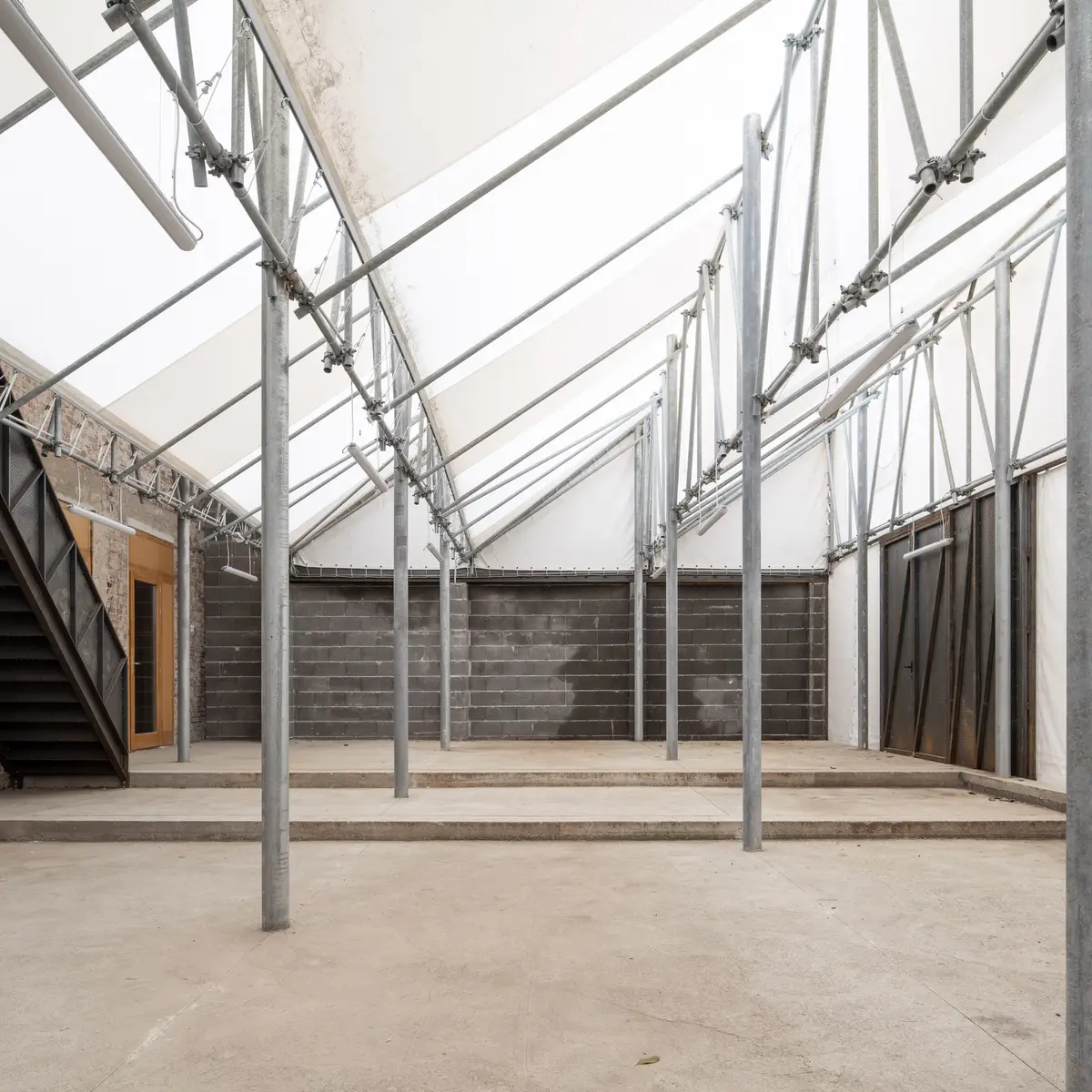
Atelier dmb Converts a Debrecen Leather-Drying Factory into an Architecture Incubator
A five-year collective build transforms a tanner's workshop into a raw, flexible home for the University of Debrecen's architecture faculty.


Ten years ago, faculty members from the Department of Architecture at the University of Debrecen went looking for a new home. They found one in an unlikely place: a crumbling leather-drying workshop in the city's former tanner's district. After a university-sponsored competition and a 20-year lease from the municipality, Atelier dmb, led by Balázs Falvai, Márton Nagy, and Dávid Török, spent five years turning 400 square meters of ruin into a working incubator for architecture students. The result is a building that wears its process on its sleeve, where the line between design and construction was deliberately blurred.
What makes The Dryer Workshop worth studying is not a singular formal gesture or a polished finish. It is the method. Atelier dmb embraced kaláka, a Hungarian tradition of collective building, as both a construction strategy and a pedagogical stance. Students and faculty built alongside professionals, making decisions on site rather than in a distant office. The architects describe their approach as that of a bricoleur, finding beauty in almost everything, and the building reflects this: unfinished surfaces remain exposed, a tree that sprouted in the yard during construction was kept, and tarpaulin roofing evokes the spatial world of the original drying racks. Nothing here pretends to be something it is not.
A Courtyard Under Tarpaulin
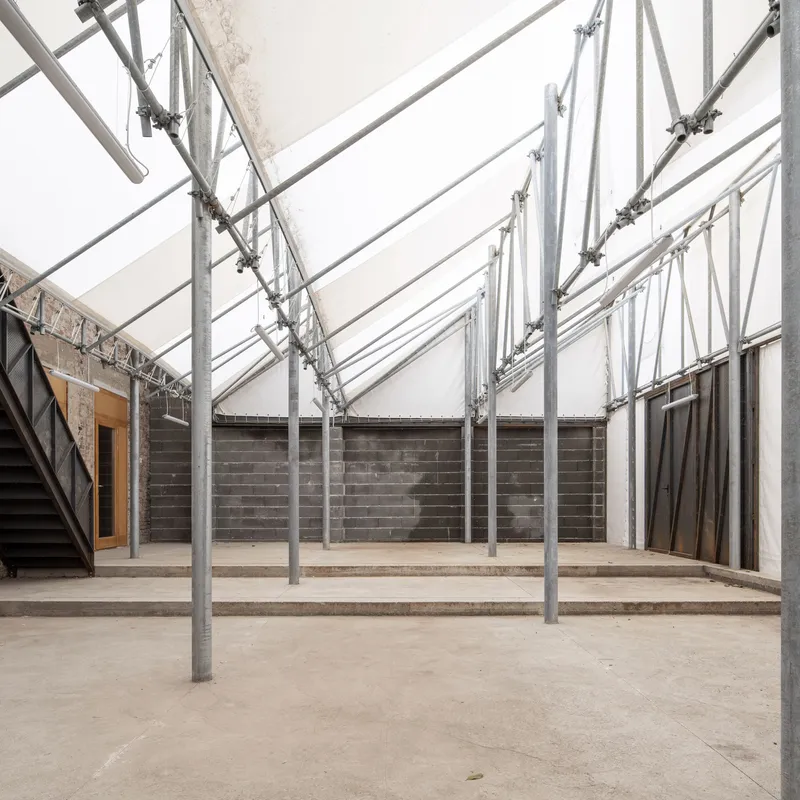
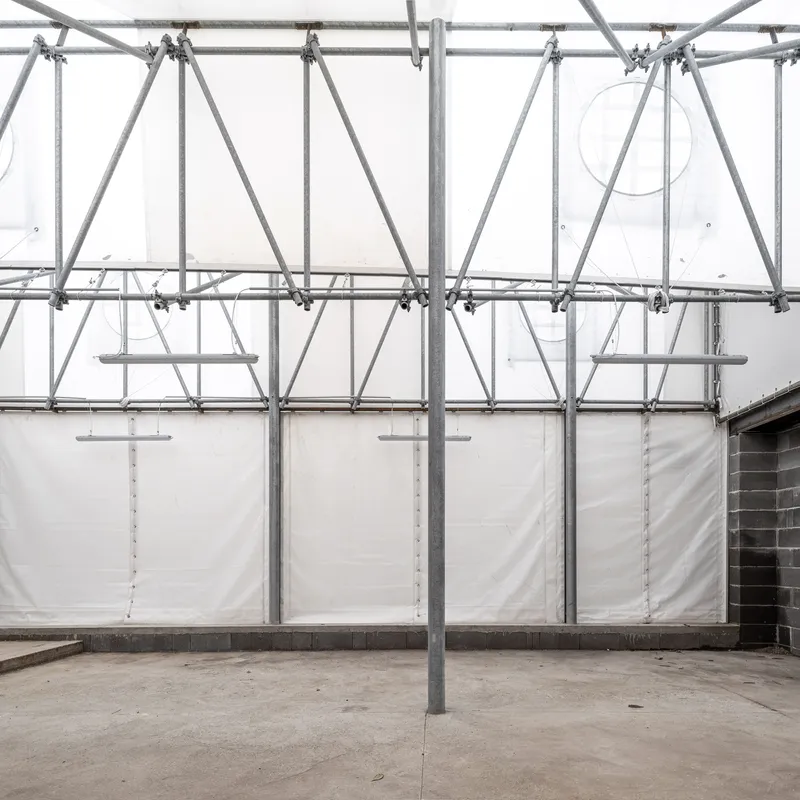
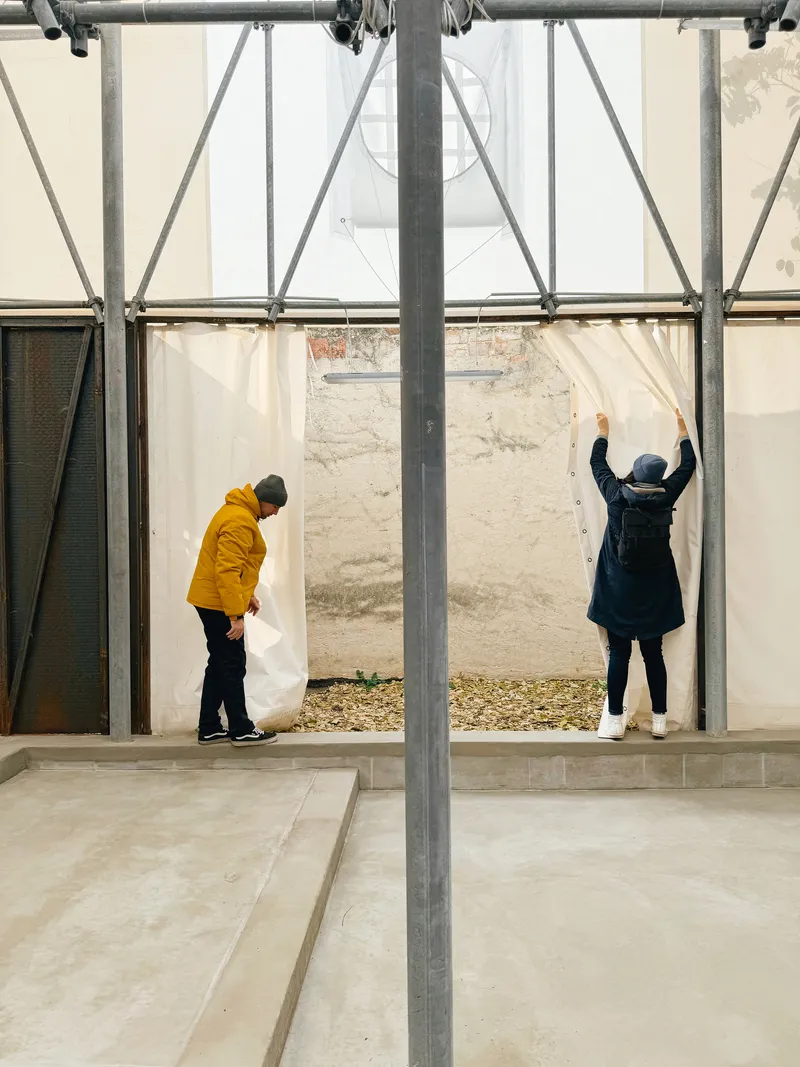
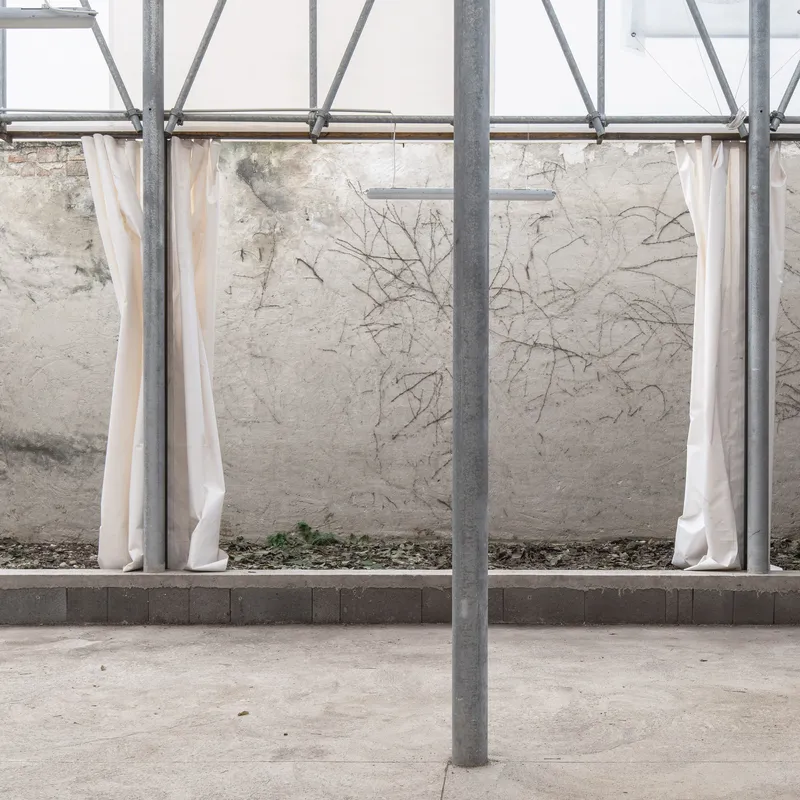
The heart of the project is the covered courtyard, a tempered interior space roofed with translucent tarpaulin stretched over a galvanized steel scaffolding frame. Light filters in from above, diffuse and even, giving the space the quality of a workshop rather than a gallery. The scaffolding itself is left raw, its bolted connections and diagonal braces fully visible. Cream fabric curtains hang from the frame, creating movable partitions that allow the courtyard to shift between event space, exhibition hall, and open-air studio.
The tarpaulin roofing is more than a practical choice. It is a direct reference to the building's past as a drying factory, where hides were hung and air circulated freely through open structures. That memory persists in the way the new enclosure breathes: it is tempered but not sealed, sheltered but not insulated from the world outside. Two visitors rearranging the curtains in one photograph perfectly capture the intended flexibility. The architecture does not dictate use; it accommodates it.
Exposed Surfaces as a Statement
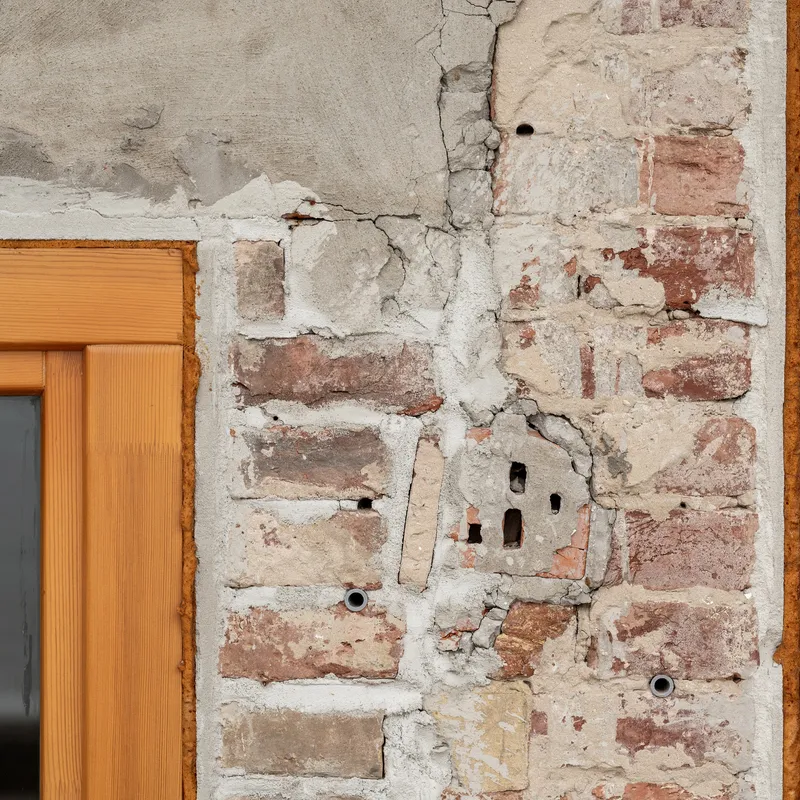
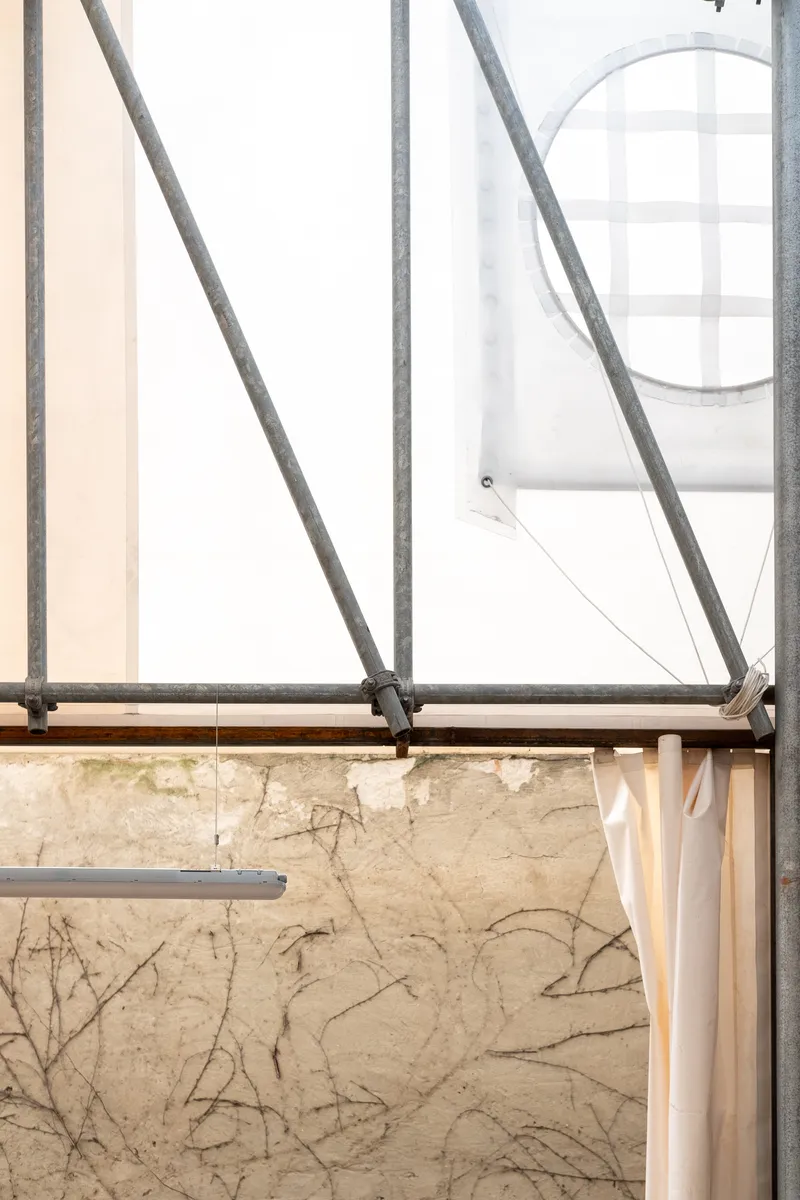
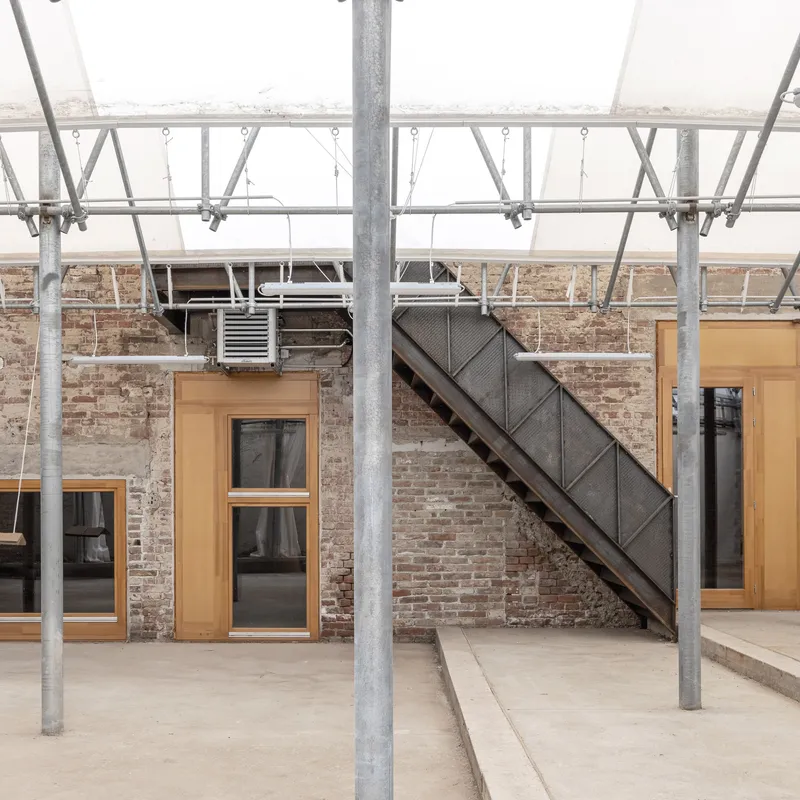
Atelier dmb made a deliberate choice to leave surfaces unfinished. Cracked plaster reveals brick beneath. Old electrical switch plates and conduit holes remain visible, marking the building's industrial past without sentimentalizing it. Diagonal steel bracing meets horizontal rails against walls scored with age, and the juxtaposition between new galvanized steel and century-old masonry is never softened. There is no plaster skim coat pretending these are new walls.
For an architecture school, this is a powerful pedagogical environment. Students working here are surrounded by evidence of how buildings are actually made: how materials weather, how structures transfer loads, how layers accumulate over time. The building itself becomes a teaching tool, which is precisely the point of the bricoleur philosophy that Atelier dmb espouses. Finish is not the goal. Legibility is.
Workshop Rooms in White Brick
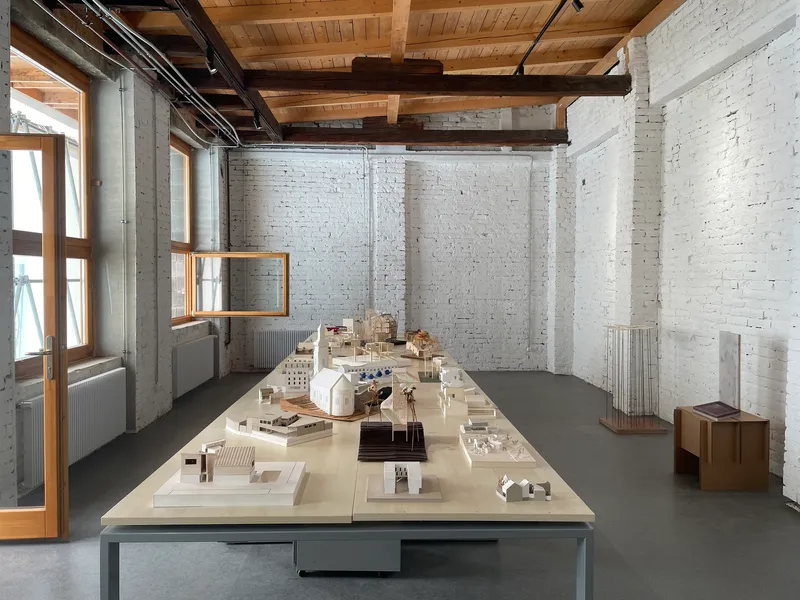
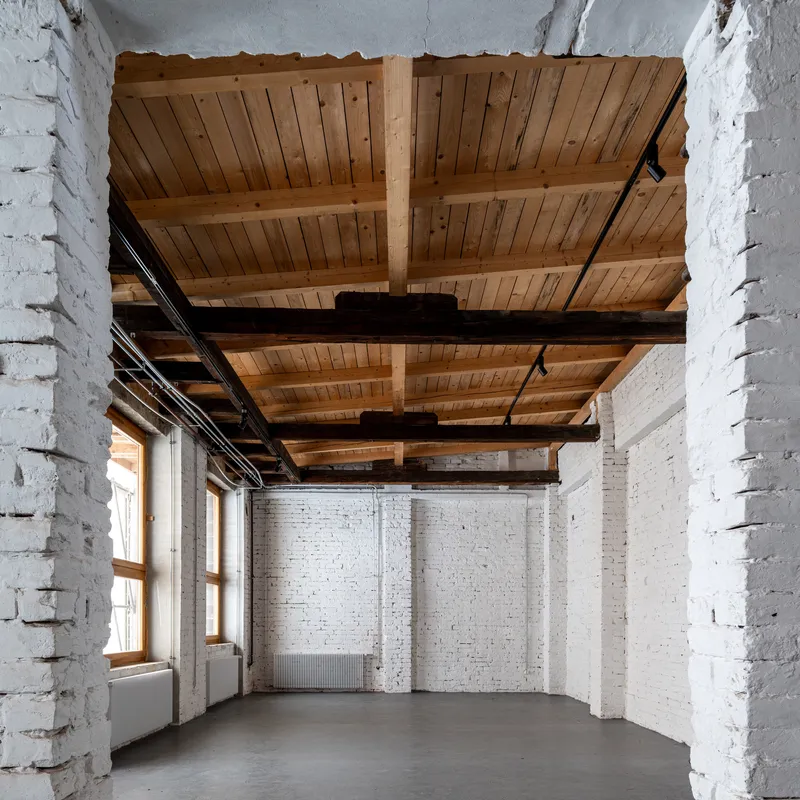
The four workshop rooms offer a counterpoint to the courtyard's rawness. White-painted brick walls brighten the interiors, while exposed timber plank ceilings and dark steel beams overhead maintain the building's honest material vocabulary. These are working rooms, not display spaces: a central table holds architectural models in progress, and the proportions favor function over impression. The sawtooth skylights above bring daylight deep into the plan, an intelligent move for studios where natural light is not a luxury but a necessity.
Handcrafted Details and Industrial Memory
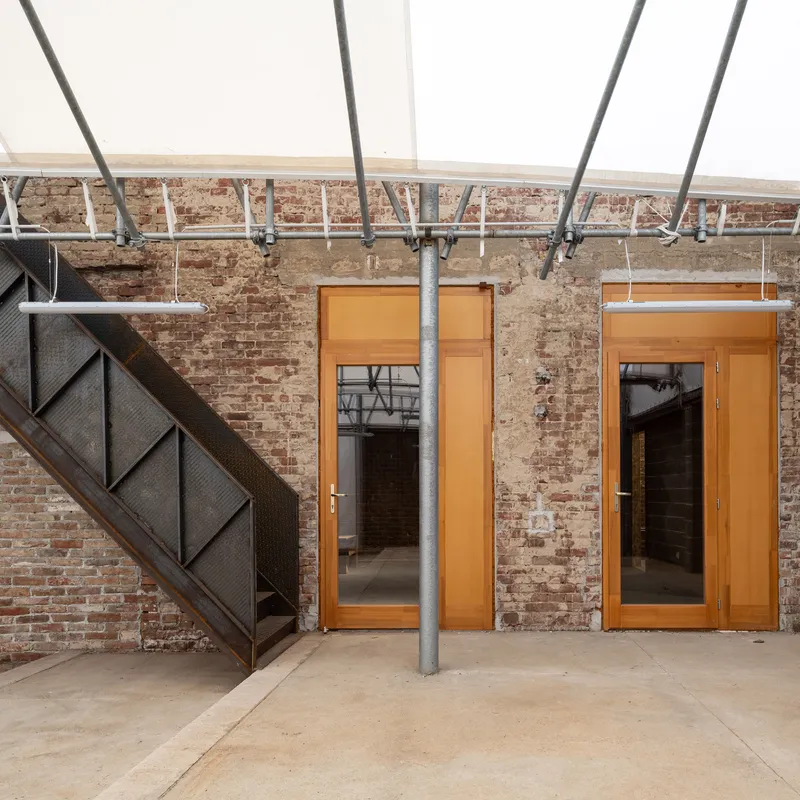
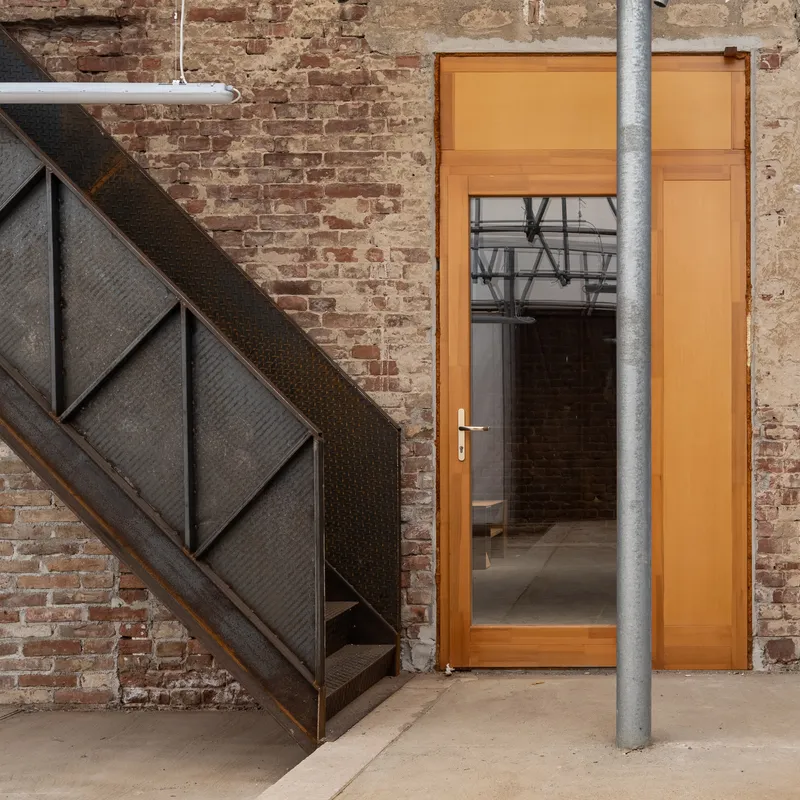
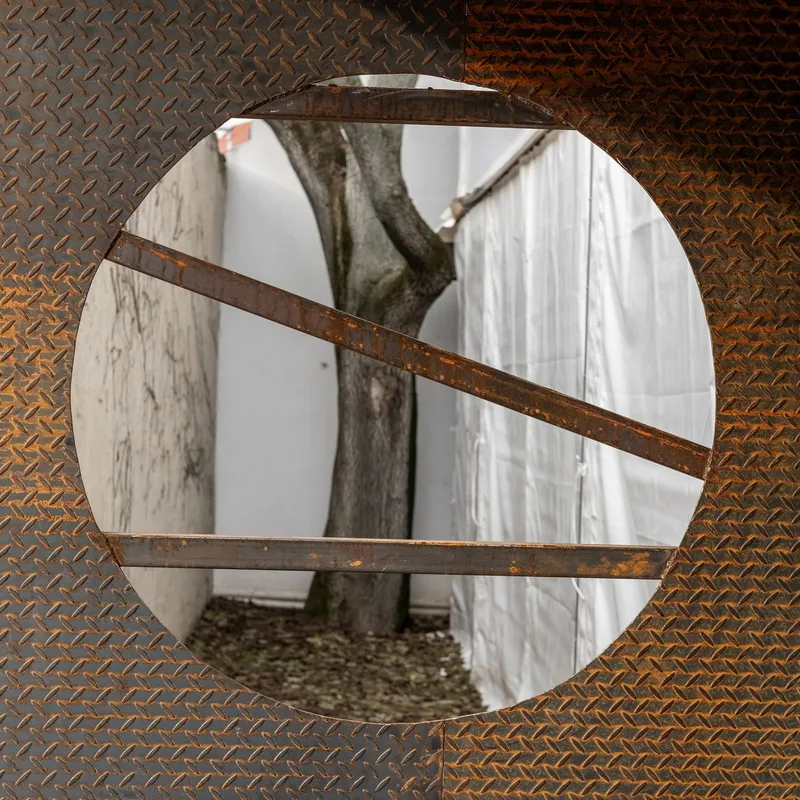
The details throughout The Dryer Workshop are resolutely handcrafted. Timber-framed glass doors are set into weathered brick walls, their orange paint a warm punctuation against the grey and brown palette. A circular opening cut into a weathered steel diamond-plate wall frames a tree and a white fabric screen beyond, a moment of almost cinematic composition inside an otherwise utilitarian structure. These are not details drawn in CAD and executed by a contractor at arm's length. They were resolved on site, in real time, as part of the open design process that defined the project.
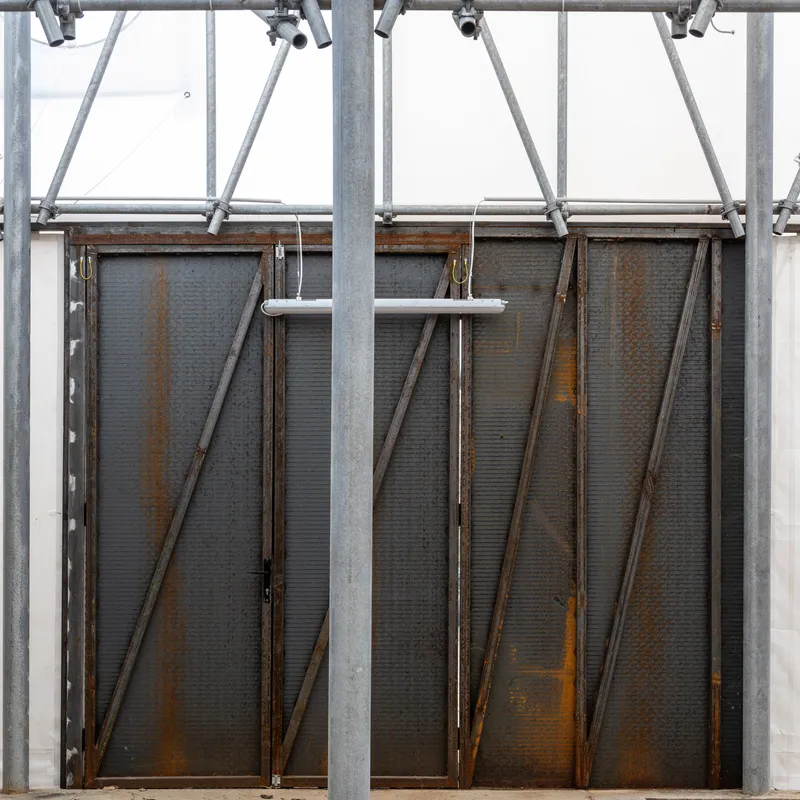
The sliding steel panel doors with diagonal bracing, suspended beneath the scaffolding structure, are perhaps the clearest expression of the project's ethos. They are heavy, industrial, and functional, yet their proportions and placement show the care of architects who understand that craftsmanship operates at every scale. The building never aspires to refinement in the conventional sense, but every joint, every connection, every material choice reflects intention.
Sawtooth Skylight and Brick Parapet
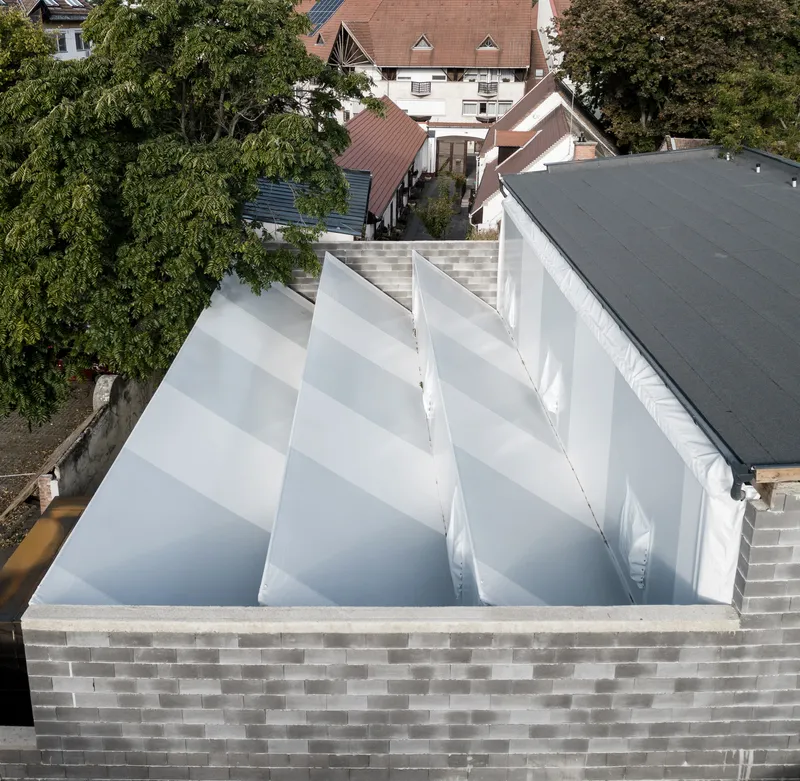
From above, the sawtooth skylight structure reads as a series of white translucent panels rising above a patterned brick parapet wall. The profile is industrial, recalling the factory typology from which the building descends. At street level, you would not necessarily know what happens inside. The exterior maintains a disciplined reticence, letting the neighborhood context, the former tanner's district, remain the dominant visual register. The building does not announce itself; it belongs.
Plans and Drawings
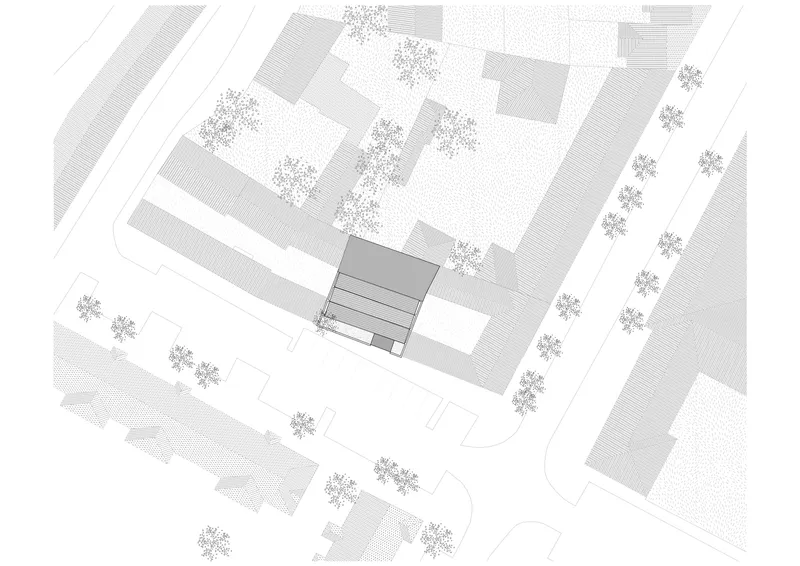
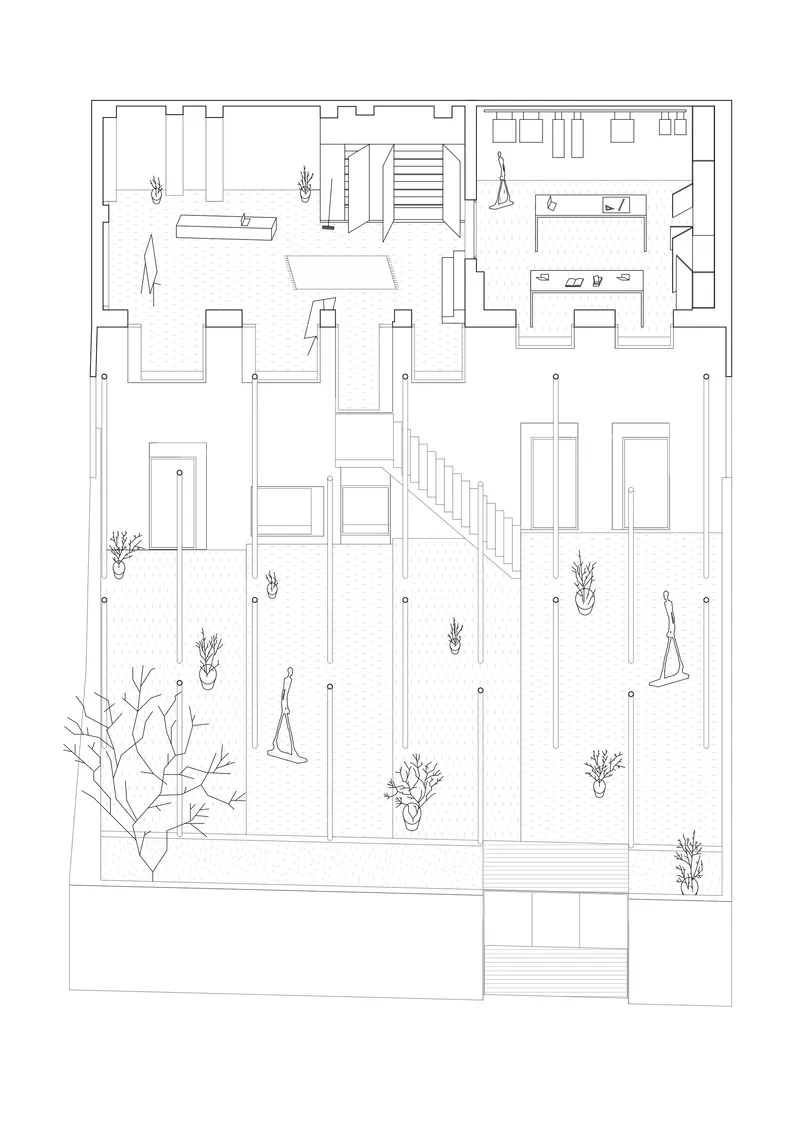
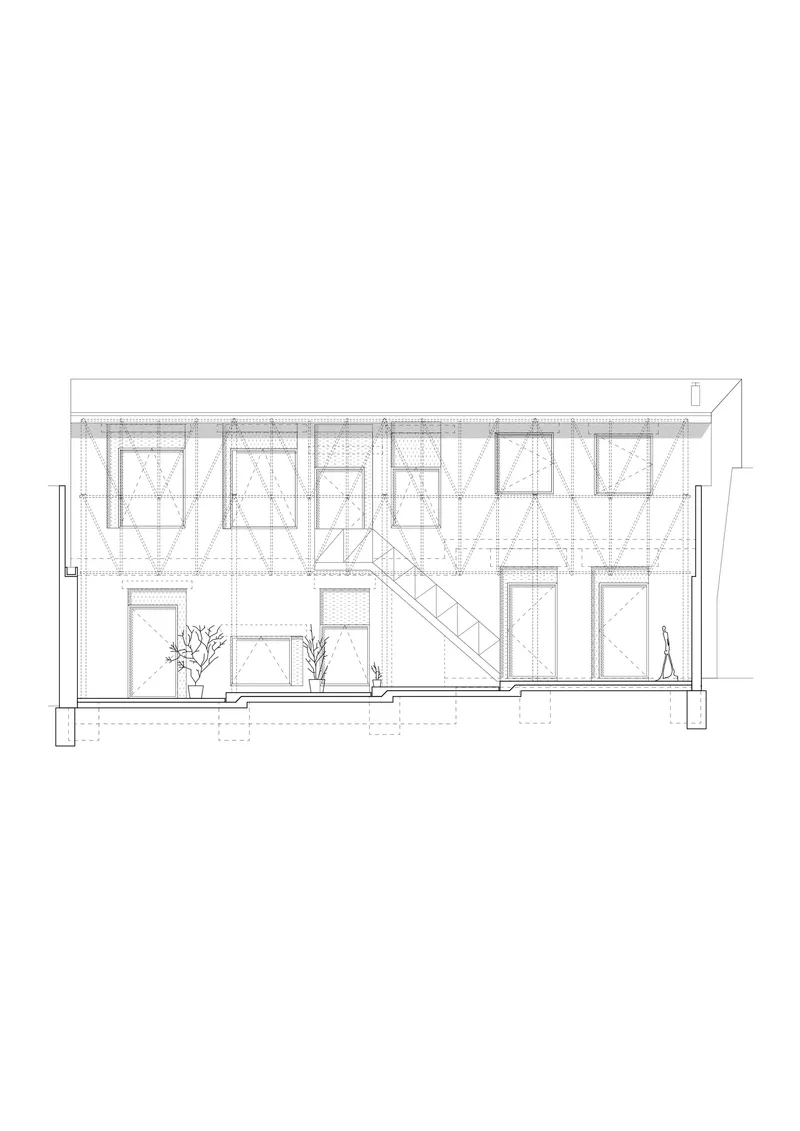
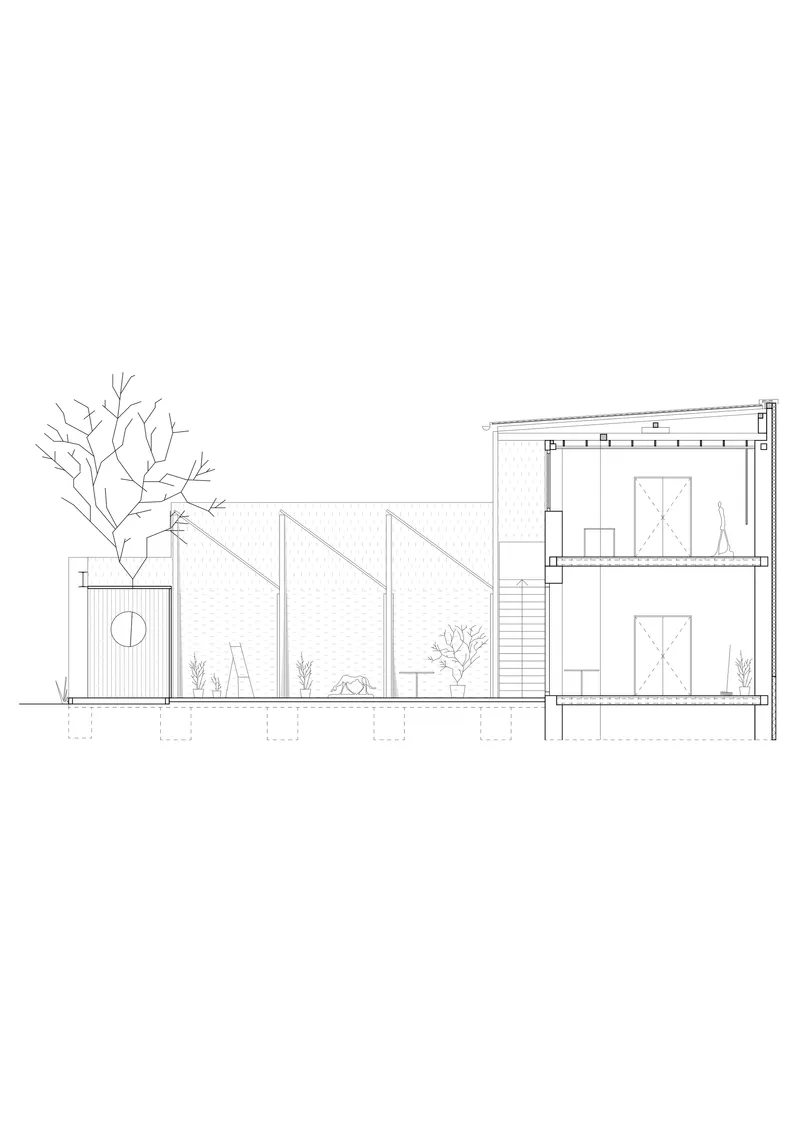
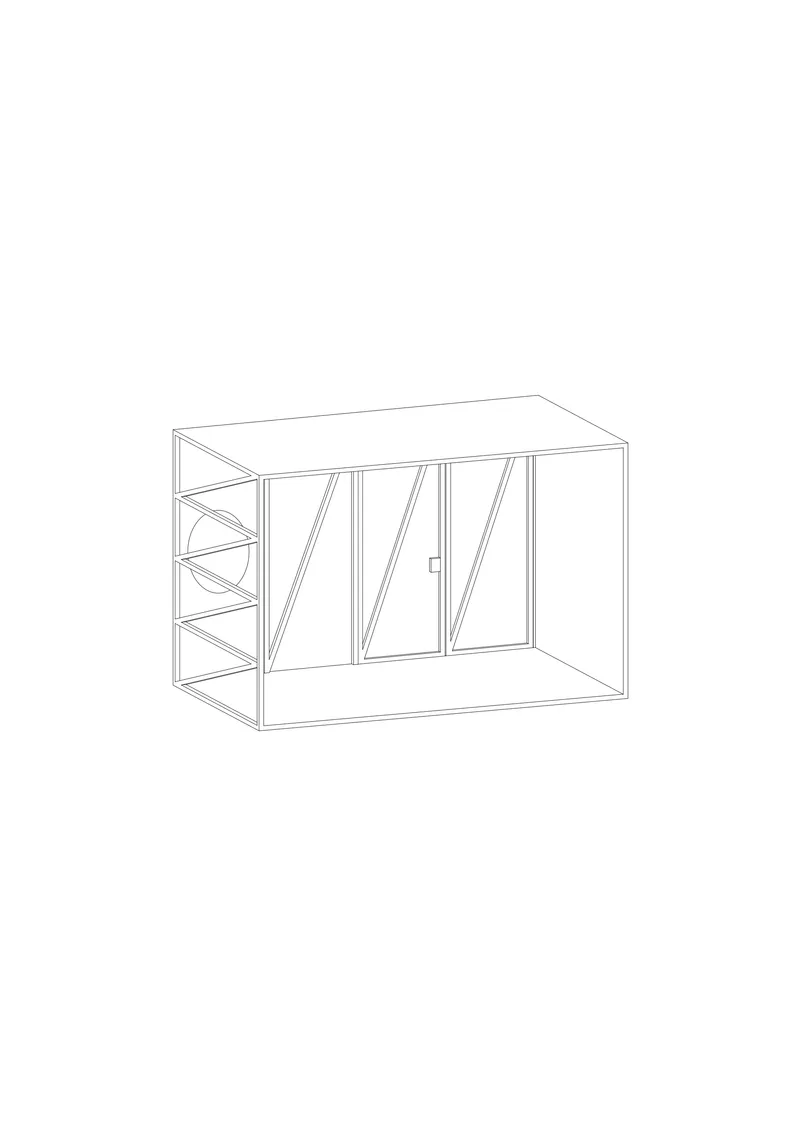
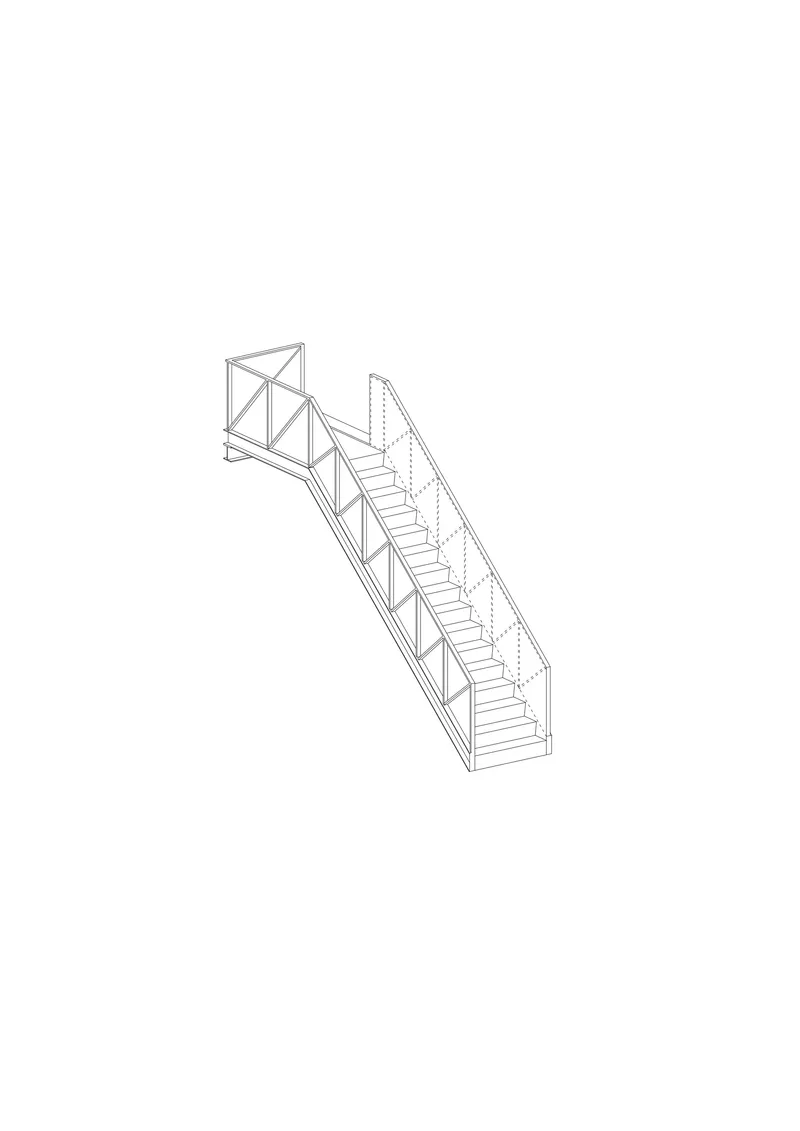
The drawings clarify what the photographs only suggest. The axonometric site plan shows how the building sits among its neighbors, a modest volume that draws no attention to itself from the street. The floor plan reveals the central staircase connecting the interior workshop rooms to the exterior courtyard, with its preserved plantings. Two section drawings cut through the diagonal bracing of the upper volume and the sloped roof over the enclosed courtyard, exposing the spatial logic of the tarpaulin enclosure. The detail axonometric of the sliding panels and the staircase isometric confirm that Atelier dmb thought through the construction at the scale of individual components, not just the whole.
Why This Project Matters
The Dryer Workshop is a quiet argument for a different way of making architecture. In a discipline increasingly dominated by digital workflows, remote coordination, and the separation of design from construction, Atelier dmb chose the opposite path. They built slowly, collectively, and on site. They preserved what they found, from brick walls to a volunteer tree, and added only what was needed using materials that do not pretend to be anything other than what they are. The result is a 400-square-meter building that took five years to complete, which by market logic is absurd and by educational logic is exactly right.
For a school of architecture, the building is its own curriculum. It teaches material honesty, structural legibility, adaptive reuse, and the value of collective labor, not through lectures but through the daily experience of inhabiting a space that was built by the community that uses it. The kaláka tradition that Atelier dmb revived is not nostalgia. It is a viable alternative to the alienated construction processes that produce most of the built environment. Debrecen's former tanner's district now has an architecture school that practices what it teaches, and that alone makes it worth paying attention to.
The Dryer Workshop by Atelier dmb (lead architects: Balázs Falvai, Márton Nagy, Dávid Török). Debrecen, Hungary. 400 m². Completed 2024. Photography by György Palkó and András Weiszkopf.
About the Studio
Share Your Own Work on uni.xyz
If projects like this are the kind of work you want to make, uni.xyz is a place to publish your own, find collaborators, and enter design competitions.


Popular Articles
Popular articles from the community


Opera by the Sea Estonia: Three Shells Dissolving Architecture into Tallinn's Coastline
A winning opera house proposal replaces monumental form with interconnected shells that blur the boundary between building, park and Baltic Sea.

Extended Shell: Retrofitting Kolkata's Balconies as Living Urban Thresholds
A modular retrofit system recovers the social and environmental intelligence of Kolkata's historic verandas for contemporary Park Street residents.

Manzana Morphosis: Stretching Barcelona's Grid into a Living Landscape for 2050
A radical reworking of the Eixample manzana turns density into a tool for generous public space, vertical ecology, and environmental performance.

Tsunami Convergenics: Turning Catastrophic Ocean Forces into Underwater Housing Infrastructure
A speculative underwater settlement off the coast of Onagawa, Japan, treats tsunamis and typhoons as energy sources rather than threats.

Similar Reads
You might also enjoy these articles

Pixel Gardens: One Repeated Module Stacked Into a Terraced Social Housing Tower for Famagusta
Salem Bader's shortlisted housing tower builds a vertical neighbourhood from one repeated module, offsetting units to carve terraces, light and air.

Bao Huynh Watercolor Atelier: A Serene Art Retreat in Hội An
Bao Huynh Watercolor Atelier in Hội An blends multifunctional art spaces, sustainable design, local materials, and family-friendly living in a serene environment.

Atelier Macri Concept Store Interior Design by CASE-REAL
Atelier Macri store features a "ko" counter, walnut wood details, cork displays, blending retail, gallery, and seamless customer experiences.

Manuel Vargas Izquierdo Stadium and High-Performance Sports Center: Architectural Excellence in Jalpa de Méndez
The Manuel Vargas Izquierdo Stadium blends sustainable design, inclusive sports facilities, and cultural-inspired architecture, revitalizing Jalpa de Méndez’s public spaces.

Explore Usptu Dep. Of Architecture Competitions
Discover active competitions in this discipline

Challenge to design public laboratory

Bring back Drive In's
Comments (0)
Please login or sign up to add comments
No comments yet. Be the first to comment!