
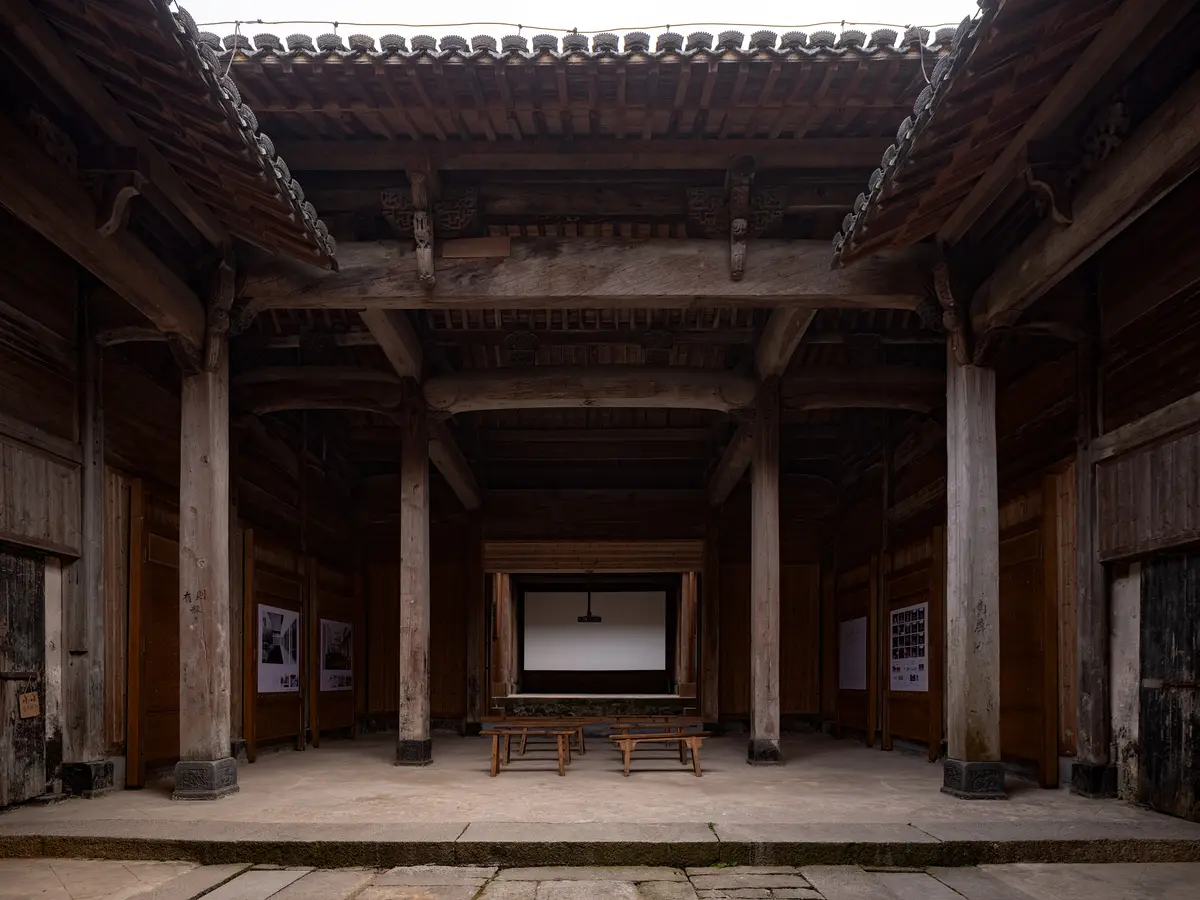
Atelier Guo Inserts a Village Cinema into a Centuries-Old Ancestral Hall Without Touching a Wall
A reversible intervention in Nanping Village near Huangshan transforms a heritage timber hall into a cinema, library, and café.


The premise sounds impossible: install a functioning cinema, a mezzanine library, and a café inside a protected ancestral hall in rural China, and do it all without drilling a single hole in the original structure. Atelier Guo, led by Liaohui Guo, pulled it off in Nanping Village near Huangshan, a settlement whose identity has long been intertwined with photography and film. The Cheng Family Ancestral Hall, with its carved brackets and post-and-beam timber frame, now hosts screenings that reject the black-box convention entirely, letting daylight, courtyard breezes, and centuries of patina share the room with projected images.
What makes this project genuinely interesting is not the adaptive reuse itself but the method. Rather than shoring up the old hall or carving out new openings, Atelier Guo designed an independent secondary structure, steel elements wrapped in wood, that sits inside the three-bay hall like a ship in a bottle. Every new piece can theoretically be removed, returning the hall to its original state. The approach borrows directly from Huizhou building tradition, which distinguishes between major structural carpentry and finer infill work. Here that logic gets updated: the ancestral hall is the carpentry, and the cinema kit is the infill.
Structure Within Structure

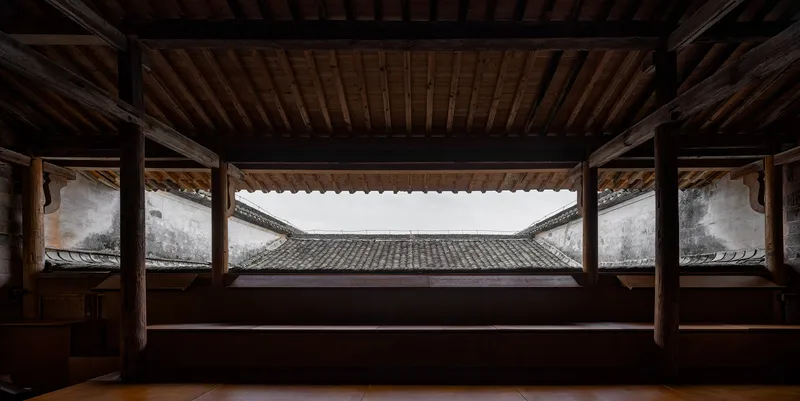
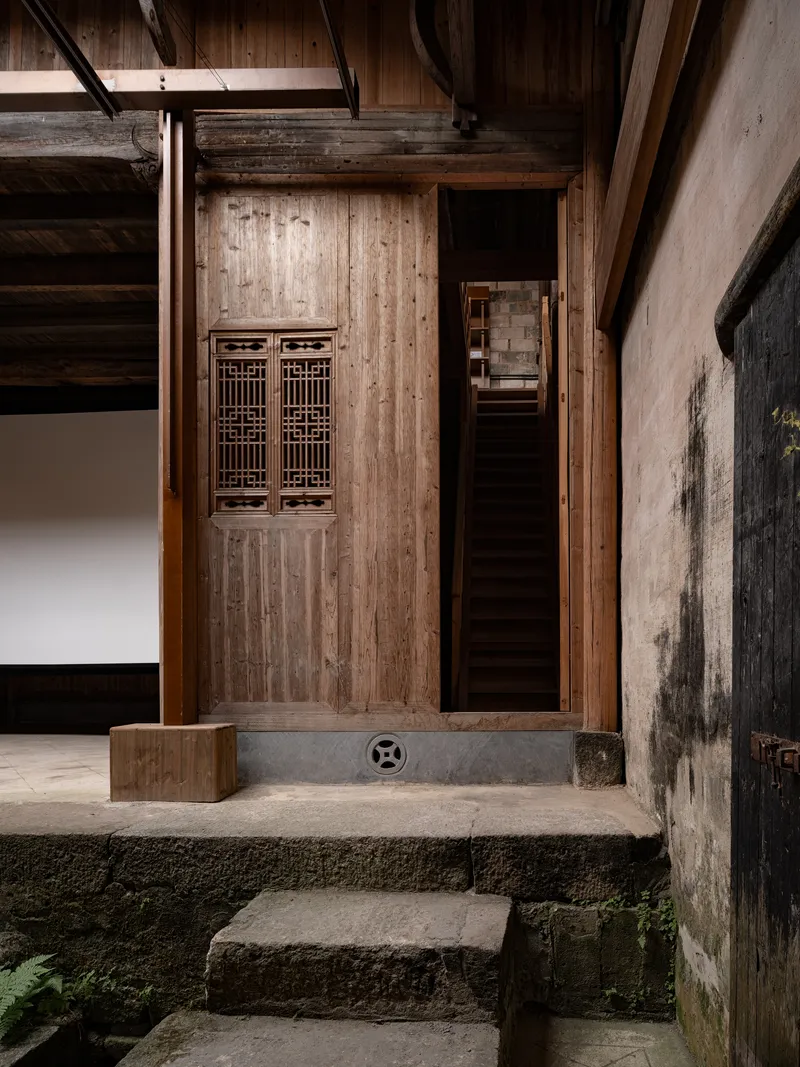
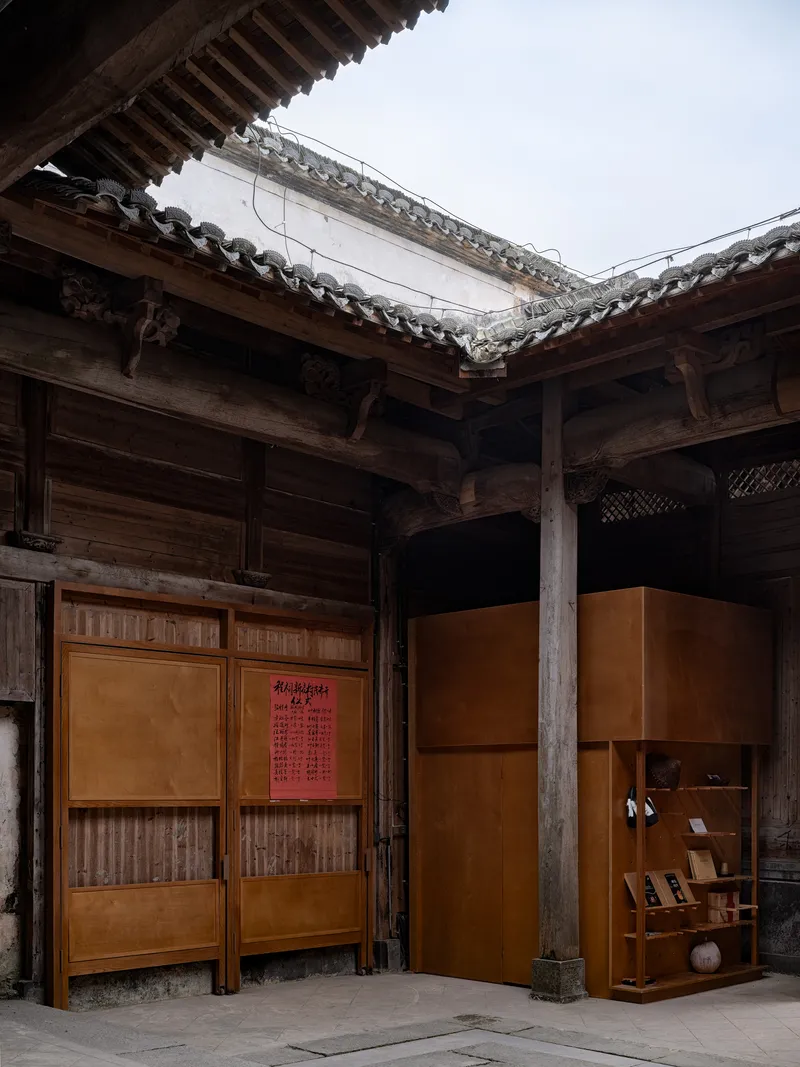
Walk through the hall and you notice the old timber columns standing free, unburdened by any new load. The inserted framework navigates around them with careful clearances, a structural puzzle solved largely off-site through prefabrication and then assembled on location by local craftsmen. The result is a spatial layering that reads clearly: dark original columns in the foreground, lighter new wood panels behind, and stone floors underfoot that predate both systems.
Service lines for the coffee bar were routed with the same discipline, threaded through the new framework rather than chased into historic fabric. It is a level of care that often gets talked about in heritage briefs but rarely executed this completely. The detachability is not a gimmick; it is the project's ethical core.
A Cinema That Lets the Light In
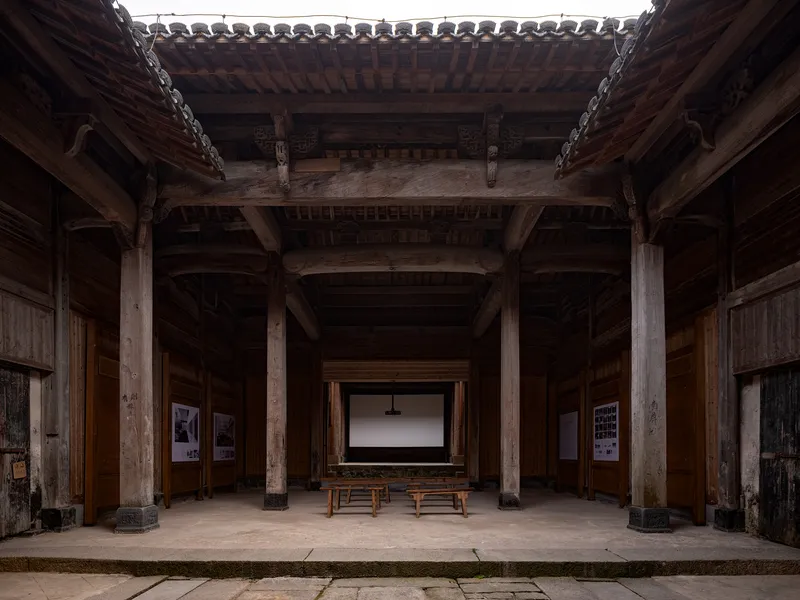
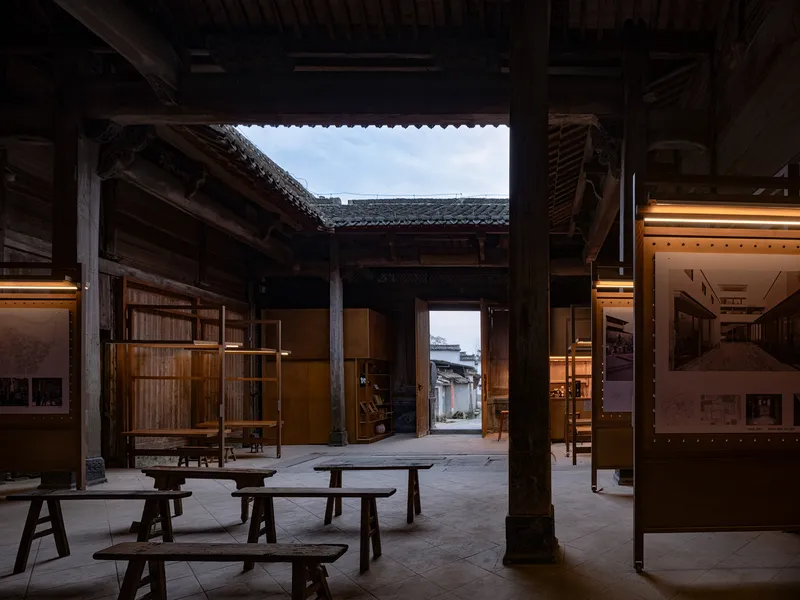
Conventional cinemas seal themselves off. This one opens up. The central hall retains its skylight, and a projection screen hangs between timber benches under the full height of the roof trusses. The second bay offers eye-level viewing, while the first-bay courtyard allows a more distant, atmospheric experience, almost like watching a film from a village square. Concrete-counterweighted shading panels above the courtyard can pivot to block sunlight for daytime screenings, an elegantly mechanical solution to a problem most architects would solve with blackout curtains.
The spatial sequence follows the hall's original three-bay organization: open and informal at the entrance, gradually concentrating toward the deeper bays where viewing and reading happen. You move from socializing to watching to studying, and the architecture supports that gradient without forcing it.
The Exhibition Layer
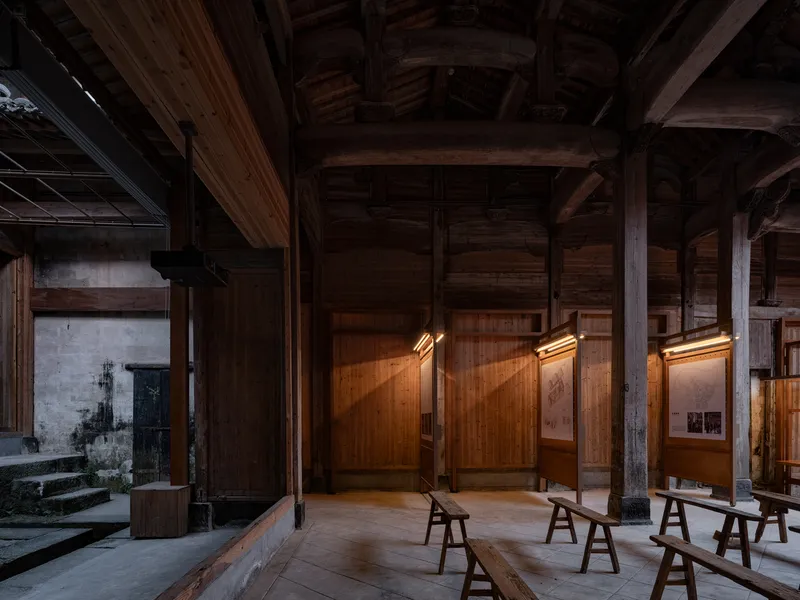
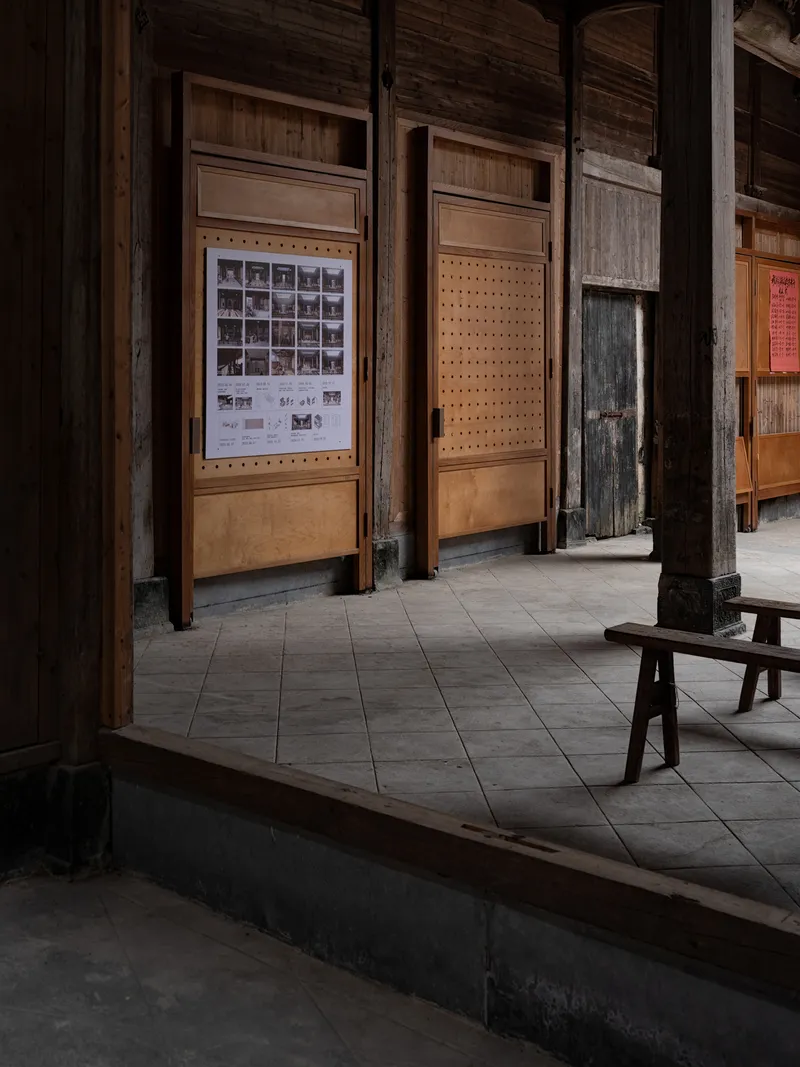
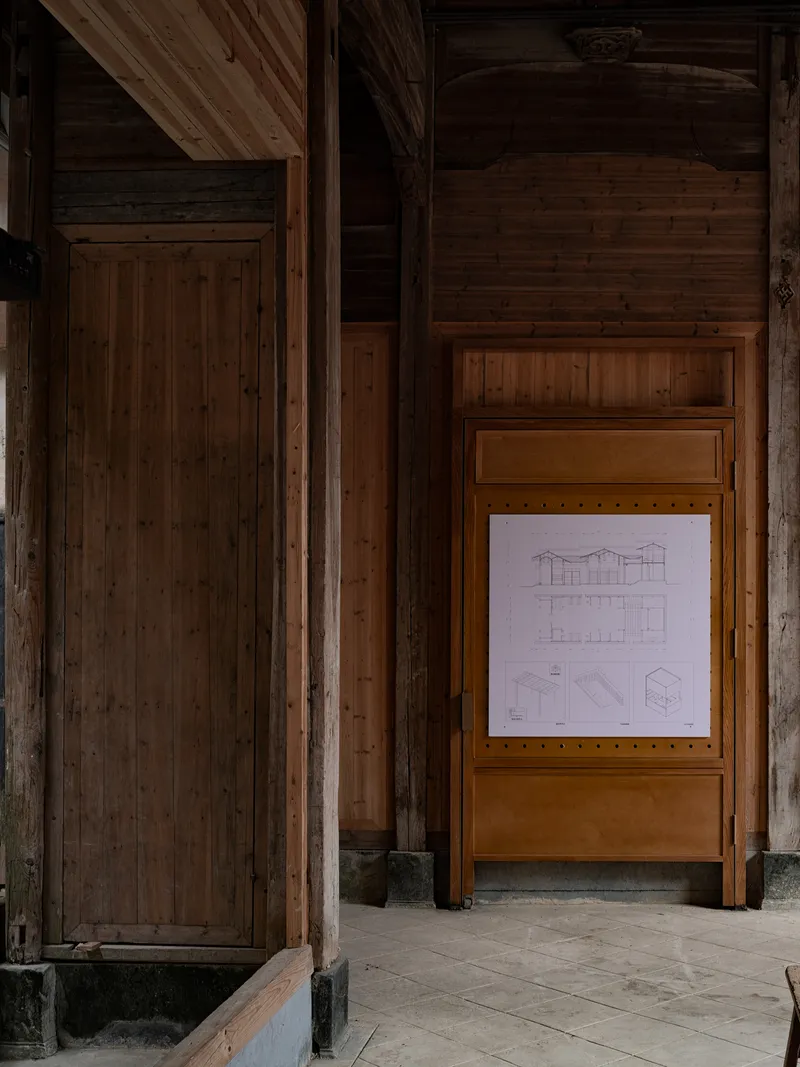
Illuminated display panels, angled outward from the timber walls, turn the circulation zones into informal gallery space. Pegboard surfaces hold printed matter and photographs, reinforcing Nanping's identity as a village of images. The panels glow amber at dusk, transforming the hall's edges into a lantern-like sequence visible from the courtyard and the street beyond.
The choice to use a mixture of old and new wood for wall panels blurs the line between what was already here and what arrived with the project. It is a material argument for continuity rather than contrast, and it works because the proportions of the new panels echo the scale of the original timber bays.
Reading Above, Coffee Below
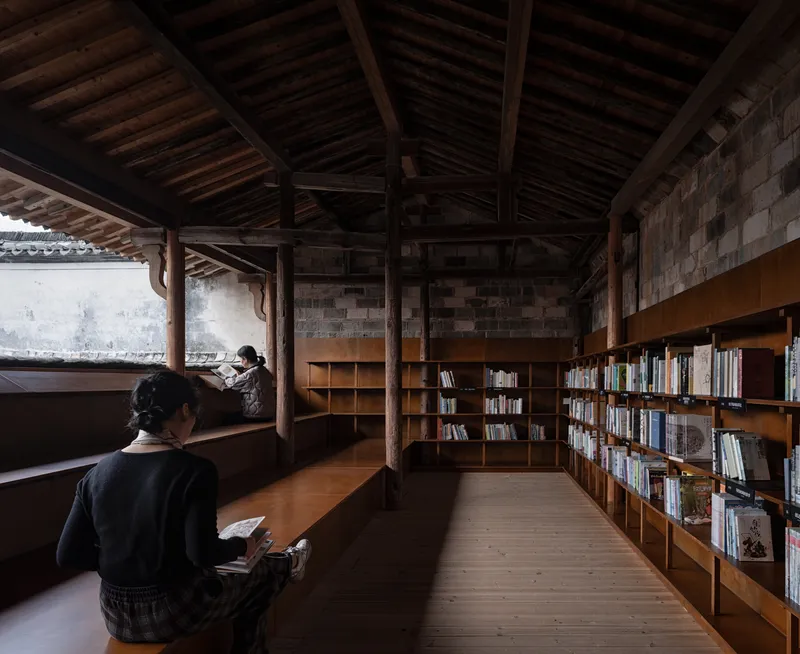
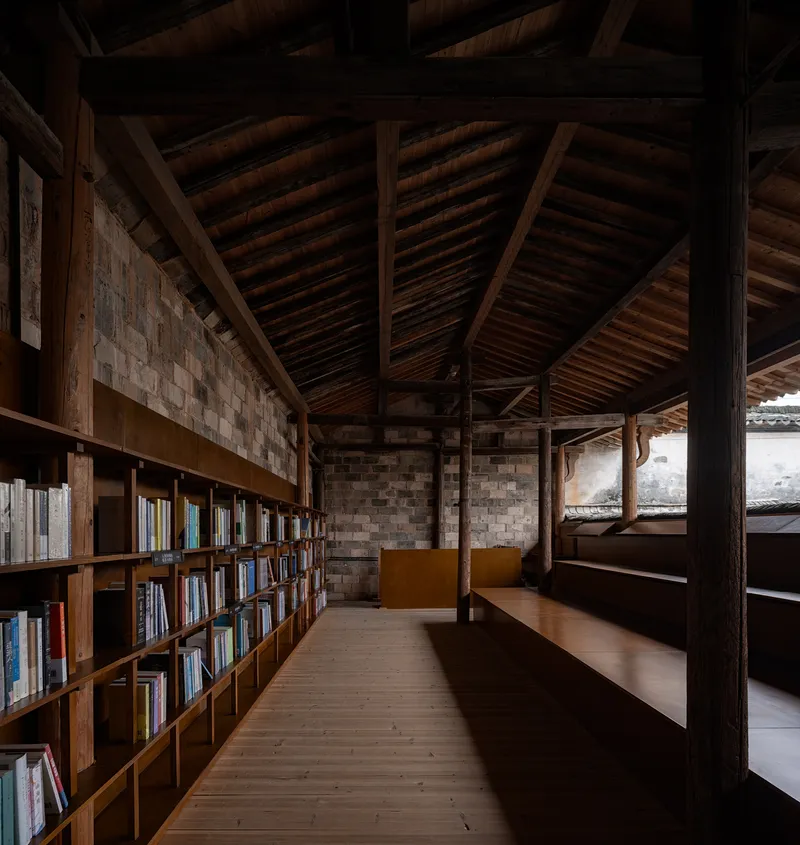
A mezzanine-level library occupies the upper layer of the hall, tucked under the exposed rafter ceiling. Low bookshelves line a grey brick wall, and the reading desks look down through the timber structure to the screening space below. It is a quiet zone that borrows its atmosphere from the roof: close rafters, warm light, the smell of old wood.
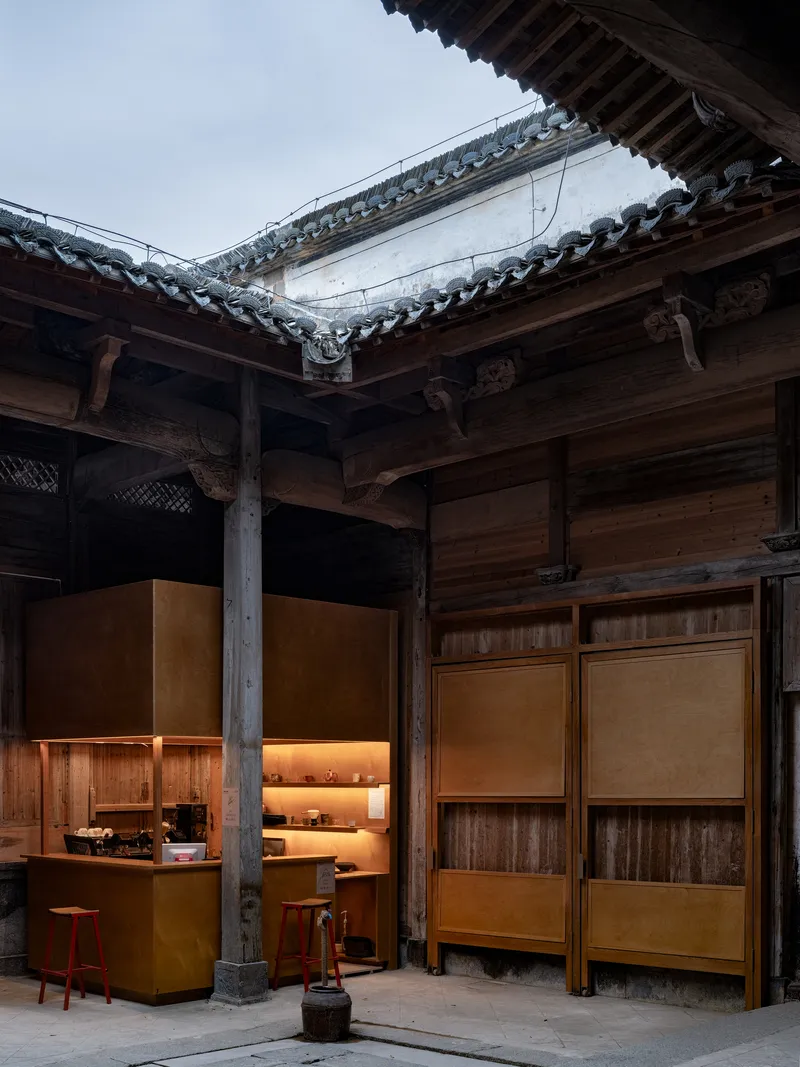
At ground level, an illuminated service counter nestled beneath the traditional tiled roof overhang serves as the café. The counter glows against the dusk sky, drawing visitors in from the village lanes. Operationally, this stacking of program, cinema, library, café, within 323 square meters is tight but legible, each function occupying a distinct vertical or horizontal zone within the same hall.
Dusk and the Village Roofscape
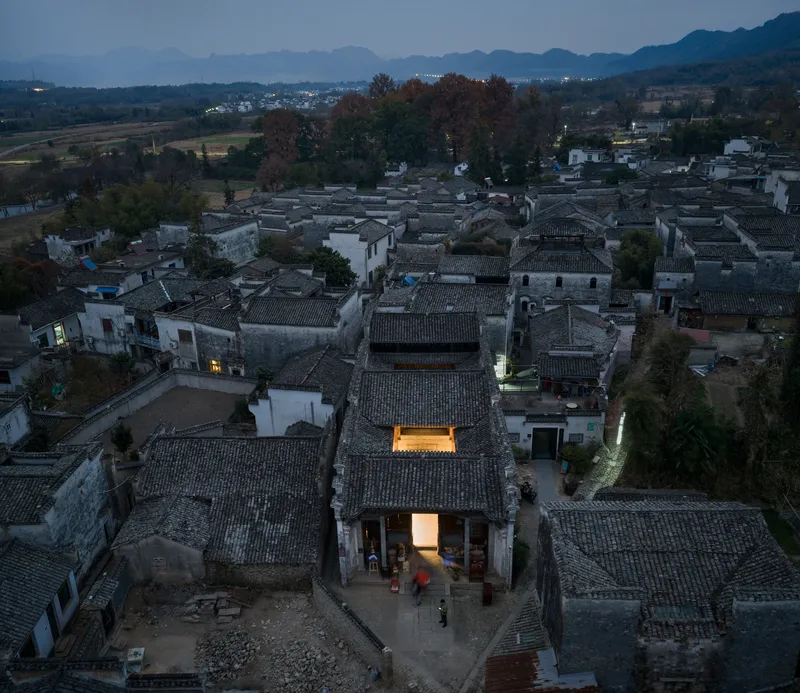
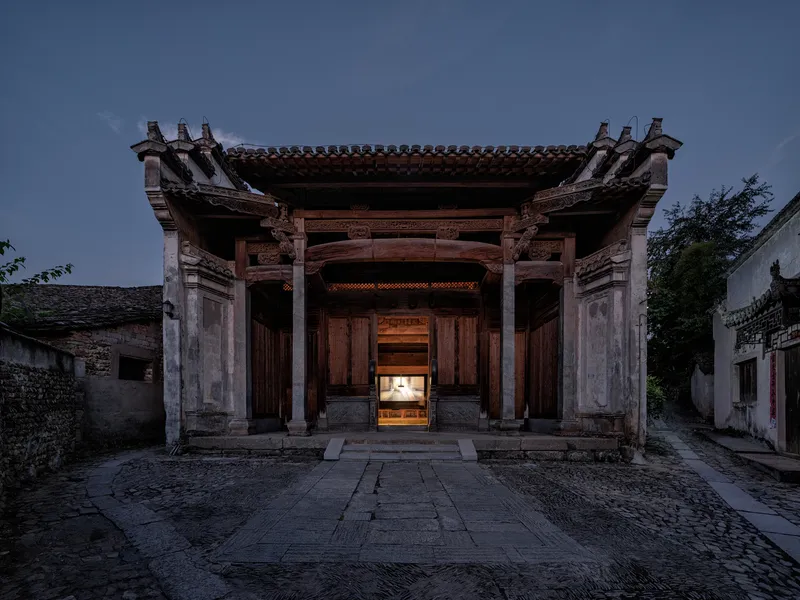
From above, the hall's tiled roofs merge with the village fabric. The courtyard glows between them, a warm pocket in a dense canopy of grey tile and white plaster. Distant mountains frame the scene. At street level, the front elevation with its carved brackets and shallow eaves reads as it always has, a hall among halls, betraying almost nothing of the programmatic transformation inside.
This restraint at the exterior is arguably the project's strongest move. Heritage interventions often announce themselves with a conspicuous material change, a glass box, a corten portal. Here the signal is light spilling through existing openings, nothing more.
Plans and Drawings
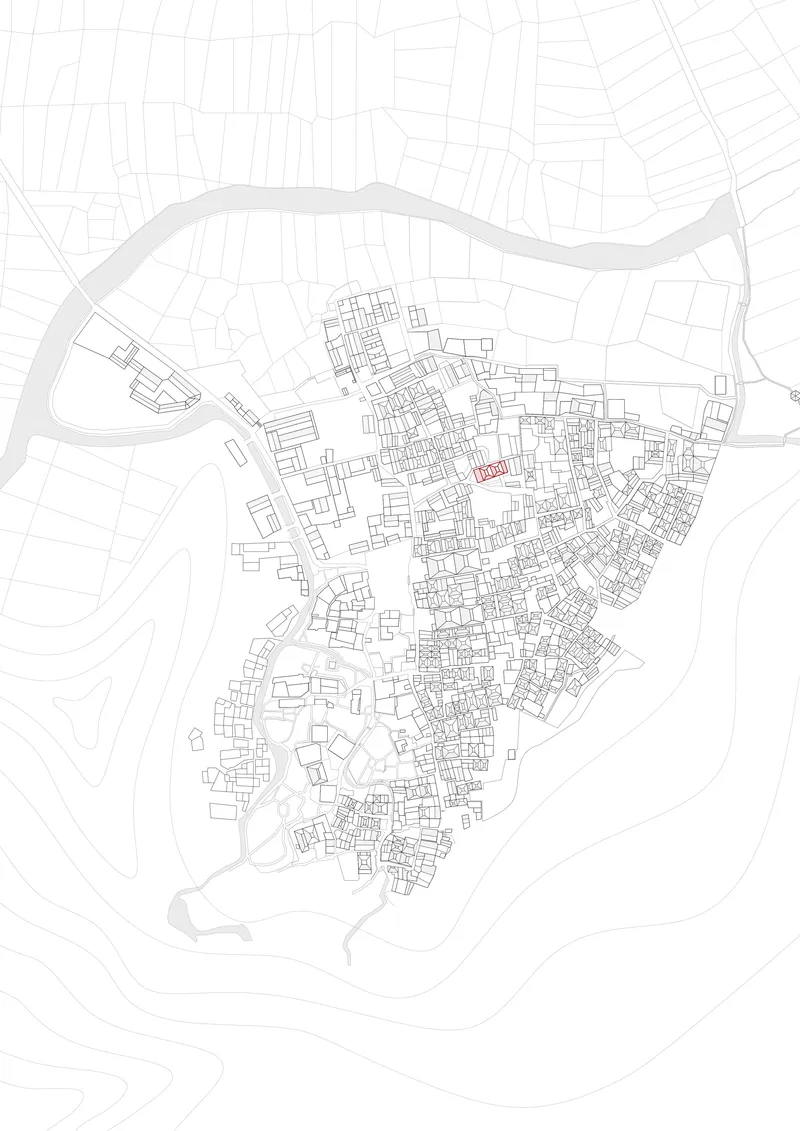
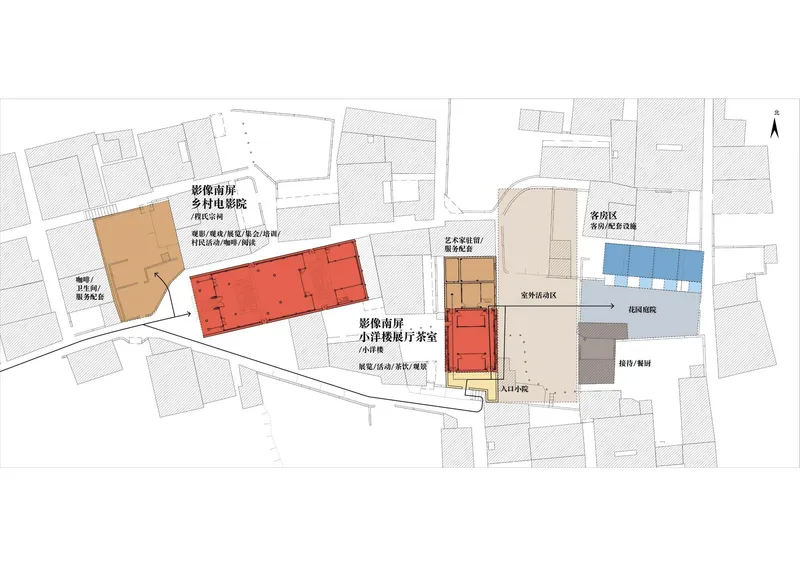
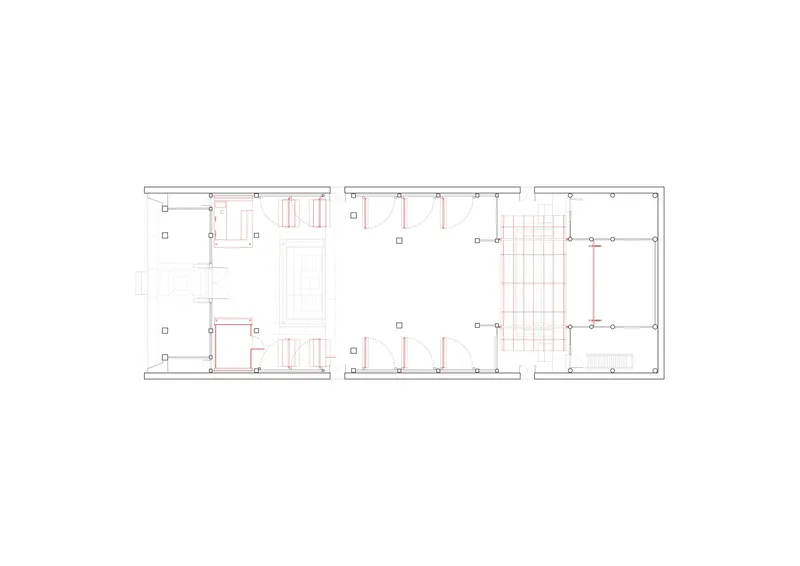
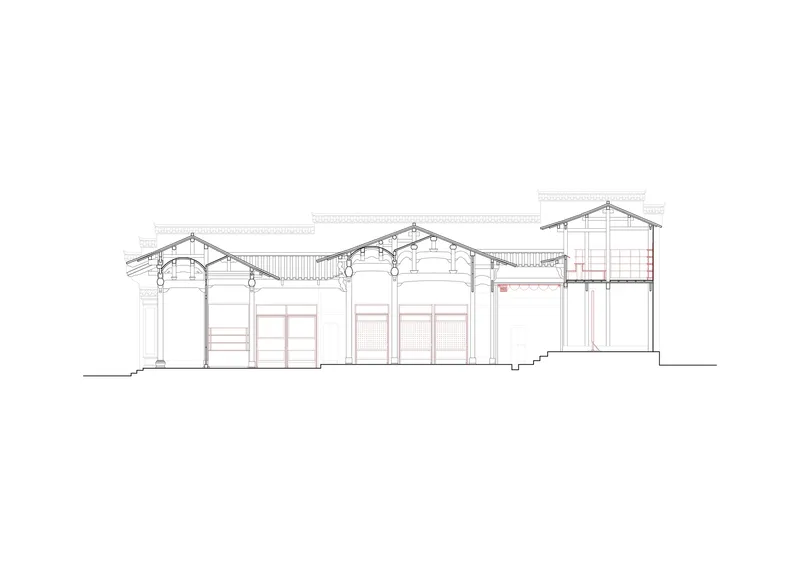
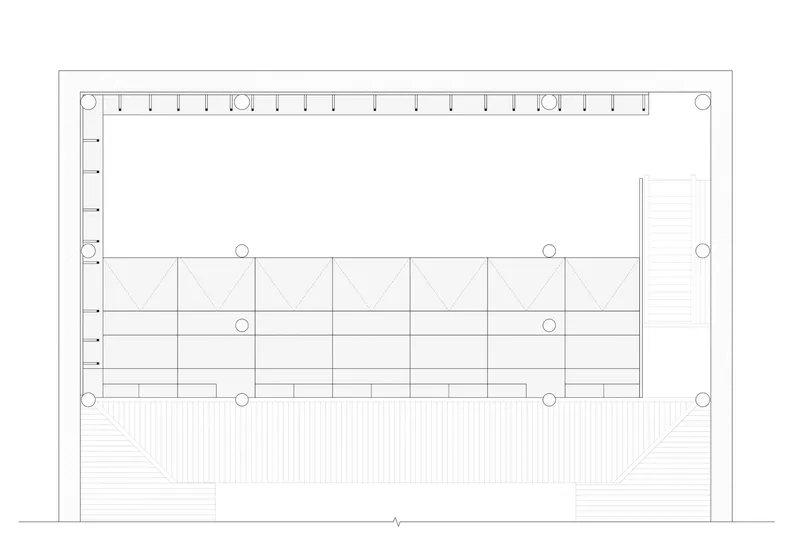
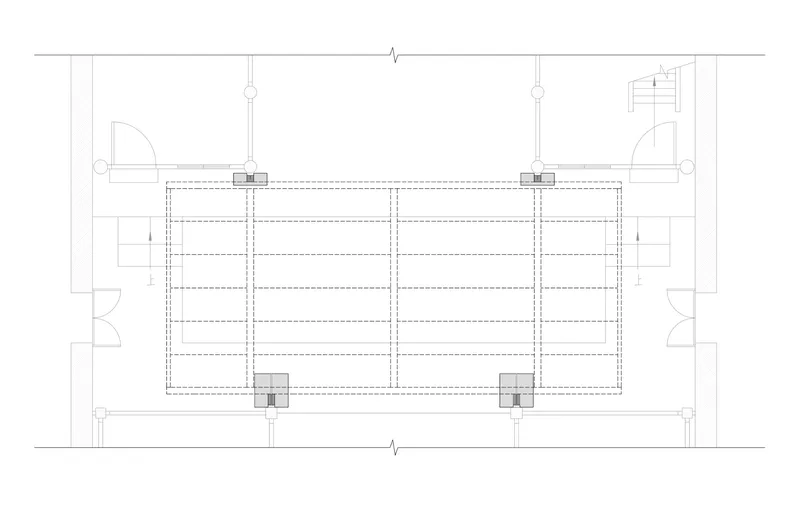
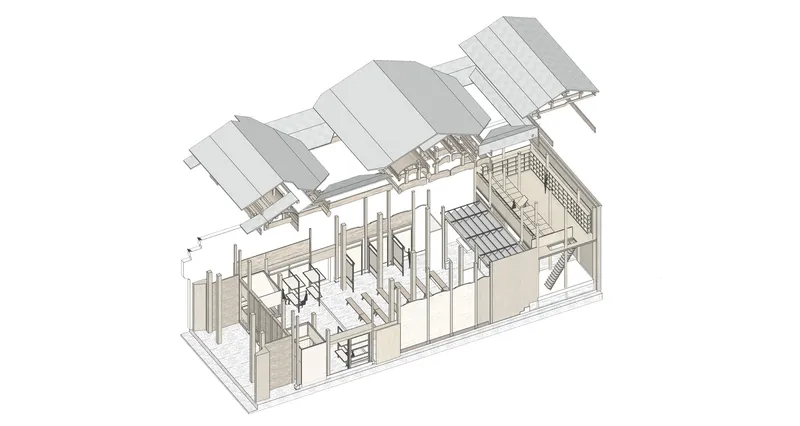
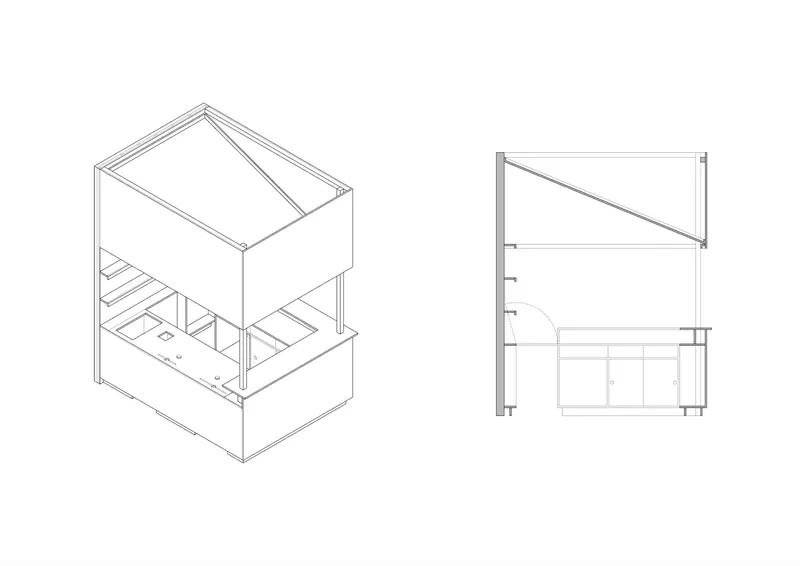
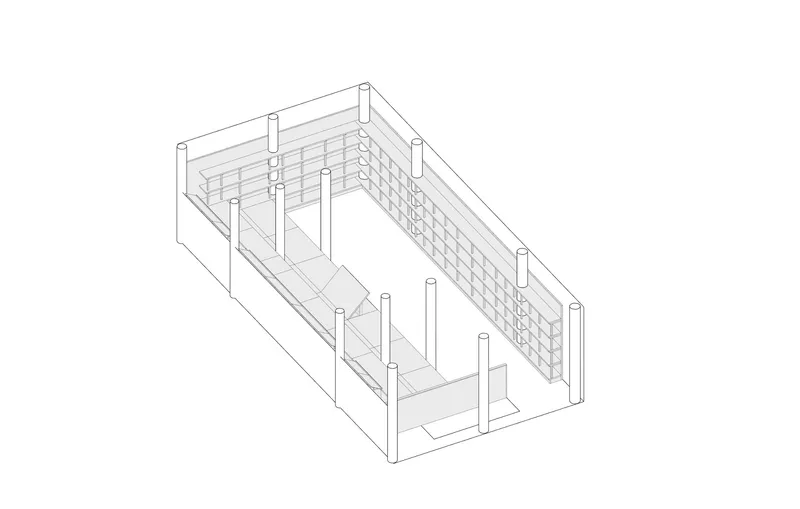

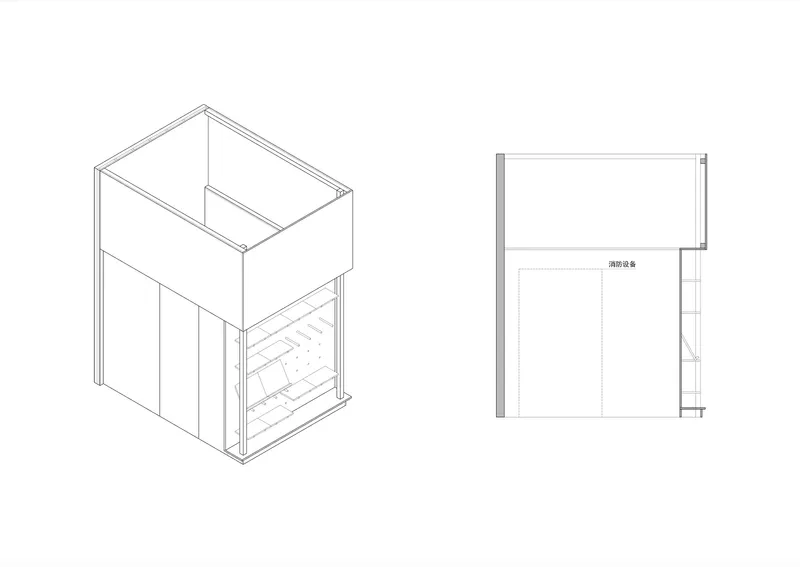
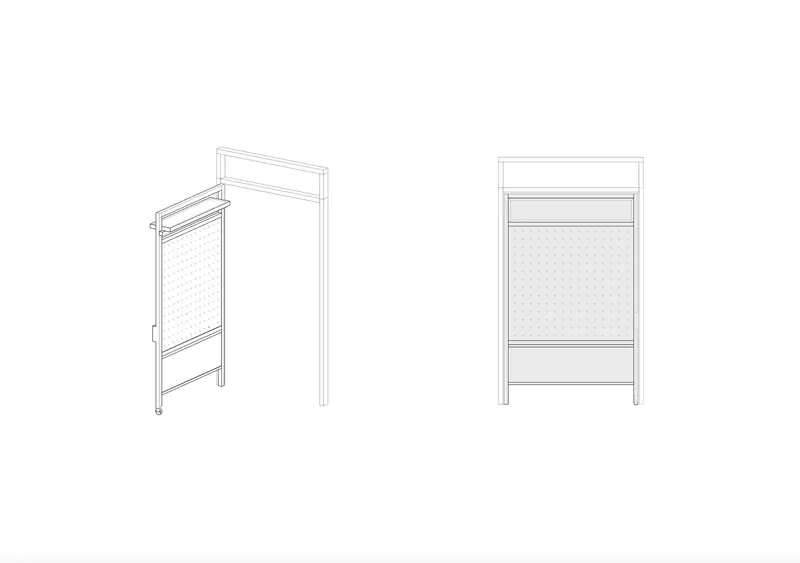
The site plan reveals how tightly the hall sits within Nanping's urban grain, pressed against a river bend and surrounded by narrow lanes. The floor plan clarifies the three-bay logic: courtyard, central screening hall, and a deeper service zone, each bay defined by the existing column grid. Sections expose the mezzanine insertion, its diagonal steel bracing visible as a stitching pattern between old and new. The axonometric exploded views are especially useful here, they show how the roof assembly, the timber frame, and the interior partitions stack independently, each system removable without disturbing the one below.
Detail drawings of the modular furniture, the pivoting shading panels, and the staircase module demonstrate that the idea of reversibility extends all the way down to the smallest components. The reflected ceiling plan, with its dashed diagonal cable system, maps the infrastructure that holds the shading panels in place. It is a comprehensive drawing set that treats the insertion as a piece of large-scale furniture rather than permanent construction.
Why This Project Matters
Heritage architecture in rural China faces a familiar dilemma: protect and freeze, or adapt and risk damage. Atelier Guo's Village Cinema charts a third path where adaptation is genuinely reversible, not just in theory but in construction detail. The independent structural system, the prefabricated components, the detachable furniture, all of it can be unbolted and carted away, leaving the Cheng Family Ancestral Hall as it was. That is a rare commitment, and the drawings prove it is not aspirational language but engineered fact.
More broadly, the project demonstrates that a cinema does not need to be a sealed box. By embracing the hall's porosity, its courtyards, its skylight, its ventilation gaps, Atelier Guo created a viewing experience rooted in place rather than isolated from it. For a village whose identity revolves around the image, this is the right kind of architecture: one that frames rather than encloses, and one that knows how to leave when the time comes.
Village Cinema, designed by Atelier Guo (lead architect Liaohui Guo), Nanping Village, Huangshan, China. 323 m², completed 2025. Photography by Qingshan Wu.
About the Studio
Share Your Own Work on uni.xyz
If projects like this are the kind of work you want to make, uni.xyz is a place to publish your own, find collaborators, and enter design competitions.


Popular Articles
Popular articles from the community


Singing Woman: An Opera House That Performs Before the Curtain Rises
Ovidiu Cristian Pavel's conceptual opera house translates Estonia's choral identity into a sculpted waterfront landmark facing the Baltic Sea.

Aquadapt: An Underwater Habitat That Rewrites Its Rooms by the Hour
Curved modules ring the seabed while one shell shifts from breakfast room to cinema, farm and football pitch as residents' needs change.


FCC Arquitectura Expands a Portuguese Granite House with a Board-Marked Concrete Wing
In Portugal, JV House pairs a cleaned-up whitewashed and granite dwelling with a timber-shuttered concrete extension, courtyards and a garden pool.

Manzana Morphosis: Stretching Barcelona's Grid into a Living Landscape for 2050
A radical reworking of the Eixample manzana turns density into a tool for generous public space, vertical ecology, and environmental performance.

Similar Reads
You might also enjoy these articles

LAVA Architecten Gives Vocational Education a Sawtooth-Roofed Face on a Mechelen School Campus
In Mechelen, Belgium, a 2,053 m² STEM school on a 6×6 m grid turns workshops and classrooms into rooms that can be rearranged as teaching changes.

KEMA Studio Turns a Derelict Marvila Attic into a 60 m² Lighthouse Apartment Above Lisbon
In Lisbon's Marvila district, a rebuilt roof, four skylights and two plywood volumes turn an unlivable attic into a bright home facing the Tagus.

Pixel Gardens: One Repeated Module Stacked Into a Terraced Social Housing Tower for Famagusta
Salem Bader's shortlisted housing tower builds a vertical neighbourhood from one repeated module, offsetting units to carve terraces, light and air.

Bao Huynh Watercolor Atelier: A Serene Art Retreat in Hội An
Bao Huynh Watercolor Atelier in Hội An blends multifunctional art spaces, sustainable design, local materials, and family-friendly living in a serene environment.

Explore Village Competitions
Discover active competitions in this discipline

Challenge to design public laboratory

Bring back Drive In's
Comments (0)
Please login or sign up to add comments
No comments yet. Be the first to comment!