
Atelier Guy Architectes Wraps a Factory and Office in Glulam Timber for SmartMill's Lévis Headquarters
A two-part headquarters in Lévis, Canada pairs a courtyard office pavilion with a column-free timber workshop under a vaulted roof.


Industrial headquarters rarely get this level of care. Atelier Guy Architectes designed the SmartMill Head Office in Lévis, Canada as two distinct volumes: a square, two-story administrative pavilion facing the street and a rectangular workshop stretching toward the back of the site, capped by a low barrel vault. The two halves share a material language of glue-laminated timber, polished concrete, and white walls, but each space operates on its own structural and spatial logic. The result is a building that functions simultaneously as a working factory, an office, and a quiet advertisement for the company's commitment to innovation.
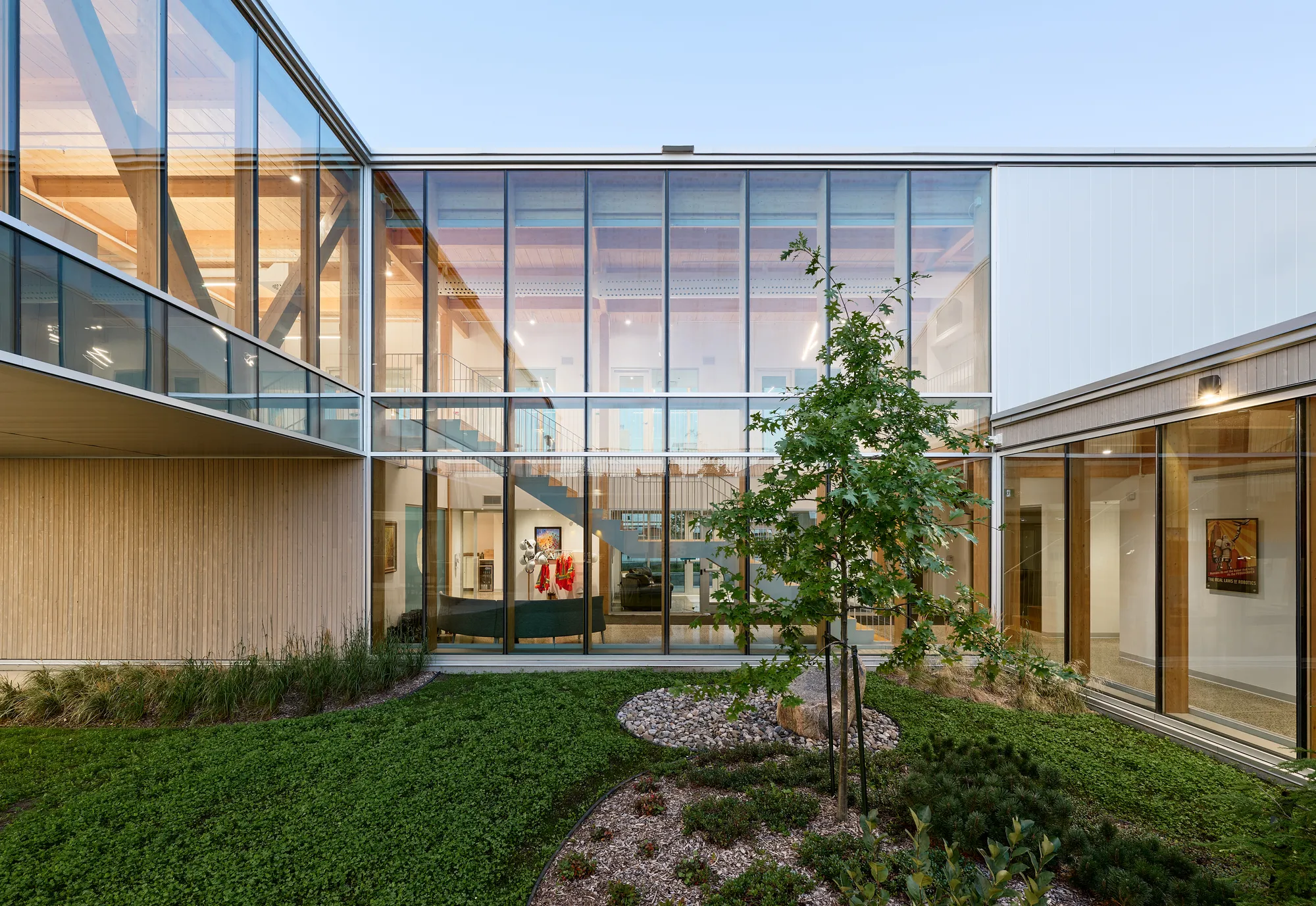
What makes the project worth studying is the way it uses a single material system to solve very different programmatic problems. In the office pavilion, a regular frame of glulam posts supports generous glazing and organizes a plan around a landscaped courtyard. In the workshop, triangulated glulam sections arc overhead to create a column-free span, giving the factory floor total flexibility. The courtyard, with its curved internal corners and planted beds, is the hinge between these two worlds, pulling daylight deep into the plan and blurring the line between industrial and office environments.
Two Masses, One Language
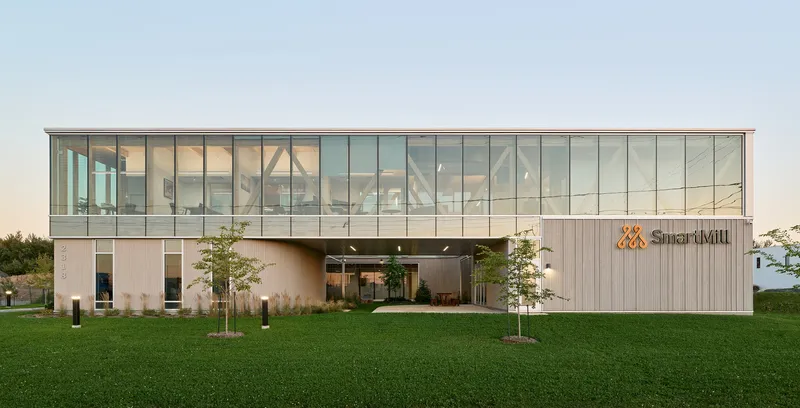
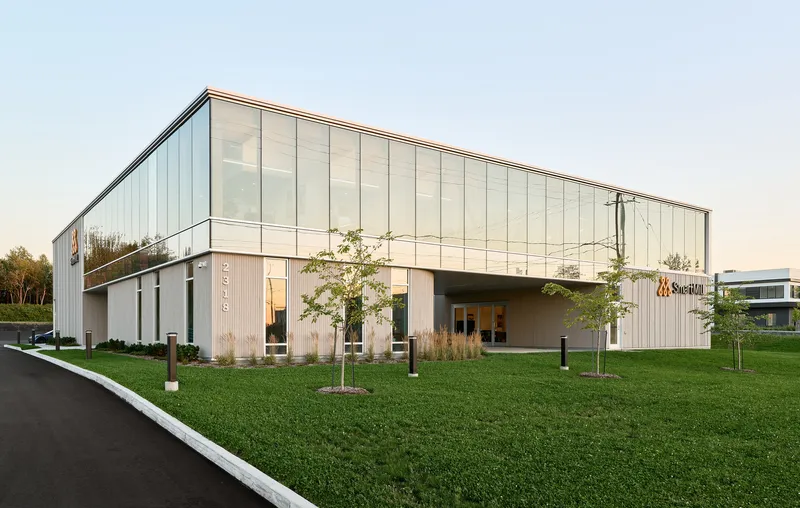
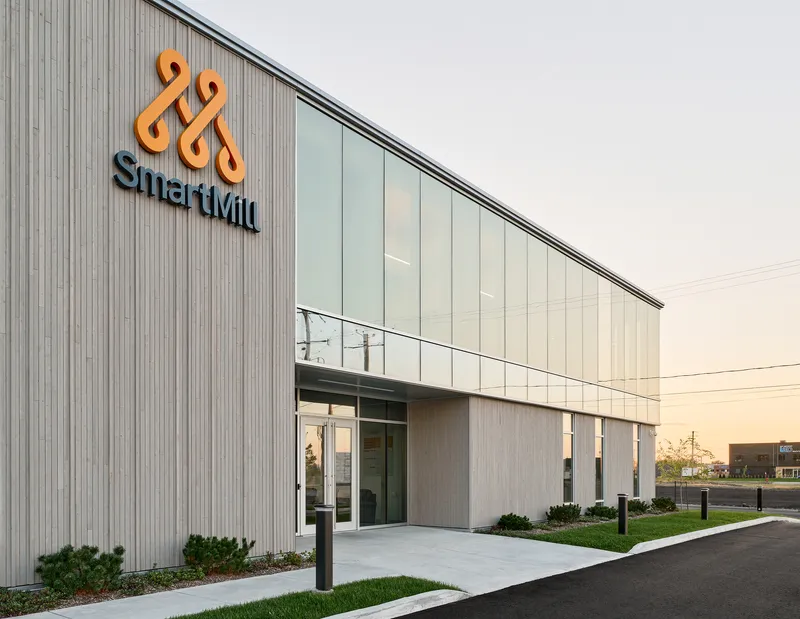
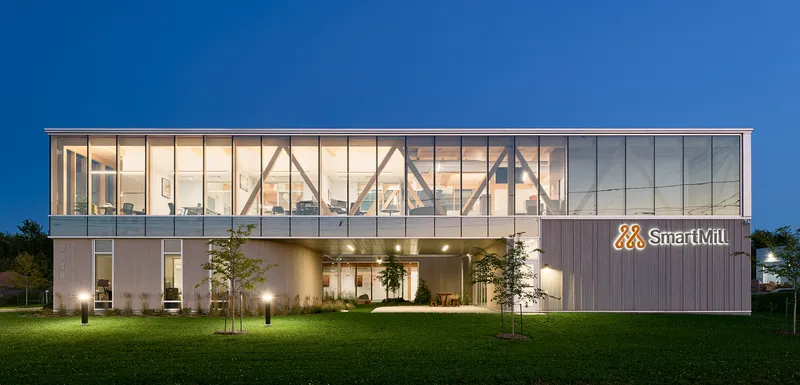
From the street, the SmartMill headquarters reads as a restrained composition of vertical metal cladding and glass. The administrative pavilion presents a largely transparent upper volume set on a more opaque base, while the workshop volume steps back, its barrel vault visible as a gentle curve against the sky. Young conifers and northern small-fruit plantings soften the industrial context without disguising it. The facade treatment is deliberately understated: corrugated metal panels, translucent upper sections, and a recessed entry that avoids grandstanding.
The decision to face the office toward the street and tuck the factory behind it is a pragmatic move that also works symbolically. Visitors and clients encounter the more refined volume first. Workers in the factory, meanwhile, get the benefit of a deep site and a generous overhead structure without the noise and distraction of a public-facing position.
The Courtyard as Organizational Core
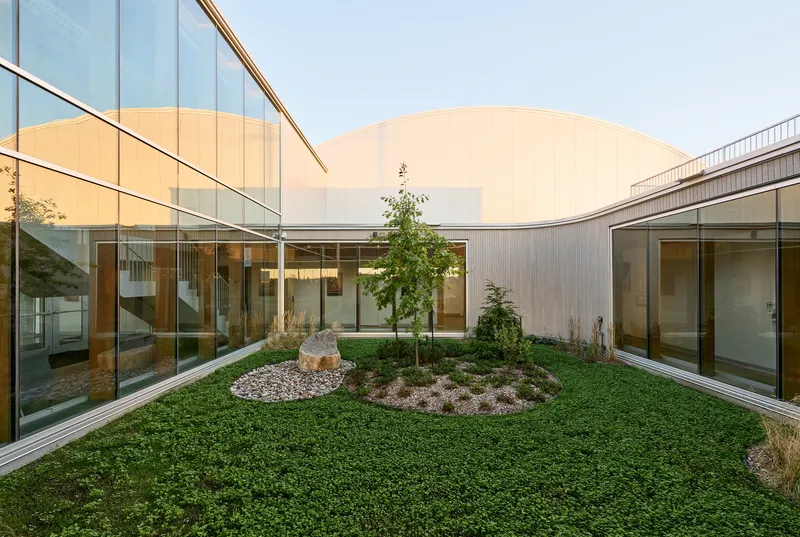
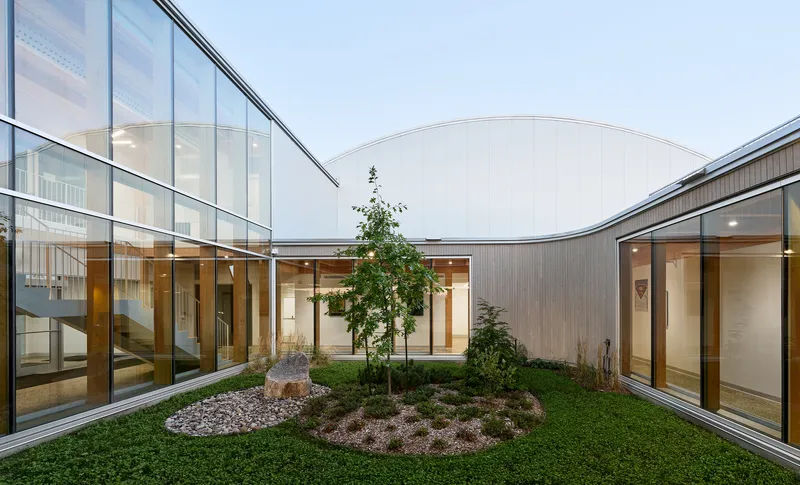
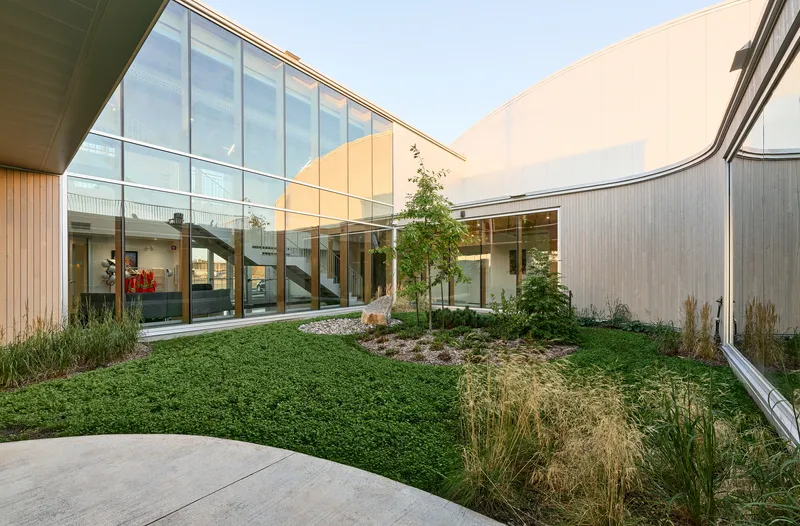
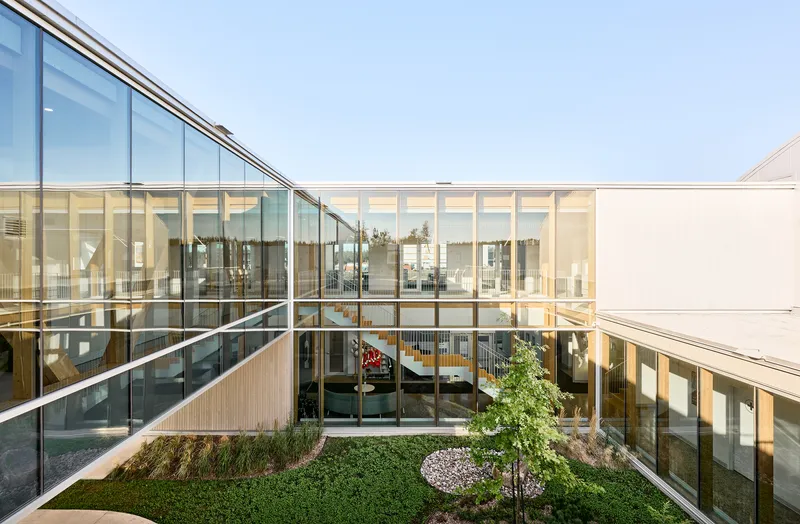
The internal courtyard is the strongest idea in the project. By breaking the administrative volume with an open-air garden, Atelier Guy Architectes created a condition where every office along the perimeter gets either exterior or courtyard-facing light, and often both. The courtyard's curved corners are a subtle detail that pays off in the way they soften views and eliminate the dead zones that sharp internal right angles tend to produce.
Planted beds with grasses, young trees, and circular groundcover compositions give the courtyard a texture that shifts with the seasons. Glass walls on all sides mean that the garden is never just a leftover void; it is the dominant visual reference for anyone working inside. At twilight, the courtyard becomes a lantern, the illuminated timber structure glowing through the glazing.
Timber Structure on Display
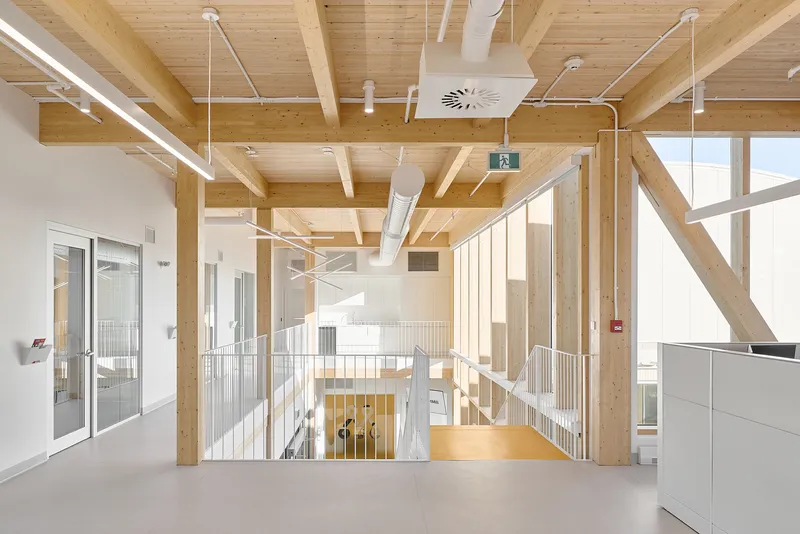
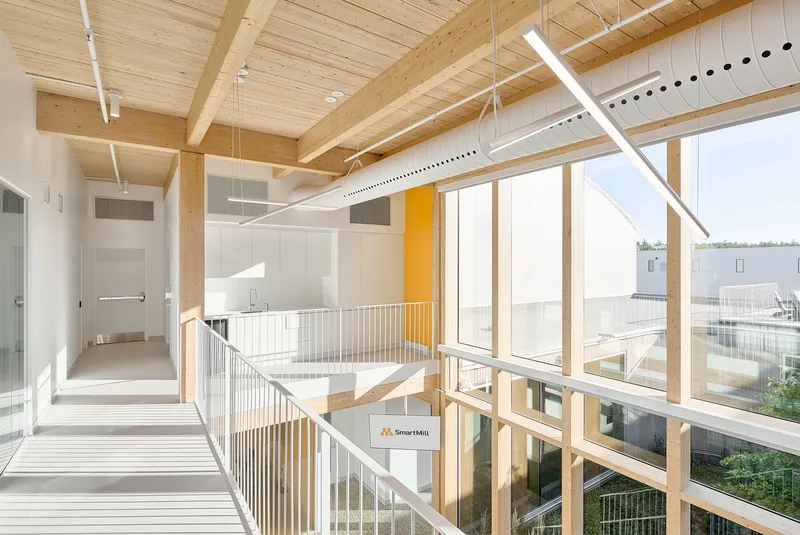
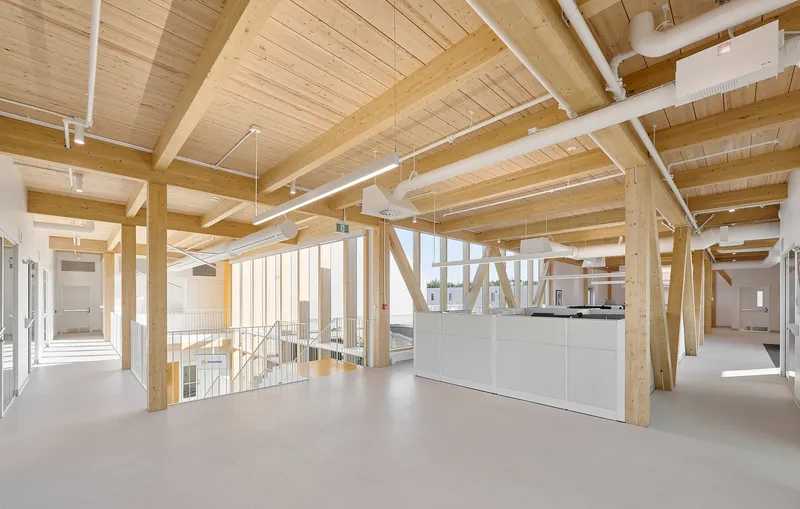
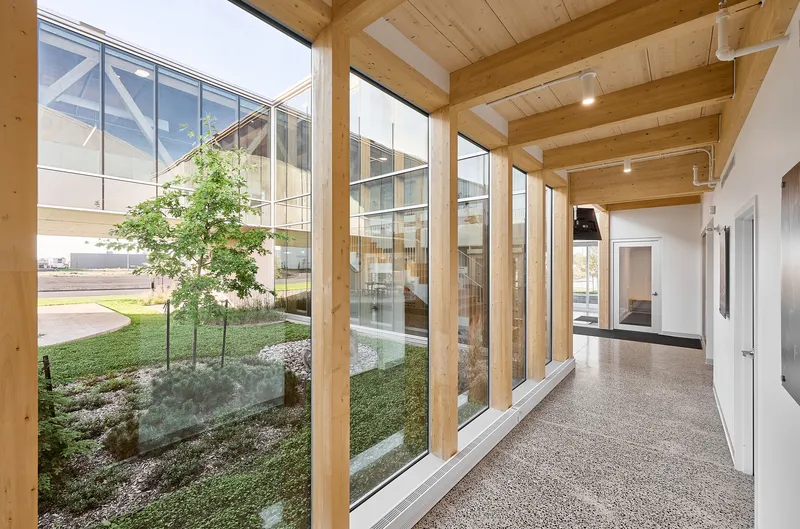
Inside the office pavilion, the glulam structure does double duty as both skeleton and ornament. The exposed timber beams running overhead establish a warm, rhythmic ceiling plane, while the posts frame views out to the courtyard and the street. The material palette is deliberately spare: polished concrete floors with exposed aggregates, white walls, and the honey tone of the wood. Nothing competes for attention.
The upper-level workspace wraps around a central atrium void, with glazed railings allowing sightlines down to the ground floor and across to the courtyard. A white millwork unit anchors the open plan, providing storage and defining zones without walls. The decision to keep the structure visible everywhere is not just aesthetic. It signals the company's investment in wood as a local, renewable resource, reinforcing the SmartMill brand without resorting to signage or graphics.
The Yellow Staircase
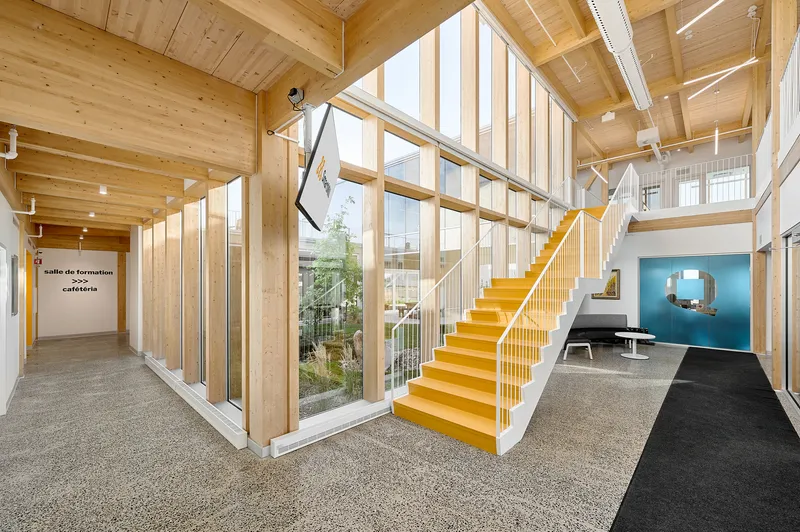
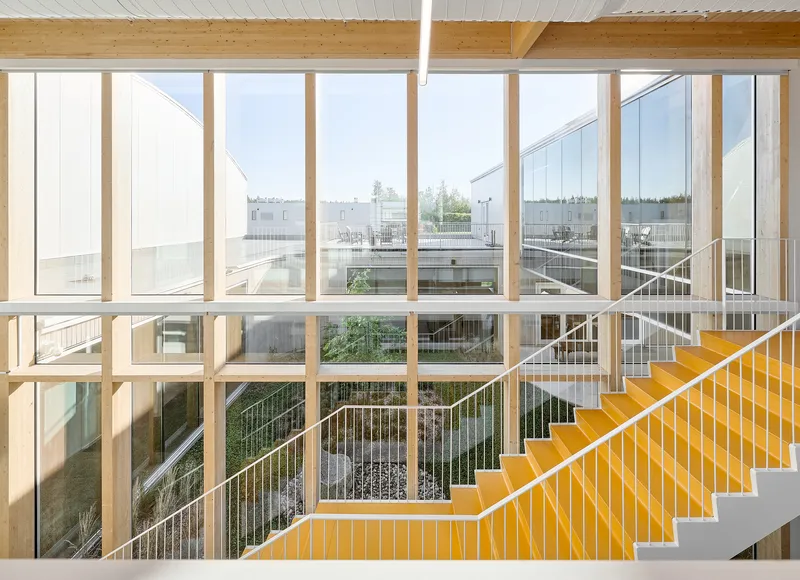
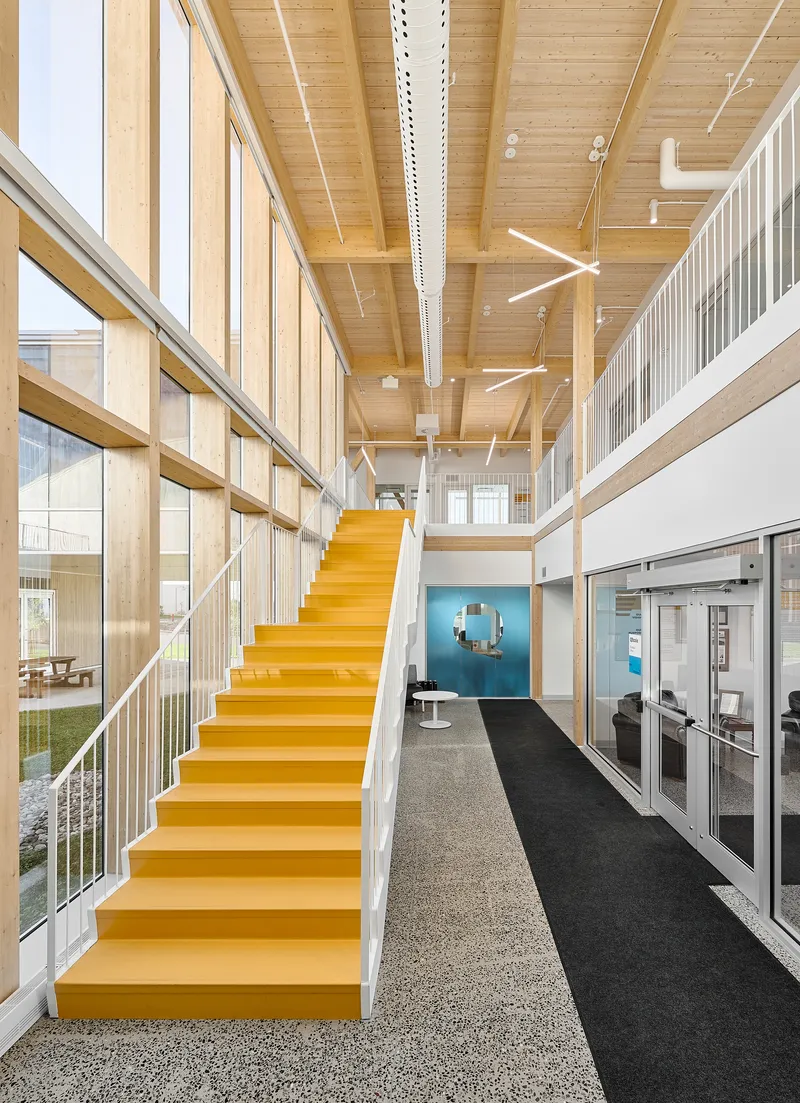
Against the otherwise neutral palette, the yellow-painted steel staircase is a deliberate disruption. It cuts through the double-height lobby with wire mesh railings and bold color, drawing the eye and orienting circulation. The stair connects every area of the building, functioning as a central spine that ties the two floors of the office together.
The choice of yellow is industrial in origin, referencing the overhead crane on the factory floor. It is a small gesture that binds the office and workshop identities together. Combined with floor-to-ceiling timber mullion windows and linear light fixtures overhead, the staircase zone becomes the most energetic space in the building, a counterpoint to the calm of the courtyard-facing offices.
Workshop Under the Vault
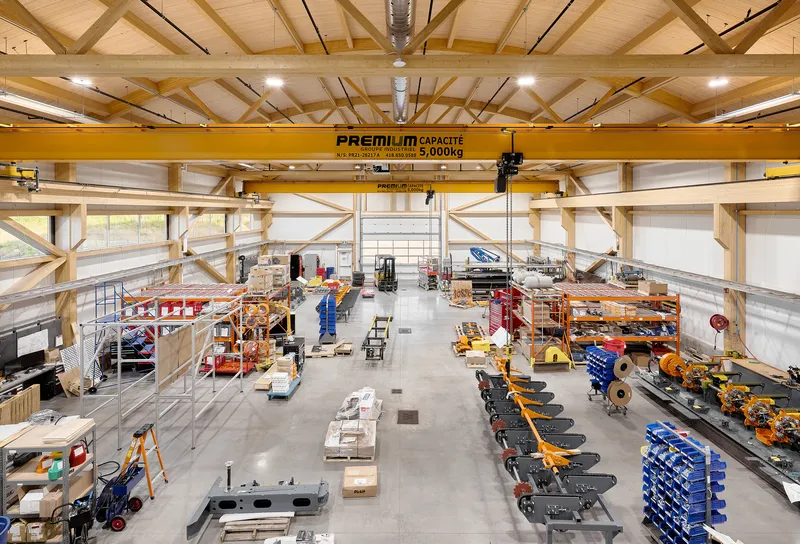
The factory space is where the structural ambition becomes most apparent. Three large triangulated sections of glulam elements arc overhead, forming the barrel vault and eliminating the need for interior columns. The result is a completely flexible floor plate that can accommodate heavy machinery, assembly lines, and a yellow overhead crane without any structural interference. A long horizontal window at the top of the workshop washes the space in natural light, reducing dependence on artificial sources during the day.
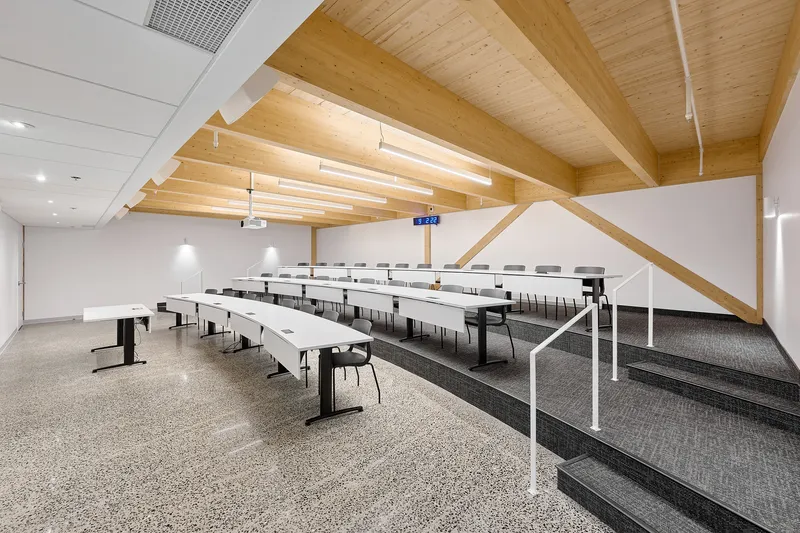
Adjacent to the workshop, a training room with tiered seating and an exposed vaulted timber roof structure serves as a secondary gathering space. The beams here follow the same curved geometry as the factory trusses, maintaining the architectural continuity between working and learning environments. It is a room that could easily have been treated as an afterthought, but the commitment to the timber structure and the careful proportions elevate it.
Bridging Interior and Exterior
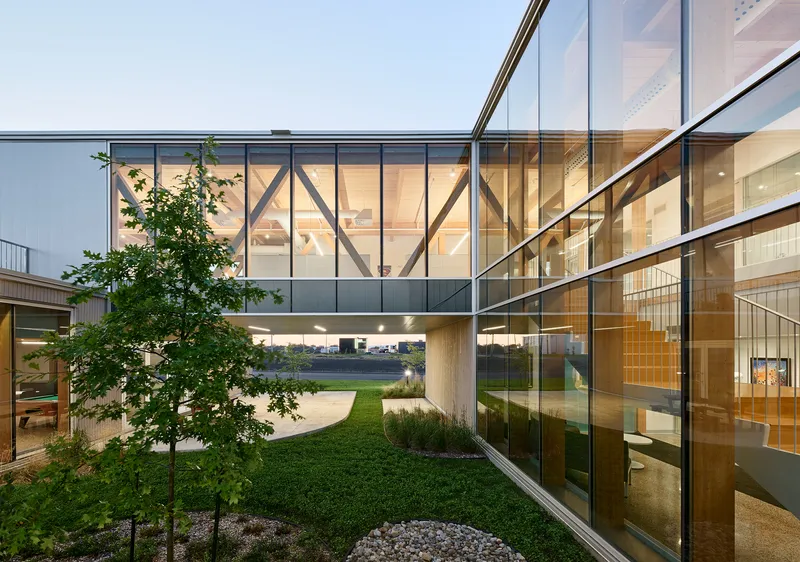
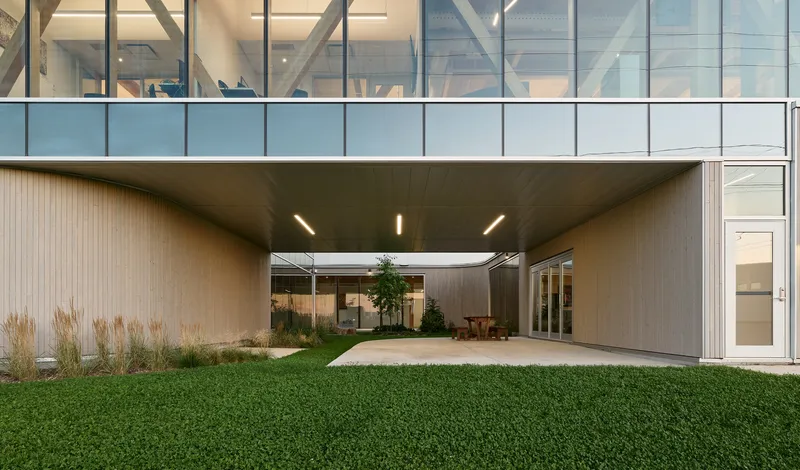
A glazed bridge links the two timber-framed volumes above the landscaped courtyard, making the connection between office and factory both literal and visual. Below, a covered passage with a timber ceiling and linear lighting runs across the lawn, creating a protected walkway between building sections. These connecting elements keep the courtyard legible as an outdoor room while ensuring that movement between programs is weather-protected and intuitive.
The corridors that wrap the courtyard at both levels are some of the best spaces in the project. Full-height glazing frames views of the planted beds and young trees, while the exposed timber beams overhead provide a consistent rhythm. River stone draining strips integrated with the green spaces manage water runoff, a practical detail that doubles as landscape texture in an industrial context.
Plans and Drawings
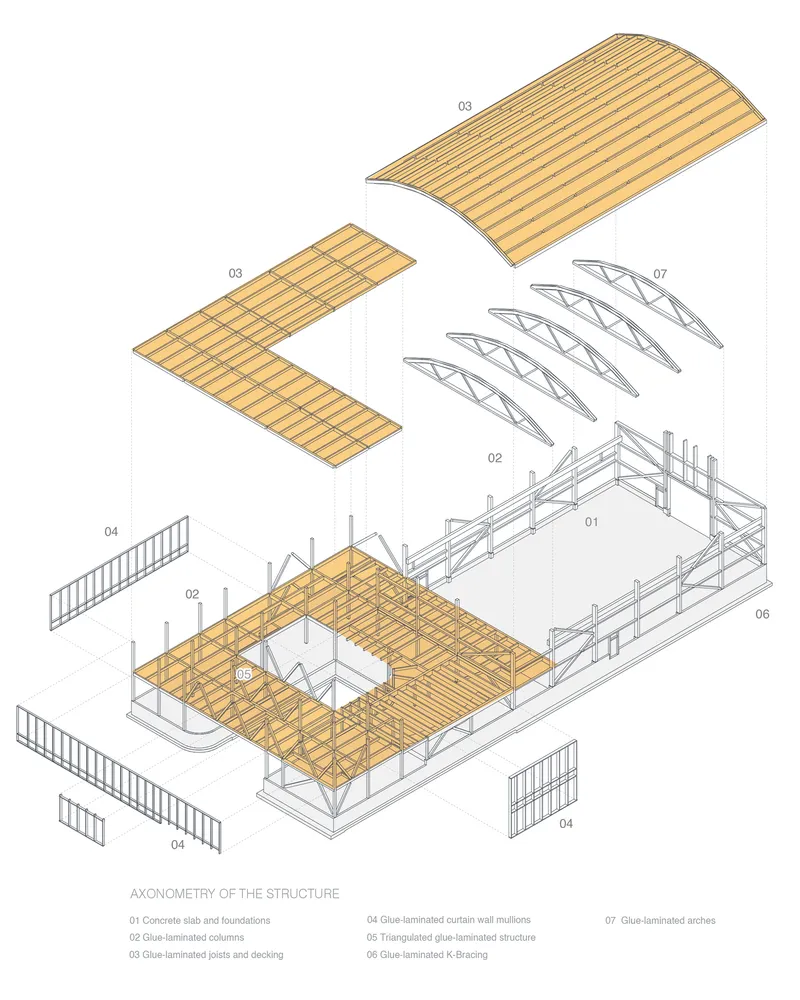
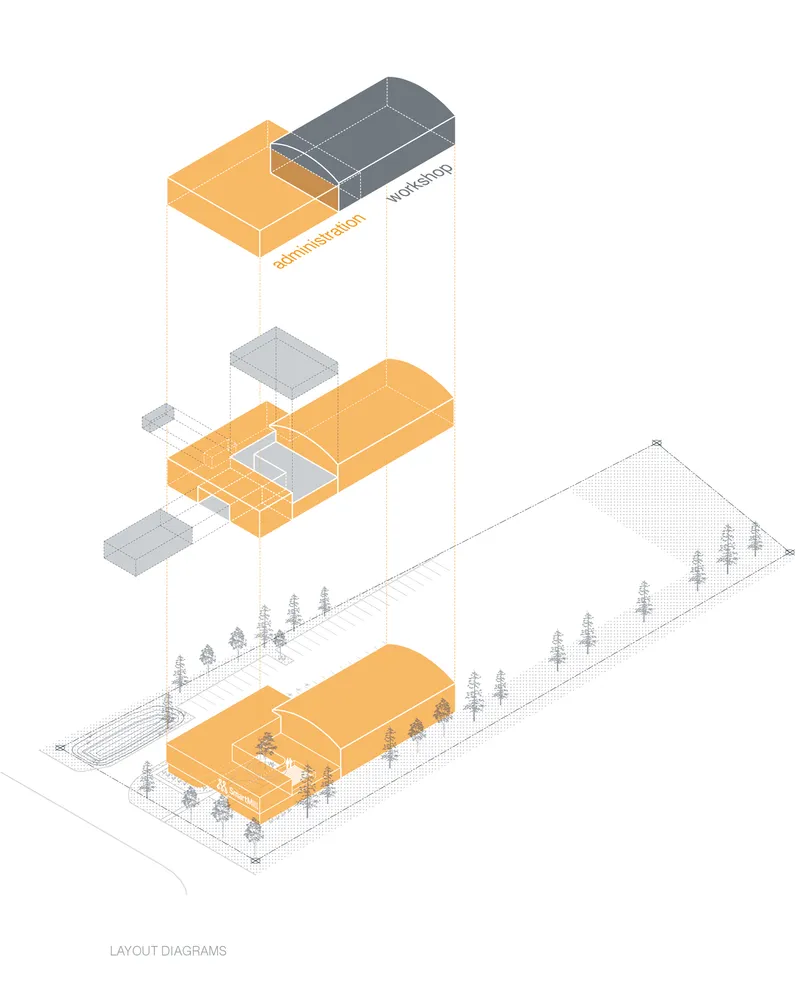
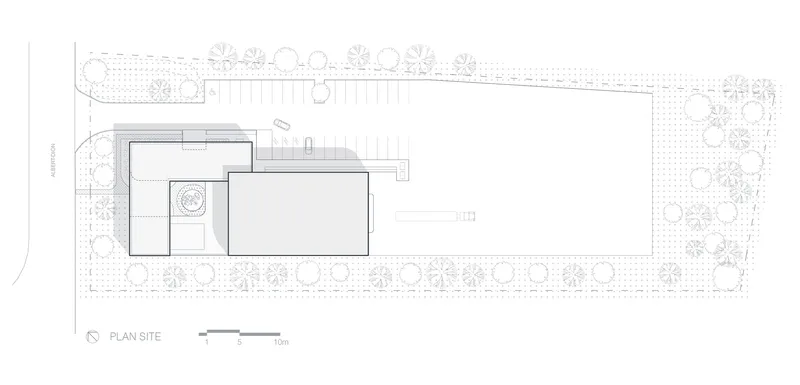
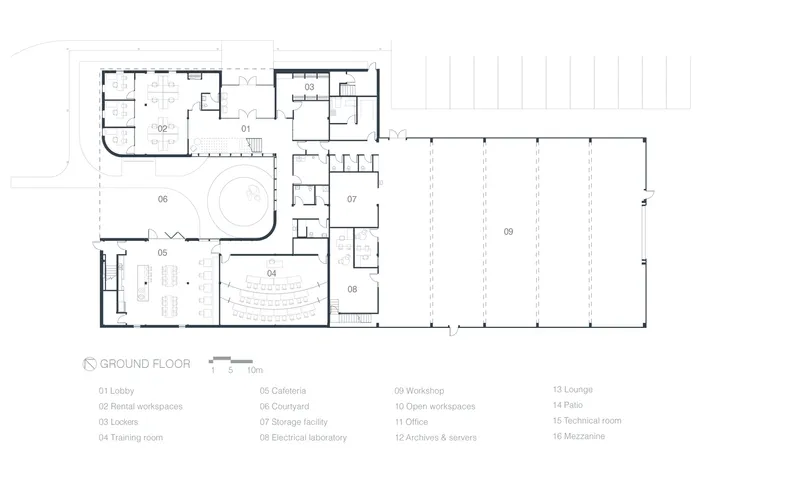
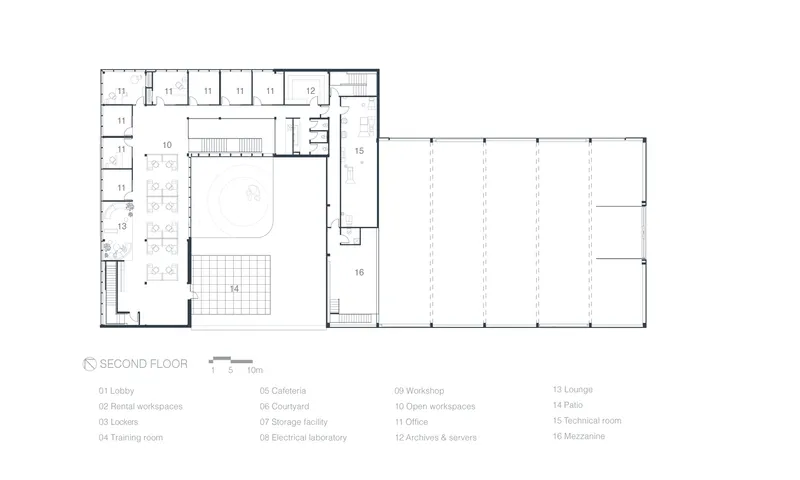
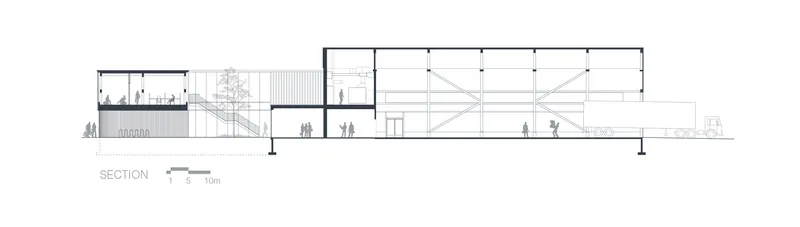
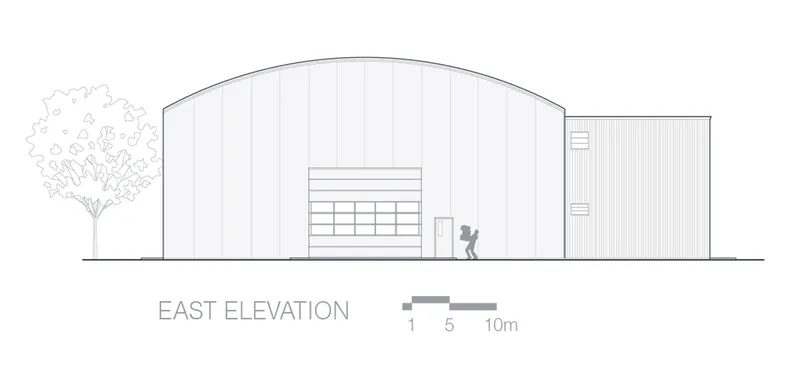
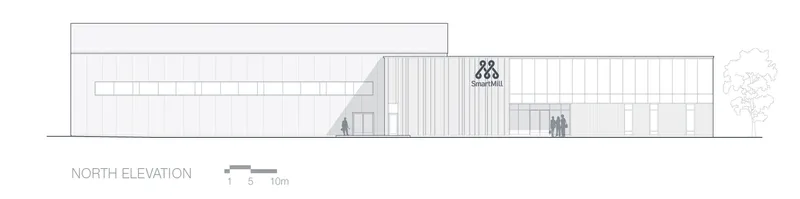
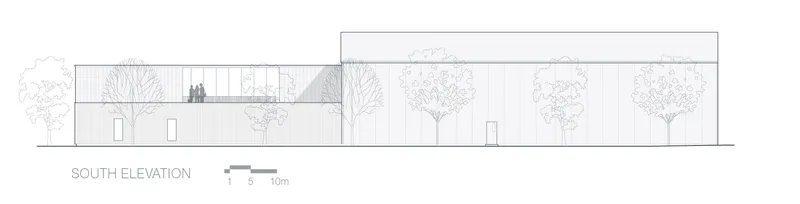
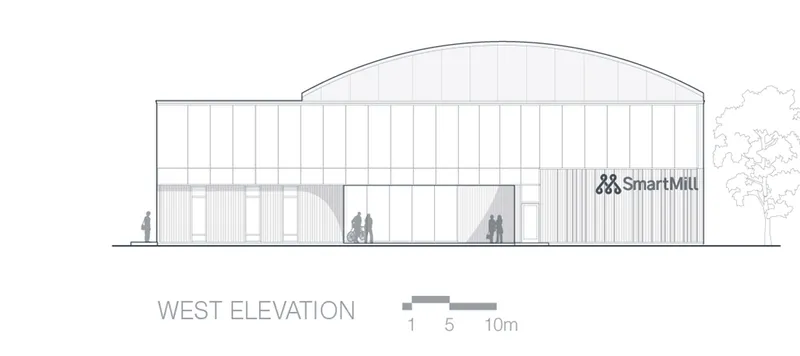
The exploded axonometric drawing is revealing. It breaks the building into its component parts: glulam arches, decking, columns, and roof panels, making clear how the structural system adapts across the two volumes. The site plan shows the two offset rectangular masses surrounded by careful tree placements and landscape buffers that integrate the building into its industrial surroundings. The ground floor plan centers on the training room, with offices wrapping the courtyard and the large workshop space extending to the rear. The second floor plan shows the open workspace organized around the central atrium void.
The section drawing is perhaps the most instructive view. It reveals the contrast in scale between the modest two-story office and the soaring factory vault, and shows how the timber roof trusses span the workshop without intermediate supports. The elevations, meanwhile, document the building's modesty from the street: low-profile, horizontal, and deferential to the landscape. The west elevation, with its arched-roof hall and glazed entry, is the most expressive face, but even here the design resists excess.
Why This Project Matters
The SmartMill Head Office matters because it refuses to accept the premise that industrial buildings should be disposable sheds. Atelier Guy Architectes took a program that could have been resolved with pre-engineered metal and parking lots and instead produced a building that uses local glulam timber as both structure and identity. The courtyard strategy brings daylight and greenery into what could have been a bleak interior, and the triangulated factory trusses demonstrate that engineered wood can compete with steel for column-free spans at this scale.
The project also shows that a company's values can be expressed architecturally without resorting to literal signage or performative gestures. SmartMill builds automated systems; its headquarters is itself a kind of system, where material, structure, and landscape work together with visible logic. In a region with strong traditions of wood construction, the building feels both contemporary and grounded. It is a headquarters that earns its ambition by delivering quality in the details where it counts: structure, light, and the relationship between working and gathering.
SmartMill Head Office by Atelier Guy Architectes, Lévis, Canada. 2,000 m². Completed 2022. Photography by Charles O'Hara.
About the Studio
Share Your Own Work on uni.xyz
If projects like this are the kind of work you want to make, uni.xyz is a place to publish your own, find collaborators, and enter design competitions.



Popular Articles
Popular articles from the community


Co-life: Sustainable Architecture for Age-Friendly Community Living
Co-life reimagines sustainable architecture for seniors through courtyards, rammed earth, shared gardens, and spaces designed for belonging.

The Musturak Paradise: Senior Living Architecture for a Connected Future in Temara, Morocco
The Musturak Paradise reimagines senior living architecture in Temara via private homes, social spaces, culture, community, and shared care.

Riyadh For All: Intergenerational Urban Design for Active Aging in Rabat
Riyadh For All reimagines urban design in Rabat with intergenerational co-living, adaptive courtyards, and Moroccan cultural exchange today.

Conexión: Biophilic Design Reimagines High-Rise Living in Hong Kong
Conexión reimagines high-rise living in Hong Kong through biophilic design, green facades, shared spaces, daylight, water and nature within.


Similar Reads
You might also enjoy these articles

Bao Huynh Watercolor Atelier: A Serene Art Retreat in Hội An
Bao Huynh Watercolor Atelier in Hội An blends multifunctional art spaces, sustainable design, local materials, and family-friendly living in a serene environment.

Atelier Macri Concept Store Interior Design by CASE-REAL
Atelier Macri store features a "ko" counter, walnut wood details, cork displays, blending retail, gallery, and seamless customer experiences.

Manuel Vargas Izquierdo Stadium and High-Performance Sports Center: Architectural Excellence in Jalpa de Méndez
The Manuel Vargas Izquierdo Stadium blends sustainable design, inclusive sports facilities, and cultural-inspired architecture, revitalizing Jalpa de Méndez’s public spaces.

KAKR Buluh Awar Hall: Revitalizing Community and Ecology Through Bamboo Architecture
Community built bamboo hall revitalizes Buluh Awar village, empowering youth, restoring ecology, celebrating vernacular craftsmanship through sustainable architecture and culture.

Comments (0)
Please login or sign up to add comments
No comments yet. Be the first to comment!