

Atelier l'Abri Scatters A-Frame Micro-Cabins Across a Wild Quebec Valley
Farouche Tremblant pairs a cedar-shingled agrotourism camp with a cathedral-ceilinged café in the Devil's River valley near Mont-Tremblant.


The word farouche translates roughly as wild, untamed, and shy. It is an apt name for a 40-hectare property in the Devil's River valley that, until recently, was exactly that: a stretch of fallow land, conifer forest, and meandering river channels on the doorstep of Mont-Tremblant National Park. Atelier l'Abri has treated the site accordingly, designing an agrotourism compound of four micro-cabins, a café-bar, a working barn, and tunnel greenhouses that collectively occupy just 464 square meters of built footprint on nearly 100 acres. The architecture does not announce itself. It recedes.
What makes Farouche Tremblant interesting is the discipline of its restraint. Every building borrows its palette from the same two regional woods, eastern white cedar and eastern hemlock, and every roof pitches steeply enough to read as a landscape form rather than a conventional building. The A-frame cabins sit on steel piles driven without cement, touching the ground as lightly as possible. The café earns its permanence with a concrete slab, cathedral ceiling, and mezzanine lounge that rewards the visitor who arrives in a snowstorm as much as the one who comes for summer sunflowers. Together these pieces argue that agrotourism architecture need not be rustic cosplay: it can be precise, sober, and genuinely of its place.
Valley and Site


From the air, the logic of the site reads clearly. A public road splits the property in two: the barn and farm operations sit to the north, while the café, cabins, and river frontage spread to the south. Fog pools in the valley at dawn, and the buildings appear and disappear inside it. The aerial perspective reveals how the four cabins cluster on a wooded peninsula between braided river channels, grouped tightly enough to feel communal yet separated by winding paths and dense vegetation.
The Laurentians region sees snow from October to May, and the layout accounts for that long winter. Hiking trails depart from behind the barn into the mountains, and the greenhouse tunnels and flower fields occupy the flatter, sunnier ground between road and river. Visitors move through the site on foot, encountering each building sequentially rather than all at once.
Cedar Shingles and the A-Frame Silhouette
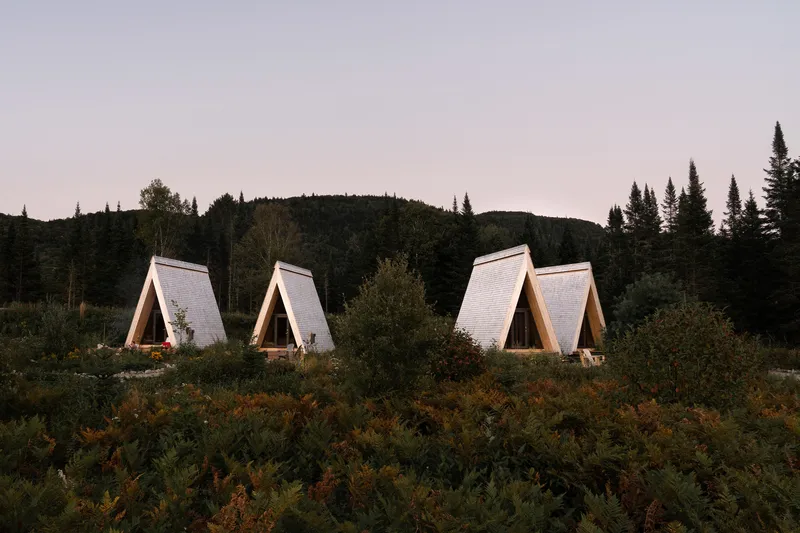
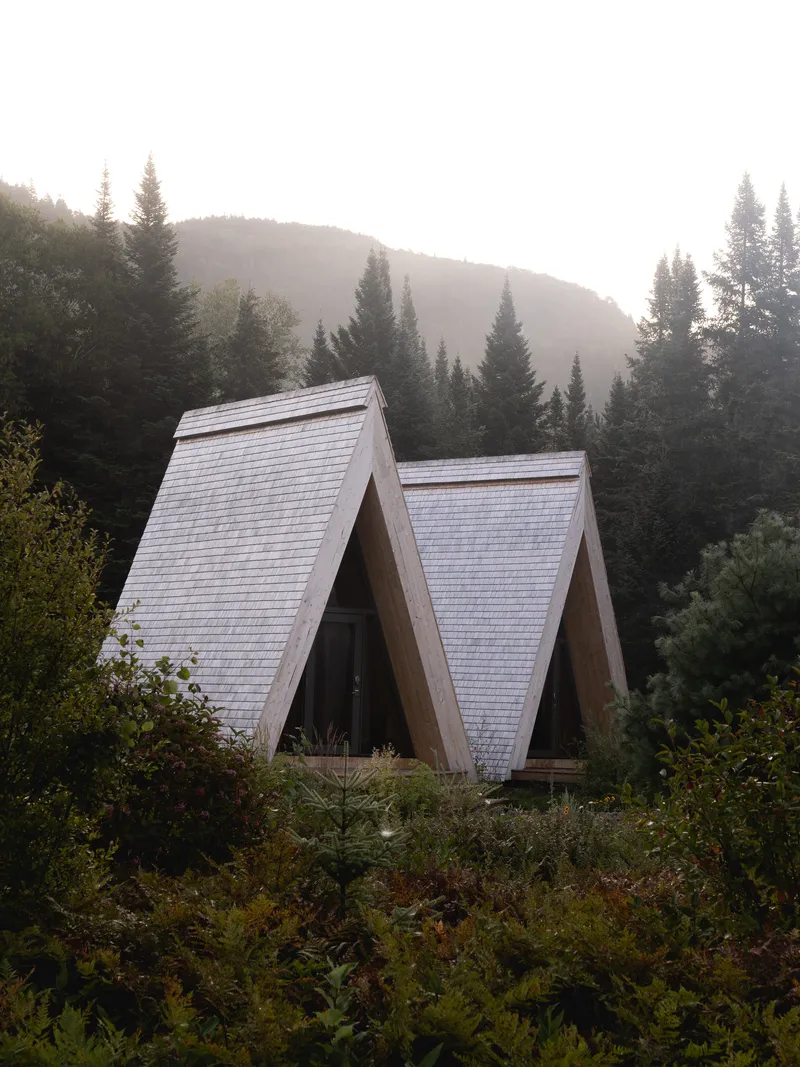

The cabins are compact A-frames whose steep-pitched roofs extend all the way to the ground, turning the roof plane into the wall. Clad in cedar shingles, these surfaces age unevenly, catching afternoon light in warm amber tones and darkening in rain to near-charcoal. The effect is deliberate: Atelier l'Abri wanted buildings that remind visitors of vernacular Laurentian farm structures without literally replicating them. The shingle texture does that work, reading as agricultural and familiar from a distance while revealing careful detailing up close.
Each cabin holds a king bed, sofa, and gas stove within a single story. Integrated storage tucks into the geometry of the frame, and a fully glazed gable end dissolves the boundary between sleeping space and forest. These are not luxury lodges. They are tight, purposeful shelters designed to make you want to go outside.
Threshold and Entry
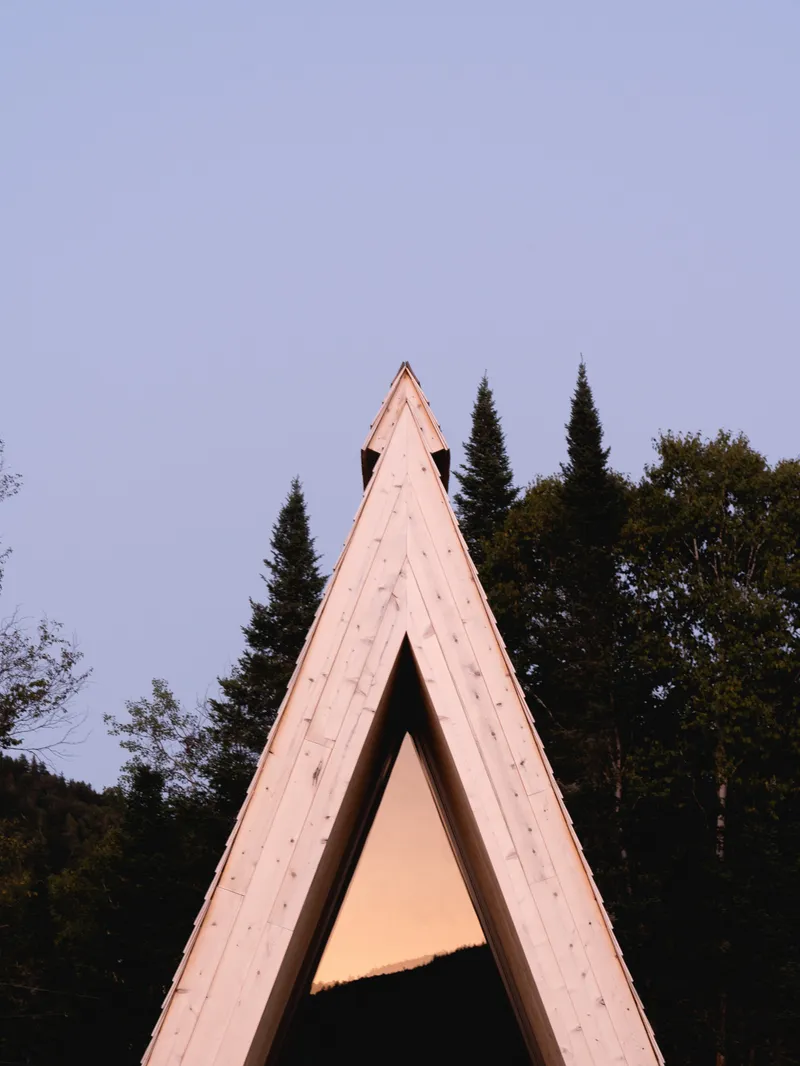
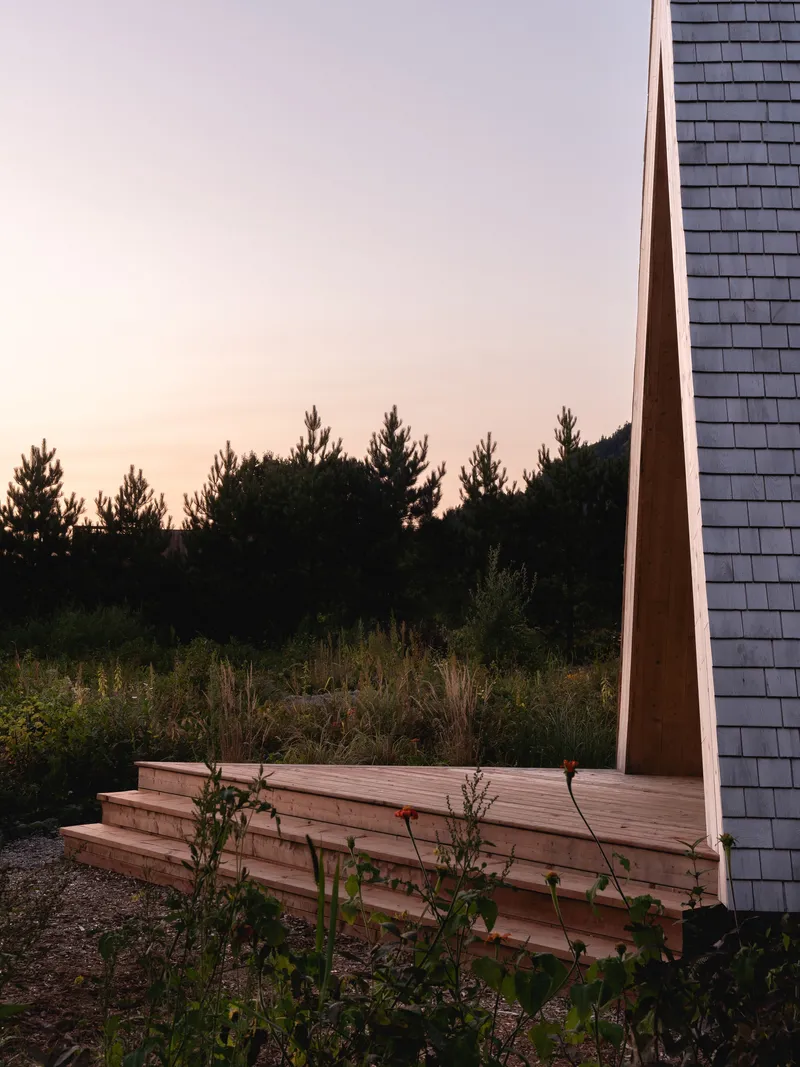
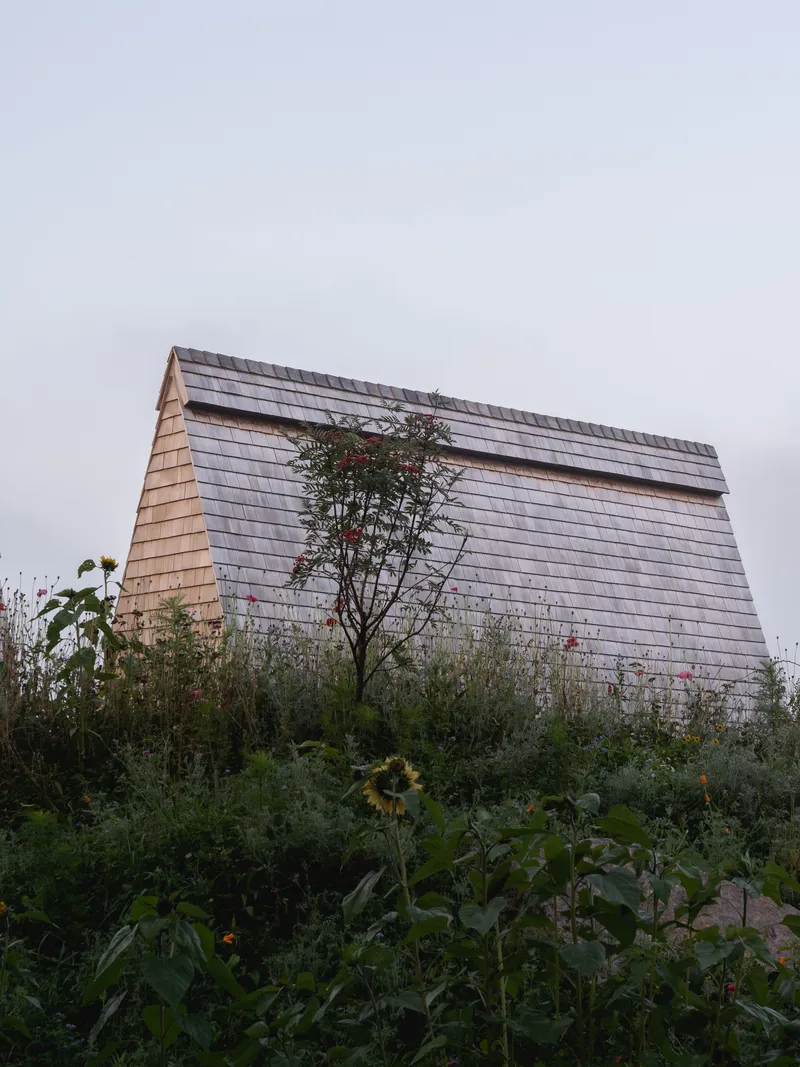
Atelier l'Abri gives each cabin a tall triangular portal that frames the sky and the treeline before you step inside. A timber bench and entry steps sit beneath the angled frame, creating a covered porch that is more gesture than room. At dusk, these portals glow against the darkening conifers, making the cabins legible as occupied shelters without relying on exterior floodlighting.
The end elevations, where the shingle surface meets the ground among wild grasses, reinforce how deliberately these structures avoid conventional base, wall, and roof distinctions. There is no foundation plinth, no visible gutter line. The cabin simply rises from the vegetation as a single folded plane.
Inside the Cabin
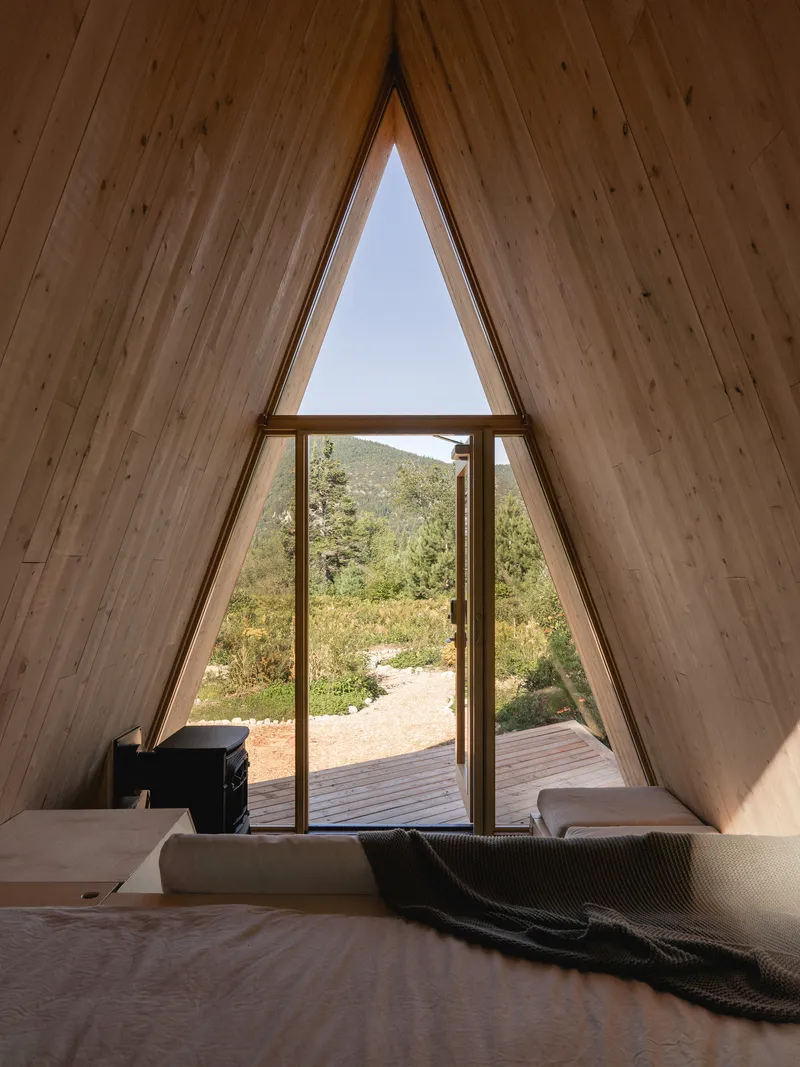

The interior view through the glazed gable is the payoff of the entire A-frame strategy. Lying in bed, you look through a triangular opening that perfectly frames the timber deck and the mountain landscape beyond. The geometry compresses the view into a cinematic slice, focusing attention on the layered ridgelines and weather rather than offering a panoramic sprawl. It is a disciplined piece of framing that earns its drama.
At twilight, the cedar columns and shingle roof of the cabins merge with the surrounding conifers. The charcoal-colored steel roof all but disappears against the night sky, leaving only the warm glow of the glazed ends to mark the buildings' presence. The cabins are designed to be experienced across all four seasons, and their muted material palette ensures they never compete with the landscape for attention.
The Café and Barn


The café and barn occupy more permanent foundations, concrete slabs with proper footings suited to the Laurentian freeze-thaw cycle. Their exteriors switch from cedar shingles to hemlock board siding and corrugated metal roofing, distinguishing them from the cabins while staying within the same tonal range. Chimney smoke rising from the café on a misty morning is the kind of image that collapses the distance between contemporary architecture and the rural buildings it references.
The café's south-facing facade opens through glazed doors onto a terrace, blurring the threshold between indoor dining and the meadow. A square window punched into the steep gable wall on the opposite elevation provides a secondary aperture, scaled to the intimacy of a reading nook rather than a dining hall. The barn, set across the road, reads as a utilitarian counterpart: vertical timber boards, a corrugated roof, and a hillside setting among dense conifers.
Cathedral Ceiling and Mezzanine

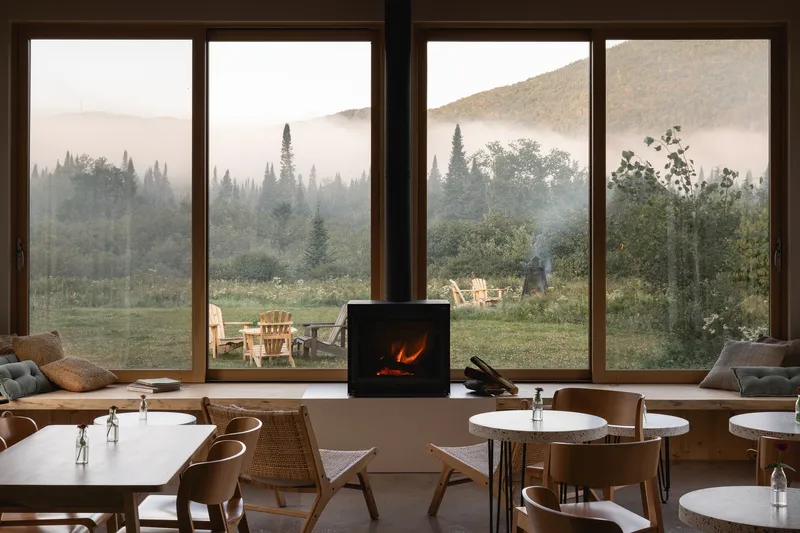

Inside the café, the steep roof pitch pays spatial dividends. The dining hall opens to a full cathedral ceiling, its timber frame exposed and finished in a warm, light tone that amplifies daylight. Large west-facing windows frame mountain views and, later in the day, sunsets. Woven pendant lights hang at varying heights, establishing a domestic scale within the tall volume. A central woodstove anchors the ground-floor seating area, with floor-to-ceiling glazing dissolving the south wall into meadow and forested hills.
The mezzanine level is the real surprise. Accessed above the bar, it is enclosed by a vertical timber slat railing that provides visual privacy without blocking light. This upper level functions as a quieter living room, a place to linger with coffee while the dining room below turns over. It is a smart sectional move: the same steep pitch that makes the exterior legible as a landscape form creates a usable second floor that would be impossible with a shallower roof.
The Working Farm

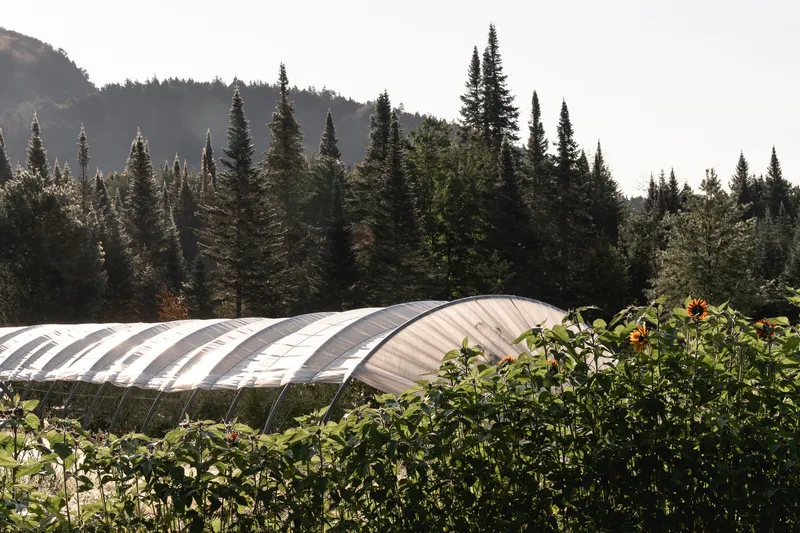
Farouche is not a resort pretending to be a farm. The arched translucent greenhouses, sunflower rows, and fallow fields are productive landscapes that supply the café's kitchen and a small market at the entry. Visitors walk through the agricultural program on their way to the cabins, encountering the food system before they encounter their beds. The route is deliberate: tunnel greenhouses, flower fields, and fallow land establish a rhythm of cultivation and rest that mirrors the architecture's own alternation between built form and open ground.
The barn on the north side of the road serves as farm headquarters, its corrugated metal roof and timber cladding setting a workaday tone that distinguishes it from the more carefully composed café and cabins to the south. Hiking trails depart from behind this building into the Devil's valley mountains, connecting the domestic scale of the compound to the vast wilderness of Mont-Tremblant.
Plans and Drawings
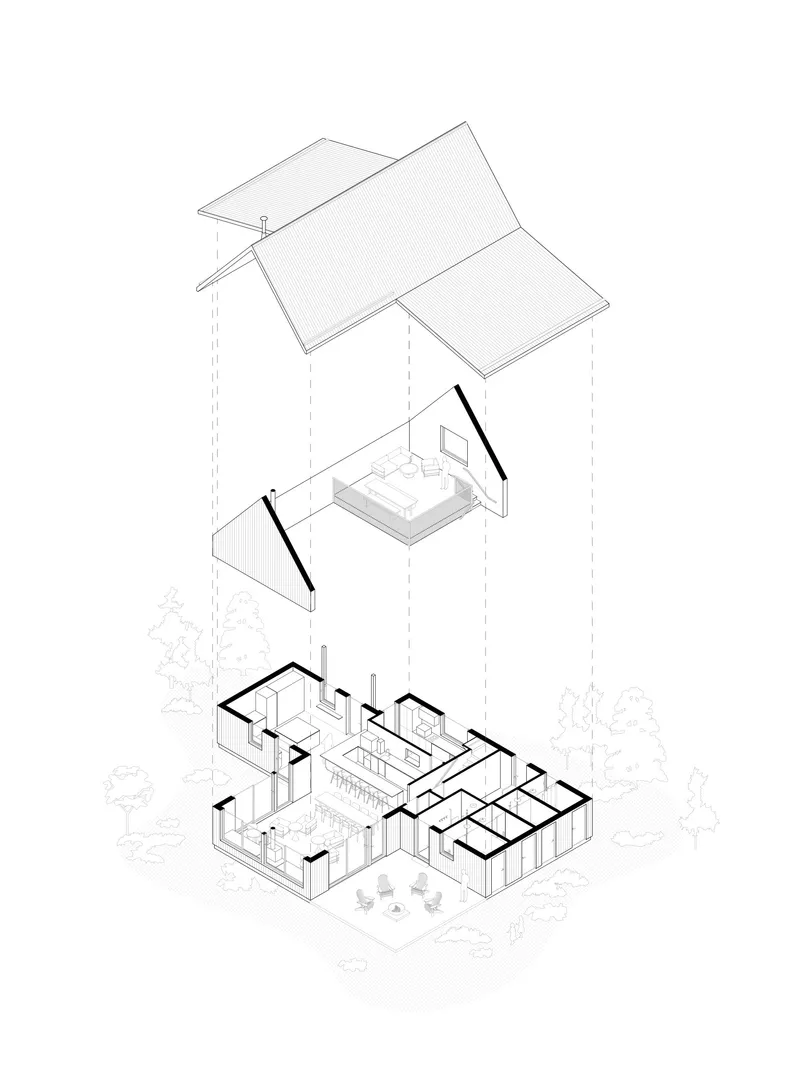


The exploded axonometric of the café reveals the logic of the steep-pitched section: ground floor, mezzanine, and separated roof planes stack neatly, with the mezzanine tucked into the upper third of the volume. The cabin isometric confirms just how compact the plan is, showing the sleeping platform beneath the gable with the open glazed facade acting as the room's primary architectural event. The floor plan of the café lays out the two-story rectangular volume, a diagonal outdoor deck, and scattered site furniture among the trees, making clear that the landscape is as much a part of the program as any interior room.
Why This Project Matters
Farouche Tremblant succeeds because it treats agrotourism as a design problem rather than a branding exercise. The buildings are genuinely modest: regional wood, steel piles, compact plans, no cement under the cabins. The material restraint is not aesthetic minimalism for its own sake but a set of decisions rooted in the reality of building lightly on a wild site adjacent to a national park. The A-frame form, often reduced to a nostalgic cliché, is deployed here with structural and spatial intelligence, producing interiors that are warm and focused rather than cramped.
More broadly, the project demonstrates that rural hospitality architecture can hold its own against the cottage-core imagery that dominates social media without surrendering to it. Atelier l'Abri has built something that photographs well, obviously, but that also works as a place: a farm that feeds a café, a café that rewards winter as much as summer, and cabins that send you outdoors. In a region famous for ski resorts and weekend escapes, Farouche offers a quieter model. The architecture disappears into the valley, and that is precisely the point.
Farouche Tremblant by Atelier l'Abri. Located in Lac-Supérieur, Canada. 464 m². Completed in 2022. Photography by Raphaël Thibodeau.
About the Studio
Share Your Own Work on uni.xyz
If projects like this are the kind of work you want to make, uni.xyz is a place to publish your own, find collaborators, and enter design competitions.


Popular Articles
Popular articles from the community

Opera by the Sea Estonia: Three Shells Dissolving Architecture into Tallinn's Coastline
A winning opera house proposal replaces monumental form with interconnected shells that blur the boundary between building, park and Baltic Sea.

Opera on the Sea: Driftwood Logic Shapes a Timber Opera House on Estonia's Coast
Trevor Orgill's opera house translates the entangled drift of floating timber into a civic building where wood, water, and music converge.

The Amber Palace Opera: A Geological Fiction Surfaces on Tallinn's Baltic Waterfront
Pierre Brillard reimagines a Baltic legend as a public landscape, opera house, and waterfront promenade rooted in Tallinn's coastal identity.

Singing Woman: Contemporary Architecture Inspired by Estonia’s Voice and the Sea
Singing Woman turns Estonia’s song culture into flowing opera house architecture, blending public life, landscape, sea, and national memory.

Similar Reads
You might also enjoy these articles

Bao Huynh Watercolor Atelier: A Serene Art Retreat in Hội An
Bao Huynh Watercolor Atelier in Hội An blends multifunctional art spaces, sustainable design, local materials, and family-friendly living in a serene environment.

Atelier Macri Concept Store Interior Design by CASE-REAL
Atelier Macri store features a "ko" counter, walnut wood details, cork displays, blending retail, gallery, and seamless customer experiences.

Manuel Vargas Izquierdo Stadium and High-Performance Sports Center: Architectural Excellence in Jalpa de Méndez
The Manuel Vargas Izquierdo Stadium blends sustainable design, inclusive sports facilities, and cultural-inspired architecture, revitalizing Jalpa de Méndez’s public spaces.

KAKR Buluh Awar Hall: Revitalizing Community and Ecology Through Bamboo Architecture
Community built bamboo hall revitalizes Buluh Awar village, empowering youth, restoring ecology, celebrating vernacular craftsmanship through sustainable architecture and culture.


Comments (0)
Please login or sign up to add comments
No comments yet. Be the first to comment!