
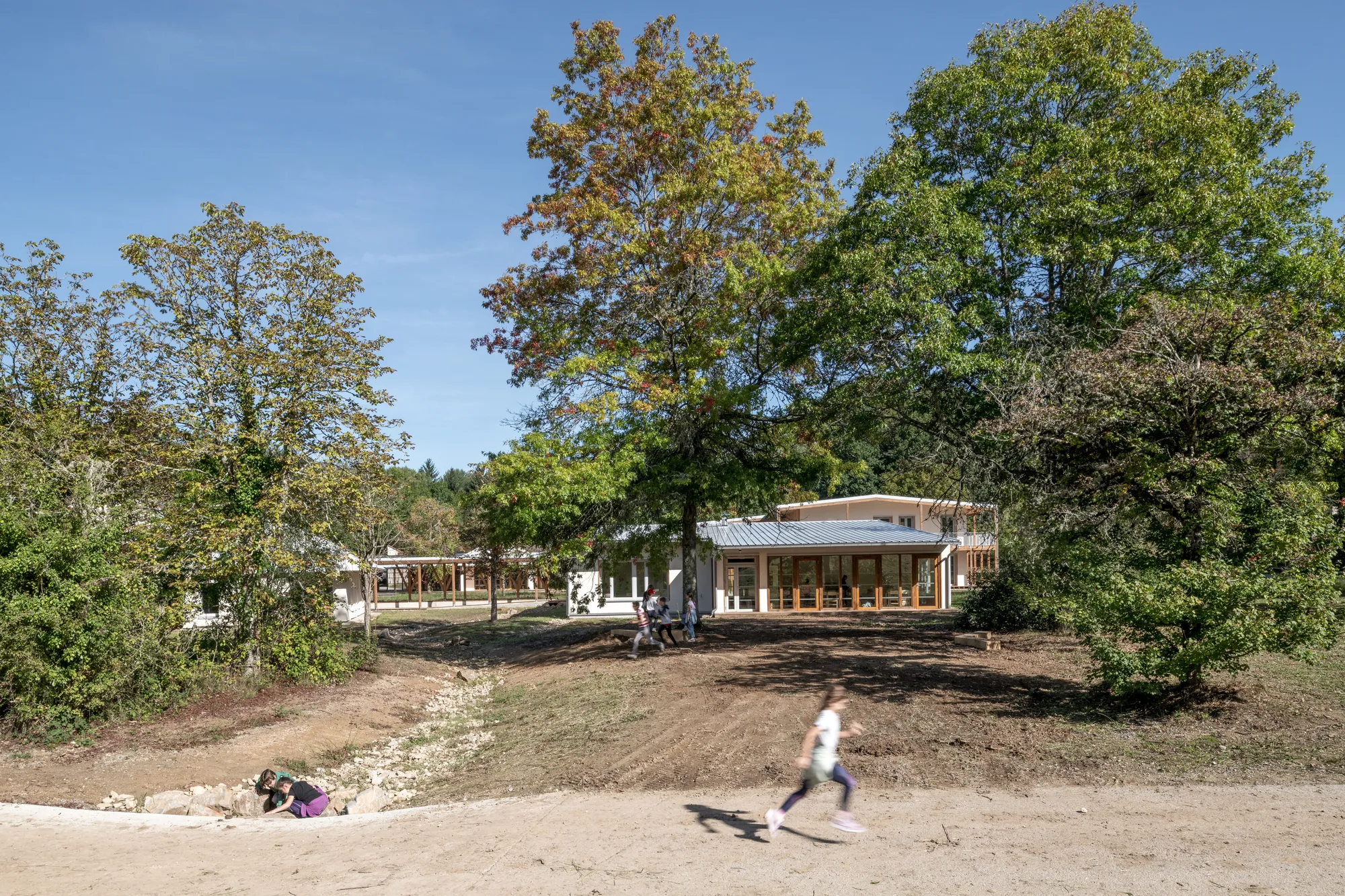
Atelier Quatre and R2K Wrap a Straw-Insulated Leisure Center Around a Lake Near Limoges
Six new timber pavilions and four rehabilitated buildings form a campus of biosourced classrooms on a former campground in central France.


Five kilometers from the center of Limoges, on a three-hectare former municipal campground between Lake Uzurat and the Bois de la Bastide forest, atelier quatre and R2K Architectes have built something genuinely rare: a leisure center for 200 children that treats its own construction as a teaching tool. The Leisure Center of Uzurat, completed in 2025, is a campus of ten buildings, six newly built and four rehabilitated, organized around a central courtyard prairie and linked by covered timber walkways. It is, among other things, the first project in France to use chopped straw insulation, a technique only authorized in the country since 2024.
What makes this project worth studying is not just its material ambition but its spatial logic. The plan reads like a small village: a porche entry leads to a planted courtyard bordered by a coursive, a continuous covered walkway that distributes children to reception, workshops, dining halls, dormitories, and age-specific activity zones. Each building carries its own identity through color, ceiling height, and interior finish, yet the whole campus coheres through a shared structural vocabulary of spruce timber frames, straw-filled walls, and metal-clad gable roofs. The architecture is legible enough for a five-year-old to navigate and rigorous enough to earn Silver certification under the Bâtiment Durable Nouvelle Aquitaine standard, a first for the former Limousin region.
A Village of Pavilions
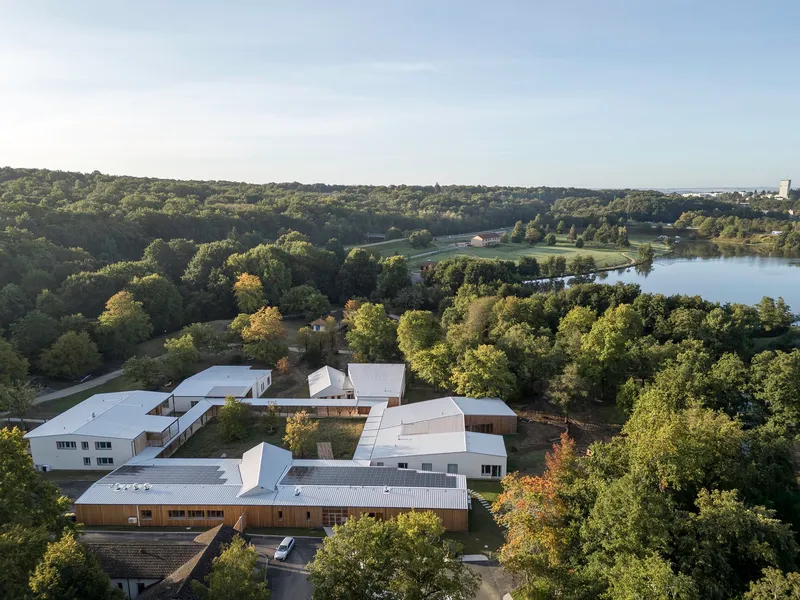
The aerial view tells the story most clearly. Rather than a single monolithic structure, the center disperses its program across a constellation of low-slung volumes that sit beneath the canopy of existing trees. Mature oaks, the site's most valuable inheritance from its camping days, were preserved and integrated into the composition so that the buildings appear to have been dropped into clearings rather than planted on cleared ground.
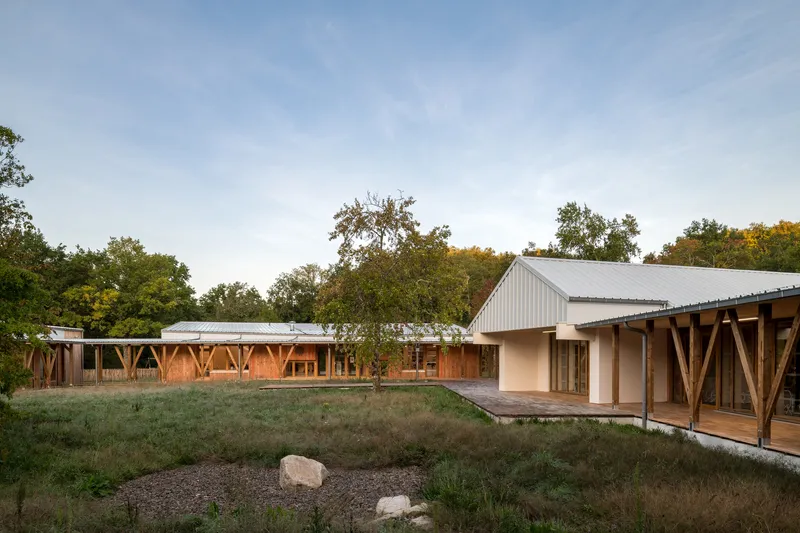
At dusk, the linked pavilions with their metal roofs and warm timber undersides read as a coherent cluster, almost domestic in scale. The courtyard between them is deliberately left as rough meadow and bare earth, not manicured landscape. Children run across it freely, and that informality is part of the pedagogical point: the architecture frames outdoor experience rather than containing it.
The Covered Walkway as Connective Spine
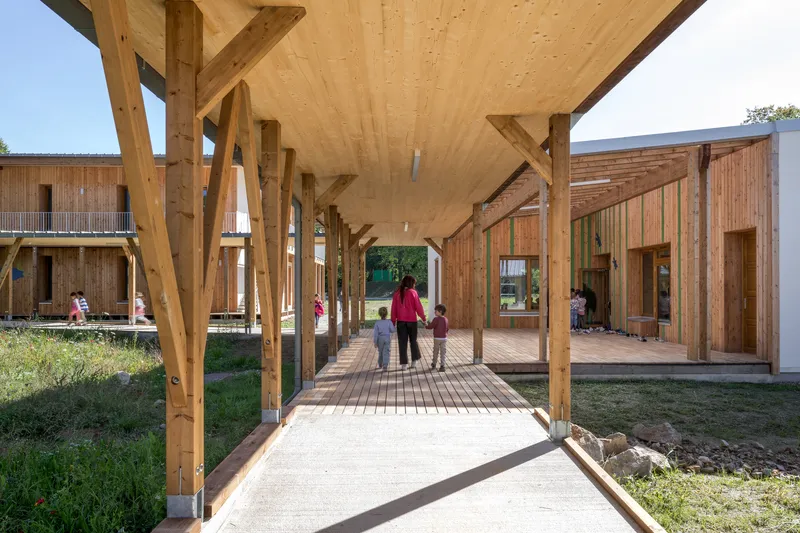


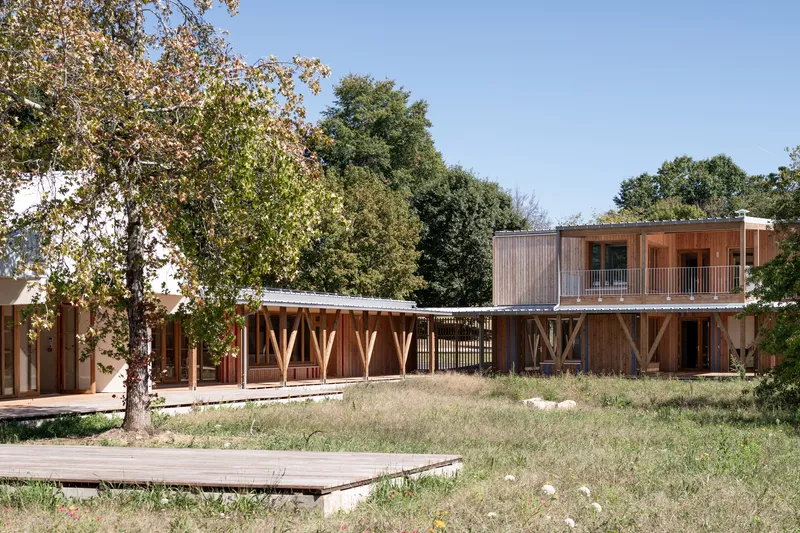
The coursive, a continuous covered walkway with laminated timber columns and diagonal bracing, is the project's most defining spatial element. It functions as corridor, porch, and outdoor classroom simultaneously. Children move through it between activities, sheltered from rain but open to the courtyard on one side and the glazed facades of classrooms on the other. The plywood ceilings and timber decking give it warmth without enclosure.
Structurally, the diagonal braces do real work: they stiffen the colonnade against lateral loads while creating a visual rhythm that makes the walkway feel like a cloister rather than a hallway. The proportions are carefully scaled to the bodies of small children, with columns spaced closely enough to feel sheltering rather than monumental. It is one of those circulation moves that becomes the most memorable space in the building.
Timber and Straw: A Material Pedagogy
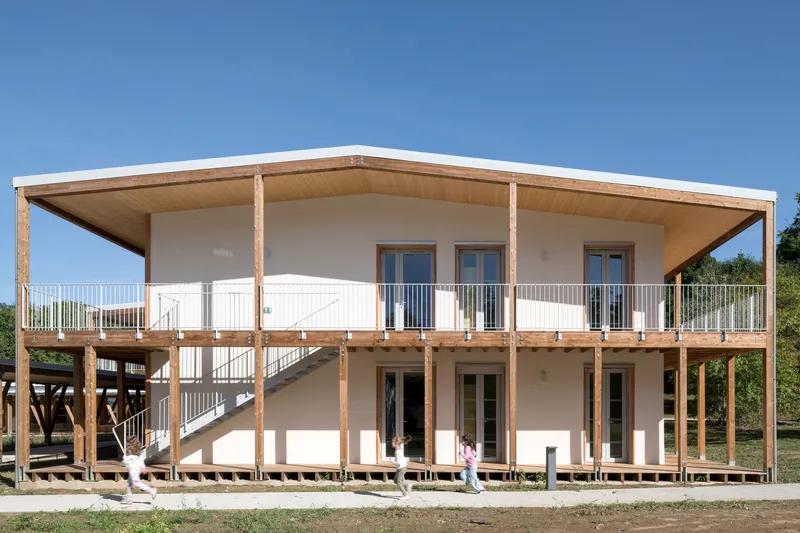
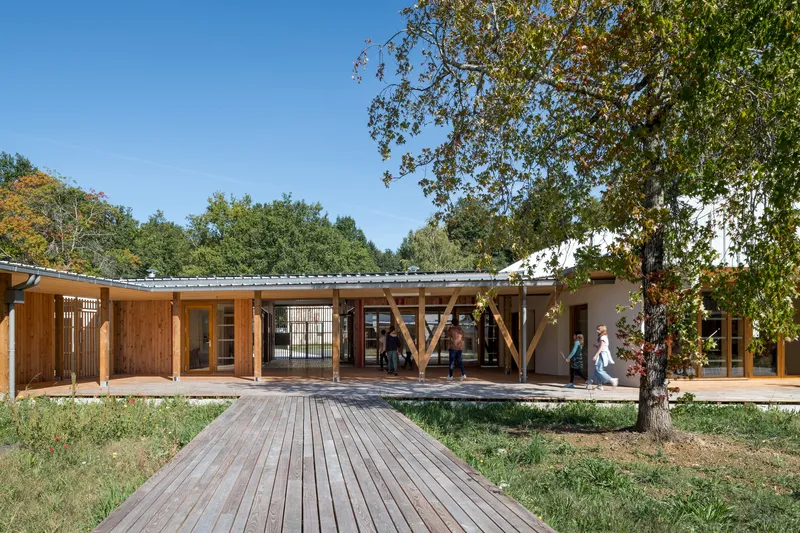

The structural system is legible everywhere. Spruce timber frames are left exposed on facades, with V-bracing and diagonal members displayed as architectural features rather than concealed behind cladding. The two-storey volumes make the structure especially visible: elevated walkways with white railings rest on expressed timber columns, and the hierarchy of primary frame, secondary structure, and infill is readable at a glance. For a building designed to teach children about ecology, this transparency is not decorative. It is didactic.
Behind the visible timber, the walls are filled with bales of straw and chopped straw insulation, a biosourced approach that accounts for 1,800 square meters of wall area. Wood fibre insulation wraps the exterior via a FOB timber frame facade system, and 500 square meters of cross-laminated timber panels contribute to the floor and roof assemblies. Chopped straw, only approved for use in French construction since 2024, makes its national debut here. The project also incorporates hemp and earth, reclaimed doors used as interior cladding, and salvaged flooring, pushing the reuse agenda alongside the biosourced one.
Interiors Calibrated for Small Bodies


Inside, the classrooms and activity rooms are carefully differentiated from standard educational interiors. Large sloping ceilings give the spaces a sense of volume that a flat ceiling at standard height could never provide. Cork panel ceilings absorb sound and add warmth. Circular pendant lights, in various diameters and colors depending on the zone, signal which part of the campus you are in. The color coding is gentle: green rubber flooring for the younger zones, orange linoleum for circulation and dining, blue for active play.
Furniture is low, timber, and purpose-built. The architects resisted the institutional impulse to specify generic school furnishings and instead designed rooms where the architecture itself does much of the work: built-in benches, timber slat wall panels that double as display surfaces, and corner windows positioned at children's eye level to connect every room back to the trees outside.
Color, Texture, and Identity Across the Campus
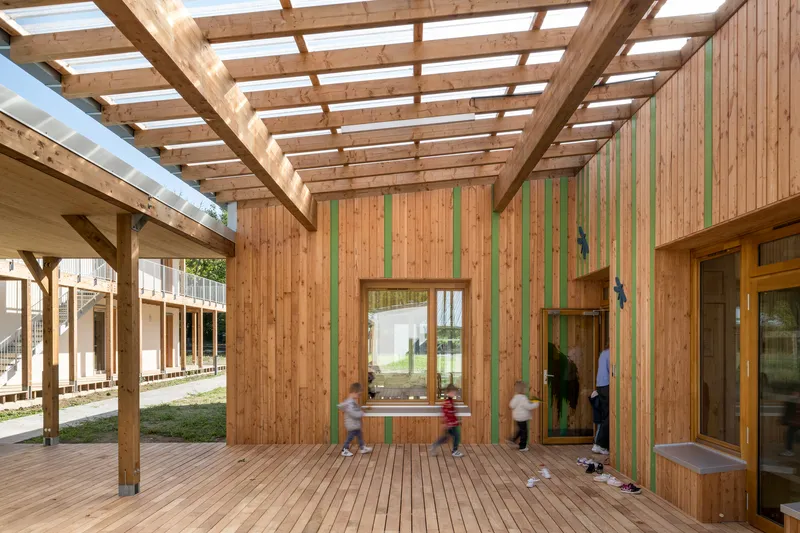


Each pavilion establishes its own identity through subtle variations in material and color. The green vertical stripes on timber cladding mark one zone; maroon disc pendant lights and built-in timber benches distinguish another. Vertical timber battens, used on both interior and exterior walls, appear in different widths and spacings to create distinct textures within the shared material palette. The effect is that children can orient themselves by feel and color rather than by signage.
Even the restrooms get this level of attention. Terracotta tile walls, arched partition doors, and narrow frosted windows create a space that feels considered rather than perfunctory. When the least glamorous room in a building receives this much care, it signals an architecture practice that understands how children actually experience space: not through plans and sections, but through the color of a wall, the texture of a floor, the shape of a door.
Working Spaces and Communal Rooms

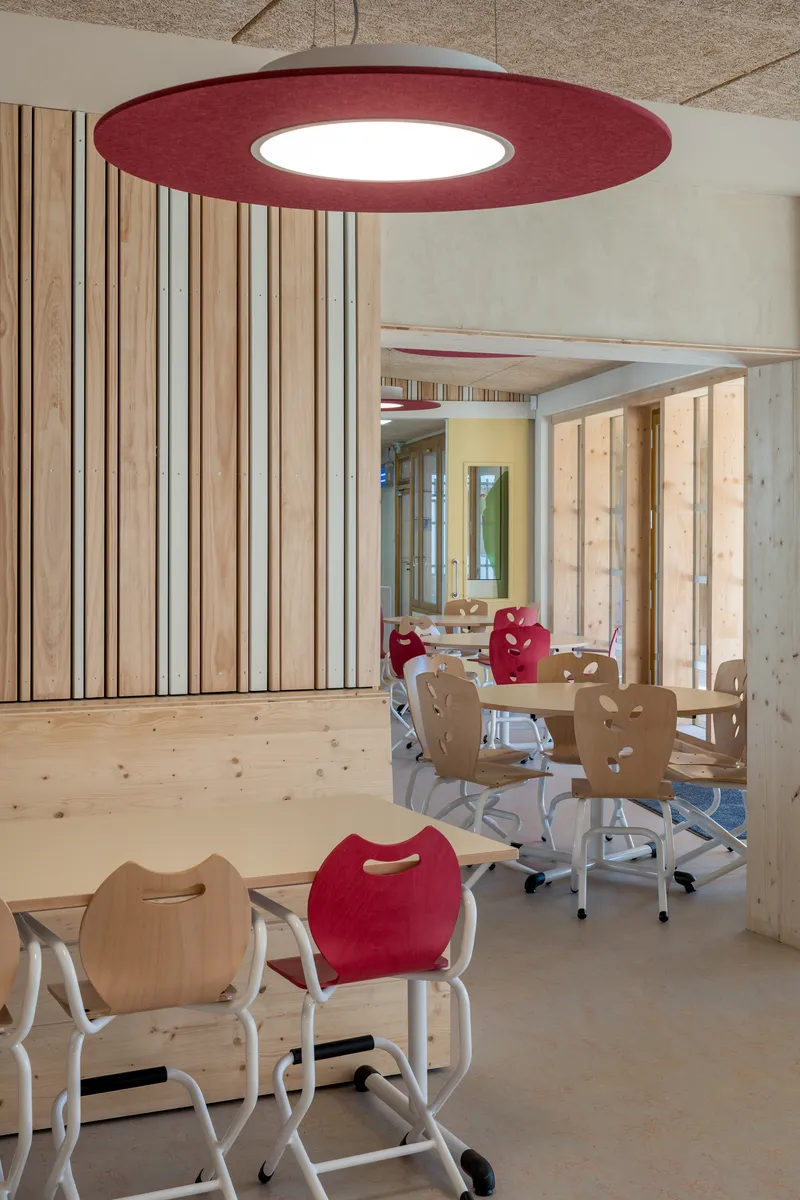

The program includes multimedia rooms, science rooms, movement rooms, craft workshops, and a pedagogical kitchen, alongside two dining halls and 66 sleeping accommodations. The activity hall, with its timber-framed glazed wall overlooking trees, is a standout: a room where children play on blue flooring beneath a roof structure that lets them see exactly how the building holds itself up. The dining areas, fitted with plywood chairs and low tables beneath pendant lights, feel more like a cooperative cafe than a canteen.
Throughout, the architects use large windows to dissolve the boundary between interior and exterior. Classrooms look out onto the courtyard garden. The glazed walkway walls frame views of diagonal bracing and planted courtyards beyond. The building is porous in a way that rewards curiosity, precisely the quality you want in a space designed for scientific discovery, outdoor sports, and environmental education.
Between Forest and Courtyard
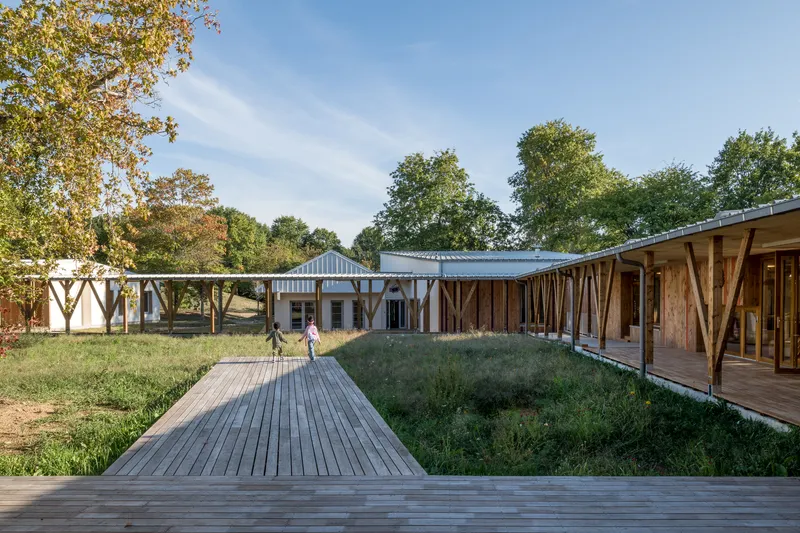


The landscape strategy is as deliberate as the architecture. A pedagogical pond, an orchard, and a garden with animals extend the educational program beyond the buildings. Reinforced vegetation provides summer comfort, reducing the need for mechanical cooling. Rainwater harvesting and solar energy production round out the ecological systems, but these are handled as infrastructure rather than spectacle. The real landscape move is the decision to preserve existing trees and let them define the spatial intervals between buildings.
The white gabled pavilions seen through foreground trees have an almost arcadian quality. Children run across lawns, gather beneath mature canopies, and move between indoor and outdoor environments without ceremony. The architecture does not impose a boundary between building and site; it negotiates one, and the negotiation is visible in every gap between volumes, every boardwalk that steps around a root zone, every pergola that extends a roof into the tree canopy.
Plans and Drawings

The site plan reveals the full scope of the campus: ten buildings arranged around water features and prairie landscape on the three-hectare site. The drawing makes clear how the covered walkway stitches the disparate volumes into a legible sequence, and how the placement of new construction defers to the positions of existing trees and the shoreline of the lake. The four rehabilitated buildings are integrated into the composition without hierarchy, distinguished from the new construction only by their slightly different geometries rather than by any obvious formal break.
Why This Project Matters
The Leisure Center of Uzurat matters because it demonstrates that biosourced construction can operate at campus scale without sacrificing spatial richness. Too many ecological buildings treat sustainability as a constraint that limits formal ambition. Here, the opposite is true: the straw walls, the timber frames, the chopped straw insulation, and the reclaimed materials are the architecture, not a performance metric layered onto it. The building teaches through its own construction, making ecological literacy a spatial experience rather than a curriculum item.
It also matters as an example of how to build for children without condescension. The color-coded interiors, the low-scaled walkways, the exposed structure, and the porous relationship to landscape are all designed with genuine respect for how young people perceive and navigate space. Atelier quatre and R2K Architectes have produced a building that treats its users as curious, capable inhabitants rather than as small adults to be managed. In a country where leisure and education centers are often utilitarian afterthoughts, Uzurat sets a standard that will be difficult to ignore.
Leisure Center of Uzurat, by atelier quatre and R2K Architectes. Limoges, France. 2,752 m². Completed 2025. Photography by Jean-François Tremege.
About the Studio
Share Your Own Work on uni.xyz
If projects like this are the kind of work you want to make, uni.xyz is a place to publish your own, find collaborators, and enter design competitions.




Popular Articles
Popular articles from the community


Co-life: Sustainable Architecture for Age-Friendly Community Living
Co-life reimagines sustainable architecture for seniors through courtyards, rammed earth, shared gardens, and spaces designed for belonging.

Play: Fragments of Their World
Familiar architecture becomes modular playground design, creating safe spaces where displaced children can learn, connect, imagine and play.

Hill & Cross Opera: Sculptural Opera House Architecture Shaped by Tallinn’s Landscape and Identity
Hill & Cross Opera reimagines opera house architecture in Tallinn through its sculptural hill, civic plaza, glass wave and a luminous cross.

Riyadh For All: Intergenerational Urban Design for Active Aging in Rabat
Riyadh For All reimagines urban design in Rabat with intergenerational co-living, adaptive courtyards, and Moroccan cultural exchange today.
Similar Reads
You might also enjoy these articles

Bao Huynh Watercolor Atelier: A Serene Art Retreat in Hội An
Bao Huynh Watercolor Atelier in Hội An blends multifunctional art spaces, sustainable design, local materials, and family-friendly living in a serene environment.

Atelier Macri Concept Store Interior Design by CASE-REAL
Atelier Macri store features a "ko" counter, walnut wood details, cork displays, blending retail, gallery, and seamless customer experiences.

Manuel Vargas Izquierdo Stadium and High-Performance Sports Center: Architectural Excellence in Jalpa de Méndez
The Manuel Vargas Izquierdo Stadium blends sustainable design, inclusive sports facilities, and cultural-inspired architecture, revitalizing Jalpa de Méndez’s public spaces.

KAKR Buluh Awar Hall: Revitalizing Community and Ecology Through Bamboo Architecture
Community built bamboo hall revitalizes Buluh Awar village, empowering youth, restoring ecology, celebrating vernacular craftsmanship through sustainable architecture and culture.




Comments (0)
Please login or sign up to add comments
No comments yet. Be the first to comment!