
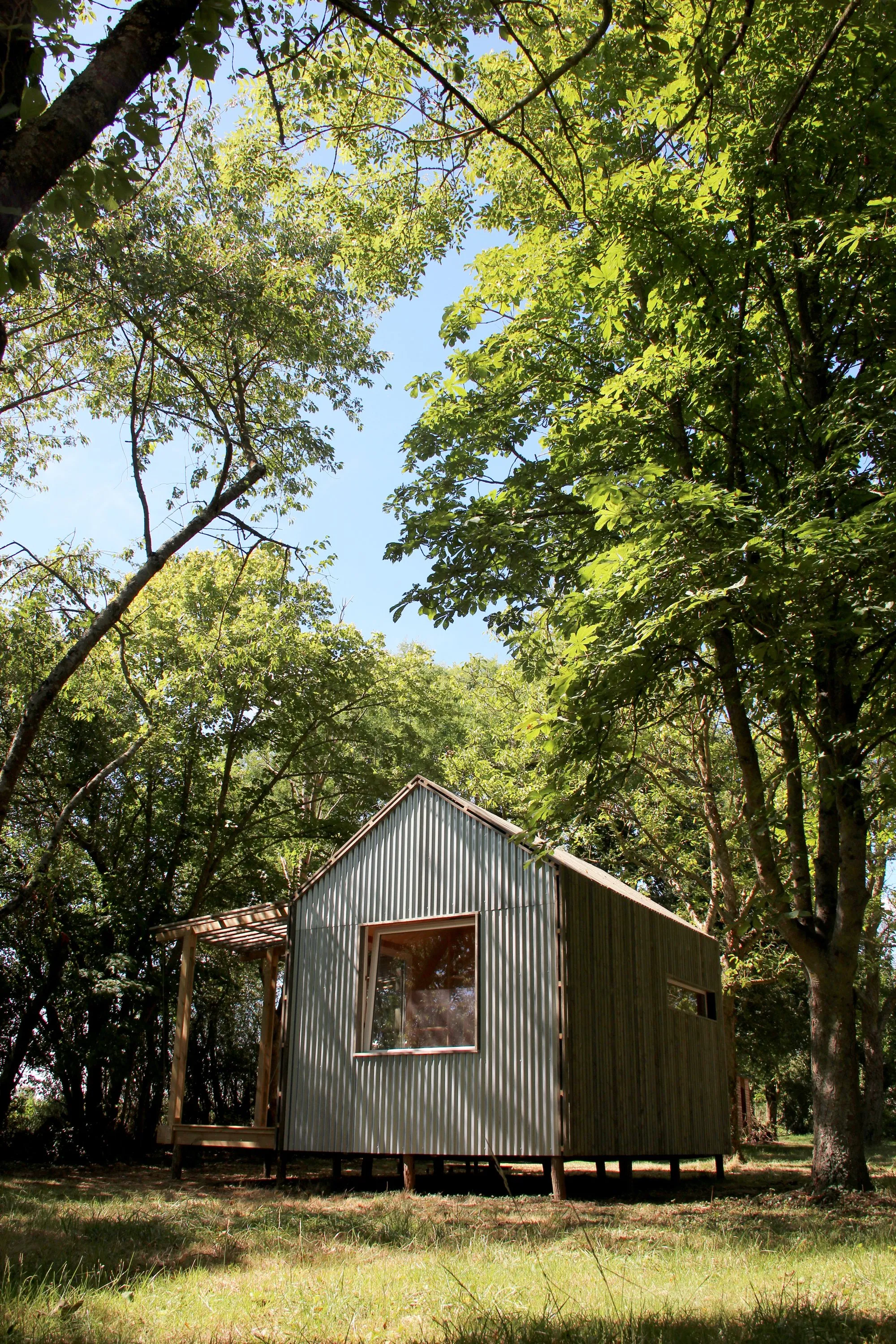
Atelier Toboggan Builds Its First Project: A 20 m² Cabin in the French Countryside
Three architect-craftsmen from Nantes design and build a wood-and-metal retreat tucked into the trees of Cernusson, France.


There is something disarming about a first project that arrives fully formed. Cabane ABC, completed in 2022 by Atelier Toboggan, is a 20 m² cabin set among mature deciduous trees in Cernusson, a small commune in western France. The collective, three young architect-craftsmen named Soulier Raphäel, Brisoux Morgan, and Janneteau Basile, graduated from the school of architecture in Nantes and operate their workshop out of Redon, Brittany. Cabane ABC is their debut as both designers and builders, and it carries the conviction of people who intend to get their hands dirty for a long time.
What makes this cabin worth attention is not its size but its economy of means. Corrugated metal, vertical timber siding, plywood interiors, and a timber post-and-beam pergola are combined with a directness that feels neither precious nor improvised. The cabin reads as a serious piece of architecture because it takes its modest program seriously: shelter, storage, a place to sit, a threshold between inside and outside. Every decision here is legible, and that legibility is the project's greatest strength.
A Gable in the Clearing
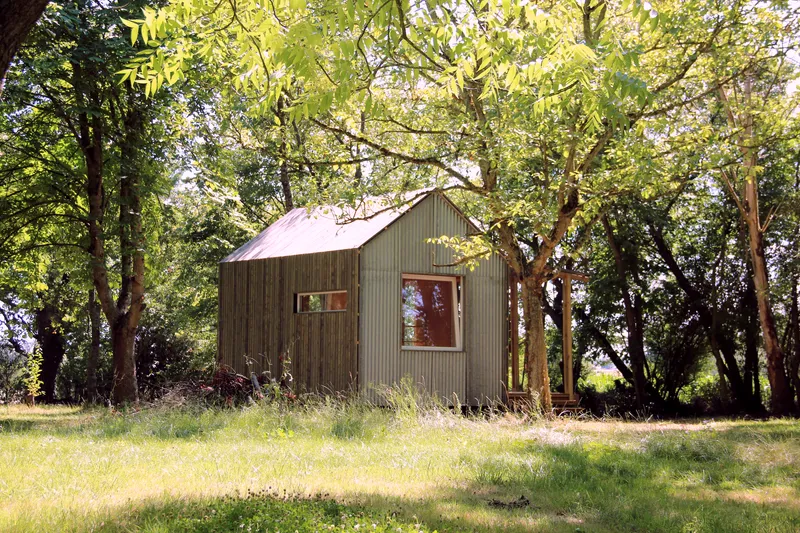
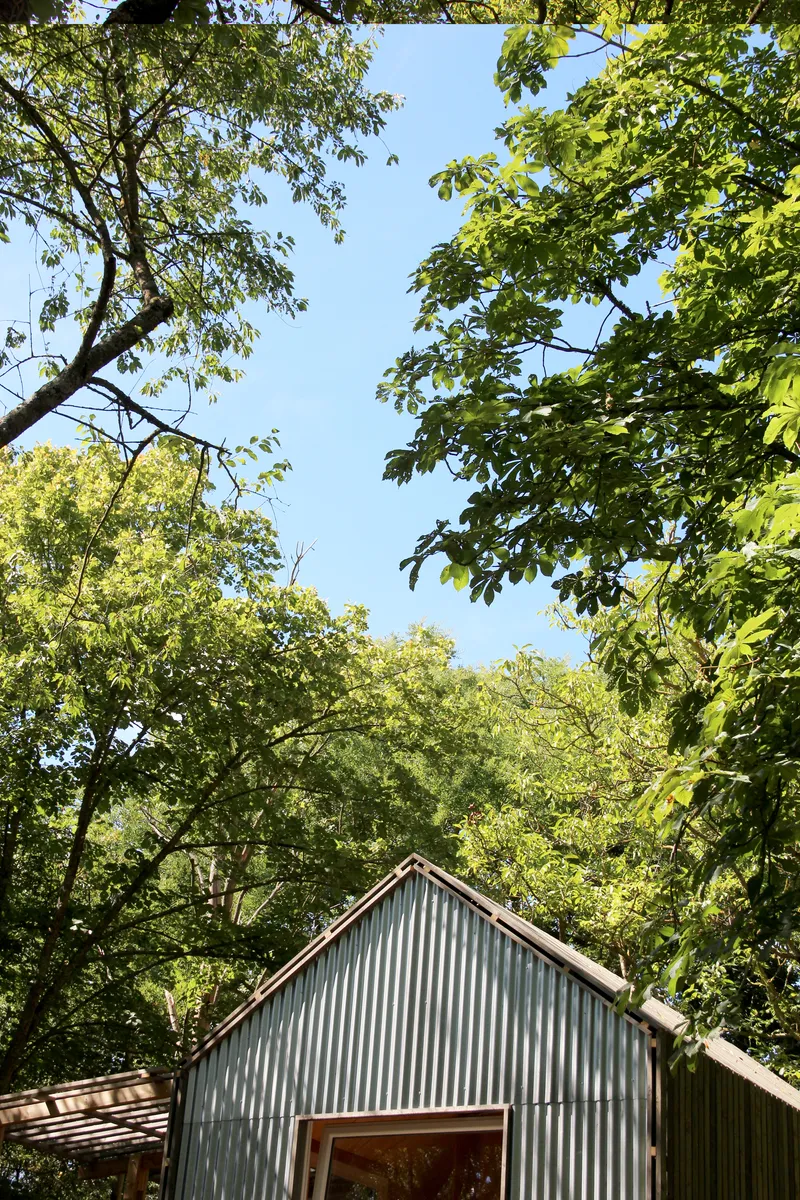
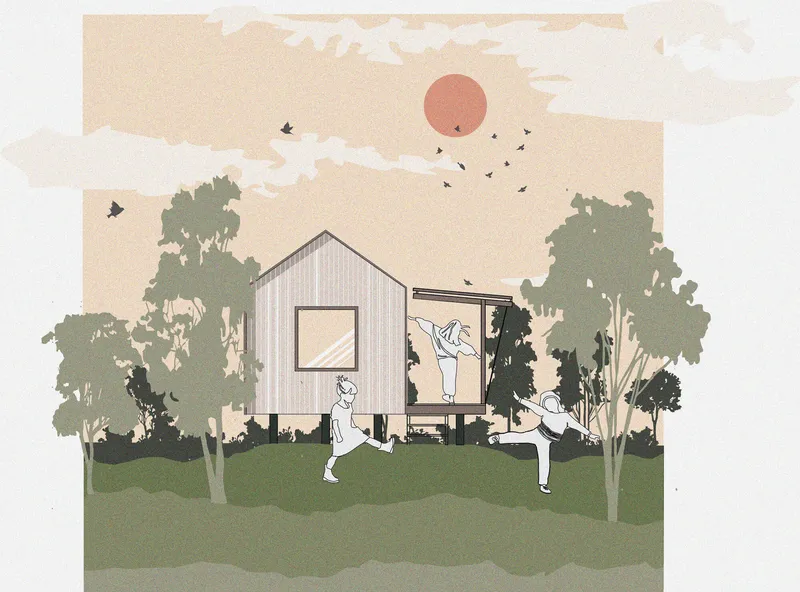
The primary volume is a gable-roofed box clad in corrugated metal. It sits among tall trees with the quiet confidence of a tool shed that has been promoted. The proportions are classical enough to feel familiar, steep enough to shed rain, and compact enough to disappear when the canopy is in full leaf. From the front gable, the structure reads as a clean triangle punched into a green backdrop.
The choice of corrugated metal is practical and honest. It ages well outdoors, requires minimal maintenance, and costs very little. Against the rough bark and shifting light of the surrounding trees, the material's regularity creates a productive tension. The cabin does not try to mimic its landscape. It announces itself as something made.
The Pergola as Social Space
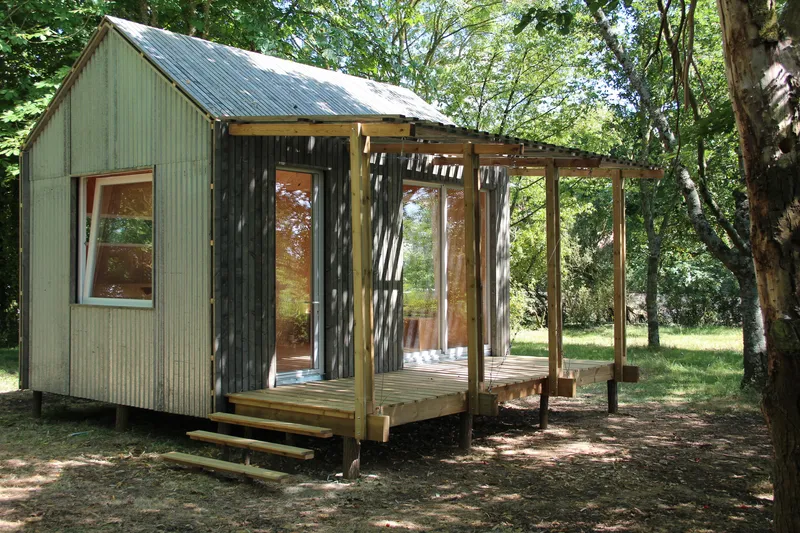
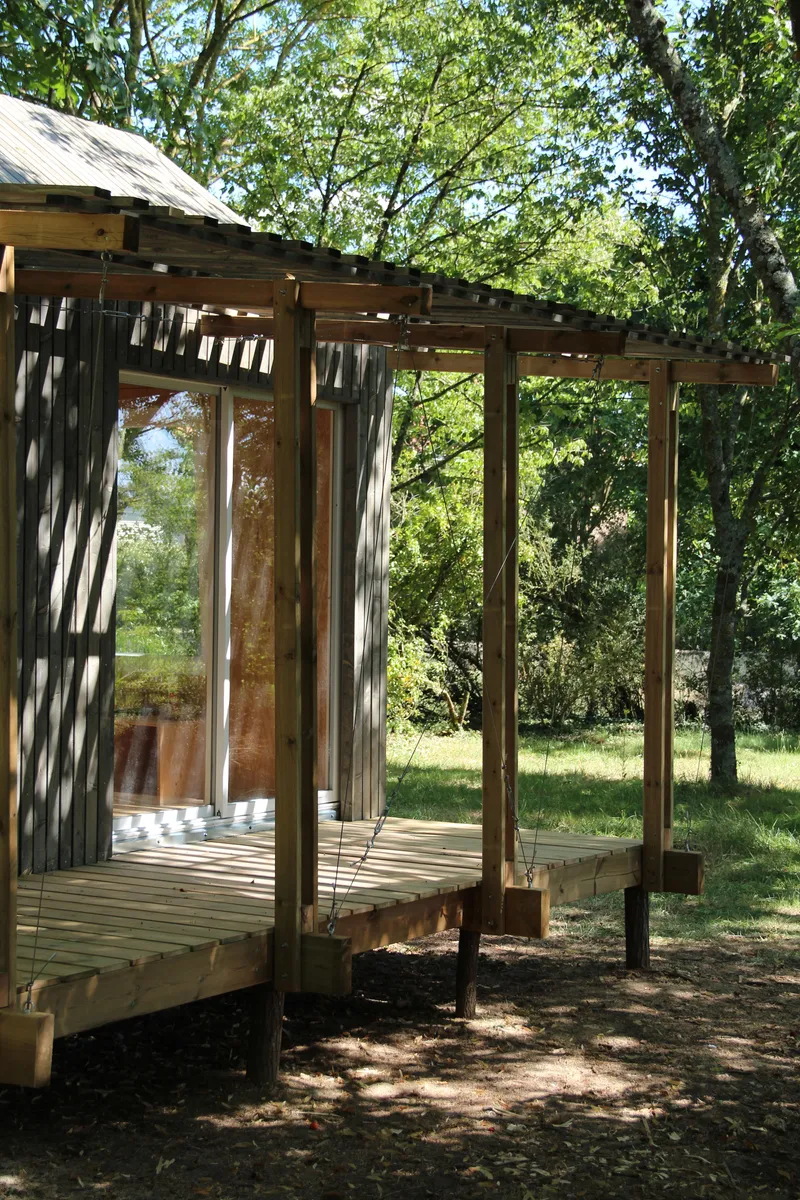
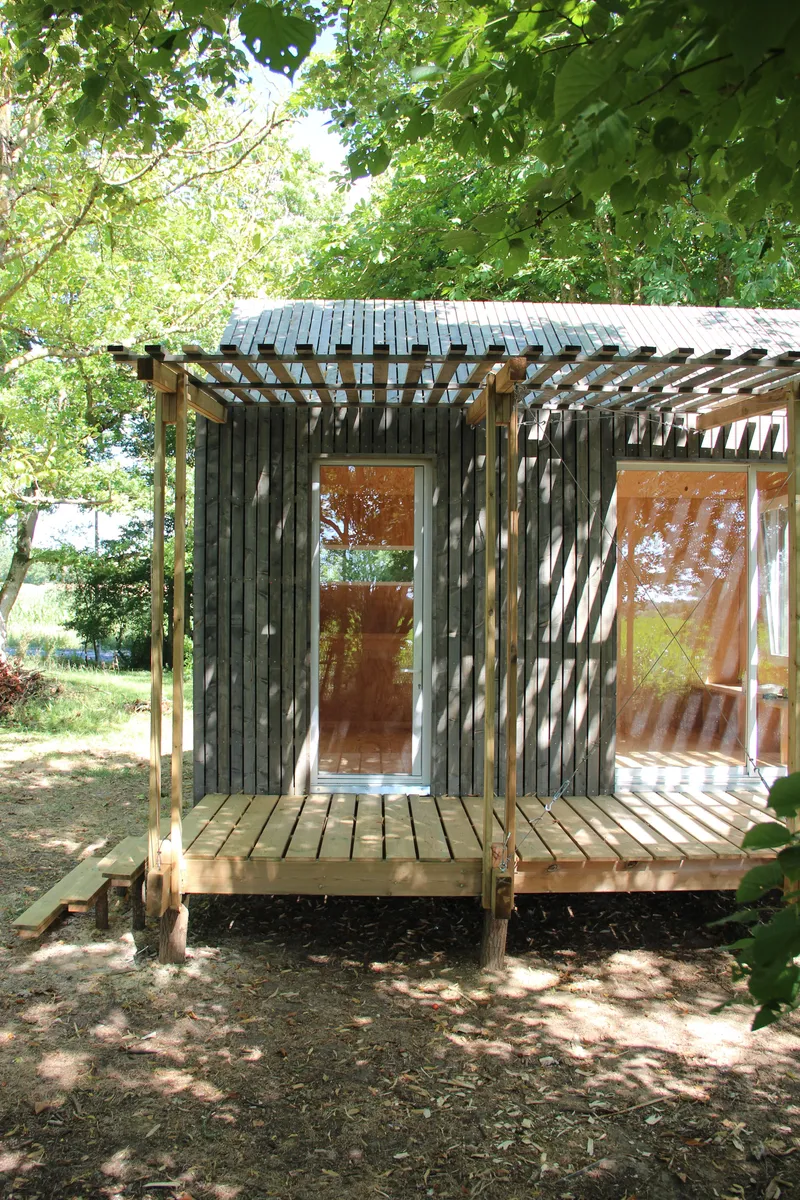
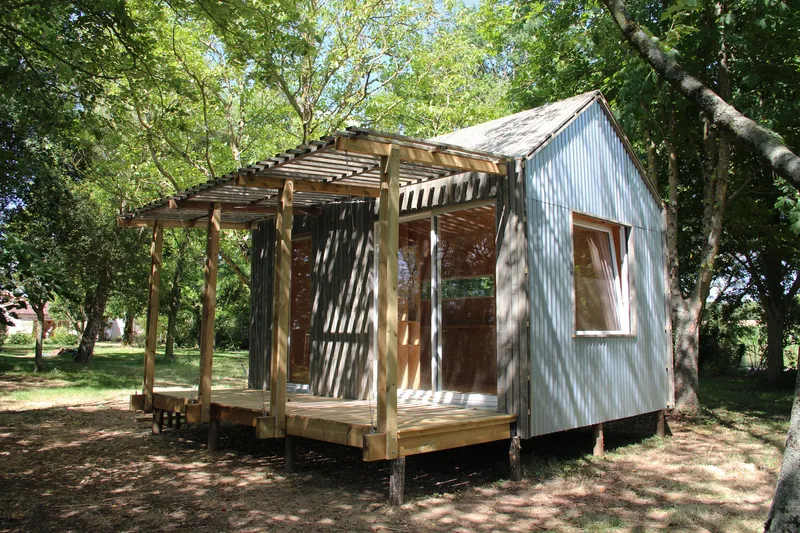
Attached to the main volume is a timber-framed deck with an open pergola. This element effectively doubles the cabin's usable footprint without adding enclosed area. The exposed rafters filter sunlight into striped shadow patterns across the deck, and the structure acts as a mediating zone between the sealed interior and the surrounding forest floor.
The pergola is where the project's ambitions as architecture, rather than mere construction, become clear. It creates a room without walls, a place to gather or eat or simply sit in shade. The post-and-beam connections are clean and confident, suggesting that Atelier Toboggan's craft skills are not decorative but structural. This outdoor room may be the best space in the project.
Material Honesty Inside and Out
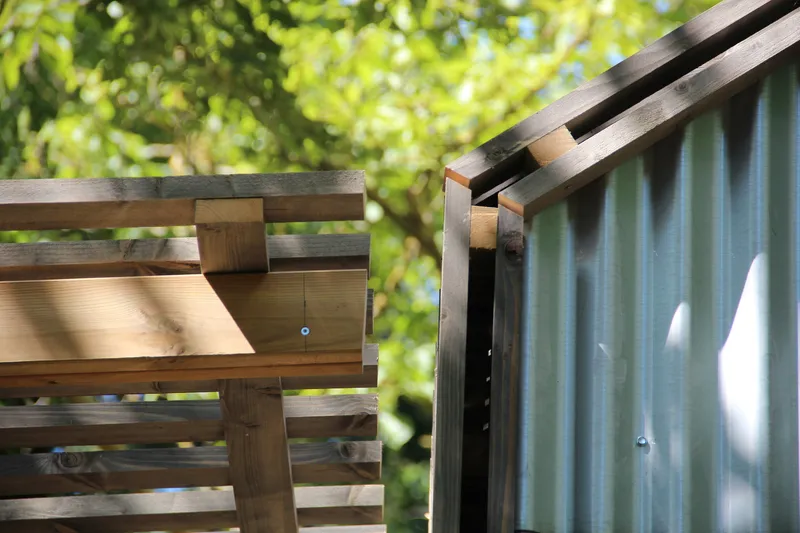
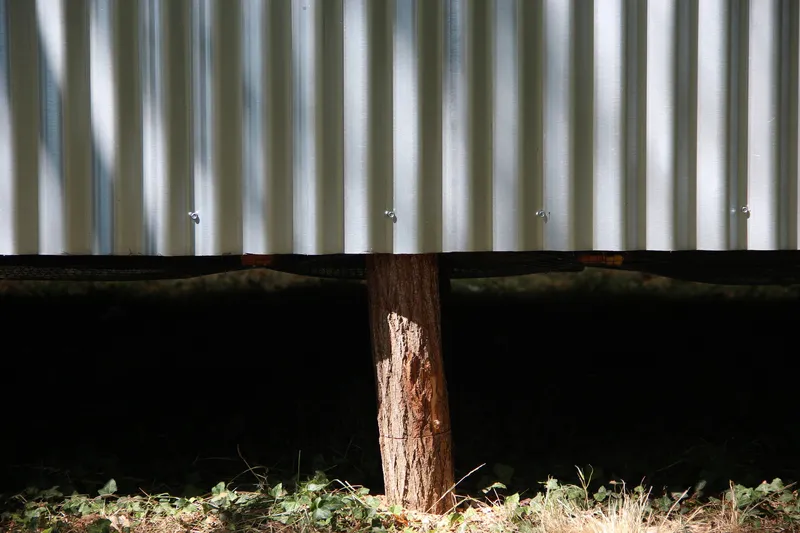
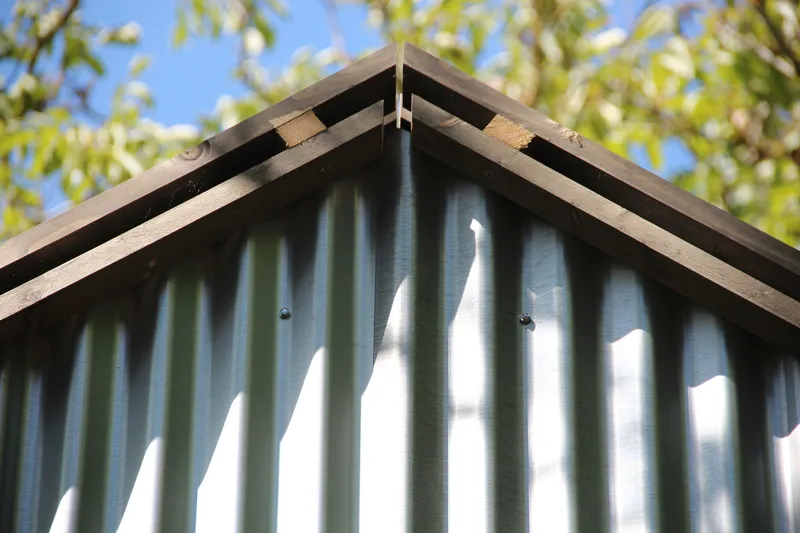
The details reward close looking. Timber posts meet the corrugated metal wall with simple, exposed connections. Column bases rest directly on the forest floor with minimal foundations. Roof trim is clean and unfussy. Nowhere do you find a detail trying to be something it is not. The fasteners are visible, the joints are readable, and the materials are left to do their own talking.
Suppliers including Bati'Brade, Biosfaire, Bois Plus, and Foussier provided the wood and steel. The material palette is deliberately restrained. Corrugated metal handles weather protection, timber handles structure and warmth, and that is essentially the entire story. For a cabin of 20 m², this restraint is appropriate and effective.
The Cladding Variations
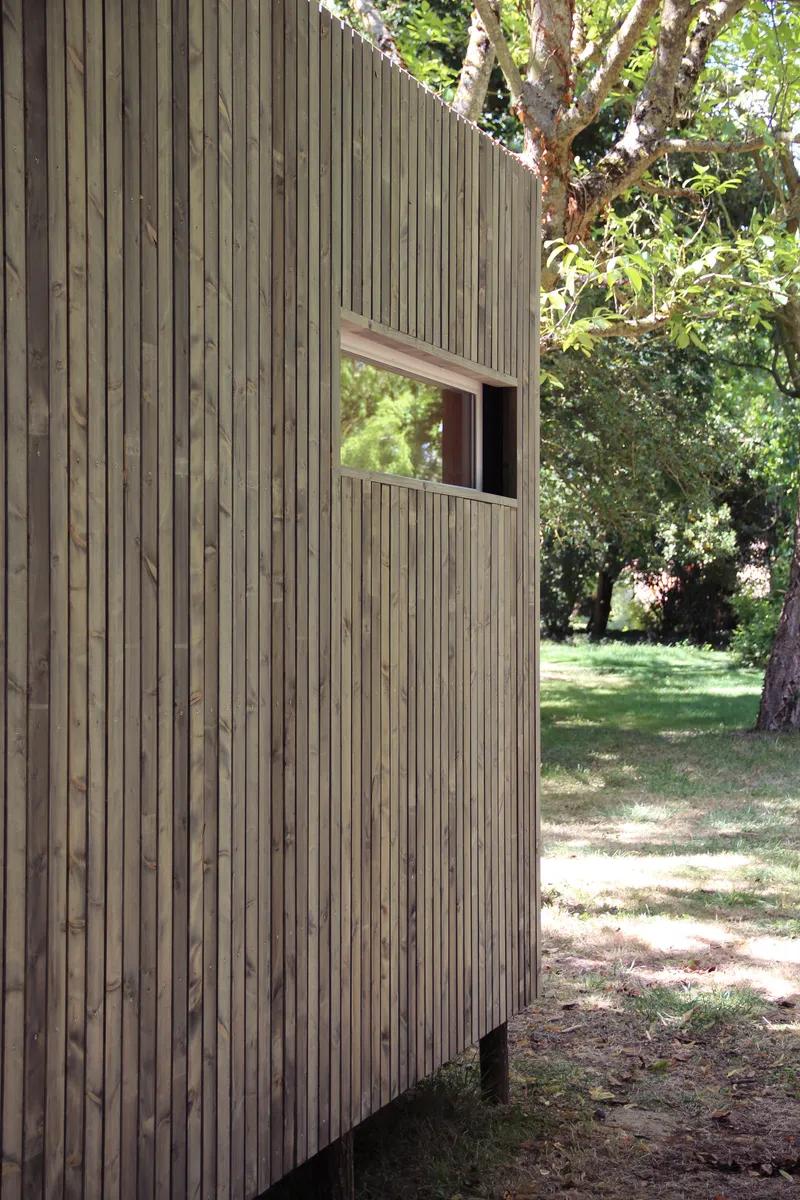
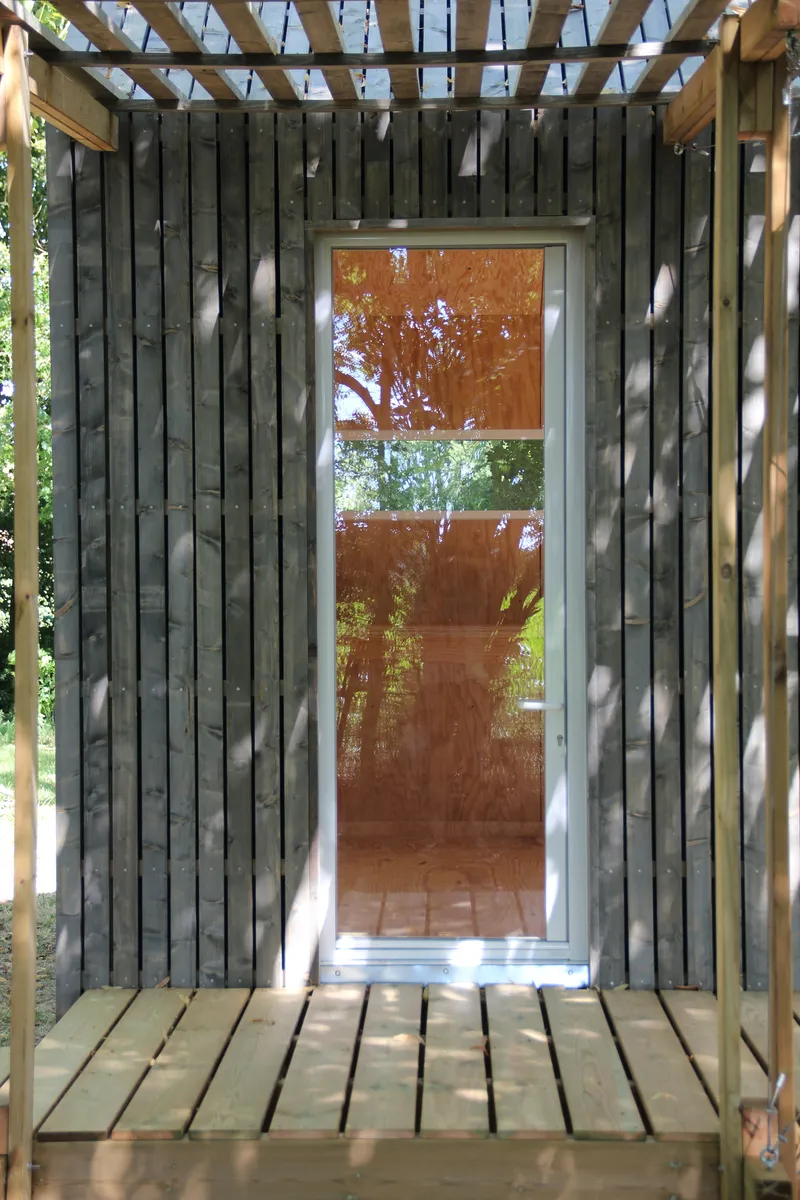
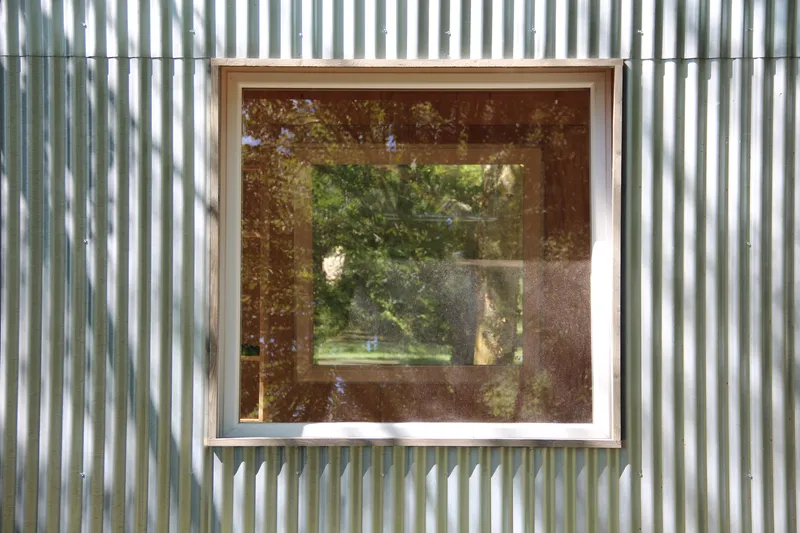
Not every face of the cabin is identical. One elevation shows vertical timber slats with a single punched window opening, a more textured and layered surface than the corrugated metal found elsewhere. Another reveals what appears to be charred wood cladding around a glazed door, hinting at a shou sugi ban treatment that adds depth and weather resistance. A square window set into the metal cladding reflects the surrounding canopy, turning the cabin into a partial mirror of its site.
These variations prevent the cabin from feeling like a single gesture repeated on four sides. Instead, each elevation responds to its orientation, its proximity to trees, and its relationship to the approach. The architects clearly thought about how the building is encountered, not just how it is assembled.
Plywood Interiors and Built-In Furniture
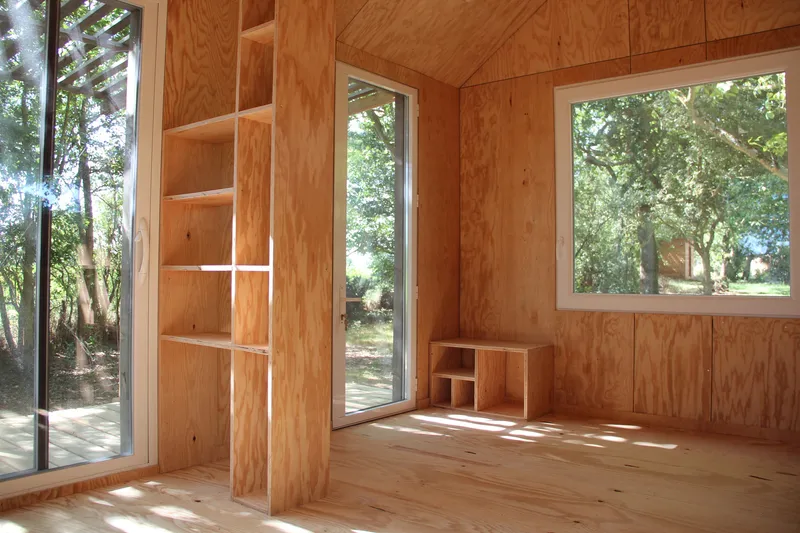
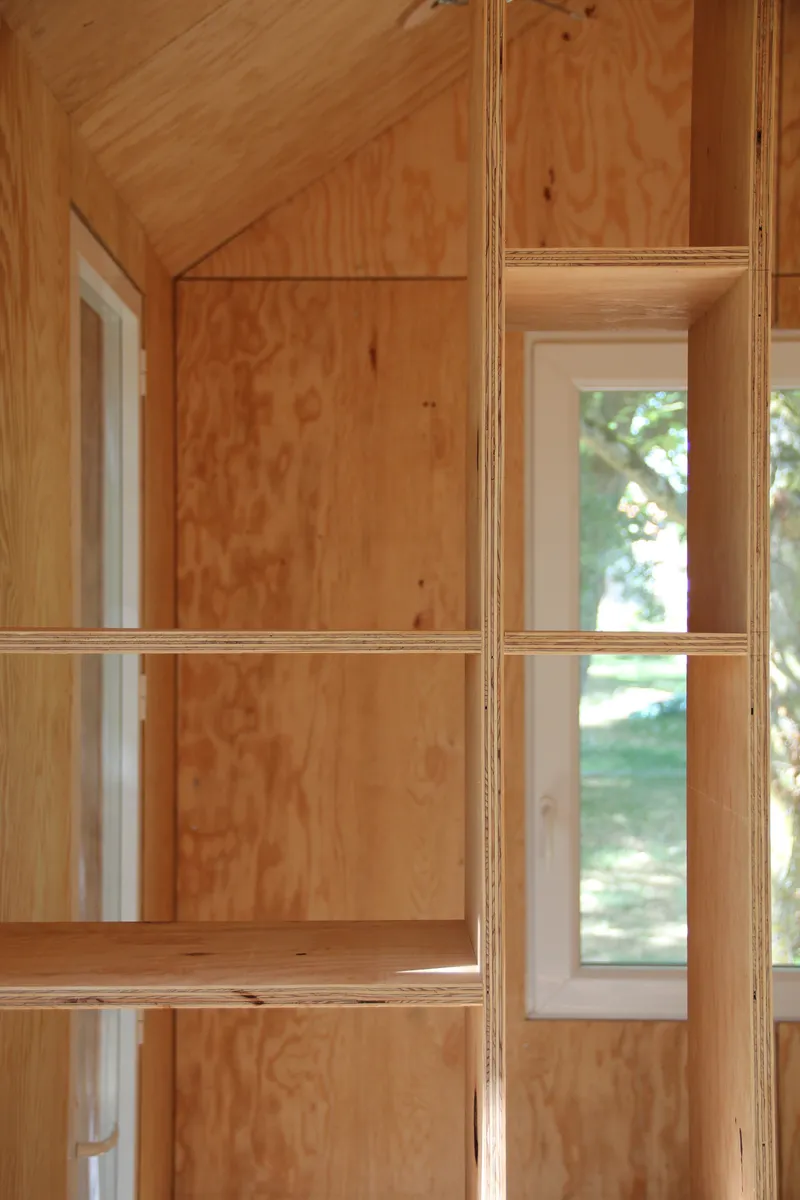
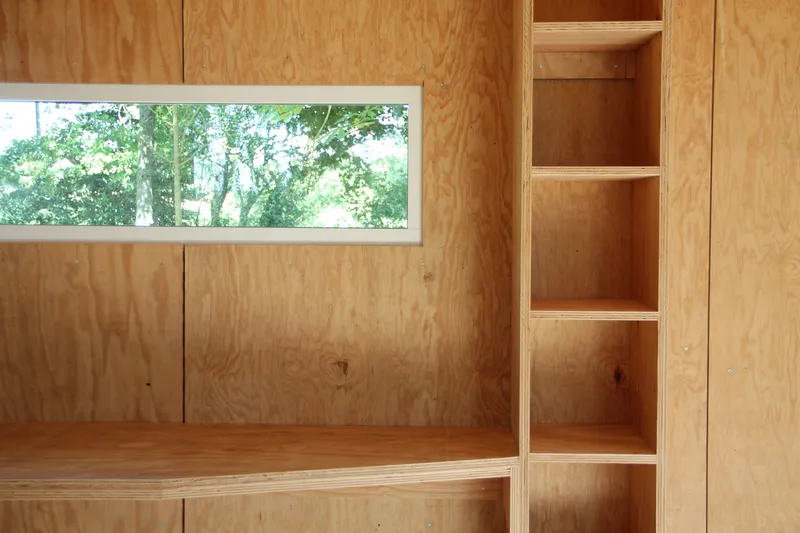
Inside, the cabin is lined entirely in plywood. Shelving, benches, and partitions are built in, maximizing usable space within the tight 20 m² footprint. Horizontal windows frame views of the surrounding lawn and tree canopy, pulling the landscape inside without sacrificing wall area for storage. Glazed doors on the deck side dissolve the boundary between the plywood interior and the timber pergola.
The interior has the quality of a well-designed boat cabin: everything has its place, nothing is superfluous, and the materials are warm enough to make the compact dimensions feel cozy rather than cramped. The plywood grain and visible screw fasteners give the space a workshop character that suits the ethos of its builder-designers.
Surface and Grain
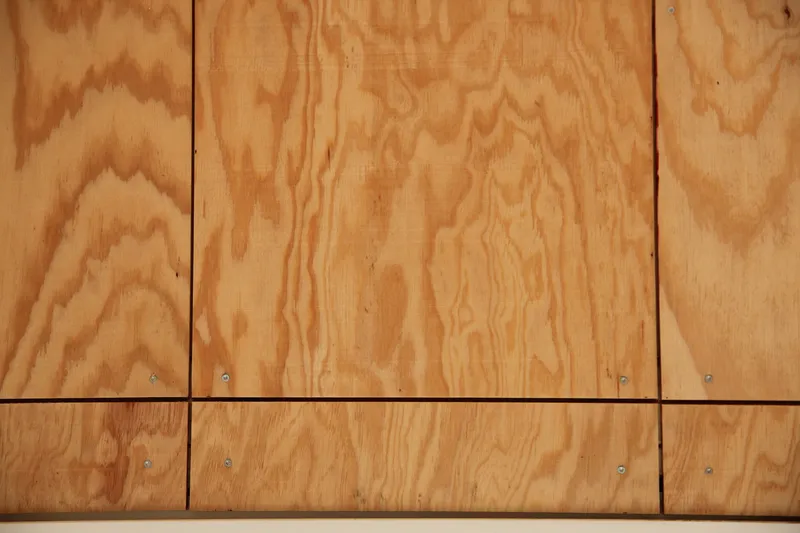
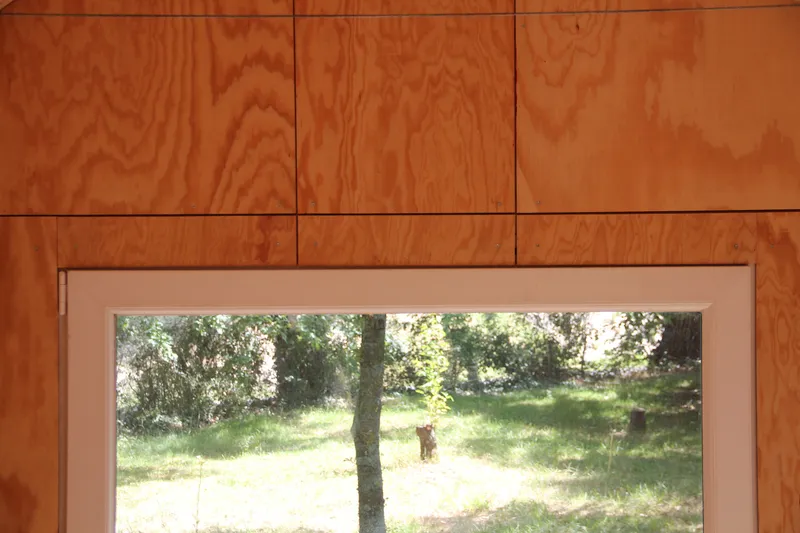
Close-up, the plywood panels reveal their grain and the screws that hold them in place. There is no attempt to conceal the construction logic. Panels are joined at visible seams, and the fasteners read as a deliberate pattern rather than an oversight. A horizontal window at mid-height frames a strip of green, turning the wall into a layered composition of wood surface and landscape.
This level of attention to surface quality is what separates a thoughtful cabin from a garden shed. Atelier Toboggan treats every panel as a design decision, and the result is an interior that feels considered at every scale.
Plans and Drawings
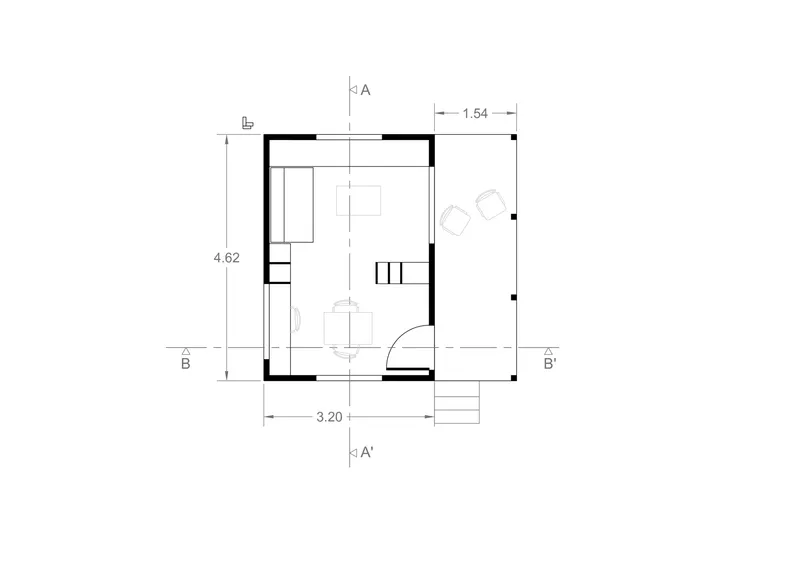
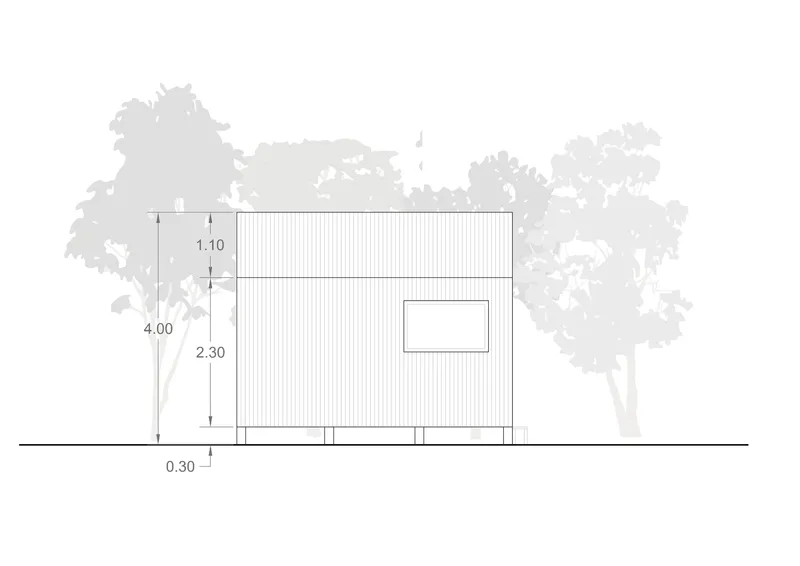
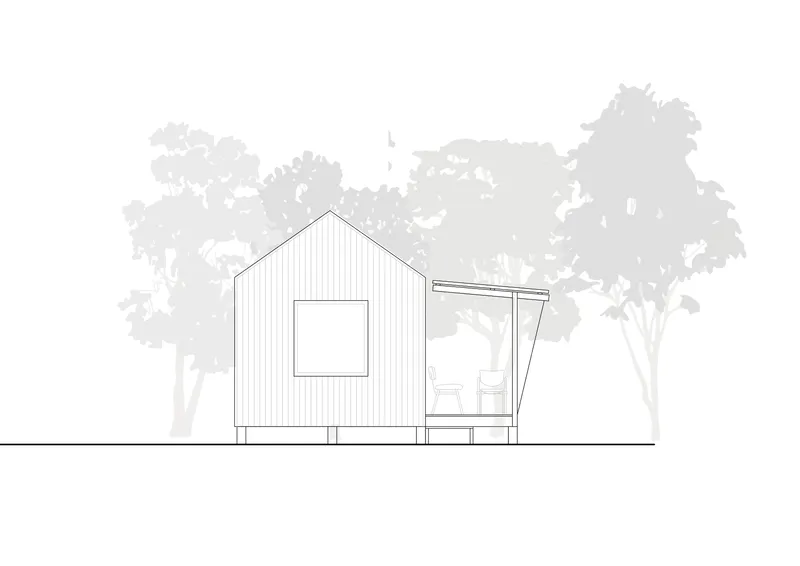
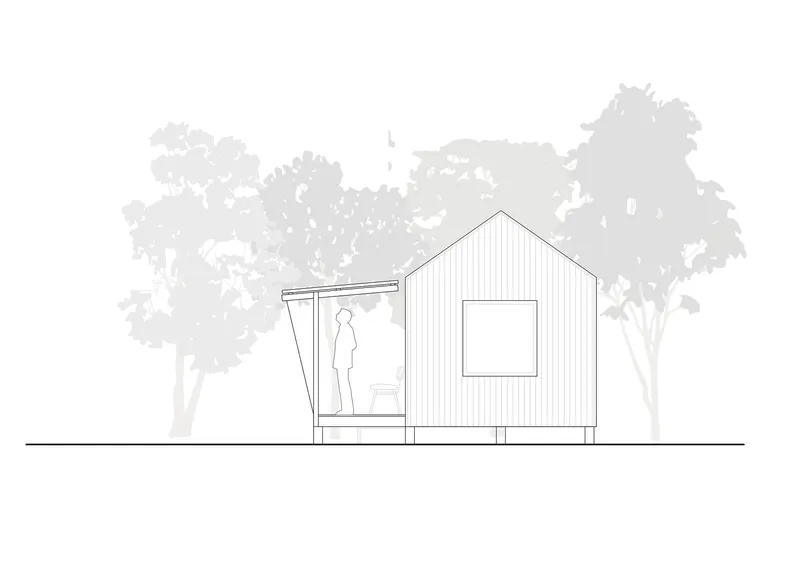
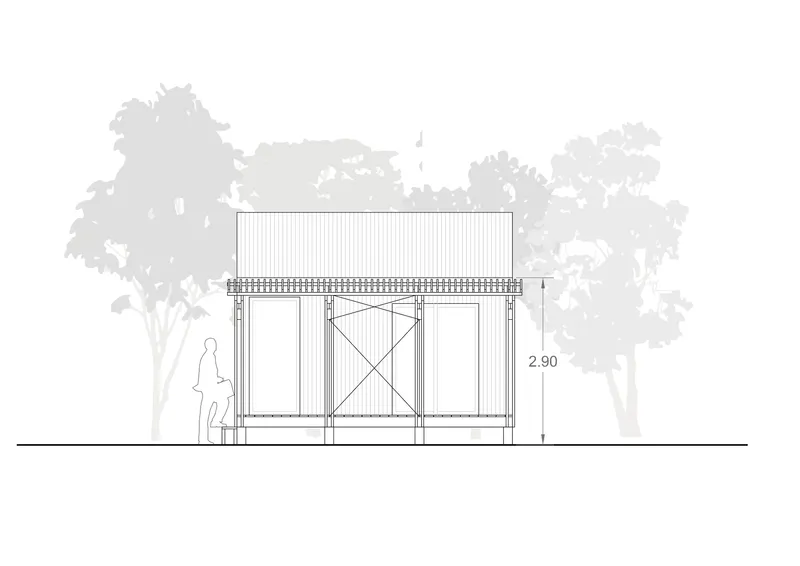
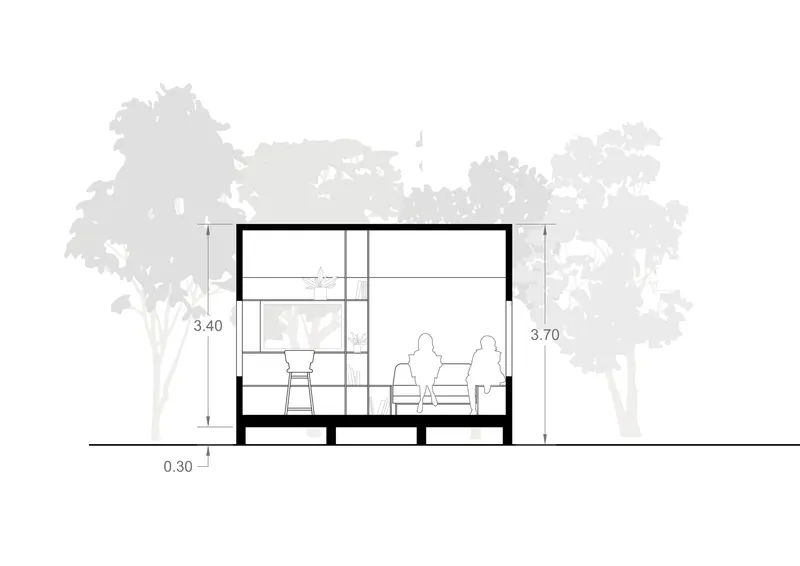
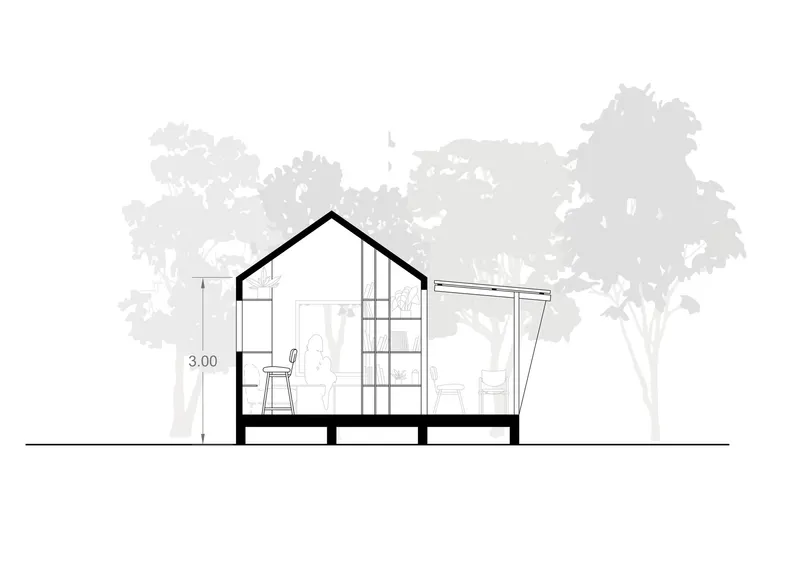
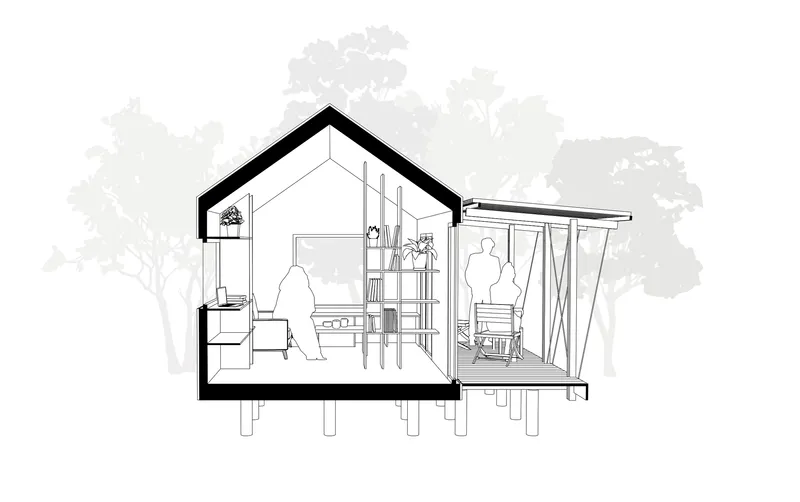
The floor plan confirms the cabin's compact logic: a rectangular layout containing a kitchen zone, a dining area, and a stair, all organized along a single axis. The elevations and sections are drawn with silhouetted trees, situating the structure firmly within its wooded context. A cross-braced raised floor structure lifts the cabin off the ground, minimizing its footprint on the site and allowing air to circulate beneath.
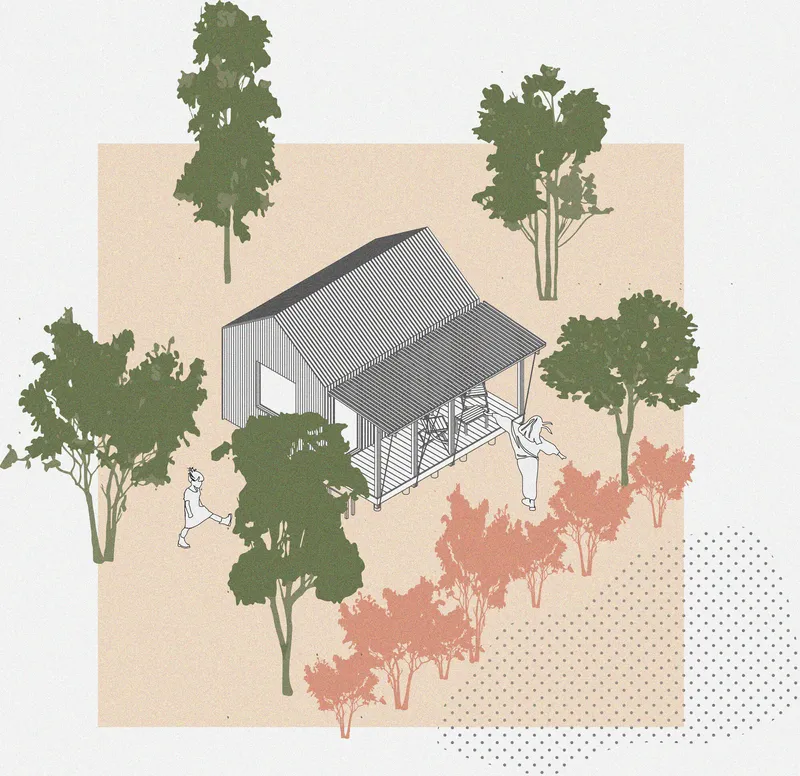
The sections are the most revealing drawings. They show seated figures inside the raised interior, a covered porch with a swing hanging from the timber piles, and the glazed facade that opens the gable end to the landscape. The axonometric drawing pulls the whole composition together, depicting a corrugated-roof pavilion nested among landscaped trees with figures occupying the deck and clearing. These are the drawings of architects who build: specific, structural, and grounded in the reality of construction.
Why This Project Matters
Cabane ABC matters because it demonstrates that small-scale architecture, when executed with care and intelligence, can carry as much conviction as a large commission. At 20 m², the project leaves no room for waste or indecision. Every material choice, every connection, every window placement is a statement about what the architects value: honesty, economy, and a deep respect for the act of making. As a debut project, it sets a remarkably clear foundation for Atelier Toboggan's future work.
The broader lesson here is about authorship. When architects design and build with their own hands, the gap between intention and execution collapses. There is no miscommunication between drawing and construction because the same people are responsible for both. Cabane ABC is a small building that argues for a big idea: that architecture is, at its core, a craft, and that the best way to learn it is to build it yourself.
Cabane ABC by Atelier Toboggan (Soulier Raphäel, Brisoux Morgan, Janneteau Basile). Cernusson, France. 20 m². Completed 2022. Photography by Soulier Raphäel.
About the Studio
Share Your Own Work on uni.xyz
If projects like this are the kind of work you want to make, uni.xyz is a place to publish your own, find collaborators, and enter design competitions.




Popular Articles
Popular articles from the community


The Musturak Paradise: Senior Living Architecture for a Connected Future in Temara, Morocco
The Musturak Paradise reimagines senior living architecture in Temara via private homes, social spaces, culture, community, and shared care.

Co-Life: Senior Housing Design That Reconnects Older Adults With the City
Co-Life reimagines senior housing design through healing gardens, shared streets, workshops, and a sustainable community across generations.

Lunar Spiral: Space Architecture Shaped by the Mathematics of the Universe
Lunar Spiral reimagines space architecture through Fibonacci geometry, lunar regolith, levitating habitats, and self-sustaining Moon living.

Conexión: Biophilic Design Reimagines High-Rise Living in Hong Kong
Conexión reimagines high-rise living in Hong Kong through biophilic design, green facades, shared spaces, daylight, water and nature within.
Similar Reads
You might also enjoy these articles

Bao Huynh Watercolor Atelier: A Serene Art Retreat in Hội An
Bao Huynh Watercolor Atelier in Hội An blends multifunctional art spaces, sustainable design, local materials, and family-friendly living in a serene environment.

Atelier Macri Concept Store Interior Design by CASE-REAL
Atelier Macri store features a "ko" counter, walnut wood details, cork displays, blending retail, gallery, and seamless customer experiences.

Manuel Vargas Izquierdo Stadium and High-Performance Sports Center: Architectural Excellence in Jalpa de Méndez
The Manuel Vargas Izquierdo Stadium blends sustainable design, inclusive sports facilities, and cultural-inspired architecture, revitalizing Jalpa de Méndez’s public spaces.

KAKR Buluh Awar Hall: Revitalizing Community and Ecology Through Bamboo Architecture
Community built bamboo hall revitalizes Buluh Awar village, empowering youth, restoring ecology, celebrating vernacular craftsmanship through sustainable architecture and culture.




Comments (0)
Please login or sign up to add comments
No comments yet. Be the first to comment!