
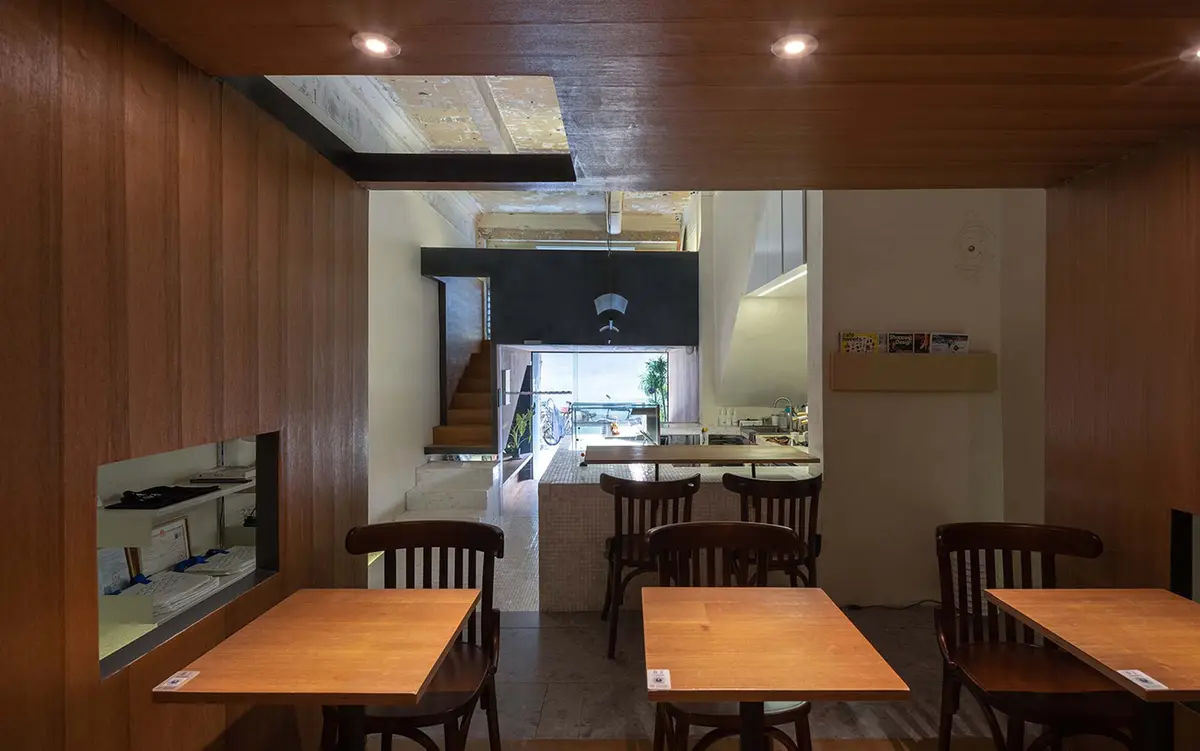
Atelier Waterside Threads a Timber Box Through a 1930s Guangzhou Tenement for Qualia Café
A 73-square-meter ground-floor renovation on the Pearl River's north bank turns weathered concrete into a warm coffee ritual.


Guangzhou's historic neighborhoods along the Pearl River's north bank hold rows of tenements built in the 1930s and 40s, modest three- and four-story concrete-frame buildings whose ground floors have cycled through countless uses over the decades. When the coffee and dessert brand Qualia (观粼) chose one of these storefronts on Wei Xin Heng Lu road for its first physical location, Atelier Waterside took on the challenge of carving a layered, atmospheric café out of just 73 square meters of inherited structure.
What makes the project worth studying is not its size but its strategy. Rather than stripping the old building back to a neutral shell or wallpapering over its age, the designers inserted distinct new timber and steel volumes into the existing space, letting the raw concrete ceiling and plaster walls remain visible as a counterpoint. The result is a café that reads as an archaeology of two eras: the weathered patina of pre-war Guangzhou held in tension with the precision of contemporary joinery.
A Narrow Frontage, a Deep Signal

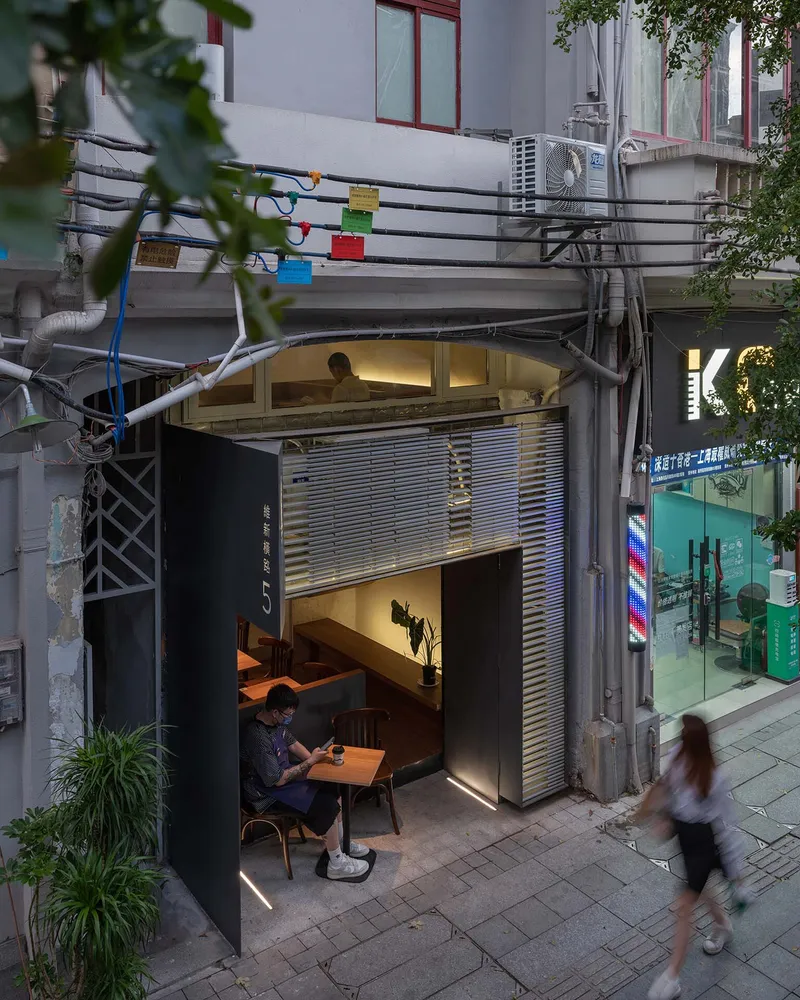
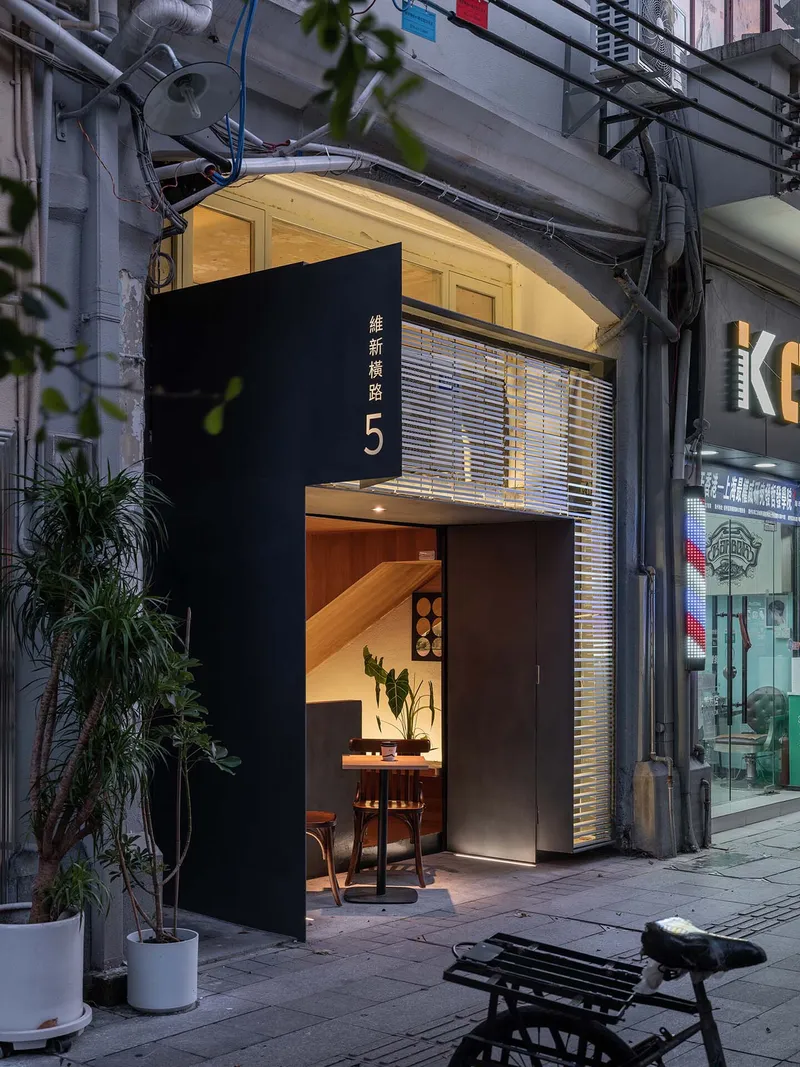
The street elevation is barely wider than a doorway, yet the architects make it work overtime. Horizontal metal louvers run floor to ceiling, filtering views of the warm interior while projecting a quiet rhythm onto the narrow lane. At dusk, the louvers glow amber, turning the façade into a lantern that signals hospitality without shouting. A slim outdoor terrace with seating extends the café's presence into the alley, borrowing public space in a way that feels earned rather than imposed.
The black-paneled side entrance, visible from the adjacent alley, is deliberately understated. Potted plants and a single horizontal slot of light are enough to mark the threshold. The restrained palette of dark steel and timber against whitewashed masonry sets a tonal contract from the first step: this is a place that respects its context and asks you to slow down.
Timber Volumes as Interior Architecture
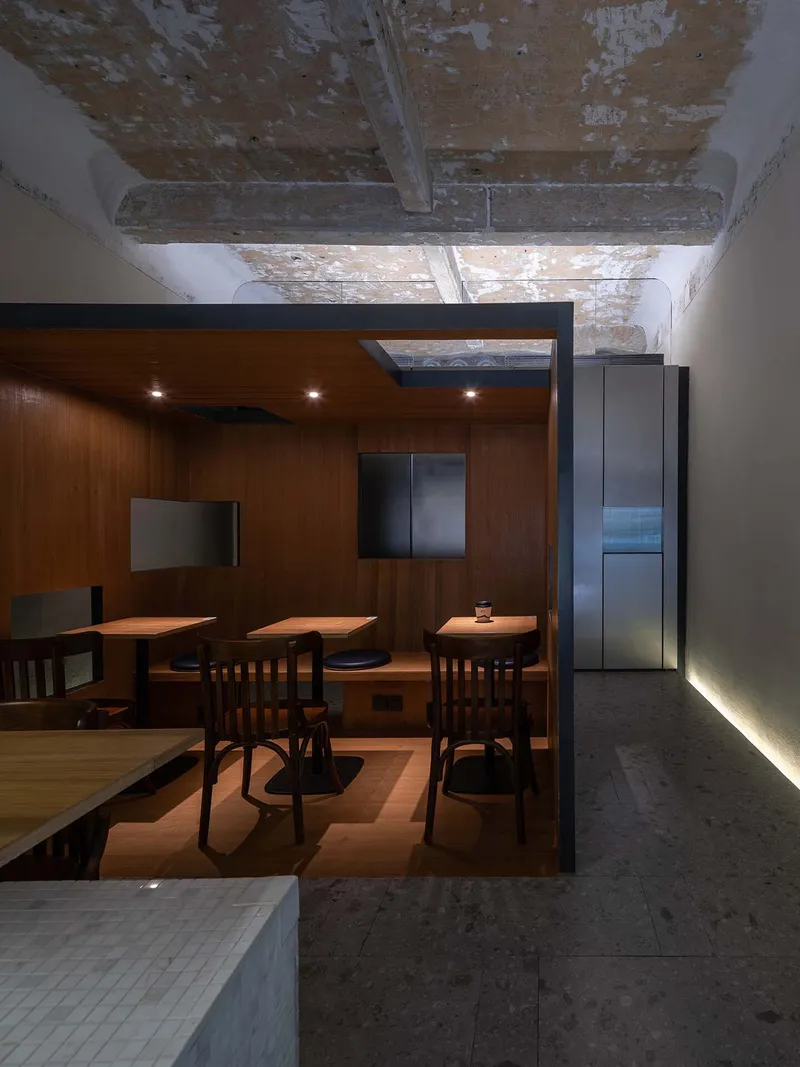

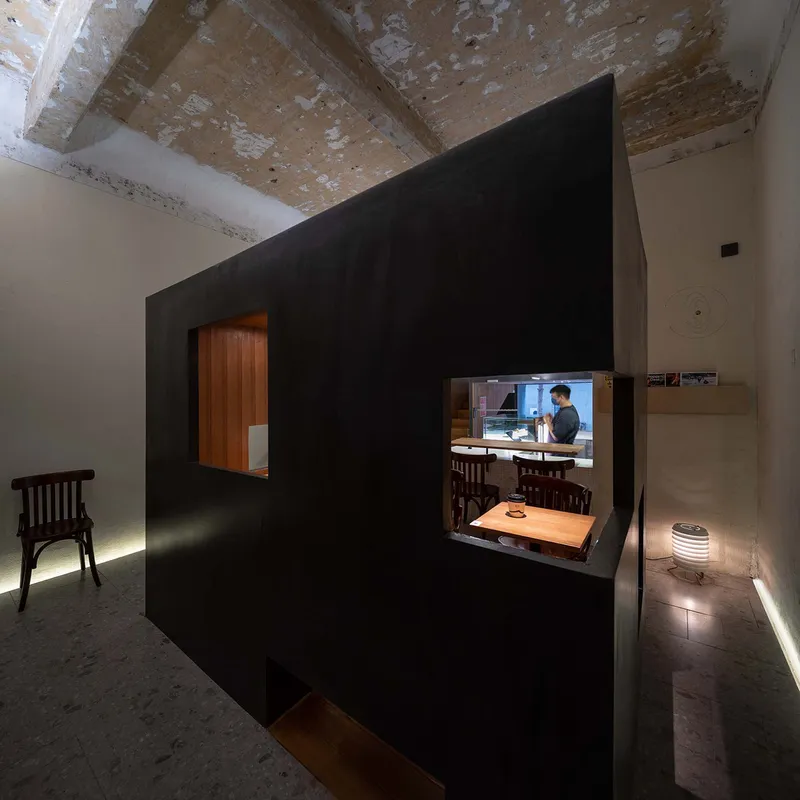
The central move of the renovation is the insertion of timber-clad volumes that function simultaneously as structure, furniture, and spatial divider. A wood-paneled enclosure wraps the main dining zone, embedding tables within its surfaces so that seating feels built-in rather than placed. Recessed lighting runs along the joints, casting an even glow that keeps the space intimate without darkening it.
Against the opposite wall, a dark steel volume punches into the whitewashed room beneath a timber ceiling whose peeling paint the designers deliberately preserved. The juxtaposition is frank: new material is clearly new, old material is clearly old, and neither pretends to be the other. It is a disciplined approach that avoids the cliché of faux-industrial nostalgia while still honoring the building's age.
The Canopy and the Threshold


A timber-lined entrance canopy extends outward from the storefront, its horizontal slat ceiling compressing the vertical dimension just enough to create a sense of passage. Sitting beneath it at dusk, you are neither fully inside nor fully outside. The canopy mediates between the humid Guangzhou street and the cooled interior, functioning as a transitional decompression zone that gives the tiny café a psychological depth far exceeding its footprint.
Looking inward through the timber-clad opening, you catch the exposed beams and their weathered finish overhead. The framing is cinematic: the architects have essentially built a proscenium that directs your gaze along the café's linear axis, rewarding the approach with a layered sequence of materials rather than a single reveal.
Counter, Ceiling, and the Evidence of Time
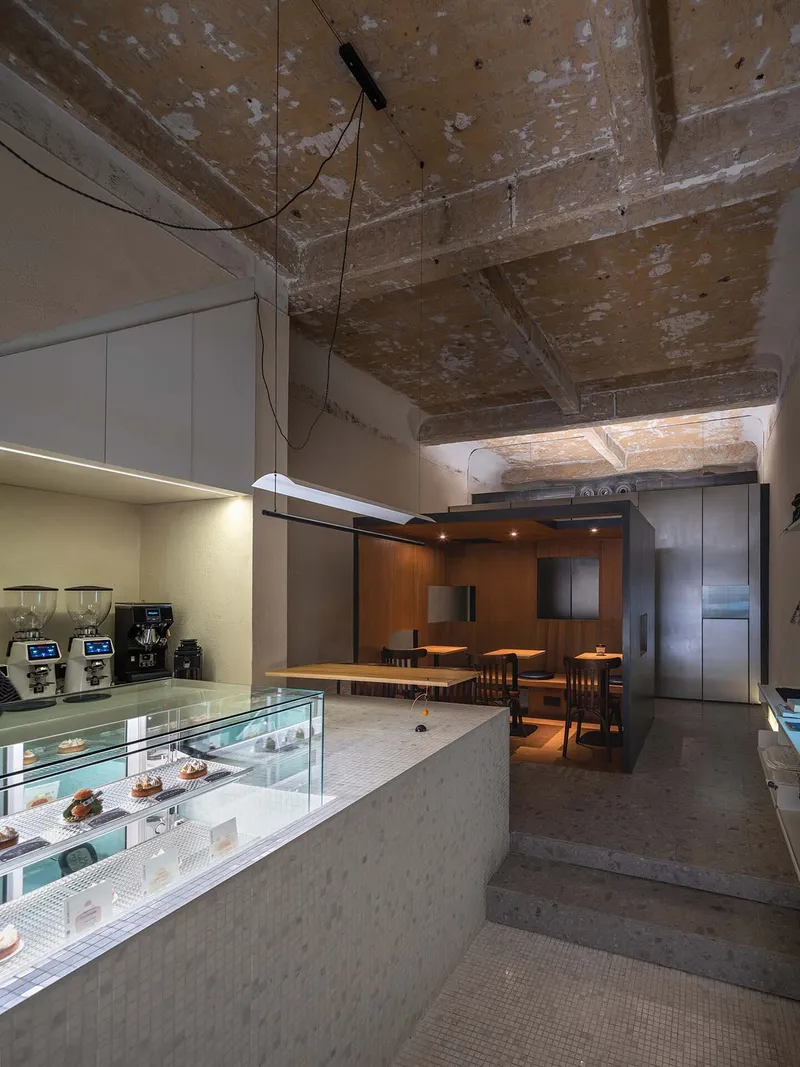

The service counter anchors the plan. A glass display case, tiled surround, and clean metal fittings sit beneath an exposed concrete beam ceiling that still shows the grain of its original formwork. The contrast is striking: polished pastry presentation below, eight decades of Guangzhou weather above. The designers resist the temptation to paint or coat the ceiling, letting its stains and texture serve as a material record.
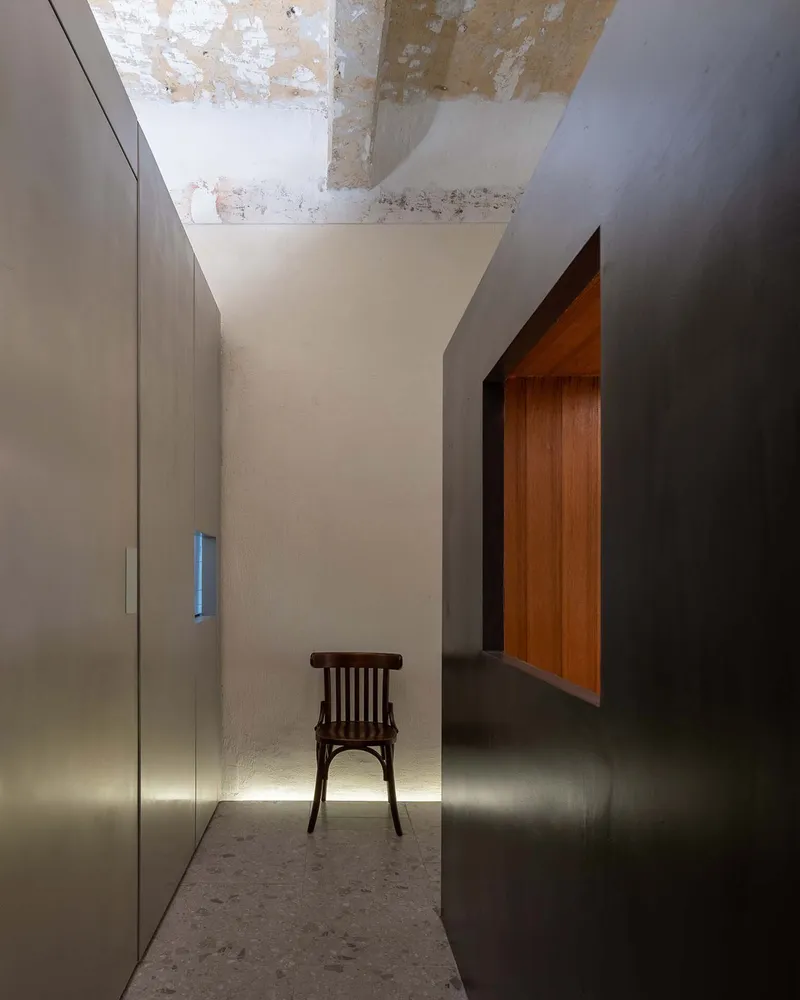
A narrow corridor further back, lined with metal wall panels and lit from above, distills the café's spatial logic to its essence: a single chair, a raw concrete ceiling, and the play of surfaces. In a 73-square-meter project, every leftover sliver of space becomes an opportunity for an atmospheric moment.
Staircase and the Glass Block Nook
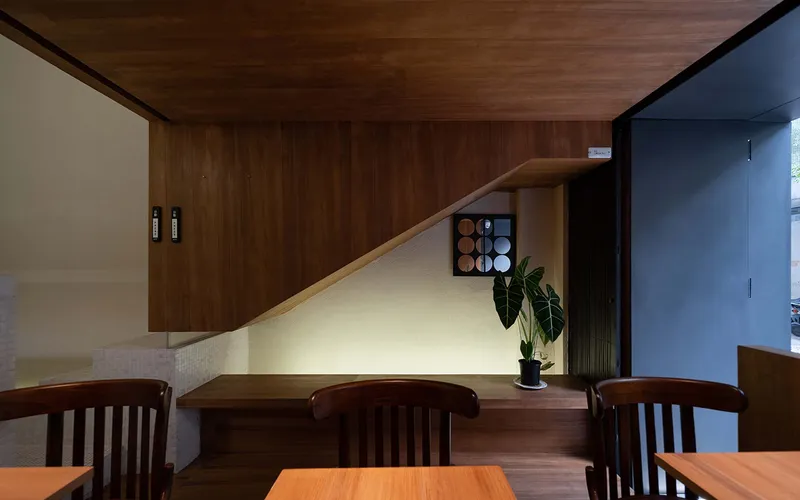


A timber staircase with integrated strip lighting rises within a black steel frame, connecting the ground-floor café to what lies above. The stair is more than circulation. Its exposed construction, set against a glazed-block wall, turns vertical movement into a visual event. Daylight filters through the glass blocks, softened into a diffuse wash that gives the adjacent seating nook an almost chapel-like quiet.
The banquette beneath the glass-block wall and vaulted ceiling is the café's most coveted seat, and rightly so. It offers enclosure without claustrophobia, natural light without glare, and a material warmth that comes from timber on three sides and translucent glass on the fourth. In a project this small, creating even one genuinely memorable moment like this is a success. Atelier Waterside creates several.
Plans and Drawings


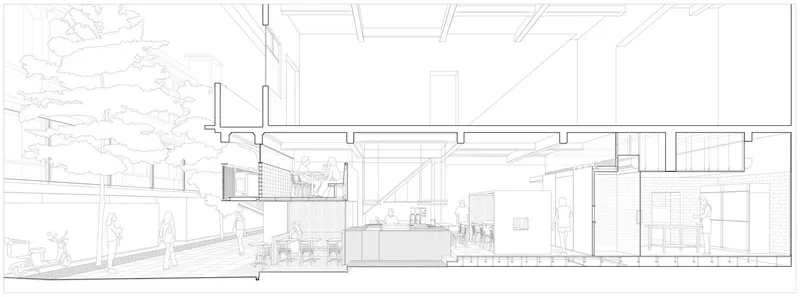
The floor plan reveals the project's linear logic: a single axis runs from the outdoor terrace through the service counter and dining room to the staircase at the rear. The elevation and section drawings make the insertion strategy legible, showing how new timber and steel volumes slot into the existing concrete frame without disturbing it. The longitudinal section is particularly instructive, exposing the varied ceiling heights and the way the architects manipulate compression and release along the building's depth to make 73 square meters feel substantially larger.
Why This Project Matters
Café design in Chinese cities has become a competitive sport, with brands chasing novelty at a pace that often produces disposable interiors. Qualia Café pushes back against that cycle. By grounding its identity in the physical history of a pre-war tenement rather than a trending material palette, Atelier Waterside gives the brand a specificity that cannot be replicated in another city or another decade. The design is inextricable from its site.
More broadly, the project is a compact demonstration of how renovation can operate as a form of curation. The architects did not restore the old building; they did not erase it. They introduced precise new objects into a rough existing container and let the conversation between the two generate atmosphere. For anyone working on small-scale hospitality conversions in historic urban fabric, this is a reference worth returning to.
Qualia Café by Atelier Waterside. Guangzhou, China. 73 m². Completed 2022. Photography by Chao Zhang.
About the Studio
Share Your Own Work on uni.xyz
If projects like this are the kind of work you want to make, uni.xyz is a place to publish your own, find collaborators, and enter design competitions.


Popular Articles
Popular articles from the community


FCC Arquitectura Expands a Portuguese Granite House with a Board-Marked Concrete Wing
In Portugal, JV House pairs a cleaned-up whitewashed and granite dwelling with a timber-shuttered concrete extension, courtyards and a garden pool.

ETEH Reworks the Shared Spaces of São Domingos School in Brazil Around Timber, Color and Hanging Plants
At São Domingos School in Brazil, 436 m² of hall, refectory and library are recast with timber joinery, a yellow and blue code and trailing greenery.

graciastudio Turns a Viewless Tijuana Lot Inward Around a Courtyard of Concrete, Timber and Trees
In Tijuana, Jorge Gracia's GA2 House stacks a timber-clad private floor over exposed concrete and replaces a missing view with a planted interior patio.


Aquadapt: An Underwater Habitat That Rewrites Its Rooms by the Hour
Curved modules ring the seabed while one shell shifts from breakfast room to cinema, farm and football pitch as residents' needs change.

Similar Reads
You might also enjoy these articles

LAVA Architecten Gives Vocational Education a Sawtooth-Roofed Face on a Mechelen School Campus
In Mechelen, Belgium, a 2,053 m² STEM school on a 6×6 m grid turns workshops and classrooms into rooms that can be rearranged as teaching changes.

KEMA Studio Turns a Derelict Marvila Attic into a 60 m² Lighthouse Apartment Above Lisbon
In Lisbon's Marvila district, a rebuilt roof, four skylights and two plywood volumes turn an unlivable attic into a bright home facing the Tagus.

Pixel Gardens: One Repeated Module Stacked Into a Terraced Social Housing Tower for Famagusta
Salem Bader's shortlisted housing tower builds a vertical neighbourhood from one repeated module, offsetting units to carve terraces, light and air.

Bao Huynh Watercolor Atelier: A Serene Art Retreat in Hội An
Bao Huynh Watercolor Atelier in Hội An blends multifunctional art spaces, sustainable design, local materials, and family-friendly living in a serene environment.

Explore Cafe Competitions
Discover active competitions in this discipline

Challenge to design luxury tourism on rails

VR headsets Storefront design competition

Designing a staircase for a client
Comments (0)
Please login or sign up to add comments
No comments yet. Be the first to comment!