
Ateliers A+ Grounds a Railway Training Campus in Landscape and Timber at Bègles
Three buildings form a triangular campus on a former industrial brownfield near Bordeaux, blending timber construction with positive-energy performance.


Training facilities rarely get architecture worth talking about. They tend to be spec buildings dropped onto leftover land, interiors calibrated for fluorescent endurance rather than genuine learning. The SNCF Training Campus in Bègles, designed by Ateliers A+ and completed in 2022, is a deliberate counter-argument: 12,265 square meters of mixed timber and concrete construction arranged across three distinct buildings on a 40,000-square-meter former industrial brownfield site near Bordeaux.
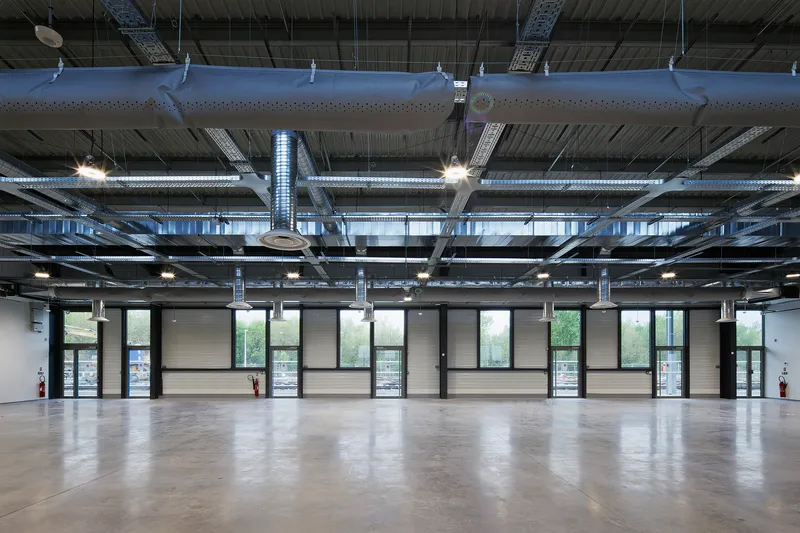
What makes the project worth studying is the way it treats a corporate campus as an exercise in landscape integration and environmental performance without sacrificing spatial quality. The three volumes, a tertiary and training building, an accommodation block with 204 rooms, and a technical workshop hall with direct access to five 220-meter rail tracks, sit in a triangular configuration that generates a shared campus heart. Planted streets between buildings create shade corridors, 1,650 square meters of photovoltaics cap the industrial hall, and the whole ensemble achieves BEPOS 2 positive-energy certification. The architecture does not shout about any of this. It simply performs.
Cladding as Camouflage
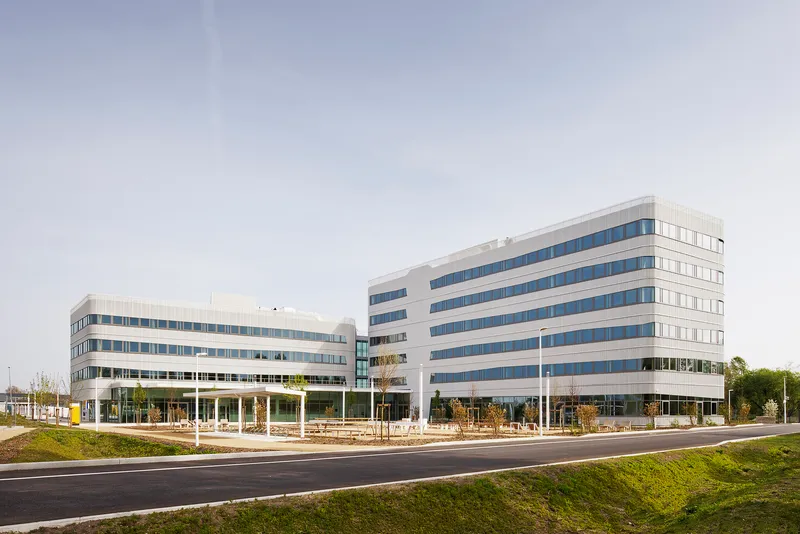
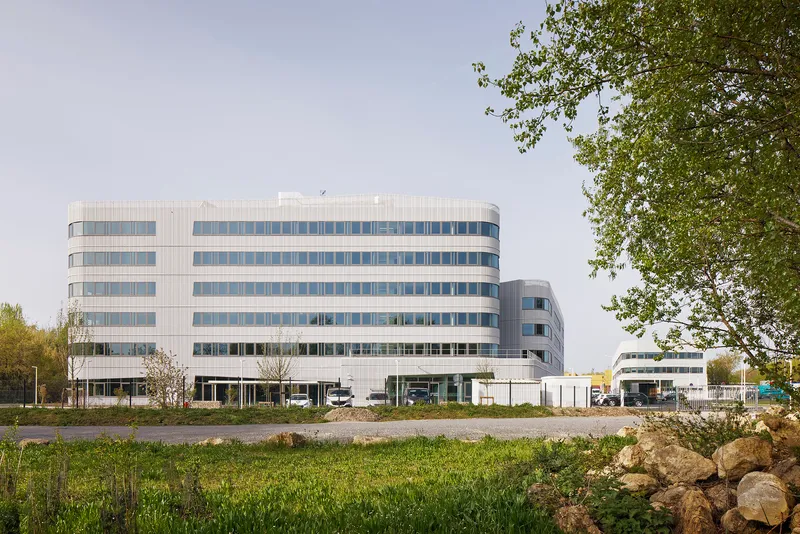

All three buildings share the same ArcelorMittal Eclectic metal cladding system, applied in both solid and perforated panels in a warm Irysa Isatis tone. Horizontal banding wraps the facades in rhythmic stripes of metal and glazing, giving the campus a visual cohesion that could easily feel monotonous. It doesn't, because the perforated panels catch light differently throughout the day and across seasons, creating what Ateliers A+ describes as a perception of the buildings evolving in resonance with the site.
The six-story accommodation block reads as a quiet bar when viewed across wild grasses and boulders at the site perimeter. The curved translucent facade of the training building, set against a grass berm, takes on an entirely different character. One cladding vocabulary, three different moods. That kind of consistency without repetition is harder to achieve than it looks.
The Curved Entry and Public Edge
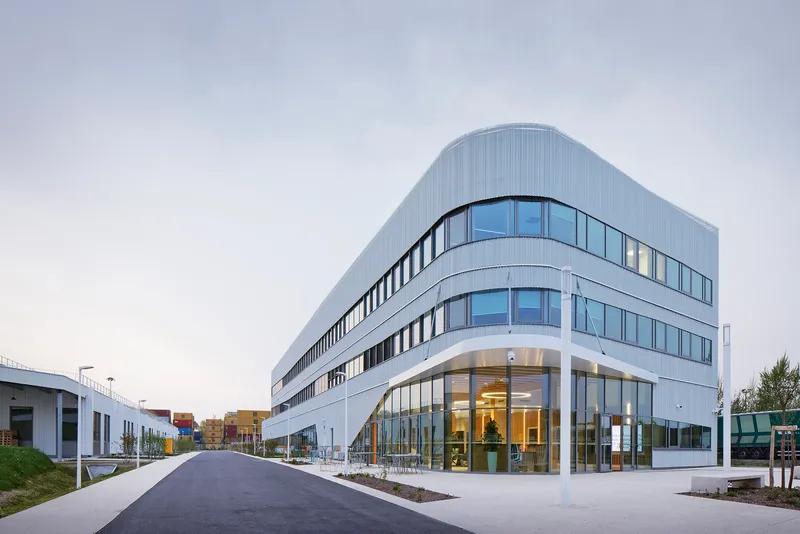


The training building addresses a public square at the site entrance with a generous curved corner clad in floor-to-ceiling glass. At twilight, the ground floor terrace beneath this curve becomes a beacon, the building's hospitality made legible from a distance. It is a simple move, curving the plan at the point of arrival, but it transforms the institutional program into something that feels welcoming rather than gatekept.
A deep canopy overhang with a pale timber soffit extends the interior outward along a glazed corridor, blurring the threshold between conditioned space and landscape. The overhang is practical, managing solar gain on the south-facing facade, but it also establishes a generous intermediate zone that trainees and staff can occupy informally. Training campuses work when people have reasons to linger between sessions, and this canopy creates exactly that kind of space.
Timber Structure as Spatial Character
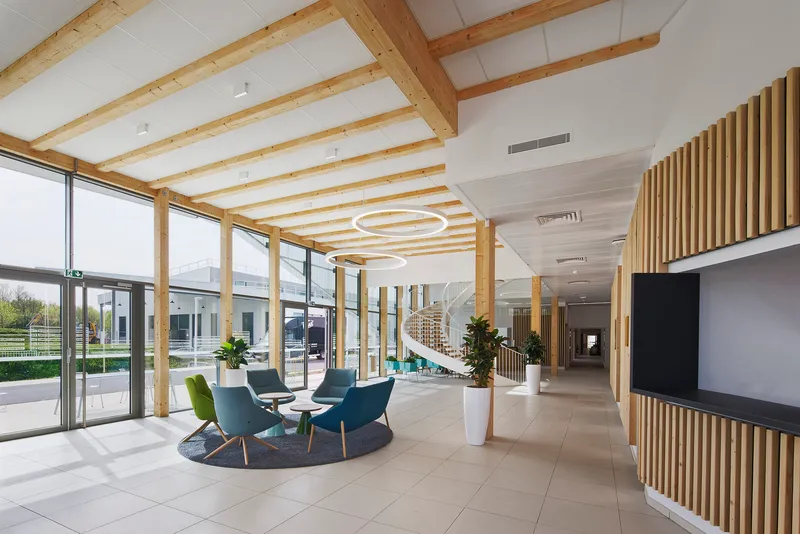

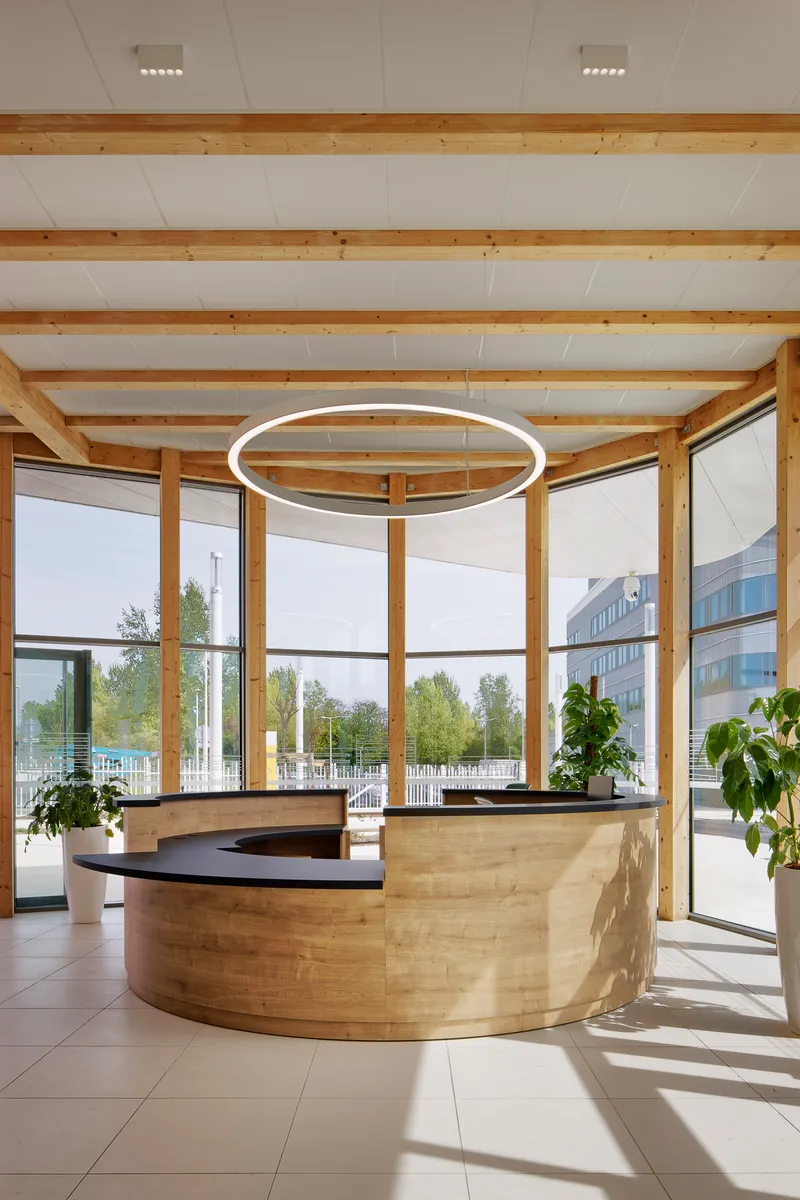
The training building uses a timber structural system, and Ateliers A+ makes no attempt to conceal it. Exposed beams span the ceilings of lobbies and common areas, creating a warm, legible structural rhythm. Vertical wood slat screens subdivide open areas without enclosing them, lending the interior a grain that metal and glass alone could never achieve. The choice of mixed wood and concrete construction reflects local heritage while allowing the flexibility in layout and reversibility that a training program requires as it evolves over time.
At the reception, a curved timber desk sits beneath exposed wooden beams and a circular pendant light, the scale domestic rather than corporate. The effect is deliberate: this is a campus, not a headquarters, and the material palette reinforces the idea that people are meant to feel at ease here.
The Helical Staircase as Vertical Anchor
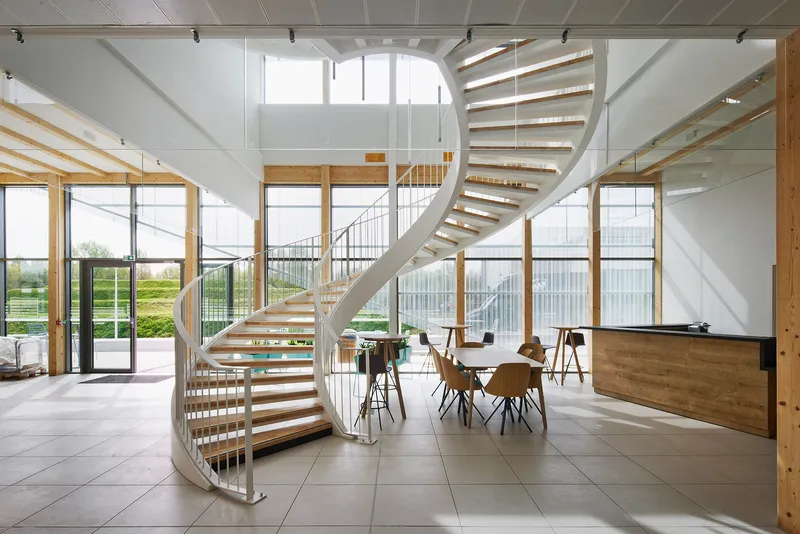
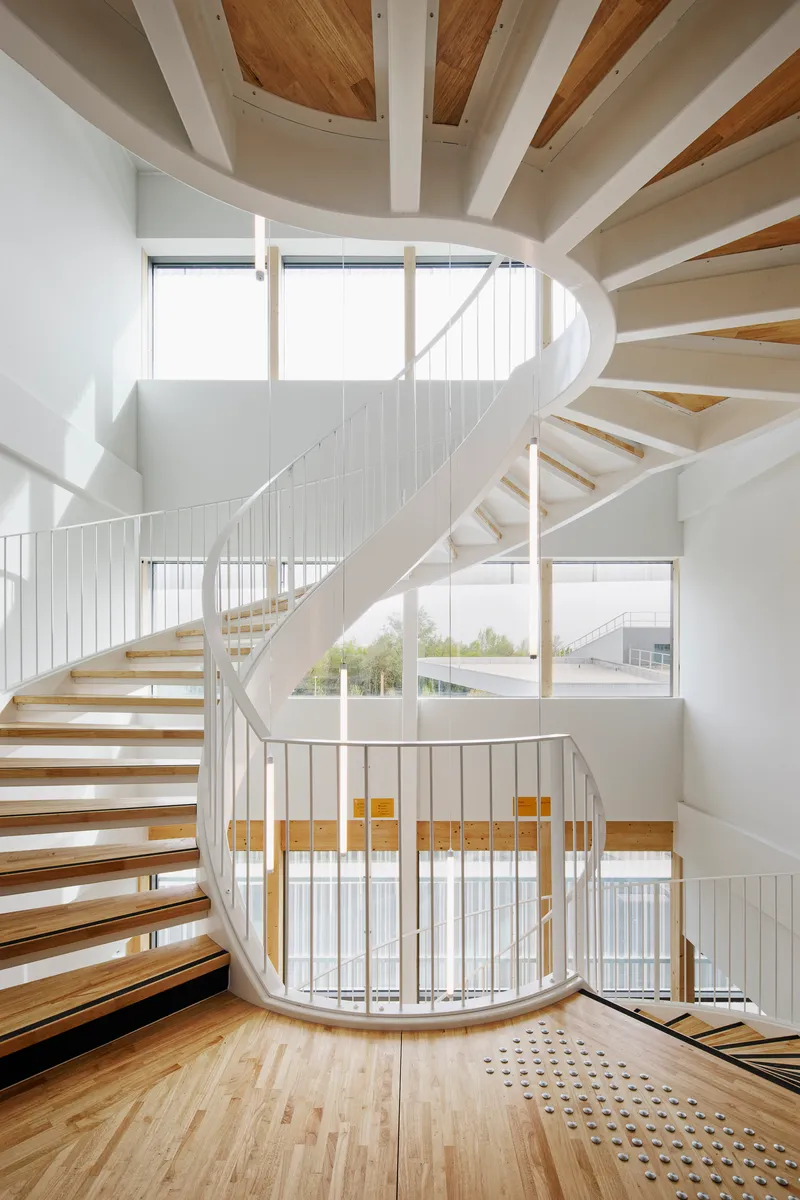

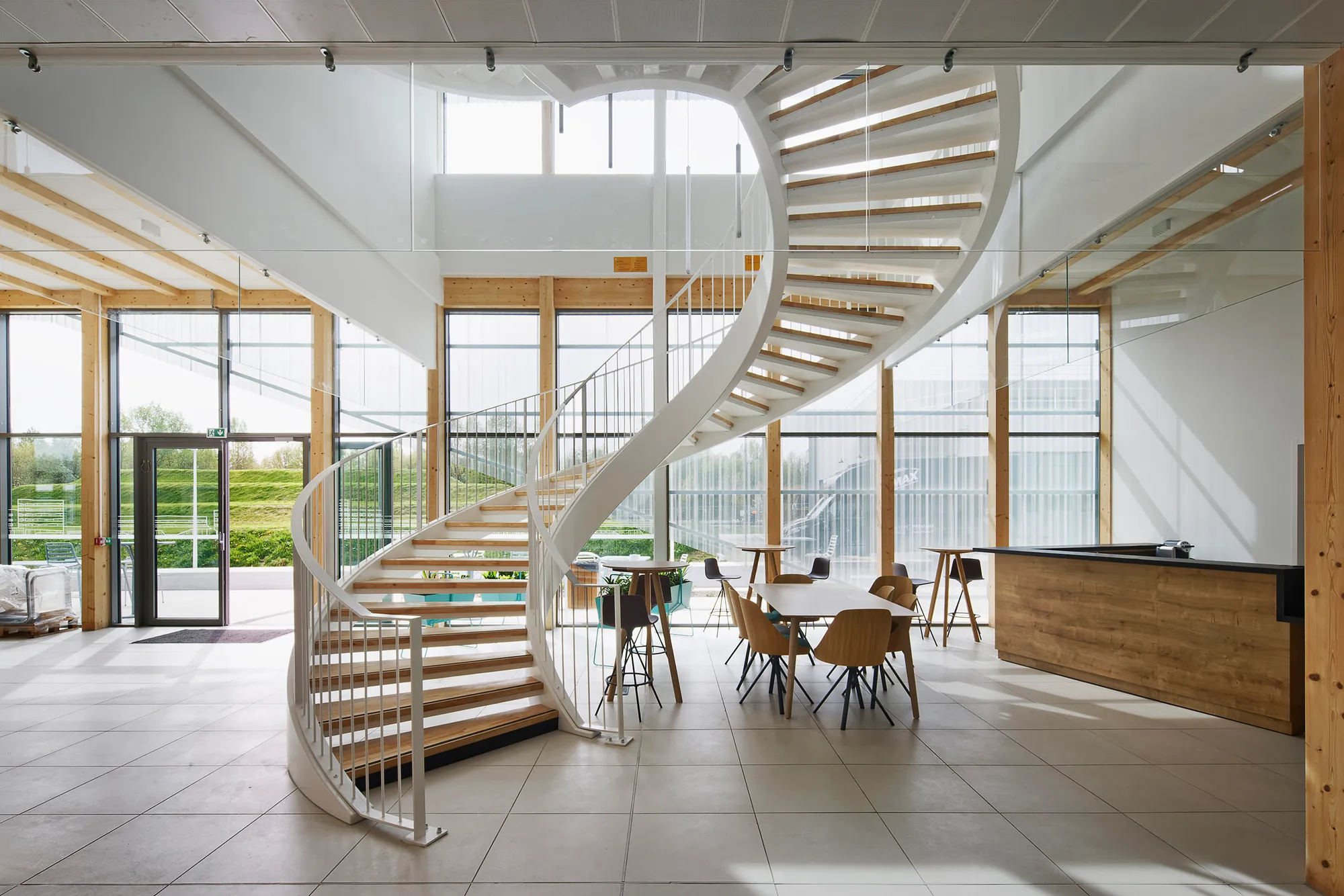
A white steel helical staircase with timber treads rises through the atrium of the training building, its spiral visible from the double-height lobby all the way to the upper floors. Skylights wash the central void with daylight, turning vertical circulation into the most animated space in the building. Looking down through the stairwell reveals alternating wood and white curved steps spiraling around a central void, a piece of geometric precision that rewards the eye from every level.
In a campus dedicated to training, circulation is not just movement. It is where informal encounters happen, where trainees from different cohorts cross paths, where knowledge transfer occurs outside the classroom. Making the staircase generous, sculptural, and daylit is an investment in exactly that kind of unscripted interaction.
Accommodation and Daily Life
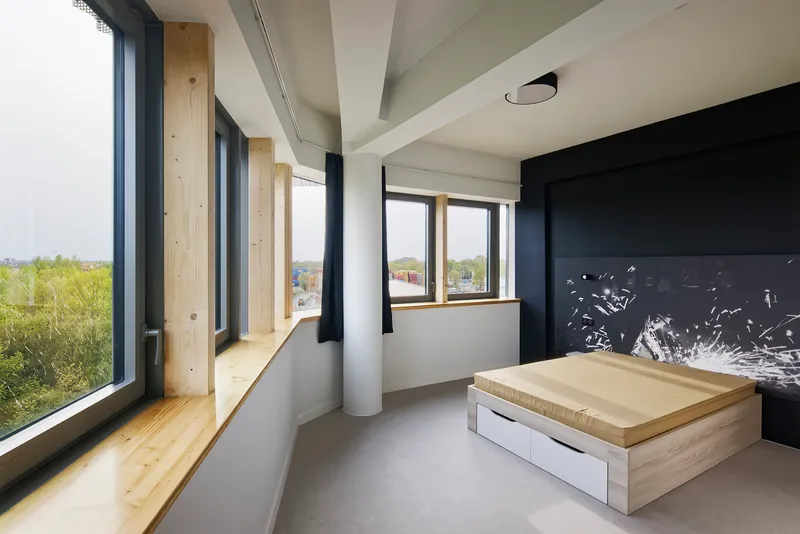
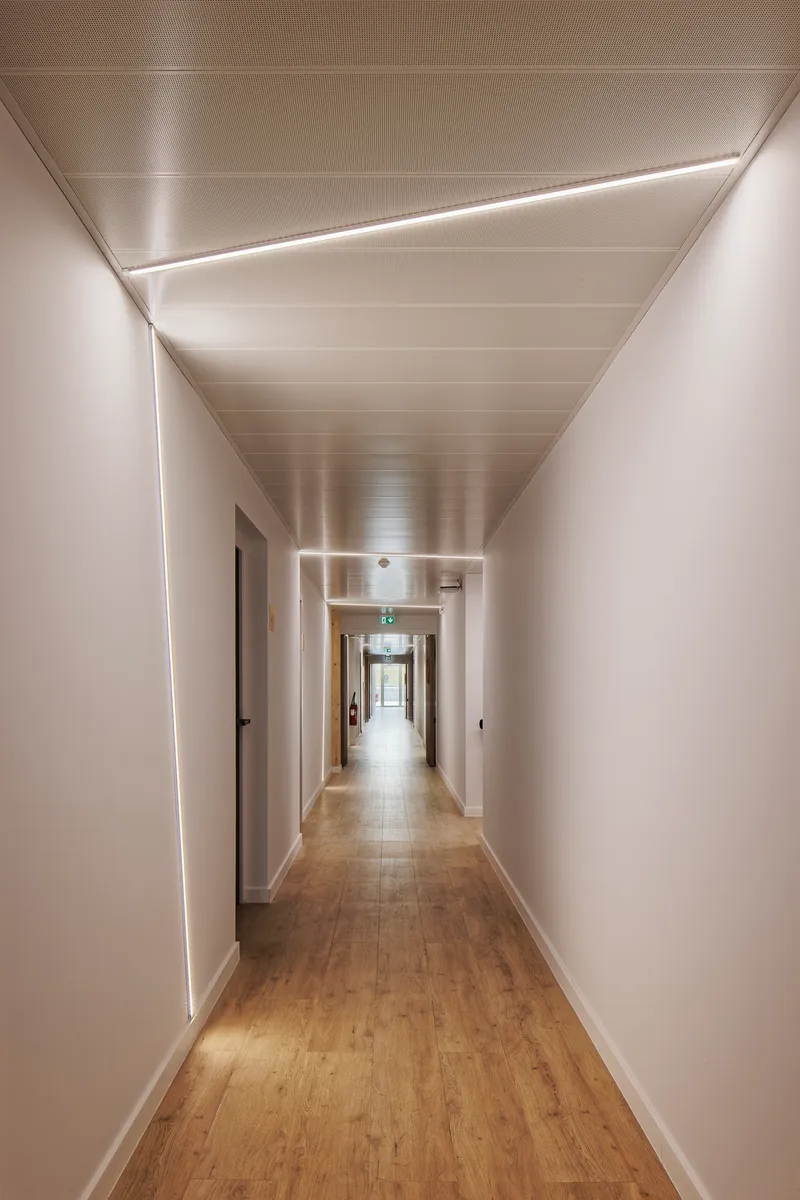
The accommodation building houses 204 rooms across its six stories, positioned slightly apart from the other volumes but visible from the site entrance. Corner rooms with exposed timber columns and polished concrete floors open onto views of the campus landscape, a raised wooden platform bed lending each room a spare, almost monastic quality. Long corridors with linear ceiling lighting and timber flooring are handled with restraint: no decorative flourishes, just good proportions and natural materials.
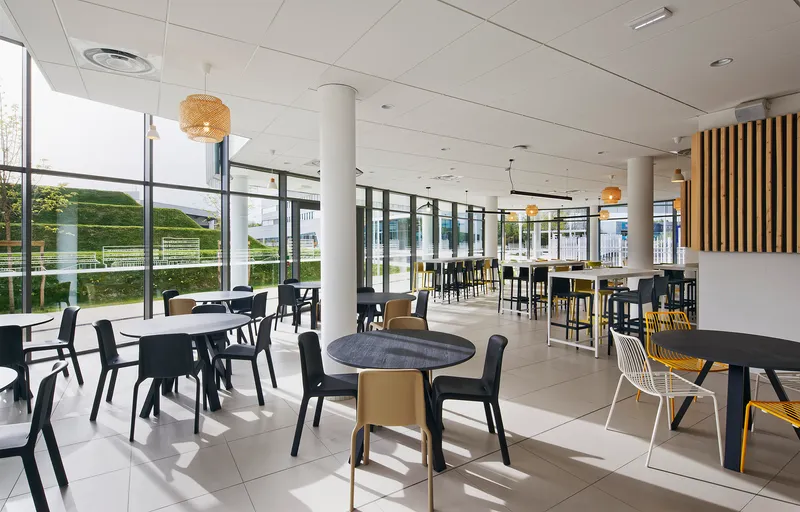
The cafeteria occupies the ground floor with views onto the landscaped courtyard, white columns supporting a generous ceiling height. Mixed seating arrangements and pendant lights create zones within the open plan, encouraging both communal meals and quiet solo breakfasts. For trainees spending weeks on campus, these are the spaces that determine quality of life, and they are treated with the same care as the more "architectural" moments.
Courtyard and Landscape Strategy

The triangular arrangement of the three buildings generates a central campus heart that functions as courtyard, meeting point, and green lung. Gravel beds, young trees, and timber benches create a ground plane that is porous rather than paved, allowing rainwater infiltration and establishing a direct connection between architecture and soil. The planted street between the training building and the technical hall provides shade and coolness on summer days, an urban-scale bioclimatic strategy that requires no mechanical input.
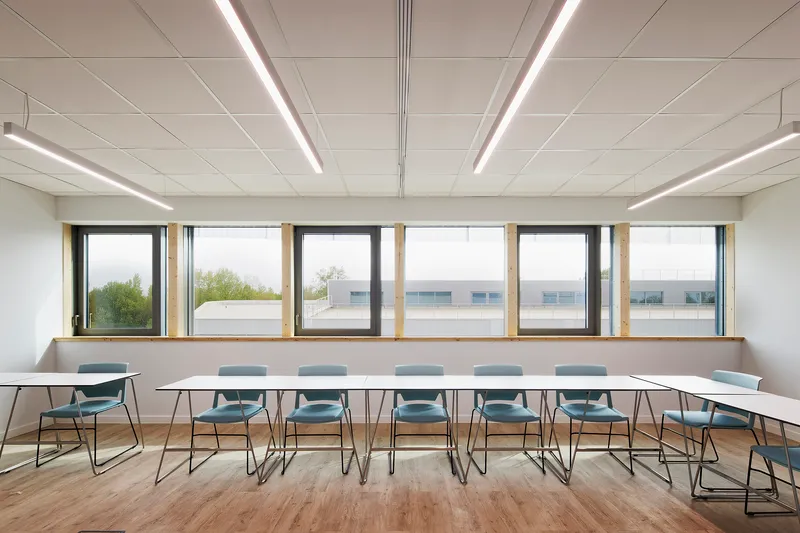
Conference rooms overlook spring trees through rhythmic timber-framed windows, their depth creating a visual buffer between the concentration of the classroom and the openness of the landscape. The design insists, at every scale, that contact with the ground and vegetation is not ornamental. It is structural to the experience of learning on this campus.
Plans and Drawings
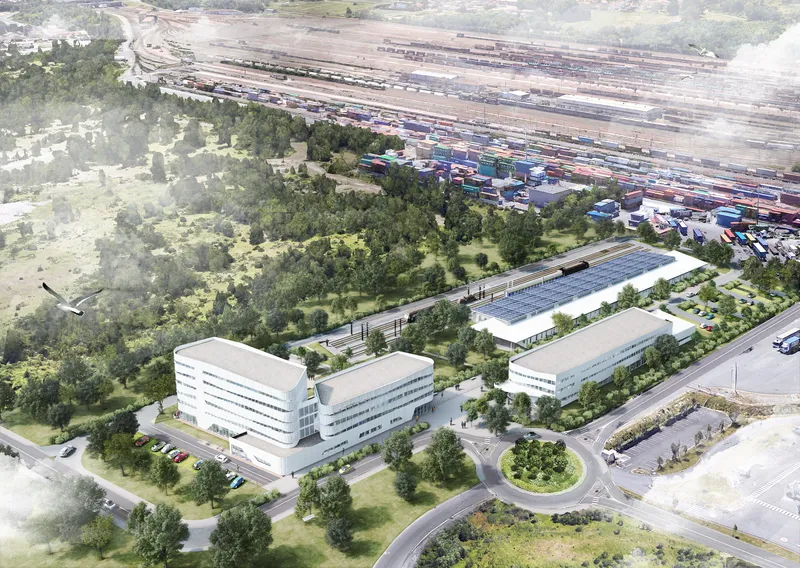


The aerial rendering confirms the triangular campus logic: three low-rise volumes oriented to define a shared center, with the rail yards visible in the distance as a reminder of the institution's operational purpose. The site plan reveals the full extent of the landscape strategy, with perimeter tree planting, a curved water feature, and parking tucked to the edge. Ground floor plans show how each building meets the ground differently: the training building opens widely onto the public square, the accommodation block presents a more controlled frontage, and the technical hall connects directly to outdoor rail platforms.
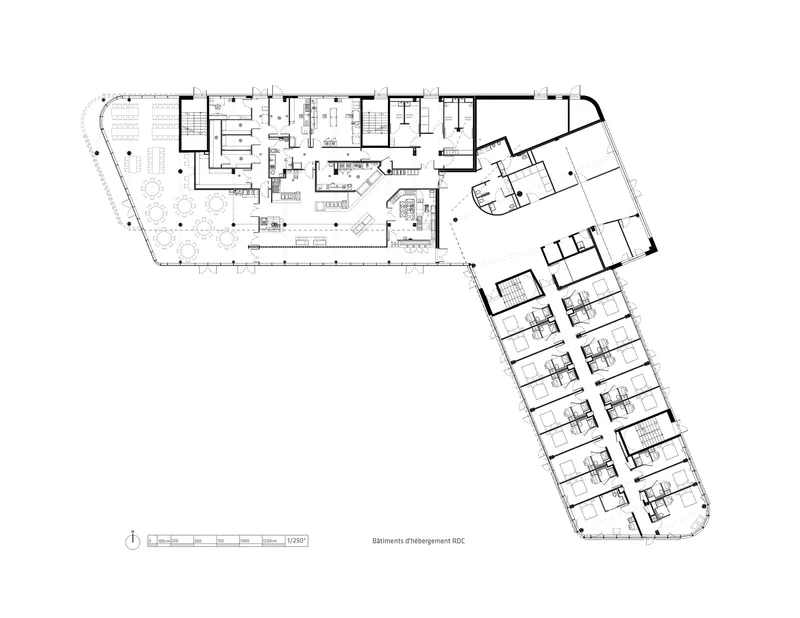
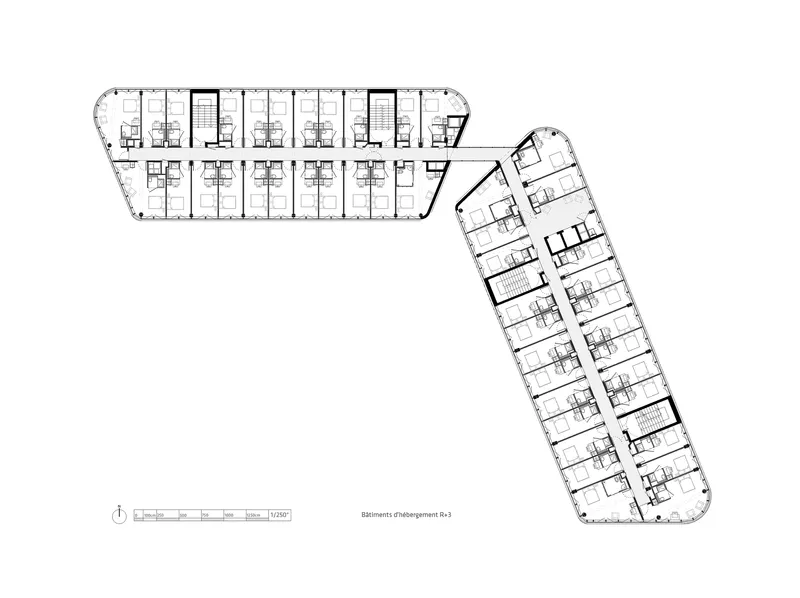
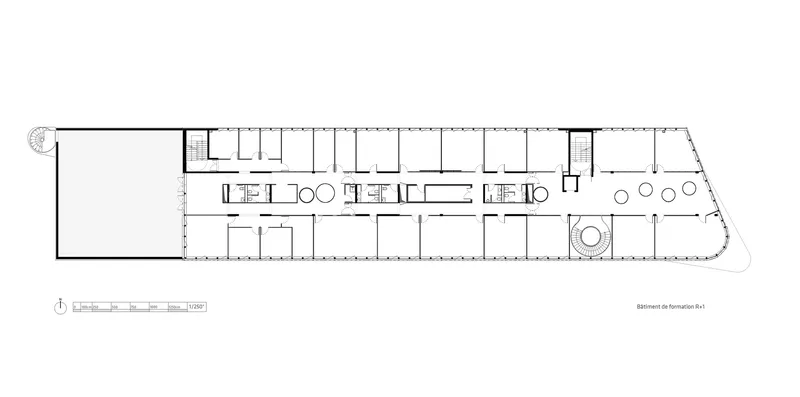
Floor plans of the accommodation building show repeating room units organized along a linear bar with circular central elements providing vertical circulation and communal gathering. The L-shaped training building plan reveals terraces carved into the building footprint, allowing outdoor space to infiltrate the upper floors. The repetition is methodical but not mechanical, each plan tailored to its program while maintaining the campus-wide discipline of orientation and structural grid.
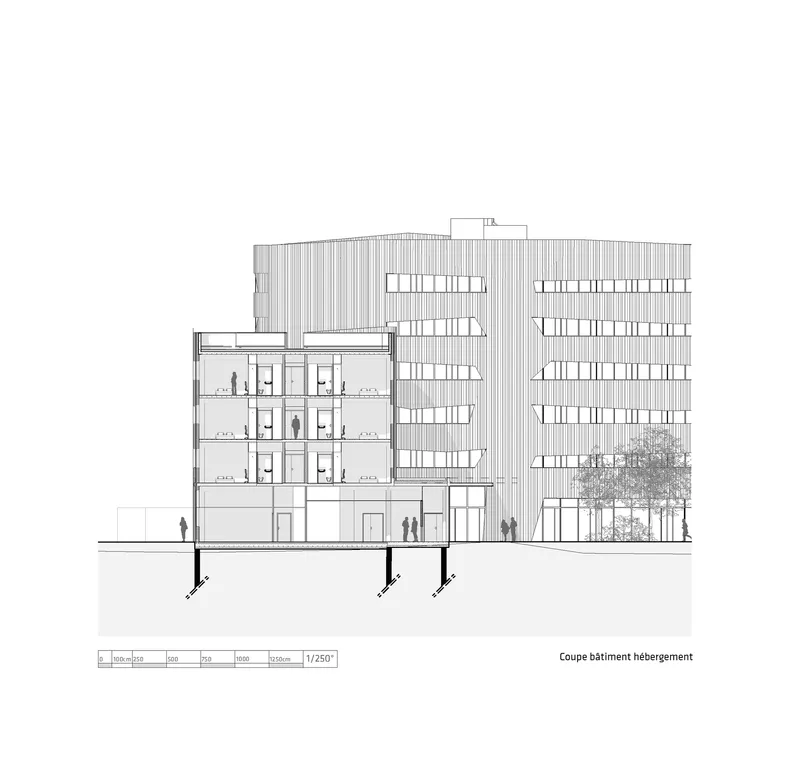
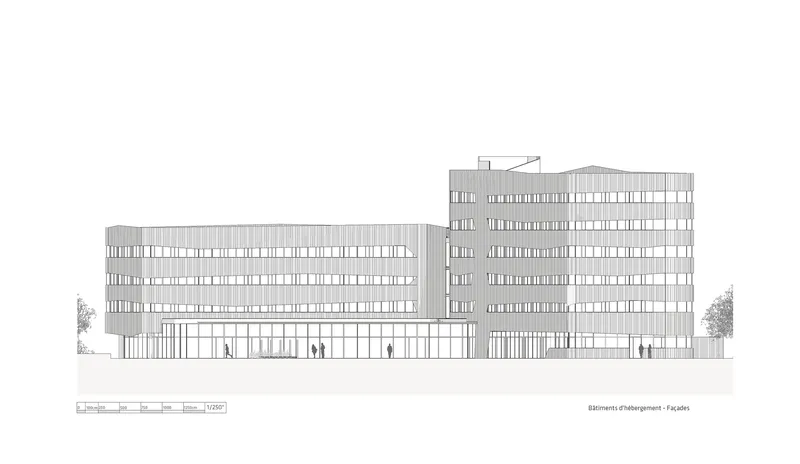
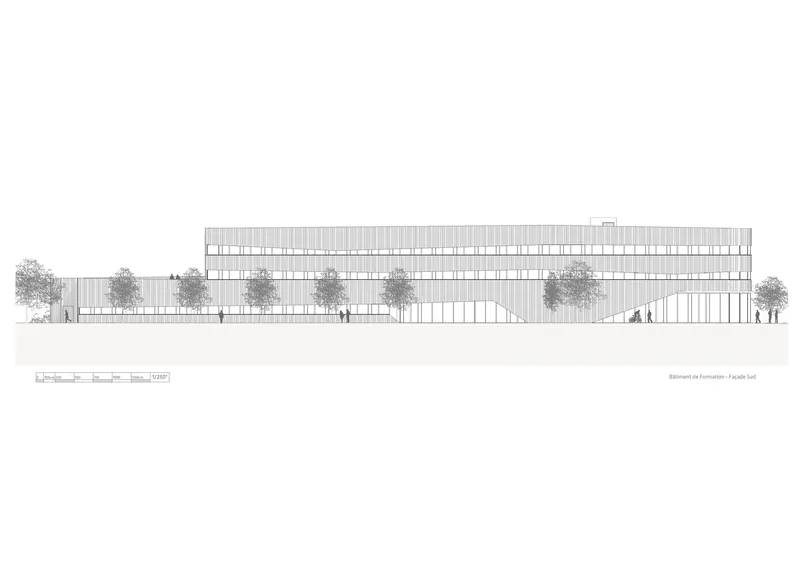
The section drawing cuts through the multi-story training building, exposing the relationship between vertical circulation, office floors, and the tree canopy at grade. Two elevation drawings illustrate the horizontal fenestration pattern and the proportional relationship between solid and void. Figures at ground level offer scale and reinforce the architects' commitment to a human-centered reading of what could easily have been a purely technical brief.
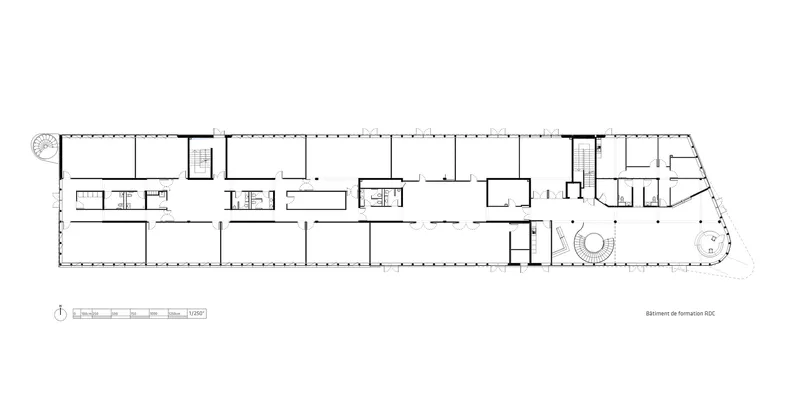

A final floor plan depicts enclosed rooms along a linear corridor with circular elements at one end, likely the technical training wing where workshops connect to the outdoor rail platform. The reception area, with its timber ceiling grid and circular light fixtures, is where the plan's formal discipline translates into tangible spatial warmth.
Why This Project Matters
Corporate training campuses are typically architecture's blind spot: too programmatically specific for design magazines, too utilitarian for awards juries, too remote from public life to attract critical attention. The SNCF Training Campus at Bègles deserves attention precisely because it takes a building type that is easy to dismiss and treats it as a genuine design opportunity. The timber structure, the positive-energy performance, the landscape strategy, and the spatial generosity of common areas all demonstrate that infrastructure serving a national railway company can be built with intelligence and care.
Ateliers A+ has delivered a campus that will age with its landscape, its metal cladding shifting in character as the young trees mature around it. The triangular plan resists the temptation of a single monumental gesture in favor of three distinct buildings that generate something more valuable between them: a center, a commons, a place where people want to be. For a project whose primary purpose is teaching rail workers how to maintain tracks, that is a quiet but significant achievement.
SNCF Training Campus by Ateliers A+, Bègles, France. 12,265 m². Completed 2022. Photography by Camille Gharbi and Sylvain Mestre.
About the Studio
Share Your Own Work on uni.xyz
If projects like this are the kind of work you want to make, uni.xyz is a place to publish your own, find collaborators, and enter design competitions.




Popular Articles
Popular articles from the community


The Earth Pod: 3D Printed Homes for Resilient Refugee Communities
The Earth Pod reimagines refugee housing through 3D printed homes made from clay, combining resilience, self-sufficiency, and rapid shelter.

Riyadh For All: Intergenerational Urban Design for Active Aging in Rabat
Riyadh For All reimagines urban design in Rabat with intergenerational co-living, adaptive courtyards, and Moroccan cultural exchange today.

The Ocean Hive: Sustainable Architecture for a Self-Sufficient Civilization at Sea
The Ocean Hive imagines sustainable architecture at sea, where modular habitats, algae, wave power and ocean waste sustain a growing colony.

The Musturak Paradise: Senior Living Architecture for a Connected Future in Temara, Morocco
The Musturak Paradise reimagines senior living architecture in Temara via private homes, social spaces, culture, community, and shared care.


Similar Reads
You might also enjoy these articles

Bao Huynh Watercolor Atelier: A Serene Art Retreat in Hội An
Bao Huynh Watercolor Atelier in Hội An blends multifunctional art spaces, sustainable design, local materials, and family-friendly living in a serene environment.

Atelier Macri Concept Store Interior Design by CASE-REAL
Atelier Macri store features a "ko" counter, walnut wood details, cork displays, blending retail, gallery, and seamless customer experiences.

Manuel Vargas Izquierdo Stadium and High-Performance Sports Center: Architectural Excellence in Jalpa de Méndez
The Manuel Vargas Izquierdo Stadium blends sustainable design, inclusive sports facilities, and cultural-inspired architecture, revitalizing Jalpa de Méndez’s public spaces.

KAKR Buluh Awar Hall: Revitalizing Community and Ecology Through Bamboo Architecture
Community built bamboo hall revitalizes Buluh Awar village, empowering youth, restoring ecology, celebrating vernacular craftsmanship through sustainable architecture and culture.





Comments (0)
Please login or sign up to add comments
No comments yet. Be the first to comment!