
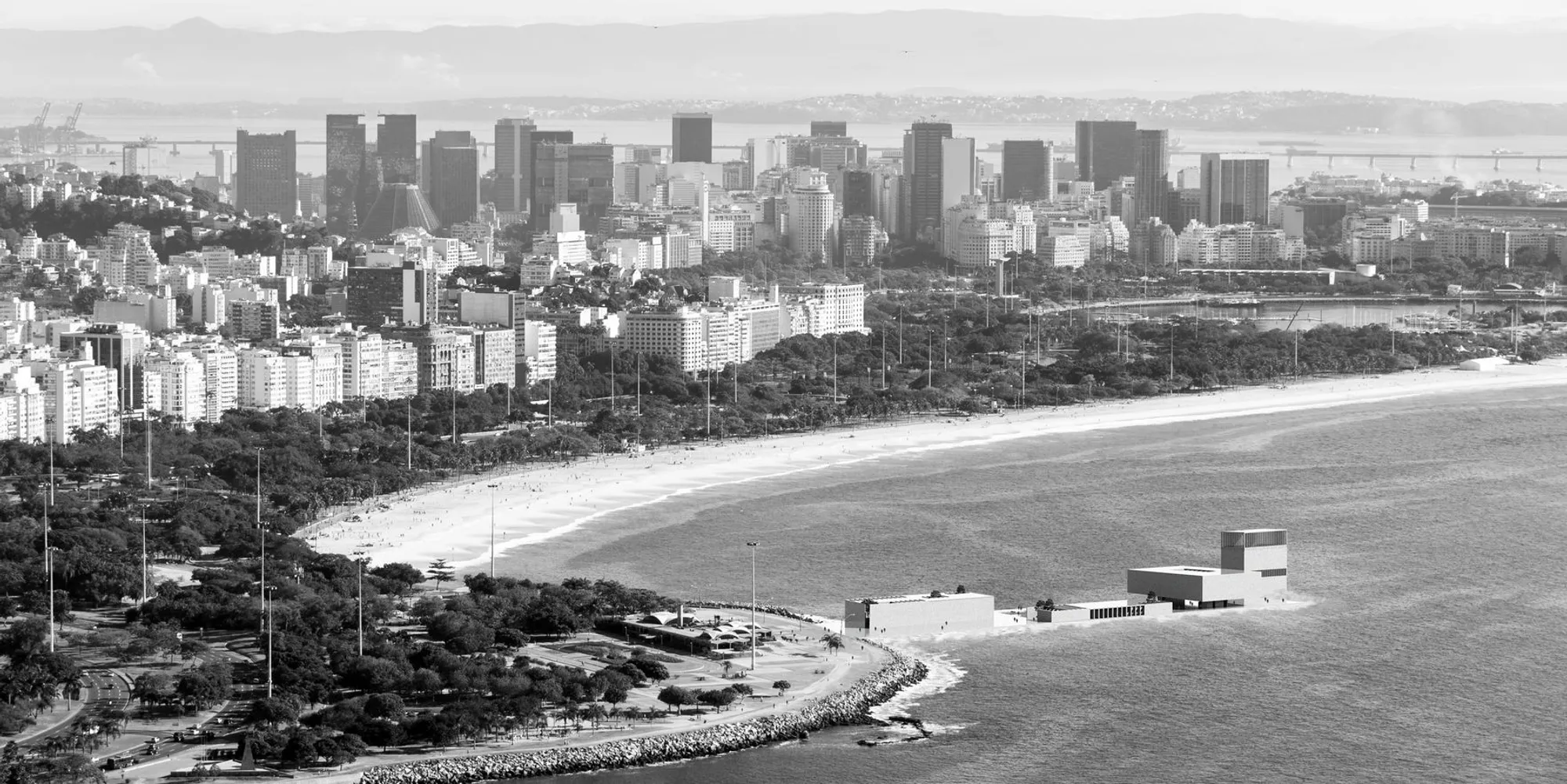
Athenaeum of World Architecture: A Coastal Dialogue Space on Rio's Edge
A linear platform of independent solids stretches over the water at Flamengo, turning Rio's coastline into a stage for architectural discourse.


Architecture does not often get a building dedicated to talking about it. When it does, the result tends to be either reverential or sterile: a gallery with white walls and models under glass. The Athenaeum of World Architecture takes a different approach. Positioned on the coastal edge of Rio de Janeiro's Flamengo precinct, it stretches over water and land as a linear platform hosting a series of independent volumes, each with its own formal identity, collectively forming a space where architecture becomes the subject of open, democratic conversation.
Designed by Lukas Hert and Can Ciftci, the project treats its site not as a neutral backdrop but as an active participant in the design. Rio's mountainous terrain, dense rainforest, and vast oceanfront inform every spatial decision, from the orientation of framed vistas toward Sugarloaf Mountain to the water basins that amplify the shifting coastal light. The Athenaeum is not a museum. It is a threshold between city and sea, organized to host exhibitions, seminars, restaurants, open-air galleries, and public courtyards within a modular framework that resists the rigidity of conventional cultural institutions.
Three Wings Radiating from a Covered Core
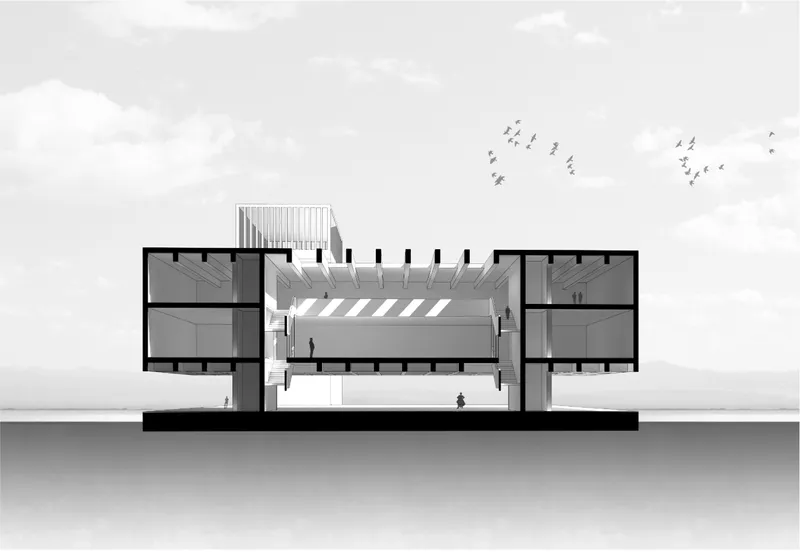
The section drawing reveals the project's organizational logic: three wings radiate outward from a central covered courtyard, establishing distinct programmatic zones while maintaining visual and circulatory continuity. Vertical louvers screen the facades, filtering coastal light into layered gradients that shift throughout the day. The central courtyard functions as the social and spatial anchor of the complex, a gathering point from which visitors disperse into exhibition halls, educational studios, or the open-air terraces beyond. The birds drawn overhead are not decorative; they reinforce the porosity of the structure, a building that breathes with the climate rather than sealing itself against it.
A Coffered Ceiling Framing the Horizon at Dusk
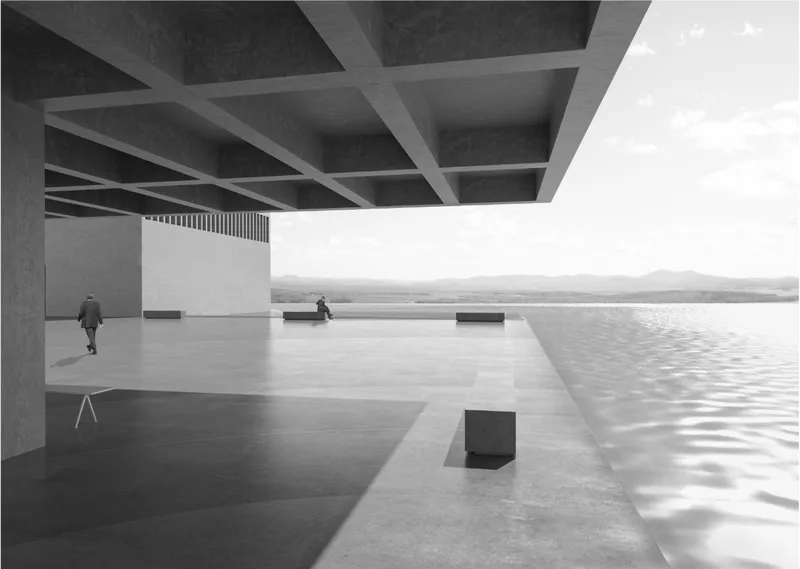
The covered terrace is one of the Athenaeum's most compelling experiential moments. A deep concrete coffered ceiling, articulated with geometric beams, compresses the vertical space and directs the eye outward toward the body of water at dusk. The ceiling's weight and materiality contrast sharply with the lightness of the horizon, creating a tension between enclosure and openness that is central to the project's spatial argument. Visitors standing here occupy a threshold: above them, structure and shadow; ahead, uninterrupted ocean.
This is where the Athenaeum's ambition to merge sensory encounter with architectural education becomes tangible. The space does not need a didactic label. The play of reflected water light across the coffers, the sound of waves below, and the panoramic framing of Rio's skyline teach visitors about spatial quality through direct experience.
Stepped Volumes and Interior Courtyards


A second section cut exposes the interior courtyard, where a single tree occupies a sunken space framed by stepped volumes. A figure descends an exterior staircase, reinforcing the project's emphasis on movement as a sequence of discoveries rather than efficient transit. The stepping of masses creates varying ceiling heights and sightlines, ensuring that no two rooms within the Athenaeum offer the same spatial character. This diversity of volume is deliberate: it symbolizes the plurality of voices and design philosophies that the building aims to host.
At ground level, the waterfront terrace translates these sectional ideas into a public landscape. Geometric paving, low seating platforms, and an angled wall containing diagonal bracing define a space that is both robust and inviting. A tree punctuates the composition, softening the concrete geometry and connecting the terrace to the surrounding parks and beaches that naturally frame the Athenaeum. The diagonal bracing is left exposed, treating structure as ornament and communicating the building's tectonic honesty to passersby.
A Four-Story Volume Facing Its Counterparts Across Water

The final section drawing reveals the tallest element of the complex: a four-story volume screened by vertical louvers, its interior spaces oriented toward distant geometric volumes across the water. This composition establishes a visual dialogue between the independent solids, reinforcing the reading of the Athenaeum as a campus of discrete objects rather than a single monolithic institution. The louvers modulate light and privacy differently on each floor, allowing the exhibition spaces to be dimmer and more contemplative while the upper levels open to panoramic coastal views.
By placing these volumes in conversation across open water, Hert and Ciftci make the gaps between buildings as important as the buildings themselves. The negative space is occupied by reflections, breezes, and shifting shadows: the very coastal conditions that the Athenaeum asks its visitors to notice and reconsider.
Why This Project Matters
The Athenaeum of World Architecture proposes something that most cultural buildings avoid: a structure whose primary subject is its own discipline. Rather than filling galleries with artifacts from other fields, it turns architectural space itself into both the medium and the message. The modular platform of independent solids allows the program to remain fluid, hosting temporary exhibitions alongside permanent collections, seminar rooms alongside open-air galleries, without any single function dominating the whole.
What makes the project genuinely compelling is its refusal to separate the building from its site. Rio de Janeiro's coastline is not a scenic amenity here; it is an active design collaborator, shaping circulation through light, water reflection, and framed vistas of Sugarloaf Mountain. Hert and Ciftci have designed a space that invites everyone, not just architects, to experience how land, water, and structure exist in constant, shifting balance. In a city defined by its extraordinary natural landscape, that invitation alone is worth building.
View the Full Project
About the Designers
Designers: Lukas Hert, Can Ciftci
Enter a Design Competition on uni.xyz
uni.xyz runs architecture and design competitions year-round that reward proposals with spatial conviction and real site intelligence.
Project credits: [b4] by Lukas Hert, Can Ciftci.


Popular Articles
Popular articles from the community

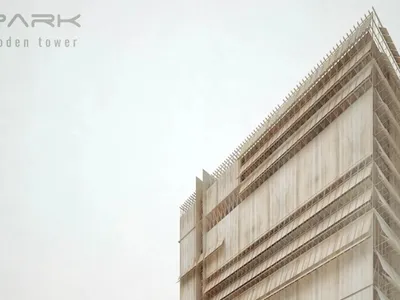
EW PARK: Sustainable Architecture Reimagines the Future of Urban Parking
EW PARK reimagines city parking as a modular wooden tower combining automation, solar energy, electric mobility, and adaptable urban design.

Co-Life: Senior Housing Design That Reconnects Older Adults With the City
Co-Life reimagines senior housing design through healing gardens, shared streets, workshops, and a sustainable community across generations.

The Earth Pod: 3D Printed Homes for Resilient Refugee Communities
The Earth Pod reimagines refugee housing through 3D printed homes made from clay, combining resilience, self-sufficiency, and rapid shelter.

Hill & Cross Opera: Sculptural Opera House Architecture Shaped by Tallinn’s Landscape and Identity
Hill & Cross Opera reimagines opera house architecture in Tallinn through its sculptural hill, civic plaza, glass wave and a luminous cross.

Similar Reads
You might also enjoy these articles

The Musturak Paradise: Senior Living Architecture for a Connected Future in Temara, Morocco
The Musturak Paradise reimagines senior living architecture in Temara via private homes, social spaces, culture, community, and shared care.

The Leaf Center: Cultural Center Architecture for Social Integration in Amsterdam
Cultural center architecture becomes a bridge at The Leaf Center, connecting international students with Amsterdam through art and exchange.

Conexión: Biophilic Design Reimagines High-Rise Living in Hong Kong
Conexión reimagines high-rise living in Hong Kong through biophilic design, green facades, shared spaces, daylight, water and nature within.

Wander to Wonder: Modular Playground Design for Children in Kutupalong Refugee Camp
Wander to Wonder uses modular playground design to create flexible, imaginative play spaces for children in Kutupalong refugee camp.



Comments (0)
Please login or sign up to add comments
No comments yet. Be the first to comment!