

KPF Deconstructs the Luxury Tower into a Stack of Monumental Blocks at Atlantis The Royal Dubai
A 43-storey resort on Palm Jumeirah treats voids and sky courts as seriously as built volume, redefining the Dubai skyline.


Most supertall hotels in the Gulf rely on a single gesture: a twisting silhouette, a cantilevered crown, a record-breaking height. Atlantis The Royal, completed in 2023 by KPF, takes the opposite approach. Instead of sculpting one monolithic form, the firm disassembles the tower typology into a loose grid of interlocking blocks, then pulls them apart to create fourteen sky courts, twenty sky terraces, and a 90-metre-long skybridge that hovers between two main volumes. The result is a 500-metre-long, 178-metre-tall composition that reads less like a single building and more like a fragment of a vertical city.
What makes the project genuinely interesting is not its scale (387,097 square metres of gross floor area on reclaimed land) but the way the design treats absence as program. The voids between stacked blocks are not leftover space. They are shaded, naturally ventilated outdoor rooms tuned to catch prevailing Gulf breezes and aimed at specific views: the Arabian Gulf on one side, the Palm Jumeirah lagoon and Dubai skyline on the other. KPF's concept of "deconstruction" borrows the language of Roman aqueduct arches and Islamic mashrabiya screens, then rebuilds it at resort scale. The six interconnected towers house 795 guest rooms, 231 serviced residences, restaurants, conference spaces, and a rooftop pool terrace, all organized so that every program has its own arrival sequence, garden, and sightline.
A Skyline Built from Gaps
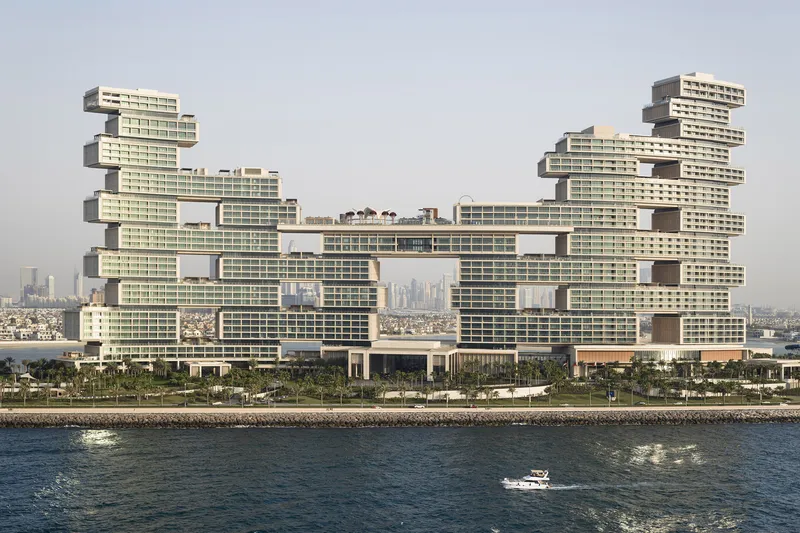
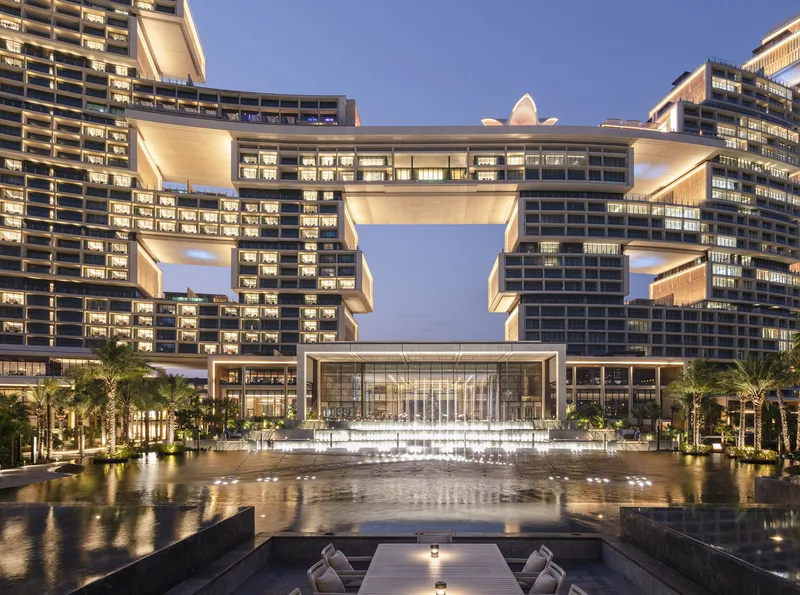
Seen from the water, the building's identity depends on what is missing. The voids between blocks register as clearly as the blocks themselves, producing a silhouette that changes character as you move around the Palm. By day the gaps are deep shadows; at dusk they glow, framing the illuminated skybridge like a lantern between two cliffs. The 43-storey hotel tower and the 37-storey residential tower are both gently curved and stepped, which means the profile never presents a flat wall to the viewer. Instead it cascades, offering each room and terrace a slightly different angle toward the Gulf or the city.
The skybridge is the centrepiece of this strategy. At 90 metres long and 33 metres wide, it was assembled above the podium and strand-jacked into position by eight hydraulic jacks at a rate of roughly six metres per hour. That ten-hour lift moved 1,350 tonnes of hybrid steel-and-composite structure into a slot between two concrete towers, creating an elevated public realm of pools, lounges, and cabanas that would be impossible in a conventional slab.
Facade as Screen
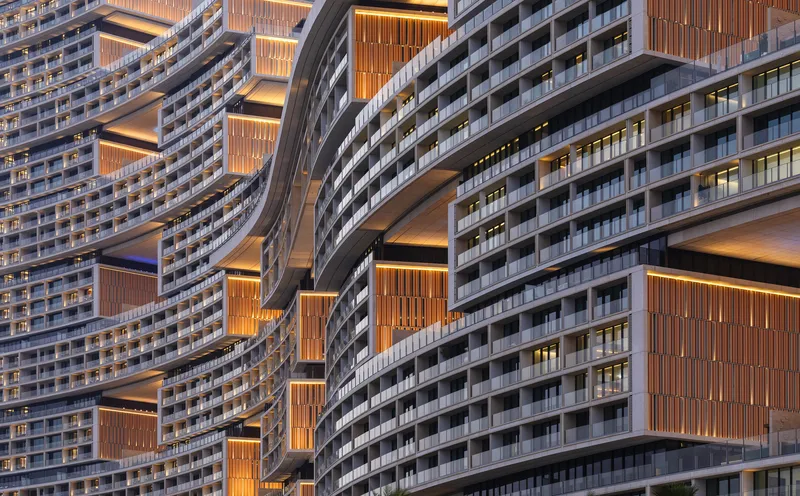
Over 33,000 glass fibre reinforced concrete (GFRC) panels wrap the building's curves, joined at a uniform 5mm gap that gives the surface a textile-like grain. The horizontal balcony bands and backlit timber louvers create a layered depth: from a distance the facade reads as a smooth, undulating wall; up close it dissolves into individual screens, each calibrated to control solar gain and frame views. Nearly one million square feet of glass sits behind this outer layer, but the GFRC and louvered shading mean that direct sun rarely hits the glazing at a harsh angle.
KPF's choice to reference Islamic screen traditions here is not cosmetic. The structural and facade engineers collaborated to mitigate wind loads on the open terraces and sky courts, so the screens also function as wind baffles. The non-corrosive materials specification, essential for a building sitting in salt spray on reclaimed land, ensures the panels will hold their appearance without the accelerated weathering that plagues Gulf-facing facades elsewhere on the Palm.
Arrival and Ground Plane
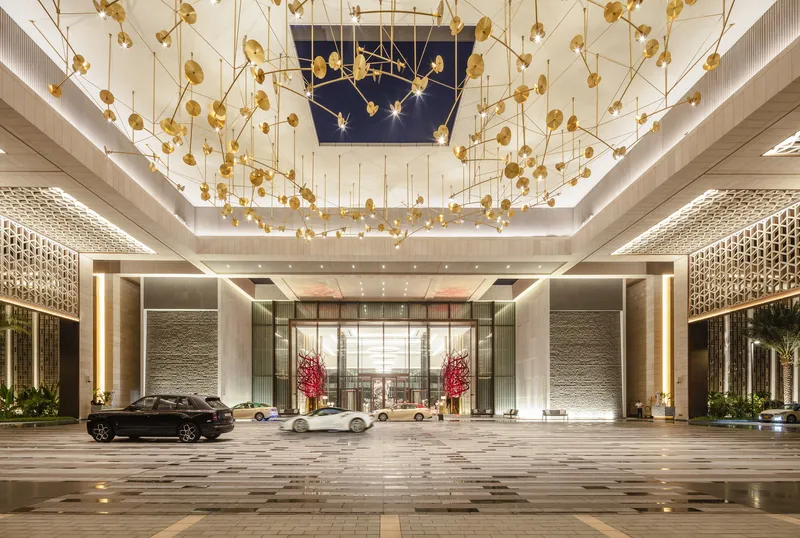
The porte-cochère sets the tone before a guest steps inside. A patterned stone ceiling hangs above a field of suspended brass pendant fixtures that catch ambient light and car headlights alike, producing a warm, theatrical threshold between the Dubai heat and the conditioned interior. The effect is deliberately processional: you arrive under the canopy, pass through the light installation, and enter the lobby along an axis that terminates in a sculptural centrepiece.
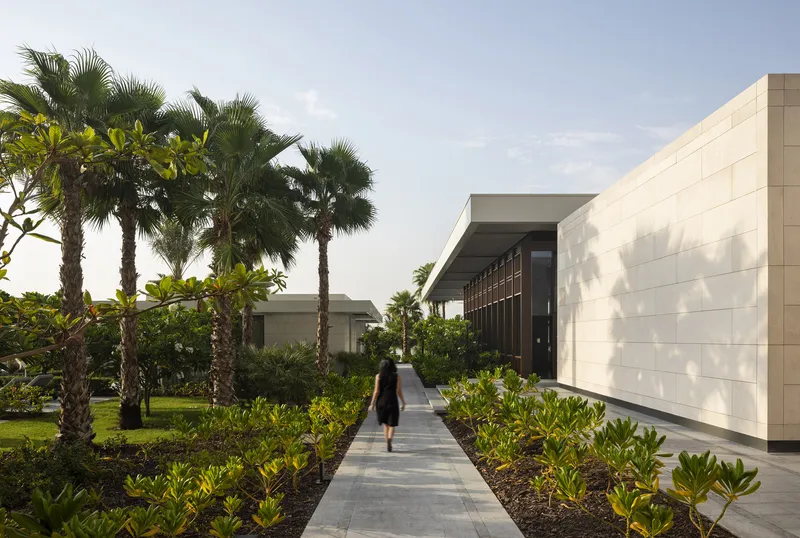
Beyond the formal entry, the ground plane breaks into garden pathways lined with palm trees and pale stone pavilions screened by vertical timber louvers. These smaller structures house stand-alone restaurants and beach amenities, and they deliberately echo the louvered language of the main tower at a human scale. The siting strategy keeps the conference, hotel, and residential programs separate at grade, each with its own drop-off, garden, and waterfront view, so the building never funnels all 795 rooms plus residents through a single lobby.
Interior Atmosphere
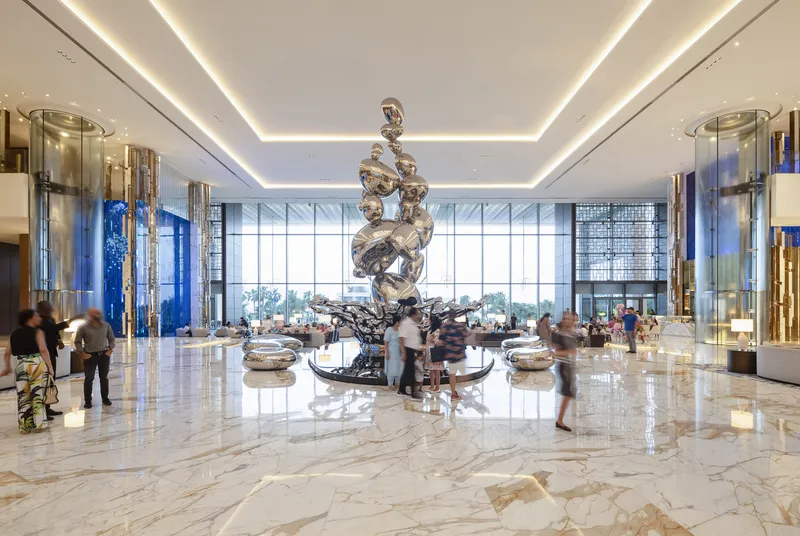
Inside, the material palette shifts to 1.6 million square feet of marble. The main lobby pairs polished stone floors with a coffered, cove-lit ceiling that softens the scale from monumental to intimate. A metallic sculpture anchors the space, giving guests an orientation point beneath a ceiling grid that recalls the GFRC panel rhythm outside. The interiors, handled by GA Design and SM Design, avoid the maximalist tendencies that plague many Gulf luxury hotels; colour is muted, textures are layered, and the light sources are almost entirely indirect.
That restraint matters in a building this large. When the public spaces rely on material richness rather than decorative excess, the architecture can hold its own against the fit-out instead of disappearing behind it. The coffered ceiling in the lobby, the brass installation at the porte-cochère, and the louvered garden pavilions share a common geometric discipline that ties inside and outside together.
Living in the Sky Courts
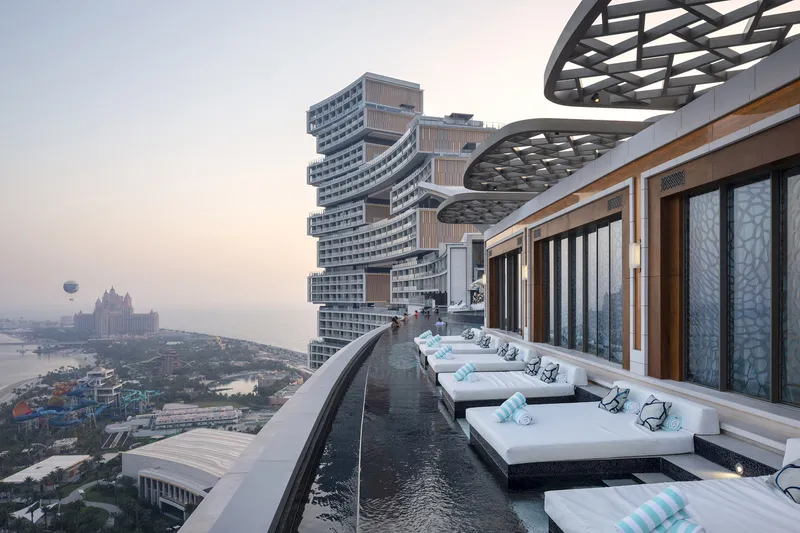
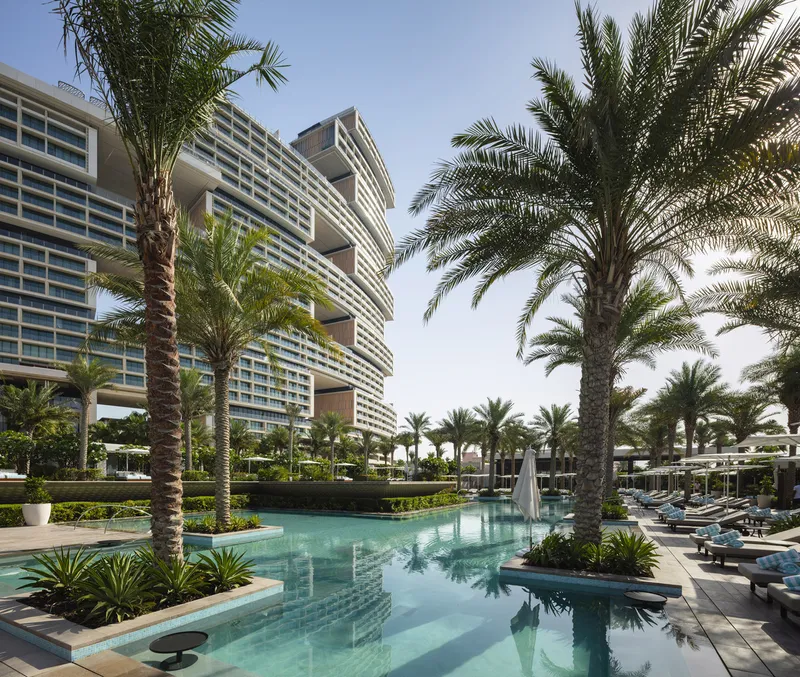
The rooftop pool terrace offers the clearest demonstration of what the stacked-block strategy achieves. White daybeds line a pool that looks directly across at the offset tower volumes, turning the building itself into the view. At sunset the stepped profile catches light at multiple angles, and the voids between blocks frame slices of sky and coastline. Below, the tiered facade with its louvered screens creates a rhythmic backdrop for the lower pool deck, where palm trees grow between concrete ledges.
The fourteen sky courts function as private and semi-private gardens for the building's most exclusive suites and duplex residences, each with plunge pools and planted terraces shaded by the block above. These are the voids made habitable: outdoor rooms at altitude that would overheat in an exposed position but remain comfortable because the stacked geometry guarantees shade for most of the day while the open sides channel Gulf breezes through. It is a passive cooling strategy executed at the scale of a mega-resort, and it works because the architecture was shaped around it from the start.
Engineering on Reclaimed Land
Beneath the spectacle sits a formidable engineering challenge. Palm Jumeirah is reclaimed land with a high groundwater table, so KPF and structural engineers Arup and WSP devised unique foundation systems using reinforced concrete bored piles to support six interconnected towers totalling 7.8 million cubic feet of concrete and 45,000 tonnes of steel rebar. Each tower consists of three reinforced concrete sub-towers, and 12-metre cantilevers are supported by tower columns through an internal bracing system.
The use of GGBS (Ground Granulated Blast-furnace Slag) in the concrete mix reduced carbon emissions, while high-strength concrete allowed smaller cross-sections, saving material without sacrificing capacity. Customised formwork systems enabled a seven-day construction cycle per floor. These decisions are invisible in the finished building, but they made the entire stacked-block concept structurally feasible. Without them, the voids that define the architecture would have required prohibitively massive structure.
Why This Project Matters
Atlantis The Royal matters because it proves that a Gulf mega-resort can be organised around environmental logic rather than against it. The stacked-block form is not arbitrary: it generates shade, captures wind, separates programs, and creates outdoor habitable space at every level. KPF took a typology that usually defaults to sealed, energy-intensive envelopes and opened it up, making the voids as programmatically rich as the occupied floors. In a climate where outdoor comfort is the scarcest luxury, that inversion is the project's most significant contribution.
It also offers a credible alternative to the signature-tower arms race. Where many Dubai projects compete on height or formal novelty, KPF competes on spatial intelligence: the quality of the sky courts, the calibration of the louvered screens, the choreography of multiple arrival sequences along a 500-metre-long site. The building is undeniably spectacular, but the spectacle is structural, not decorative. That distinction is worth paying attention to as the Gulf continues to build at extraordinary scale.
Atlantis The Royal by KPF (Kohn Pedersen Fox), Palm Jumeirah, Dubai, UAE. 387,097 m² gross floor area. Completed 2023. Photography by H.G. Esch.
About the Studio
Share Your Own Work on uni.xyz
If projects like this are the kind of work you want to make, uni.xyz is a place to publish your own, find collaborators, and enter design competitions.


Popular Articles
Popular articles from the community


Manzana Morphosis: Stretching Barcelona's Grid into a Living Landscape for 2050
A radical reworking of the Eixample manzana turns density into a tool for generous public space, vertical ecology, and environmental performance.

Tsunami Convergenics: Turning Catastrophic Ocean Forces into Underwater Housing Infrastructure
A speculative underwater settlement off the coast of Onagawa, Japan, treats tsunamis and typhoons as energy sources rather than threats.

The Amber Palace Opera: A Geological Fiction Surfaces on Tallinn's Baltic Waterfront
Pierre Brillard reimagines a Baltic legend as a public landscape, opera house, and waterfront promenade rooted in Tallinn's coastal identity.
Temporary Home for Dogs: A Reversed Zoo Rethinks Animal Shelter Architecture
In Bucharest, a sinuous corridor and freed landscape flip the logic of containment, designing a shelter that works to make itself unnecessary.

Similar Reads
You might also enjoy these articles


Hodi-Mandai Geram
Project Function: Preservation and revitalization of the Intangible heritage and socio-spatial identity of the Hodi by Housing, Cultural Memory Center, Sacred Grove, landscape, local tourism economy


Olio Towers: A Mid-Rise for Performers That Fuses Housing, Rehearsal, and Stage
Located blocks from Houston's Theater District, this modular tower stacks living units around a central performance atrium.

Oasis: Modular Green Housing Carved into Dhaka's Urban Fabric
A shortlisted Plugin Housing entry reclaims unauthorized settlements in Dhaka with stepped concrete volumes, green roofs, and ventilation-driven design.

Black Hole: A Floating Megastructure for the Post-Physical Era
Emiliano Mazzarotto envisions a spherical, self-scaling arena where e-sports, digital hotels, and holographic stadiums replace traditional public space.

Explore Dubai Competitions
Discover active competitions in this discipline

Challenge to reimagine the Iron Throne

Photograph architecture without architects

Illustrate the lost glory of Angkor Wat - Render Challenge

Design challenge to reuse E-waste
Comments (0)
Please login or sign up to add comments
No comments yet. Be the first to comment!