
Audrius Ambrasas Architects Merge a Science Center into a Latvian Hillside at VIZIUM
A copper-clad building in Ventspils folds into the landscape, housing seven interactive galleries and a 26-meter observation point on the river.


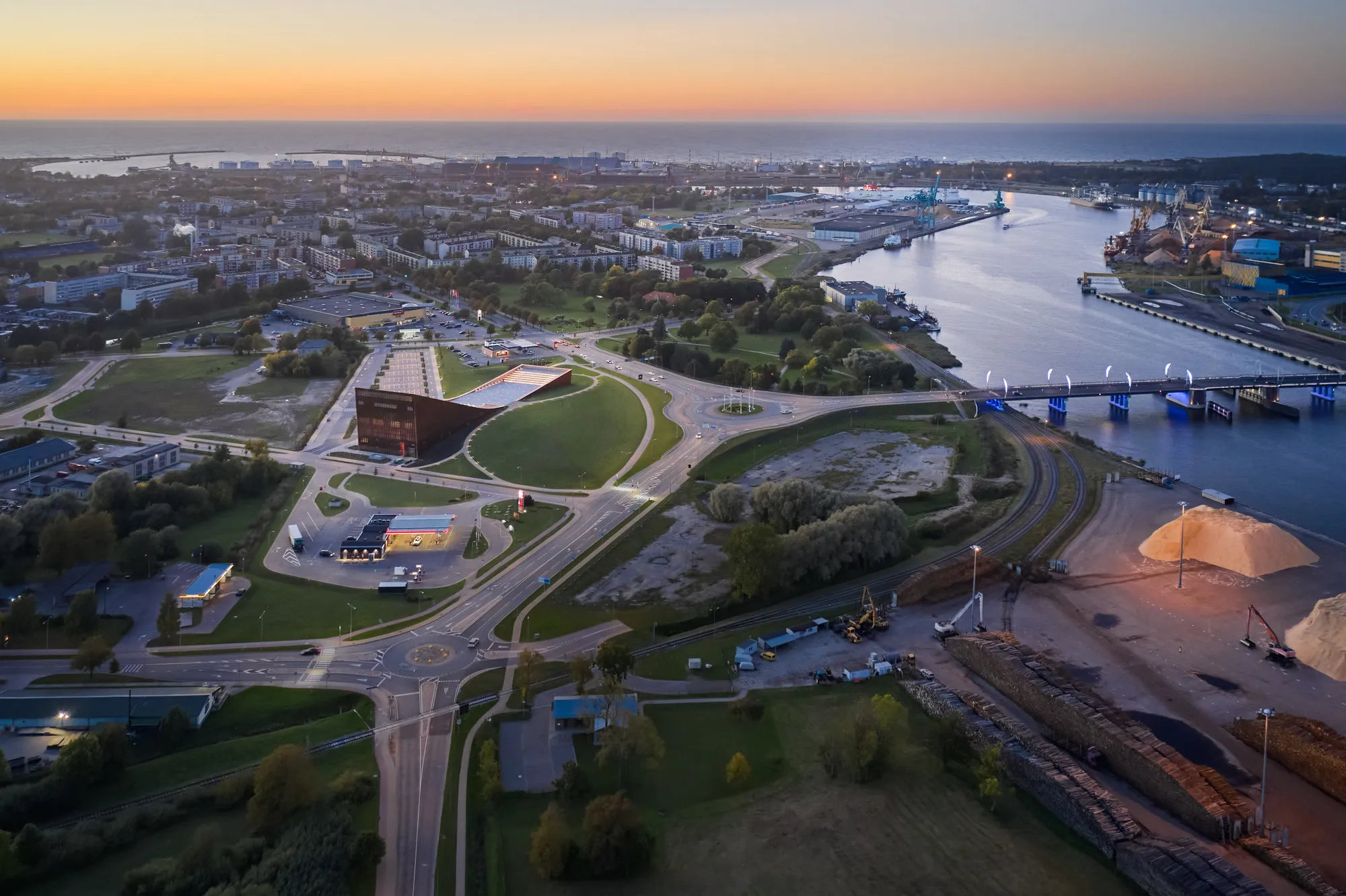
Most science centers announce themselves. They rise from their surroundings with sculptural exuberance, daring you to ignore them. VIZIUM, designed by Audrius Ambrasas Architects on the banks of the Venta River in Ventspils, Latvia, does the opposite. Rather than planting a landmark on the axis of the city's pedestrian bridge, the architects left that axis open and let the building grow out of the ground itself, its copper roof merging with a man-made hill so that the boundary between architecture and topography dissolves almost completely.
The result, completed in 2022 after winning an international competition in 2015, is a 6,653-square-meter facility that splits its program between a low-slung science center tucked beneath the landscape and a six-story innovation tower that steps up to a 26-meter observation point. Copper sheets treated with a technique used for the first time in Latvia hold their dark golden tone against the Baltic weather, while the lobby floor alone contains more than 600,000 Murano glass mosaic tiles arranged as a world map with Ventspils at the center. It is a building that earns its ambition quietly, through material precision and topographic intelligence rather than formal spectacle.
A Building That Becomes the Ground
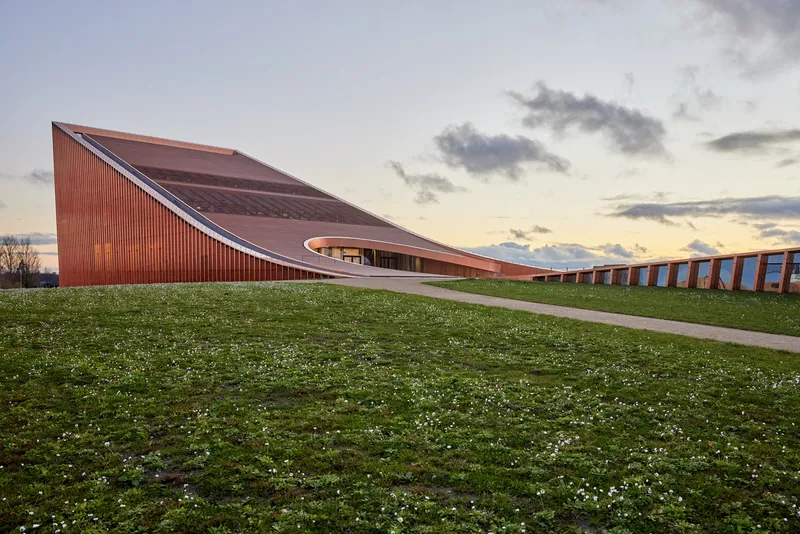


The most radical gesture here is the simplest one: the roof is a hill. Walk up it and you barely register the building beneath your feet. The planted surface lifts from the lawn in a long, sweeping arc, and at dusk it reads as pure landscape, a lone figure silhouetted against the sky no different from someone crossing any other Latvian meadow. From above, the drone reveals the game: circular skylights puncture the green plane, the copper cladding peels away from the grass, and the angular geometry of the innovation tower breaks the pastoral illusion.
The eastern portion of the site shapes this hill for public use: picnics, open-air events, and river views. It is a generous move that gives the city an amenity even when the galleries are closed. Architecture here operates in service of the ground rather than against it.
Copper and Glass at the River's Edge


Where the building does rise, it does so with conviction. The innovation tower's vertical fin facade catches low Baltic light in bands of warm copper and reflective glass, creating an elevation that shifts character throughout the day. At twilight the fins glow against the darkening sky; at sunrise they appear almost weightless beside passing cyclists. The facade system relies on WICONA aluminum frames with silicone insulated glass units, many of them trapezoid-shaped, covering around 2,400 square meters. Glass is affixed in sections that conceal the aluminum profiles, so from the exterior only glass is visible, a sleight of hand that gives the tower its clean, planar intensity.
The treated copper finishing sheets deserve attention. Their dark golden tone is not patina; it is an intentional surface achieved through a process new to Latvia. The material ages differently from standard copper, holding its warmth rather than greening over time. Set against the river and the autumn foliage visible in aerial photographs, the copper creates a dialogue with the site's natural palette rather than competing with it.
Carved Thresholds and Exterior Rooms
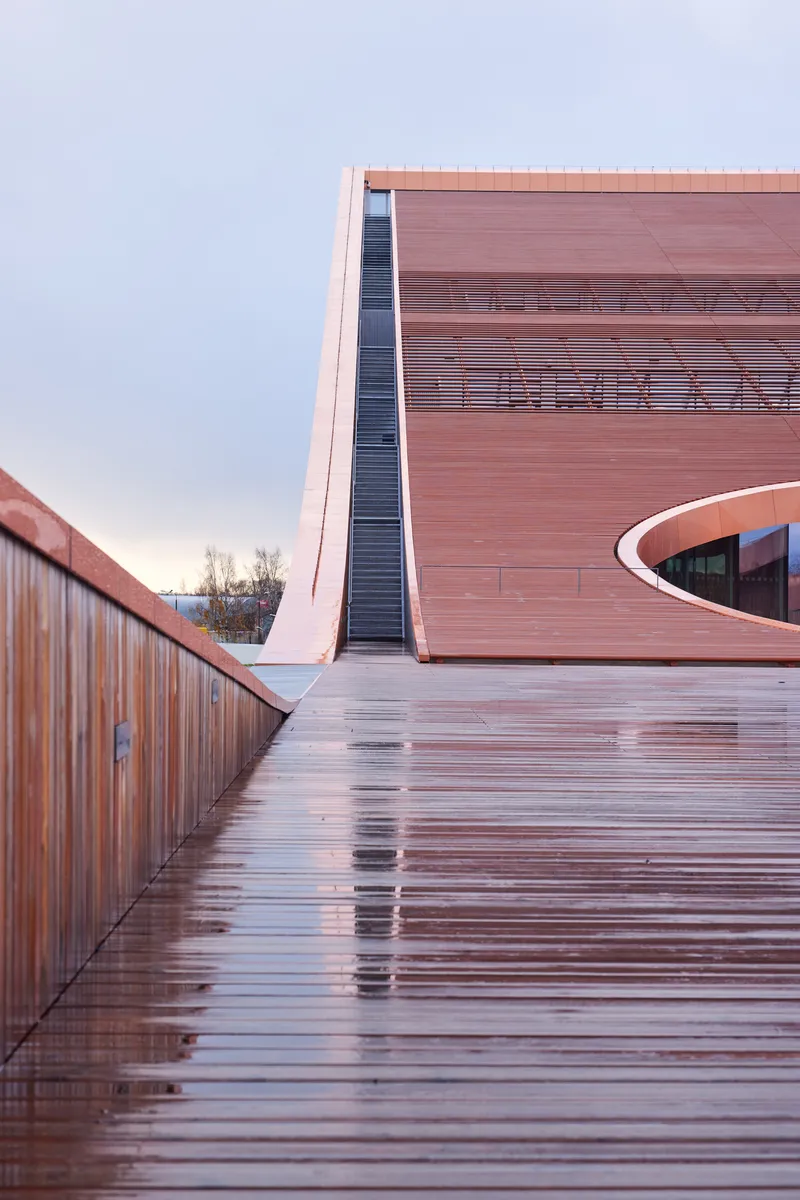


The transitions between landscape, terrace, and interior are among the project's most carefully considered moments. A wet timber deck leads to a curved cutout in the facade, framing a stairway that descends between copper-clad walls with strip lighting. Overhead, a covered terrace with timber ceiling and decking creates an outdoor room that looks back through the same curved opening toward the city. These are not mere circulation moves; they are spatial events that slow the visitor down and establish the building's relationship to horizon, sky, and river before any exhibit is encountered.
The pergola structure, with its red steel beams and glass infill panels, extends the interior color language outward at sunset. It is a detail that signals the architects' interest in continuity: inside and outside are not binary conditions here but points on a gradient.
The Vertical Screen and Its Soft Shadow

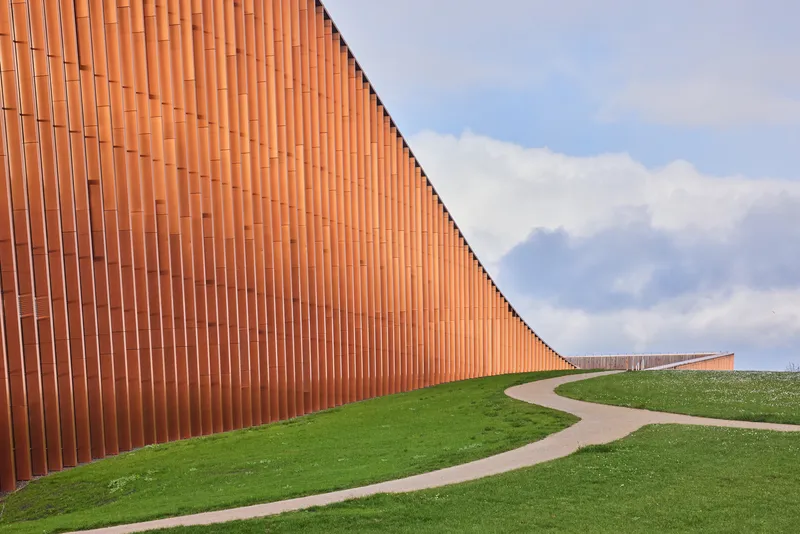
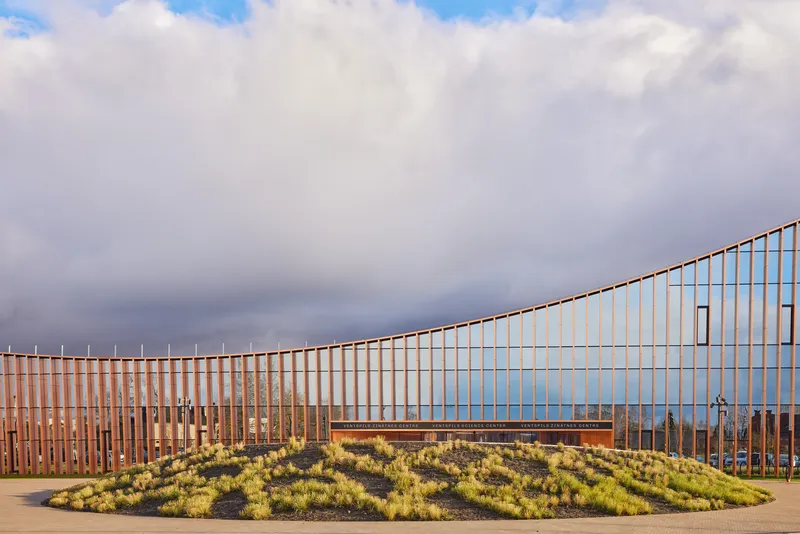
The lower volumes wrap themselves in vertical fins and screens that read differently depending on your distance. Up close, the terracotta and corten tones are warm and tactile. From the path, the fins create a moiré effect that shifts as you walk, turning a static facade into a kinetic surface. Behind a circular planted bed, the curving timber and corten screen under stormy skies looks almost defensive, a fortress of vertical lines softened only by the greenery at its base.
These screens serve practical ends as well. The building achieves an A+ energy efficiency rating at 34.72 kWh per square meter, with facade thermal insulation values reaching 0.65 W/(m²K) and the best air permeability recorded in Latvia. The fins modulate solar gain without resorting to mechanical louvers. Performance and appearance are inseparable.
Interiors Shaped by Circles and Color
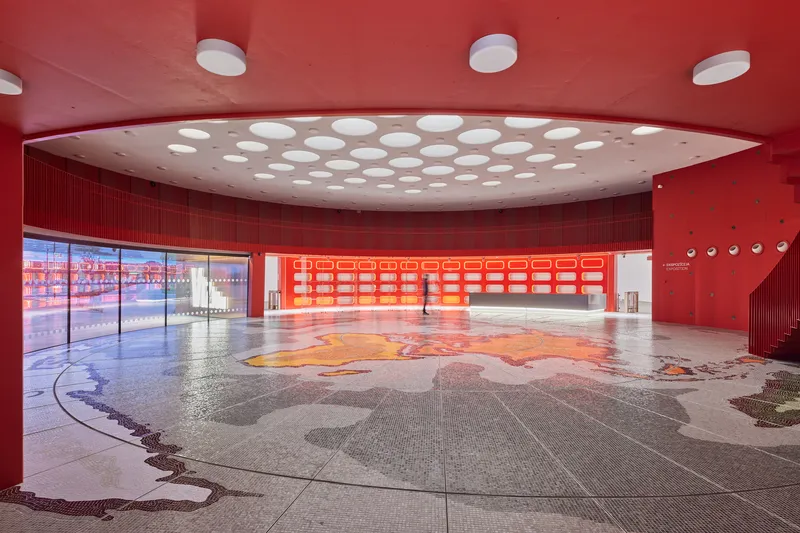


Step inside and the color language shifts to saturated reds. The entrance lobby reveals a curved red ceiling pierced by circular skylights, its terrazzo floor inlay marking the beginning of the 365-square-meter world map in Murano mosaic. The palette is deliberate: red signals energy, science, and curiosity without becoming cartoonish. A red-painted staircase curves upward through a cylindrical void, its geometry simultaneously sculptural and legible as wayfinding.
Beneath the lobby center, the foundations contain a time capsule with a message for future generations. It is a romantic gesture for a building type that usually trades in the empirical, and it grounds VIZIUM in a civic purpose that extends beyond its seven interactive galleries.
Gallery Spaces and Material Restraint
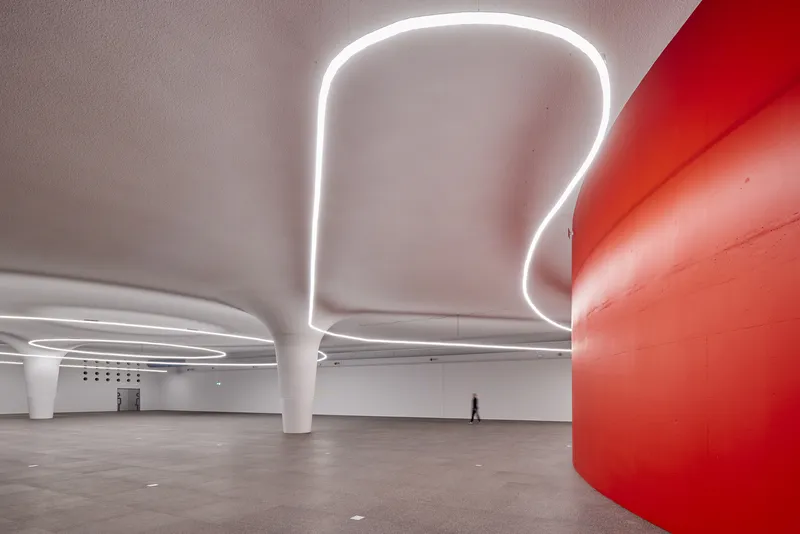


The gallery spaces themselves pull back from the lobby's intensity. White curved columns and organic LED light fixtures create a neutral backdrop for exhibits on sports, smart technology, physics, geography, human cognition, and a dedicated children's gallery. The restraint is strategic: in a science center, the exhibits are the content, and the architecture needs to recede enough to let them breathe while still offering spatial interest.
Other interior moments, like the dark grey lobby with circular porthole windows and the minimalist kitchen island beneath twin ceiling fixtures, reveal a building that sustains its material discipline room by room. The porthole windows rhyme with the roof skylights, establishing a circular motif that carries from exterior to interior without becoming a gimmick.
The Roof as Public Infrastructure


From above, the building's organizational logic is unmistakable. The copper roof with its circular skylights sits at the center of a network of curving pathways that connect parking to the west, the river promenade to the east, and the pedestrian bridge to the north. The sloping roof continues upward toward the observation point, opening panoramic views of the river and the city. It is a roof that works three times: as waterproofing, as landscape, and as public infrastructure.
The decision to keep vehicle access and technical transport on the south and west sides, separated from visitor arrival, means the eastern hillside remains uninterrupted. Ventspils gains a year-round public landscape that happens to contain a science center, rather than a science center that happens to have a green roof.
Plans and Drawings

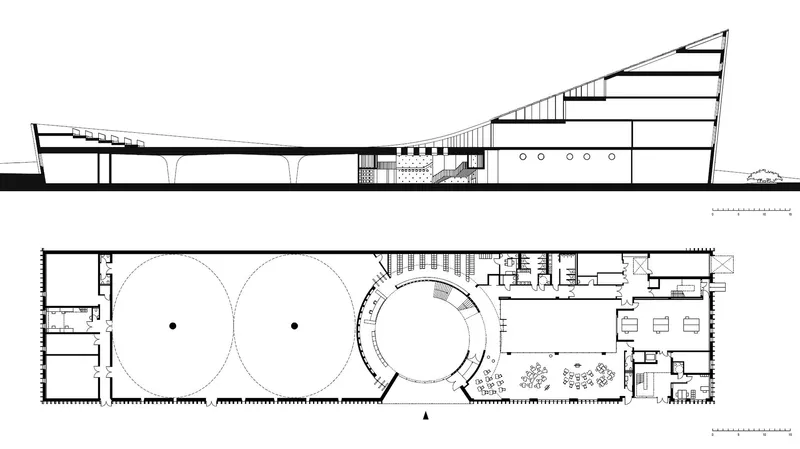

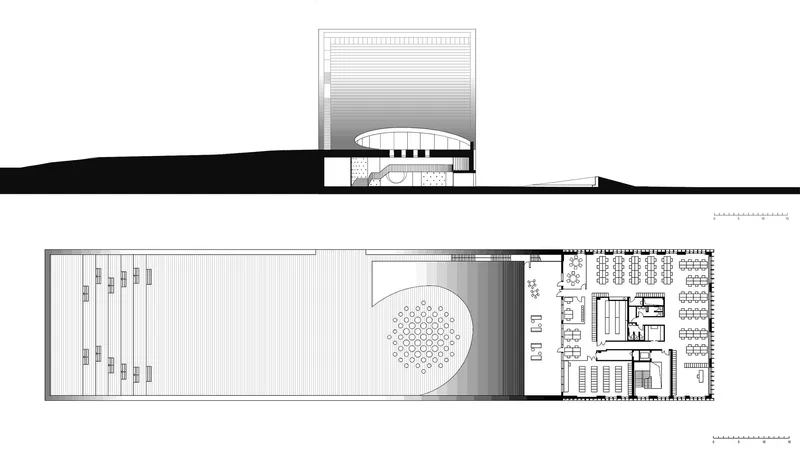
The site plan reveals how the building's angular footprint negotiates between the orthogonal parking grid to the west and the organic topographic contours of the hillside to the east. Sections make the roof slope legible: the low science center volume hugs the ground while the innovation tower steps up in a series of floors to the observation level. Circular interior volumes, visible in plan, correspond to the gallery spaces and the cylindrical stair void. The elevation drawing of the tower shows how the vertical fin system wraps the full height of the rectangular volume, with the curved theater volume nestled at its base.
Why This Project Matters
VIZIUM matters because it refuses the easy equation between public architecture and iconic form. In a small Latvian coastal city, the temptation to produce a signature building must have been strong, especially after an international competition with fifteen teams from four countries. Audrius Ambrasas Architects chose a harder path: making the building nearly invisible from certain angles, giving the city a hill and a river promenade as much as a science center, and investing the spectacle in material craft rather than silhouette.
The technical achievements are real. An A+ energy rating, pioneering copper treatment, 2,400 square meters of custom-shaped glass, and a Murano mosaic floor with 600,000 tiles all testify to a project where ambition lives in the details. But the larger lesson is about generosity: about what a public building gives to its site rather than what it takes from it. Ventspils did not need a landmark. It needed a place. VIZIUM provides one.
Science and Innovation Center VIZIUM by Audrius Ambrasas Architects, Ventspils, Latvia. 6,653 m². Completed 2022. Photography by Norbert Tukaj.
About the Studio
Share Your Own Work on uni.xyz
If projects like this are the kind of work you want to make, uni.xyz is a place to publish your own, find collaborators, and enter design competitions.



Popular Articles
Popular articles from the community

EW PARK: Sustainable Architecture Reimagines the Future of Urban Parking
EW PARK reimagines city parking as a modular wooden tower combining automation, solar energy, electric mobility, and adaptable urban design.

Co-Life: Senior Housing Design That Reconnects Older Adults With the City
Co-Life reimagines senior housing design through healing gardens, shared streets, workshops, and a sustainable community across generations.

Riyadh For All: Intergenerational Urban Design for Active Aging in Rabat
Riyadh For All reimagines urban design in Rabat with intergenerational co-living, adaptive courtyards, and Moroccan cultural exchange today.
AL-JANNAH: Sustainable Architecture and Permaculture for Afghan Widows
AL-JANNAH uses sustainable architecture and permaculture to create resilient oasis of housing, learning, work and renewal for Afghan widows.
Similar Reads
You might also enjoy these articles

Bao Huynh Watercolor Atelier: A Serene Art Retreat in Hội An
Bao Huynh Watercolor Atelier in Hội An blends multifunctional art spaces, sustainable design, local materials, and family-friendly living in a serene environment.

Atelier Macri Concept Store Interior Design by CASE-REAL
Atelier Macri store features a "ko" counter, walnut wood details, cork displays, blending retail, gallery, and seamless customer experiences.

Manuel Vargas Izquierdo Stadium and High-Performance Sports Center: Architectural Excellence in Jalpa de Méndez
The Manuel Vargas Izquierdo Stadium blends sustainable design, inclusive sports facilities, and cultural-inspired architecture, revitalizing Jalpa de Méndez’s public spaces.

KAKR Buluh Awar Hall: Revitalizing Community and Ecology Through Bamboo Architecture
Community built bamboo hall revitalizes Buluh Awar village, empowering youth, restoring ecology, celebrating vernacular craftsmanship through sustainable architecture and culture.
Comments (0)
Please login or sign up to add comments
No comments yet. Be the first to comment!