
Back to the Nature
Plays with physical challanges in the nature again..

When we examined the digital games that today's children play the most, we saw that although they differ according to age groups, they are generally exciting, competitive with different difficulty levels, taking risks and adventurous games.
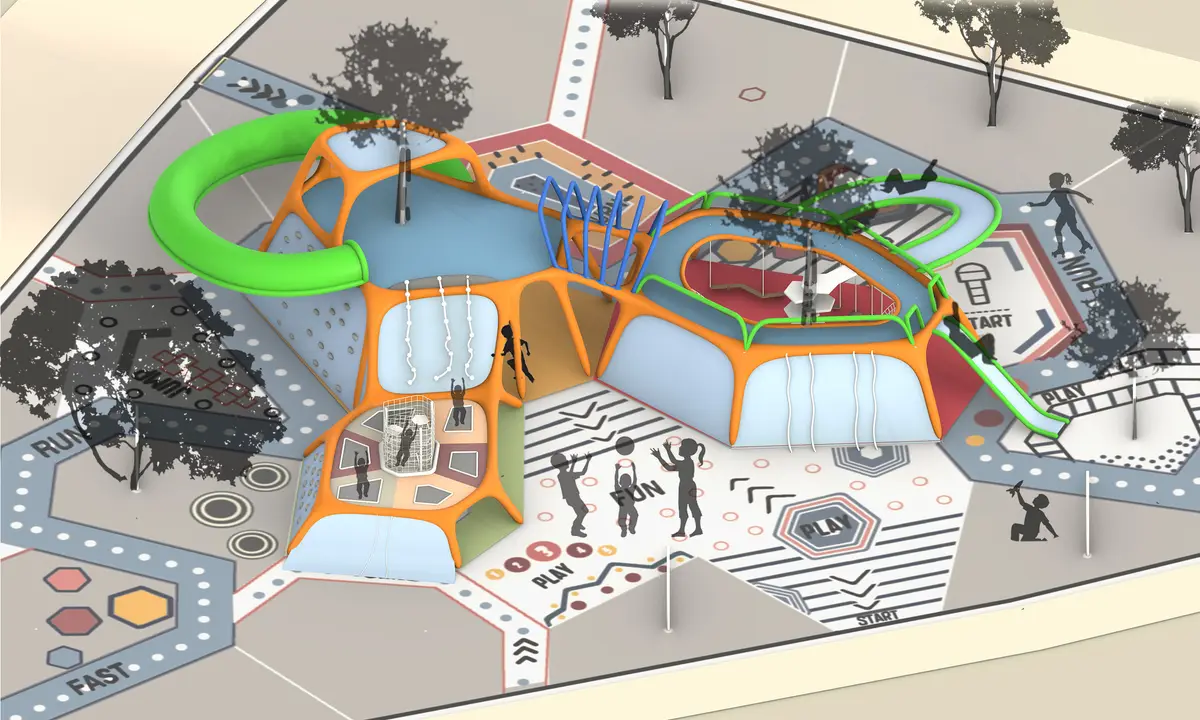
The concept of the project is to design a playground that offers each age group the opportunity to develop different skills (sensory, social, physical). This playground is more than a game structure, it is the game itself. Children will not only push the limits of their physical skills, but will also have fun, excitement, adrenaline and happiness while climbing, trying to balance, and sliding down the slides.
Children who throw their energy away by contacting nature get away from stress, and the rate of anger attacks and anxiety decreases. Based on this information, we have chosen trees as the central point of the game (play structure) we set up for children to embrace nature. We determined the position of the structural and unstructured playgrounds using the voronoi diagrams (buildings, green spaces, trees) with the principle of equidistance. Then we created the floor traces from the combination of these schemes. In addition, we benefited from the mobility abilities of children in different age groups (0-2 / 3-5 / 6-12 years) in varying height measurements of the structure.
Many trials were made until the final product such as he design of playgrounds in a single structure, more fragmented and spreading game modules, the design of playground equipment played above or under the ground without being connected to a structure, the design of playgrounds consisting of closed-semi-open-open areas.
First of all, a literature search was conducted on children's movements, physical abilities and play preferences. Then, climate and built environment analyzes of Warsaw were made. In line with these researches, the final product was created.

Popular Articles
Popular articles from the community


Opera by the Sea Estonia: Three Shells Dissolving Architecture into Tallinn's Coastline
A winning opera house proposal replaces monumental form with interconnected shells that blur the boundary between building, park and Baltic Sea.

Singing Woman: An Opera House That Performs Before the Curtain Rises
Ovidiu Cristian Pavel's conceptual opera house translates Estonia's choral identity into a sculpted waterfront landmark facing the Baltic Sea.

Cloaked Colonization: A Mobile Underwater Habitat That Moves Like a Fish
Micah Abaya's shortlisted EHC Pacific entry reimagines ocean settlement as a dispersed network of self-sustaining architectural organisms.

Tsunami Convergenics: Turning Catastrophic Ocean Forces into Underwater Housing Infrastructure
A speculative underwater settlement off the coast of Onagawa, Japan, treats tsunamis and typhoons as energy sources rather than threats.

Similar Reads
You might also enjoy these articles
The Rhythm of Seasons
A Farmers' Market Connecting Nature and the City

More Than a Building-Designing a Living System
More Than a Building-Designing a Living System
Base Beyond
DESERT COMPOUND ARID: TOURISM OF ABSENCE AND ABUNDANCE

Comments (0)
Please login or sign up to add comments
No comments yet. Be the first to comment!