
Badie Architects Sculpts a Cairo House Where Walls Flow Like Wind and Trees Grow Through Floors
Beit Hawa, a 500-square-metre residence in Uptown Cairo, dissolves the boundary between landscape and living through morphic plaster surfaces.


Beit Hawa, which translates roughly to "House of Wind," is the kind of project that dares you to find a right angle. Designed by Badie Architects under the lead of Mohamed Badie, this 500-square-metre residence in Uptown Cairo treats every vertical and horizontal surface as a continuous, sculpted membrane. Walls curve into ceilings, floors accept living trees, and arched openings layer into each other like the chambers of a nautilus shell. It is a house that performs softness without ever feeling weak.
What makes Beit Hawa genuinely interesting, beyond its obvious formal ambition, is its commitment to treating planting not as decoration but as architecture. Trees rise through polished floors. Shrub beds line staircases. Flowering branches occupy kitchen countertops as naturally as appliances do. The design proposition is that a domestic interior can be a landscape, not merely look at one. That idea is old, but the execution here is remarkably thorough: every room hosts vegetation, and the plaster surfaces seem designed specifically to make greenery pop against their monochrome whiteness.
A Staircase as Centerpiece
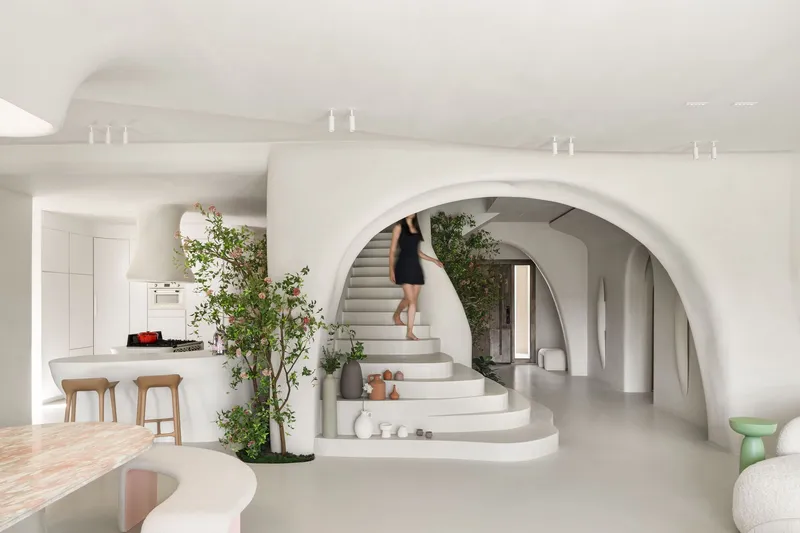
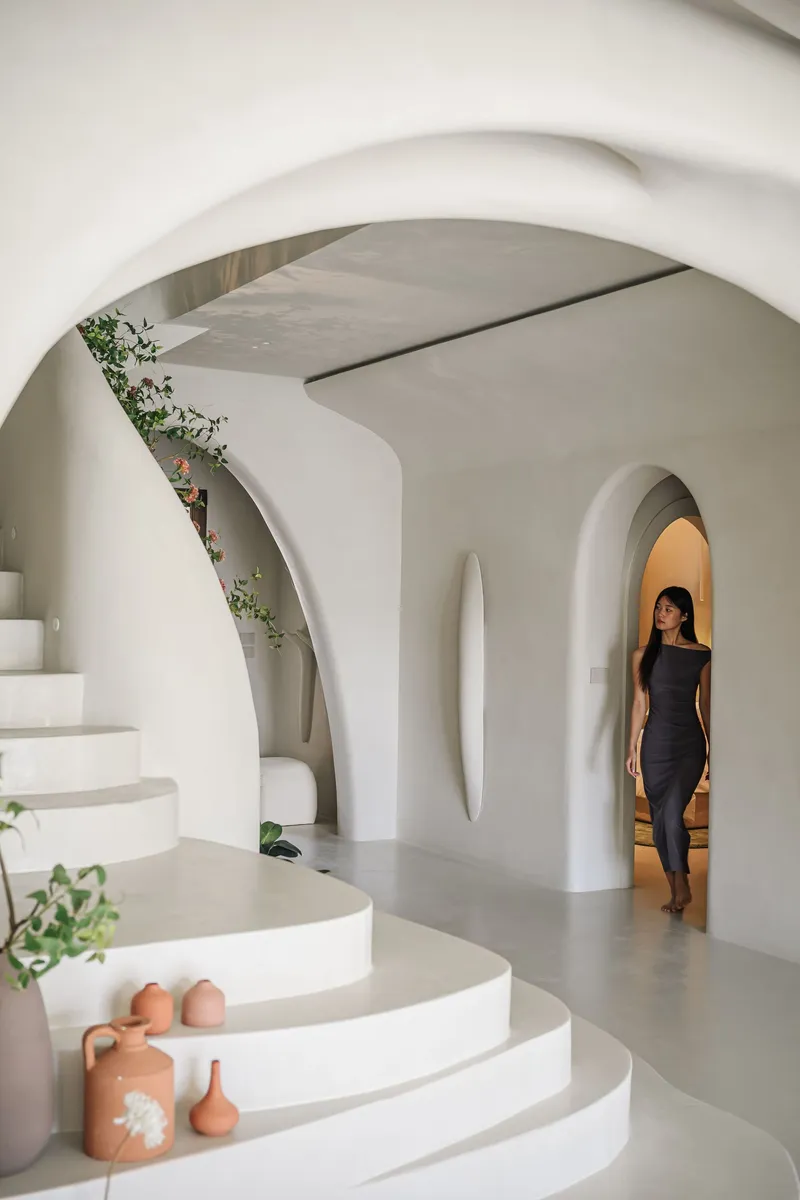
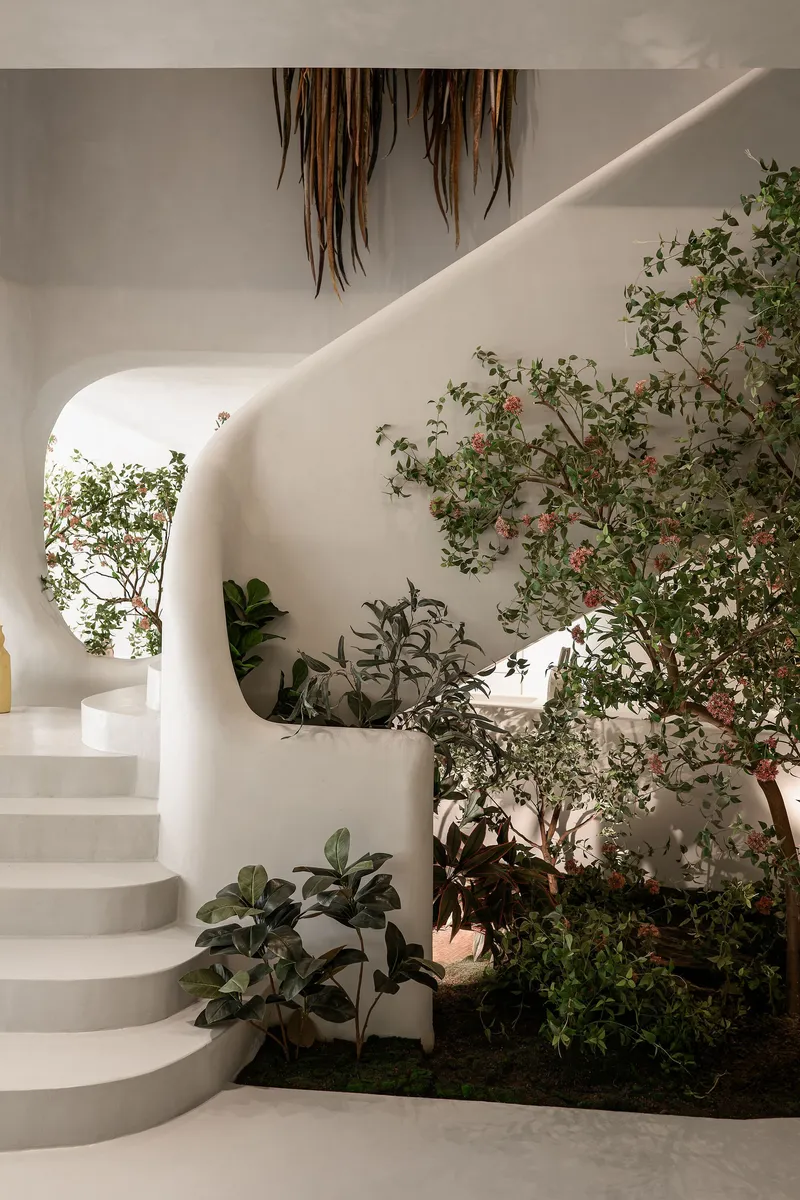
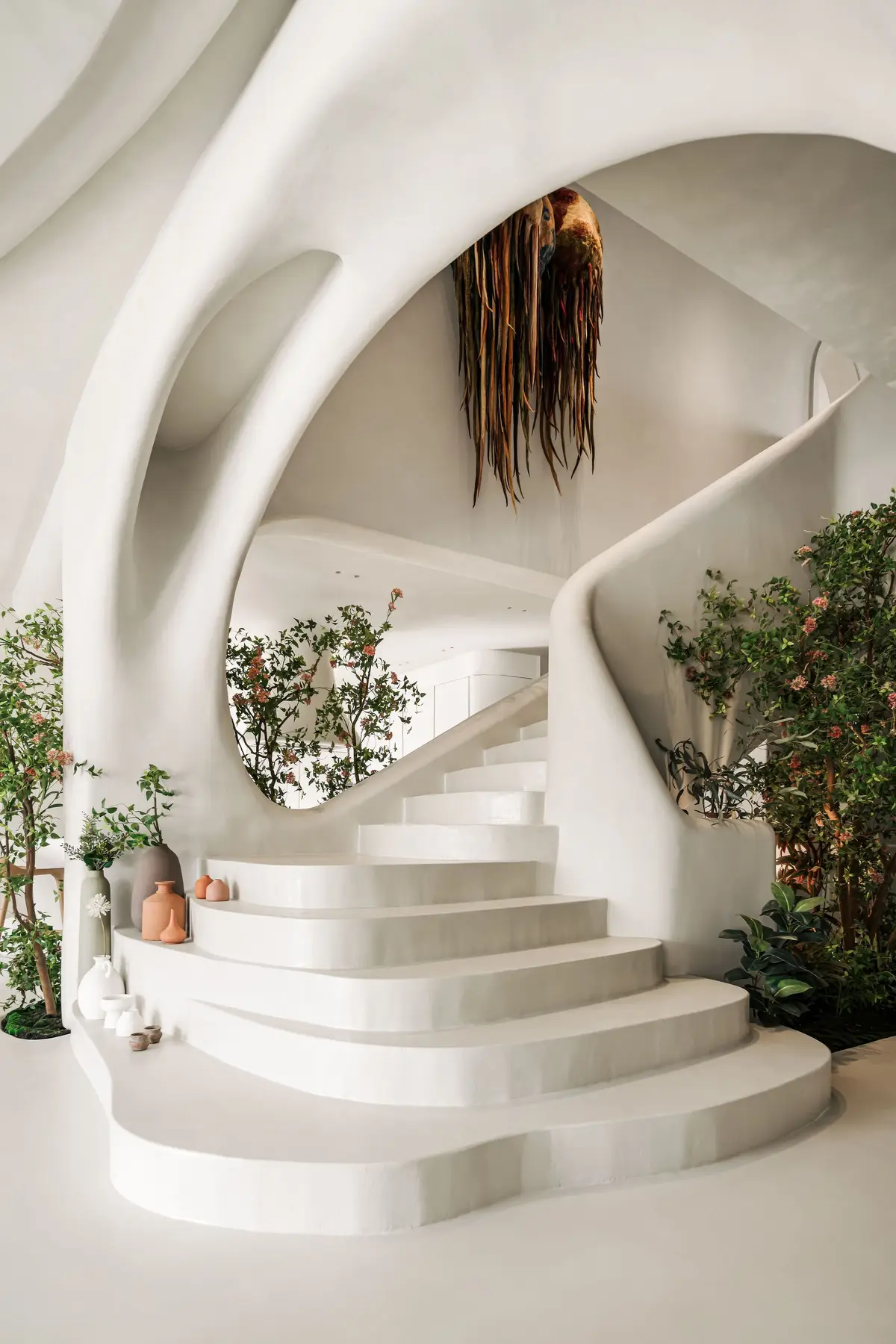
The spiral staircase is the gravitational center of Beit Hawa. Its rounded treads rise through a double-height void, flanked by planted beds and framed by layered arched openings that give the space a grotto-like depth. A fiber sculpture hangs overhead, adding a textural counterpoint to the smooth plaster. The staircase does not merely connect floors; it organizes every adjacent room around its presence, pulling sightlines toward it from living areas, corridors, and entries alike.
Viewed from different thresholds, the staircase transforms. From the entry hall it reads as monumental, its white curves catching evening light. From the living areas it becomes a backdrop, a vertical garden with ceramic vases and flowering branches arranged casually on the treads. This multiplicity of readings suggests a careful choreography of movement and view that elevates the stair from circulation element to spatial event.
Living Spaces That Refuse Flatness
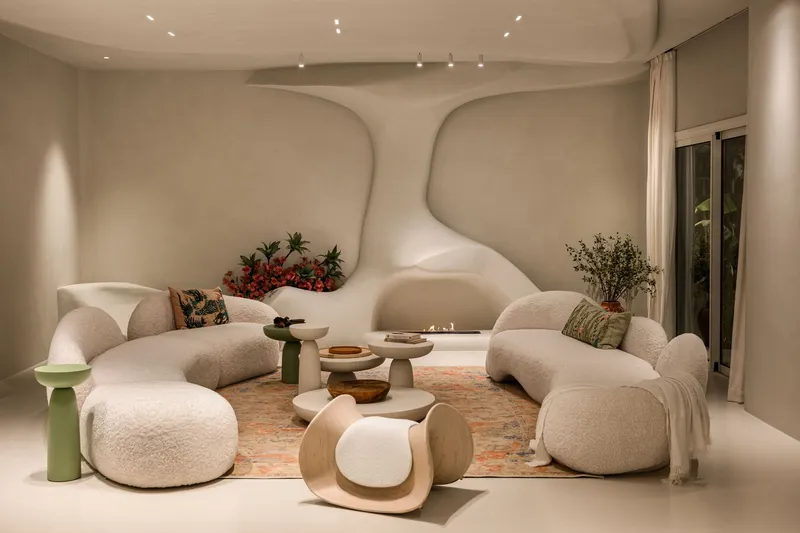
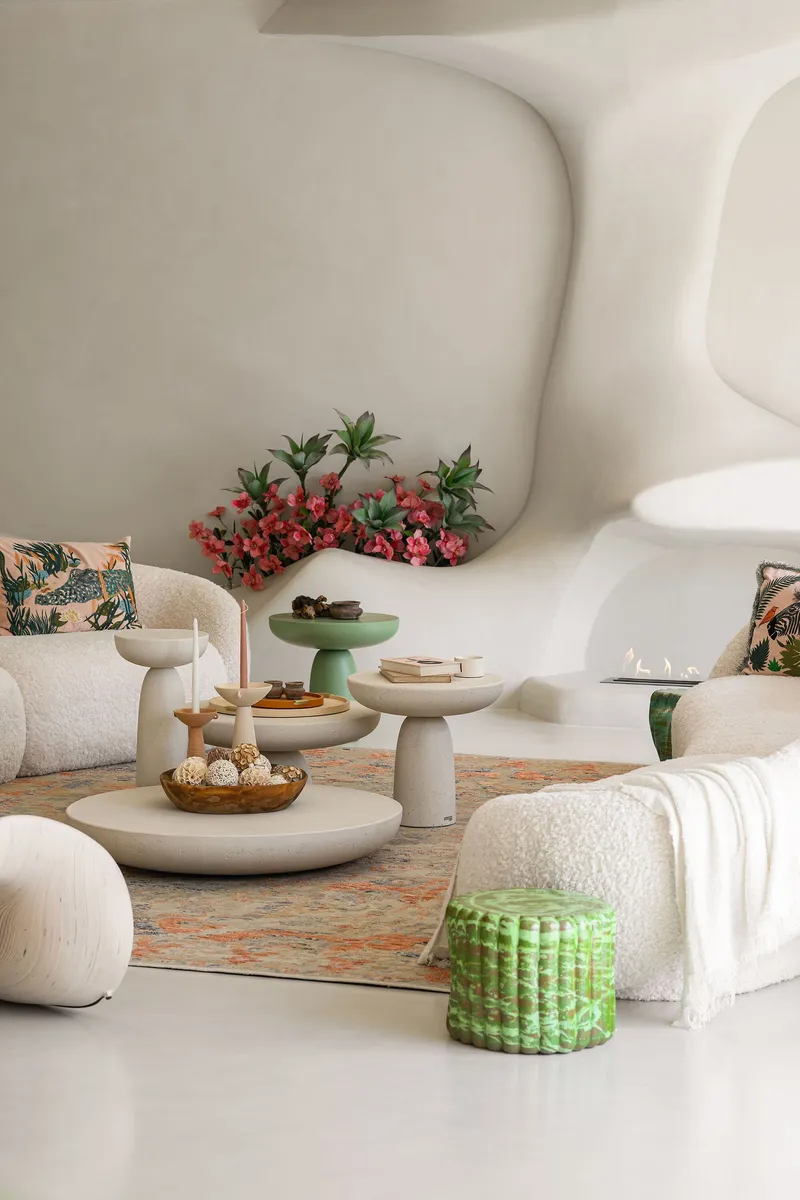
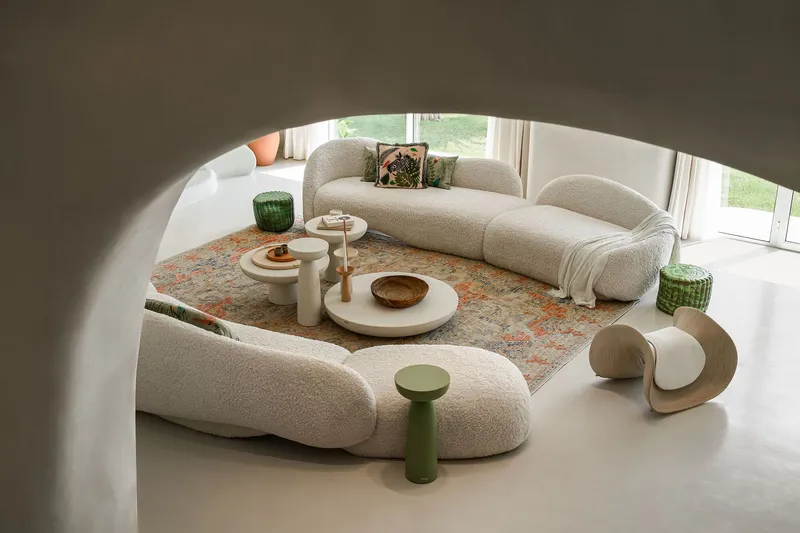
The living rooms at Beit Hawa deploy sculptural ceiling waves, sunken seating zones, and walls that billow outward as though pressurized from behind. Every surface carries a subtle modulation. Track lighting follows the ceiling's organic geometry, and low pedestal tables sit on patterned rugs that anchor the otherwise free-flowing space. The furniture is upholstered in earth tones and muted pinks, calm enough to let the architecture do the talking.
An overhead view of the sunken lounge reveals how floor-to-ceiling glazing connects the interior to garden views, pulling daylight deep into the plan. The room is not simply white; it is luminous, its plaster surfaces bouncing light in unpredictable ways that shift as the sun moves. The effect is less minimalism than it is a kind of material maximalism executed in a single material.
A Kitchen Where Trees Grow Along the Wall
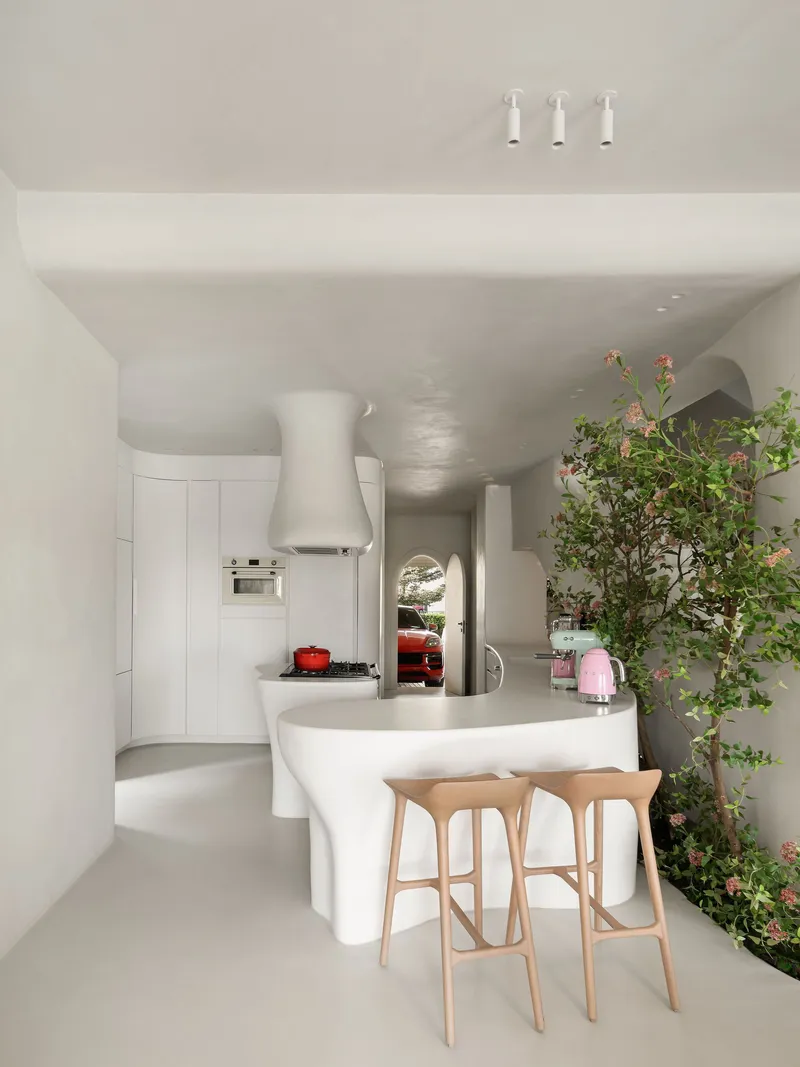
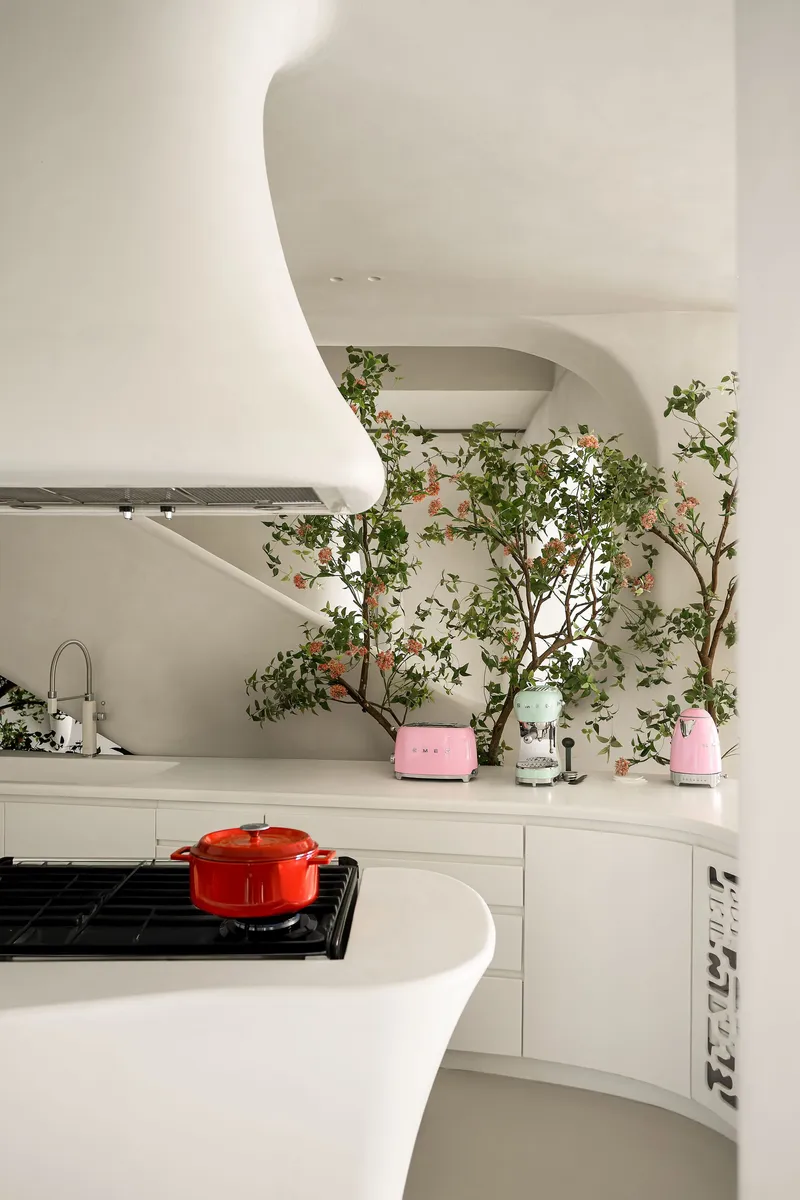
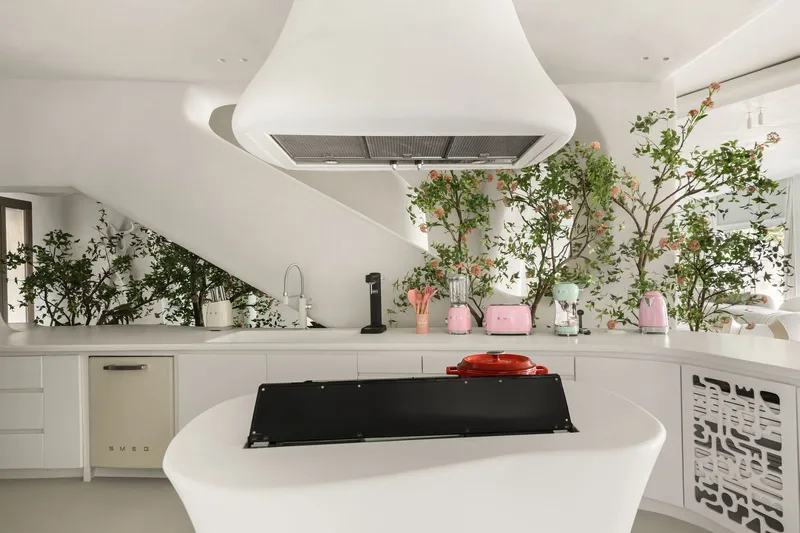
The kitchen might be the room that best captures Beit Hawa's ethos. A curved white island houses a black cooktop, and timber bar stools provide seating alongside a flowering tree that rises directly from the polished floor. Along one wall, espaliered fruit trees grow in a line, their branches trained against the plaster in a gesture that collapses the distinction between pantry and garden. It is practical and theatrical in equal measure.
Details like the pale blue refrigerator tucked beneath flowing plaster shelves, or the line of potted plants along the counter, reveal a designer who treats the kitchen as a living room with a cooktop rather than a utilitarian zone. The island's curved geometry prevents the room from reading as a conventional galley, and the integrated range hood disappears into the ceiling volume so completely that you might not notice it.
Bedrooms and the Art of the Arch
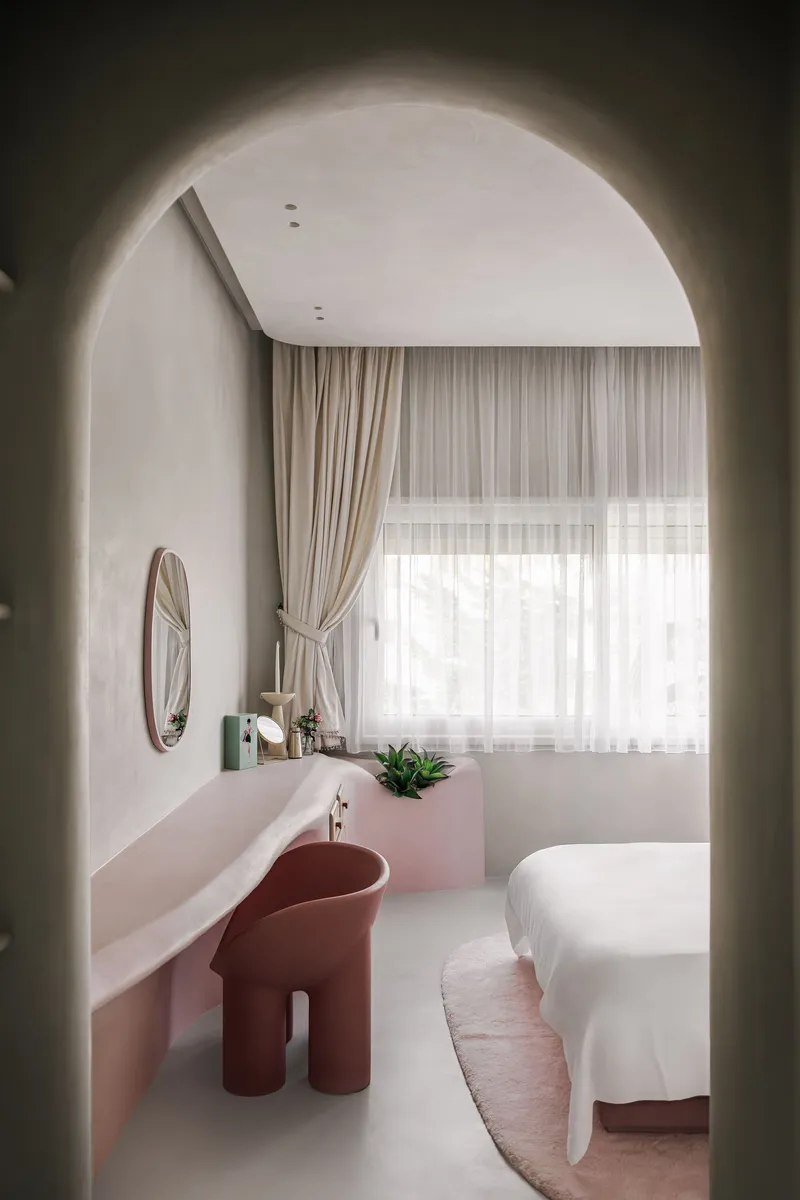
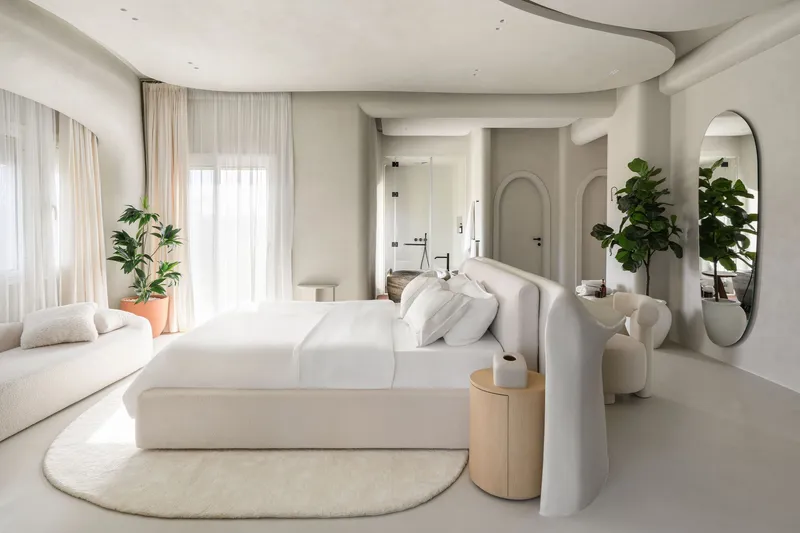
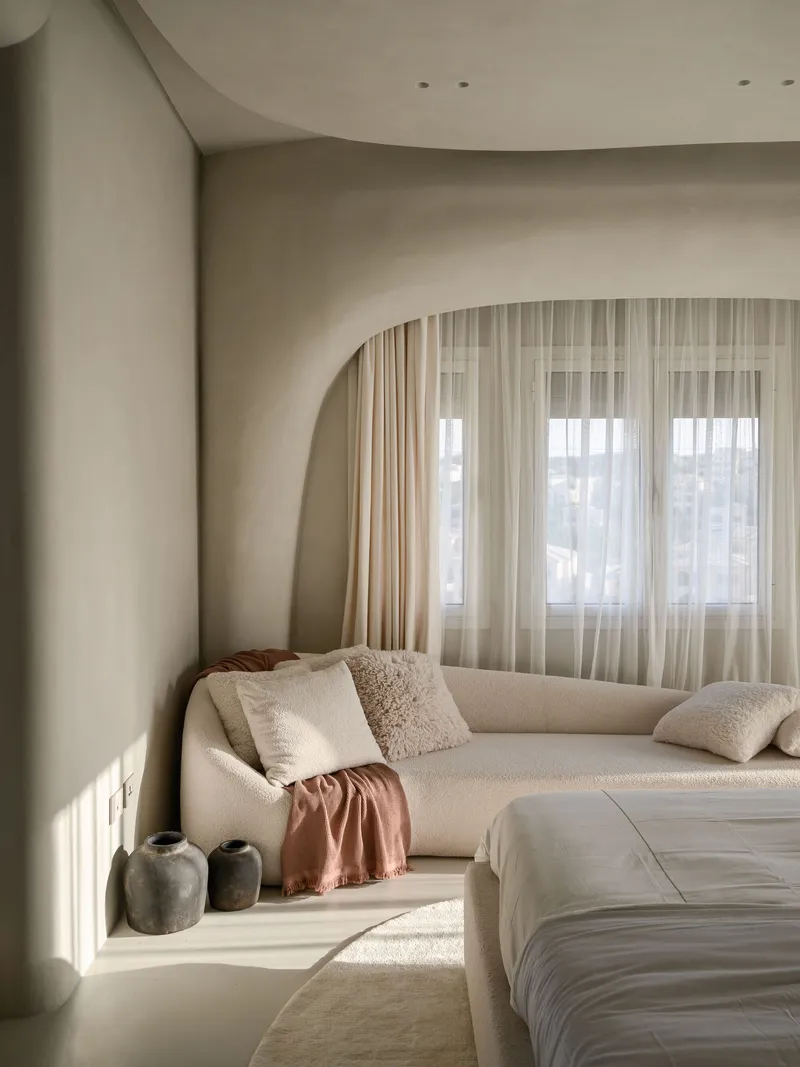
Beit Hawa's private rooms continue the vocabulary of arched openings and curved plaster, but at a more intimate scale. Bedrooms are entered through rounded archways that frame each room like a scene. A pink ledge desk and terracotta chair in one bedroom introduce color without disrupting the tonal palette. Layered curtains filter daylight into a warm, diffused glow that softens every edge further still.
An arched window alcove with a built-in daybed is perhaps the most coveted spot in the house: a niche designed purely for reading, napping, or watching the afternoon light shift. The curved ceiling overhead compresses the space just enough to feel sheltering without feeling small. It is a detail that speaks to the difference between designing a bedroom and designing a place to rest.
Bathrooms Carved From Stone and Light
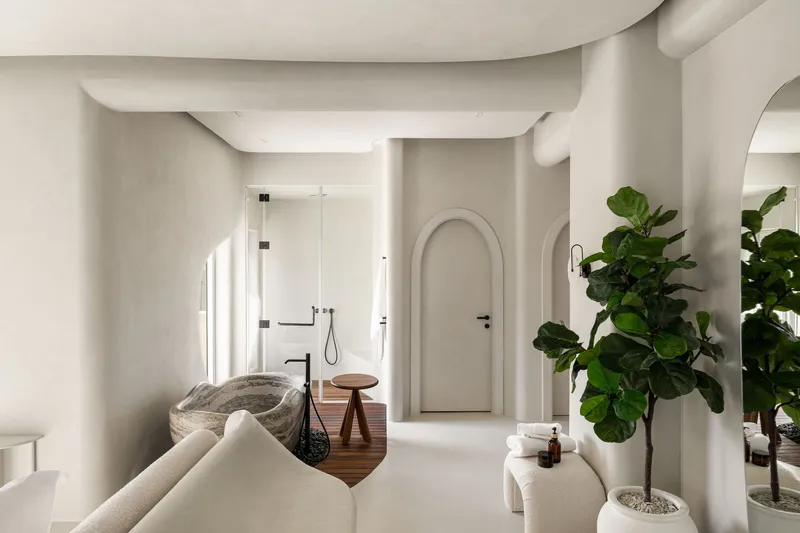
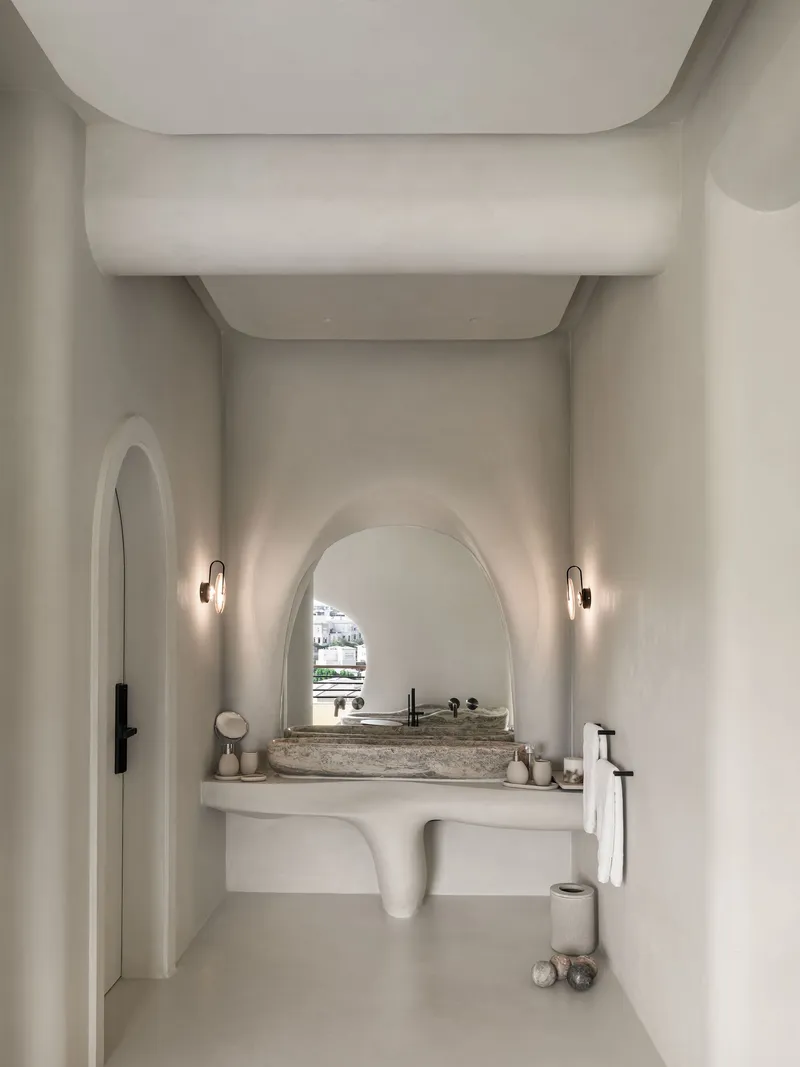
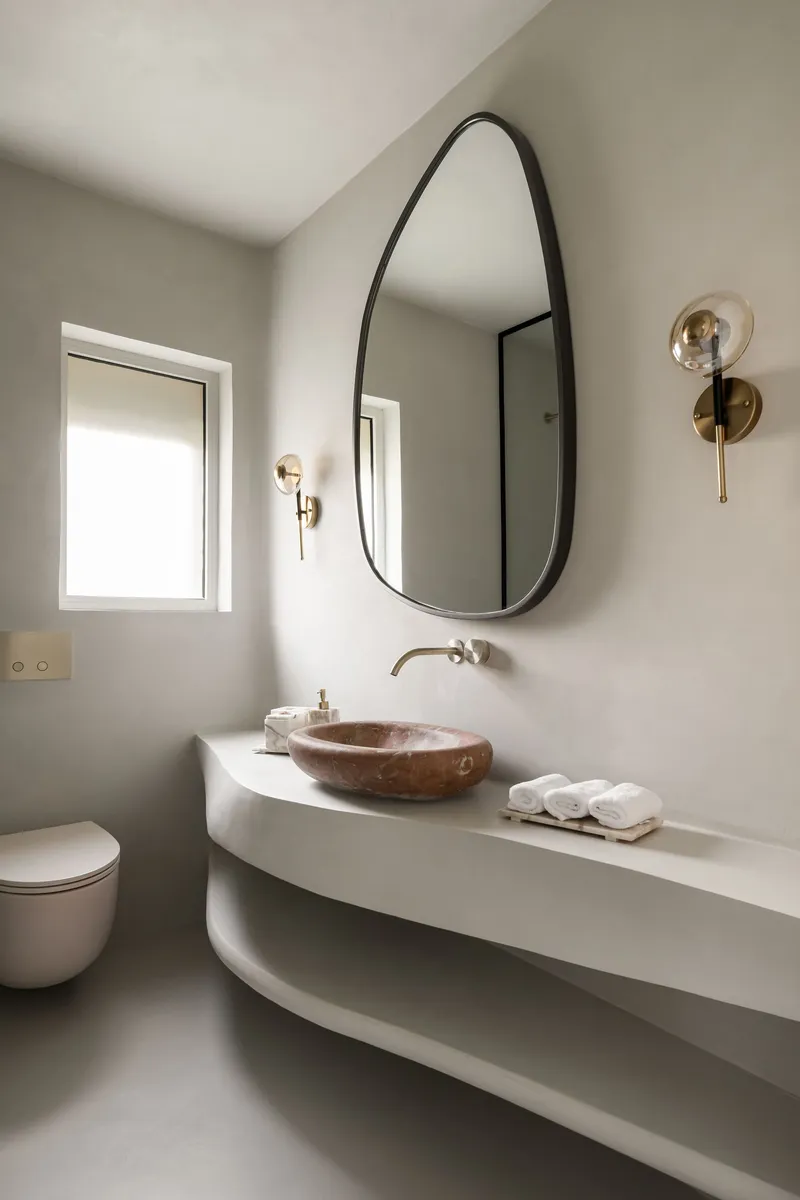
The bathrooms at Beit Hawa deserve their own conversation. A carved stone tub sits on a timber platform between arched doorways, flanked by fiddle-leaf fig trees that nearly reach the ceiling. The powder room layers curved ceiling volumes over an arched vanity niche and a stone basin, creating a sequence of nested forms that feel almost geological. A copper vessel sink with brass wall-mounted faucet and sconces in another bathroom introduces metallic warmth against the dominant white.
These are not spa-inspired bathrooms in the generic sense. They reference hammam traditions, the weight and coolness of carved stone, the intimacy of vaulted ceilings over water. The presence of living plants in every wet room reinforces the house's central argument: that nature is not something you look at through a window but something that shares your domestic routine.
The Garden as Architecture, Not Afterthought
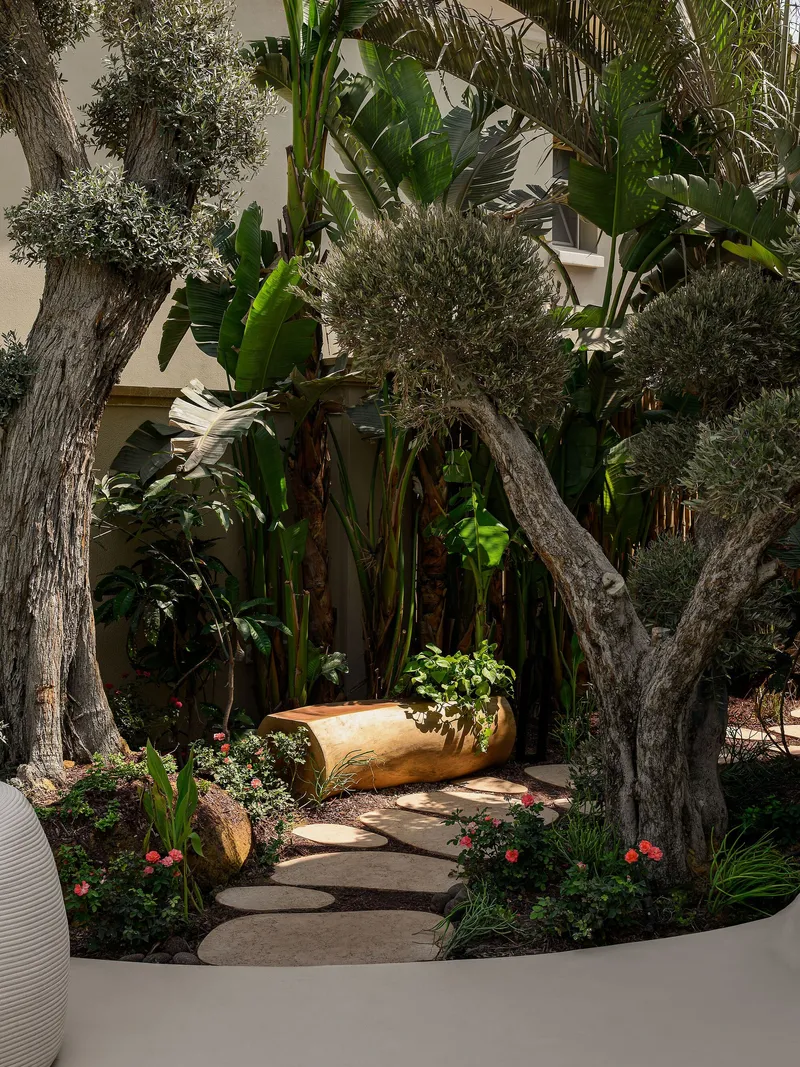
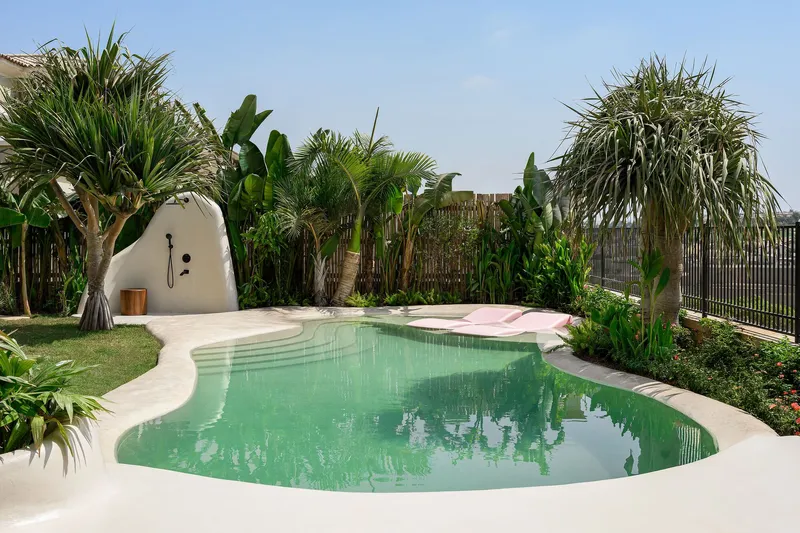
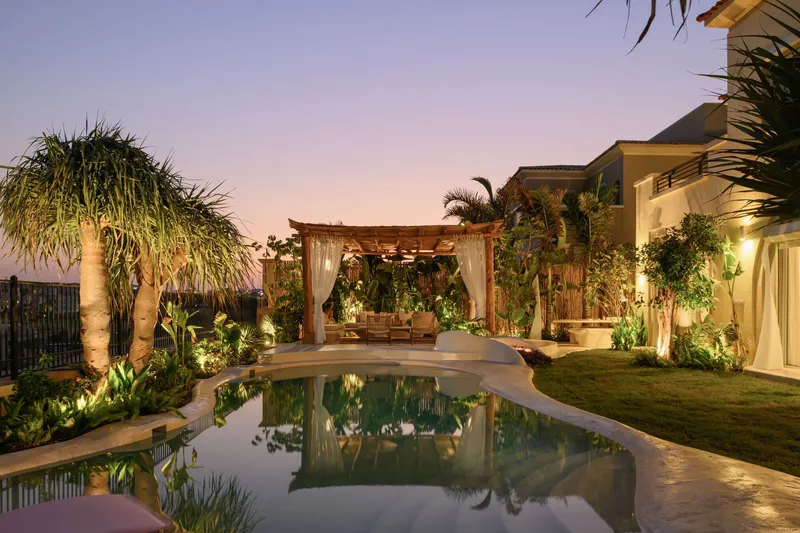
Outdoors, the landscape continues the project's organic logic. Stepping stone pathways wind through dense plantings of olive trees and banana palms. A kidney-shaped pool with pale green water sits on a lawn shaded by tropical canopy. At dusk, the timber pergola and pool terrace glow with uplighting, transforming the garden into a room with no walls. The planting is dense, varied, and deliberately wild in contrast to the controlled whiteness inside.
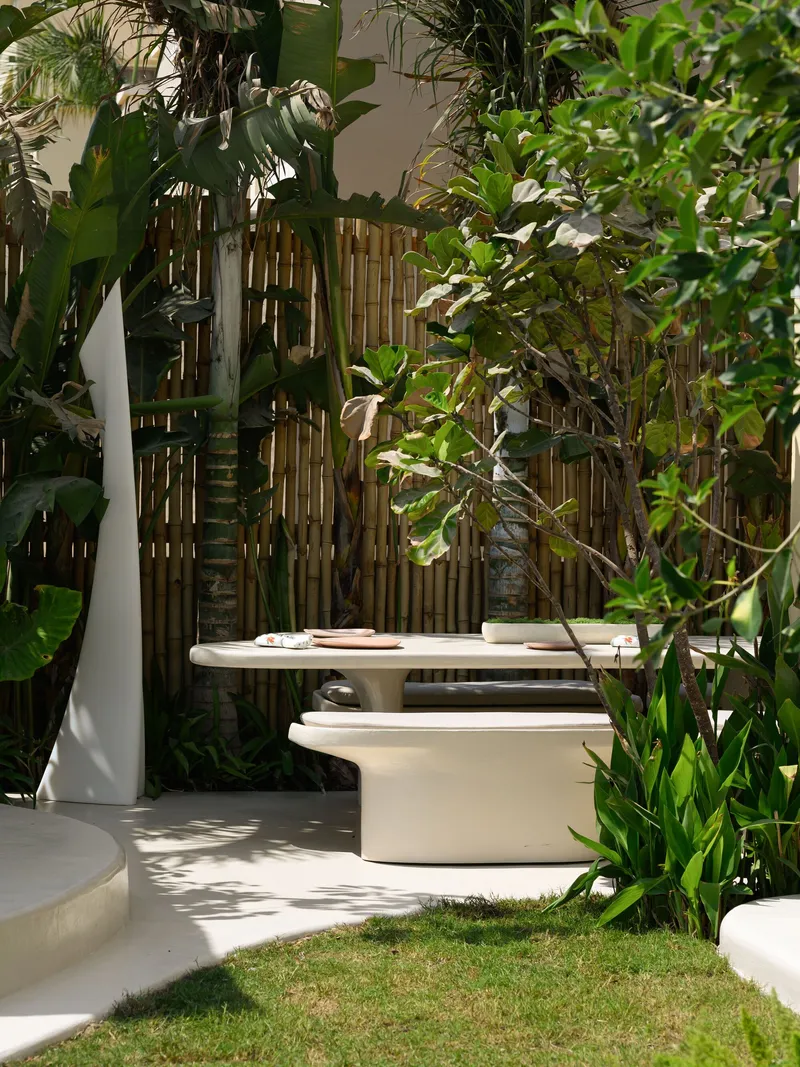
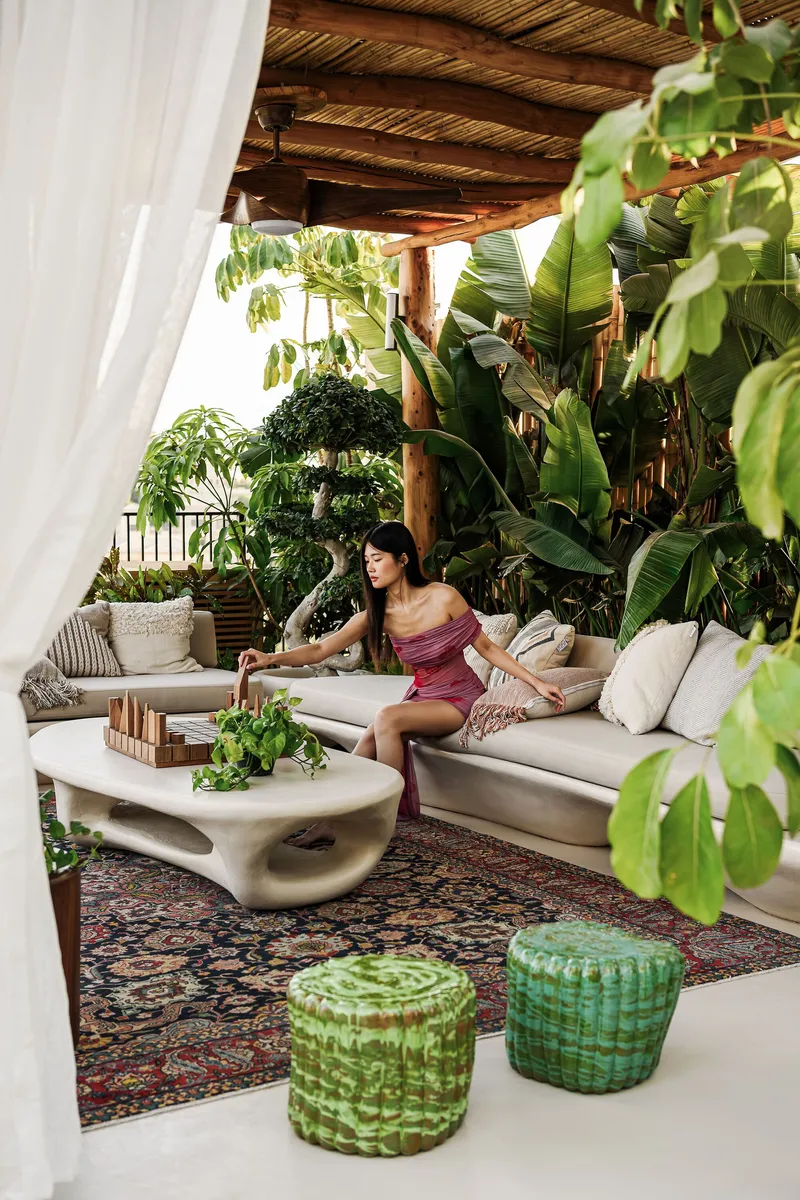
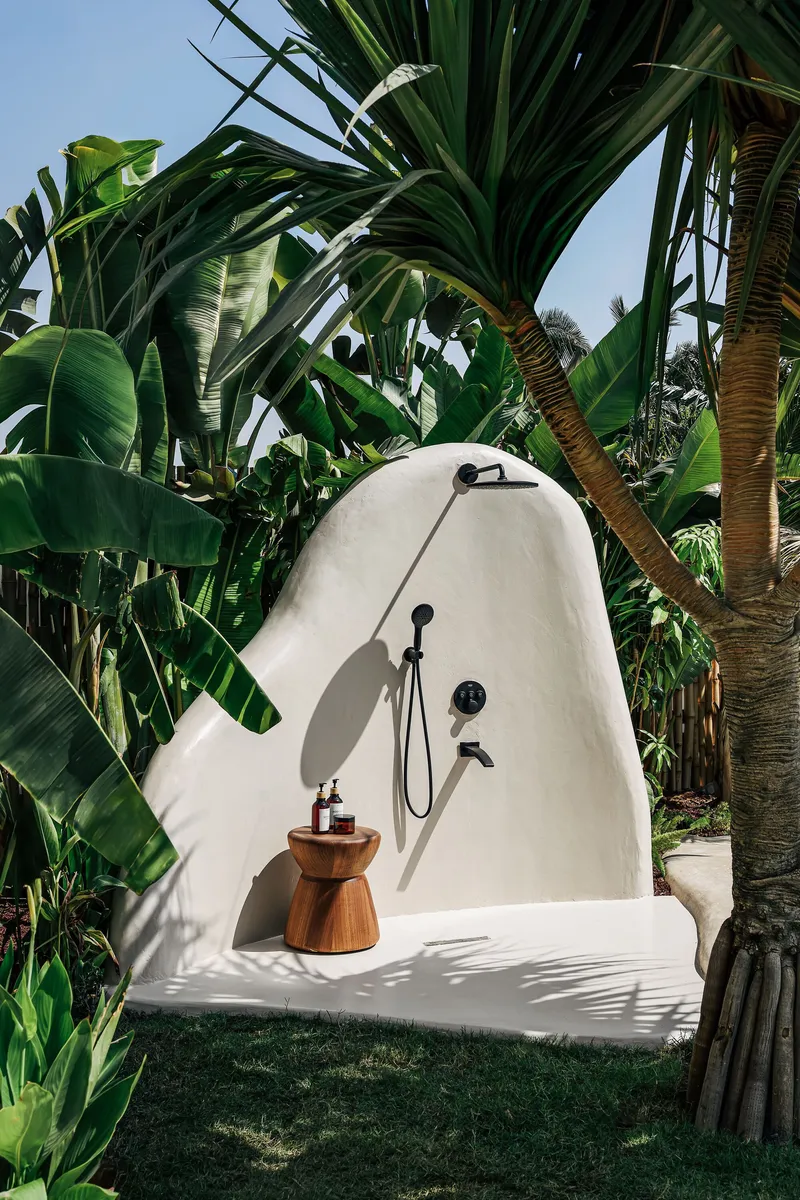
A bamboo screen wall defines an outdoor seating area where dappled sunlight filters through overhead foliage. An outdoor kitchen counter with integrated sink sits among banana palms. Even the outdoor shower gets its own curved plaster alcove, surrounded by tropical planting. The landscape design by Badie Architects treats every exterior space as a destination, not a leftover zone between the house and the property line.
Interior Details and Moments of Rest
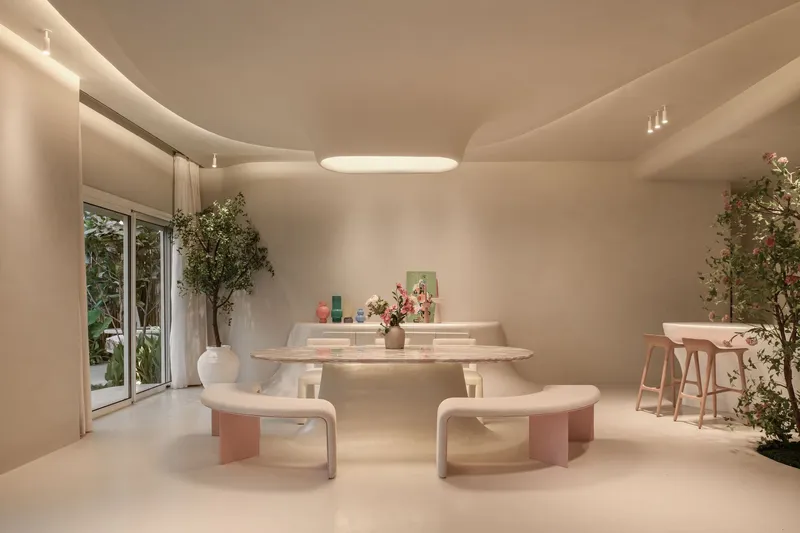
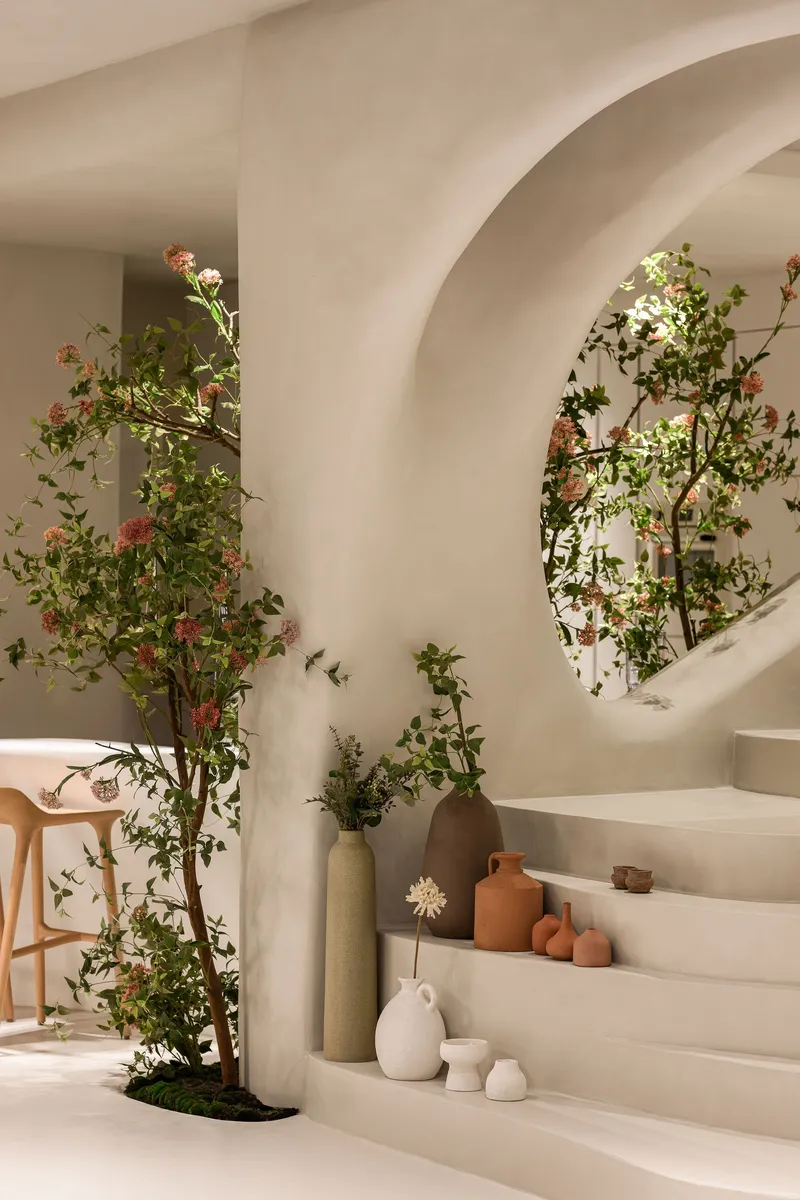
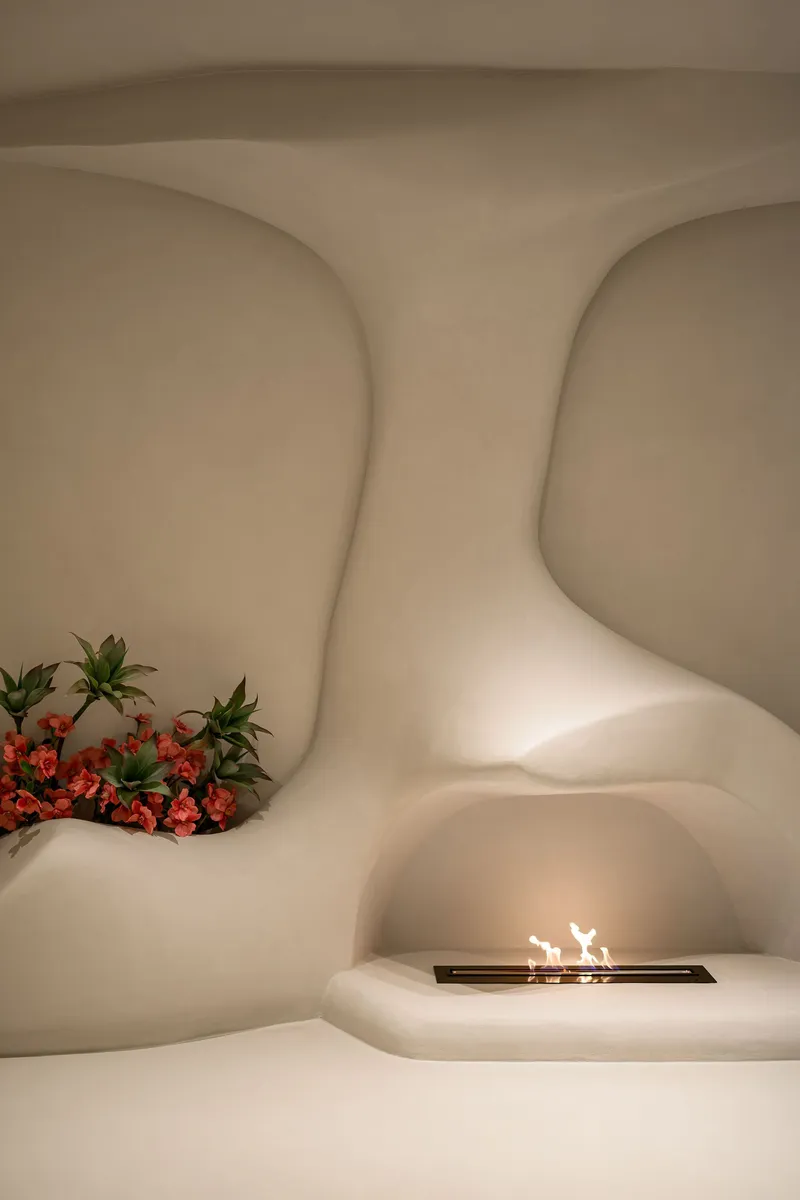
Throughout the house, smaller moments reward close attention. A dining area with a pale stone table and curved benches sits beneath soft ceiling light, the space made vertical by a potted tree rising alongside the table. A circular portal frames stepped display shelves with planted trees and ceramic vessels, creating a composition that reads as both functional storage and gallery installation. A built-in fireplace nestles inside a curved plaster alcove with a planted bed of flowering shrubs, a detail that summarizes the entire project in miniature.
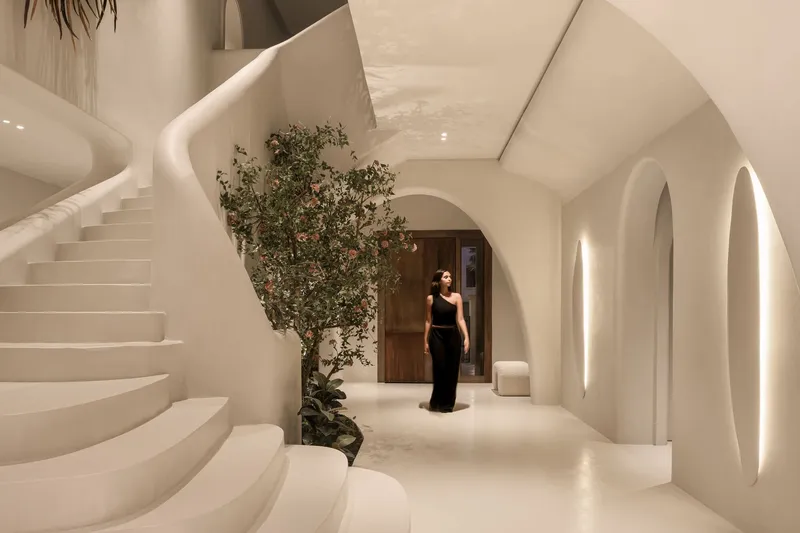
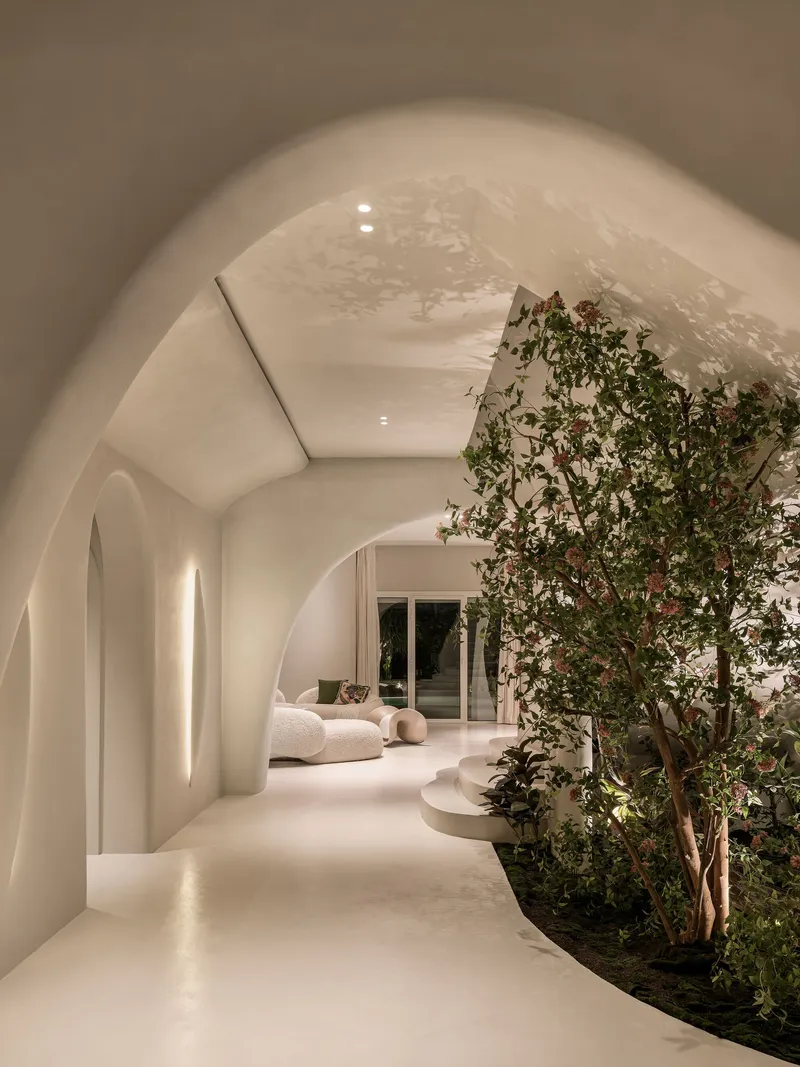
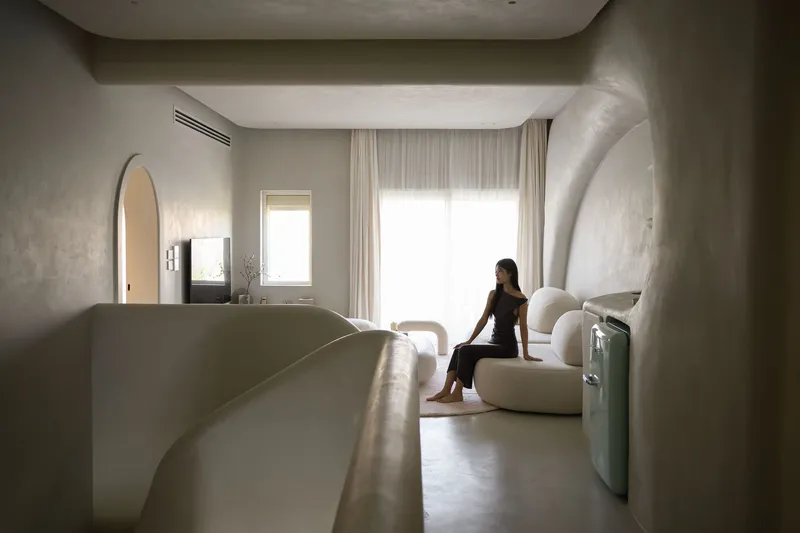
Corridors and transition spaces receive equal care. A vaulted hallway lined with planted trees and warm artificial lighting turns a passage into a procession. Entry halls glow with evening light through arched doorways. A woman seated on a curved bench beneath an arch, light streaming through sheer curtains: these are the moments Beit Hawa seems designed to produce, scenes of stillness within a house that never stops moving.
Plans and Drawings
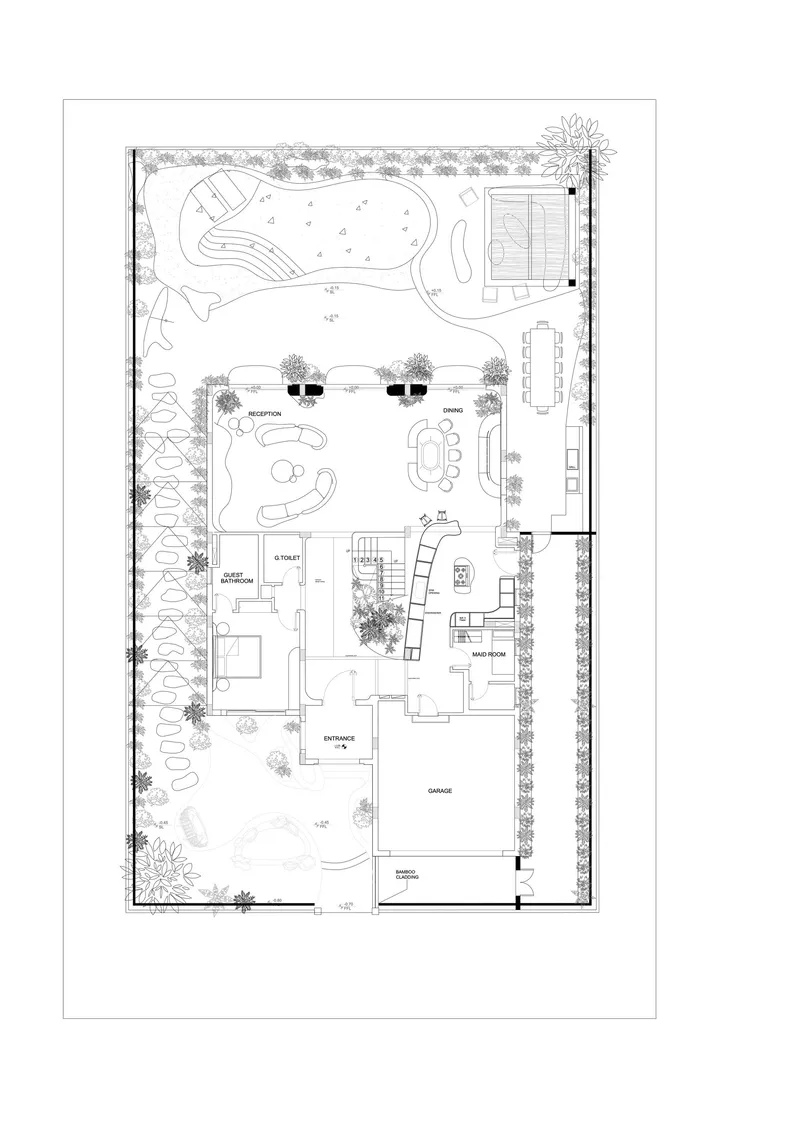
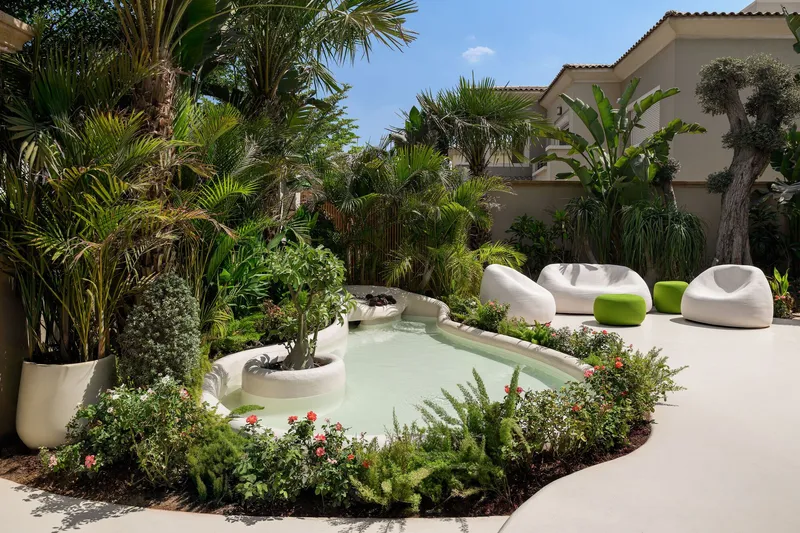
The site plan reveals the house's strategy in plan: a compact footprint organized around a central staircase core, with the pool and extensive landscaping consuming a significant portion of the plot. The courtyard with its shallow pool and planted beds mediates between interior living spaces and the wilder garden beyond. What the plan makes clear is that the organic curves visible in the interior are not arbitrary; they follow a consistent geometry that accommodates planting beds, circulation paths, and structural logic within a single flowing line.
Why This Project Matters
Beit Hawa matters because it demonstrates that a fully committed formal language, pursued through every room and detail, can produce coherence rather than monotony. Many contemporary houses dabble in curves or arches as accent moves. This project makes them the entire system, from the staircase to the shower alcove, and backs that commitment with real planting rather than token greenery. The result is a house that feels genuinely new in its totality, even if its individual gestures reference longstanding traditions in North African and Middle Eastern domestic architecture.
There is a risk, of course, that such total design becomes oppressive, that every surface screaming "I was sculpted" leaves no room for the occupant's own personality. But the abundance of living plants, the variety of light conditions, and the loose arrangement of furniture suggest that Badie Architects understood this danger and designed against it. Beit Hawa is a controlled environment that feels, against all odds, generous and alive.
Beit Hawa by Badie Architects (lead architect: Mohamed Badie). Al Abageyah, Egypt. 500 m². Completed 2025. Photography by Nour El Refai.
About the Studio
Share Your Own Work on uni.xyz
If projects like this are the kind of work you want to make, uni.xyz is a place to publish your own, find collaborators, and enter design competitions.


Popular Articles
Popular articles from the community


Play: Fragments of Their World
Familiar architecture becomes modular playground design, creating safe spaces where displaced children can learn, connect, imagine and play.

The Musturak Paradise: Senior Living Architecture for a Connected Future in Temara, Morocco
The Musturak Paradise reimagines senior living architecture in Temara via private homes, social spaces, culture, community, and shared care.

ALGAL REALM: A Bio-Integrated Lunar Habitat Design for Life Beyond Earth
ALGAL REALM reimagines lunar habitat design with algae-powered life support, 3D-printed regolith, and vertical living for a lunar future.

Conexión: Biophilic Design Reimagines High-Rise Living in Hong Kong
Conexión reimagines high-rise living in Hong Kong through biophilic design, green facades, shared spaces, daylight, water and nature within.

Similar Reads
You might also enjoy these articles

Bao Huynh Watercolor Atelier: A Serene Art Retreat in Hội An
Bao Huynh Watercolor Atelier in Hội An blends multifunctional art spaces, sustainable design, local materials, and family-friendly living in a serene environment.

Atelier Macri Concept Store Interior Design by CASE-REAL
Atelier Macri store features a "ko" counter, walnut wood details, cork displays, blending retail, gallery, and seamless customer experiences.

Manuel Vargas Izquierdo Stadium and High-Performance Sports Center: Architectural Excellence in Jalpa de Méndez
The Manuel Vargas Izquierdo Stadium blends sustainable design, inclusive sports facilities, and cultural-inspired architecture, revitalizing Jalpa de Méndez’s public spaces.

KAKR Buluh Awar Hall: Revitalizing Community and Ecology Through Bamboo Architecture
Community built bamboo hall revitalizes Buluh Awar village, empowering youth, restoring ecology, celebrating vernacular craftsmanship through sustainable architecture and culture.


Comments (0)
Please login or sign up to add comments
No comments yet. Be the first to comment!