

Balance of Power
An essay on the history and the modern-day relationship between politics and architecture.

Since the early stages of human civilization, architecture and politics have always been intertwined. From the early empires of Greece, Egypt, and Rome to the modern-day superpowers, the intangible relationship between these two has transcended both time and history. Politics has used architecture as a platform and vice versa, having said this, it comes as no surprise that politics influences architecture, and inversely, architecture (on occasion) influences politics. With that influence, the pair has achieved many things together (both good and bad). On the bright side, the mere strength of political will is enough to ignite infrastructure initiatives and create awe-inspiring architecture. Inversely, politics can also be the greatest detriment to architecture. Additionally, there have been occasions where outside forces pressure politics to bend to their will, and, in turn, politics pressures architecture. The relationship between the two is complex, to say the least, but with all its deep negatives and overwhelming positives, it is this relationship that has helped significantly spur the development of our civilization (whether good or bad).
Politics has manifested in architecture since the primordial era of our civilization. In the olden days, this manifested as bigger huts or bigger dwelling spaces for the tribal leaders. As our civilization progressed, the manifestations grew along with it. The early empires created towering statues to honor their pantheon of deities (i.e., the Statue of Zeus, the Sphinx, Obelisks, etc.) and grandiose structures that exemplify the strength of their builders (i.e. The Great Lighthouse, The Parthenon, The Pyramids of Giza, The Colosseum, The Pantheon, etc.). During the Middle Ages, the manifestations became religiously inclined, but political, nonetheless. The political will of the Catholic Church, at the time, birthed some of the most iconic pieces of architecture known throughout history. Instead of towering and grandiose structures honoring multiple people and/or deities, they became devoted predominantly to one entity: God. Fast forward to the Pre-Modern and Modern Era: mankind’s newest manifestation was infrastructure. Factories, buildings, and eventually, skyscrapers were all the rage. These new types of structures and construction marvels replaced the monuments of old. While the relationship shifts back and forth from mutualism to parasitic (depending on the alignment and relationships of those involved), architecture and politics always seem to be drawn to one another, expressing this complex relationship throughout history and via many channels and works.
Although historically used to show strength, some politicians influence architecture to showcase a strong sense of nation-building. A good example of this in the modern era is Singapore’s former Prime Minister Lee Kuan Yew who used his political influence to transform the former fishing village into one of the most efficient and urbanized cities in the world. As most of us know, Singapore is a paragon of ideal living in the modern era. This case is a good example to show the mutualist relationship between politics and architecture as well as the success that the relationship can generate. On top of that, the complex relationship between architecture and politics has taken a rather divisive turn. In the past, we have seen more cases of politics influencing architecture than the inverse. Fortunately, there has been a paradigm shift in that aspect of the relationship. Today, architecture has the influence to amplify benevolent intent and challenge malevolent power. Either through protest installations or by projects that push the envelope of the relationship, there are many examples of this ‘challenge’ aspect of the relationship between politics and architecture. Much like the new design dynamics of BIG’s Tallin City Hall or the ingenious solution of Alejandro Aravena to the Chilean housing problem, the architecture of the modern era has demonstrated a renewed sense of societal resolve against the control of politics over architecture. In this case, the introduced concept and design dynamics by BIG and the solution proposed by Aravena are both examples of an undeniable resolve to balance the power dynamics. Though not directly, the architects of today have found a chink in the armor or a gap in the defense, if you will, of political control over architecture, and to an extent, the built environment. It is only through this gap that we can successfully navigate a new relationship that not only works for us but also benefits society. These two cases I have given are prime examples of architects renegotiating the balance of power and responsibility in the relationship. Instead of giving in to the commands of the politician, our profession has successfully found a way to not only create iconic architecture in a tumultuous setting but to also have the power to hold politicians accountable for their actions. Instead of perpetuating the high status of politicians, BIG proposed a new, more “accountable” dynamic in which there are elements of the design that can show politicians that they’re held liable for their decisions (i.e., the public is allowed in the plaza at the ground floor of the town hall, a mirror showing the reflection of Tallinn is integrated into the session halls, etc.). In addition, while Aravena’s solution to the Chilean housing dilemma isn’t political, the climate in which he conducted his solution was. Alejandro Aravena’s situation was a modern parallel to the days of old. In the olden days, politicians or those in power would dictate their uncompromising desires to the architects/designers/builders of the era and expect them to execute just as they imagined. Although instead of presenting an uncompromised solution, Aravena gave them a realistic and reasonable compromise.
Long story short, unlike the architects and designers of old, most, if not all modern-day architects weigh the needs of the public more than the needs of the politicians and politics. This is a significant shift in the relationship, especially because the opposite is true if you look at it from a historic point of view. The moral of the examples that I have given is simple: architecture has the influence and knowledge to work alongside politics, not beneath it nor above it. The same holds true for the relationship that architects have with the public, but that’s a conversation for another time. The old relationship between politics and architecture should serve as a perennial history lesson: it is not wrong for politics to influence architecture, it is, however, wrong to distort society through architecture. A good case of the aforementioned thought is the architecture in places like North Korea. Since their form of government relies on nationalistic propaganda, it is both fascinating and despicable to use the art form that is architecture to distort the lens of their society. It is the mark of a healthy society to allow its citizens to think for themselves and that is exactly the right that they are robbing their people off. It is also ironic to use an art form (any art form), particularly one that celebrates individual thought and expression like architecture to fulfill their political agenda. Thankfully, the architecture profession has developed the knowledge and theory to allow for a function other than building the uncompromising wants of those in power. The reason why modern-day architects can create compromises in the context of architecture and politics is that we have the know-how to solve more complex issues than ever before. This and the reliance on the mastery of creating are the reasons why those in power trust the judgment of architects more than ever. It is in this expertise where we must constantly apply our trade and educate all those involved in the design process, to guide it in the proper direction, as opposed to having a person in power dictate their terms which would benefit nobody.
To sum up, it’s quite easy to get lost in the complex relationship between politics and architecture. Those in power and those with the power to build have often tangled with one side being the clear leader, and the other, the follower. Thankfully, those days have changed. The architecture profession has more power and influence to create and design without the constant direction and influence of those in politics. While some may still use architecture as a weapon against the public, I like to believe that more modern-day architects uphold their social responsibility instead of their responsibility to those in power. Shifts in the style of governments from autocracy to democracy also have a great influence on architecture’s influence and power as well. Of course, democracy would cater to the needs of the public before the needs of the politicians, and it is there where part of our strength lies. Any architecture, whether commissioned or influenced by politicians, that suppresses or brainwashes the public is an aberration that must be corrected. In an ideal world, the relationship between architecture and politics would be purely mutualistic. Come to think of it, it should exist that way due to the nature of the two. However, since the ideal scenario isn’t the case, we must use the powers of democracy and compromise to redefine the relationship between politics and architecture, because only by redefining the relationship can we help the public in negotiating a proper balance of power. This balance of power ensures that we have more leverage and influence over the built environment, to create a better and hopefully more sustainable one compared to the monuments of old.



Popular Articles
Popular articles from the community


The Earth Pod: 3D Printed Homes for Resilient Refugee Communities
The Earth Pod reimagines refugee housing through 3D printed homes made from clay, combining resilience, self-sufficiency, and rapid shelter.

Riyadh For All: Intergenerational Urban Design for Active Aging in Rabat
Riyadh For All reimagines urban design in Rabat with intergenerational co-living, adaptive courtyards, and Moroccan cultural exchange today.

Co-life: Sustainable Architecture for Age-Friendly Community Living
Co-life reimagines sustainable architecture for seniors through courtyards, rammed earth, shared gardens, and spaces designed for belonging.

Conexión: Biophilic Design Reimagines High-Rise Living in Hong Kong
Conexión reimagines high-rise living in Hong Kong through biophilic design, green facades, shared spaces, daylight, water and nature within.


Similar Reads
You might also enjoy these articles

Day and Night Park: A Time-Based Urban Newsstand in Beijing
A temporary urban newsstand in Beijing blending travel, light, and reading through poetic colors, compact form, and community-focused design.

Modernist Patio Renovation in El Masnou, Barcelona by Oliver Segura Arquitectura + Cebrià Arquitectura
Modernist patio renovation blending tradition and innovation with a movable pool, leveled floors, and Catalan materials in El Masnou.

Alto Residencial Coop: Cooperative Housing Development in Santiago de Compostela by Carbajo Barrios Arquitectos
A linear cooperative housing complex blending white volumes and perforated metal façades, enhancing community living, natural light, privacy, and urban integration.
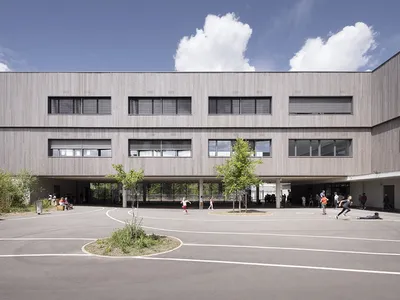
Vil Genis School by BPA ARCHITECTURE – Massy, France
Vil Genis School in Massy, France, features sustainable design, south-facing classrooms, community integration, accessible spaces, and modern educational architecture.


Comments (0)
Please login or sign up to add comments
No comments yet. Be the first to comment!