

Balloon Carnival: A Pop-Up Installation That Lures City Dwellers Away From Their Screens
Inspired by a classic French short film, this ephemeral urban intervention turns sidewalks into stages of interaction and play.


What if a balloon could change the way you experience a city? The Balloon Carnival takes that premise literally, scattering glowing, soft-to-the-touch balloon canopies across urban sidewalks and plazas to pull pedestrians out of their screen-induced tunnels and back into physical, communal space. It is part sensory installation, part spatial therapy: an ephemeral architecture that treats overstimulation with childlike wonder rather than more noise.
Designed by Chauyee Jang, the project was shortlisted in the Elevate 2019 competition. Drawing direct inspiration from The Red Balloon, the 1956 French short film in which a sentient balloon leads a boy through the streets of Paris, Jang translates that quiet, magical bond between child and object into an architectural proposition for contemporary cities.
Reading the City at Dusk: Context as Catalyst

The street-level perspective here is telling. High-rise buildings frame a corridor of asphalt and headlights, a suspension bridge hovering at the vanishing point. This is the dense metropolitan rhythm Jang identifies as the problem site: a landscape engineered for throughput, not dwelling. Pedestrians move through it with eyes lowered, attention captured by the small rectangles in their palms. The Balloon Carnival is conceived as an interruption in exactly this kind of corridor, installed within adaptable sidewalk volumes so it can slot into the existing urban fabric without disrupting traffic flow while still commanding attention upward.
White Discs on the Plaza: Canopies That Invite a Pause
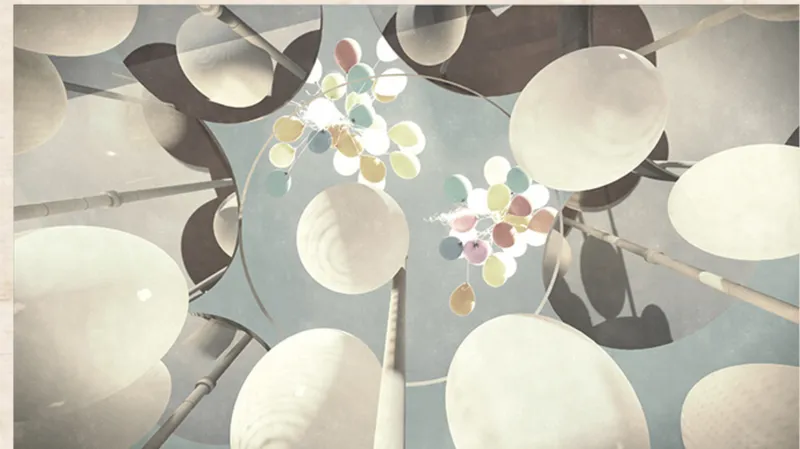
Seen from above, the installation reveals its spatial logic. White disc-shaped canopies are distributed across a plaza, each one creating a distinct pocket of shade and enclosure beneath it. People are seated, lingering, talking. The arrangement is neither gridded nor random; it reads as a loose constellation that encourages movement between nodes. Each canopy functions as a visual beacon and a temporary landmark, transforming flat, undifferentiated public space into a sequence of addressable places. The overhead view makes the point clearly: what was open pavement becomes a landscape of social micro-events.
The formal choice of the disc, soft-edged and luminous, reinforces the balloon metaphor without literalizing it into kitsch. These are functional shelters that happen to carry a memory of buoyancy and play, acting as what Jang describes as spatial therapy for overstimulated city dwellers.
Waterfront Play: Where Architecture Meets Childhood Curiosity

On a waterfront lawn, the balloon-shaped canopies take on a different character. Children run beneath and around them, the bridge visible in the background anchoring the scene in a recognizable urban waterfront condition. The shift from hard plaza to soft lawn demonstrates the installation's adaptability: it is designed to work across surface types and contexts, maintaining its identity while responding to local conditions. Here, the cinematic reference lands most directly. A child chasing a balloon across green grass echoes the Parisian streets of The Red Balloon, but reframed as collective, public experience rather than solitary fantasy.
The installation's materiality matters. The canopies are described as soft to touch and alluring in motion, suggesting a fabric or inflatable construction that responds to wind and contact. This tactile quality is central to the project's ambition: it asks people to engage not just visually but physically, bridging the gap between looking and participating that defines so much passive urban experience.
Why This Project Matters
The Balloon Carnival operates at a scale and with a lightness that makes it easy to underestimate. It proposes no new buildings, no permanent infrastructure, no programmatic complexity. What it does propose is a recalibration of attention. In a design culture increasingly drawn to large-scale, technology-heavy interventions, Jang's project argues that a few well-placed, tactile, glowing objects can do more for public life than a million-dollar digital façade.
The strength of the concept lies in its legibility. Everyone understands a balloon. Everyone remembers holding one. By leveraging that universal memory and scaling it to architectural dimensions, the project collapses the distance between designed environment and human emotion. It turns sidewalks into stages, as Jang puts it, and in doing so makes the case that urban regeneration through play is not a soft option but a serious spatial strategy.
View the Full Project
About the Designers
Designer: Chauyee Jang
Enter a Design Competition on uni.xyz
uni.xyz runs architecture and design competitions year-round that reward proposals with spatial conviction and real site intelligence.
Project credits: Balloon Carnival by Chauyee Jang Elevate 2019 (uni.xyz).


Popular Articles
Popular articles from the community


EW PARK: Sustainable Architecture Reimagines the Future of Urban Parking
EW PARK reimagines city parking as a modular wooden tower combining automation, solar energy, electric mobility, and adaptable urban design.

Co-Life: Senior Housing Design That Reconnects Older Adults With the City
Co-Life reimagines senior housing design through healing gardens, shared streets, workshops, and a sustainable community across generations.

Co-life: Sustainable Architecture for Age-Friendly Community Living
Co-life reimagines sustainable architecture for seniors through courtyards, rammed earth, shared gardens, and spaces designed for belonging.

The Musturak Paradise: Senior Living Architecture for a Connected Future in Temara, Morocco
The Musturak Paradise reimagines senior living architecture in Temara via private homes, social spaces, culture, community, and shared care.

Similar Reads
You might also enjoy these articles
The Musturak Paradise: Senior Living Architecture for a Connected Future in Temara, Morocco
The Musturak Paradise reimagines senior living architecture in Temara via private homes, social spaces, culture, community, and shared care.

The Leaf Center: Cultural Center Architecture for Social Integration in Amsterdam
Cultural center architecture becomes a bridge at The Leaf Center, connecting international students with Amsterdam through art and exchange.

Conexión: Biophilic Design Reimagines High-Rise Living in Hong Kong
Conexión reimagines high-rise living in Hong Kong through biophilic design, green facades, shared spaces, daylight, water and nature within.

Wander to Wonder: Modular Playground Design for Children in Kutupalong Refugee Camp
Wander to Wonder uses modular playground design to create flexible, imaginative play spaces for children in Kutupalong refugee camp.


Explore Urban Circus Competitions
Discover active competitions in this discipline


Challenge to design a portable theatre

Challenge to design a portable music platform

Challenge to design lighting inspired by nature

Challenge to design an open learning module for the elderly
Comments (0)
Please login or sign up to add comments
No comments yet. Be the first to comment!