

BIROE Architecture Weaves a 32-Meter Bamboo Dome for World Leaders at the G20 Bali Summit
Built by 40 Balinese artisans in Gianyar and assembled in three weeks at Nusa Dua, the pavilion turns bamboo into diplomacy.


When twenty heads of state sat down for lunch on November 15, 2022, they did so inside a structure that could be disassembled and returned to the earth. BIROE Architecture designed the Bamboo Dome as a non-permanent pavilion for the G20 Summit in Bali, positioning it on the Ocean Front Lawn of the Apurva Kempinski Hotel in Nusa Dua, directly facing the beach. At 805 square meters and 32 meters in diameter, the dome is large enough to seat the world's most powerful leaders at full round tables, yet it was prefabricated in the bamboo villages of Gianyar district and assembled on site in just three weeks.
What makes this project genuinely interesting is not the spectacle of bamboo at scale, which Bali has seen before, but the speed, intentionality, and layered cultural symbolism packed into a temporary lunch venue. Every surface, from the structural ribs to the dining tables, is bamboo. The decorative program draws on Balinese shadow theatre and sacred lotus iconography. And the whole thing was built by roughly 40 artisans from Belega Village in Gianyar's Blabatuh district, people for whom bamboo construction is not a trend but a generational practice. The dome makes a case that sustainability at the highest political stage does not require imported technology. Sometimes it requires trusting local craft.
A Circle on the Shoreline
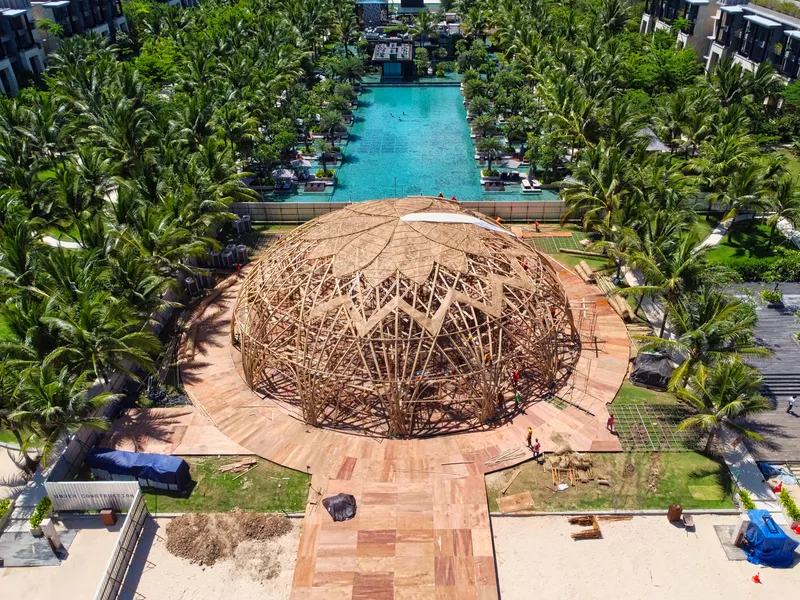
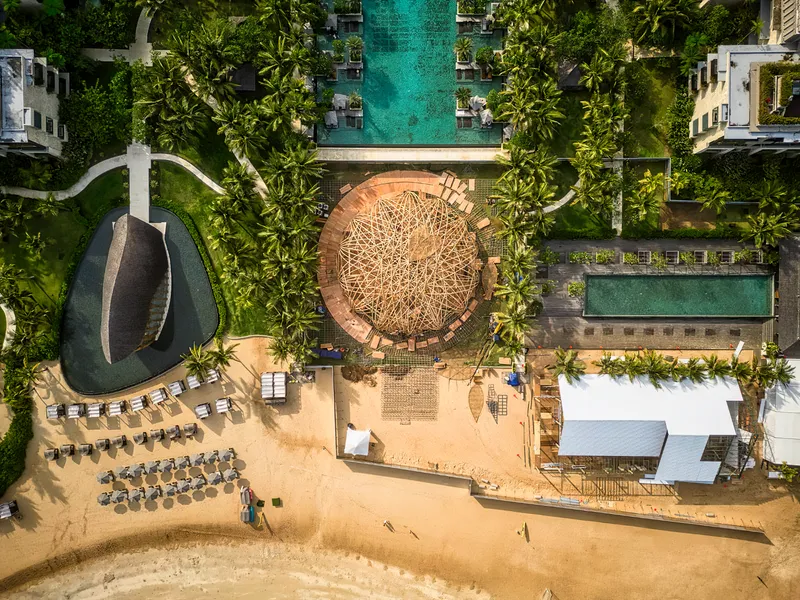
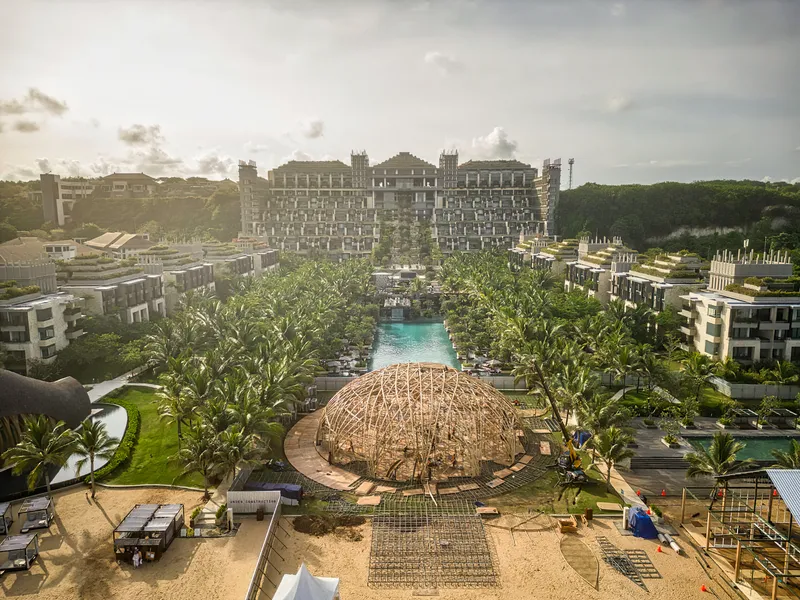
Seen from above, the dome reads as a tightly woven disc nestled between the Indian Ocean and the hotel's rectangular swimming pool. The siting is deliberate: the circular plan, free of any dominant axis, reinforces the diplomatic symbolism of equality among participating nations. There is no head of the table when every table is round and the room itself has no front or back.
The aerial views also reveal just how precisely the pavilion threads between existing landscape elements. Palm trees, pool decks, and manicured lawns remain intact, a consequence of both the structure's non-permanent classification and its modular prefabrication. Nothing was demolished. The dome simply arrived and took its place.
Structural Ribs and the Logic of the Weave
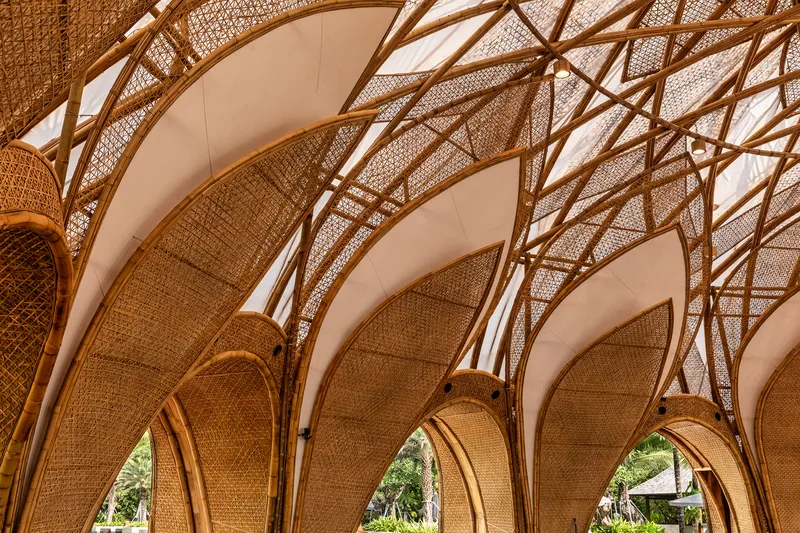
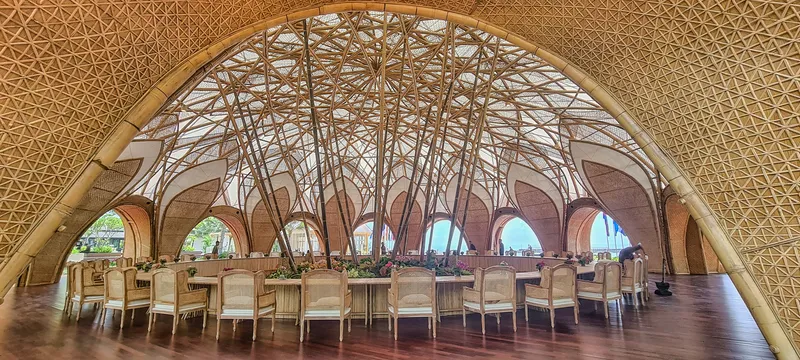
Step inside and look up. The dome's interior reveals an intertwining structural framework where curved bamboo ribs rise from the perimeter and converge at a radial lattice at the crown. Weight distribution across the dome is equalized through this interlocking geometry, an approach that borrows from the way bamboo grows in clusters, each culm supporting its neighbors. The structural engineering, overseen by Ir. Ashar Saputra of Gajah Mada University, translates this natural principle into a buildable system.
Between the ribs, woven rattan panels fill the ceiling surface. These are not merely decorative. The woven bamboo lotus flowers integrated into both interior and exterior ceilings function as passive heat barriers, reducing solar gain where direct sunlight would otherwise penetrate the dome. It is climate control through craft, not machinery, and the effect is both visible and tactile.
Arches That Frame the Landscape
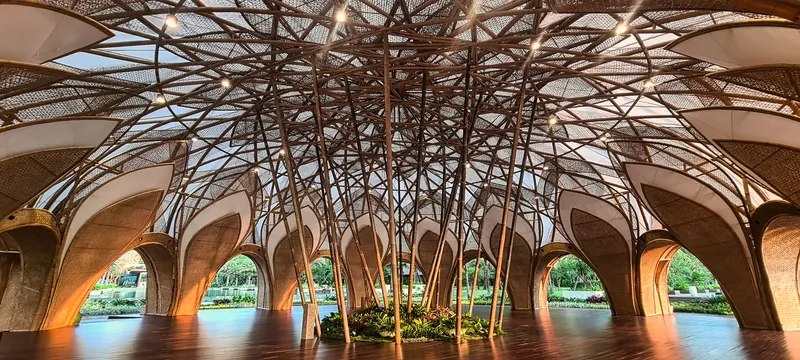
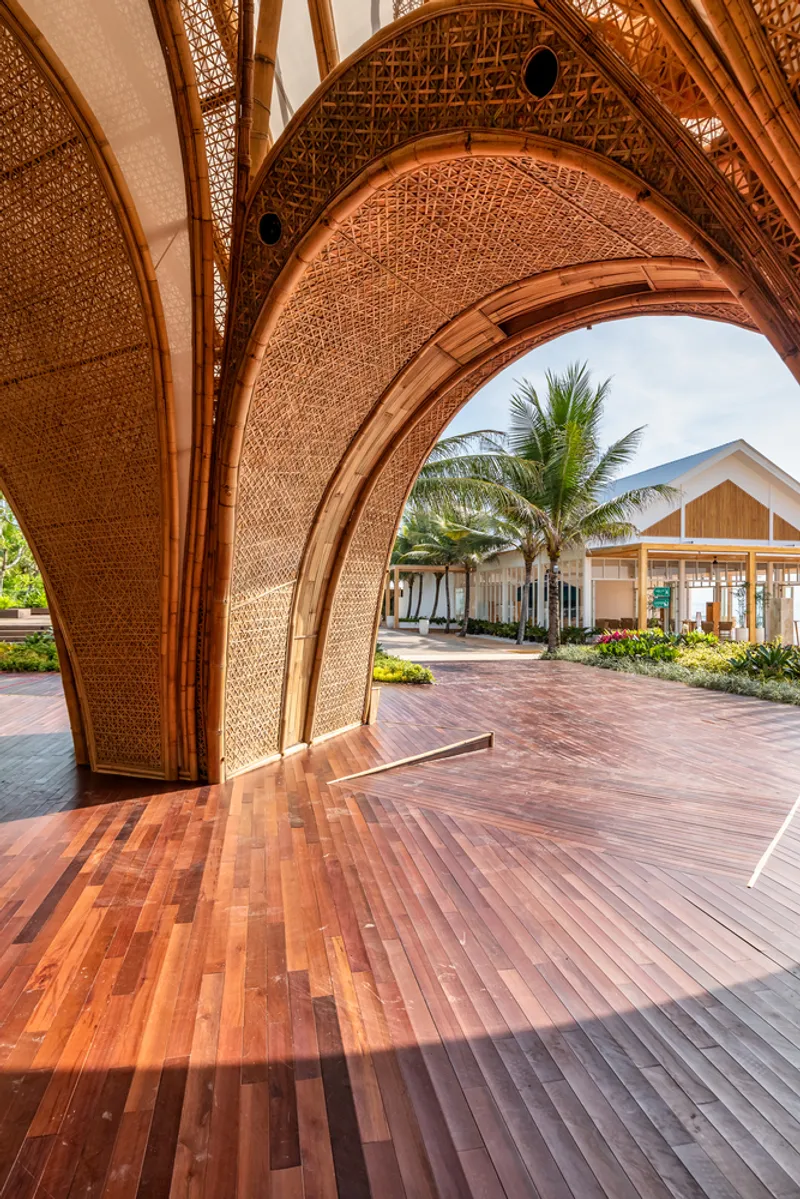
The dome's perimeter is punctuated by arched openings that serve as both structural rhythm and visual frames. From inside, each arch captures a different slice of the Nusa Dua landscape: the turquoise pool, palm canopies, the gabled pavilions of the hotel beyond. The effect is cinematic, turning a lunch venue into a series of curated views.
From outside, the arches reveal the layered depth of the bamboo construction. You can read the lattice structure through the openings, see the central decorative elements inspired by the Gunungan wayang, the triangular mountain shape from traditional Balinese shadow puppetry. These motifs, placed at key interior junctures, ground the pavilion in a cultural register that goes far beyond generic tropical aesthetics.
Approaching the Dome
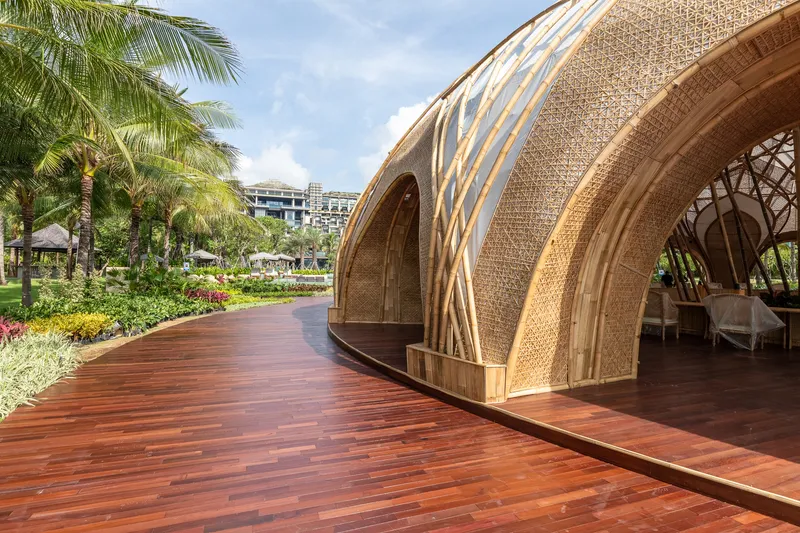
The arrival sequence matters. A herringbone timber deck curves past the woven bamboo arches, guiding visitors along the dome's perimeter before entering. Under midday sun, the interplay of shadow cast by the woven surface creates a shifting pattern on the deck, a quality that static photographs only partially convey. The approach is deliberate: you register the scale and materiality of the structure gradually, not all at once.
Pulling back to a longer view, the dome sits modestly against the overcast Bali sky and the hotel's more conventional built fabric. It does not compete. Its authority comes from material conviction rather than size, which is a useful reminder that a 32-meter bamboo span can hold its own against concrete and glass without raising its voice.
Why This Project Matters
The Bamboo Dome is a proof of concept at the highest possible political visibility. By choosing bamboo, local artisans, and a non-permanent construction model for an event watched by the entire world, Indonesia demonstrated that sustainable architecture does not require sacrifice or compromise at the scale of diplomacy. The material performed structurally, aesthetically, and symbolically: it held the roof up, it looked extraordinary, and it told a story about interconnection, the bamboo cluster as metaphor for global cooperation.
More practically, the project's timeline is instructive. Two months of prefabrication in Gianyar followed by three weeks of on-site assembly means this kind of architecture can be deployed rapidly and removed without permanent impact. For a world scrambling to reduce construction waste and embodied carbon, the dome offers a model that is both ancient and urgently relevant. BIROE Architecture, working with the artisans of Belega Village, proved that the most forward-looking building material might be the one that has been growing in Bali's forests all along.
Bamboo Dome for G20 Bali Summit, designed by BIROE Architecture. Located at the Ocean Front Lawn of Apurva Kempinski Hotel, Nusa Dua, Bali, Indonesia. 805 square meters. Completed in 2022. Photography by Danar Tri Atmojo and Embara Films.
About the Studio
Share Your Own Work on uni.xyz
If projects like this are the kind of work you want to make, uni.xyz is a place to publish your own, find collaborators, and enter design competitions.


Popular Articles
Popular articles from the community


longwave studio Reorganizes a 112 m² Tainan Apartment Around the Daily Routines of a Family and Two Cats
In Tainan, Taiwan, birch plywood, rust-red furniture and a freestanding plaster wall link arrival, storage, work and family life in one apartment.

Cube Design Draws an Ecological Corridor Between Two Shenzhen Hills with the Nankai Building
Beside Shenzhen's container docks, the Nankai Building pairs stacked balconies with a climbing green screen to connect two hillsides across its height.

David Macias Steps a Doorless Stone and Plaster House Down a Tropical Colombian Hillside
In the humid hills of Colombia, Threshold House replaces the front door with an open void and terraces its 850 m² down the slope instead of fighting it.

GROUP A Strips a 1969 Rotterdam Harbor Headquarters to Its Frame and Wraps It in Timber Louvers
In Rotterdam's M4H harbor district, Ferro Offices reuses a 1969 frame, adds one timber storey and reaches BREEAM-NL Outstanding.

Similar Reads
You might also enjoy these articles


Hodi-Mandai Geram
Project Function: Preservation and revitalization of the Intangible heritage and socio-spatial identity of the Hodi by Housing, Cultural Memory Center, Sacred Grove, landscape, local tourism economy


Olio Towers: A Mid-Rise for Performers That Fuses Housing, Rehearsal, and Stage
Located blocks from Houston's Theater District, this modular tower stacks living units around a central performance atrium.

Oasis: Modular Green Housing Carved into Dhaka's Urban Fabric
A shortlisted Plugin Housing entry reclaims unauthorized settlements in Dhaka with stepped concrete volumes, green roofs, and ventilation-driven design.

Black Hole: A Floating Megastructure for the Post-Physical Era
Emiliano Mazzarotto envisions a spherical, self-scaling arena where e-sports, digital hotels, and holographic stadiums replace traditional public space.

Explore Bamboo Construction Competitions
Discover active competitions in this discipline

Challenge to design a portable theatre

Challenge to design a portable music platform

Challenge to design an open learning module for the elderly

Challenge to reimagine the Iron Throne
Comments (0)
Please login or sign up to add comments
No comments yet. Be the first to comment!