

Bamboo Tree Pavilion: A Modular Canopy System Grown from Nature's Own Logic
Pranav Raghavan translates the branching geometry of bamboo groves into a low-carbon pavilion built with jute-bound joinery and layered panels.


What if a building could grow the way a bamboo grove does, with slender vertical stems branching outward into a sheltering canopy? The Bamboo Tree Pavilion takes that question literally, translating the organic geometry of bamboo's branching patterns into a modular canopy system made almost entirely from the plant itself. The result is a structure that reads simultaneously as sculpture and shelter, its wave-like roof rippling overhead like a grove caught mid-sway.
Designed by Pranav Raghavan, the pavilion was awarded Best in Category at the Beegraphy Design Awards. The project positions bamboo not as a rustic novelty but as a serious structural material capable of producing spatially rich, climate-responsive public architecture. Sited near waterfront promenades and urban parks, the pavilion is designed to scale from small installations to expansive community structures.
From Stem to Structure: Reading the Concept Sketches
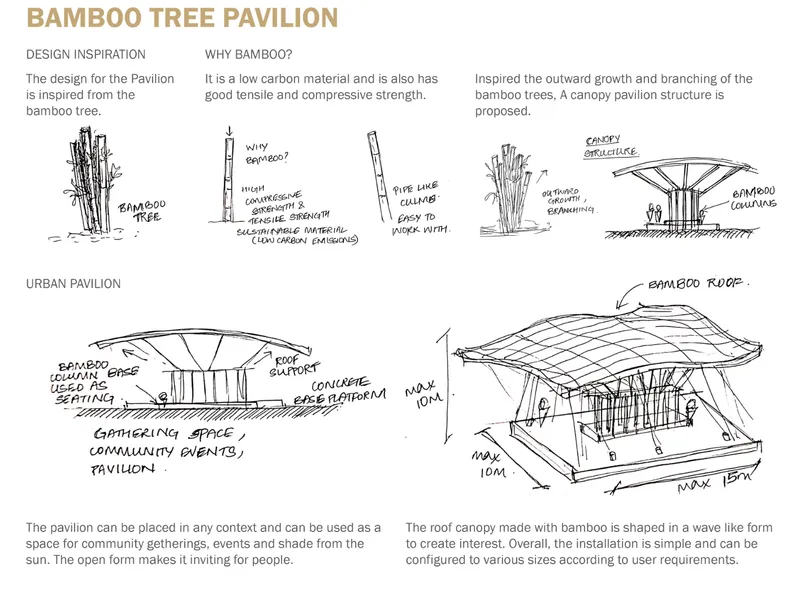
The concept sheet traces a clear lineage from bamboo's natural form to the pavilion's final geometry. Raghavan isolates the plant's key characteristics: the slender vertical stalk, the rhythmic nodal points, and the way branches fan outward at the crown. These observations become architectural moves. Vertical stalks become clustered column bundles, nodal points become structural joints, and the crown's outward spread becomes the undulating roof canopy. The translation is disciplined rather than decorative, each formal decision tied to a structural or spatial function.
Clustered Columns and a Radiating Roof
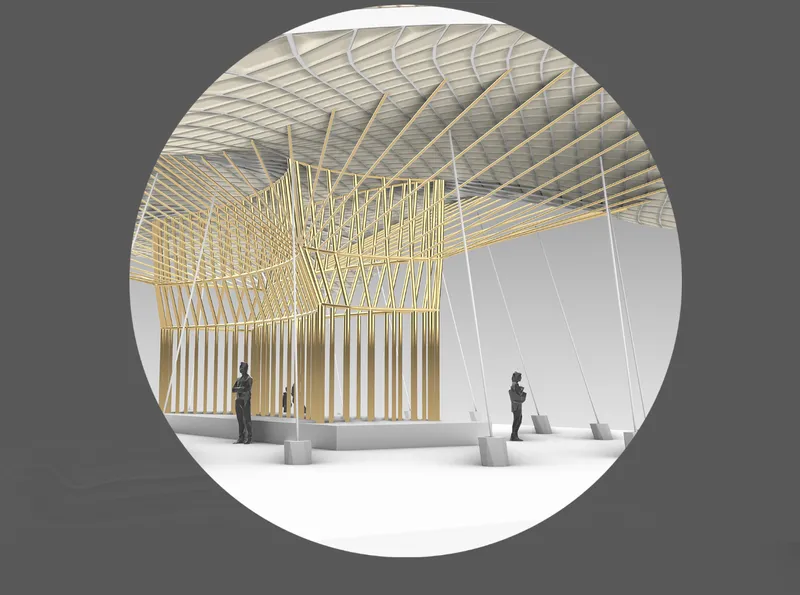
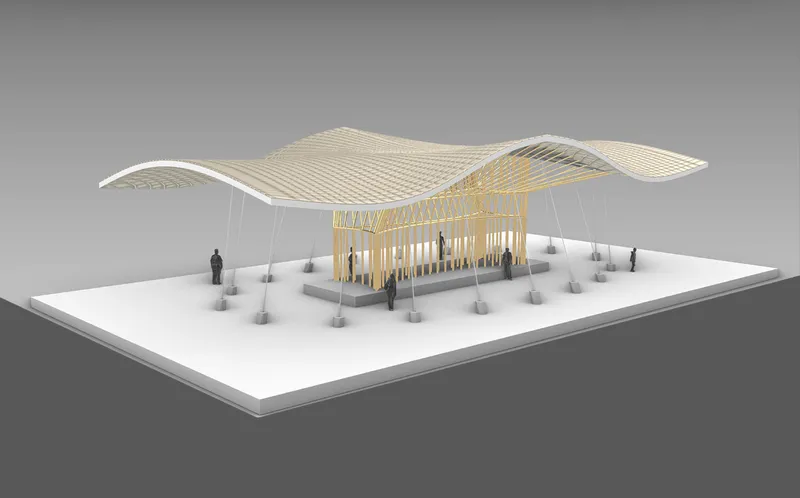
Beneath the pavilion, bundled bamboo columns rise from the ground and splay outward to support the roof, mimicking the natural branching system of the tree. This clustering does more than look organic; it distributes loads along multiple paths, allowing the canopy to span wide without heavy beams. The interior rendering shows how these column bundles create a rhythmic forest of vertical elements, giving the space beneath a sense of enclosure without walls.
The physical model confirms the structural ambition. The undulating roof canopy, assembled from layered bamboo panels and slant supports, is anchored by cable connections at the base. Steel pegs tie the bamboo columns to a concrete footing for stability, while jute rope fibers bind the 5 to 10 cm diameter bamboo poles at their joints. This hybrid system merges traditional craft with modern engineering thinking, and critically, it allows for disassembly and material reuse.
Elevations That Reveal the Wave
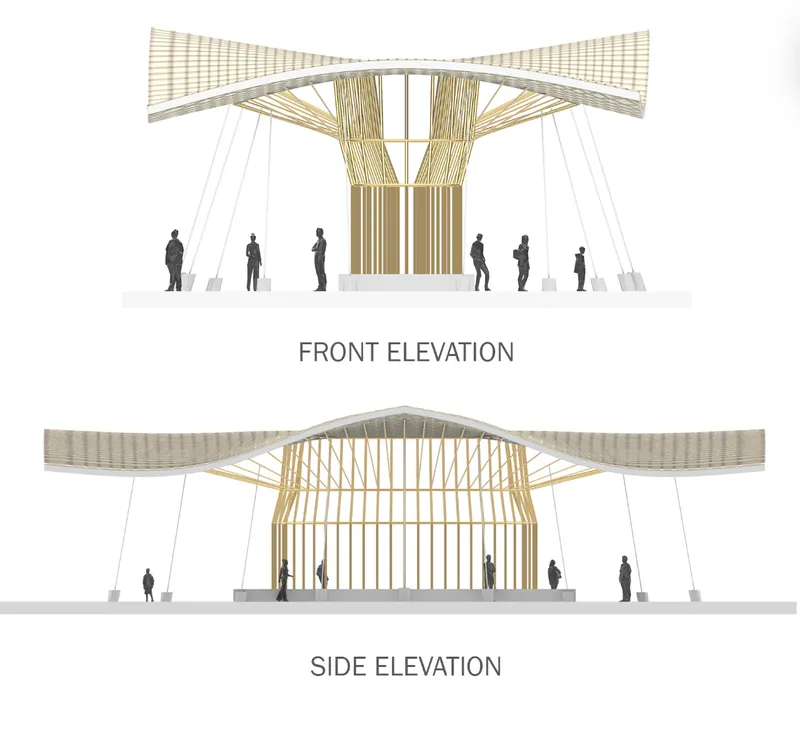
The front and side elevation drawings strip the pavilion back to its structural essentials. From the side, the roof's curvature is most legible: a continuous wave that rises and dips, creating zones of higher clearance for gathering and lower edges for intimacy. The vertical column bundles read as trunks rooted into the platform, their upper branches dissolving into the roof plane. What the elevations make clear is that the pavilion has no facade in the traditional sense. It is permeable on all sides, prioritizing ventilation, visibility, and inclusivity over enclosure.
A Public Room Along the Waterfront
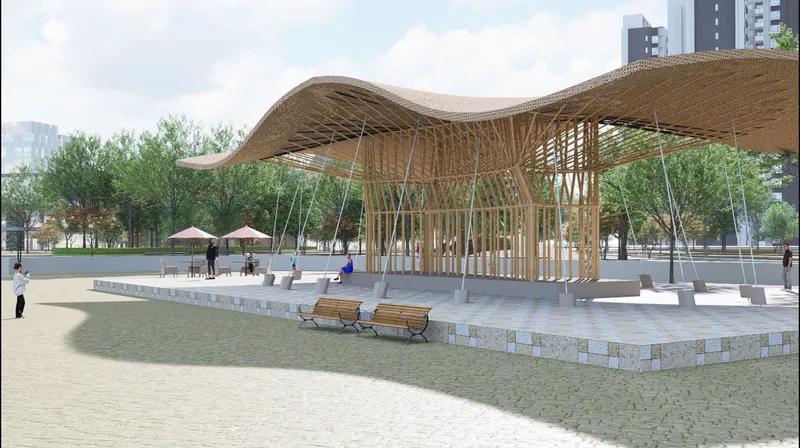
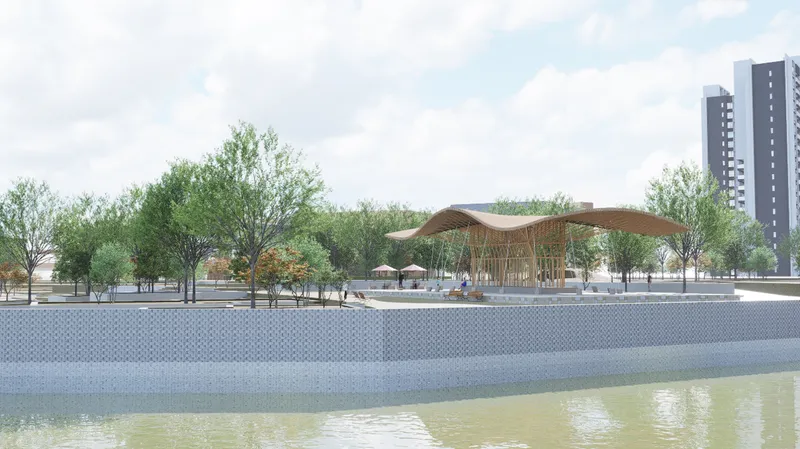
Raghavan positions the pavilion as a community hub capable of hosting gatherings, exhibitions, and performances. The plaza rendering shows benches integrated beneath the woven roof canopy, with people moving freely through and under the structure. The open layout avoids dead corners; every direction offers a view out and a way through. Placed on a paved platform along a waterfront promenade, the pavilion anchors the public realm without dominating it.
The waterfront view is particularly revealing. Residential towers rise in the background, establishing the urban context in which this low-carbon pavilion would operate. Trees line the platform edge, blurring the boundary between built structure and landscape. The pavilion's modularity means it could be scaled to fit a small neighborhood park or stretched to serve a major civic waterfront, adapting its footprint and column count to the site.
Light, Shadow, and the Swing
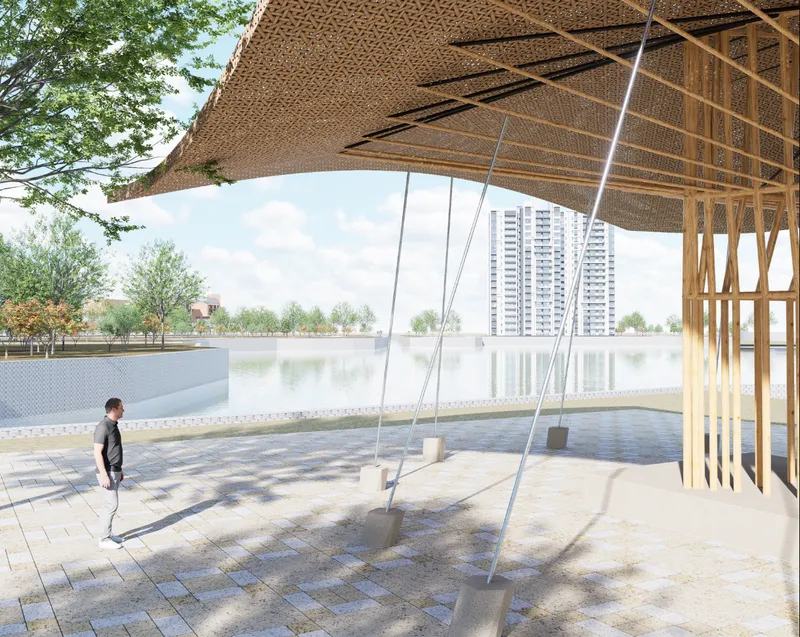
The final rendering captures the pavilion's experiential ambition. A figure sits on a swing suspended from the exposed timber structure, framed by the woven bamboo roof with a waterfront view stretching beyond. The interplay of light and shadow through the lattice overhead produces a dappled, grove-like atmosphere, reinforcing the biophilic premise of the entire project. The structure blurs the line between architecture and landscape: it is both shelter and sculpture, functional enough to gather under and evocative enough to linger in.
Why This Project Matters
Bamboo's credentials as a building material are well established: rapid renewability, high tensile and compressive strength, low embodied energy. What the Bamboo Tree Pavilion adds to the conversation is a rigorous formal language that makes those credentials legible in space. The branching column system is not a stylistic choice applied to a generic shed; it is a structural strategy derived from the material's own biology. The jute-bound joinery, the layered roof assembly, and the steel-peg base connections form a coherent construction logic that respects craft traditions while remaining scalable and demountable.
As cities confront the urgency of low-carbon construction, projects like this demonstrate that sustainability and spatial generosity are not competing goals. Raghavan's pavilion offers shade, community space, and visual delight while keeping its material palette honest and its carbon footprint minimal. It is a convincing argument that the next generation of public architecture can grow, quite literally, from the ground up.
View the Full Project
About the Designers
Designer: Pranav Raghavan
Enter a Design Competition on uni.xyz
uni.xyz runs architecture and design competitions year-round that reward proposals with spatial conviction and real site intelligence.
Project credits: Bamboo Tree Pavilion by Pranav Raghavan Beegraphy Design Awards (uni.xyz).



Popular Articles
Popular articles from the community


Play: Fragments of Their World
Familiar architecture becomes modular playground design, creating safe spaces where displaced children can learn, connect, imagine and play.

The Ocean Hive: Sustainable Architecture for a Self-Sufficient Civilization at Sea
The Ocean Hive imagines sustainable architecture at sea, where modular habitats, algae, wave power and ocean waste sustain a growing colony.

Hill & Cross Opera: Sculptural Opera House Architecture Shaped by Tallinn’s Landscape and Identity
Hill & Cross Opera reimagines opera house architecture in Tallinn through its sculptural hill, civic plaza, glass wave and a luminous cross.

Riyadh For All: Intergenerational Urban Design for Active Aging in Rabat
Riyadh For All reimagines urban design in Rabat with intergenerational co-living, adaptive courtyards, and Moroccan cultural exchange today.


Similar Reads
You might also enjoy these articles

Lunar Spiral: Space Architecture Shaped by the Mathematics of the Universe
Lunar Spiral reimagines space architecture through Fibonacci geometry, lunar regolith, levitating habitats, and self-sustaining Moon living.
The Main Dream: Modular Architecture for Play, Learning, and Community
A modular playground turns recycled plastic into adaptable spaces where refugee children can play, build, learn, and reconnect.
Play: Fragments of Their World
Familiar architecture becomes modular playground design, creating safe spaces where displaced children can learn, connect, imagine and play.

Wadi Rum Observatory: Desert Architecture Designed for the Night Sky
Wadi Rum Observatory turns desert architecture into a quiet instrument for astronomy, hiding research spaces under Jordan's starlit terrain.

Explore Bamboo Construction Competitions
Discover active competitions in this discipline



Challenge to design a portable theatre


Challenge to design a portable music platform


Challenge to design an open learning module for the elderly
Comments (0)
Please login or sign up to add comments
No comments yet. Be the first to comment!