
Perkins&Will Wraps a 50-Unit Residential Building in Bamboo on Brazil's Atlantic Forest Coast
Bambu Atmosfera in Ubatuba uses locally sourced bamboo for operable facade screens, floors, and furniture across 6,000 square meters.


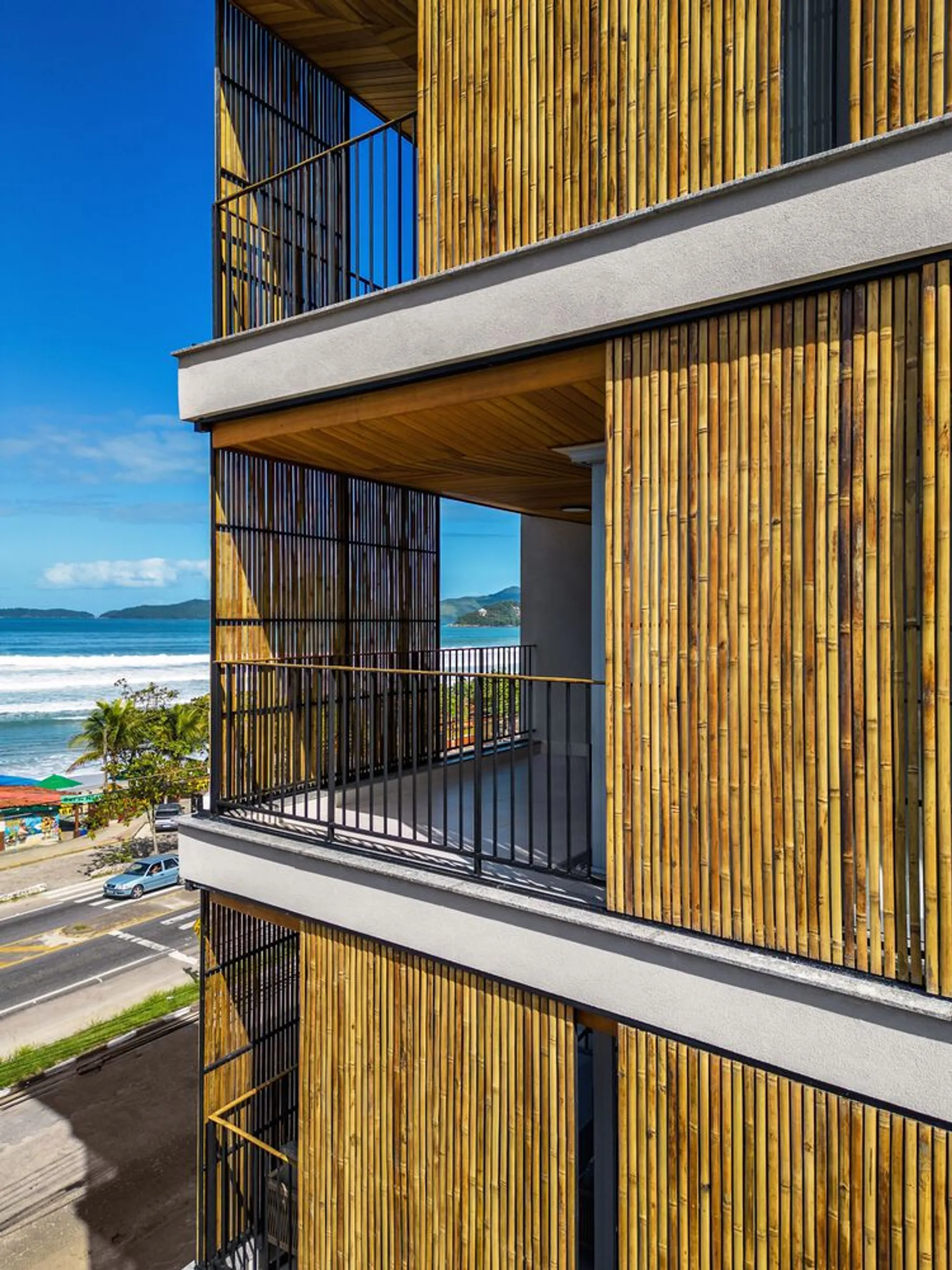
Bamboo shows up in architecture frequently enough as ornament or accent. Rarely does it become the entire thesis. At Bambu Atmosfera, a 50-unit residential building on Praia Grande in Ubatuba, Perkins&Will committed to giant bamboo not just as a facade element but as the material logic governing floors, ceilings, cabinetry, furniture, gates, handrails, elevator interiors, and decorative panels. Everything that could be bamboo was made from it, sourced and fabricated by local artisans at Sarkiss Bamboo on the northern coast of São Paulo state. The result is a building that looks like a grove before it looks like a residence.
What makes the project genuinely interesting, though, is the way this material commitment intersects with a rigorous passive climate strategy. Ubatuba sits in a humid tropical zone between the Atlantic Ocean and the Atlantic Forest, a microclimate defined by punishing solar exposure and frequent rain. The U-shaped plan, the operable bamboo brise-soleil, and the raised ground floor all serve that context. Bamboo here is not symbolic. It is functional infrastructure for thermal comfort, and the building's form follows that logic completely.
An Operable Skin Built from Local Supply Chains
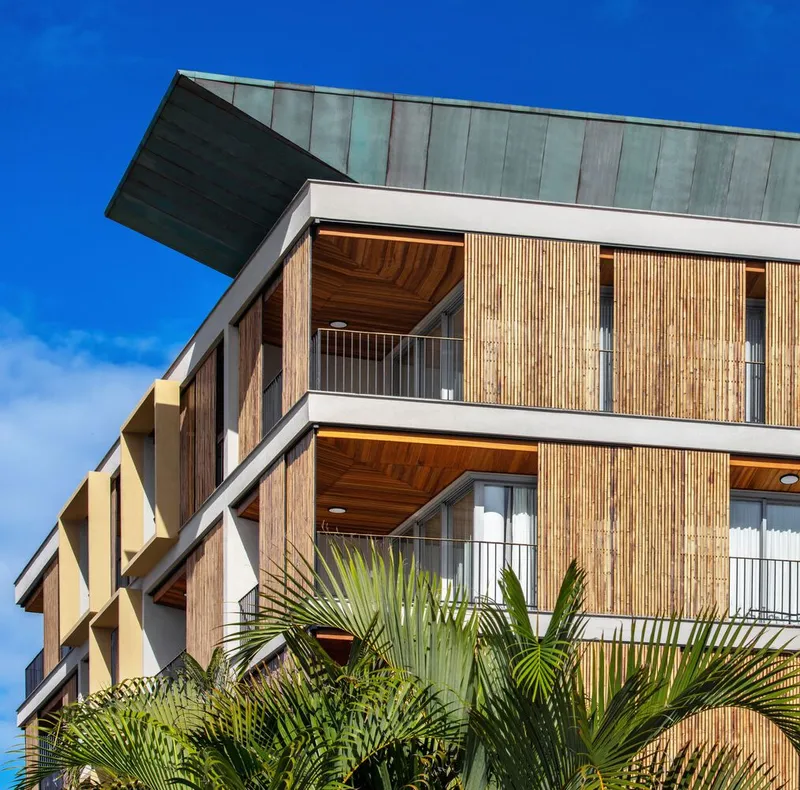
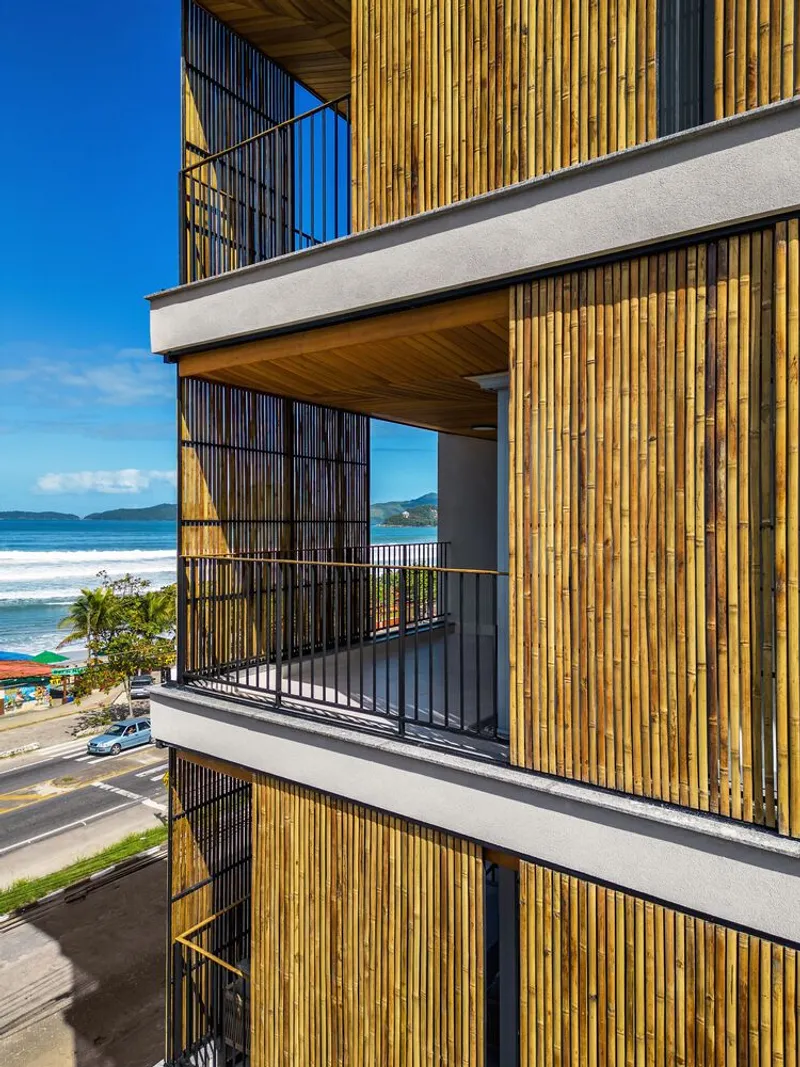
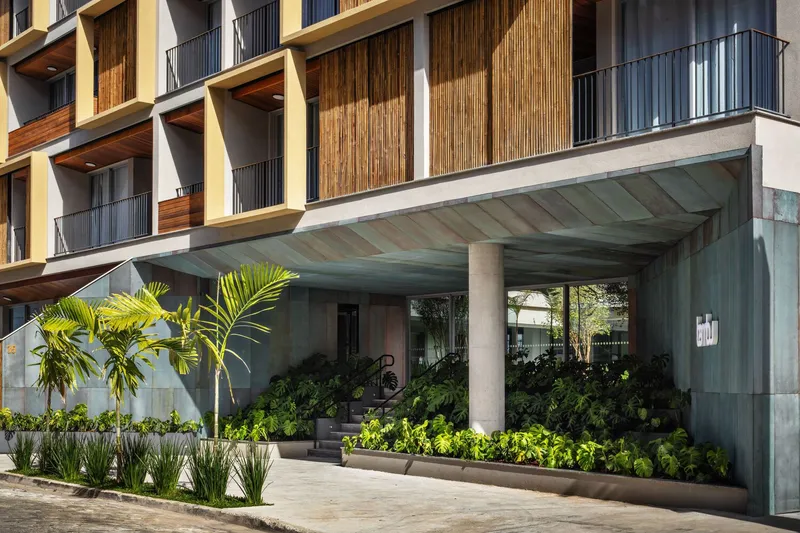
The facade reads as a series of vertical bamboo slats arranged into articulated brise-soleil panels. These are not fixed screens. Each apartment's residents can adjust their own panels to control sunlight and airflow, a simple mechanical gesture that eliminates much of the need for air conditioning in a climate where that would otherwise be the default. The treated bamboo slats are spaced to allow cross-ventilation while filtering direct solar gain, and the warm wood soffit of every balcony reinforces the material consistency. Green-toned corten steel accents at the entrance and rooftop complement the bamboo's organic palette, and the architects have noted that both materials are intended to evolve over time, gaining patina rather than degrading.
Critically, this is not an imported material. Bamboo grows rapidly across Brazil and can be sourced with short supply chains, keeping costs low and carbon emissions modest. Every bamboo component in the building was sourced, treated, transported, and installed by a single local fabricator. That kind of closed-loop material strategy is rare in mid-rise residential construction, where supply chains typically sprawl across continents.
The U-Shape and Its Central Grove
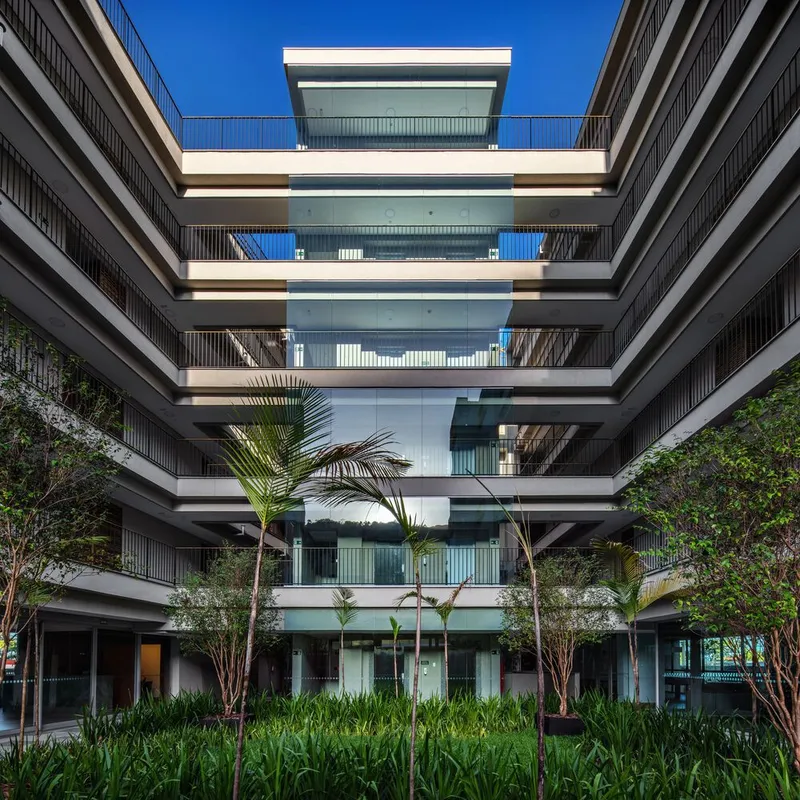
The building's U-shaped footprint is doing several things at once. It opens every apartment toward the ocean, guaranteeing views from all 50 units across the five floors. It creates a generous internal courtyard planted with native Atlantic Forest species, including bamboo itself, forming what the architects describe as a contemporary bamboo grove. And it allows daylight and cross-ventilation to reach deep into the plan, which is essential on a 1,843 square meter site that could easily have been filled with a single slab.
The courtyard is not decorative leftover space. It functions as a social and environmental core, with shaded walkways, native planting, and ground-level garden units that transition between private residences and shared outdoor areas. Looking up from the courtyard, the stacked balconies and glass circulation core create a layered section that channels air upward. At the rooftop, 20 meters above street level, a pool terrace and communal pavilion cap the sequence with panoramic ocean views. The landscape strategy grounds the building in its specific ecology: Atlantic Forest species, not generic tropical planting.
Compact Units with Calibrated Flexibility
The 50 apartments range from 62 to 110 square meters across five typologies, with 11 units per floor and larger apartments occupying the building's corners where dual-aspect exposure is greatest. Three penthouses on the top floor have private terraces and gardens. Every unit uses movable interior panels to let residents reconfigure layouts and optimize daylight penetration, a strategy that extends the facade's operable logic inward. Balconies with planted beds push the biophilic agenda right to the threshold of each living space.
Ground-floor garden units open directly onto the central plaza and face the sea, creating a hybrid condition between apartment and garden house. Shared amenities, including a fitness space, laundry facilities, swimming pools, and an on-site market, are distributed through the ground level and rooftop. Circulation runs through a central lobby served by three elevators and stairways, and even the elevator interiors are finished in bamboo. With 80 parking spaces and 50 bicycle spaces, the infrastructure acknowledges how people actually live on Brazil's coast without pretending the car has disappeared.
Material Honesty at the Ground Plane
At ground level, the building's material palette shifts to exposed concrete, a deliberate move that distinguishes the public base from the bamboo-clad residential floors above. A concrete canopy shelters the entrance, planted beds, and pedestrian approach, while the raised ground floor minimizes excavation and preserves the site's natural topography. The cantilever of the upper floors over the entrance creates a generous threshold that is shaded and welcoming without requiring any additional structure. Fire-galvanized steel railings, glass, and metal elements at this level provide the necessary durability for a coastal ground plane exposed to salt air and foot traffic.
The contrast between the raw concrete base and the warm bamboo above is the building's strongest compositional gesture. It registers the shift from public to private, from durable to living, from mineral to vegetal. And it ensures the bamboo is elevated away from ground moisture and splash zones, which is simply good detailing for a natural material in a tropical climate.
Why This Project Matters
Bambu Atmosfera is not a boutique villa or a research pavilion. It is a 50-unit, 6,000 square meter residential building with parking garages, elevators, and a market. The fact that bamboo could be deployed at this scale, across every surface and system from facade to furniture, and sourced entirely through local artisans, is what makes the project significant. It demonstrates that natural, rapidly renewable materials can structure the economics and aesthetics of mainstream housing, not just experimental prototypes.
Perkins&Will's design also proves that passive climate strategies and material ambition can reinforce each other rather than compete. The operable bamboo screens are the building's most striking visual feature and its primary tool for thermal regulation. The U-shaped plan is both the landscape concept and the ventilation strategy. Nothing here is applied after the fact. When every design decision serves the same material and climatic logic, the architecture coheres in a way that no amount of green certification alone can achieve.
Bambu Atmosfera Residential Building by Perkins&Will. Ubatuba, São Paulo, Brazil. 6,000 sqm. Completed 2023. Photography by Nelson Kon.
About the Studio
Perkins&Will
Official website of Perkins&Will, one of the studios behind this project.
perkinswill.comShare Your Own Work on uni.xyz
If projects like this are the kind of work you want to make, uni.xyz is a place to publish your own, find collaborators, and enter design competitions.




Popular Articles
Popular articles from the community


Riyadh For All: Intergenerational Urban Design for Active Aging in Rabat
Riyadh For All reimagines urban design in Rabat with intergenerational co-living, adaptive courtyards, and Moroccan cultural exchange today.
AL-JANNAH: Sustainable Architecture and Permaculture for Afghan Widows
AL-JANNAH uses sustainable architecture and permaculture to create resilient oasis of housing, learning, work and renewal for Afghan widows.

The Earth Pod: 3D Printed Homes for Resilient Refugee Communities
The Earth Pod reimagines refugee housing through 3D printed homes made from clay, combining resilience, self-sufficiency, and rapid shelter.

Co-Life: Senior Housing Design That Reconnects Older Adults With the City
Co-Life reimagines senior housing design through healing gardens, shared streets, workshops, and a sustainable community across generations.


Similar Reads
You might also enjoy these articles


Hodi-Mandai Geram
Project Function: Preservation and revitalization of the Intangible heritage and socio-spatial identity of the Hodi by Housing, Cultural Memory Center, Sacred Grove, landscape, local tourism economy


Olio Towers: A Mid-Rise for Performers That Fuses Housing, Rehearsal, and Stage
Located blocks from Houston's Theater District, this modular tower stacks living units around a central performance atrium.

Oasis: Modular Green Housing Carved into Dhaka's Urban Fabric
A shortlisted Plugin Housing entry reclaims unauthorized settlements in Dhaka with stepped concrete volumes, green roofs, and ventilation-driven design.

Black Hole: A Floating Megastructure for the Post-Physical Era
Emiliano Mazzarotto envisions a spherical, self-scaling arena where e-sports, digital hotels, and holographic stadiums replace traditional public space.

Explore Bamboo Construction Competitions
Discover active competitions in this discipline


Challenge to design mud housing for contemporary communities


Challenge to reimagine the Iron Throne


Photograph architecture without architects


Illustrate the lost glory of Angkor Wat - Render Challenge
Comments (0)
Please login or sign up to add comments
No comments yet. Be the first to comment!