

Tectoniques and SQUAD Build a Timber Cathedral for Learning in the Vosges Mountains
A 3,800 m² school in Vagney, France replaces a context-blind 1970s predecessor with local wood, bioclimatic rigor, and an agora at its core.


When a 1970s school sits in the middle of former farmland, ignoring every road, building, and sightline around it, the question is not whether to replace it but how aggressively to correct the original mistake. Tectoniques Architects and SQUAD architectes answered that question in Vagney, a small commune in the Vosges mountains of eastern France, with a 3,800 m² timber school that locks itself to Jules Ferry Road, reestablishes a street wall, and knits together the kindergarten, primary school, dining hall, and gymnasium already scattered across the site. The building was completed in 2022, and it reads less like a school than like a piece of civic infrastructure that happens to contain classrooms.
What makes Ban de Vagney worth studying is the severity of its commitments. The structure is almost entirely wood, sourced from local Vosges forests and prefabricated in modular elements. Concrete appears only where bracing and anchorage demand it. Heating is capped at 25 kWh/m² per year and drawn from a municipal biomass network. And the organizing idea, a central light-filled gallery the architects call the Agora, is not a metaphor but a literal spine: a double-height corridor that every classroom, courtyard, and staircase feeds into. The result is a building where material discipline, energy strategy, and spatial ambition reinforce one another instead of competing.
Aligning with the Street
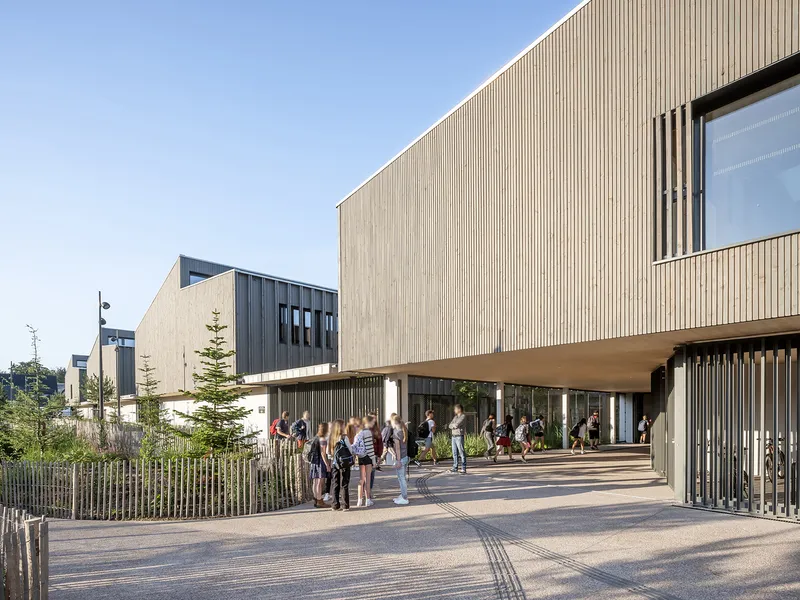
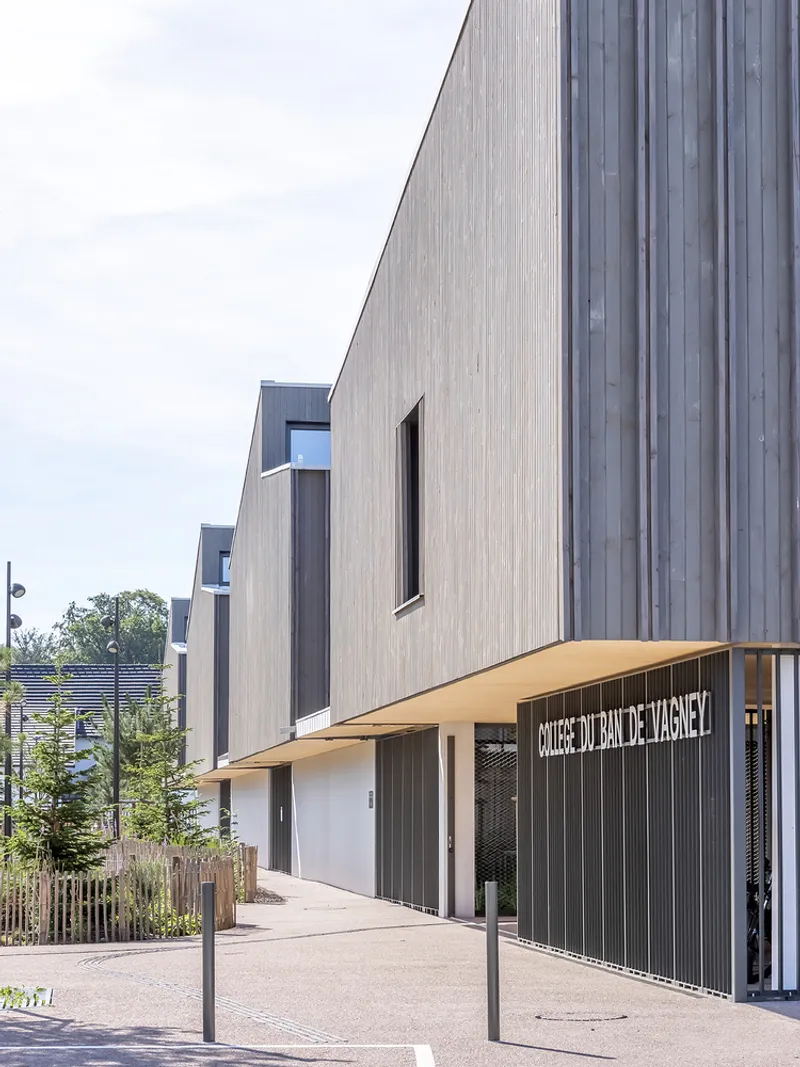
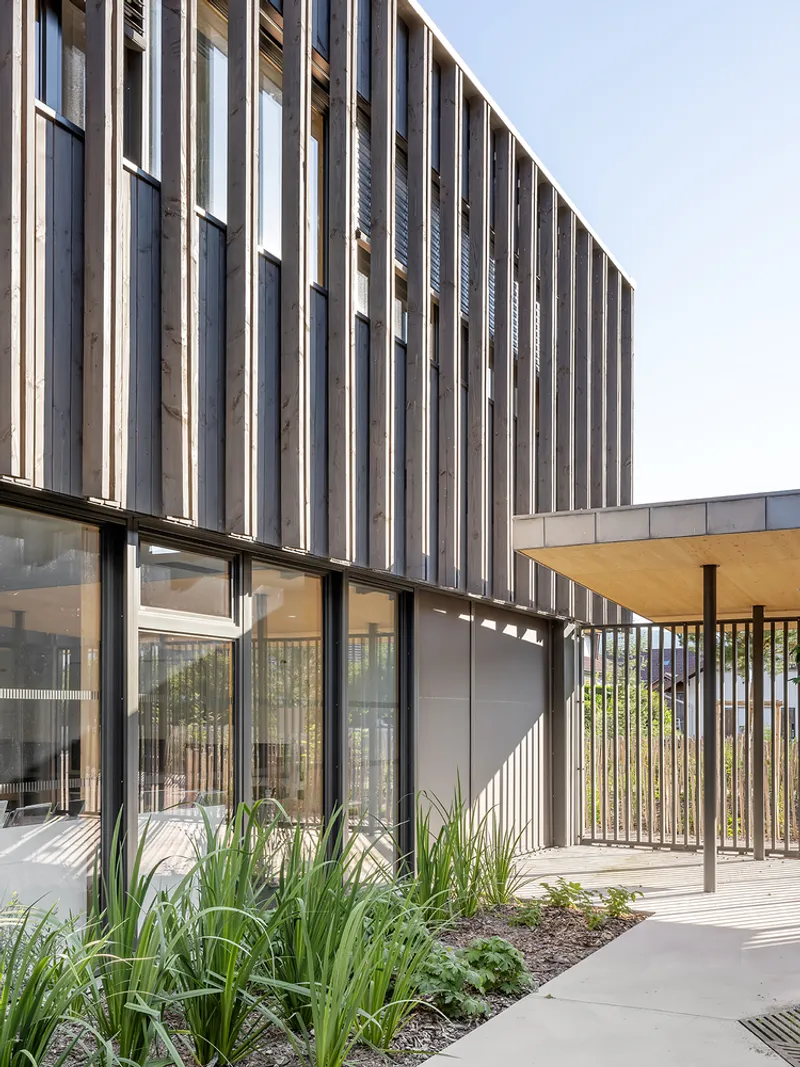
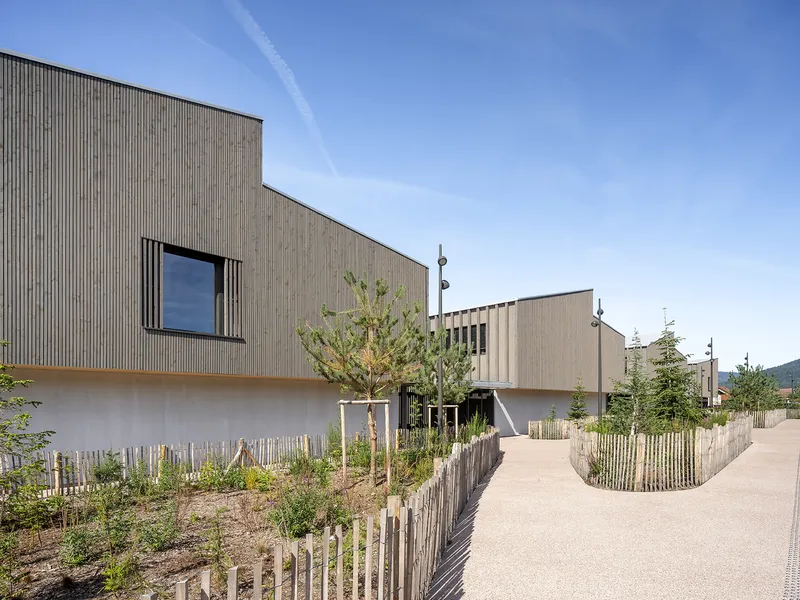
The most consequential design decision happened before any wall was drawn. By aligning the new building parallel to Jules Ferry Road, Tectoniques reversed the predecessor's indifference to context and created a proper urban edge for the first time. The cantilevered timber volume that greets arriving students signals this intent immediately: the school addresses the street, shelters a walkway beneath its overhang, and frames a sequence of planted beds and gravel paths that mediate between public road and school grounds.
Along the facade, vertical metal louvers and timber pergola structures break up the building's mass without undermining its civic presence. The planting strategy, dense grasses and low shrubs in raised beds, softens the base of the building while keeping sightlines open. It is a surprisingly urban gesture for a commune of fewer than 4,000 people, and it works precisely because the architects treated the site as a fragment of a town, not as an isolated campus.
The Agora as Organizing Spine
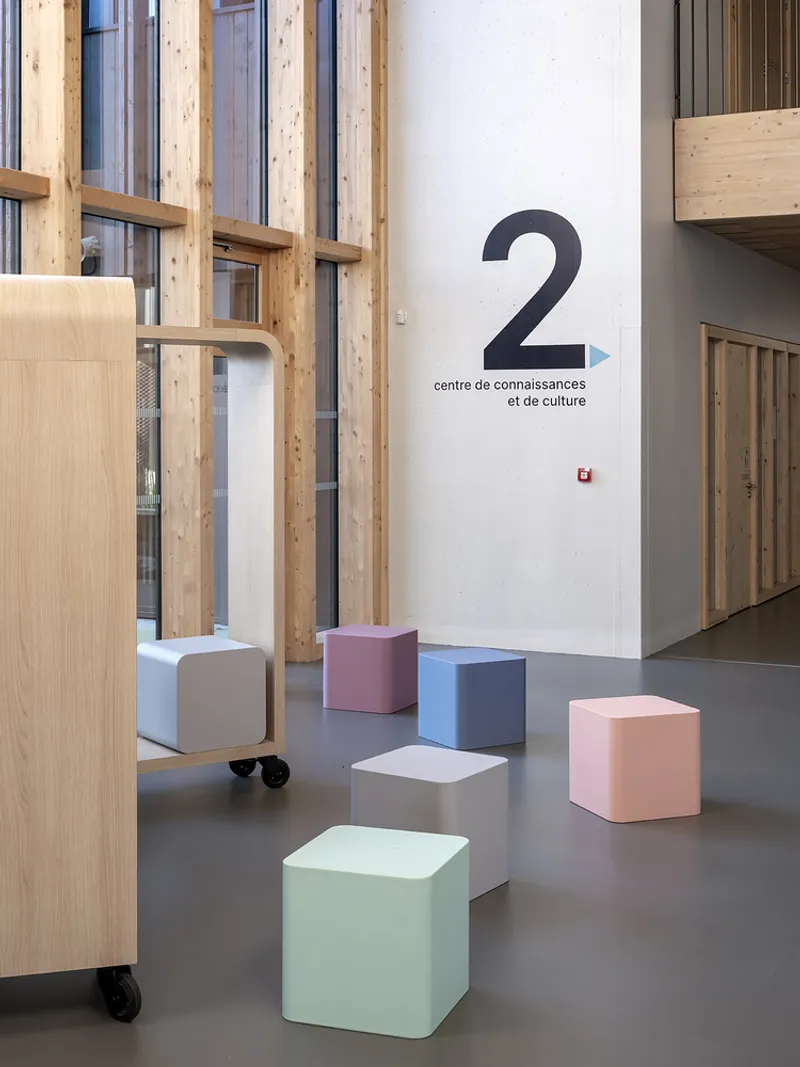
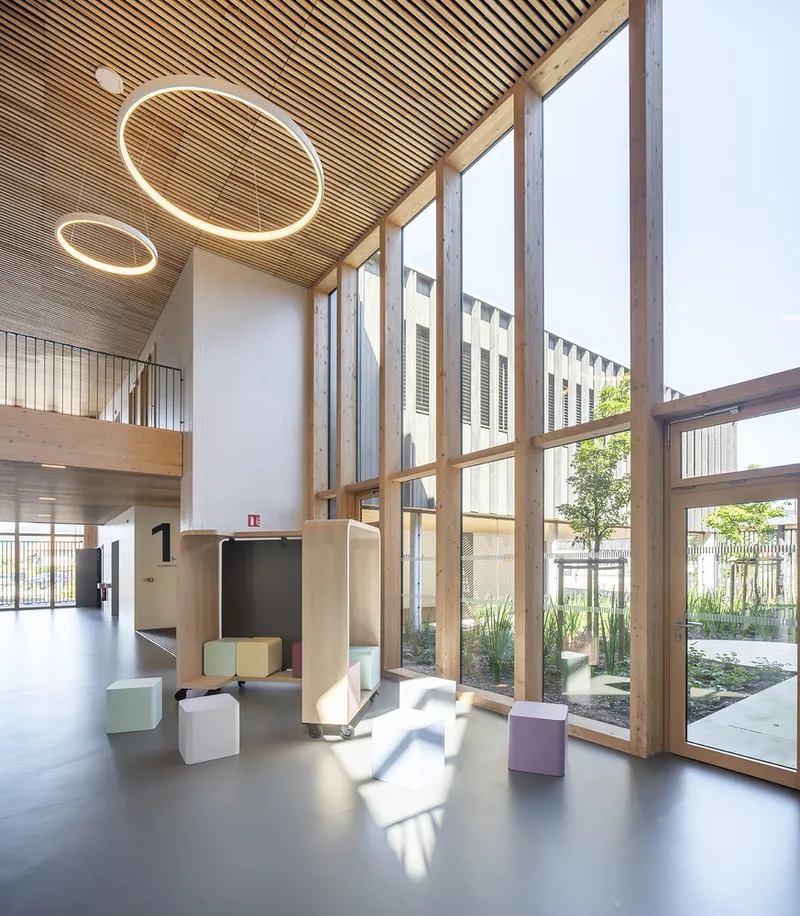
The Agora is the project's structural and social core: a double-height gallery that runs the length of the building, flooding the interior with daylight and connecting every programmatic zone. At ground level, the space is furnished with scattered pastel cube seats designed by SQUAD architectes, turning what could have been a sterile corridor into an informal commons. Floor-to-ceiling glazing on one side opens views to a planted courtyard, ensuring that the deepest part of the plan never feels landlocked.
The description of the building as a "timber cathedral" is not hyperbole. Exposed laminated columns and beams rise through the gallery, and the proportions are deliberately tall relative to the width. Circular pendant lights hang at varying heights, reinforcing the verticality. The effect is simultaneously civic and intimate, a scale that feels important enough for assembly but comfortable enough for a ten-year-old sitting alone with a book.
Timber Structure as Language
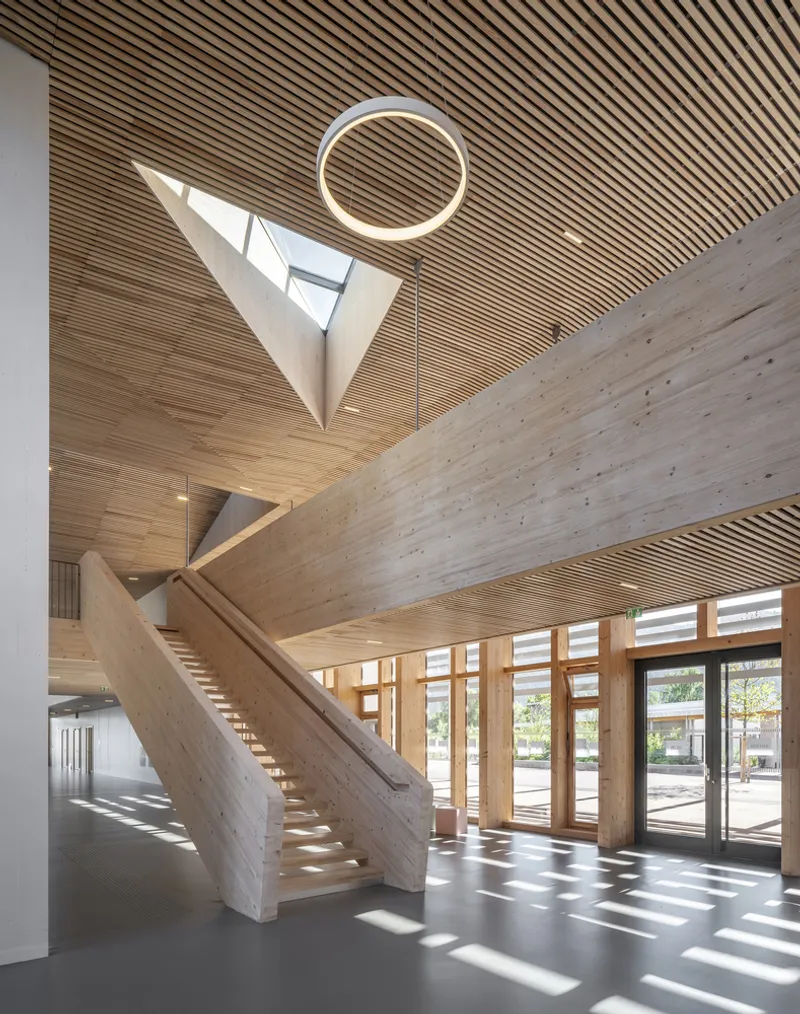
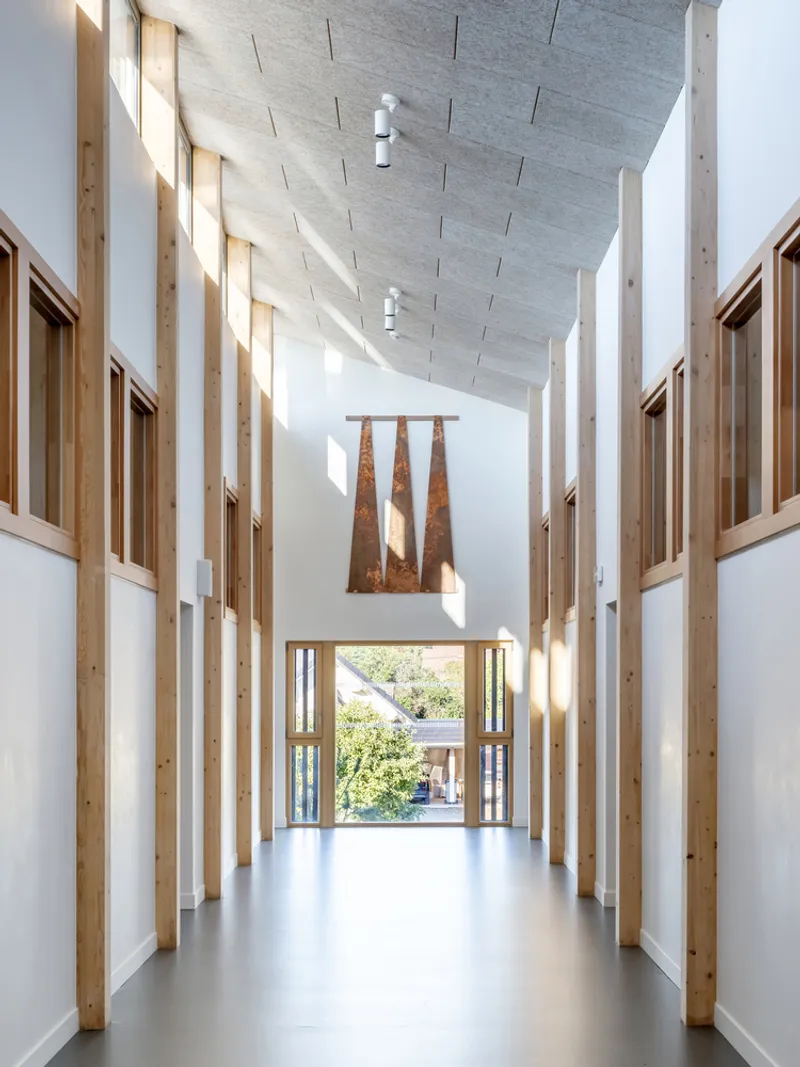
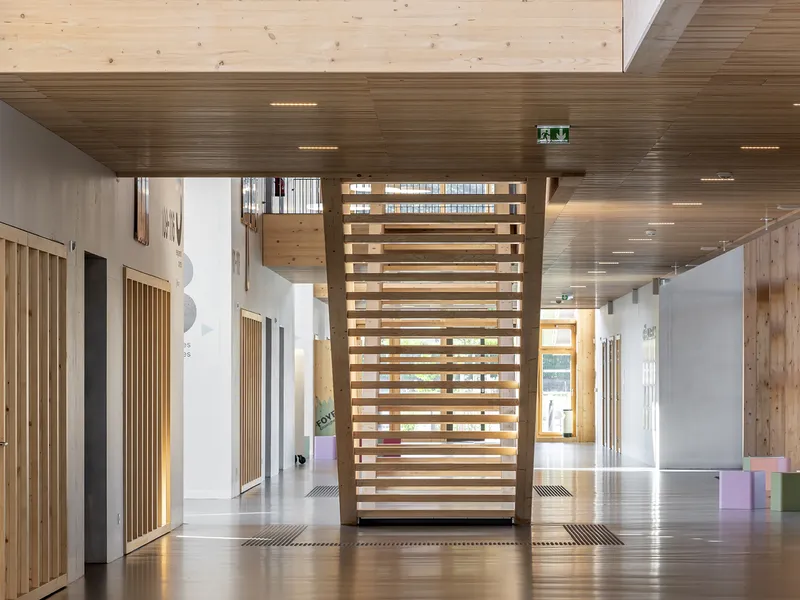
Wood is not decorative here; it is structural, acoustic, and atmospheric all at once. The staircase rising beneath a triangular skylight reveals the honesty of the approach: laminated members meet at clean joints, and light enters along the ridge, illuminating the grain. Elsewhere, timber-framed walls with acoustic ceiling panels line corridors that lead to glazed doors and courtyards beyond. The palette is restrained, pale wood against polished concrete floors, with no paint and no cladding concealing the logic of the frame.
A standout structural moment is the 30-meter laminated beam that spans the indoor bridge, measuring 1.8 meters in depth. That single element does more to communicate the building's ambition than any rendering could. It demonstrates that local Vosges timber, processed through prefabrication, can achieve spans typically reserved for steel or concrete. The freestanding timber screens that subdivide corridors operate at the other end of the spectrum: lightweight, repositionable, and fine-grained, they prove the material's versatility across scales.
Light, Shadow, and Passive Comfort
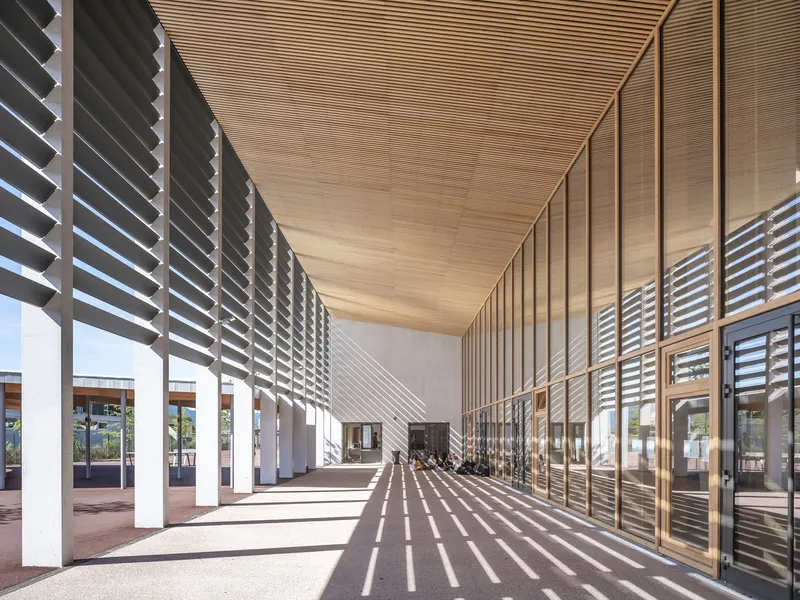
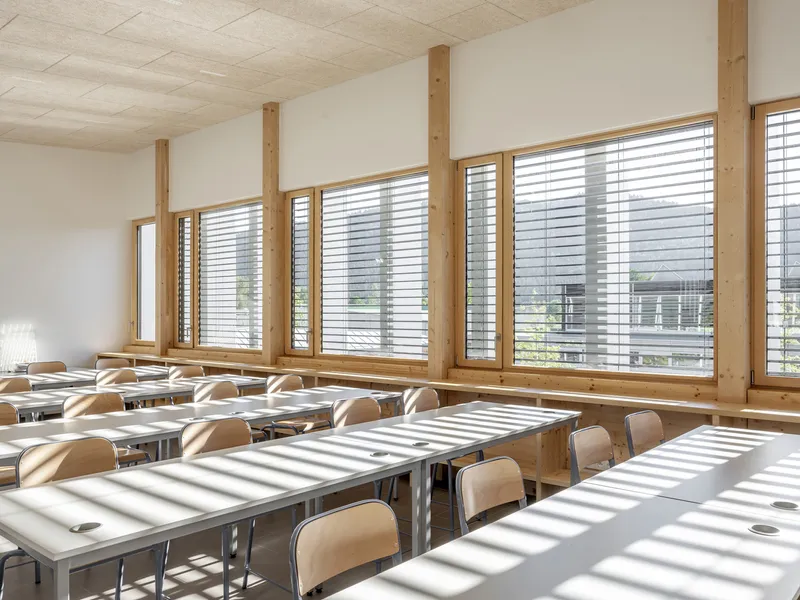
The bioclimatic strategy is legible in every photograph that involves sunlight. Horizontal timber louvers along covered corridors cast striped shadows across the floor, filtering solar gain while maintaining visual connection to the outdoors. In classrooms, rows of windows on the north and south facades deliver even daylight across worktables. The architects avoided east and west glazing entirely, sidestepping the problem of low-angle sun without resorting to motorized blinds or external screens.
For a building in the Vosges, where winters are cold and heating is the dominant energy concern, compactness matters. The plan is tight, with inner patios carved out rather than wings extended, minimizing the ratio of envelope to volume. Passive insulation, meticulous airtightness, and high-performance glazing push heating demand down to 25 kWh/m² per year, a figure made possible because 90% of the supply comes from Vagney's biomass-powered district heat network. The building does not merely reduce its footprint; it plugs into a renewable infrastructure that already exists.
Courtyards and In-Between Spaces

The covered courtyard, captured at dusk with interior lights glowing behind white columns and a timber soffit, is one of the project's quieter triumphs. It is neither fully interior nor fully exterior, a threshold space where students can gather in rain or snow without retreating inside. The planted pathway flanked by slatted wooden fencing performs a similar role at a smaller scale, channeling movement between buildings while keeping the landscape visually porous.
These in-between zones are where the school's identity as a "living organism" becomes tangible. Each patio, corridor, and canopy operates as connective tissue between the differentiated organs of the program. The architects clearly understood that a school's most formative moments rarely happen inside a classroom, and they allocated generous square footage to the spaces where informal learning, conversation, and play actually occur.
Why This Project Matters
Ban de Vagney is not a showcase for one idea. It is a demonstration that several difficult things, local timber construction, stringent energy targets, urban repair, and genuinely inventive spatial organization, can coexist in a single public building without any of them being diluted. The collaboration between Tectoniques Architects and SQUAD architectes produced a school where the structure is the architecture, where the heating strategy is inseparable from the massing, and where the furniture is designed with the same care as the facade. That coherence is rare.
For architects working on educational buildings in cold climates, the project offers a transferable lesson: compactness and warmth do not require introversion. The Agora, the courtyards, and the generous corridors prove that a thermally efficient envelope can contain spatially generous interiors. And by sourcing virtually all of its wood from Vosges forests and connecting to an existing biomass network, the school avoids the trap of sustainability theater. Every claim it makes is backed by a material choice or an energy number. That is what distinguishes a genuinely sustainable building from one that merely looks the part.
Ban de Vagney School, Vagney, France. Architects: Tectoniques Architects and SQUAD architectes. Landscape architects: ItinéraireBis / Jean Baptiste Lestra. Wood structure engineering: Perin et associés. Acoustic engineering: LINK Acoustique. Area: 3,800 m². Completed: 2022.
About the Studio
Share Your Own Work on uni.xyz
If projects like this are the kind of work you want to make, uni.xyz is a place to publish your own, find collaborators, and enter design competitions.


Popular Articles
Popular articles from the community


FCC Arquitectura Expands a Portuguese Granite House with a Board-Marked Concrete Wing
In Portugal, JV House pairs a cleaned-up whitewashed and granite dwelling with a timber-shuttered concrete extension, courtyards and a garden pool.


Aquadapt: An Underwater Habitat That Rewrites Its Rooms by the Hour
Curved modules ring the seabed while one shell shifts from breakfast room to cinema, farm and football pitch as residents' needs change.

Cube Design Draws an Ecological Corridor Between Two Shenzhen Hills with the Nankai Building
Beside Shenzhen's container docks, the Nankai Building pairs stacked balconies with a climbing green screen to connect two hillsides across its height.

David Ortega Stacks a Two-Story Mexico City Penthouse Around a Steel Stair and a Pergola-Shaded Roof Terrace
In Colonia Roma, a 300 m² penthouse uses oak joinery, a planted steel stair and a slatted roof pergola to make a new-build apartment feel like a house.

Similar Reads
You might also enjoy these articles


Hodi-Mandai Geram
Project Function: Preservation and revitalization of the Intangible heritage and socio-spatial identity of the Hodi by Housing, Cultural Memory Center, Sacred Grove, landscape, local tourism economy


Olio Towers: A Mid-Rise for Performers That Fuses Housing, Rehearsal, and Stage
Located blocks from Houston's Theater District, this modular tower stacks living units around a central performance atrium.

Oasis: Modular Green Housing Carved into Dhaka's Urban Fabric
A shortlisted Plugin Housing entry reclaims unauthorized settlements in Dhaka with stepped concrete volumes, green roofs, and ventilation-driven design.

Black Hole: A Floating Megastructure for the Post-Physical Era
Emiliano Mazzarotto envisions a spherical, self-scaling arena where e-sports, digital hotels, and holographic stadiums replace traditional public space.

Explore Educational Building Competitions
Discover active competitions in this discipline

Challenge to design public laboratory

Challenge to reimagine the Iron Throne

Photograph architecture without architects

Illustrate the lost glory of Angkor Wat - Render Challenge
Comments (0)
Please login or sign up to add comments
No comments yet. Be the first to comment!