
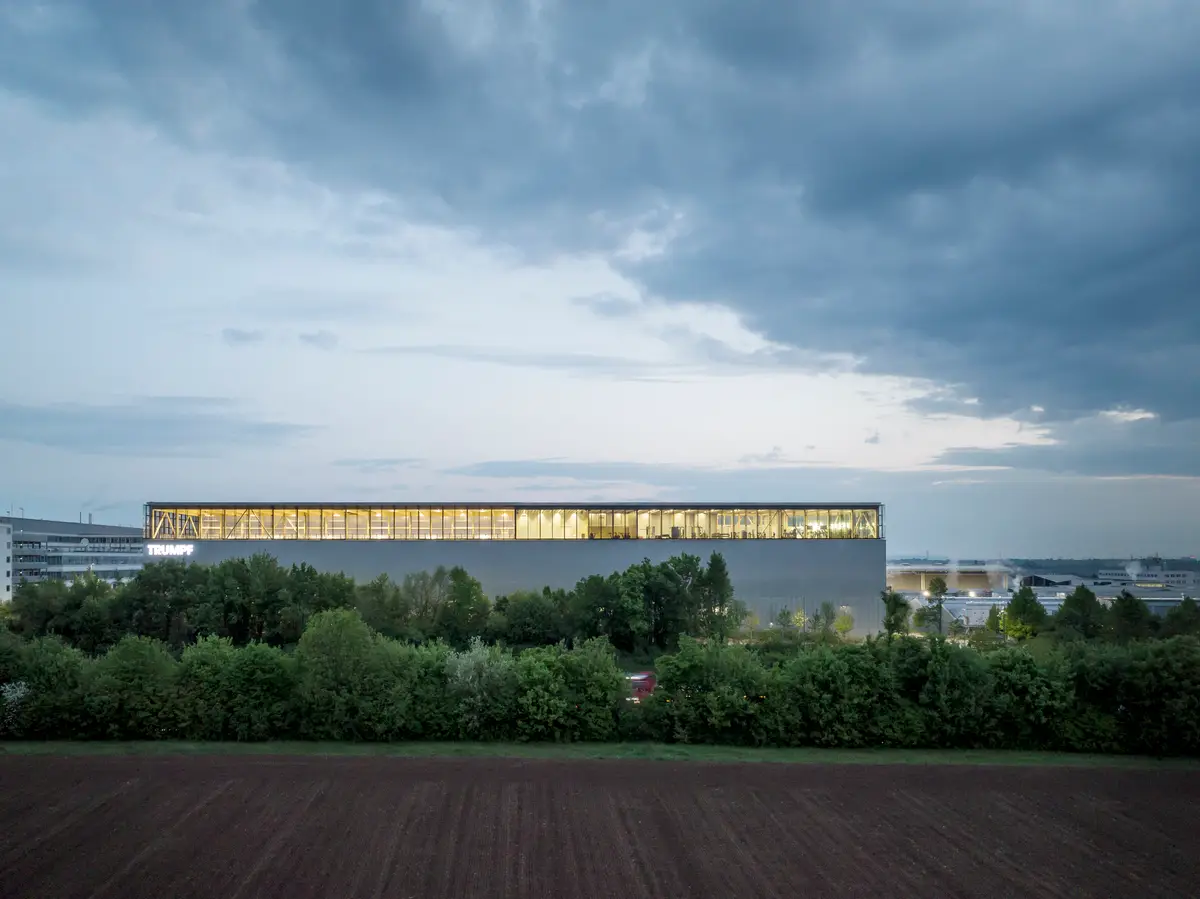
Barkow Leibinger Stacks a Timber Sports Center on Top of a Logistics Warehouse in Ditzingen
A laminated spruce fitness pavilion hovers 30 meters above the autobahn, turning a rooftop into an athletic campus for TRUMPF employees.


Corporate campuses rarely grow upward. They sprawl, adding parking lots and annexes until they bump against a highway or a municipal boundary. That is exactly what happened to TRUMPF's manufacturing headquarters in Ditzingen, about 15 kilometers northwest of Stuttgart, where the A81 autobahn and surrounding agricultural fields had long ago sealed the campus perimeter. Barkow Leibinger, the firm's longtime campus architect, answered the spatial impasse by going vertical: placing a 7,400 square meter fitness and sports center on the roof of an existing logistics building at the campus's southwestern edge.
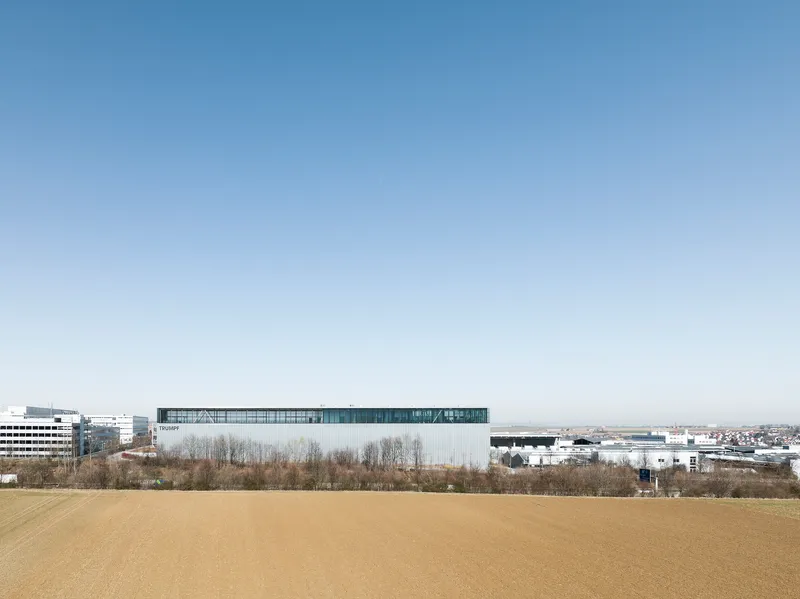
What makes the project genuinely interesting is not just the stacking maneuver but its material logic. The existing warehouse was never designed to carry a building on its back, so Barkow Leibinger turned to prefabricated laminated spruce timber, a lightweight structural system whose trusses span up to 23.5 meters while keeping dead loads to a minimum. The result is a luminous, long-span pavilion that reads from the highway as a glowing glass bar floating above the industrial roofscape, while from the inside it offers panoramic views over fields and the corporate campus below.
Vertical Densification as Campus Strategy
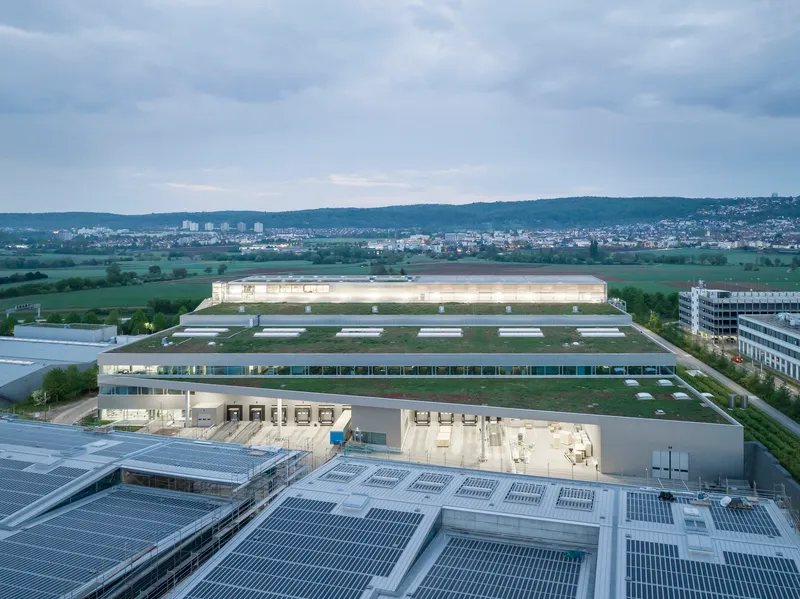
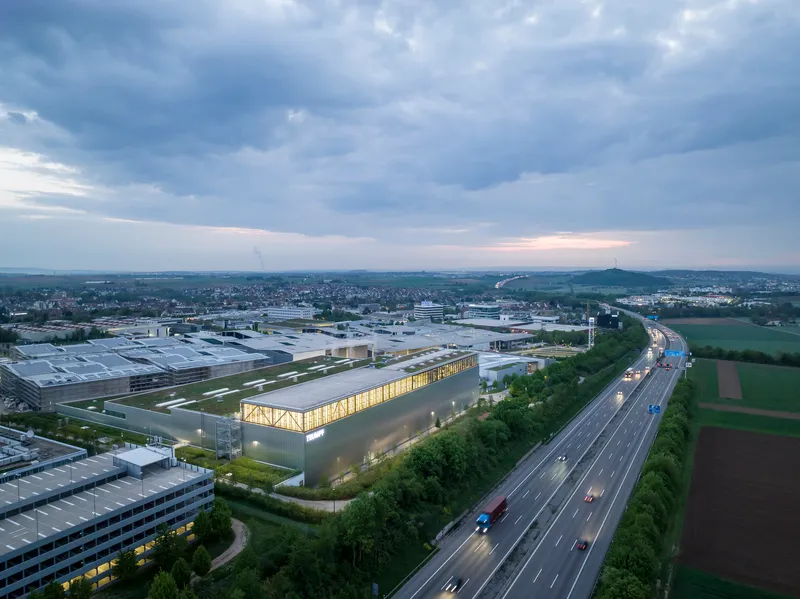
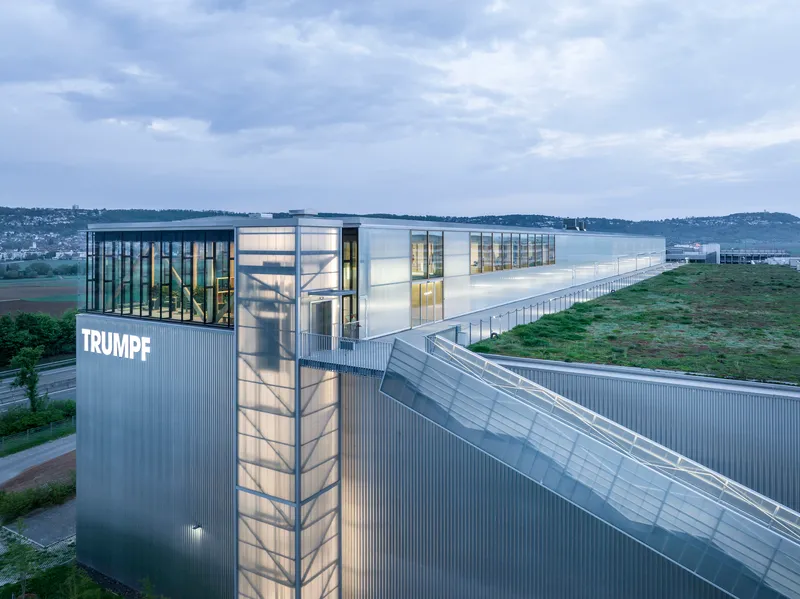
From the air, the TRUMPF campus looks like a spread of photovoltaic arrays and corrugated metal roofs bisected by the autobahn. The fitness center occupies what had been empty rooftop real estate on the logistics center, converting dead space into program without consuming a single additional square meter of ground. Barkow Leibinger's move is a clear argument for vertical densification in industrial contexts, where horizontal growth is cheap and habitual but ultimately finite.
The remaining roof area around the new building has been extensively planted, creating a green terrace that doubles as a visual buffer and a panoramic viewing platform. The dusk aerial photographs make the case plainly: the illuminated volume is legible from the highway, signaling that the campus has a life beyond production shifts.
Arrival and Ascent
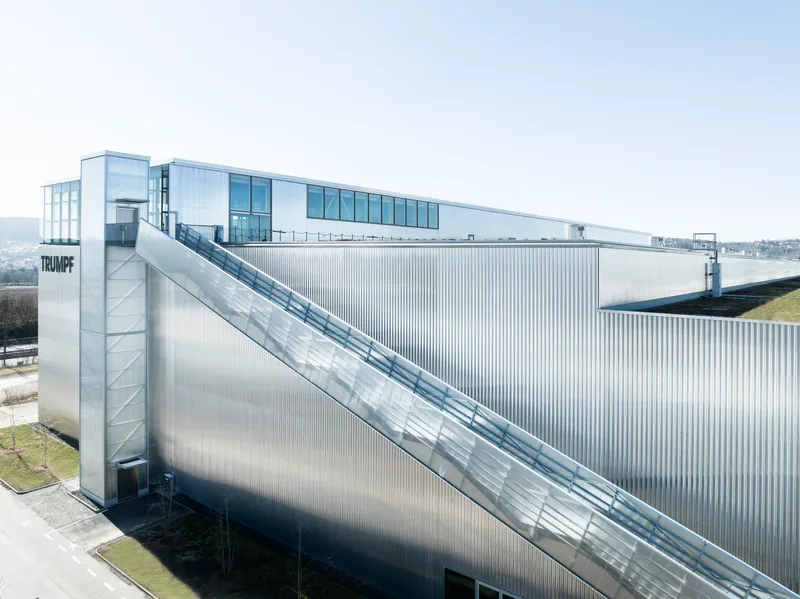
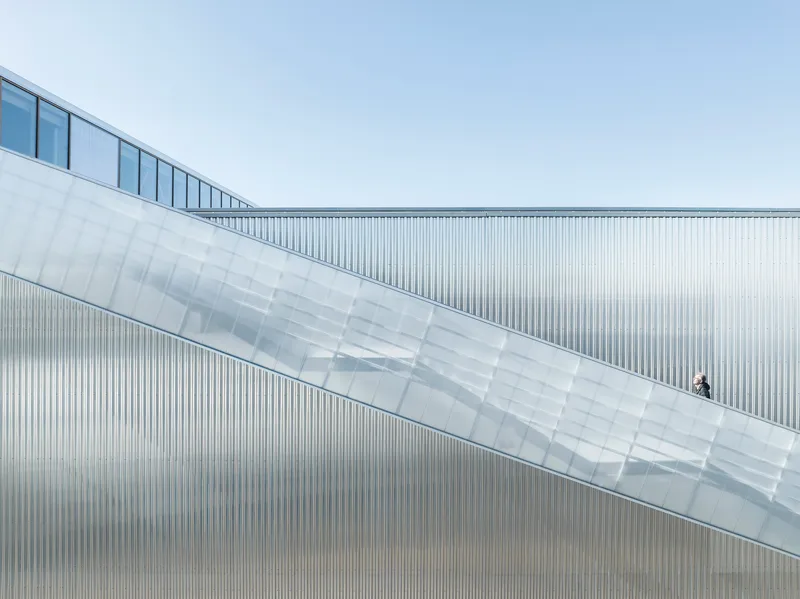
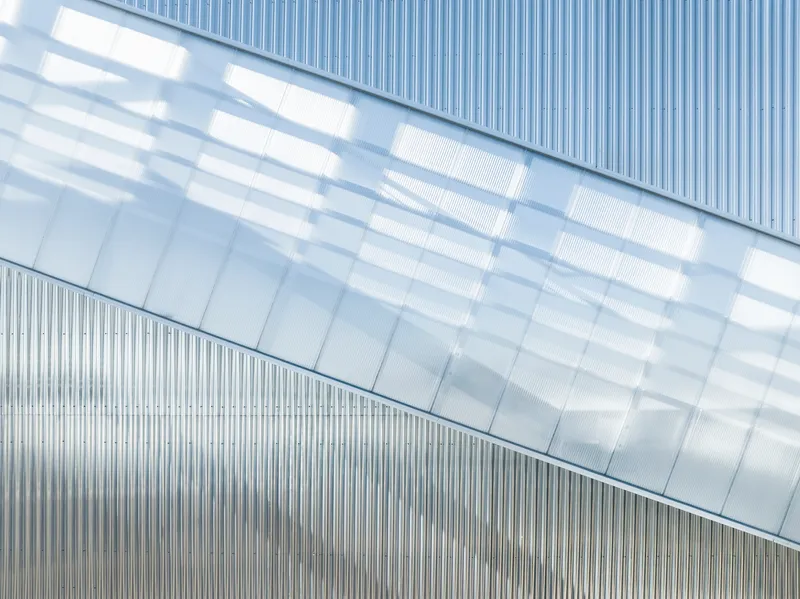
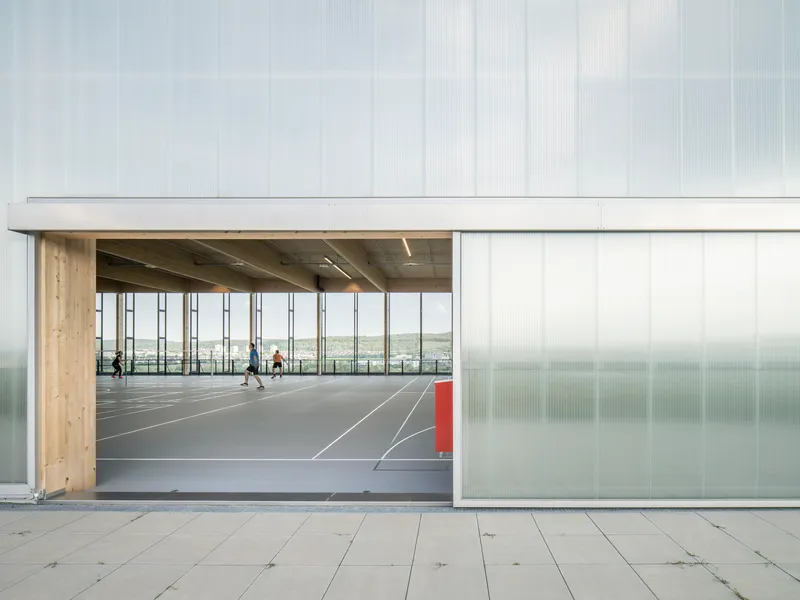
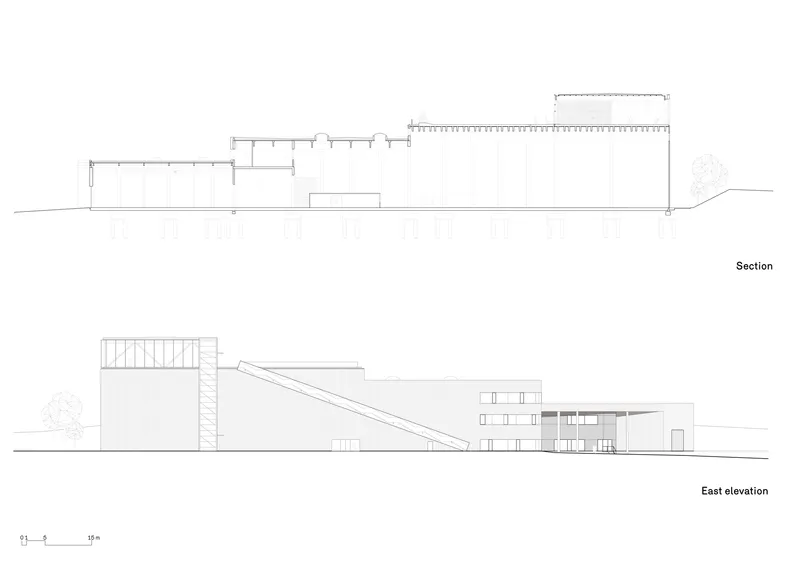
Getting to a rooftop gym 30 meters above grade is itself a design problem. Barkow Leibinger treats the circulation sequence as part of the athletic program. A diagonal skybridge clad in translucent polycarbonate panels ramps up from the campus to the new volume, and external staircases double as a training parkour. The corrugated metal cladding of the existing warehouse meets the lighter, more transparent skin of the sports center at these connection points, making the material contrast between old and new explicit rather than apologetic.
A cylindrical glass stair tower punctuates the composition vertically, serving as both a wayfinding landmark and a nighttime lantern. The detailing is restrained: ribbed metal, translucent panels, steel railings. Nothing competes with the primary architectural gesture of the elevated volume itself.
The Double Facade and Climate Logic
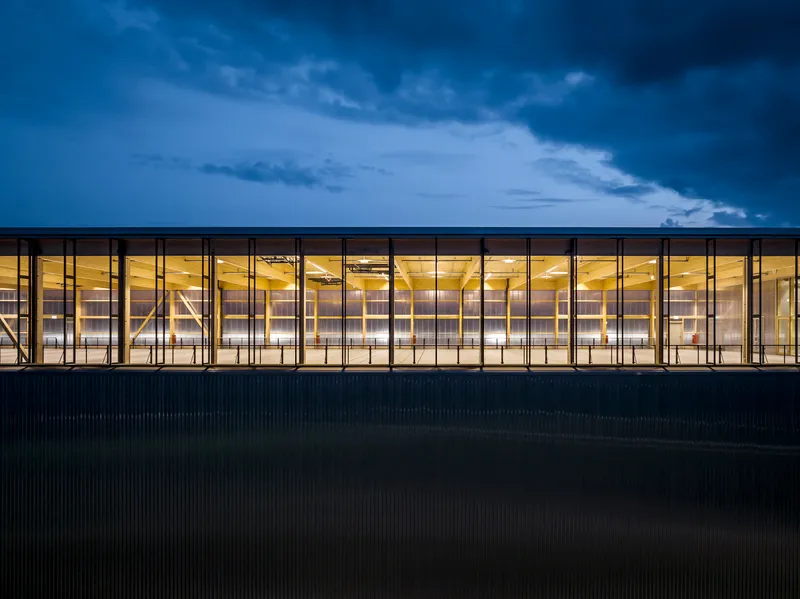
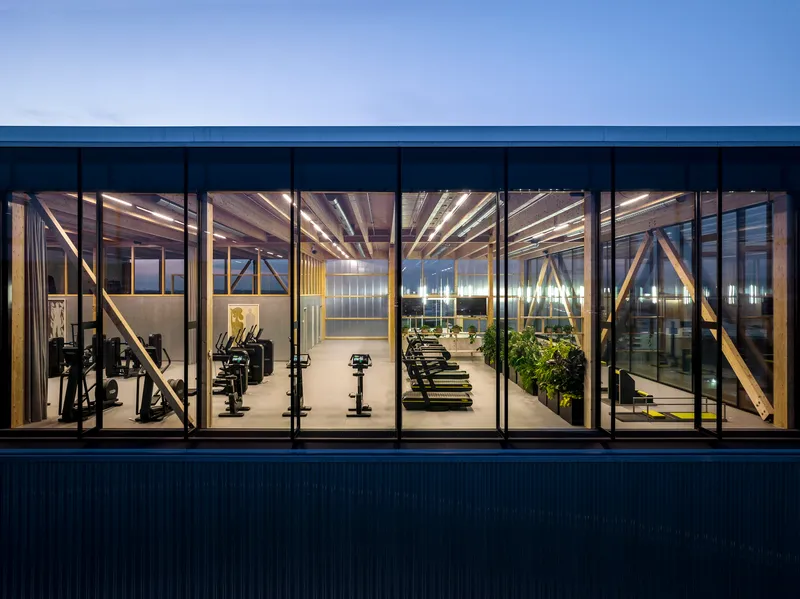
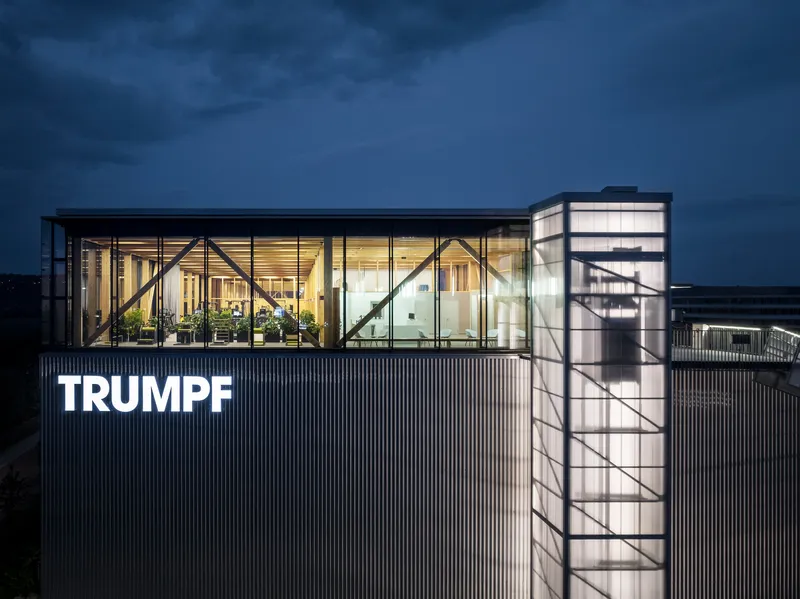
Running alongside the autobahn demands acoustic defense. The southern facade deploys a continuous double glazing system: an outer insulating glass layer absorbs highway noise while creating a cavity for wind-protected sun shading. On the northern side, translucent polycarbonate panels admit diffuse daylight into the sports hall without the thermal penalty of full glazing. The sports hall itself forgoes insulating glass entirely in favor of protective netting, allowing large sliding doors to open directly onto the rooftop garden for natural ventilation.
The environmental strategy is straightforward and effective. The building does not rely on elaborate mechanical systems to achieve comfort; it uses orientation, material transparency, and operable openings to manage heat, light, and sound. For a sports facility where occupants generate significant metabolic heat, this passive approach is both practical and low-energy.
Spruce Timber and the Weight Equation
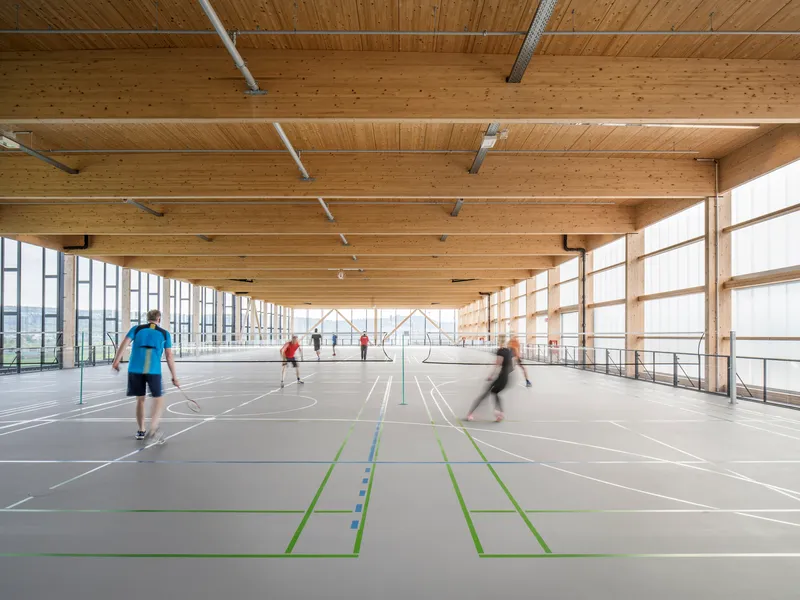
The choice of laminated spruce timber was driven by engineering, not aesthetics. A steel or concrete frame capable of spanning 23.5 meters would have imposed loads the logistics center could not support without expensive structural reinforcement. Prefabricated spruce trusses, reaching up to 1.2 meters in height, deliver the necessary spans at a fraction of the weight while significantly reducing the project's embodied carbon. The span width is halved in the fitness and yoga zones, creating a finer grain of structure where the ceiling drops closer to occupants.
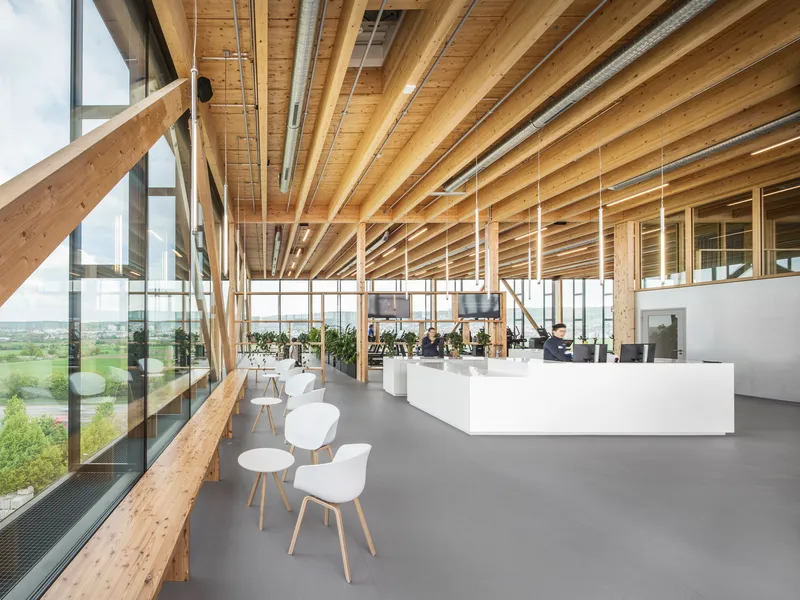
Inside the sports hall, the exposed timber trusses establish a warm, rhythmic ceiling plane that contrasts with the industrial character of the campus below. The repetitive bay structure is honest and legible: columns, beams, and diagonal bracing are all visible, giving the space the clarity of a well-organized warehouse rather than the visual clutter of a typical gym.
Fitness Spaces and Interior Quality
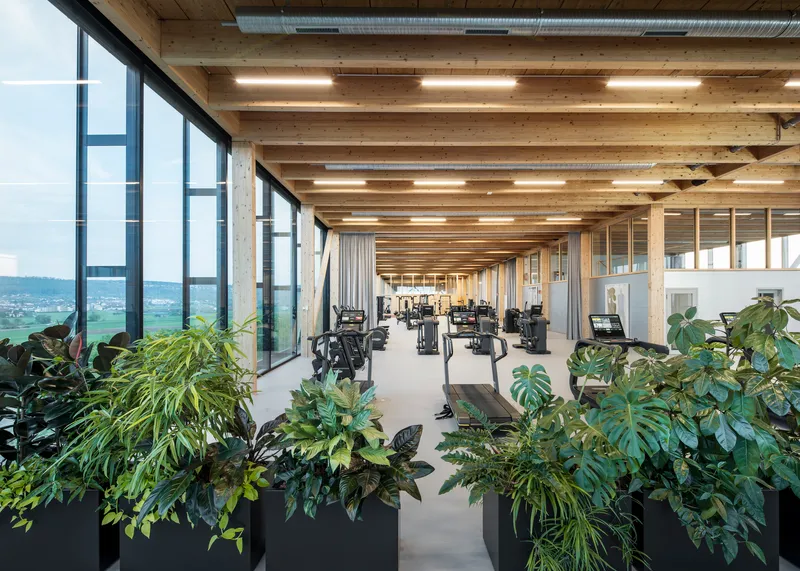
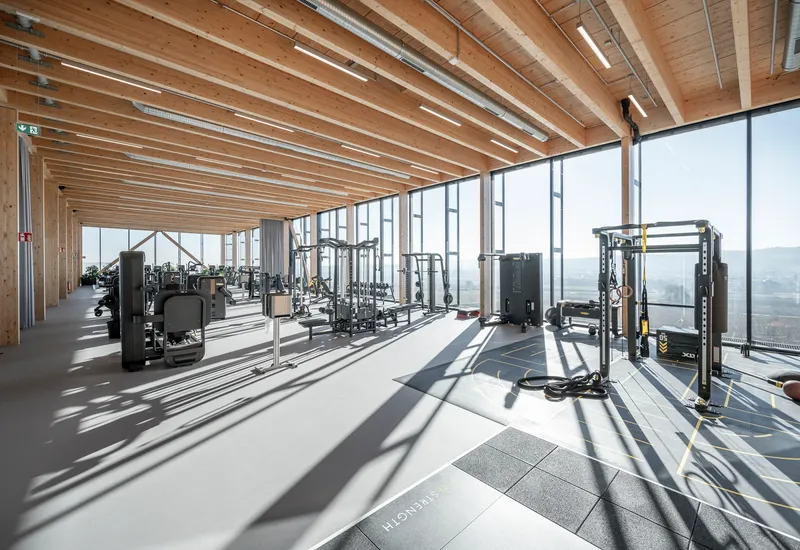
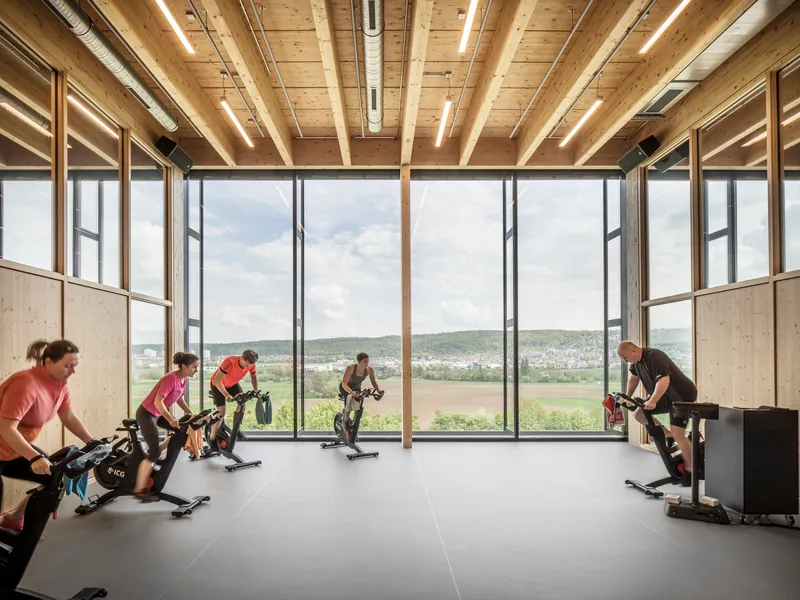
The program divides into two primary zones: a fitness area with yoga and class spaces, a foyer, and changing rooms on one side, and a sports hall with three full playing fields for basketball, soccer, and badminton on the other. The fitness side benefits from floor-to-ceiling curtain wall glazing facing south, where exercise machines sit in long shadows cast by the timber joists above. Planters along the glazing line soften the threshold between interior and rooftop landscape.
The training rooms and open fitness areas share a quality of generous daylight and long views over the surrounding agricultural landscape. For a building perched atop a warehouse, the interiors feel remarkably grounded. The timber ceiling provides acoustic warmth, the glazing connects occupants to the horizon, and the proportions of the one-story volume with its mezzanine keep the scale human rather than cavernous.
Night Presence on the Highway
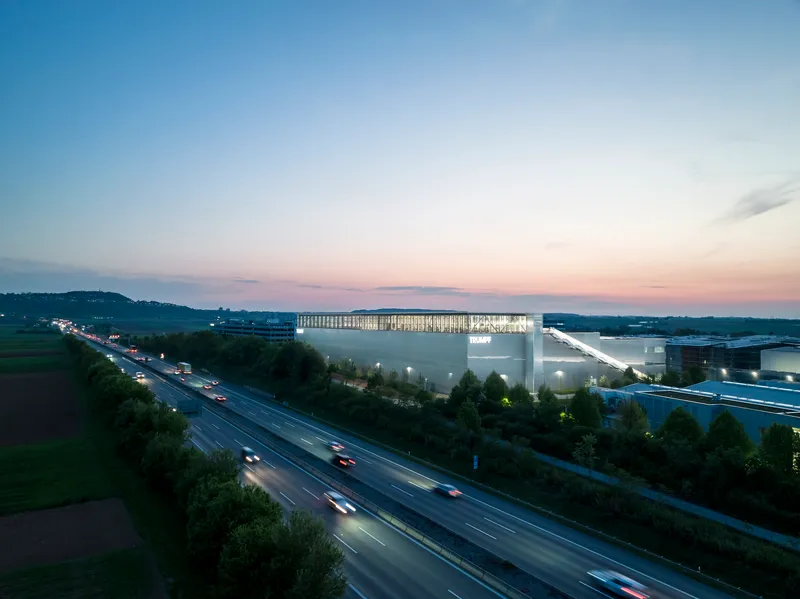
At dusk the building transforms. The continuous glass facades turn the sports center into a luminous bar suspended above the tree line, visible to thousands of daily commuters on the A81. Long exposure photographs capture the building as a stable horizontal glow above the streaking headlights below, a neat inversion of the typical relationship between infrastructure and architecture. The highway is kinetic and anonymous; the building is still and occupied.
Barkow Leibinger have clearly thought about this nocturnal reading. The transparency that serves daylight and views during working hours becomes a signaling device after dark, projecting the company's investment in employee wellbeing to anyone passing by. It is corporate branding by architectural means, and it works precisely because the building is genuinely good rather than merely photogenic.
Plans and Drawings
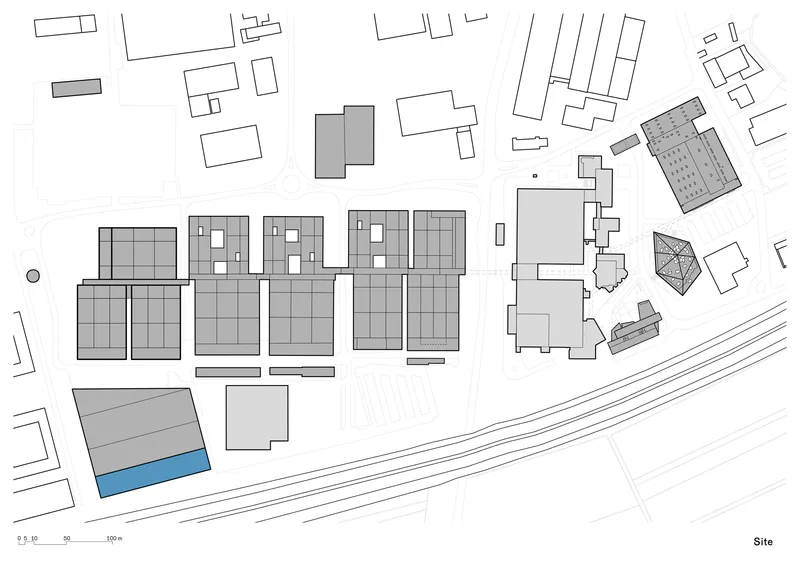
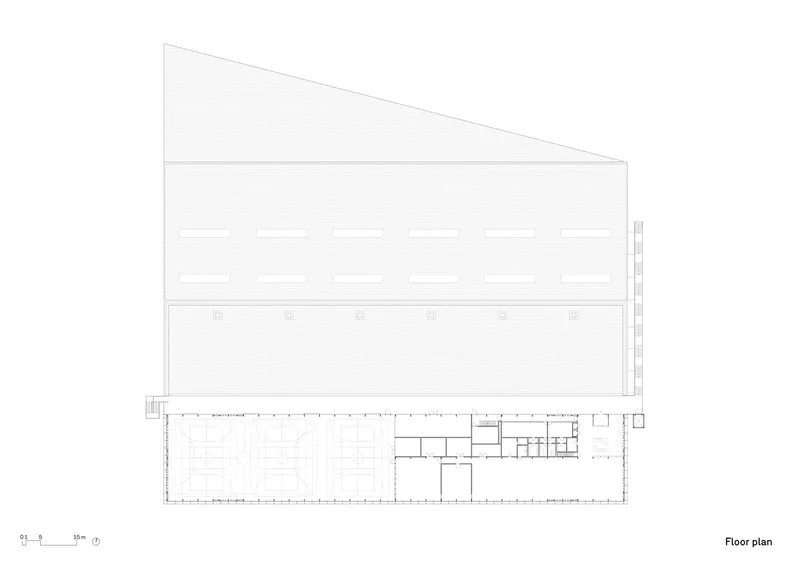
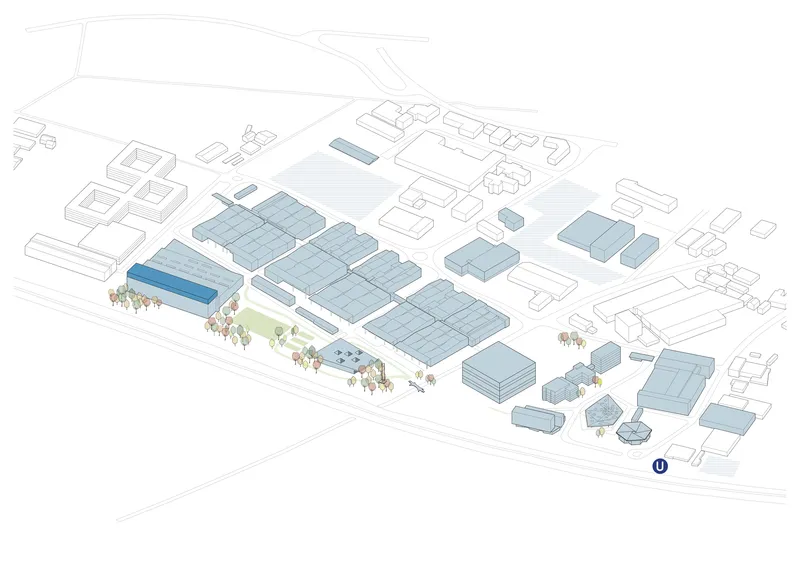
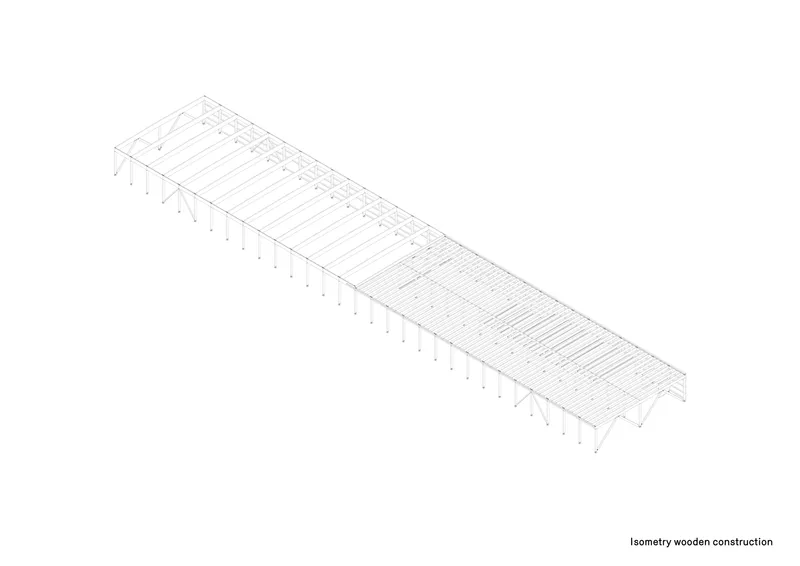
The site plan confirms the constraint that motivated the project: five linear warehouse structures packed tightly along the highway, with no room to expand horizontally. The floor plan reveals the building's straightforward organization, a long open volume with service rooms clustered at one end and clerestory roof sections admitting additional daylight. The axonometric drawing of the timber framing system makes the structural logic explicit, showing repetitive bays of columns and beams that could be fabricated off-site and erected quickly, minimizing disruption to the logistics operations below.
The section and elevation drawings illustrate the sloped roof profile and the relationship between the new sports center and the warehouse volumes beneath it. The isometric campus view shows how the saw-toothed industrial roofscape is softened by planted pathways and green roofs, establishing a visual continuity between the new intervention and the landscape strategy across the broader site.
Why This Project Matters
The TRUMPF Fitness and Company Sports Center is a compact demonstration of what vertical densification can achieve on an industrial campus when material intelligence guides the design. Barkow Leibinger did not simply add a building; they identified an underused surface, understood its structural limits, and selected a construction system calibrated to those constraints. The result is a lightweight, low-carbon, high-span pavilion that delivers genuine spatial quality for its occupants while consuming zero additional land.
More broadly, the project signals a shift in how corporations think about their physical footprint. The era of the sprawling suburban campus is bumping up against real limits: highways, zoning boundaries, environmental regulation. Stacking program on existing rooftops is not a new idea, but executing it at this scale and with this level of architectural ambition is rare. Barkow Leibinger make a convincing case that the roof of a logistics building can be as good a site as a greenfield, perhaps better, because the constraint itself generates the invention.
TRUMPF Fitness and Company Sports Center by Barkow Leibinger, Ditzingen, Germany. 7,400 square meters. Completed 2021. Photography by David Franck.
About the Studio
Share Your Own Work on uni.xyz
If projects like this are the kind of work you want to make, uni.xyz is a place to publish your own, find collaborators, and enter design competitions.


Popular Articles
Popular articles from the community


Singing Woman: Contemporary Architecture Inspired by Estonia’s Voice and the Sea
Singing Woman turns Estonia’s song culture into flowing opera house architecture, blending public life, landscape, sea, and national memory.

The Amber Palace Opera: A Geological Fiction Surfaces on Tallinn's Baltic Waterfront
Pierre Brillard reimagines a Baltic legend as a public landscape, opera house, and waterfront promenade rooted in Tallinn's coastal identity.

Extended Shell: Retrofitting Kolkata's Balconies as Living Urban Thresholds
A modular retrofit system recovers the social and environmental intelligence of Kolkata's historic verandas for contemporary Park Street residents.

Opera by the Sea Estonia: Three Shells Dissolving Architecture into Tallinn's Coastline
A winning opera house proposal replaces monumental form with interconnected shells that blur the boundary between building, park and Baltic Sea.

Similar Reads
You might also enjoy these articles

Bao Huynh Watercolor Atelier: A Serene Art Retreat in Hội An
Bao Huynh Watercolor Atelier in Hội An blends multifunctional art spaces, sustainable design, local materials, and family-friendly living in a serene environment.

Atelier Macri Concept Store Interior Design by CASE-REAL
Atelier Macri store features a "ko" counter, walnut wood details, cork displays, blending retail, gallery, and seamless customer experiences.

Manuel Vargas Izquierdo Stadium and High-Performance Sports Center: Architectural Excellence in Jalpa de Méndez
The Manuel Vargas Izquierdo Stadium blends sustainable design, inclusive sports facilities, and cultural-inspired architecture, revitalizing Jalpa de Méndez’s public spaces.
KAKR Buluh Awar Hall: Revitalizing Community and Ecology Through Bamboo Architecture
Community built bamboo hall revitalizes Buluh Awar village, empowering youth, restoring ecology, celebrating vernacular craftsmanship through sustainable architecture and culture.
Explore Sports Center Competitions
Discover active competitions in this discipline

Challenge to reimagine the Iron Throne

Photograph architecture without architects

Illustrate the lost glory of Angkor Wat - Render Challenge

Design challenge to reuse E-waste
Comments (0)
Please login or sign up to add comments
No comments yet. Be the first to comment!