

Gui Mattos Wraps a São Paulo Residence in Stone Walls and Timber Screens That Dissolve into Garden
Baroneza XI layers raw stone, vaulted ceilings, and vertical timber slats into a low horizontal house that merges with its Brazilian landscape.


The Baroneza XI Residence by Gui Mattos is a study in mass and permeability. From the street, the house presents itself as a monolithic stone perimeter, nearly fortified, giving nothing away. Step past that wall and the architecture flips: timber screens dissolve into garden views, vaulted stone ceilings funnel light down corridors, and an L-shaped plan wraps a courtyard that pulls the landscape into the center of domestic life.
What makes the project genuinely interesting is the tension between its two primary materials. Stone is treated as boundary, gravity, permanence. Timber is used for everything that mediates: the screens that filter light, the ceilings that hover over living spaces, the decks that extend rooms into planting. Neither material defers to the other. They sit side by side, each doing distinct work, and the house reads clearly because of that discipline.
The Stone Perimeter


The perimeter wall is the first move and probably the most consequential. Built from rough-cut stone and rising just high enough to obscure the house behind it, the wall establishes the property as a walled compound in the best sense: private without being hostile, present without being showy. Young trees planted along its base will eventually soften the line, but even now the masonry reads as landscape feature more than barrier.
This is not a token gesture. The wall runs long enough to give the residence a public face that is almost entirely mineral. It absorbs the scale of the lot, compresses expectations, and makes the transition to the open interiors behind it feel genuinely rewarding.
Vaulted Stone Corridors

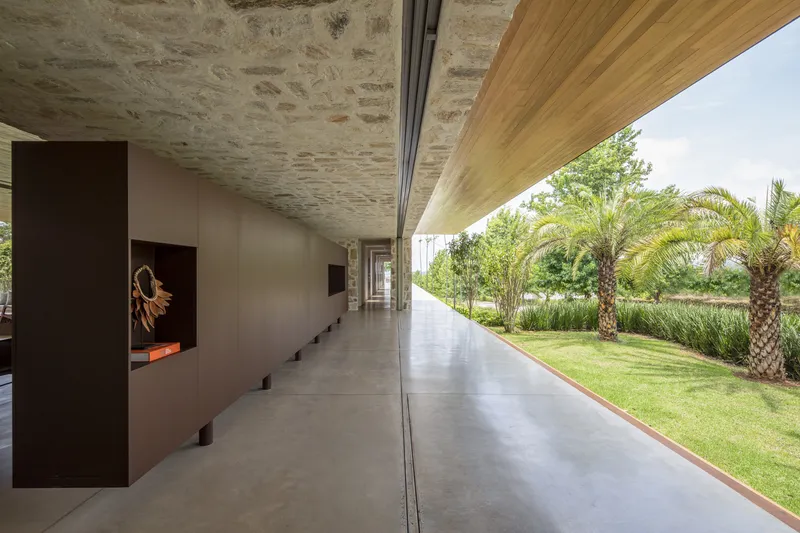

Inside the perimeter, Mattos takes the stone vocabulary vertical. A gallery corridor features a vaulted stone ceiling with a timber soffit, punctuated by circular skylights that drop perfect discs of light onto the concrete floor. The effect is almost ecclesiastical: processional, calm, and deliberate. These are not spaces you rush through.
Where the vault meets the garden, the stone frame holds a horizontal window that crops the lawn and palm trees into a composed scene. The framing is tight and intentional. You see the landscape because the architecture decides where and how much. It is a generous restriction, the kind that sharpens perception rather than limiting it.
Timber Screens and the Horizontal Volume


From the garden, the house reveals its second identity. The main volume is long, low, and clad in vertical timber slats that filter light and views in both directions. The planted roof edges blur the top line into the canopy, while the base hovers above a planted slope. Under a jacaranda canopy, the residence almost disappears into the middle distance.
The timber screens do real environmental work. They modulate heat gain across the long facades, provide privacy without curtains, and give the interiors a warm, dappled quality that changes through the day. As a formal choice, they also prevent the house from reading as a glass box on a plinth, which is the default move for this kind of program and budget. Mattos sidesteps that cliché cleanly.
Living Spaces Open to the Landscape
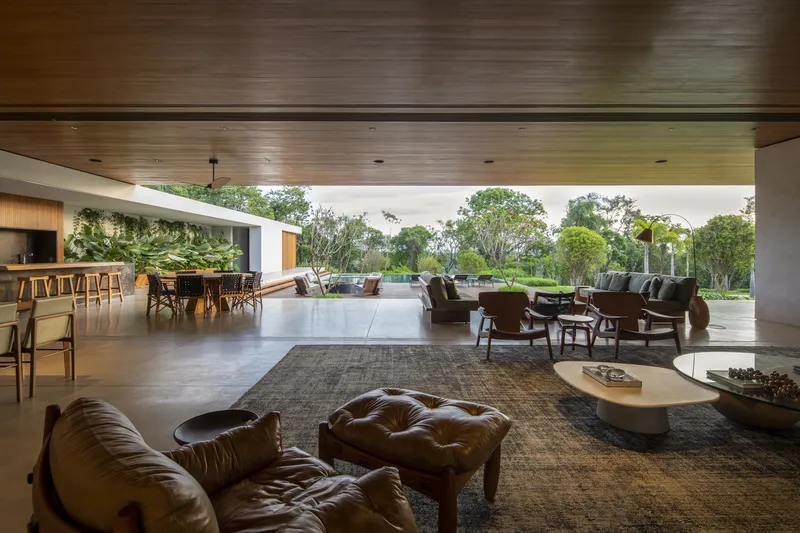


The main living areas are defined by timber ceilings, floor-to-ceiling glass, and a direct relationship with the courtyard and garden beyond. One space flows into the next with minimal partitioning: a stone wall anchors one side, planting arrives through an interior courtyard, and the covered terrace with its concrete floor extends the living room onto a timber deck. The sequence from enclosed to semi-enclosed to open is handled with care.
There is a material honesty here that holds the interiors together. The timber ceiling is structural in presence if not always in fact. The stone wall feels load-bearing. The concrete floor registers as ground. Nothing is pretending to be something it is not, and the result is a set of rooms that feel calm without feeling sparse.
The Courtyard and Pool Deck


The courtyard is the hinge of the plan. A timber deck holds low lounge chairs around a fire pit, backed by a planted green wall that climbs one boundary. It is an outdoor room in the fullest sense, scaled for evening use and sheltered enough to feel intimate despite the openness of the plan around it.
On the opposite side of the house, the pool deck stretches along the rear elevation. White pavilion volumes punctuate the terrace, and the timber decking ties the pool area back to the material language of the main house. A figure walking the edge of the terrace gives the scale: the space is generous but never sprawling, proportioned to the body rather than the lot line.
Plans and Drawings

The ground floor plan confirms what the photographs suggest: the house is organized as an L-shaped volume wrapping a courtyard, with a linear wing extending along one edge in repetitive bays. The courtyard is not leftover space; it is the organizational center from which every wing departs and to which every circulation path returns. The repetitive bays of the secondary wing suggest bedrooms or guest suites, held at a disciplined rhythm that contrasts with the more open social spaces of the main volume.
Why This Project Matters
Brazilian residential architecture has a long tradition of dissolving the boundary between inside and outside, from the Modernist houses of the mid-twentieth century to the tropical minimalism that dominates luxury practice today. Baroneza XI sits comfortably in that lineage but distinguishes itself through its commitment to opacity. The stone perimeter, the filtered timber screens, the carefully cropped window openings: these are all strategies of withholding, of choosing what to reveal. In a market that often equates openness with generosity, Mattos argues that restraint can be more generous still.
The project also demonstrates that material palette, handled with enough conviction, can do the work that formal complexity often tries to do. There are no dramatic cantilevers, no folded rooflines, no sculptural staircases competing for attention. Stone and timber, used with rigor and consistency, carry the entire architectural argument. That is harder than it looks, and it is why the house holds together so well across very different spatial conditions, from the tight vaulted corridor to the open pool deck.
Baroneza XI Residence by Gui Mattos. Location: São Paulo, Brazil. Photography by Maíra Acayaba.
About the Studio
Share Your Own Work on uni.xyz
If projects like this are the kind of work you want to make, uni.xyz is a place to publish your own, find collaborators, and enter design competitions.




Popular Articles
Popular articles from the community


Co-life: Sustainable Architecture for Age-Friendly Community Living
Co-life reimagines sustainable architecture for seniors through courtyards, rammed earth, shared gardens, and spaces designed for belonging.

Hill & Cross Opera: Sculptural Opera House Architecture Shaped by Tallinn’s Landscape and Identity
Hill & Cross Opera reimagines opera house architecture in Tallinn through its sculptural hill, civic plaza, glass wave and a luminous cross.

The Earth Pod: 3D Printed Homes for Resilient Refugee Communities
The Earth Pod reimagines refugee housing through 3D printed homes made from clay, combining resilience, self-sufficiency, and rapid shelter.

AL-JANNAH: Sustainable Architecture and Permaculture for Afghan Widows
AL-JANNAH uses sustainable architecture and permaculture to create resilient oasis of housing, learning, work and renewal for Afghan widows.


Similar Reads
You might also enjoy these articles


Hodi-Mandai Geram
Project Function: Preservation and revitalization of the Intangible heritage and socio-spatial identity of the Hodi by Housing, Cultural Memory Center, Sacred Grove, landscape, local tourism economy


Olio Towers: A Mid-Rise for Performers That Fuses Housing, Rehearsal, and Stage
Located blocks from Houston's Theater District, this modular tower stacks living units around a central performance atrium.

Oasis: Modular Green Housing Carved into Dhaka's Urban Fabric
A shortlisted Plugin Housing entry reclaims unauthorized settlements in Dhaka with stepped concrete volumes, green roofs, and ventilation-driven design.

Black Hole: A Floating Megastructure for the Post-Physical Era
Emiliano Mazzarotto envisions a spherical, self-scaling arena where e-sports, digital hotels, and holographic stadiums replace traditional public space.


Explore Brazilian Architecture Competitions
Discover active competitions in this discipline



Challenge to reimagine the Iron Throne


Photograph architecture without architects


Illustrate the lost glory of Angkor Wat - Render Challenge


Design challenge to reuse E-waste
Comments (0)
Please login or sign up to add comments
No comments yet. Be the first to comment!