
Bauherde: A Living Building Organism Rooted in Chelsea's High Line
A shortlisted Bauhaus Neue entry reimagines architectural education through biophilic design, modular beehive workshops, and a protective organic skin.


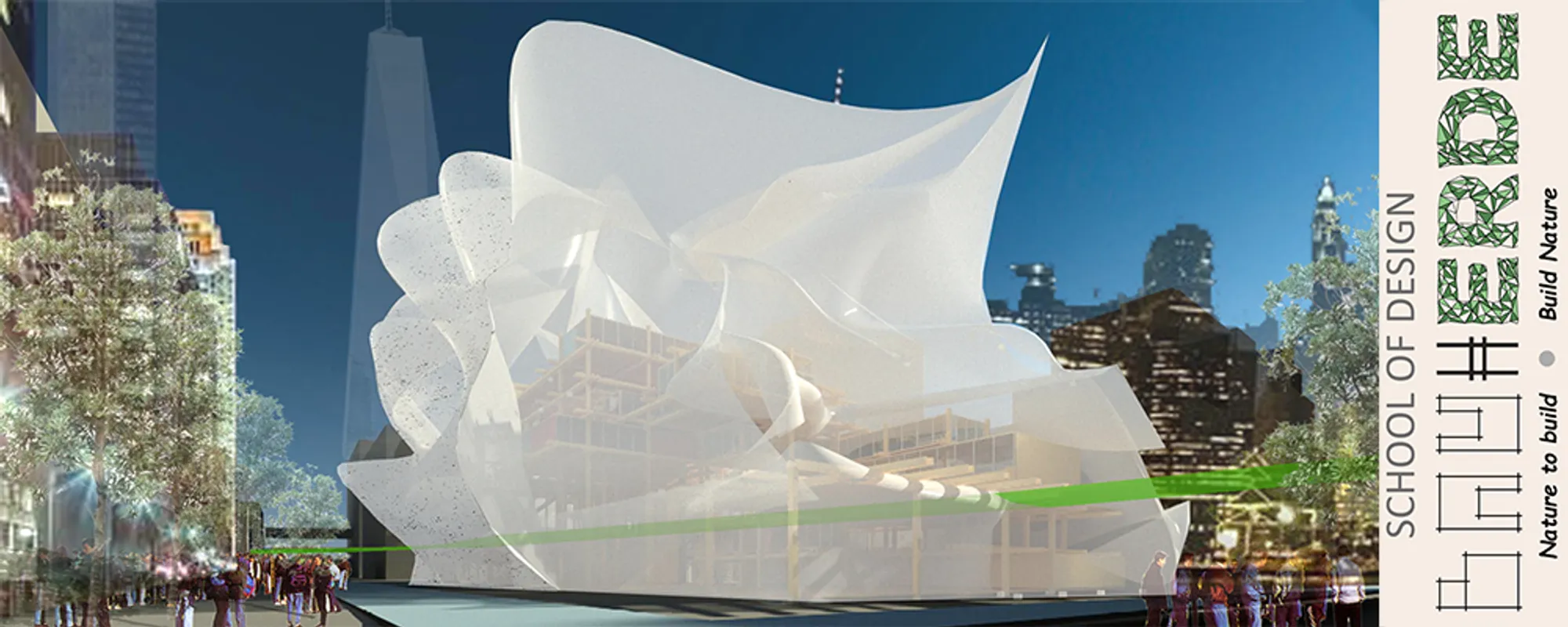
What if a school of architecture could behave like a forest? Bauherde proposes exactly that: a building conceived as a living organism, where a modular framework of vertical poles mimics tree canopies, learning spaces interlock like honeycomb cells, and an outer shell acts as a protective cocoon filtering light and weather. Sited in New York City's Chelsea district, the project bridges two parcels via the High Line, turning an old railroad corridor into the connective tissue of an educational ecosystem that refuses to separate building from biology.
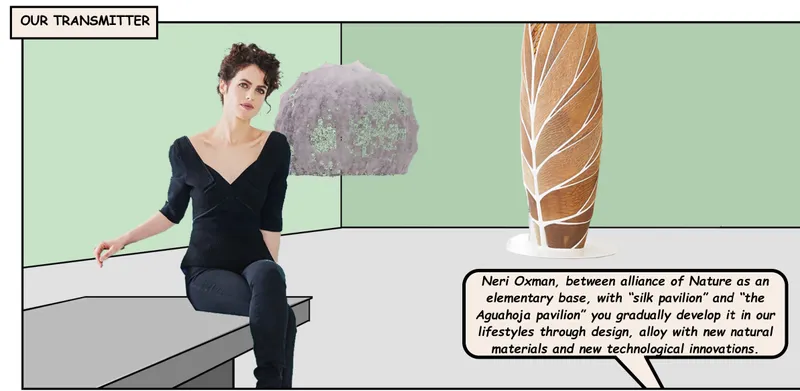
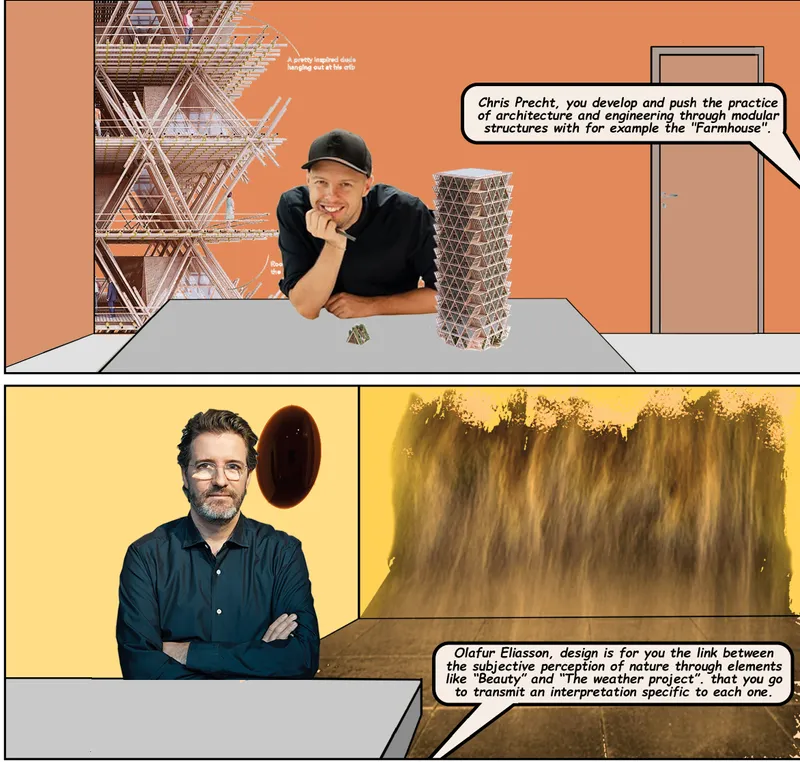
Designed by Léo Goyet and Gauthier Laurent, Bauherde was shortlisted in the Bauhaus Neue competition. The brief asked entrants to reconsider the legacy of the Bauhaus movement for a contemporary context. Goyet and Laurent responded with a provocation: the materials and techniques that defined early modernism contributed to ecological imbalance, and any honest successor must make sustainability its structural principle, not its afterthought. Their design draws on the thinking of Neri Oxman's bio-integrated material science, Chris Precht's modular timber systems, and Olafur Eliasson's explorations of emotional resonance between nature and built space.
A Faceted Cocoon on a Chelsea Sidewalk
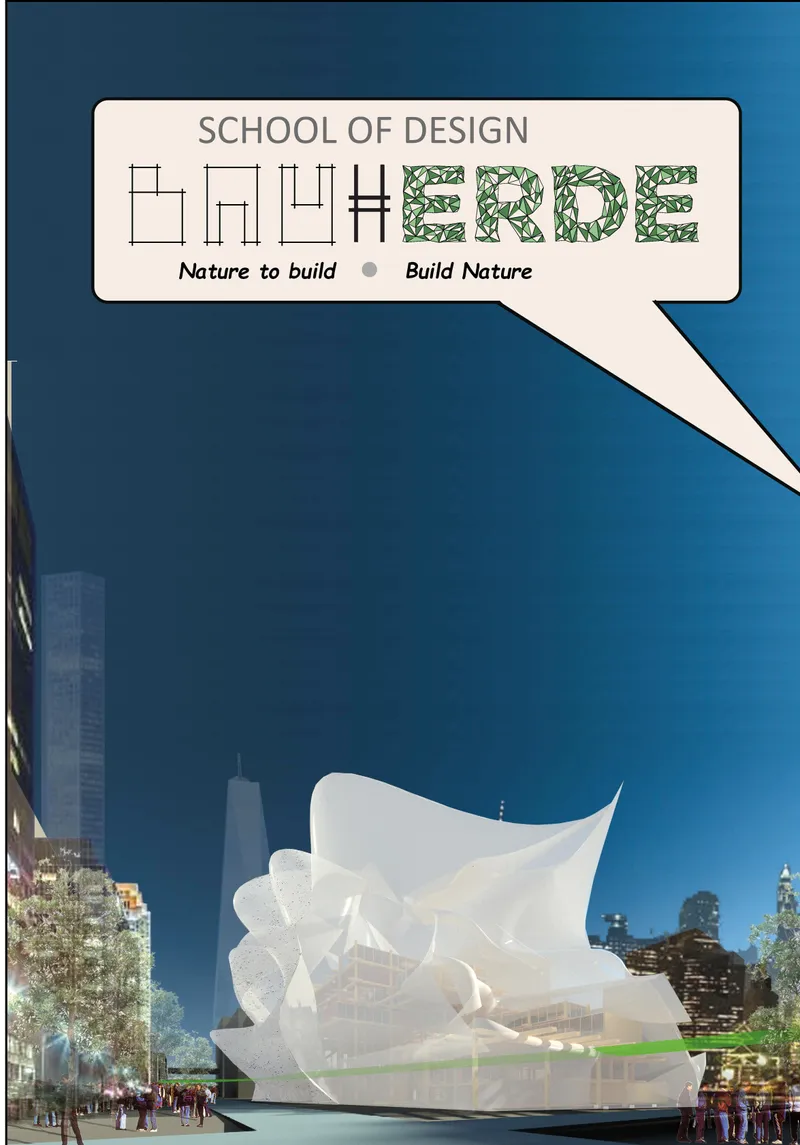
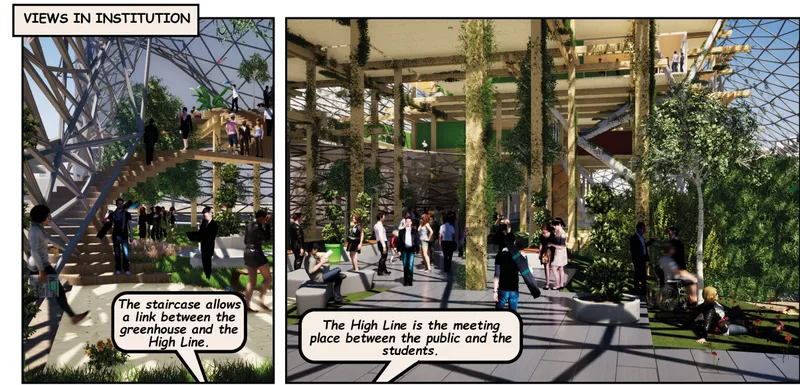
From the street, Bauherde reads as a white sculptural mass of folded, faceted surfaces that catch light at shifting angles throughout the day. The outer shell is more than formal gesture; it operates as the project's "protective cocoon," providing environmental resilience against New York's temperature swings, wind loads, and noise. Step inside, and the atmosphere inverts. A forest of timber columns rises through planted undergrowth toward a triangulated geodesic roof structure. Vegetation wraps the columns, blurring the line between interior and garden. The biophilic intent is immediate and physical: you are inside the building, but you are also inside a canopy.
Workshops That Behave Like a Beehive
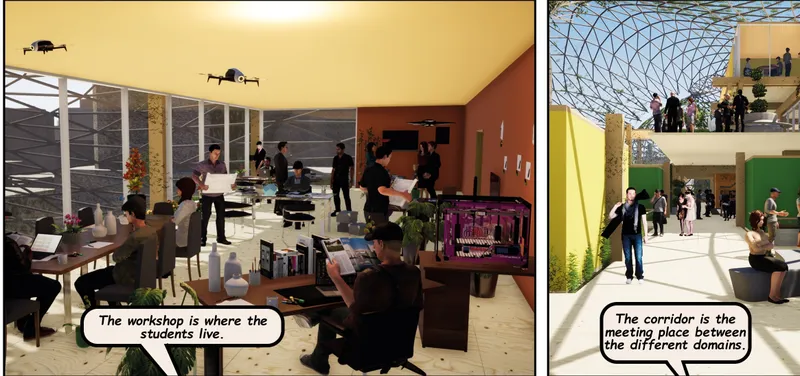
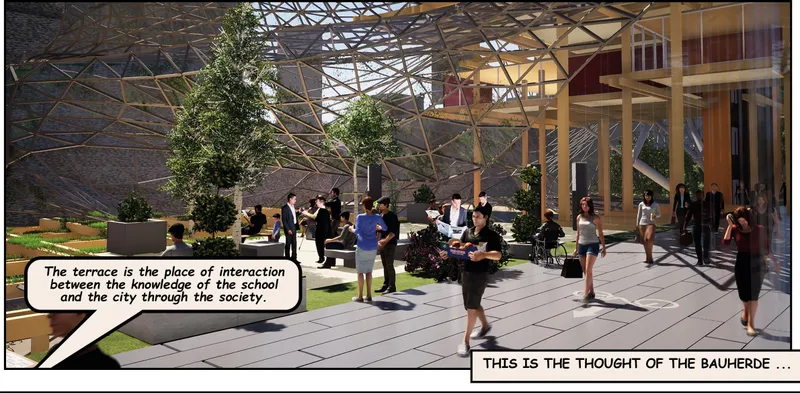
The interior programme is organized around what the designers call a "beekeeping concept": modular learning spaces that interconnect like cells in a hive. Studio workspaces sit beneath yellow ceiling planes that define individual zones while remaining visually open to planted terraces beyond the glass. The color coding is functional, helping occupants orient themselves within the larger organism without rigid corridor walls. Outside, timber deck terraces beneath the latticed geodesic canopy serve as informal gathering spaces where students sit, sketch, and debate. The canopy filters direct sunlight into a dappled pattern, producing conditions closer to a clearing in a forest than a conventional rooftop.
At Bauherde, the designers envision students as co-creators of the built environment rather than passive inhabitants. Artists, designers, and engineers share workshop modules that can evolve independently while maintaining coherence within the larger framework. It is a model of interdisciplinary collaboration baked into the spatial logic of the school itself.
Structural Logic: A Forest of Poles Beneath a Mesh Skin
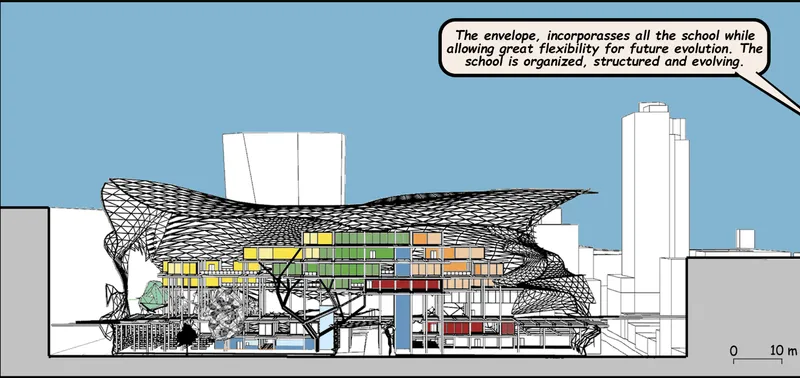
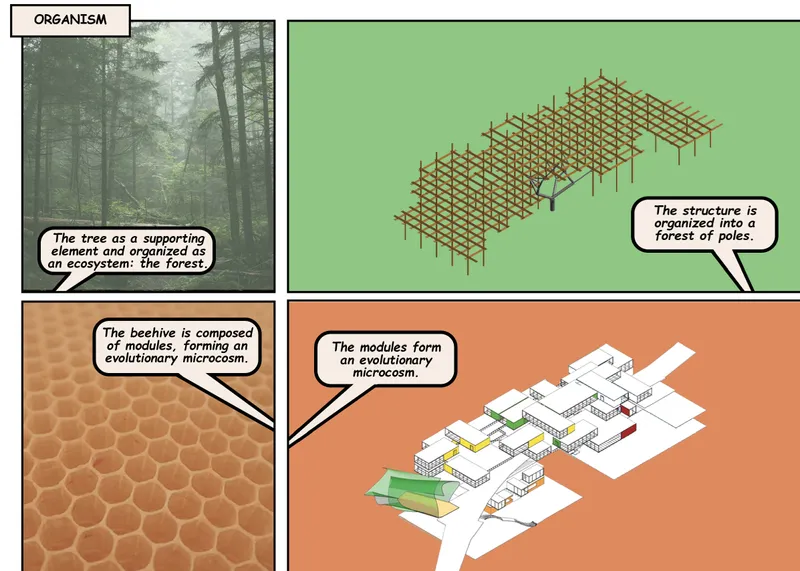
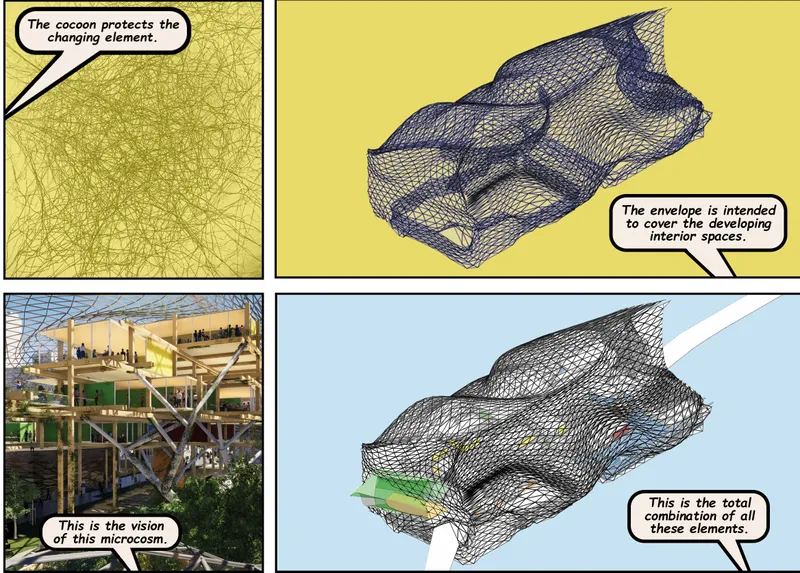
The section drawing reveals the full ambition of the scheme: colored programmatic volumes are stacked and nested beneath a flowing lattice roof canopy that extends well beyond the building footprint, sheltering outdoor zones and mediating between interior and city. An axonometric drawing breaks the structure down to its generative principle, a field of vertical poles arranged in a modular grid. The designers describe this as a "forest of poles" that mimics the branching logic of tree canopies, distributing loads while allowing light and air to penetrate deeply into the plan.
A diagram series traces the envelope's development: a wireframe mesh wraps progressively tighter around a sectional model of stacked floor plates, demonstrating how the organic skin is not arbitrarily shaped but derived from the interior volumes it protects. The envelope negotiates between structural performance and environmental mediation, thickening where wind pressure is greatest and opening where natural ventilation is desired. It is a genuinely adaptive strategy, not merely a smooth rendering of a free-form surface.
From Digital Model to Physical Prototype
The physical models test ideas that digital renderings alone cannot validate. A suspended textured sphere and a spiral-wrapped cylindrical form investigate the material behavior of the organic skin at different curvatures. On a separate exhibition table, triangulated structural models and a lattice tower prototype test the scalability of the geodesic framework. These are not presentation props; they are working artifacts that reveal how the designers moved iteratively between digital simulation and hand-built testing. The material evidence suggests a serious engagement with fabrication logic, not just formal ambition.
Why This Project Matters
Bauherde takes the Bauhaus legacy seriously enough to challenge it. Rather than reviving a visual style or quoting canonical forms, Goyet and Laurent confront the ecological consequences of industrial modernism head-on. Their response fuses biophilic urbanism with modular flexibility, producing a school that is simultaneously a pedagogical instrument, a green infrastructure node on the High Line, and a prototype for how buildings might grow and adapt over time.
The project's strength lies in its systemic coherence. The forest-of-poles structure, the beehive programme, and the cocoon envelope are not three separate metaphors stapled together; they operate as interdependent layers of a single organism. In a competition field asking what comes after the Bauhaus, Bauherde answers with a building that breathes, adapts, and teaches its inhabitants to do the same.
View the Full Project
About the Designers
Designers: Léo Goyet, Gauthier Laurent
Enter a Design Competition on uni.xyz
uni.xyz runs architecture and design competitions year-round that reward proposals with spatial conviction and real site intelligence.
Project credits: Bauherde by Léo Goyet, Gauthier Laurent Bauhaus Neue (uni.xyz).



Popular Articles
Popular articles from the community


The Ocean Hive: Sustainable Architecture for a Self-Sufficient Civilization at Sea
The Ocean Hive imagines sustainable architecture at sea, where modular habitats, algae, wave power and ocean waste sustain a growing colony.

Riyadh For All: Intergenerational Urban Design for Active Aging in Rabat
Riyadh For All reimagines urban design in Rabat with intergenerational co-living, adaptive courtyards, and Moroccan cultural exchange today.

Co-life: Sustainable Architecture for Age-Friendly Community Living
Co-life reimagines sustainable architecture for seniors through courtyards, rammed earth, shared gardens, and spaces designed for belonging.

Play: Fragments of Their World
Familiar architecture becomes modular playground design, creating safe spaces where displaced children can learn, connect, imagine and play.


Similar Reads
You might also enjoy these articles

Bao Huynh Watercolor Atelier: A Serene Art Retreat in Hội An
Bao Huynh Watercolor Atelier in Hội An blends multifunctional art spaces, sustainable design, local materials, and family-friendly living in a serene environment.

Atelier Macri Concept Store Interior Design by CASE-REAL
Atelier Macri store features a "ko" counter, walnut wood details, cork displays, blending retail, gallery, and seamless customer experiences.

Manuel Vargas Izquierdo Stadium and High-Performance Sports Center: Architectural Excellence in Jalpa de Méndez
The Manuel Vargas Izquierdo Stadium blends sustainable design, inclusive sports facilities, and cultural-inspired architecture, revitalizing Jalpa de Méndez’s public spaces.

KAKR Buluh Awar Hall: Revitalizing Community and Ecology Through Bamboo Architecture
Community built bamboo hall revitalizes Buluh Awar village, empowering youth, restoring ecology, celebrating vernacular craftsmanship through sustainable architecture and culture.

Explore New Bauhaus Competitions
Discover active competitions in this discipline



Challenge to design public laboratory


Challenge to reimagine the Iron Throne


Photograph architecture without architects


Illustrate the lost glory of Angkor Wat - Render Challenge
Comments (0)
Please login or sign up to add comments
No comments yet. Be the first to comment!