

Baumschlager Eberle Wraps a Bioclimatic Timber Office in Copper on Nantes Island
A seven-story CLT workplace for 800 postal workers channels natural ventilation through a skylitcentral atrium on the Loire.


Nantes Island sits in the middle of the Loire, and for decades its identity was industrial. The city has been rewriting that narrative, replacing warehouses and logistics yards with service-sector buildings that face the water instead of ignoring it. Baumschlager Eberle Architekten's Maison de l'Innovation is one of the most ambitious entries in that transformation: a 15,500 square meter timber-framed office building for La Poste, housing roughly 800 workers on a site the postal service previously occupied with a far less memorable structure.
What makes the project worth studying is not the timber frame alone, which is increasingly common in French institutional work, but the way the architects orchestrated a full bioclimatic envelope around a central atrium so that the building can sidestep conventional air conditioning for much of the year. Passive ventilation, radiant ceilings, rooftop agriculture, and a connection to a 100% renewable district heating network are not add-ons here; they are the core of the design logic. The facade's copper-finished aluminum fins do double duty as sun control and civic ornament, giving the building a warm, vertical grain that reads well against the island's grey skies.
A Copper Veil and an Arched Ground
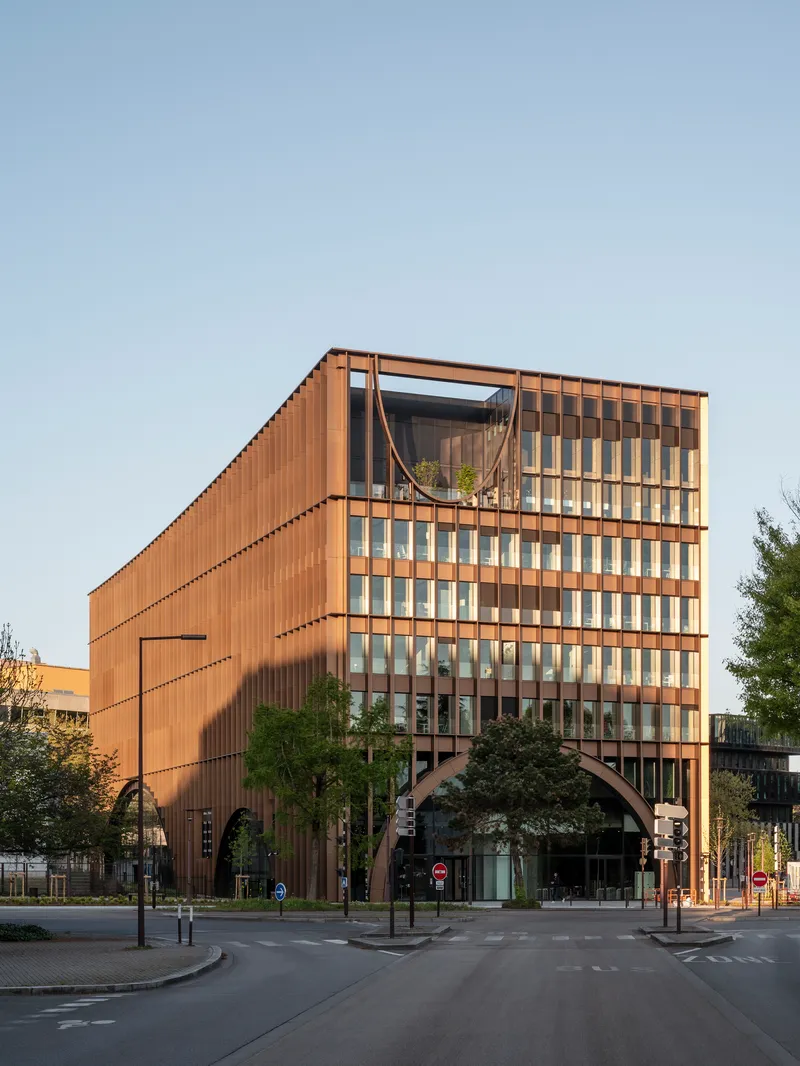
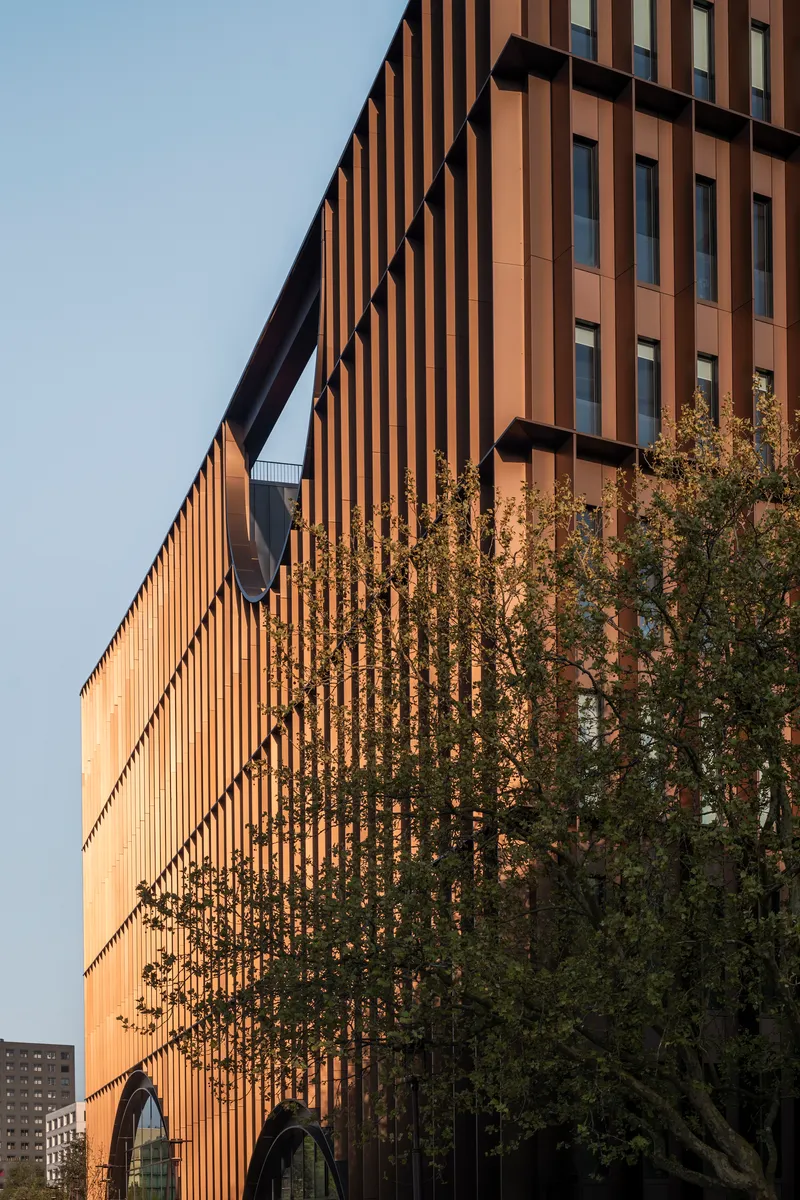
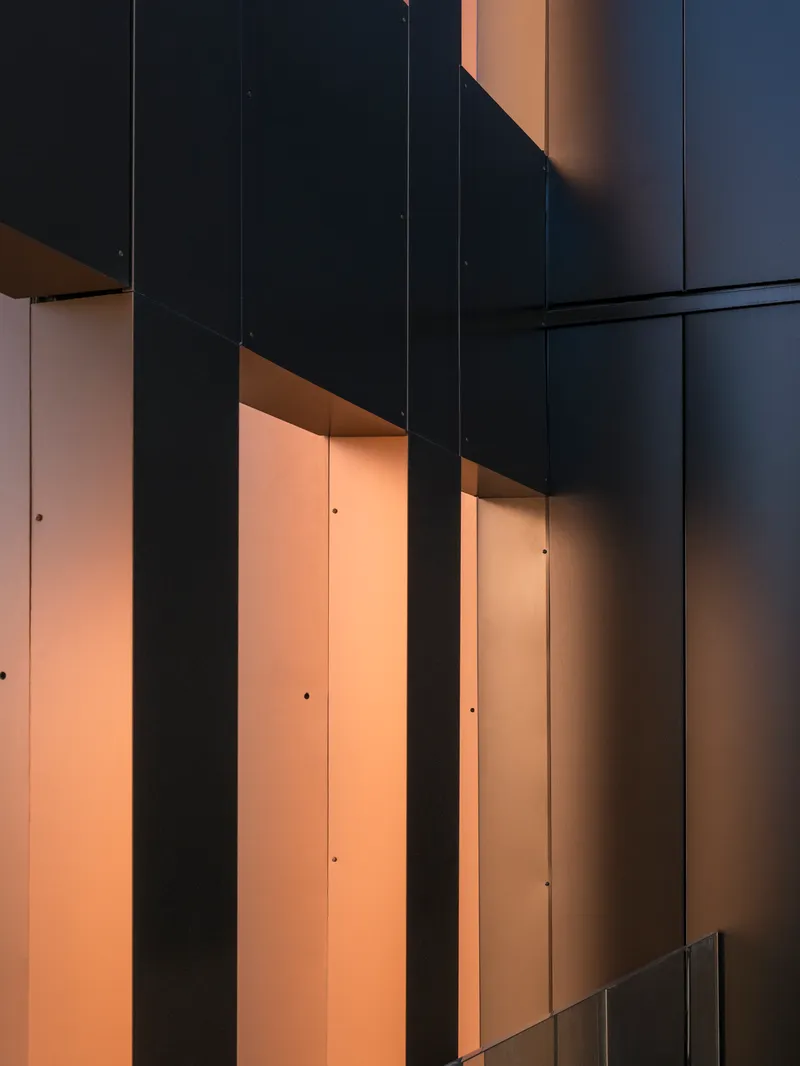
The facade is a unitized curtain wall system dressed in vertical slats of aluminum composite panels finished to resemble copper. The material is 50% recycled aluminum, and the slats are set at roughly 60 centimeters deep, enough to function as serious solar shading rather than decorative screening. In direct sunlight the fins throw sharp parallel shadows across the recessed glass; at dusk the entire skin catches warm light and glows against the darkening sky.
At street level, large arched openings punch through the concrete substructure and create an arcade that is both structural and civic. The arches support the open patio above while inviting pedestrians into the ground floor, which houses a restaurant, local services, and public-facing spaces. It is a generous gesture for a corporate office and one that acknowledges the building's role in a neighborhood that is still finding its footing.
The Atrium as Climate Engine
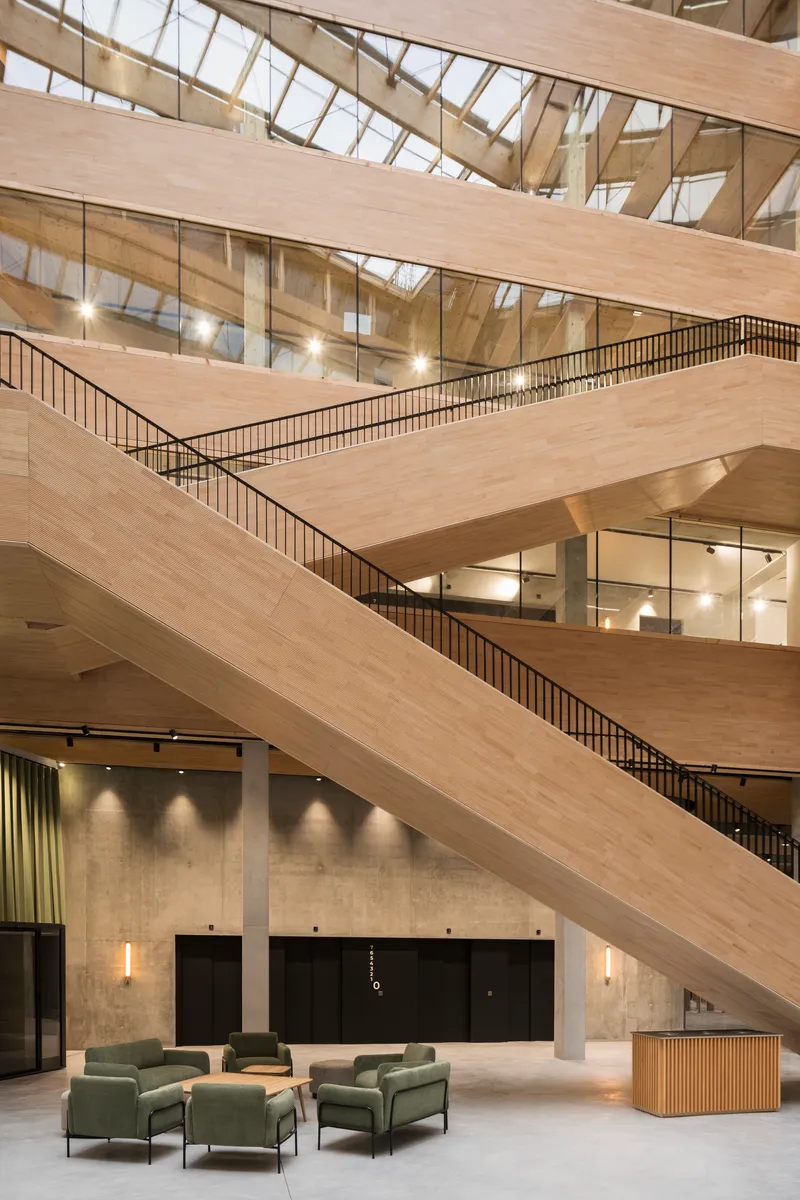
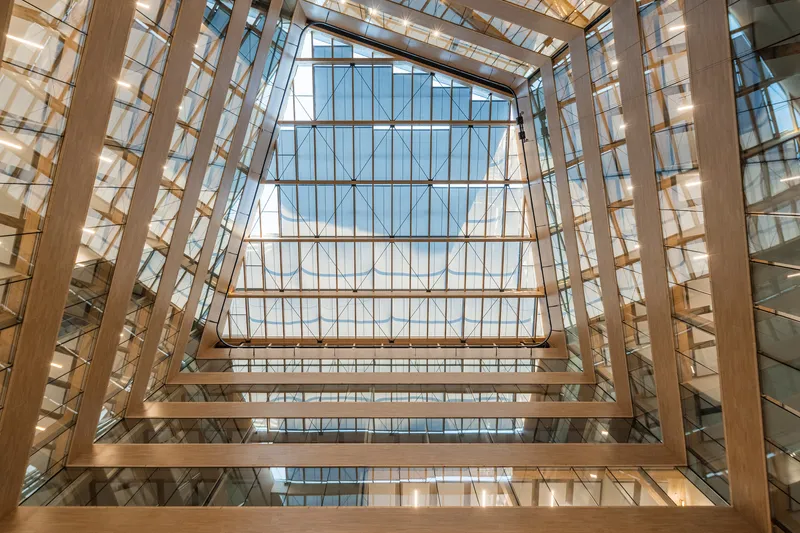
The central atrium is the building's organizing principle, its primary light source, and its ventilation stack all at once. Six stories of timber-clad balconies wrap around the void, and a peaked glass skylight crowns the top. The skylight is fitted with double-glazed, low-emissivity, solar-control glass and external fabric blinds, so it admits daylight without becoming a greenhouse. Operable panels along the skylight's sides allow hot air to escape, creating a chimney effect that draws cooler air upward from the ground floor at night.
Ceiling-mounted air circulators supplement this passive strategy, and an adiabatic dry cooler paired with a chiller handles peak loads. Radiant ceilings provide heating in winter, connected to a district biomass network. The result is a building that earns its HQE Excellent, E+C-, OsmoZ, Biodivercity, and R2S certifications without feeling ascetic. The atrium is genuinely pleasant: light, tall, warm in material tone, and animated by the movement of people across its balconies.
Timber Structure, Concrete Base
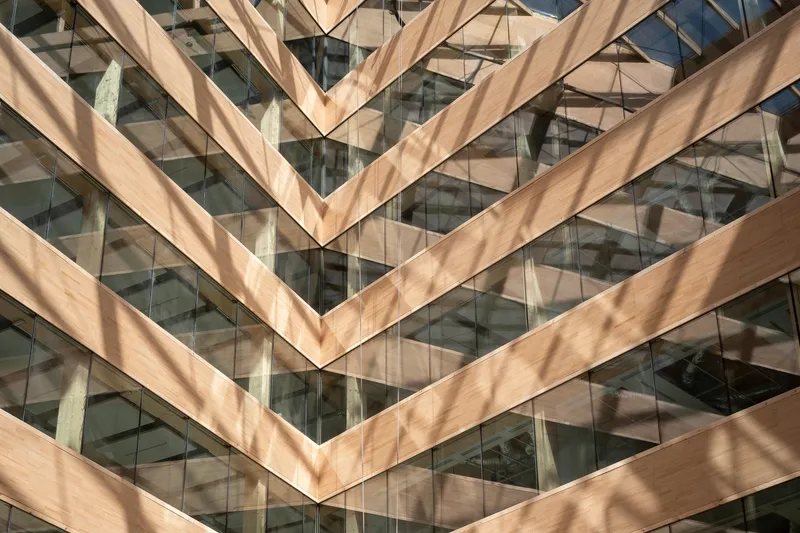
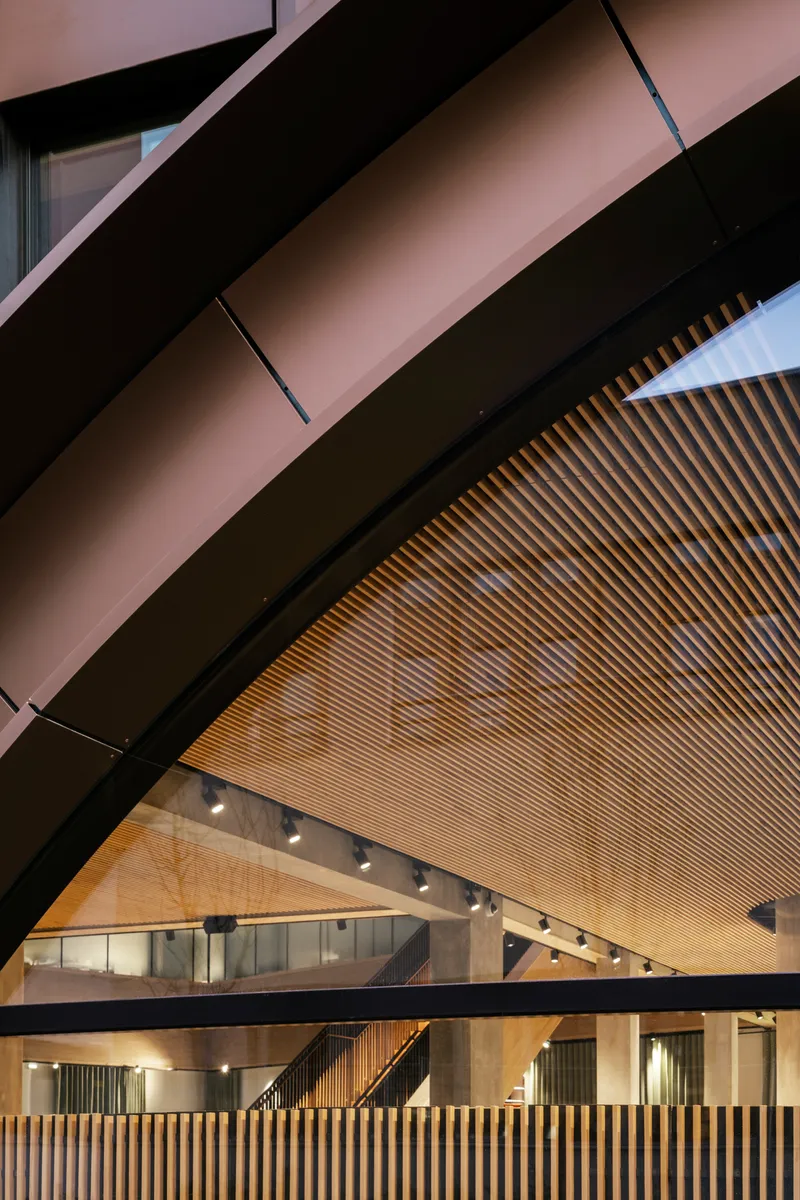
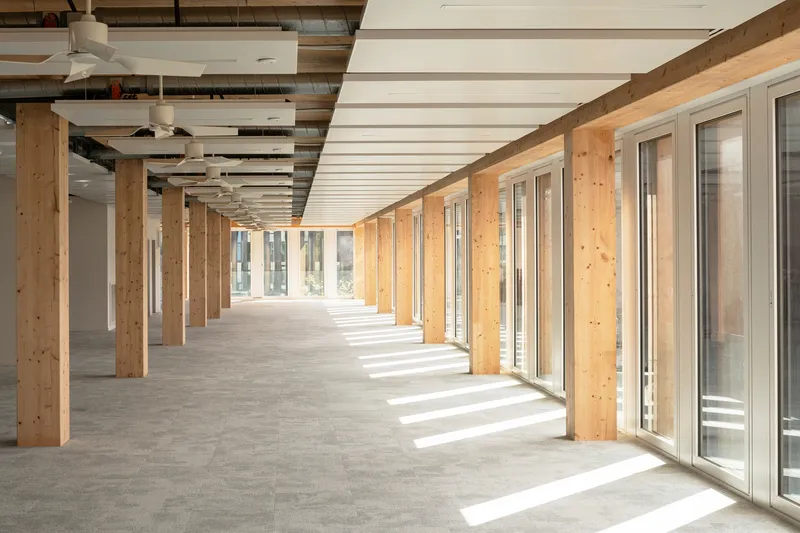
The structural logic splits cleanly between materials. From the basement through the first floor, the building is concrete: arches, columns, and the heavy base that anchors the structure to the island's fluvial soil. From the second floor up, everything shifts to cross-laminated timber and glued laminated timber sourced from French forests. The transition is visible in the interiors, where concrete columns at the lower levels give way to exposed timber beams and columns above.
The timber detailing is assertive rather than polite. Chevron-patterned beams layer over glazed facades, casting dappled shadows that shift through the day. Angular black steel connections at key junctions read honestly against the wood grain. The corridors are generous, with exposed timber columns and white ceiling slats creating a rhythm that channels natural light deep into the floor plates. The architects clearly wanted the structure to be experienced, not hidden behind drywall.
Gathering and Eating on the Ground Floor
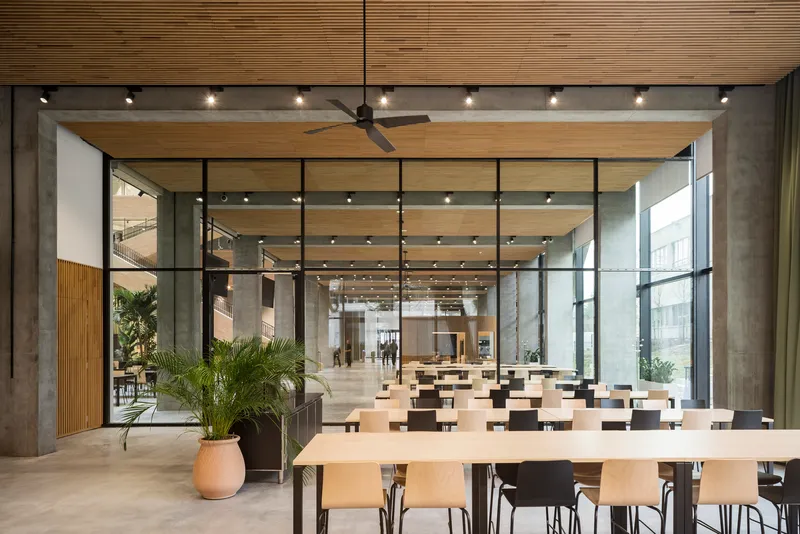
The ground-floor canteen occupies a double-height volume with slatted timber ceiling panels overhead and concrete columns marching through rows of communal tables. Potted palms soften the space without cluttering it. It is a straightforward room that does its job well: feeding 800 people while maintaining visual continuity with the streetscape through floor-to-ceiling glazing.
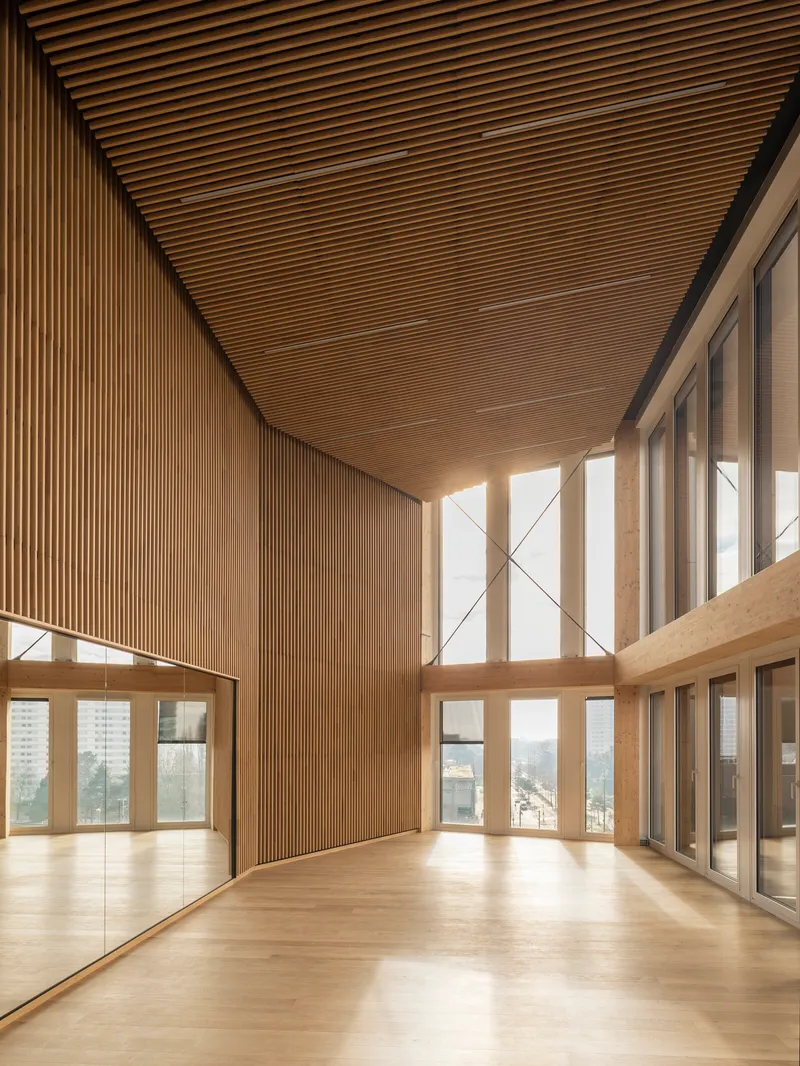
Elsewhere on the ground floor, the double-height lounge spaces offer views out to the Nantes cityscape. These are the building's social connectors, positioned to encourage informal exchange between the specialized teams that La Poste has consolidated here. The open floor plates on the levels above are designed for flexibility, with work areas oriented toward both the atrium and the exterior facades, giving occupants a choice between inward focus and outward views.
Facade at Dusk
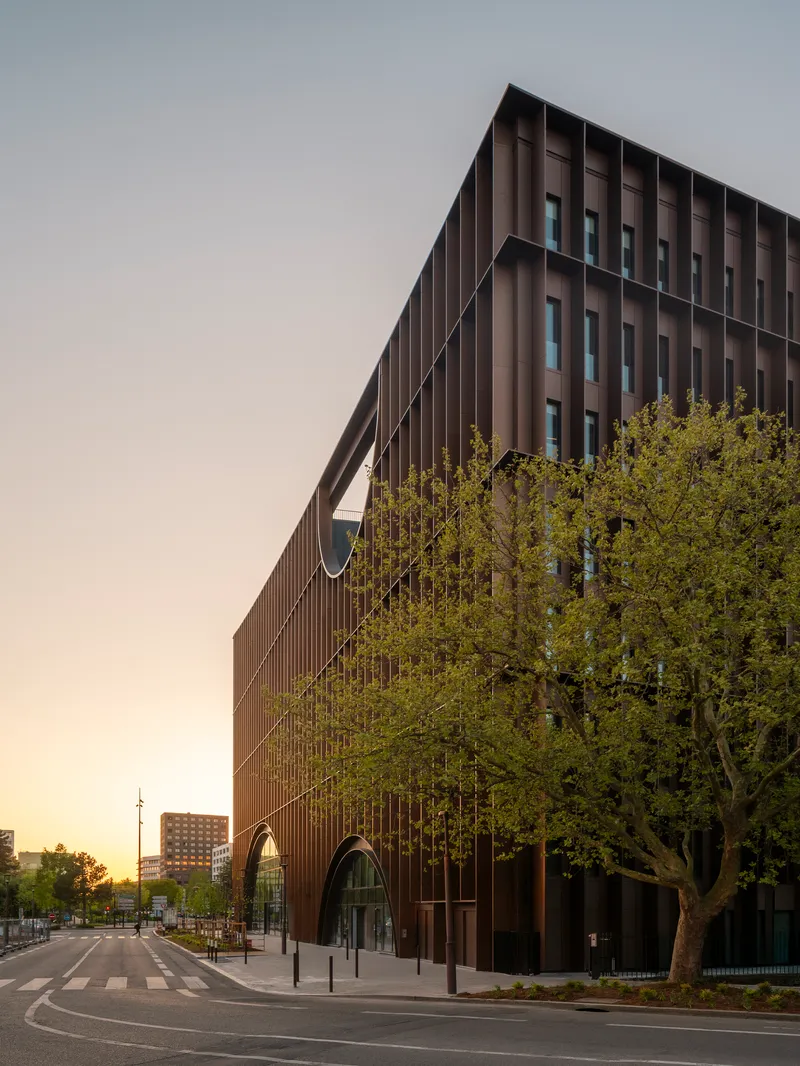
The building's relationship with existing trees on the site is worth noting. Mature specimens press close to the facade in several places, their canopies partially screening the arched entries and softening the copper cladding. The ground-floor plan reveals a triangular footprint, which means the building wraps around its site rather than dominating it. Tree canopies are drawn into the plan as deliberately as columns.
At dusk, the interplay between warm artificial light spilling from recessed windows and the copper-toned slats gives the building a lantern quality. The dark recesses between fins create depth, so the facade reads as a thick, inhabited wall rather than a flat skin. It is a considered approach to a material that could easily have become monotonous over seven stories.
Plans and Drawings
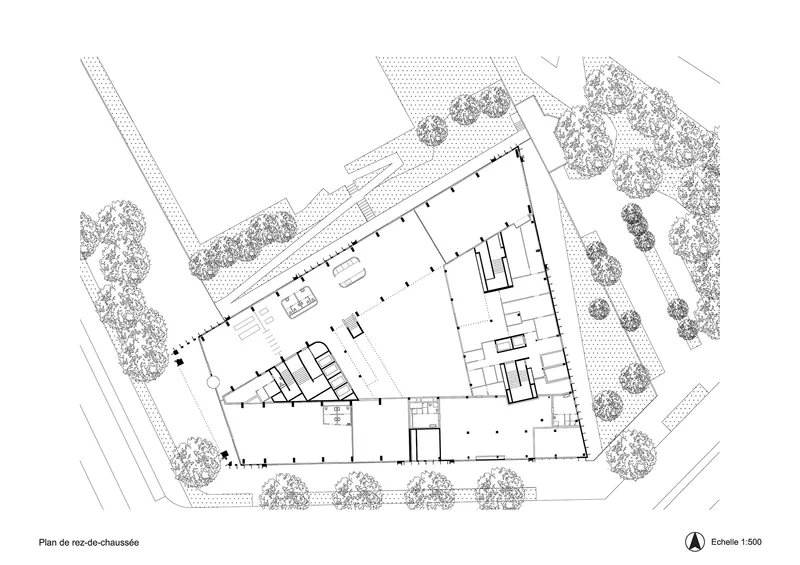
The ground-floor plan confirms the triangular footprint and reveals the central core, which houses circulation and services while freeing the perimeter for open workspace. Surrounding tree canopies are mapped in detail, underscoring the landscape strategy. The plan also shows how the arcade at ground level opens the building's edges to pedestrian flow, dissolving the boundary between office and neighborhood.
Why This Project Matters
Large corporate offices have a dismal track record when it comes to urban generosity. They tend to seal themselves off, hide behind lobbies and turnstiles, and contribute nothing to the street. Maison de l'Innovation takes the opposite approach, opening its ground floor to public life, using its atrium as a visible social core, and giving its facade a material warmth that rewards a second look. The fact that it does all of this in timber, at scale, on a French island that was until recently an industrial afterthought, makes it a meaningful case study for post-industrial urban regeneration.
The bioclimatic strategy is the project's most transferable lesson. Instead of bolting sustainability features onto a conventional floor plate, Baumschlager Eberle built the climate logic into the section: atrium, skylight, ventilation stack, radiant ceilings, rooftop agriculture. Every decision feeds the next. The building recovered 10,000 square meters of raised flooring from the demolished predecessor on the site, a detail that signals a circular-economy mindset extending beyond the glamorous timber structure. When a workplace for 800 people can avoid conventional air conditioning for much of the year and still earn five environmental certifications, the industry should be paying attention.
Maison de l'Innovation Office by Baumschlager Eberle Architekten. Nantes, France. 8,391 m². Completed 2024. Photography by Cyrille Weiner.
About the Studio
Share Your Own Work on uni.xyz
If projects like this are the kind of work you want to make, uni.xyz is a place to publish your own, find collaborators, and enter design competitions.


Popular Articles
Popular articles from the community


GROUP A Strips a 1969 Rotterdam Harbor Headquarters to Its Frame and Wraps It in Timber Louvers
In Rotterdam's M4H harbor district, Ferro Offices reuses a 1969 frame, adds one timber storey and reaches BREEAM-NL Outstanding.

longwave studio Reorganizes a 112 m² Tainan Apartment Around the Daily Routines of a Family and Two Cats
In Tainan, Taiwan, birch plywood, rust-red furniture and a freestanding plaster wall link arrival, storage, work and family life in one apartment.

Cube Design Draws an Ecological Corridor Between Two Shenzhen Hills with the Nankai Building
Beside Shenzhen's container docks, the Nankai Building pairs stacked balconies with a climbing green screen to connect two hillsides across its height.

U.GA Architects Wraps an Oval Rooftop Pool in Curved Board-Formed Concrete on Busan's Jeollidan-gil
In Busan's Jeonpo-dong, a 454 m² mixed-use block stacks a neighborhood facility, guest rooms and an oval rooftop pool inside spiraling concrete walls.

Similar Reads
You might also enjoy these articles


LAVA Architecten Gives Vocational Education a Sawtooth-Roofed Face on a Mechelen School Campus
In Mechelen, Belgium, a 2,053 m² STEM school on a 6×6 m grid turns workshops and classrooms into rooms that can be rearranged as teaching changes.

KEMA Studio Turns a Derelict Marvila Attic into a 60 m² Lighthouse Apartment Above Lisbon
In Lisbon's Marvila district, a rebuilt roof, four skylights and two plywood volumes turn an unlivable attic into a bright home facing the Tagus.

Pixel Gardens: One Repeated Module Stacked Into a Terraced Social Housing Tower for Famagusta
Salem Bader's shortlisted housing tower builds a vertical neighbourhood from one repeated module, offsetting units to carve terraces, light and air.

Bao Huynh Watercolor Atelier: A Serene Art Retreat in Hội An
Bao Huynh Watercolor Atelier in Hội An blends multifunctional art spaces, sustainable design, local materials, and family-friendly living in a serene environment.

Explore Innovation & Business Competitions
Discover active competitions in this discipline

Challenge to reimagine the Iron Throne

Photograph architecture without architects

Illustrate the lost glory of Angkor Wat - Render Challenge

Design challenge to reuse E-waste
Comments (0)
Please login or sign up to add comments
No comments yet. Be the first to comment!