

B.E Architecture Builds a Modern Renaissance Home Behind a Victorian Facade in Albert Park
A three-storey residence in Melbourne's Albert Park weaves classical arches, stone craftsmanship, and passive design into 855 square metres.


Most heritage additions in Melbourne settle for a polite glass box tacked onto the back of a Victorian terrace. B.E Architecture took a sharply different path with the St Vincents Place Residence in Albert Park, treating the rear extension not as a quiet appendage but as a cultural bridge between the original building, once part of a convent, and a distinctly contemporary domestic program spread across three storeys and 855 square metres. The result is a house that reads as neither pastiche nor rupture.
What makes the project genuinely interesting is its commitment to classical spatial devices, arched openings, curved cornices, axial sequences, executed with modern construction techniques and a material palette that ranges from board-formed concrete and Torino granite to green onyx and American Oak. The house is organized around a series of internal courtyards that do real environmental work, generating cross-ventilation and a chimney effect that draws hot air upward through rooftop terraces. It is a house built for looking at, certainly, but also one engineered to perform.
Arched Thresholds and Spatial Depth
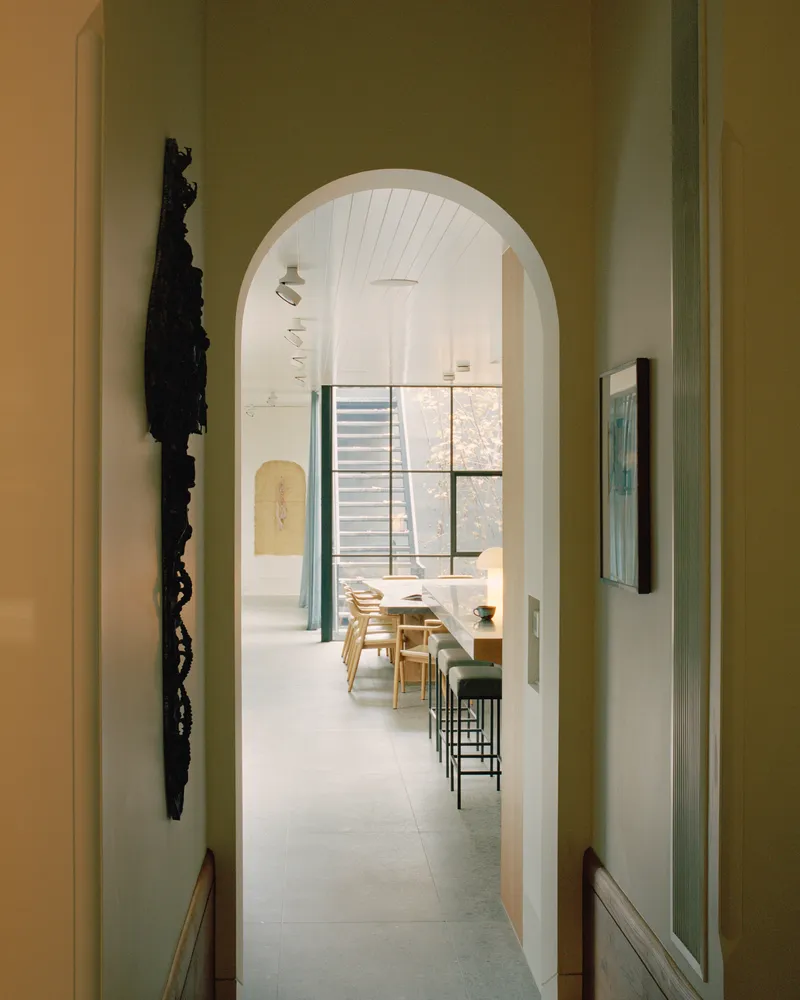

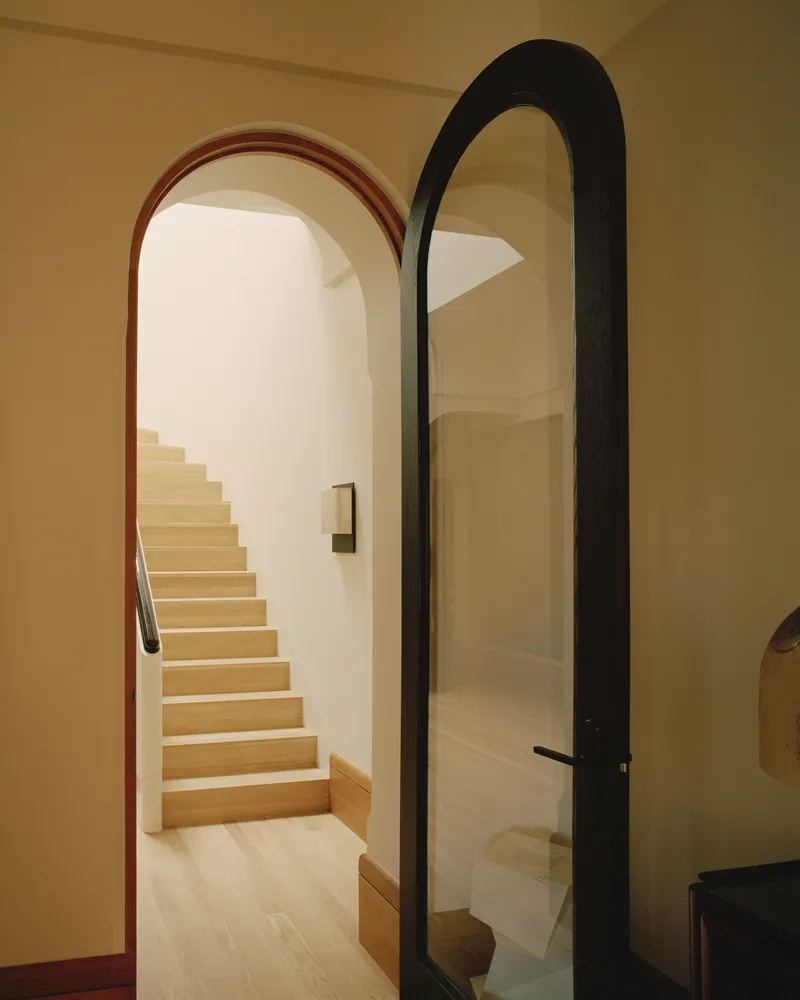
The defining spatial gesture of the St Vincents Place Residence is its use of arched openings as framing devices. Walk through the house and you encounter a sequence of arched doorways that compress and release views along the plan's considerable length. The effect is almost cinematic: each arch frames the next room, then the courtyard beyond, then the steel-gridded windows at the rear. Curved cornices and arched doors are not typical in modern construction methodologies, and B.E Architecture clearly relished the challenge, calibrating proportions that feel classical without mimicking a specific historical source.
The entry sequence sets the tone. Ornamental ironwork at the Victorian porch gives way to a timber-framed arched door backlit by agate stone panels, a threshold that immediately signals the house's ambition to operate between eras. From there, successive archways pull you deeper into the plan, past a staircase with a curved steel handrail, through rooms organized to reward movement rather than static occupation.
Heritage Front, Concrete Rear
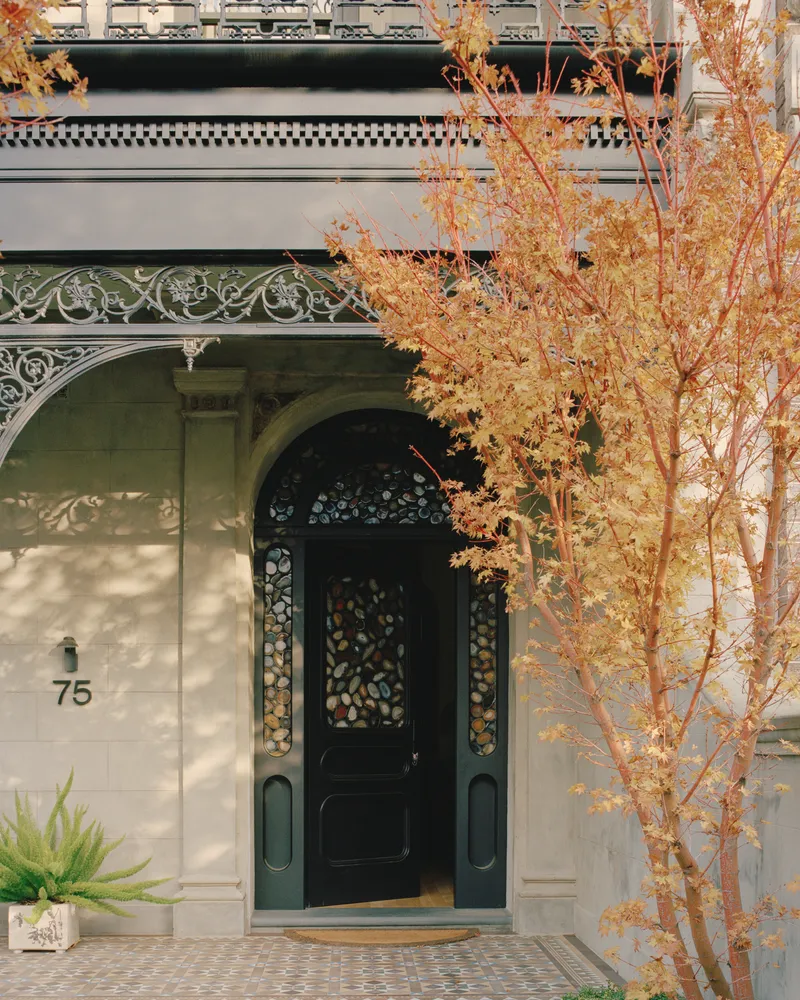

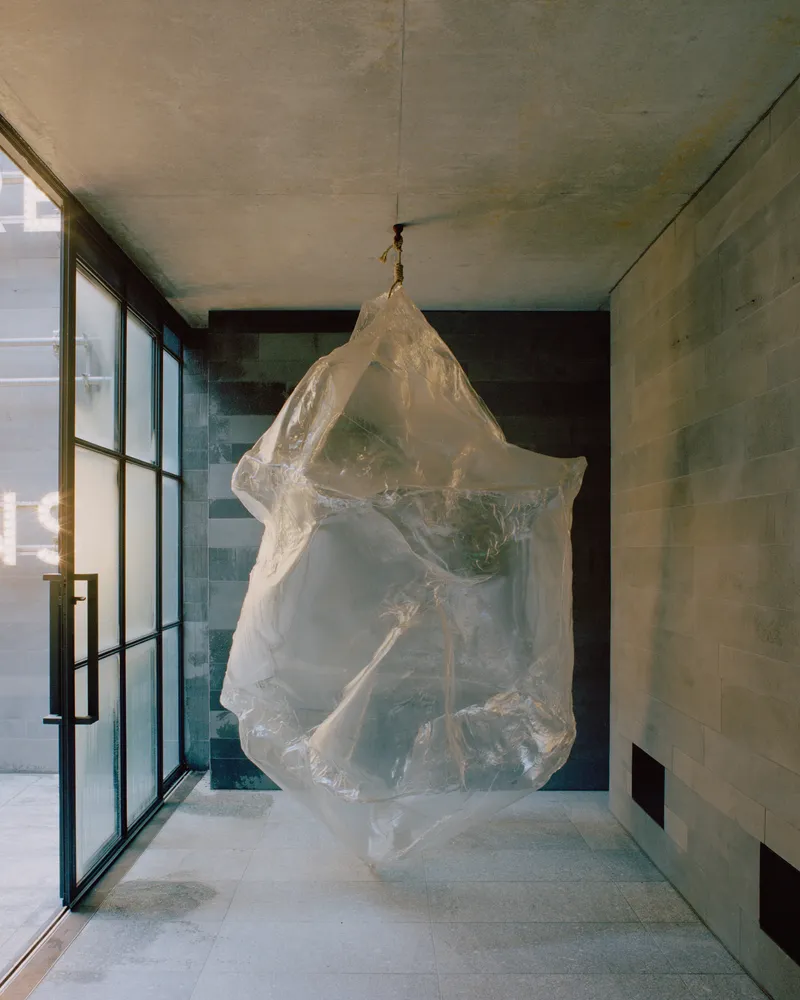
The project's dual identity is legible from the street. The heritage facade, Victorian ironwork, rendered masonry, a deep porch shaded by autumn foliage, is preserved intact, reading as a single house in a row of period terraces. Step through the backlit agate entry door and the language shifts. Board-formed concrete surfaces appear in hallways, a suspended translucent sculpture hangs beside glazed walls, and the material register tilts toward a controlled brutalism that makes the classical references in other rooms feel deliberate rather than decorative.
This tension between front and rear is the project's engine. B.E Architecture resisted blending the two into a seamless gradient. Instead, the break is acknowledged and celebrated, with the courtyards acting as decompression chambers between the heritage volume and the new extension. It is a strategy that gives each part of the house its own character while still reading as a single domestic narrative.
Material Intelligence at Every Scale

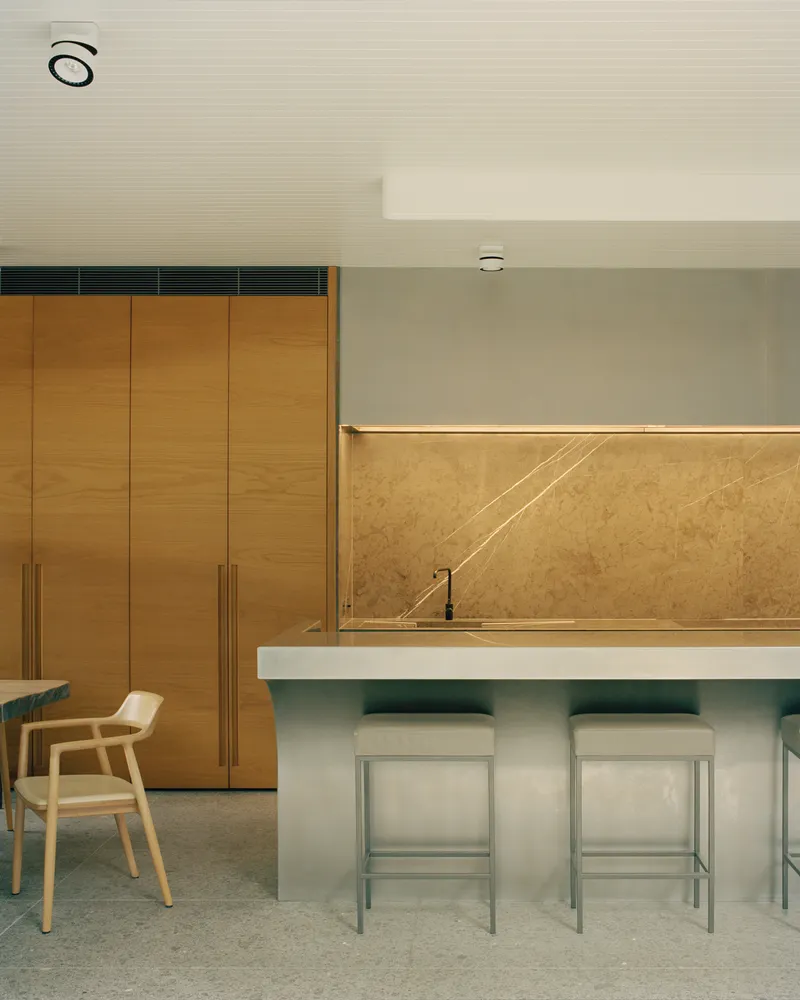

The material palette is expansive but disciplined. American Oak appears in flooring and cabinetry, warm enough to soften the concrete and steel that dominate the extension. The kitchen island pairs a pale counter with a bronze backsplash wall, a combination that gives the room weight without darkness. In the bathrooms, Fallow granite and pale green tile cladding meet rounded mirrors and floating sinks, details that echo the house's broader interest in curved geometry.
Hand-stained dovetail joints along the timber skirting boards speak to a level of craft investment that distinguishes the project from the typical luxury renovation. Custom curved granite tiles, basins, and a bath were fabricated specifically for the house, as were natural hand-finished chestnut joinery elements. B.E Architecture explicitly invested in local trades and suppliers, and the detail quality makes that commitment visible.
Courtyards and Living Rooms
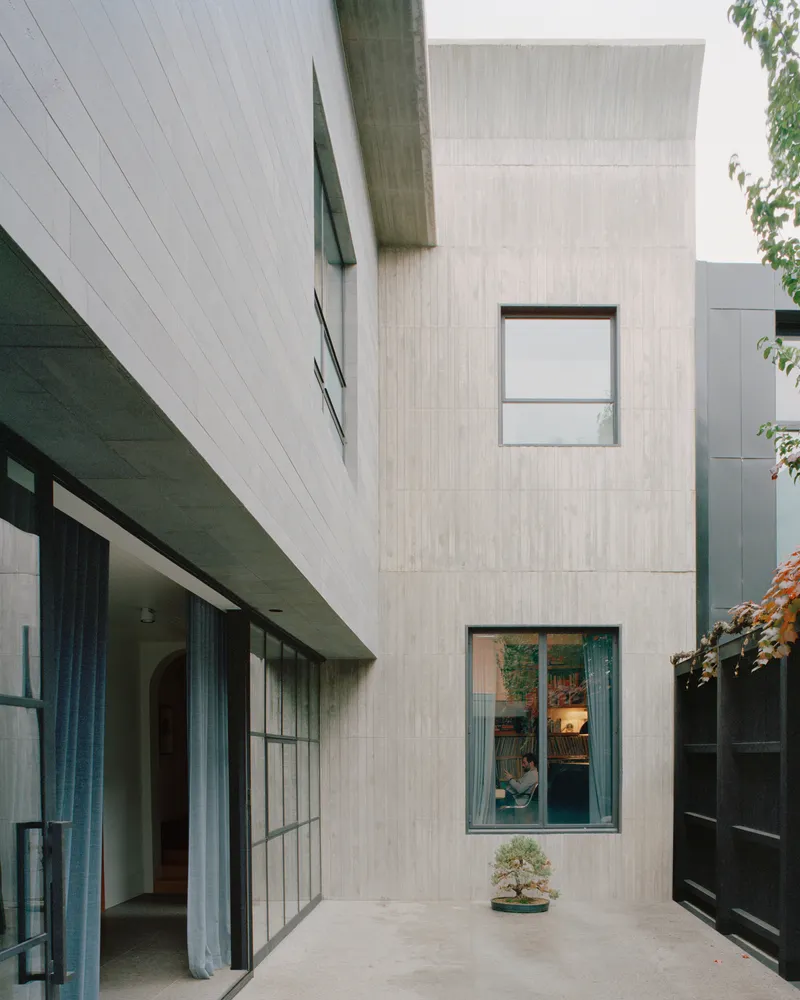
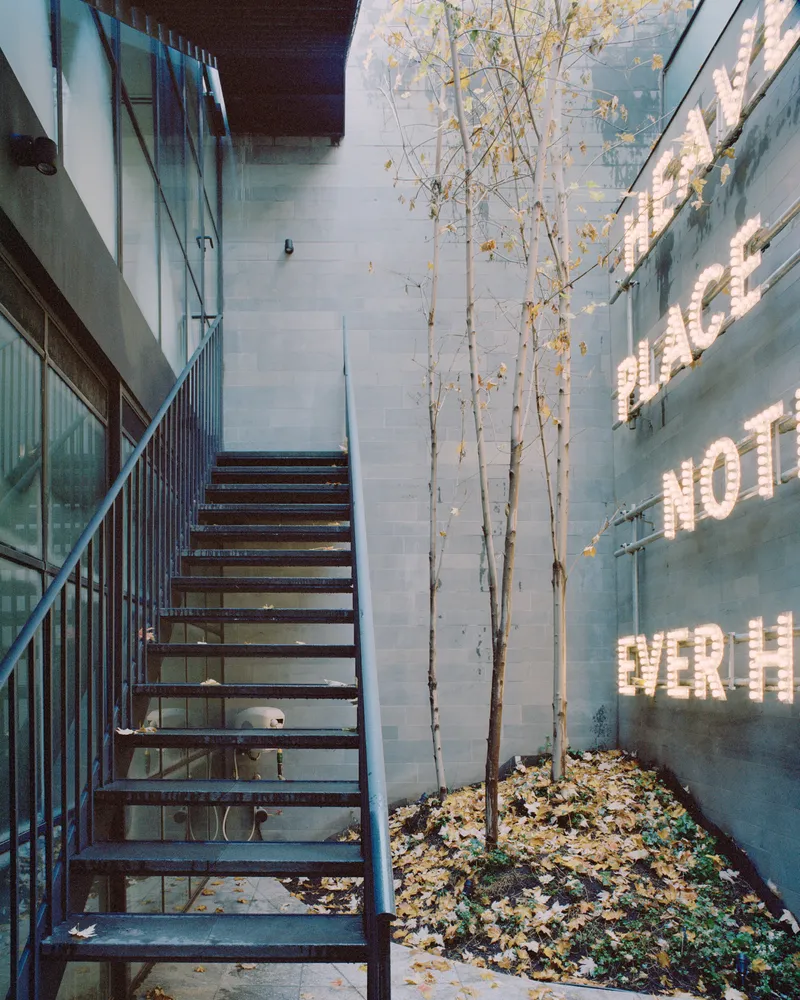
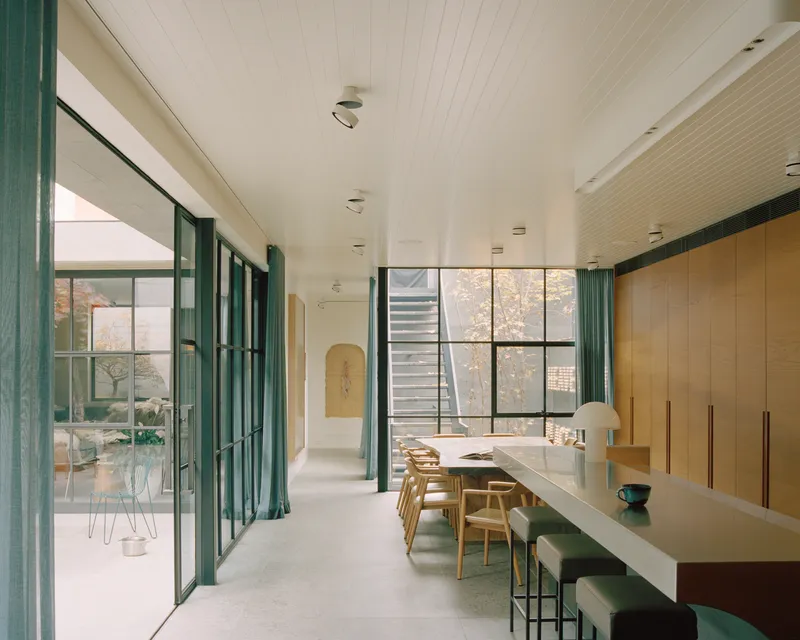
The internal courtyards are not token light wells. They are genuine outdoor rooms, paved in concrete, planted with birch trees and bonsai, and large enough to alter the microclimate of the spaces they serve. Sliding steel-framed glass doors fold open to merge dining areas with courtyard air, and in summer the courtyards generate cross-ventilation that reduces reliance on mechanical cooling. The rooftop terraces above complete the stack effect, creating a natural chimney that draws warm air upward and out of the house.
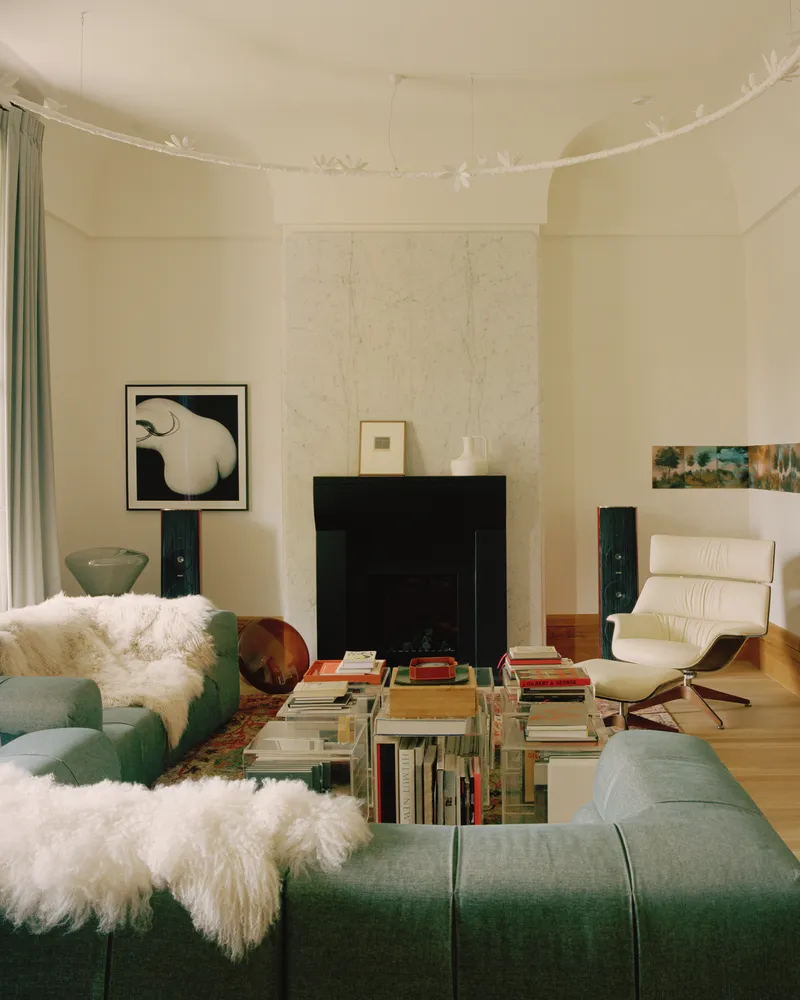
Inside, the living spaces are organized around the client's book collection. Expansive shelving flanks workspaces and living rooms, and a custom acrylic coffee table in the main sitting room was designed as a centerpiece, transparent enough to keep sightlines open across the deep plan. Green velvet sofas and curtains recur as a chromatic thread, tying rooms together across levels and bridging the gap between the heritage front and the concrete rear.
The Subterranean Pool and Passive Systems
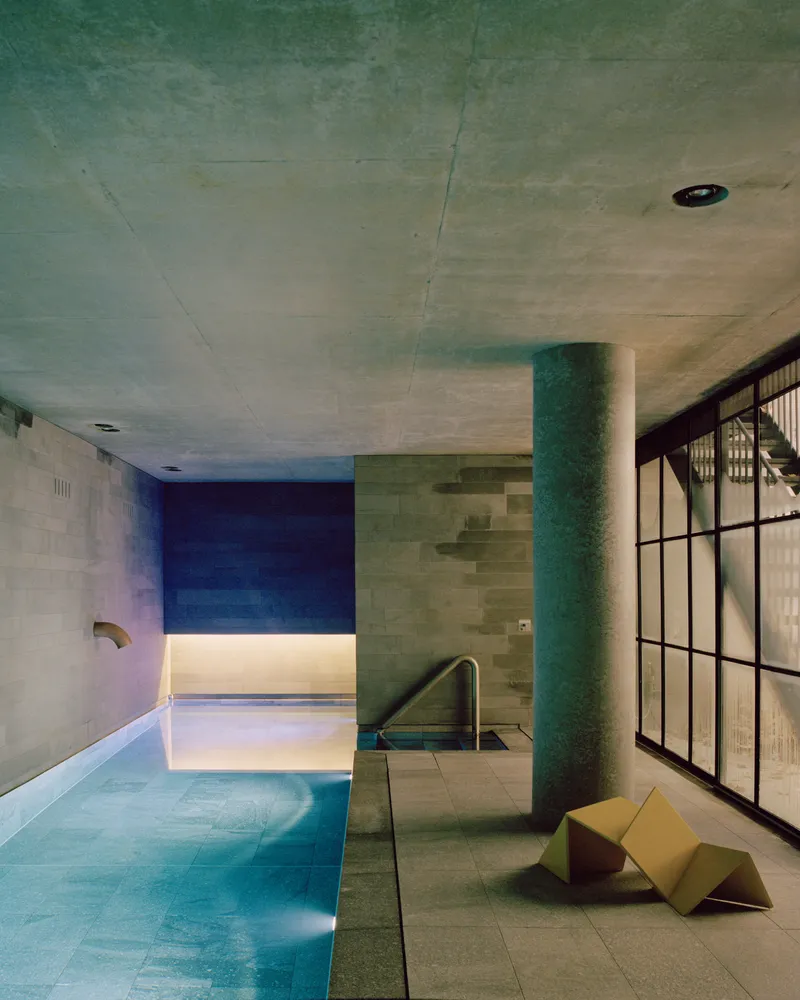
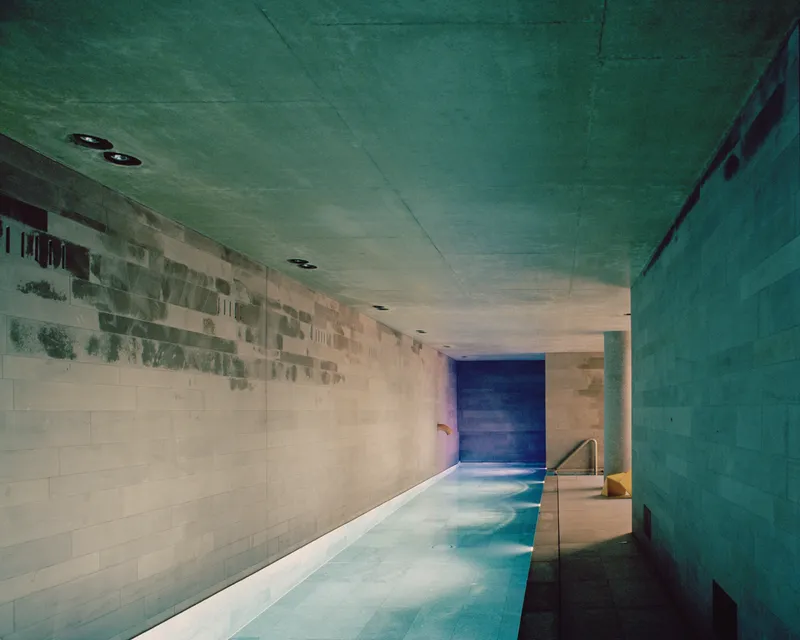
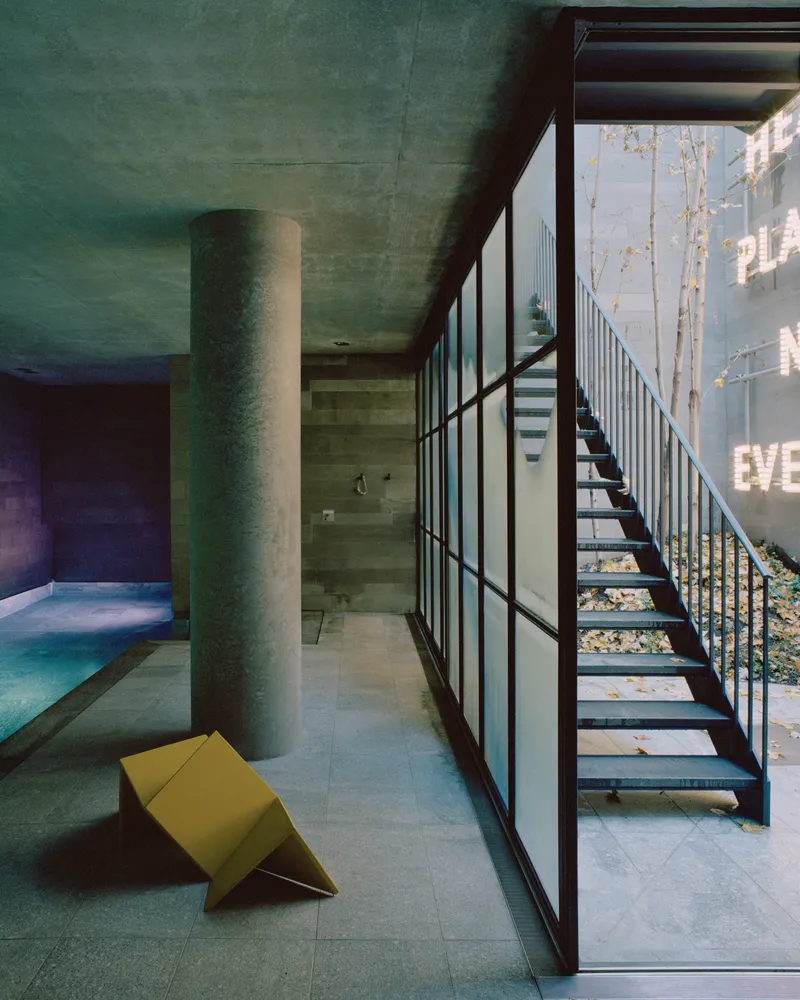
Below grade, a basement pool occupies a concrete-lined corridor where water reflects color gradations on the rear wall. A cylindrical green column punctuates the space beside steel-framed glazing, lending the room an almost industrial character. The pool is not just a luxury amenity; it sits within a broader passive strategy. Ten banks of solar vacuum tubes on the roof collect hot water stored underground, reducing gas consumption for both the pool and the house's hydronic heating system. Rainwater is collected in large underground tanks and reused for onsite gardens.
The commercial structural solution that supports the original house while accommodating a new basement is an engineering story in its own right. Increased insulation in walls, ceilings, and floors, double-glazed bedroom windows, in-slab heating, and five low-voltage thermofans all contribute to a building that performs well beyond what its heritage streetscape might suggest. A two-storey veranda with an extended eave on the western facade provides shade where the house is most exposed.
Private Rooms and Personal Detail
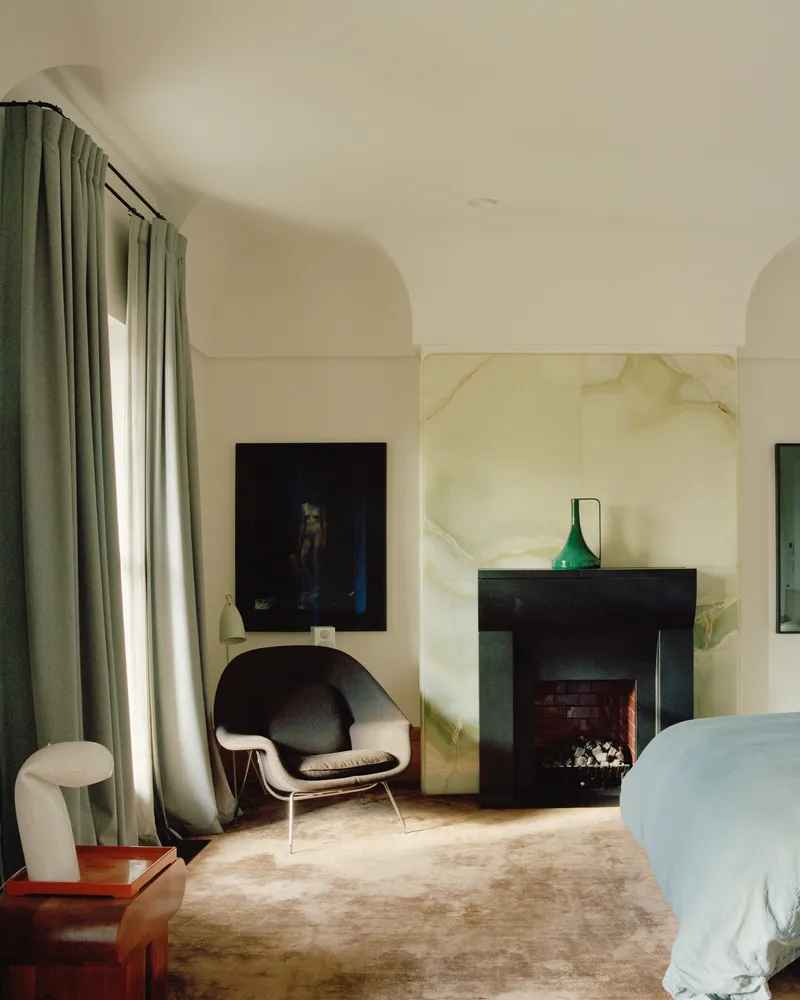
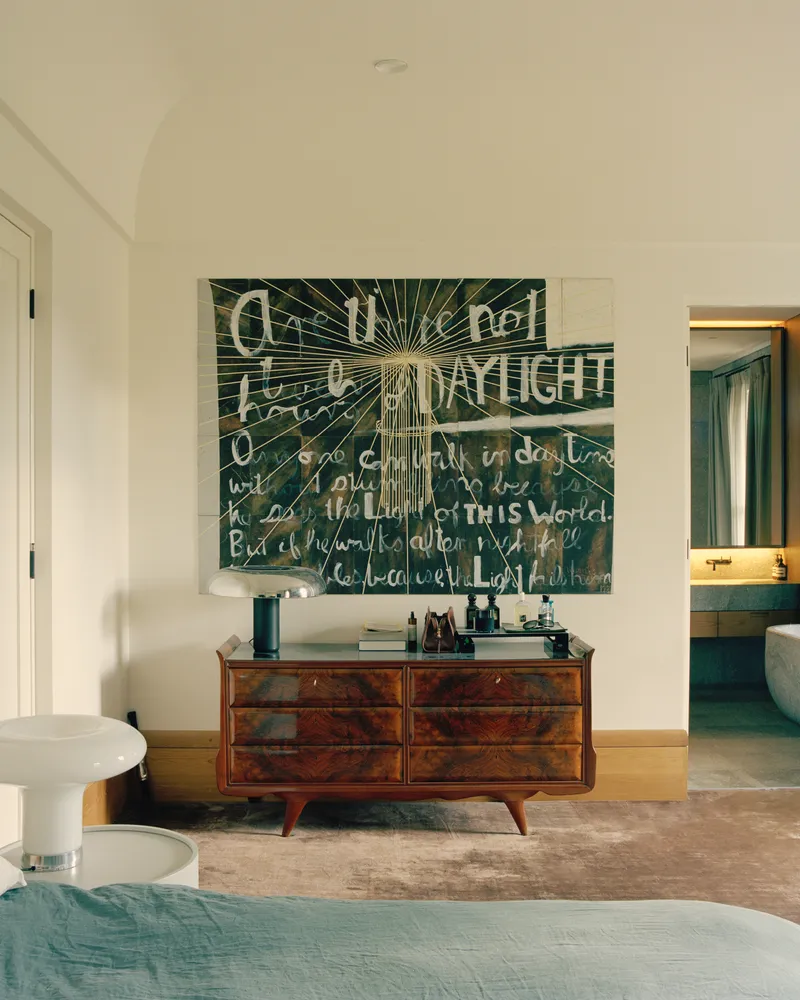
The bedrooms occupy the upper level, where the tone shifts from the public grandeur of the ground floor to something quieter. Black fireplace surrounds appear again, this time set against veined marble panels beneath arched ceilings, a detail that compresses the house's classical and modern impulses into a single wall. Walnut dressers, text-covered artwork, and generous doorways to ensuite bathrooms give each room a specific identity.
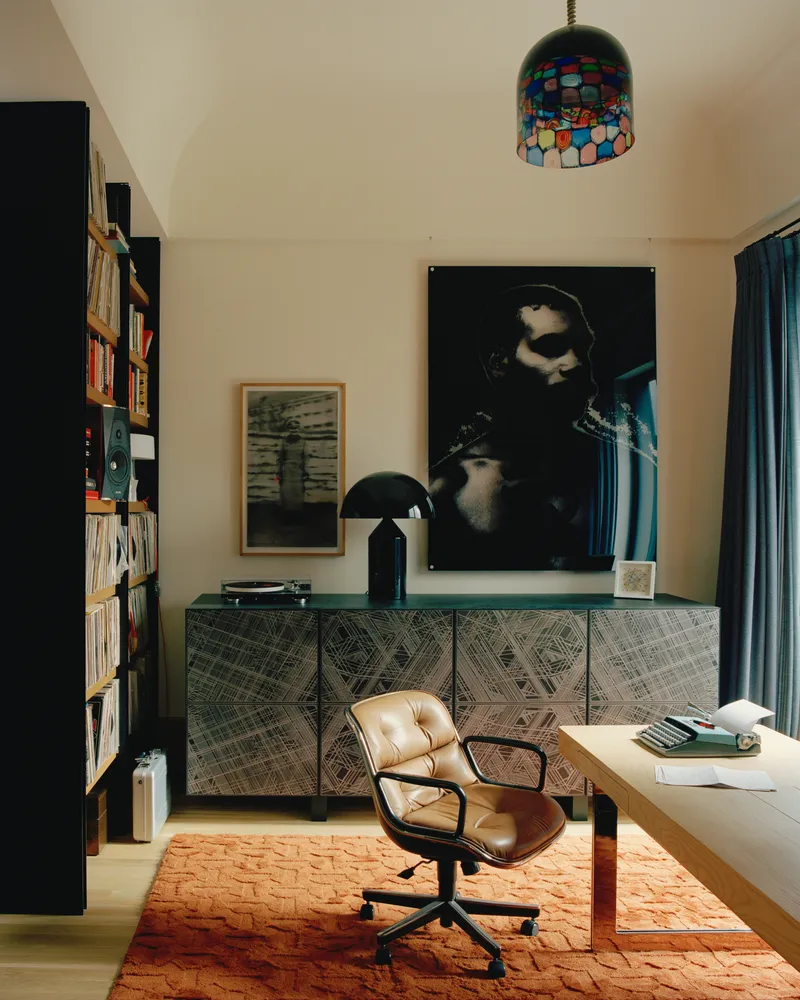
The home office is one of the house's most resolved rooms: a patterned credenza beneath a mosaic pendant light, tall bookshelves flanking the workspace, and enough visual density to feel like a room with purpose rather than a spare bedroom pressed into service. It is a space that takes the client's intellectual life seriously, something the entire house seems designed to do.
Facade and Courtyard Encounters
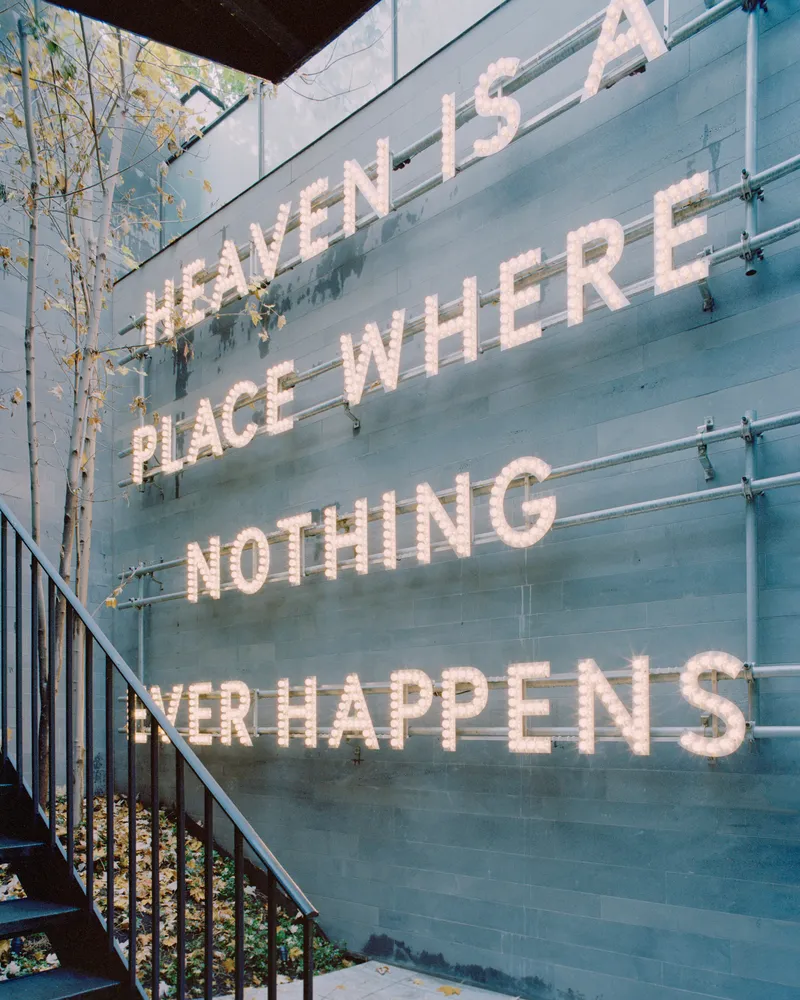
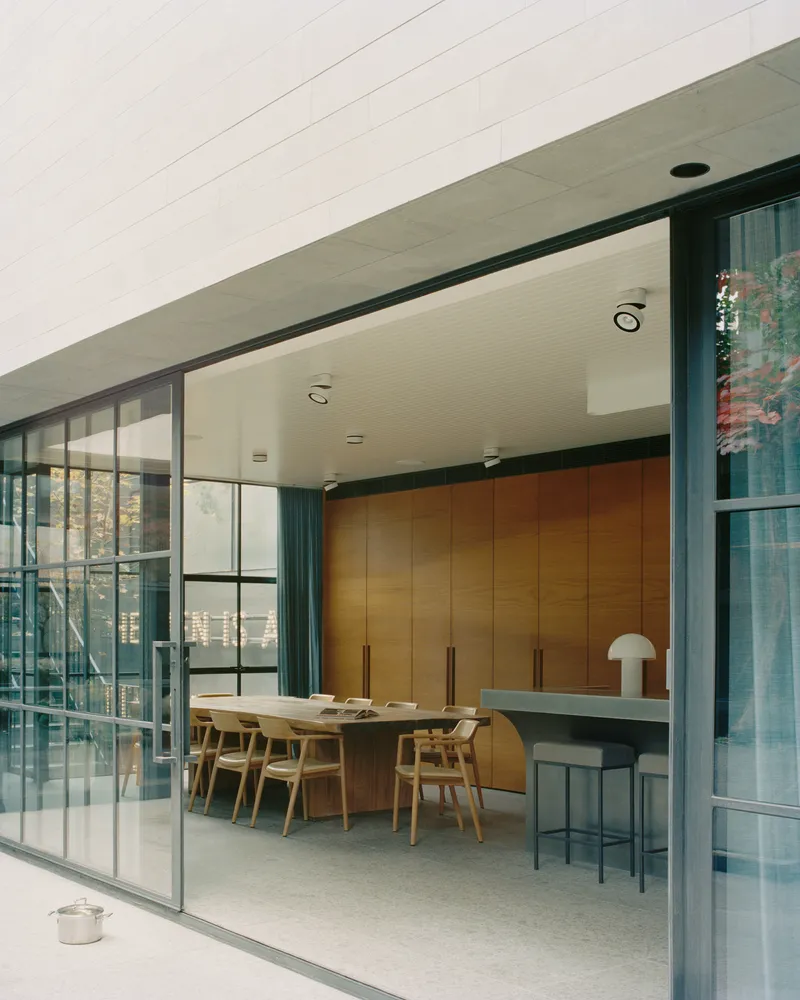
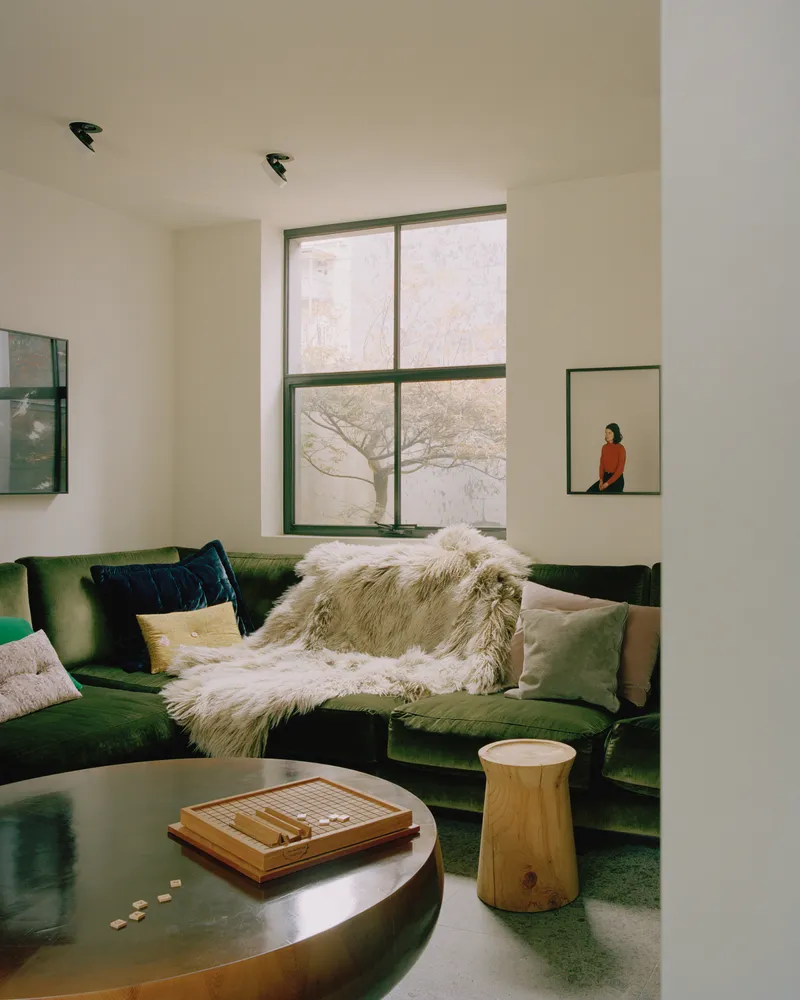
From the courtyard side, the rear extension reveals itself through glass-clad facades, text installations, and planted courtyards dappled with light. The steel-framed glazing system recurs throughout, gridded and proportioned to recall industrial sash windows while performing at a contemporary thermal standard. Tall metal-framed windows in the living room overlook bare winter trees, a view composed to change character with the seasons, a reminder that the house sits within a garden as much as within a streetscape.
Staircase as Spatial Event
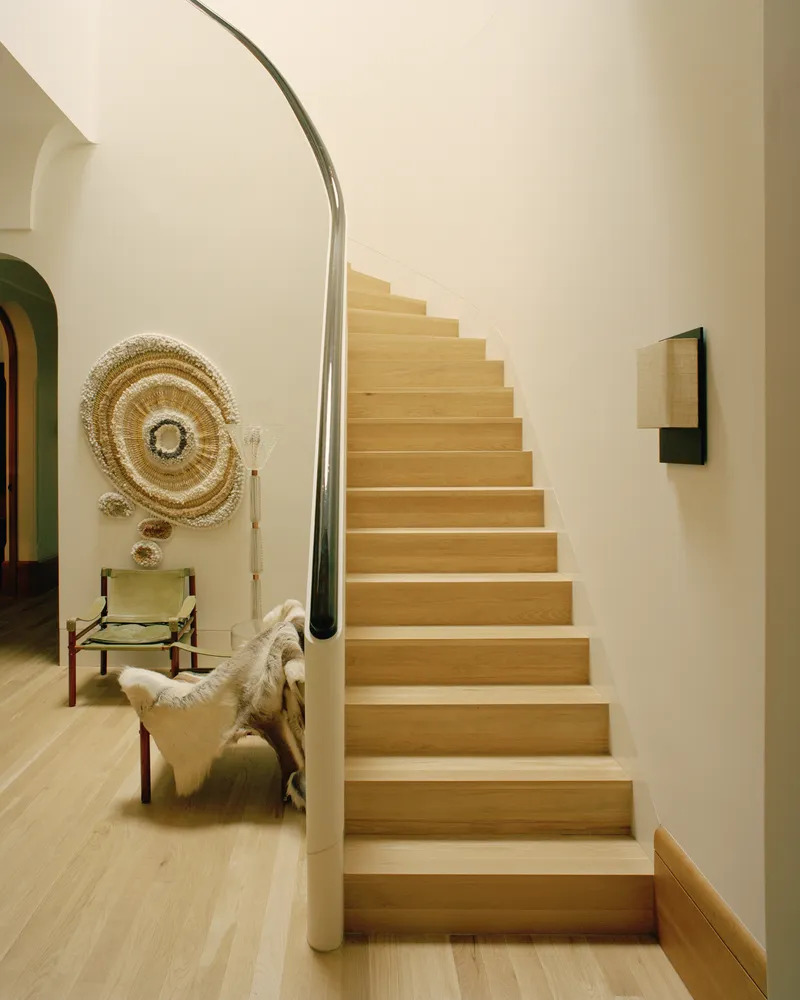
Two stair conditions define vertical movement. The oak staircase with its curved steel handrail ascends beside white walls and a woven wall hanging, tactile and warm. Elsewhere, an open steel stair sits beside a floor-to-ceiling gridded window wall, its industrial language aligned with the rear extension's concrete aesthetic. Both stairs treat circulation as a spatial event rather than a utilitarian connector, which in a three-storey house of this length is a necessity, not a luxury.
Plans and Drawings
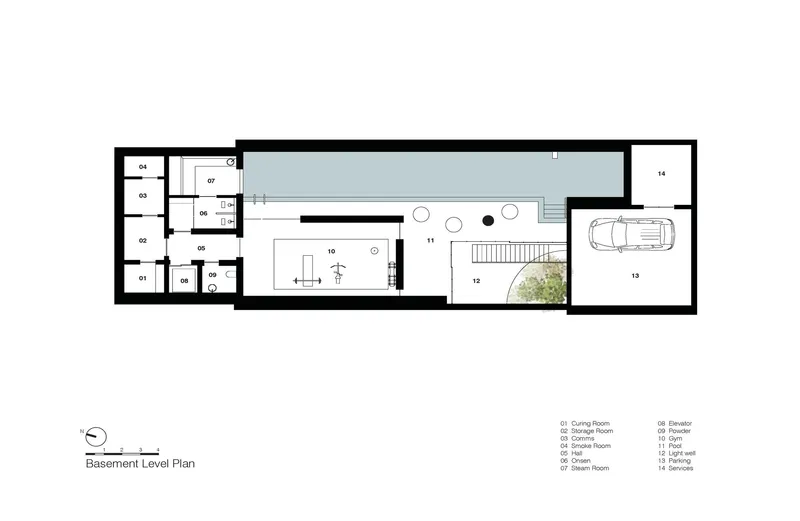
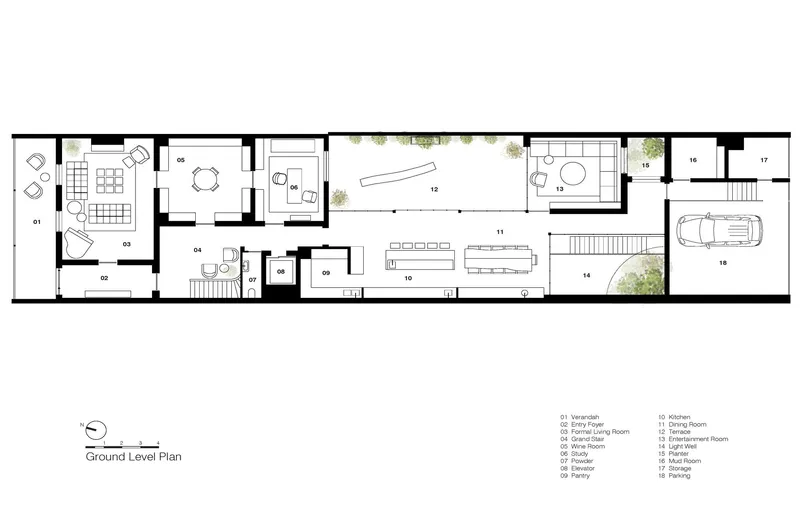

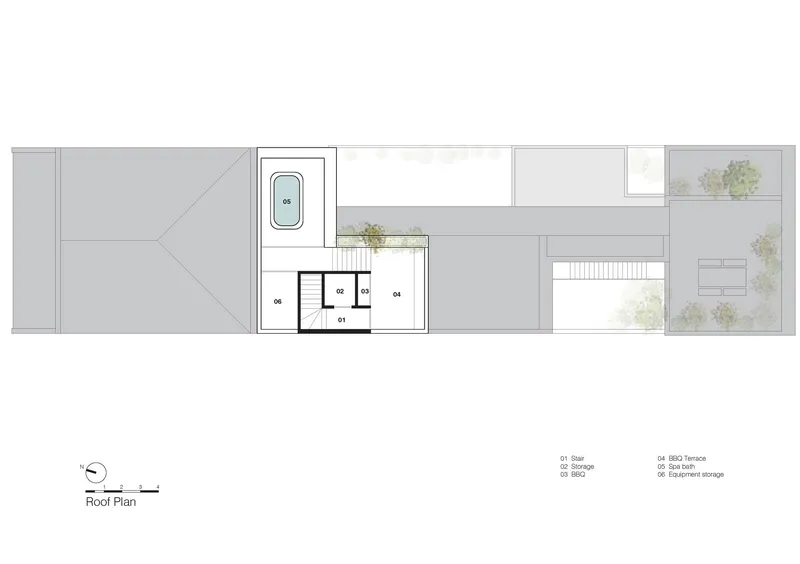
The plans reveal the house's remarkable linearity. At basement level, the program is compressed into a narrow band with garage and pool occupying opposite ends. The ground floor reads as a sequence of rooms punctuated by courtyard gardens, a strategy that brings light and air deep into what would otherwise be a relentlessly long, narrow plan. Level one stacks bedrooms above the public rooms and positions a terrace garden at the far end, while the roof plan distributes terraces, planted areas, and the pool across the elongated volume. The drawings make clear how seriously the project takes its section: every level has a distinct relationship to daylight and outdoor space.
Why This Project Matters
The St Vincents Place Residence matters because it refuses the easy binary that dominates heritage residential work in Australian cities. Rather than treating the Victorian facade as a museum piece and the extension as a separate building, B.E Architecture engineered a dialogue between the two, using arched geometries, material craft, and courtyard planning to create continuity without sameness. The passive design strategies embedded in the house, solar vacuum tubes, rainwater harvesting, cross-ventilation through courtyards, demonstrate that environmental performance can coexist with formal ambition.
At a moment when many Australian practices default to minimal white interiors behind heritage facades, this project argues for richness: of material, of spatial sequence, of reference. The investment in local trades, custom stone fabrication, and hand-finished joinery positions the house as an argument for craft in residential architecture, not as nostalgia, but as a contemporary discipline. It is the kind of project that earns its complexity.
St Vincents Place Residence by B.E Architecture, Albert Park, Australia. 855 m². Completed 2017. Photography by Gavin Green Interior.
About the Studio
Share Your Own Work on uni.xyz
If projects like this are the kind of work you want to make, uni.xyz is a place to publish your own, find collaborators, and enter design competitions.


Popular Articles
Popular articles from the community


Opera on the Sea: Driftwood Logic Shapes a Timber Opera House on Estonia's Coast
Trevor Orgill's opera house translates the entangled drift of floating timber into a civic building where wood, water, and music converge.

Manzana Morphosis: Stretching Barcelona's Grid into a Living Landscape for 2050
A radical reworking of the Eixample manzana turns density into a tool for generous public space, vertical ecology, and environmental performance.


Cube Design Draws an Ecological Corridor Between Two Shenzhen Hills with the Nankai Building
Beside Shenzhen's container docks, the Nankai Building pairs stacked balconies with a climbing green screen to connect two hillsides across its height.

ETEH Reworks the Shared Spaces of São Domingos School in Brazil Around Timber, Color and Hanging Plants
At São Domingos School in Brazil, 436 m² of hall, refectory and library are recast with timber joinery, a yellow and blue code and trailing greenery.

Similar Reads
You might also enjoy these articles

LAVA Architecten Gives Vocational Education a Sawtooth-Roofed Face on a Mechelen School Campus
In Mechelen, Belgium, a 2,053 m² STEM school on a 6×6 m grid turns workshops and classrooms into rooms that can be rearranged as teaching changes.

KEMA Studio Turns a Derelict Marvila Attic into a 60 m² Lighthouse Apartment Above Lisbon
In Lisbon's Marvila district, a rebuilt roof, four skylights and two plywood volumes turn an unlivable attic into a bright home facing the Tagus.

Pixel Gardens: One Repeated Module Stacked Into a Terraced Social Housing Tower for Famagusta
Salem Bader's shortlisted housing tower builds a vertical neighbourhood from one repeated module, offsetting units to carve terraces, light and air.

Bao Huynh Watercolor Atelier: A Serene Art Retreat in Hội An
Bao Huynh Watercolor Atelier in Hội An blends multifunctional art spaces, sustainable design, local materials, and family-friendly living in a serene environment.


Comments (0)
Please login or sign up to add comments
No comments yet. Be the first to comment!