
André Vainer Lets the Trees Stay Put in a Baleia Beach House Built Around Nature
On Brazil's Atlantic coast, a concrete and timber residence weaves itself around existing tree trunks and dense tropical planting.

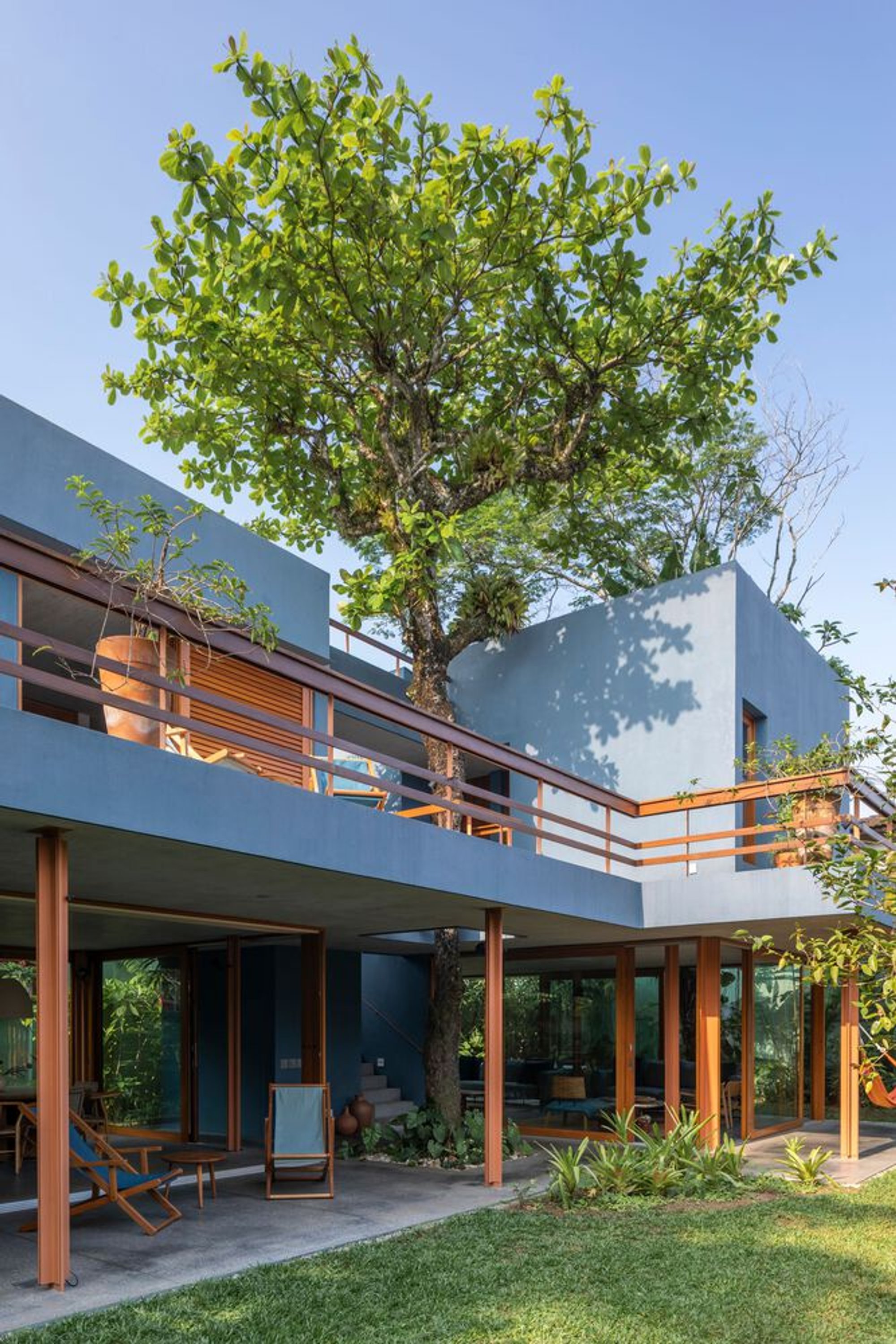
Most beach houses treat their sites like blank canvases. The trees come down, the ground gets leveled, and a pristine object lands on the sand. André Vainer Arquitetos took the opposite approach at Baleia Beach on the São Paulo coast. Mature trees were mapped first, then the house was designed around them, letting trunks puncture decks and rise through skylights as if the architecture were the guest and the landscape the host.
The result is a two-storey residence where the boundary between inside and outside is deliberately ambiguous. Concrete ceilings hover overhead while tropical foliage presses against every opening. Plywood cabinetry and cylindrical timber columns give the interiors a warm, workshop quality that refuses to compete with the greens and golds visible through floor-to-ceiling glazing. It is a house that earns its beachside setting by refusing to dominate it.
A Facade That Recedes Into the Canopy
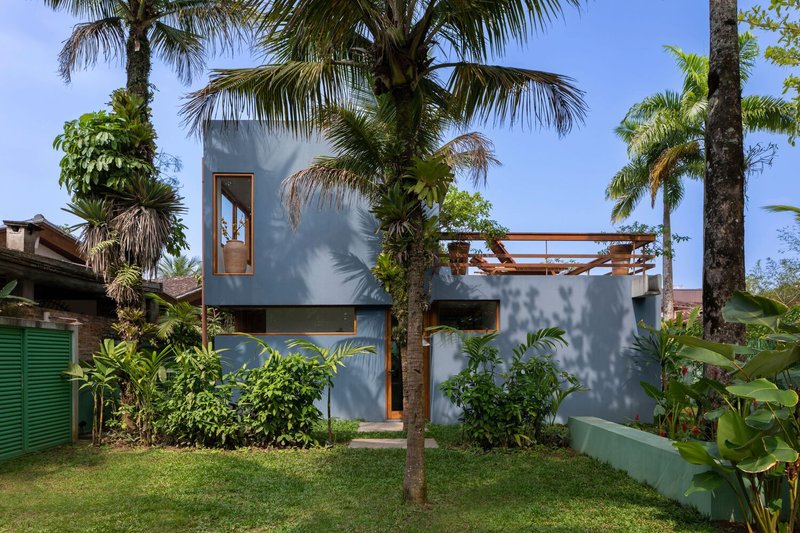
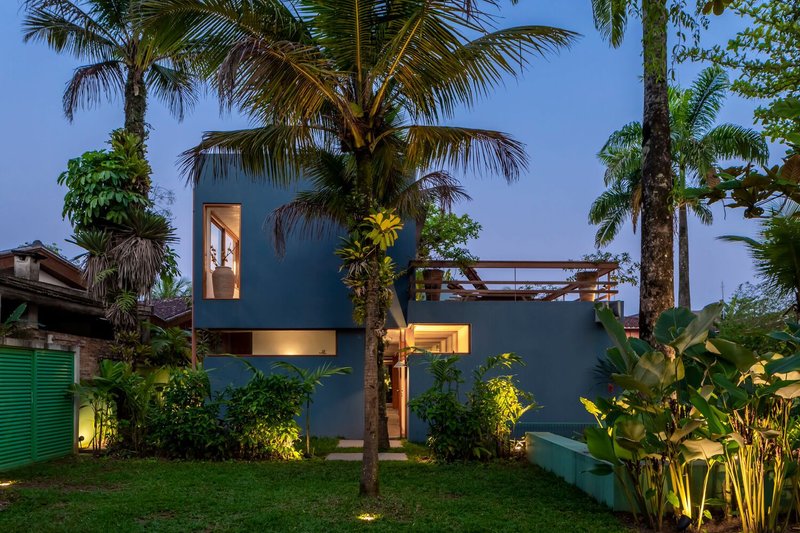
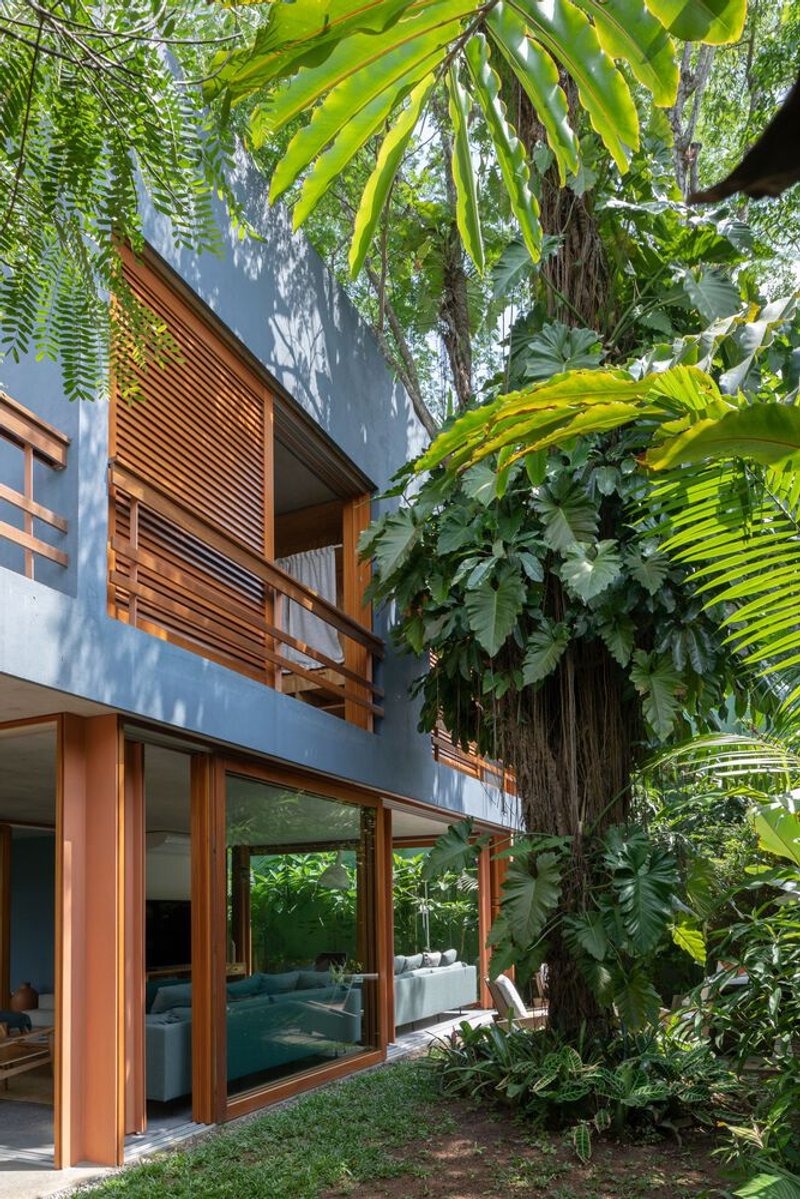
Finished in grey-blue stucco, the house's volumes sit beneath and behind the tree canopy rather than in front of it. At twilight the illuminated windows glow through layers of palm fronds and broad-leafed planting, making the architecture read almost like a series of lit rooms suspended in a garden. Timber louvres and horizontal shutters break down the facade into operable fragments, allowing residents to modulate privacy, ventilation, and light without closing themselves off from the landscape.
The two-storey elevation along the garden side is honest about its structural logic: pilotis at the ground level open the footprint to airflow and views, while the upper deck cantilevers around existing trunks. There is no heroic entrance or symmetrical composition. The house simply shows up where the trees allow it.
Trees as Co-Authors
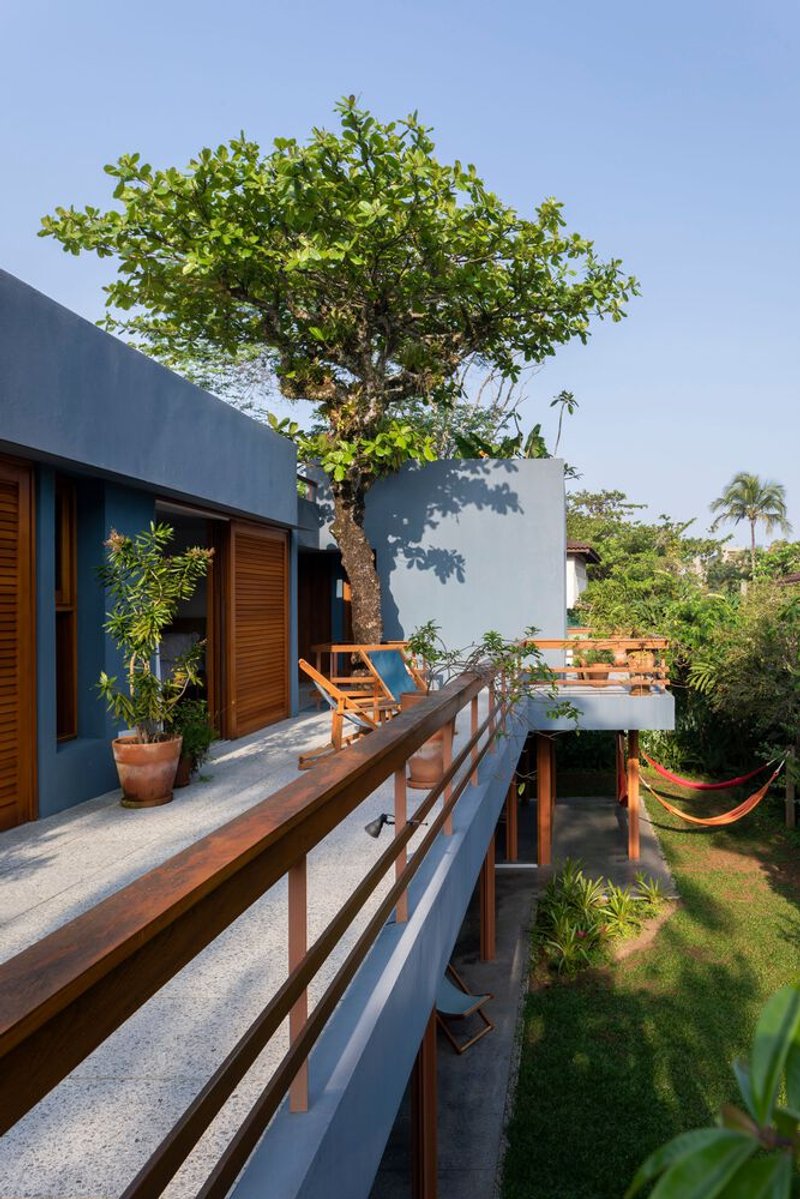
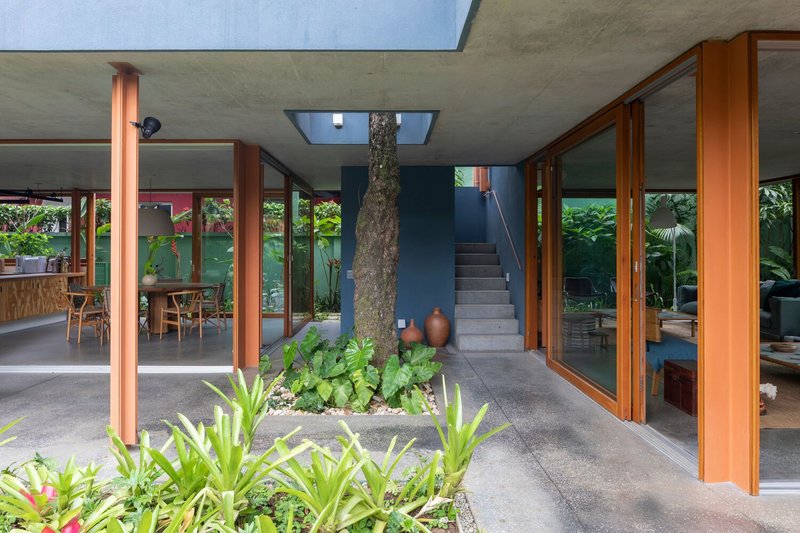
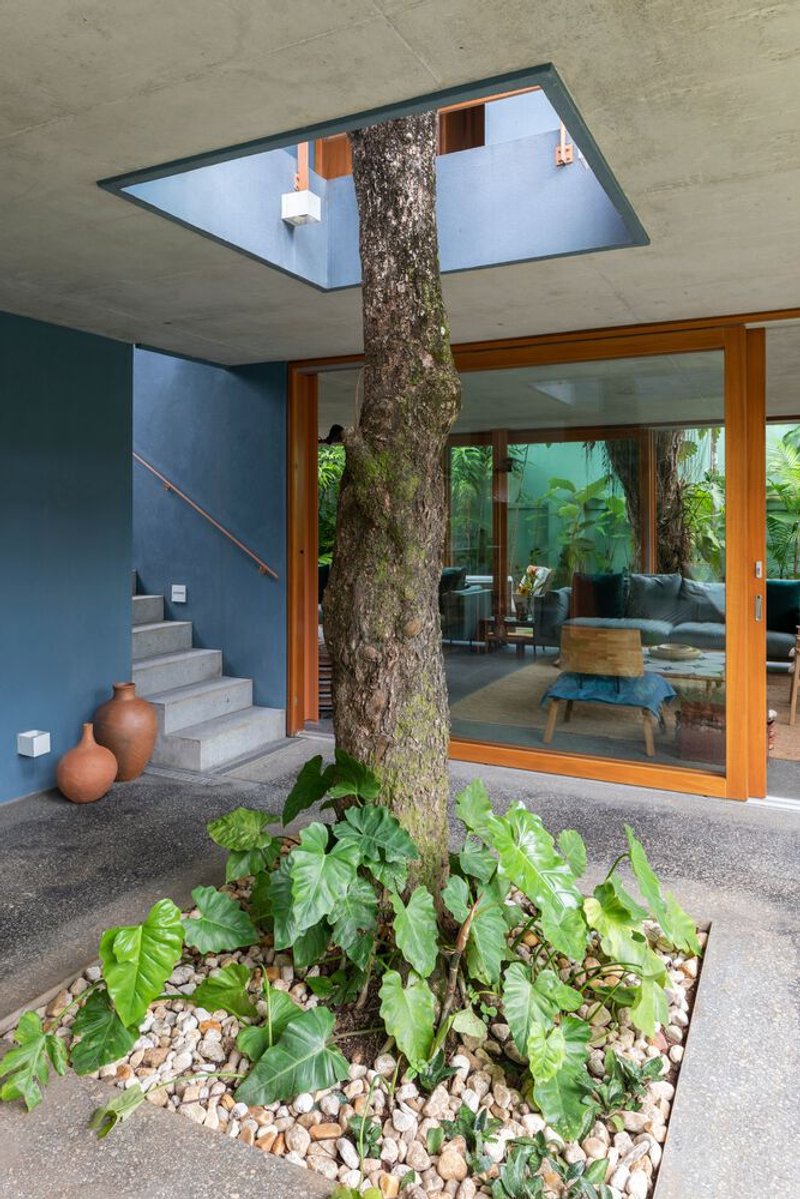
The most memorable move in the project is structural generosity toward the existing vegetation. At least one large tree trunk rises through the concrete deck of the upper balcony, its bark untouched, a timber railing curving gently around it. Inside, a courtyard opens to the sky through a rectangular cut in the roof slab, giving a second trunk room to grow vertically through the section of the house.
These are not decorative gestures. They required precise coordination between the survey of root systems, the placement of footings, and the detailing of waterproofing around each penetration. The payoff is spatial: natural light filters down through leaf canopies directly into the heart of the plan, and the scale of the rooms is measured not by ceiling height alone but by the upward sweep of living wood.
The Living Spine
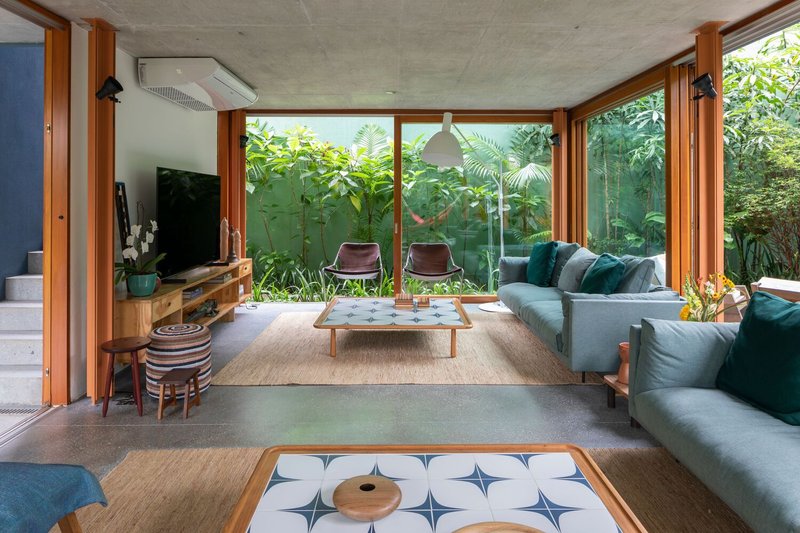
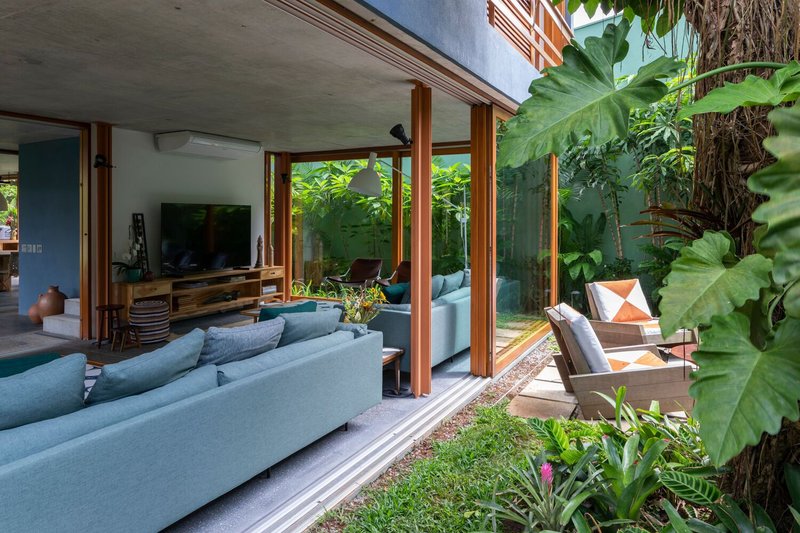
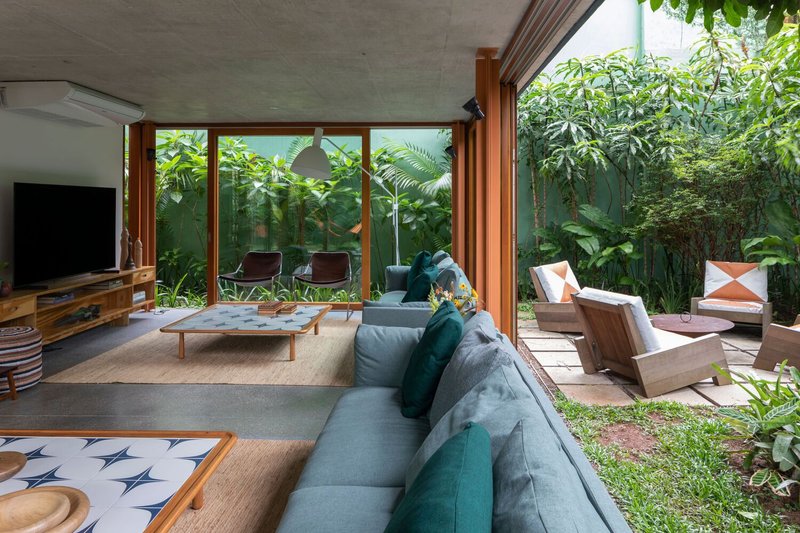
The ground floor is organized around a circulation spine that links the social areas, with planted courtyards flanking both sides. Full-height timber-framed glazing transforms the living room into a kind of inhabited veranda, its threshold to the garden reduced to the thickness of a sliding door. When fully opened, the cross-ventilation path runs uninterrupted from one courtyard to the next, pulling ocean air through the house.
Furniture is kept low and sparse, giving the eye permission to travel outward to the planting rather than settling on objects. The exposed concrete ceiling acts as a neutral datum above, its raw finish a deliberate counterpoint to the lush greens pressing in from every side.
Kitchen and Dining as Social Core
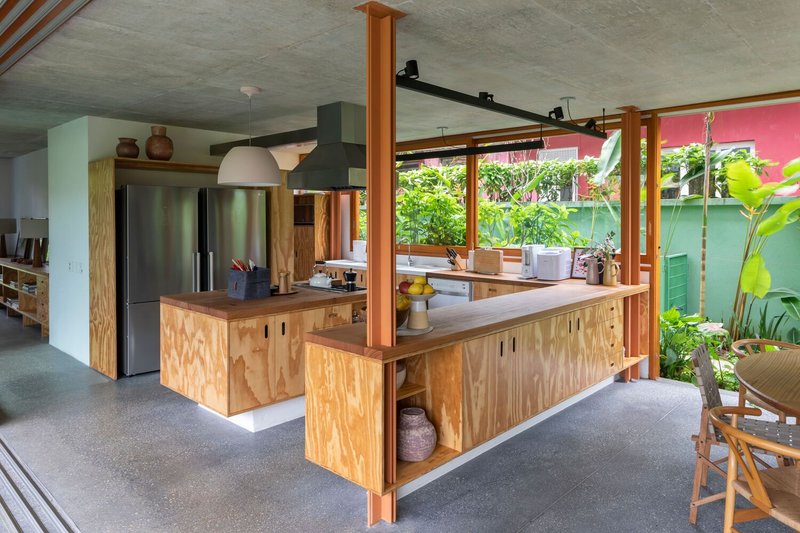
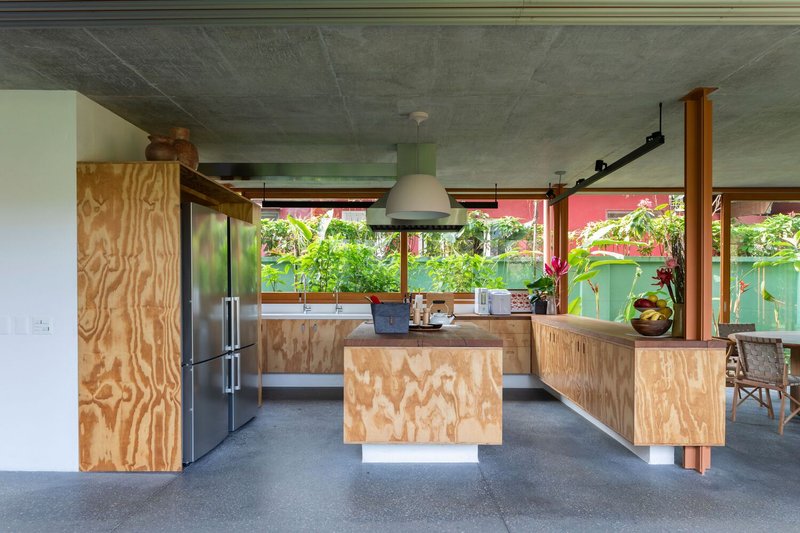
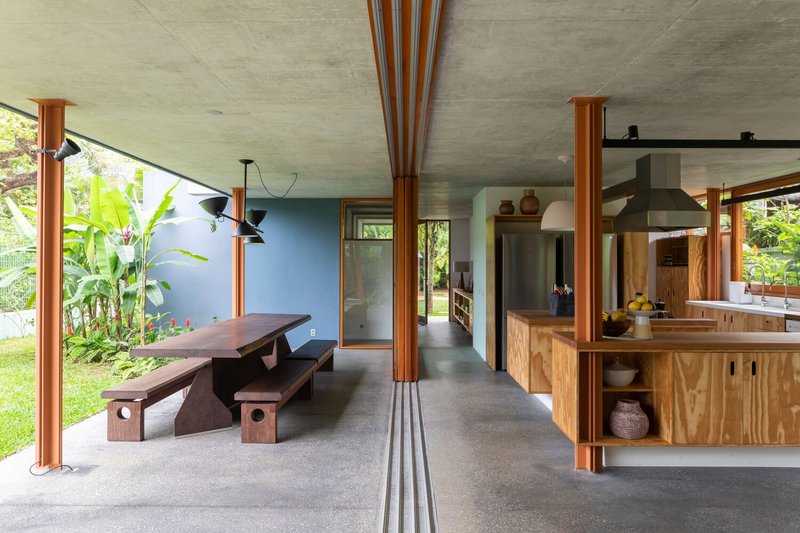
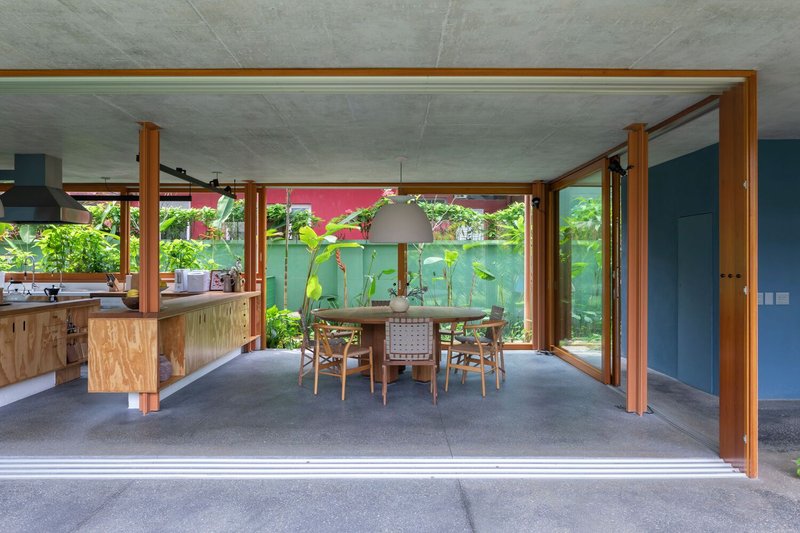
The kitchen and dining zone occupies the widest span of the plan, anchored by a plywood island and flanked by cylindrical timber columns that carry the roof load. Cabinetry is finished in the same light plywood, giving the space a cohesive warmth without veering into rustic cliché. Horizontal windows at counter height frame bands of tropical greenery, a subtle reminder that even while cooking you are embedded in vegetation.
The dining table sits beneath the exposed concrete slab, its raw soffit marked by formwork lines that echo the grain of the timber columns. It is a room that feels generous without being oversized, its proportions calibrated to a family gathering rather than an architectural photograph.
Corridors, Thresholds, and In-Between Spaces
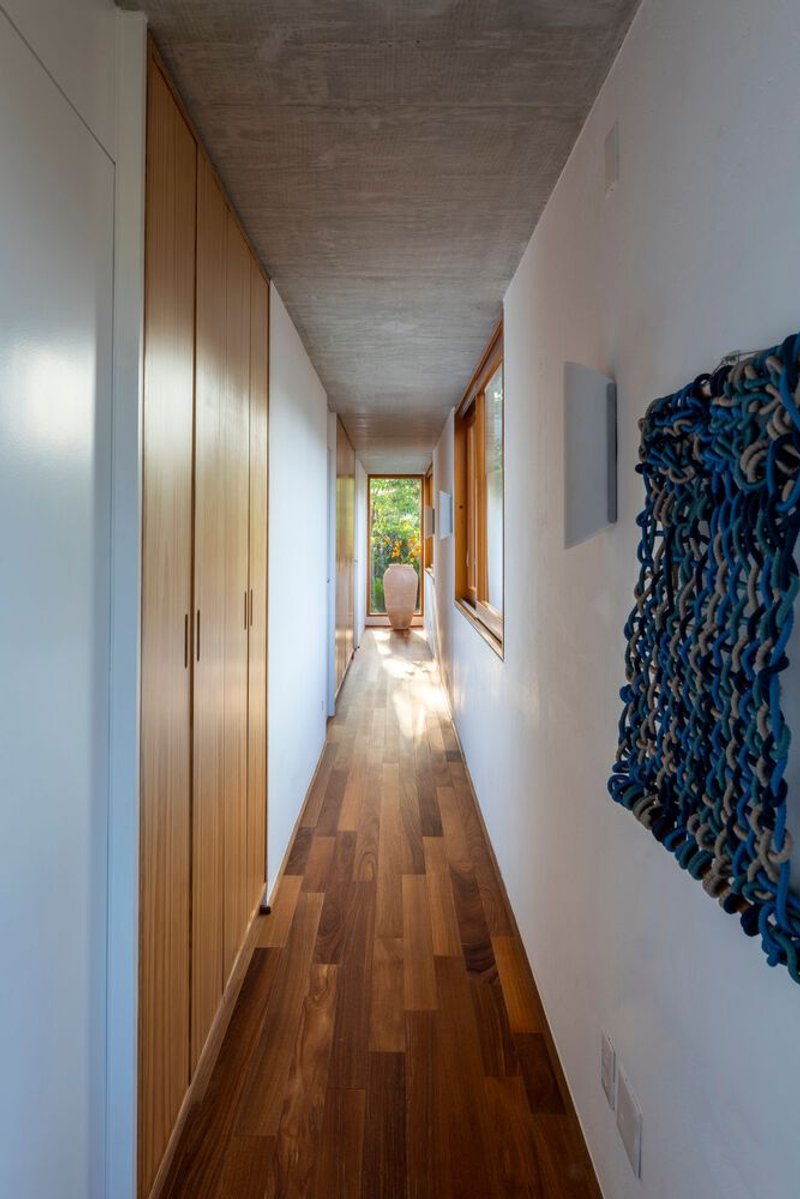
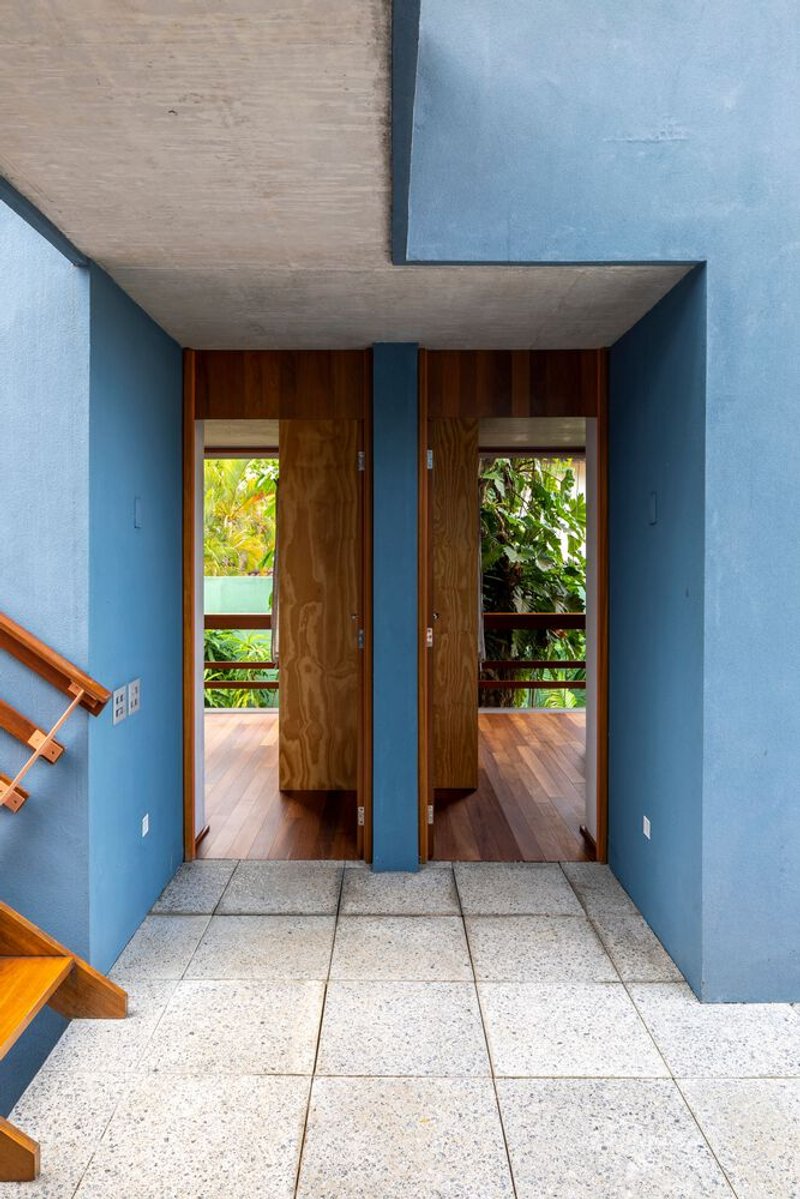
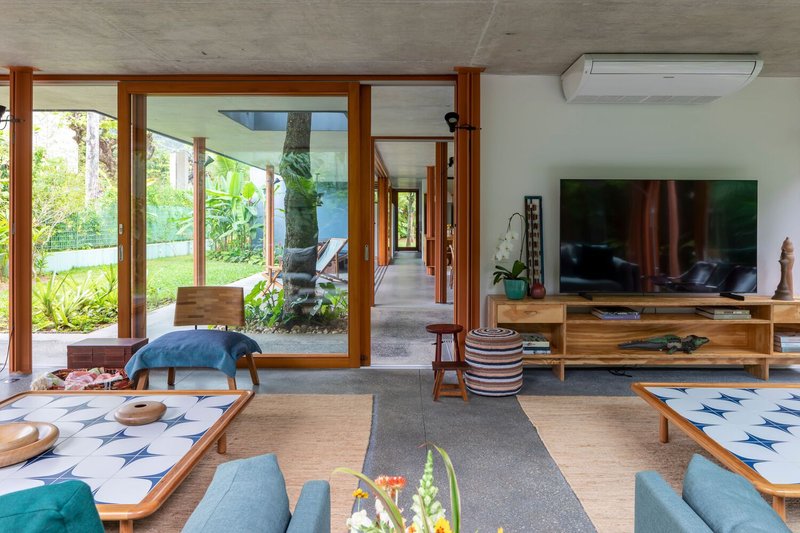
André Vainer treats circulation not as leftover space but as a sequence of framed views. A corridor lined with vertical wood paneling terminates in a garden vista. The entry hall, finished in blue plaster with a terrazzo floor, channels visitors past a pivot door and into the plan's central axis. A view through layered glass doors reveals courtyards on both sides, collapsing the distinction between hallway and garden path.
These transitional moments slow your movement through the house. They are deliberately narrow relative to the rooms they connect, compressing the spatial experience before releasing it into the next planted void.
Upper Floor: Private Rooms Open to the Canopy
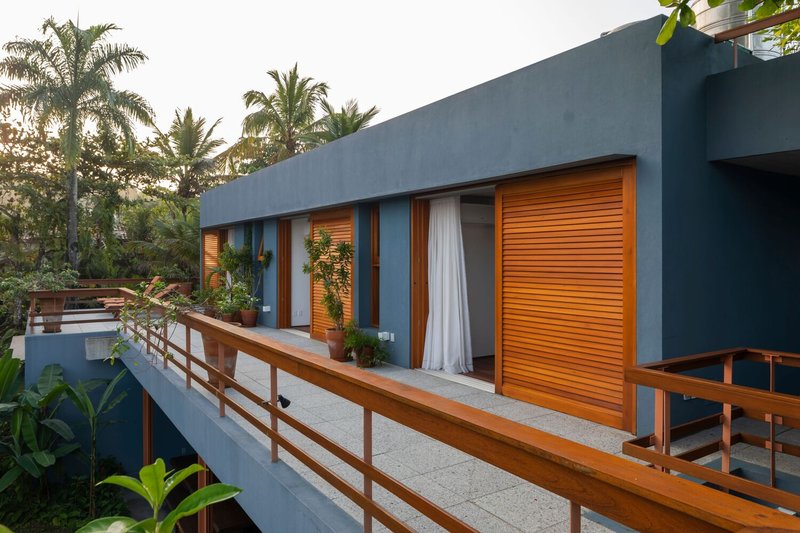
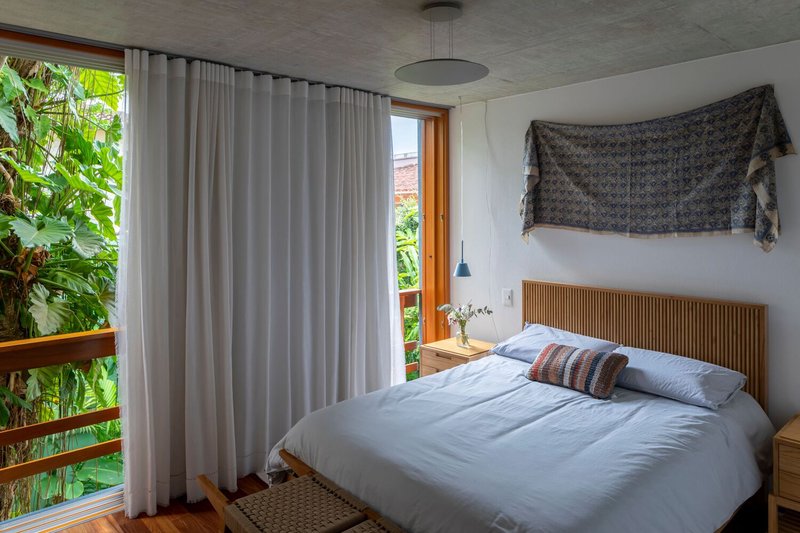
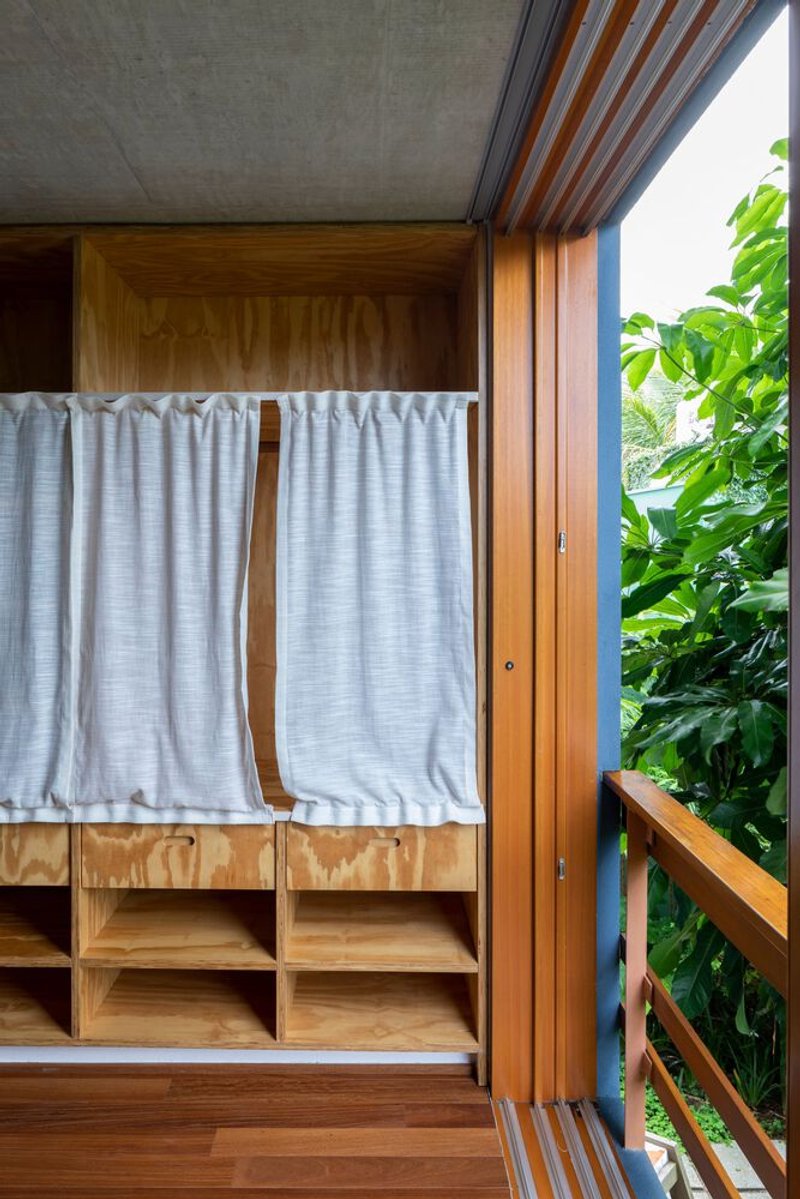
The second floor pulls away from the ground-level transparency and offers a different register of privacy. A walkway with timber handrails connects grey-blue volumes at dusk, the horizontal wood shutters filtering light into the bedrooms behind. Inside, timber-framed windows open directly into the dense canopy, placing sleepers at eye level with the treetops rather than the garden floor.
Built-in plywood storage with linen curtains keeps the bedrooms uncluttered, reinforcing the sense that this is a house for being outside, where the interior is stripped to essentials so the landscape can do the heavy lifting.
Bathrooms in Full Color
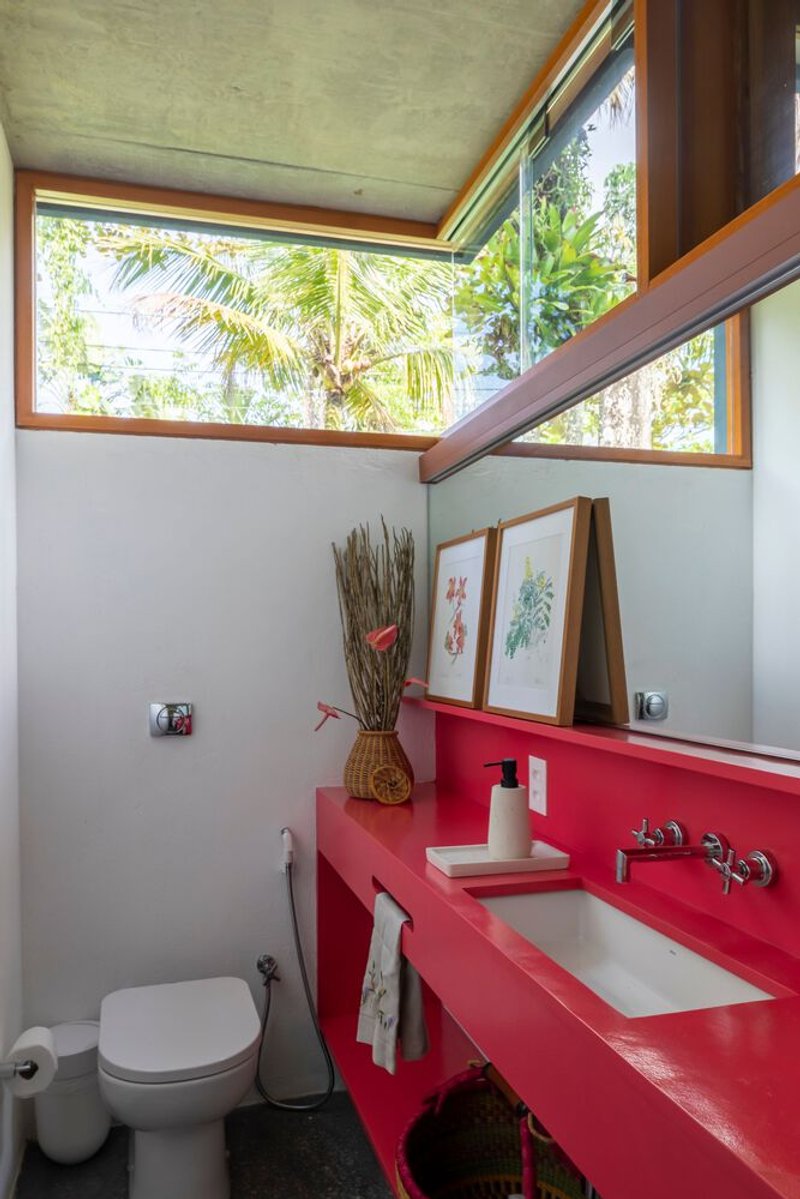
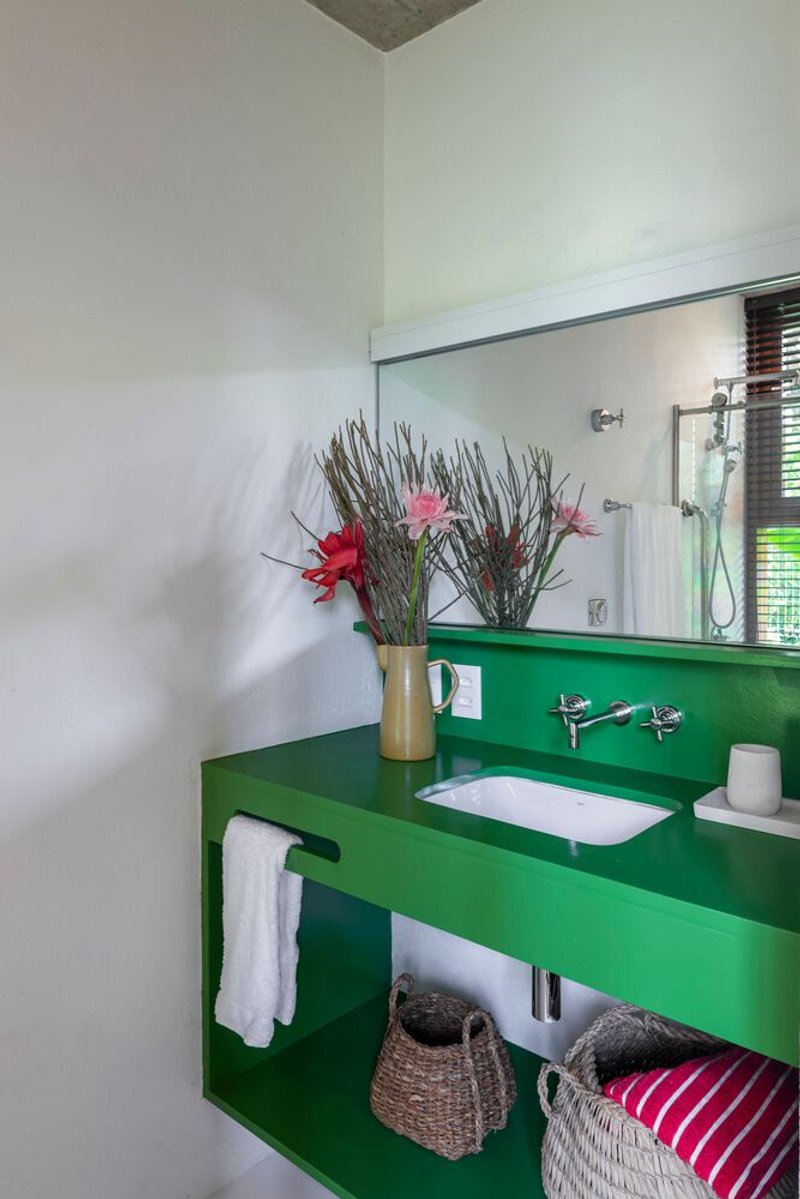
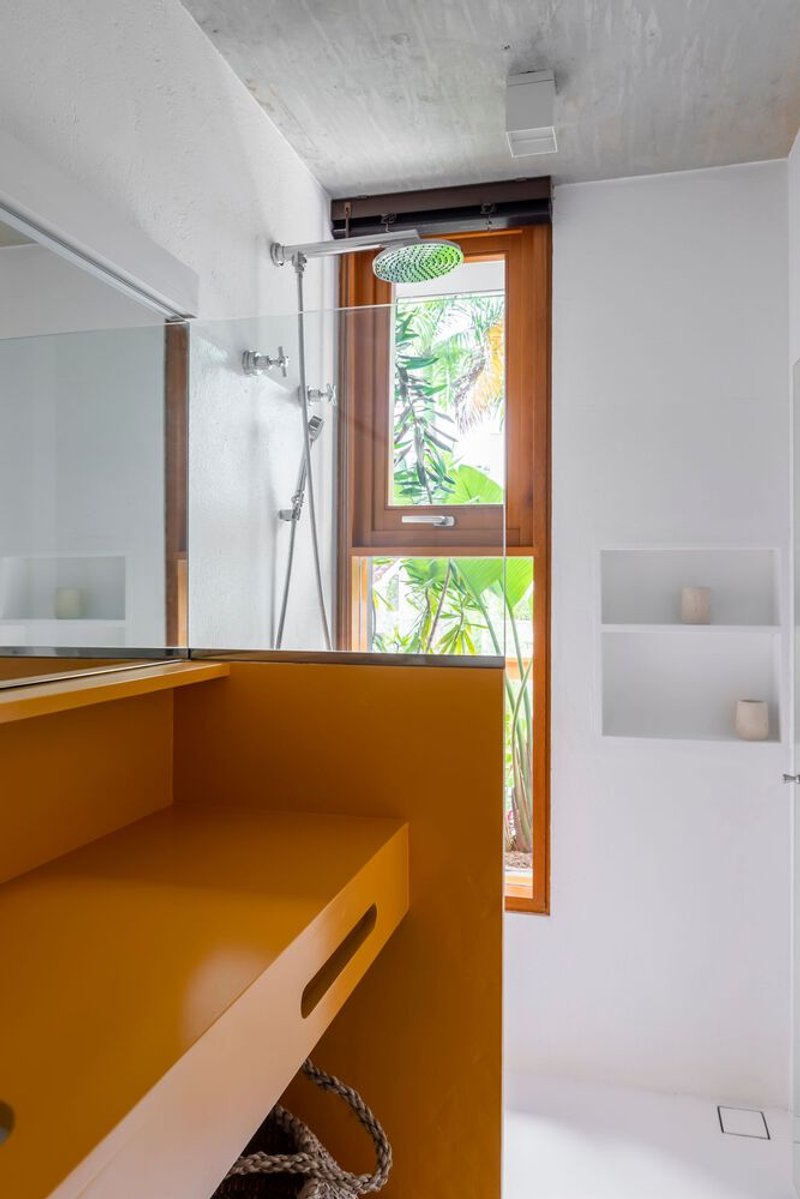
Where the living spaces defer to the garden palette, the bathrooms assert themselves with saturated color. A red vanity counter catches light from clerestory windows framing palm fronds. A green vanity unit with an integrated sink glows under dappled sun. A yellow-tiled bathtub sits beside a vertical window that frames banana leaves like a botanical painting. Each bathroom is a discrete chromatic event, proof that restraint in the common areas does not require timidity everywhere.
The strategy is smart: by concentrating color in small, enclosed rooms, the architects avoid visual competition with the landscape in the larger spaces while still giving the house personality and warmth.
The Terrace as Threshold to the Horizon
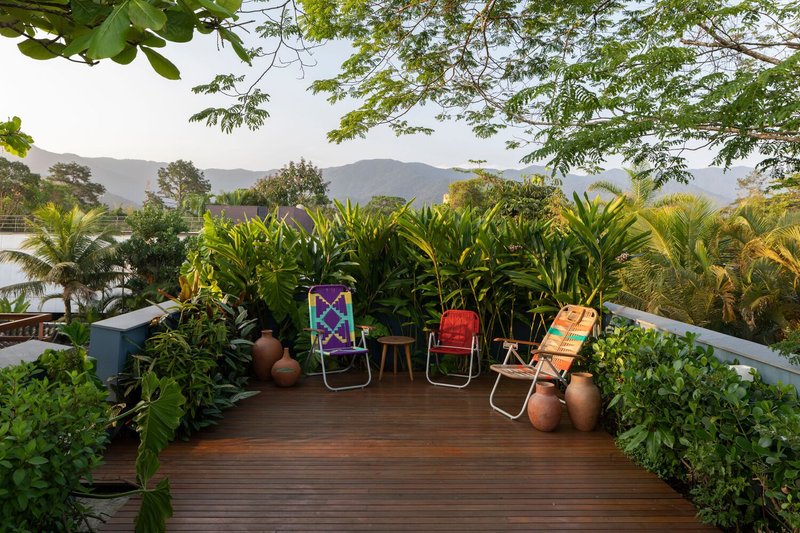
A timber deck terrace extends into the surrounding vegetation, furnished simply with folding chairs and potted plants. Dense tropical growth frames the view toward distant hills, and the terrace feels less like a designed outdoor room and more like a cleared patch in a forest. This is the house at its most relaxed, where architecture does the minimum and the site does the rest.
Plans and Drawings
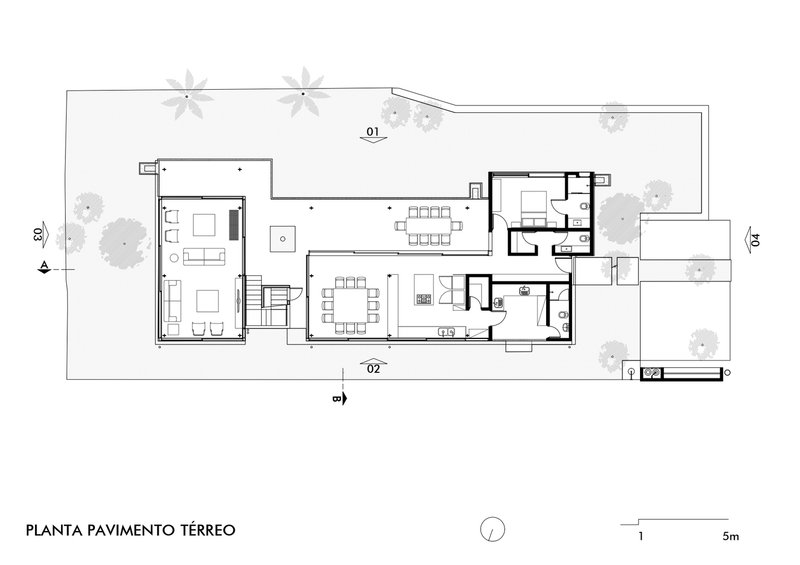
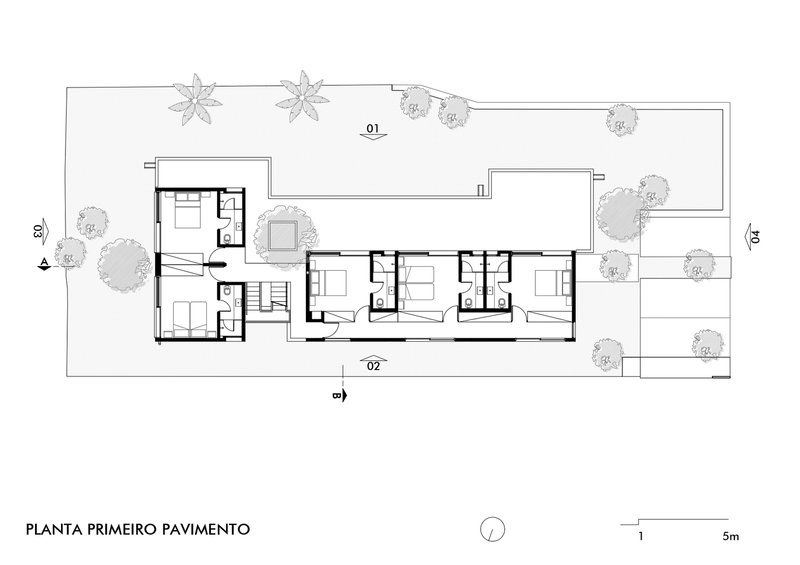
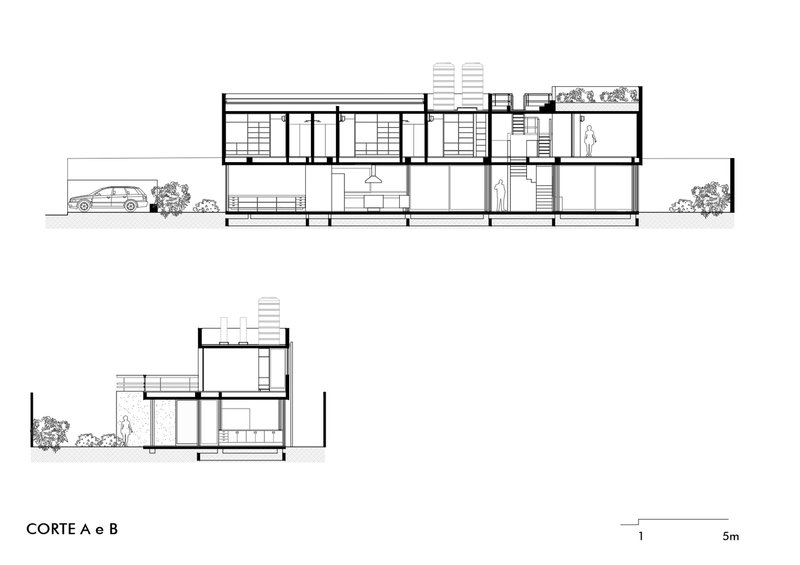
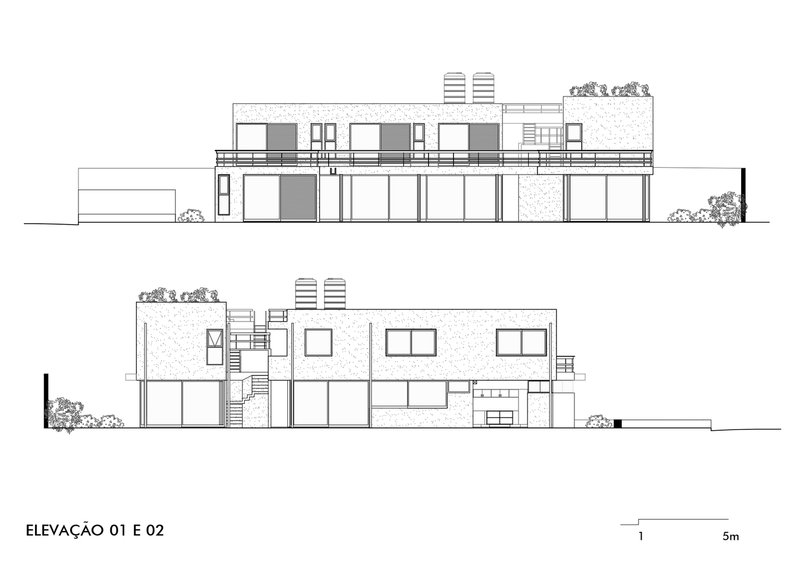
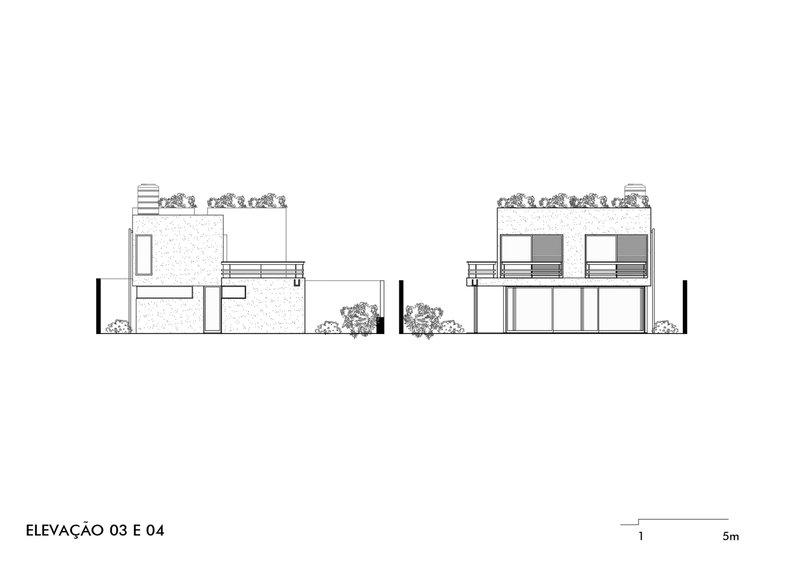
The ground floor plan reveals how the social spaces wrap around a central staircase with trees annotated in their exact positions, confirming that the landscape survey preceded the architectural layout. The first floor plan shows bedrooms arranged in a linear sequence, each with its own bathroom, minimizing corridor area. Sections cut through the two-storey volume expose the relationship between interior ceiling heights and the tree canopy above, while the elevations document the interplay of pilotis, shutters, and rooftop vegetation that gives the facade its layered character.
Why This Project Matters
Beach house design has long been dominated by two extremes: the transparent glass pavilion that ignores climate, and the fortress compound that ignores context. André Vainer's house at Baleia Beach proposes a third way, one in which the architecture literally shapes itself around what was already there. The decision to preserve existing trees is not a sentimental gesture but a design methodology. It forces the plan to be irregular, the structure to be adaptive, and the spatial experience to be unpredictable.
In a moment when sustainability is too often reduced to insulation values and solar panels, this project reminds us that the most ecological move an architect can make is to leave the site as intact as possible. The trees predate the house and, given concrete's lifespan, they may well outlast it. That inversion of permanence, architecture as the temporary layer and nature as the enduring one, is the most radical idea here, and it is executed with real skill.
The House on Baleia Beach by André Vainer Arquitetos, located at Baleia Beach, São Paulo coast, Brazil. Photography by Pedro Napolitano Prata.
About the Studio
Share Your Own Work on uni.xyz
If projects like this are the kind of work you want to make, uni.xyz is a place to publish your own, find collaborators, and enter design competitions.


Popular Articles
Popular articles from the community

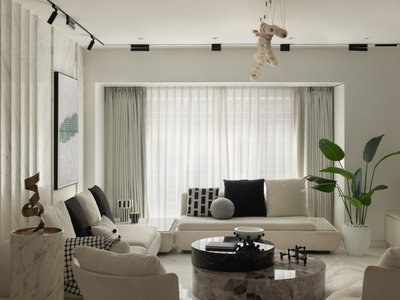
Inside a Timeless Mumbai Residence by Aether Studio
Aether Studio's 2,250 sq ft apartment in Malad, Mumbai uses marble, brass, boucle, and disciplined restraint to build a quiet retreat from the city.

IKC de Geluksvogel: Sustainable School Architecture Designed for Free Movement and Digital Learning
IKC de Geluksvogel turns sustainable school architecture into a flexible Maastricht campus for digital learning, nature, and free movement.
Milan Crossover: Sustainable Architecture for a New Fashion Culture in Milan
Milan Crossover transforms fashion culture through sustainable architecture, linking material libraries, remake studios, and public runways.
The Faith: Modular Architecture for Play, Learning, and Hope in Kutupalong Refugee Camp
A modular playground architecture project in Bangladesh where play, learning, safety, and hope rebuild childhood inside a refugee camp anew.


Similar Reads
You might also enjoy these articles

Olio Towers: A Mid-Rise for Performers That Fuses Housing, Rehearsal, and Stage
Located blocks from Houston's Theater District, this modular tower stacks living units around a central performance atrium.
Oasis: Modular Green Housing Carved into Dhaka's Urban Fabric
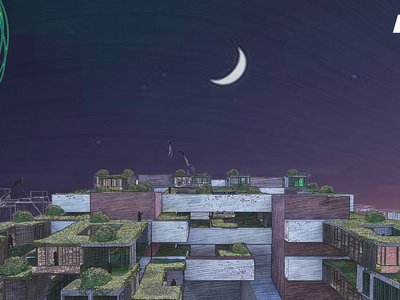
A shortlisted Plugin Housing entry reclaims unauthorized settlements in Dhaka with stepped concrete volumes, green roofs, and ventilation-driven design.

Black Hole: A Floating Megastructure for the Post-Physical Era
Emiliano Mazzarotto envisions a spherical, self-scaling arena where e-sports, digital hotels, and holographic stadiums replace traditional public space.
Compact & Sustainable Living in Piraeus: A Four-Level Family Home Built Around Light and Air
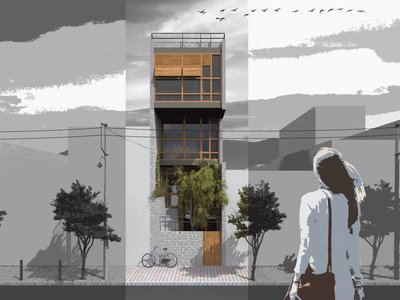
A narrow townhouse in one of Greece's densest port cities uses a central atrium and passive strategies to house three generations under one roof.


Explore Architecture Competitions
Discover active competitions in this discipline




The International Standard for Design Portfolios


The Global Benchmark for Architecture Dissertation Awards


The Global Benchmark for Graduation Excellence


Challenge to reimagine the Iron Throne
Comments (0)
Please login or sign up to add comments
No comments yet. Be the first to comment!