

Beatriz Henriques Weaves Climate and Craft into a Timber Vacation House in Trancoso
A 600-square-meter home in Bahia's coastal forest uses wind studies, woven screens, and passive cooling to live lightly in the tropics.


Trancoso sits at a sweet spot on Brazil's southern Bahia coast: close enough to the Atlantic for sea breezes, lush enough to feel deep in the tropics. When Beatriz Henriques Arquitetura took on a vacation house inside the Altos de Trancoso condominium, the practice did not default to a white-box resort aesthetic. Instead, the 600-square-meter Trama House starts from climate data, mapping prevailing winds and solar angles before a single wall was drawn. The result is a home that reads as a series of low-pitched timber pavilions threaded through dense planting, each volume oriented to capture airflow while deflecting heat.
What makes the project worth studying is the consistency of its logic from site plan to ceiling detail. The name Trama, Portuguese for "weave," names both the literal technique seen across ceilings, screens, and light fixtures and the broader design attitude: every layer of the house interlocks with the next. Louvered shutters filter sun, woven bamboo panels soften reflected glare, vertical timber slats let wind pass while blocking sightlines. None of these elements feel decorative. They are the cooling system.
Forest Canopy and Site Strategy
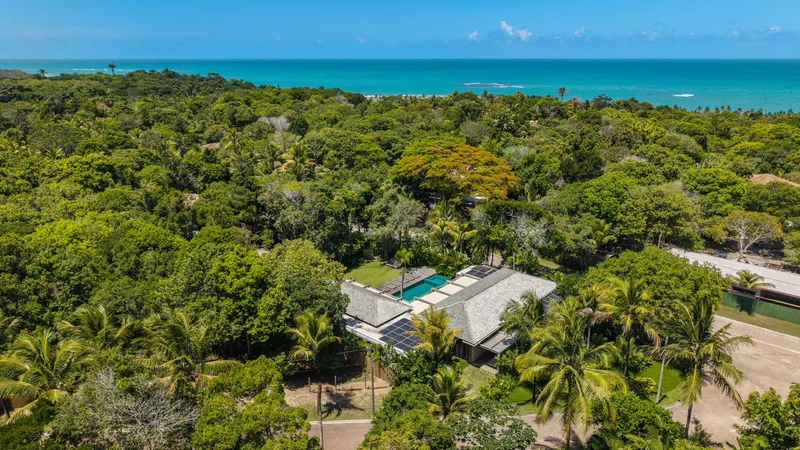
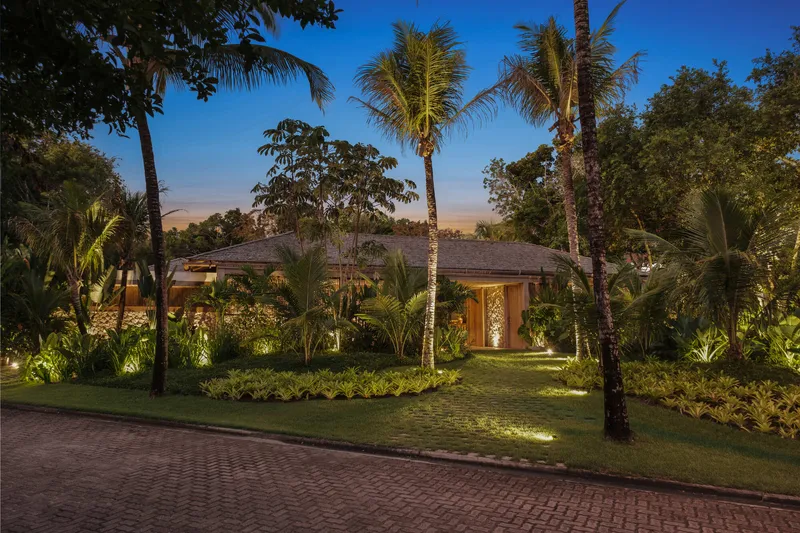
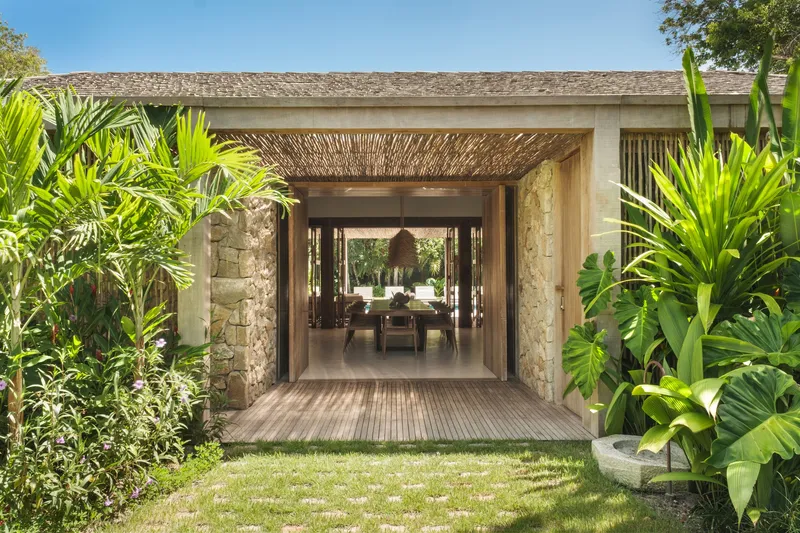
From the air, the house almost disappears. Low-pitched roofs sit beneath the coastal forest canopy, revealing their outline only by the subtle geometry of their ridgelines against a carpet of green. A sliver of turquoise ocean beyond confirms the proximity of the coastline, yet the house turns inward, choosing shade and privacy over panoramic exposure. Landscaping plays a structural role here: clusters of palm trees and tropical planting create a privacy buffer along property edges while controlling the microclimate around each pavilion.
The twilight view shows how the massing dissolves into a gentle silhouette, the roof barely rising above the lawn. Approaching the entry, you pass through dense vegetation before arriving at a covered passage with a woven timber ceiling overhead, signaling the material language of the entire house before you step inside.
Thresholds of Stone and Timber
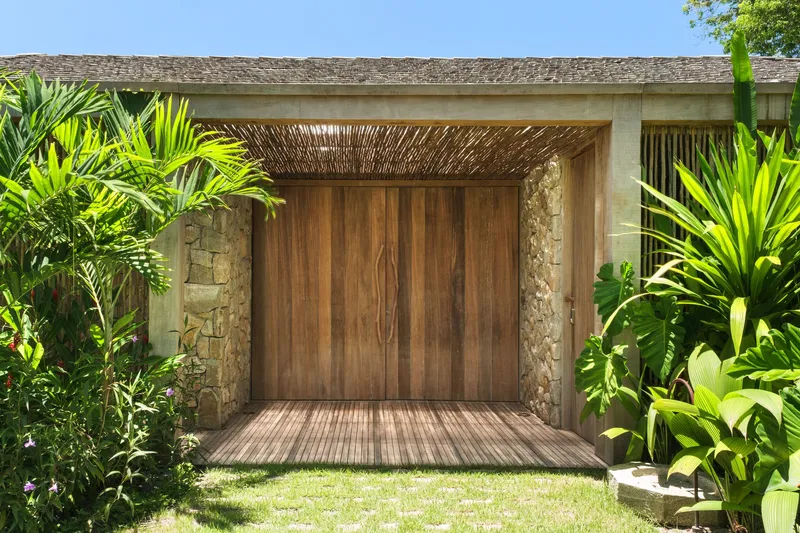
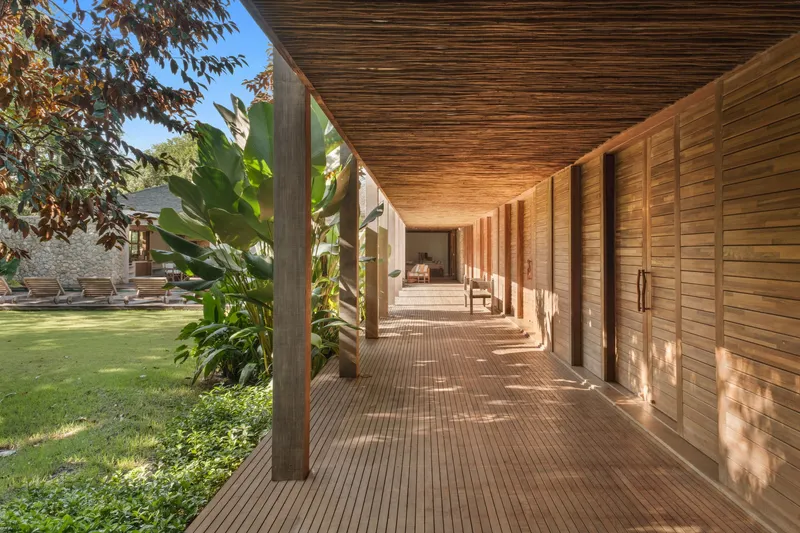
The entrance sequence is deliberate. Heavy stone walls anchor the covered entry, grounding the structure with mass and permanence. Timber doors sit flush within them, their proportions echoing the vertical slat vocabulary found across the rest of the house. From here, a covered walkway stretches toward the pool and garden, framed by exposed rafters and vertical wood cladding that creates a rhythm of open and enclosed.
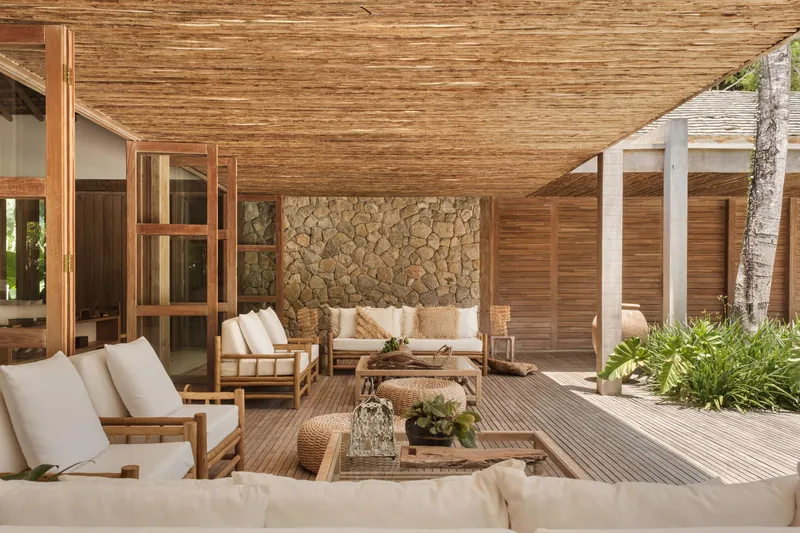
A terrace with stone-backed alcoves and louvered privacy screens illustrates how the architects managed the tension between openness and enclosure. Slatted pergolas overhead let light through in strips while maintaining airflow, a functional detail that also happens to look beautiful at midday when the shadows sharpen. These transition zones between indoors and outdoors are where the passive cooling strategy works hardest: shaded, ventilated, and visually connected to green on every side.
Living Under the Trusses
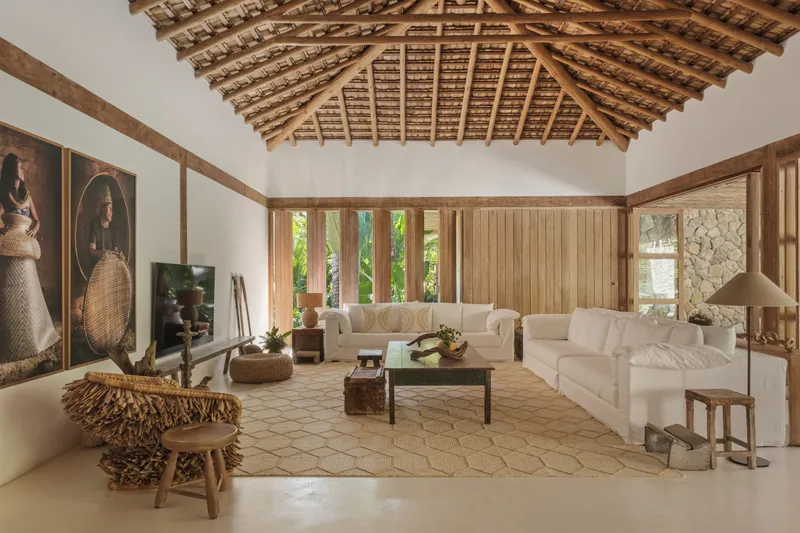
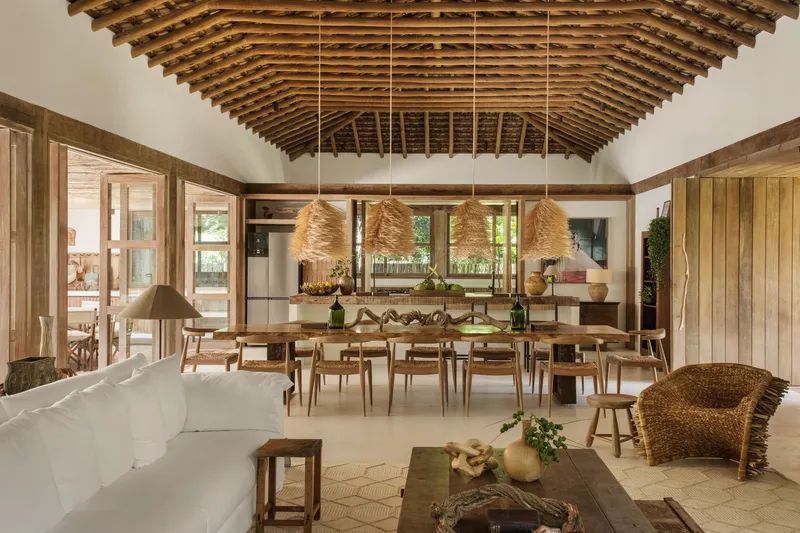
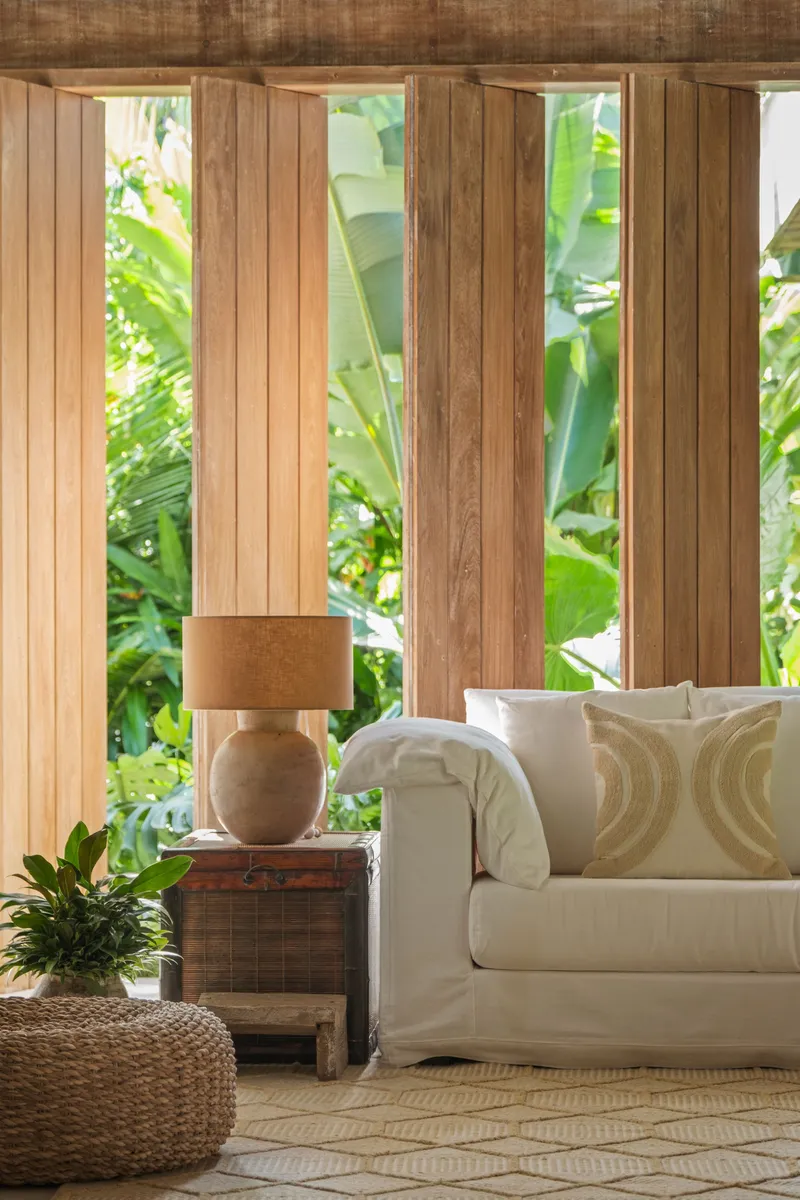
The main living space is defined by its roof. Exposed timber trusses span the open plan, leaving the structure visible and the volume generous. A vertical slat window wall stretches across one side of the living room, framing the garden in a controlled strip of green and filtering afternoon light into soft parallels across the polished floor. Woven pendant lights drop from the ridge, echoing the material grammar of the ceiling screens.
There is a directness to this interior that avoids the trap of tropical-chic styling. The palette is limited: timber in various profiles, polished concrete, stone, woven bamboo. No material appears only once. Each surface connects back to the structural or environmental logic of the house. The vertical slats that compose the facade walls reappear as furniture elements, cabinetry faces, and garden screens, making the vocabulary legible at every scale.
Kitchen as Social Core
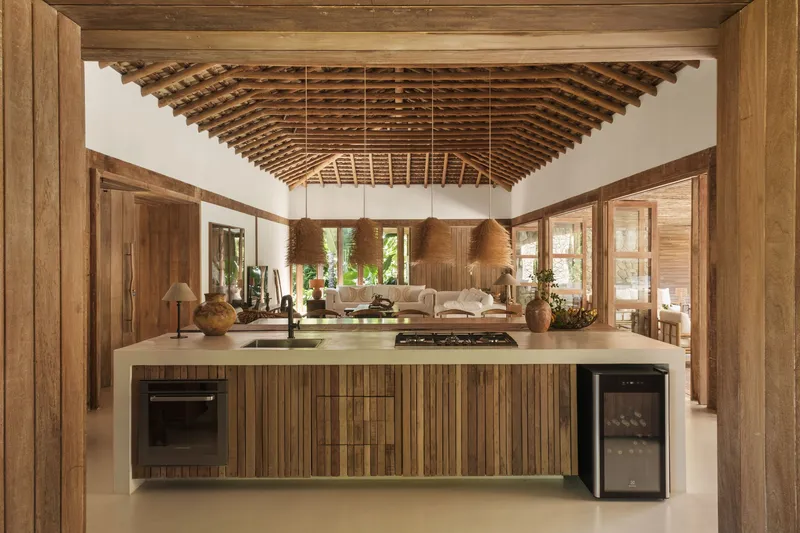
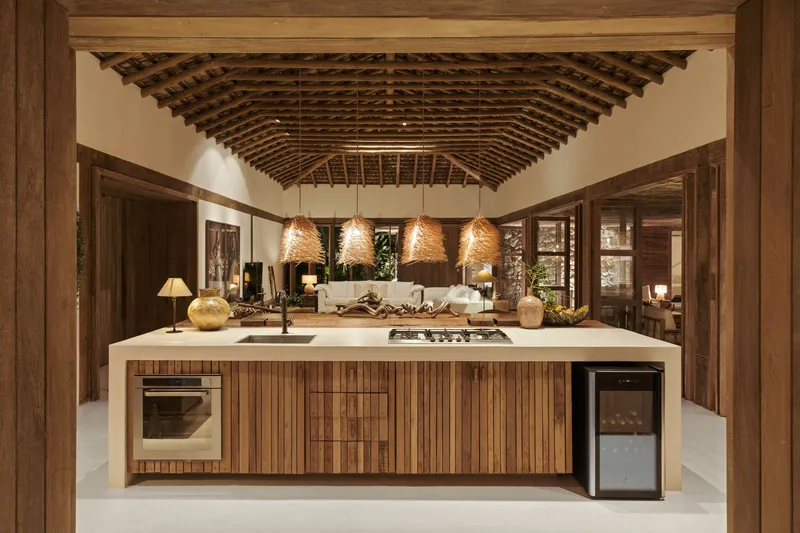
The kitchen occupies the center of the plan, beneath the tallest volume. An island counter sits under the primary roof trusses, with sight lines stretching through to the living area in one direction and into a service passage in the other. Vertical timber-clad cabinetry wraps the perimeter, its grain matching the structural framing above. Woven pendant lamps punctuate the space, casting soft pools of light that soften the harder geometry of the trusses.
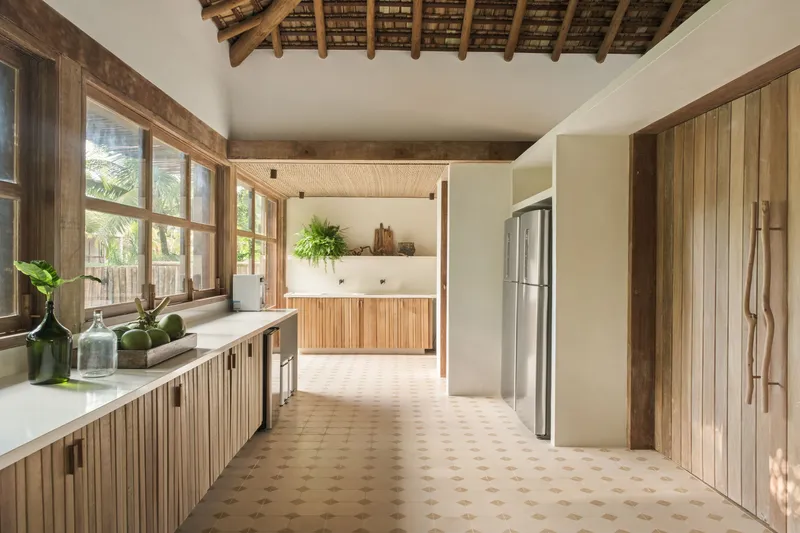
A secondary passage leads to more utilitarian zones where patterned terracotta floor tiles replace polished concrete, adding a layer of texture and color. Even here, the roof structure remains exposed, and the ceiling weave continues overhead. The consistency matters: it tells you the architects treated every room as part of a single thermal and spatial system, not just the public-facing ones.
Woven Ceilings and Filtered Light
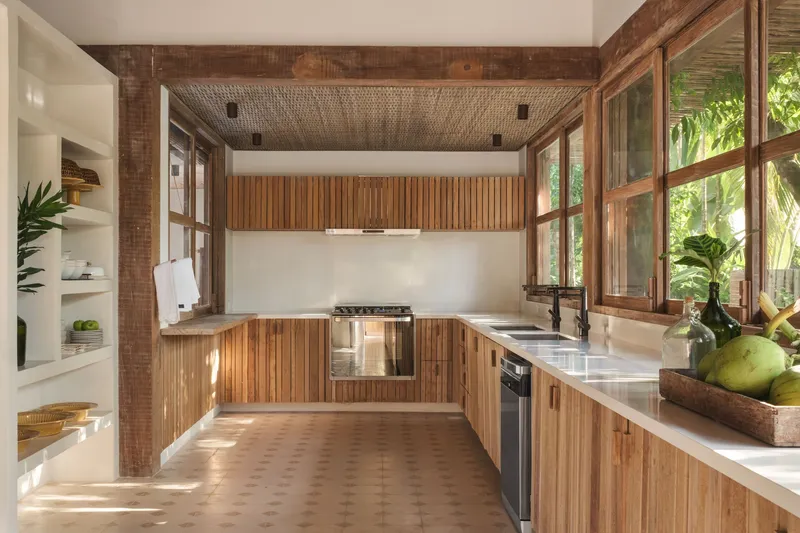
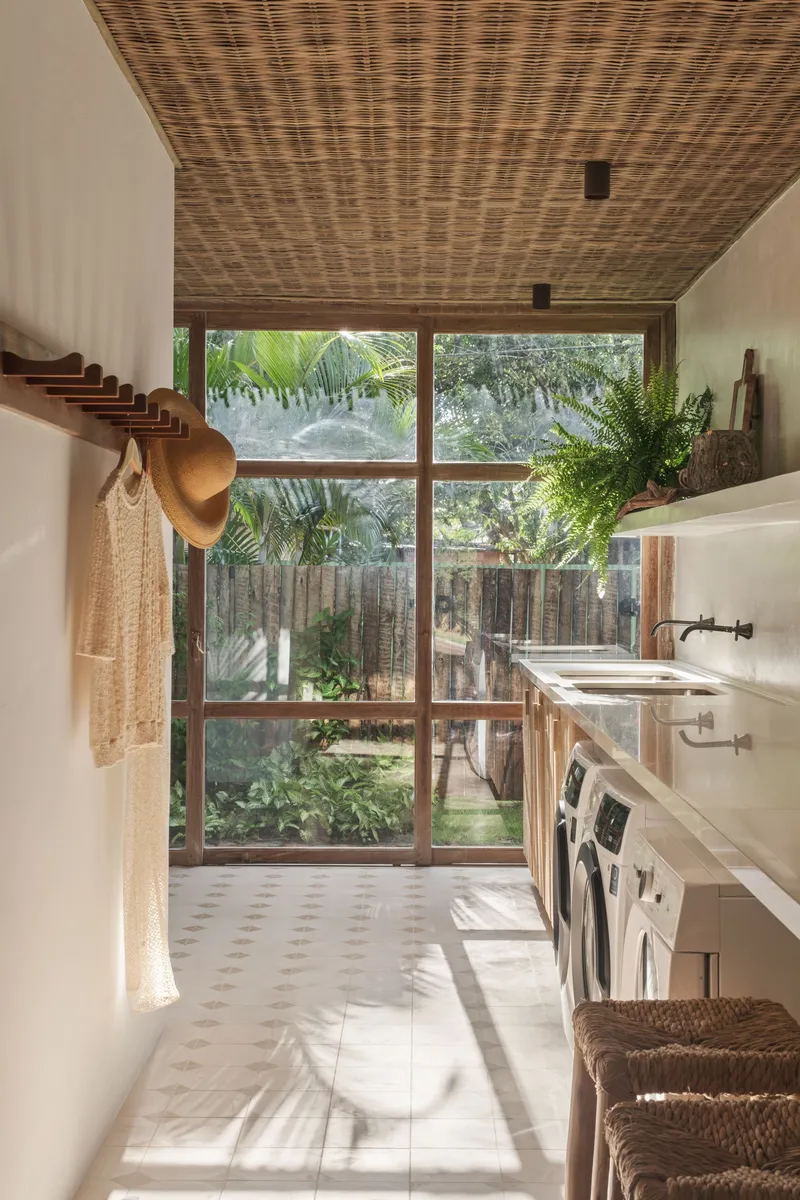
The woven bamboo ceiling panel is the signature detail. It appears in the kitchen, the laundry, the bathrooms, always performing double duty as an acoustic softener and a light diffuser. In the kitchen, windows framed by the woven panel look out onto banana palms, the foliage providing a final layer of solar filtering before daylight reaches the interior. In the laundry room, a full-height glazed wall opens to a tight interior courtyard garden, bringing air and light into a space that lesser houses would relegate to a windowless box.
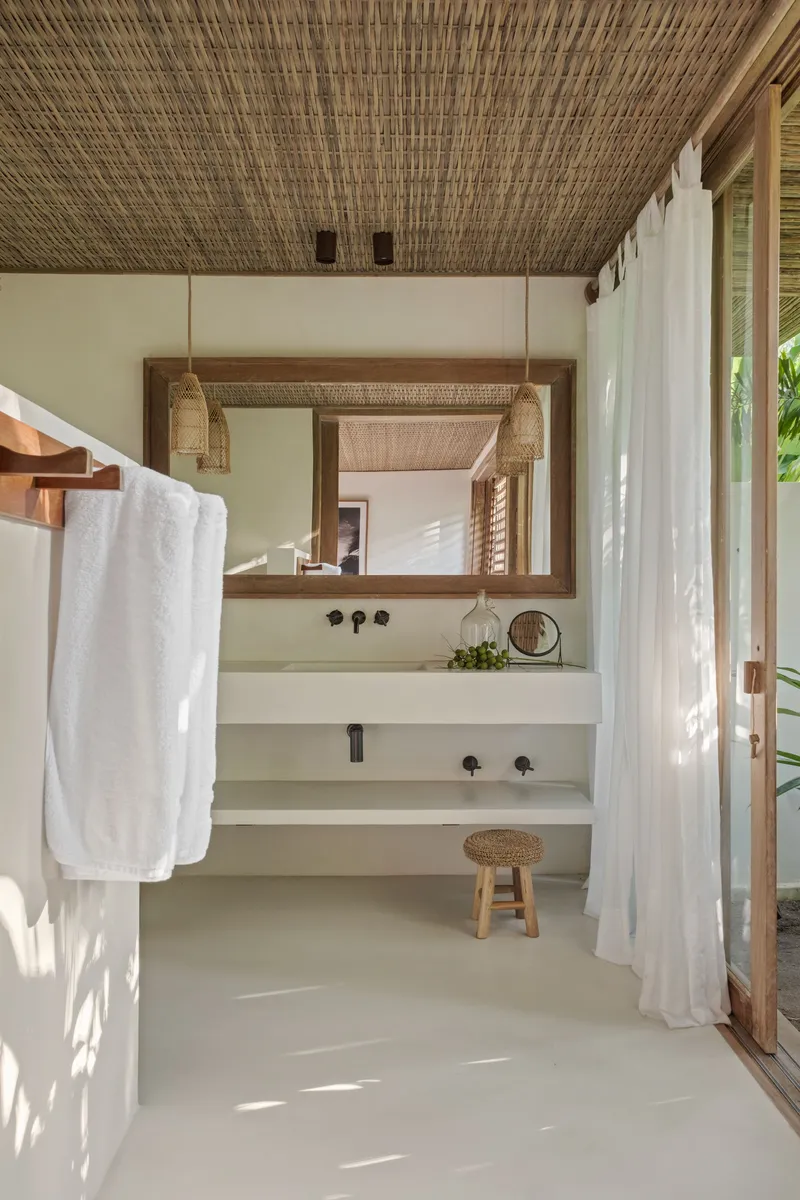
The bathroom vanity captures this layering at its most refined. White curtains filter dappled sunlight through a canopy of trees outside, and the woven ceiling tempers whatever glare remains. The polished concrete floor catches the residual light and reflects it upward, keeping the room bright without direct solar exposure. No mechanical cooling is needed in a space designed this carefully.
Bedrooms as Screened Pavilions
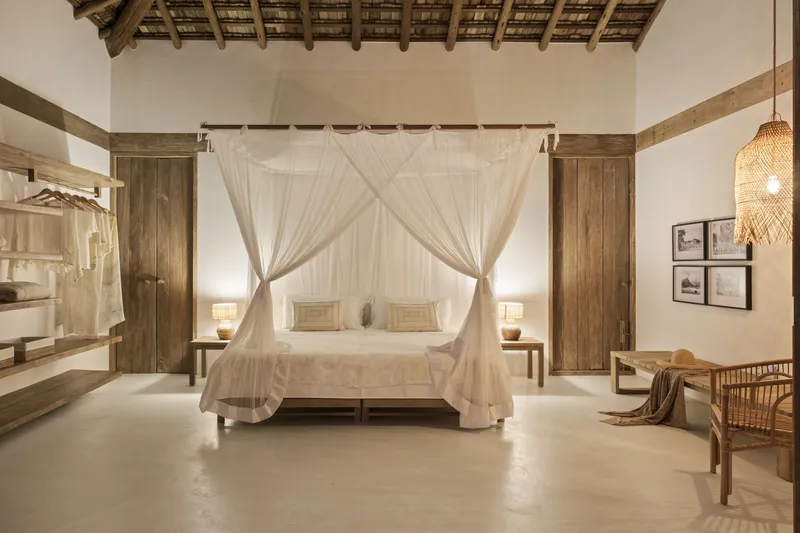
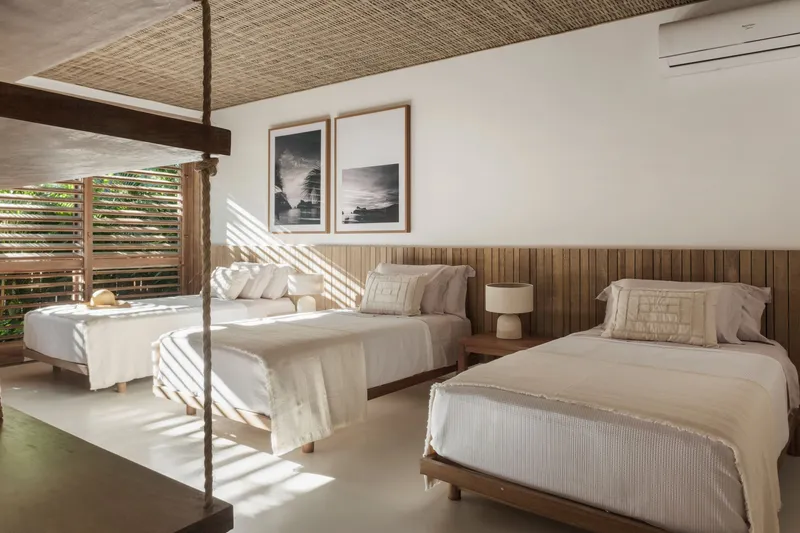
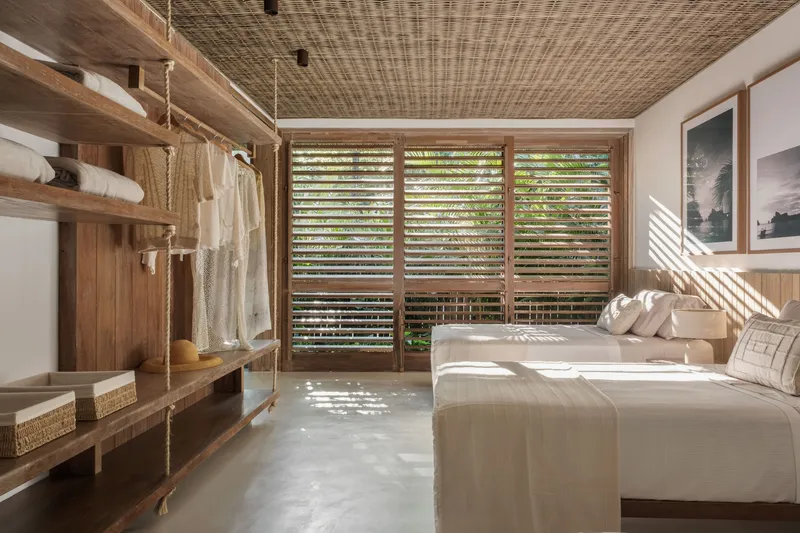
Each bedroom works as a miniature pavilion. Exposed timber roof structures remain visible overhead, while woven bamboo panels line the ceilings in a softer register. Canopy beds with mosquito netting give the rooms a quiet theatricality, their draped fabric echoing the idea of layered filtration that governs the entire house. Timber louvered shutters cast striped shadows across polished floors, turning the movement of the sun into an interior event.
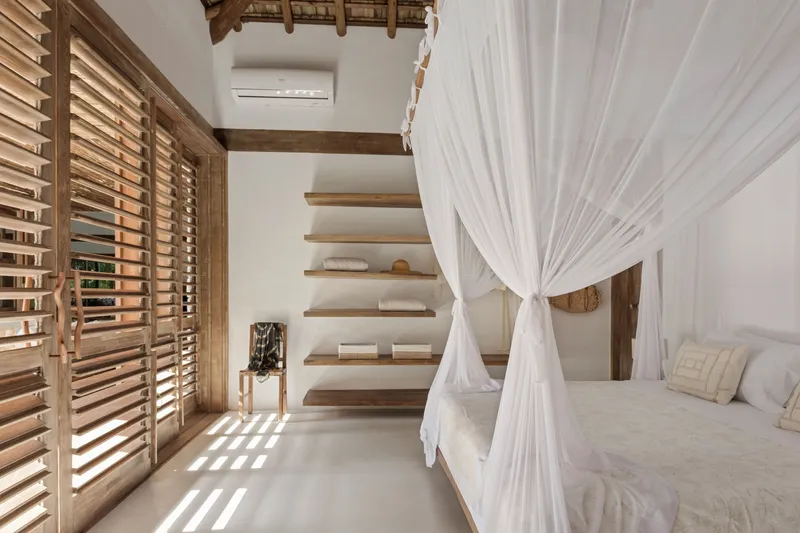
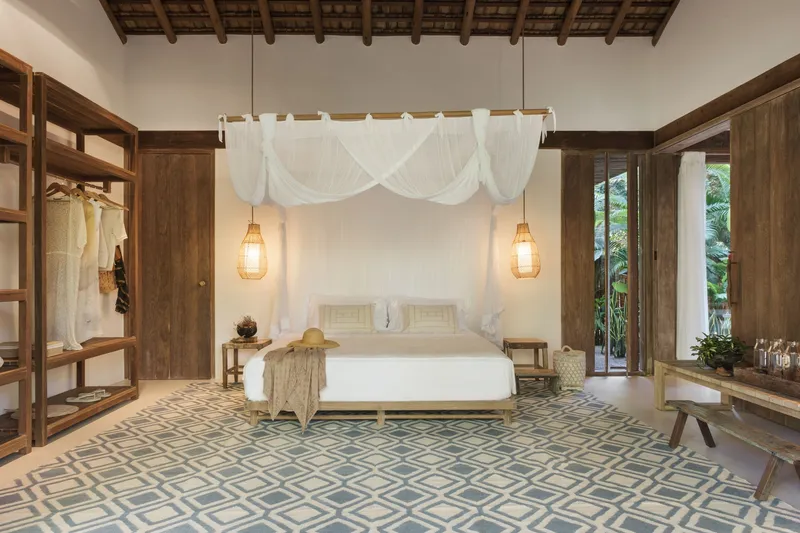
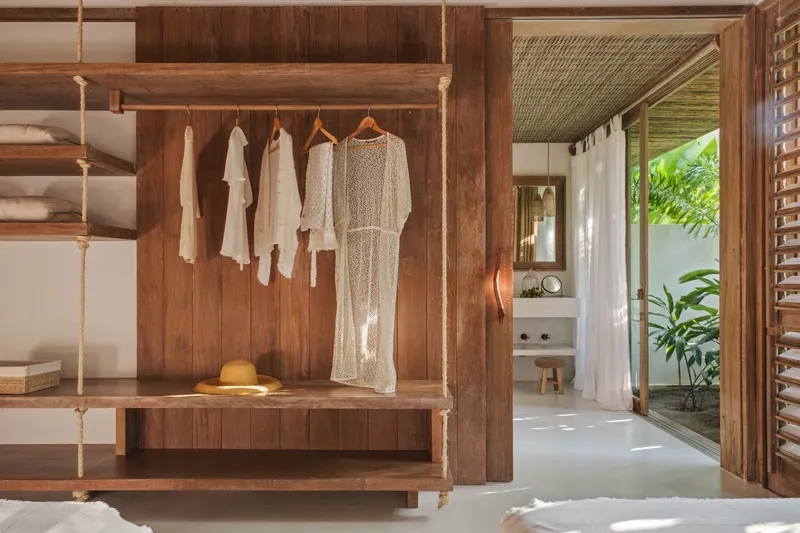
A floating timber staircase beside louvered shutters connects levels within one of the bedroom volumes, its open treads maintaining visual continuity. Another bedroom pairs patterned floor tiles with pendant lights for a warmer, more graphic character. The closet space, with its rope-suspended bench and view through to an ensuite, captures the project's consistent attention to threshold moments: each zone reveals the next through a frame, a screen, or a change in material.
Pool Deck and Outdoor Living
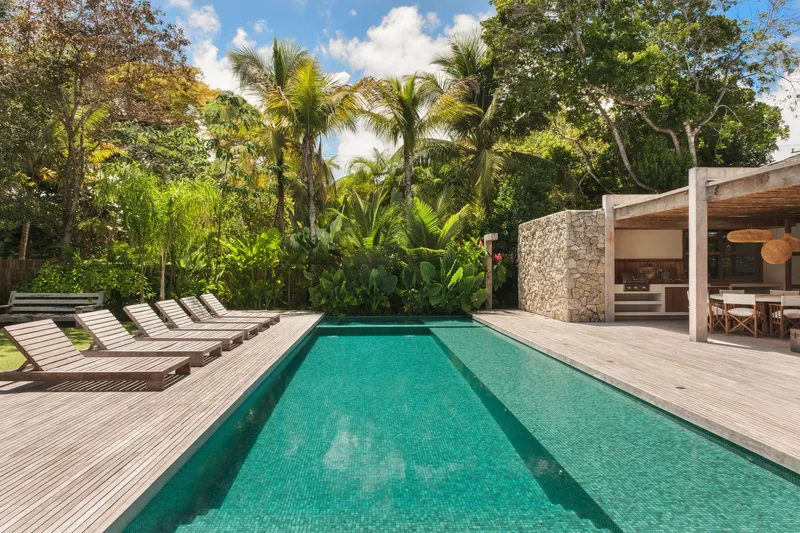
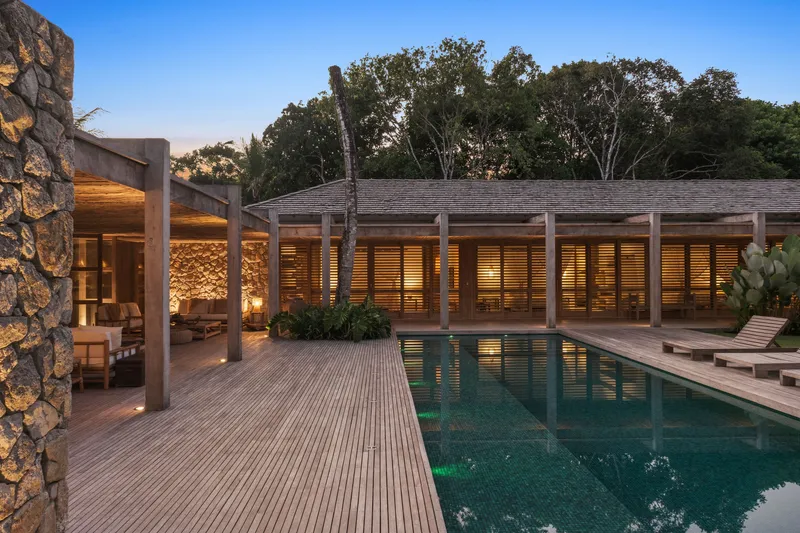
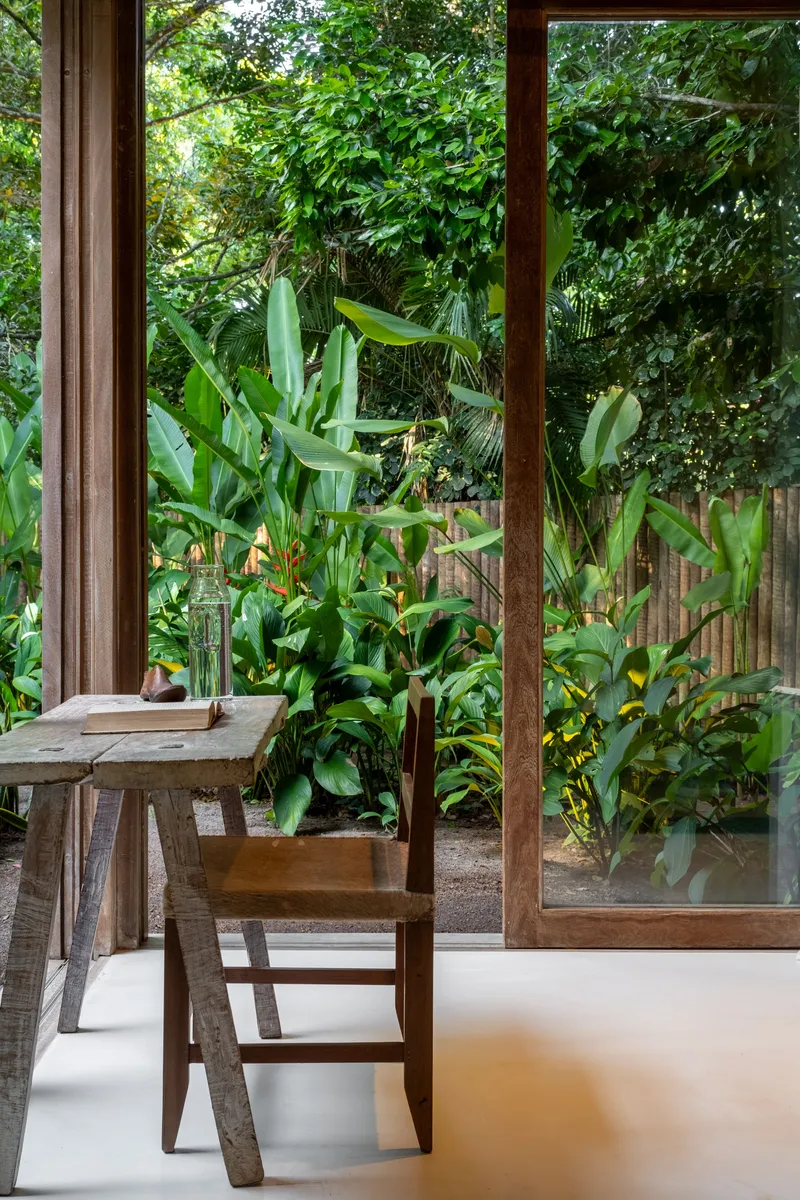
The pool sits at the heart of the site, flanked by timber decking and shaded by mature palm trees. Green tiles give the water a deep emerald tone that aligns with the surrounding vegetation rather than fighting it. Timber loungers line the deck, their proportions echoing the horizontal datum of the low-pitched roofs. At dusk, the louvered facade wall glows from within, transforming the privacy screen into a lantern.
A glazed door opening onto a garden planted with banana leaves captures the easy porosity between inside and outside. In Trancoso's climate, this permeability is not a luxury but a necessity: moving air through the house is the primary cooling strategy, and every opening is calibrated to contribute. The photovoltaic panels mentioned in the project brief handle whatever active energy demand remains, but the passive design does the heavy lifting.
Plans and Drawings
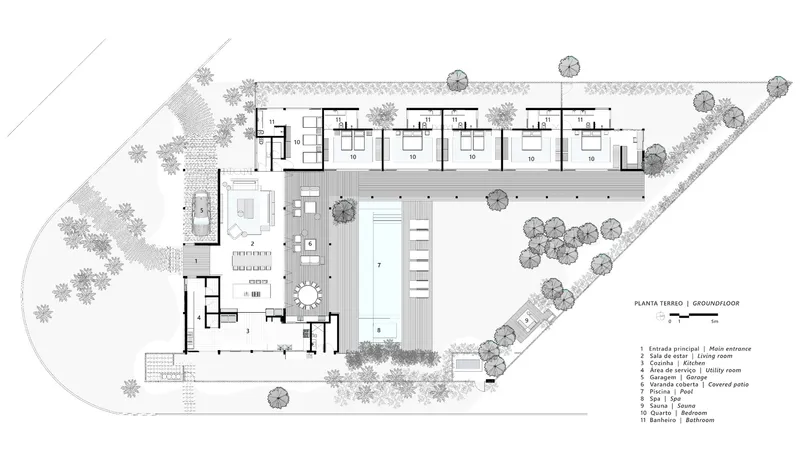
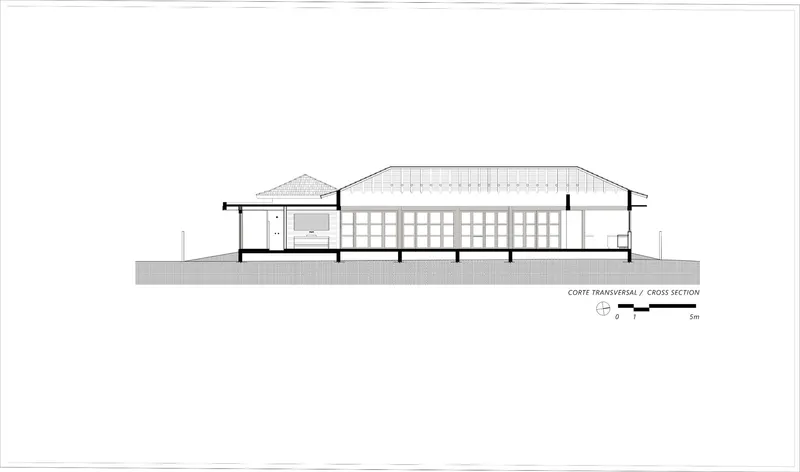
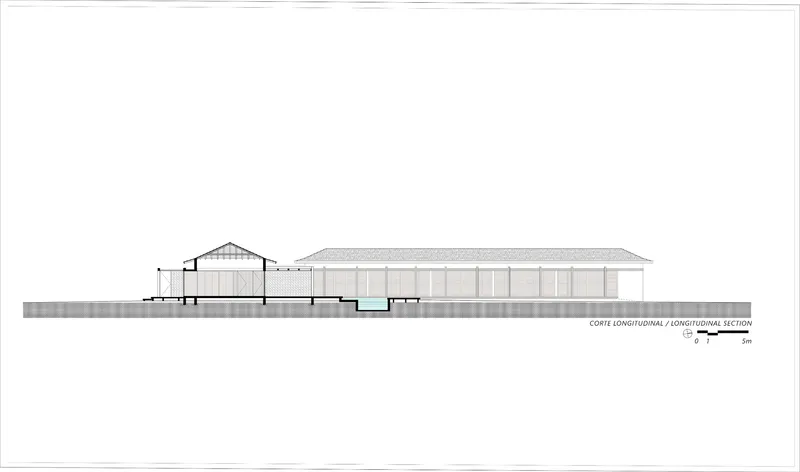
The site plan confirms what the aerial photograph suggests: the building mass is pushed to the upper edge of the property, keeping the central zone open for the pool and generous landscape. Clustered trees fill the gaps between volumes, functioning as both privacy screens and microclimate regulators. The cross section reveals a vaulted central volume, the primary social space, flanked by lower pitched roof structures housing bedrooms and service areas. The longitudinal section makes the colonnade legible, showing a continuous low-pitched roof stretching across the full width of the site, unifying the pavilions into a coherent whole.
What the drawings make clear is the project's disciplined hierarchy. The tallest volume anchors the communal program. The lower wings create sheltered edges. And the spaces between, the walkways, courtyards, and covered passages, do the essential work of moving air and managing light. The architecture is organized around climate before it is organized around program, and that ordering principle gives the house its coherence.
Why This Project Matters
Tropical residential architecture has a tendency to collapse into two modes: the sealed glass box with air conditioning doing all the work, or the open-sided pavilion that sacrifices privacy and security for atmosphere. Trama House avoids both. It uses a rigorous system of screens, louvers, woven panels, and strategic massing to achieve thermal comfort through design rather than machinery. The climate data that generated the initial site orientation remains legible in every finished detail, from the angle of a shutter to the placement of a courtyard garden.
Beatriz Henriques has produced a house that takes its coastal Bahian context seriously without romanticizing it. The craft is real: woven bamboo ceilings, stone walls, and exposed timber trusses are not applied decoration but structural and environmental components. For a vacation house, Trama carries an unusual amount of conviction. It argues that even the most relaxed program deserves architecture that thinks about where the wind comes from.
Trama House by Beatriz Henriques Arquitetura. Located in Trancoso, Bahia, Brazil. 600 m². Completed in 2024. Photography by Oka Fotografia.
About the Studio
Beatriz Henriques Arquitetura
Share Your Own Work on uni.xyz
If projects like this are the kind of work you want to make, uni.xyz is a place to publish your own, find collaborators, and enter design competitions.


Popular Articles
Popular articles from the community


Cloaked Colonization: A Mobile Underwater Habitat That Moves Like a Fish
Micah Abaya's shortlisted EHC Pacific entry reimagines ocean settlement as a dispersed network of self-sustaining architectural organisms.

Opera on the Sea: Driftwood Logic Shapes a Timber Opera House on Estonia's Coast
Trevor Orgill's opera house translates the entangled drift of floating timber into a civic building where wood, water, and music converge.

Manzana Morphosis: Stretching Barcelona's Grid into a Living Landscape for 2050
A radical reworking of the Eixample manzana turns density into a tool for generous public space, vertical ecology, and environmental performance.

Faces of the Soviet Avant-Garde: Turning Moscow's Street Names into an Open-Air Museum
A network of sculptural installations across a Moscow residential district transforms forgotten architect names into spatial encounters with cultural memor

Similar Reads
You might also enjoy these articles

Bao Huynh Watercolor Atelier: A Serene Art Retreat in Hội An
Bao Huynh Watercolor Atelier in Hội An blends multifunctional art spaces, sustainable design, local materials, and family-friendly living in a serene environment.

Atelier Macri Concept Store Interior Design by CASE-REAL
Atelier Macri store features a "ko" counter, walnut wood details, cork displays, blending retail, gallery, and seamless customer experiences.

Manuel Vargas Izquierdo Stadium and High-Performance Sports Center: Architectural Excellence in Jalpa de Méndez
The Manuel Vargas Izquierdo Stadium blends sustainable design, inclusive sports facilities, and cultural-inspired architecture, revitalizing Jalpa de Méndez’s public spaces.

KAKR Buluh Awar Hall: Revitalizing Community and Ecology Through Bamboo Architecture
Community built bamboo hall revitalizes Buluh Awar village, empowering youth, restoring ecology, celebrating vernacular craftsmanship through sustainable architecture and culture.

Explore Interior Architecture Competitions
Discover active competitions in this discipline

Challenge to design a portable theatre

Challenge to design a portable music platform

Challenge to design an open learning module for the elderly
Comments (0)
Please login or sign up to add comments
No comments yet. Be the first to comment!