
Beaumont Eurorennes Urban Complex
A mixed-use concrete landmark in Rennes combining housing, offices, and public spaces, shaped by sloping façades to enhance light, density, and urban porosity.


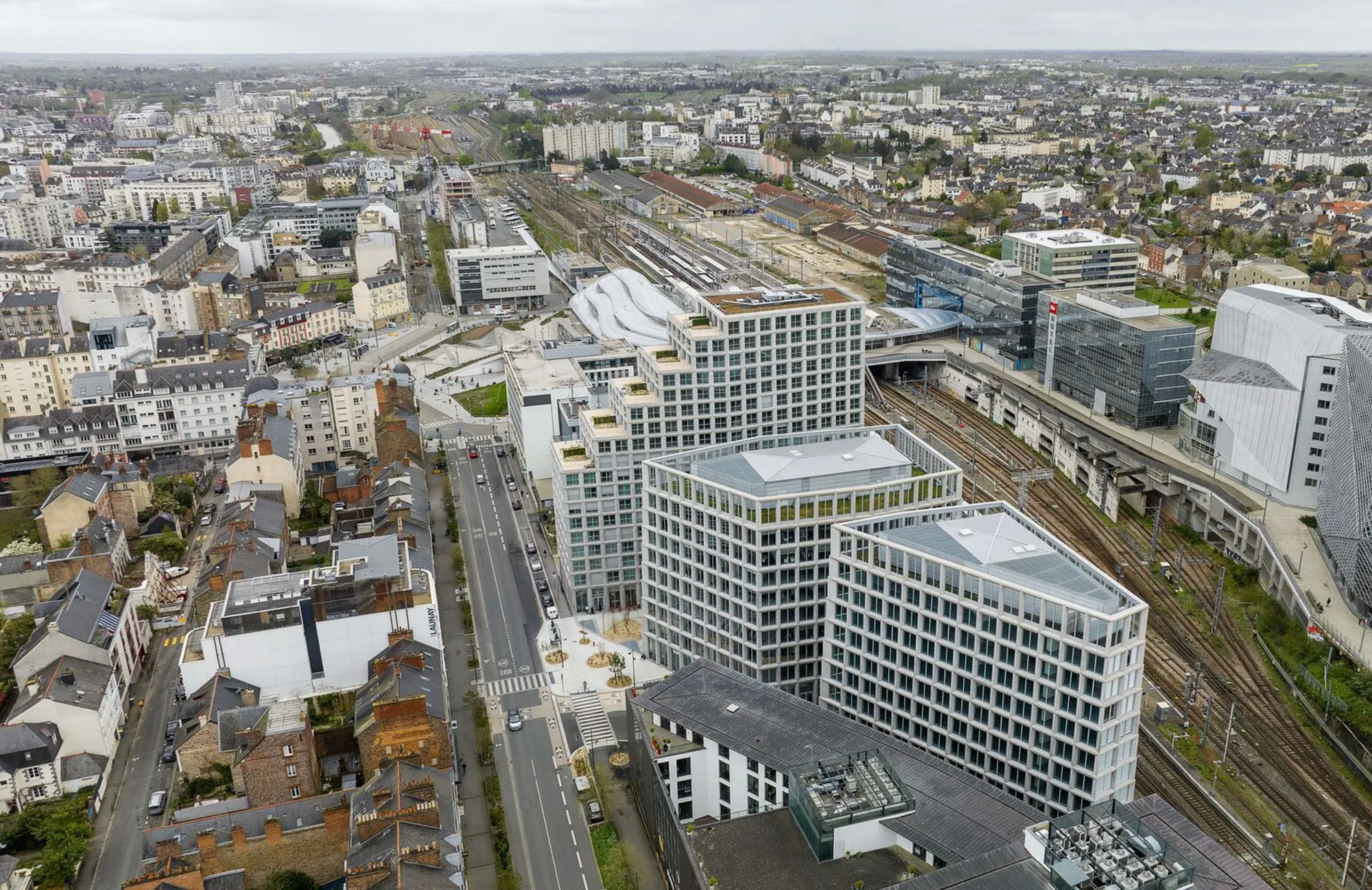
The Beaumont Eurorennes Buildings form a key mixed-use development within the ambitious EuroRennes urban regeneration project in Rennes, strategically positioned opposite the city’s newly transformed high-speed rail station. Designed by Atelier Kempe Thill in collaboration with Rennes-based Atelier 56S, the project responds to the rapid urban densification triggered by Rennes’ direct TGV connection to Paris, transforming former railway land into a high-value metropolitan district.
Urban Framework and Planning Strategy
EuroRennes is one of the most significant contemporary urban development projects in France, structured through a ZAC (Zone d’Aménagement Concerté) model that prioritizes architectural quality through competitive design processes. The master plan, led by FGP Urban Architects, envisions a dense yet porous cityscape composed of freestanding building volumes resembling urban villas and compact high-rises. This approach creates a fine-grained urban fabric defined by streets, squares, and visual permeability rather than monolithic blocks.
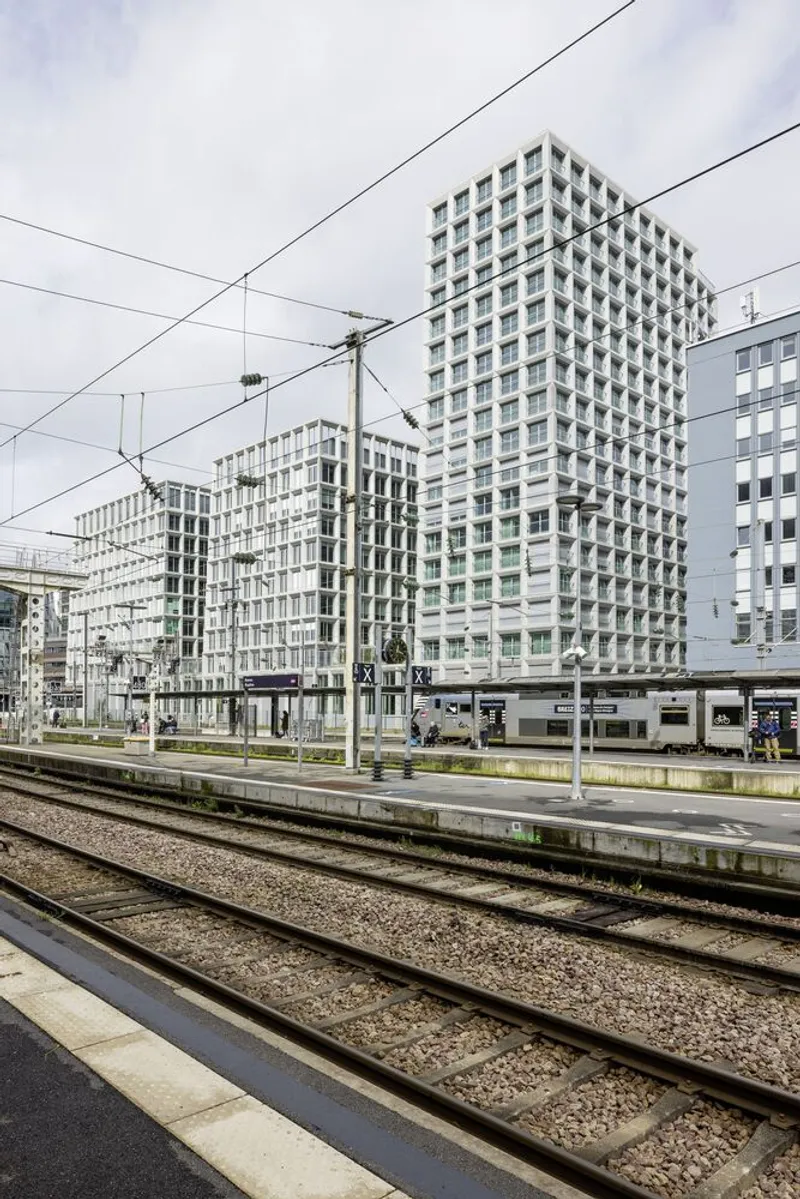
Within this context, the Beaumont site occupies a prominent location directly adjacent to the train platforms. The urban design guidelines impose a distinctive formal requirement: all façades must slope in plan and section, generating a sculptural, rock-like morphology. Rather than resisting this constraint, the architects transformed it into a spatial and environmental asset.
Hybrid Program and Functional Flexibility
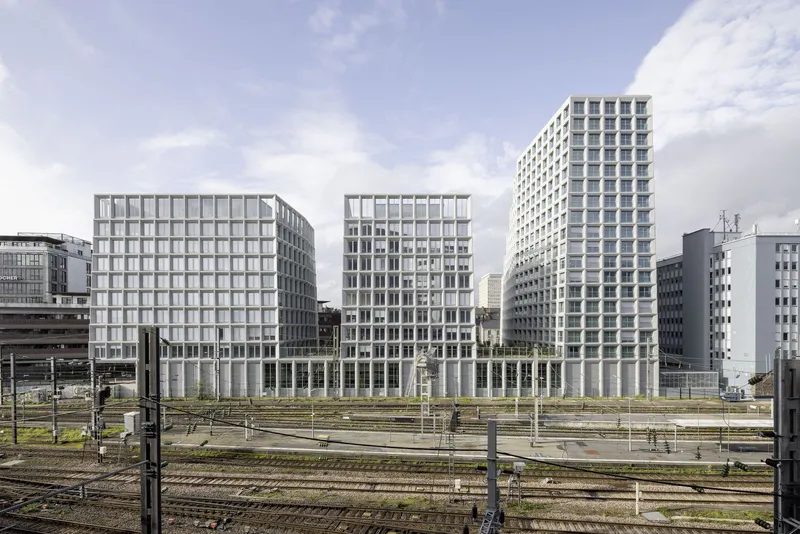
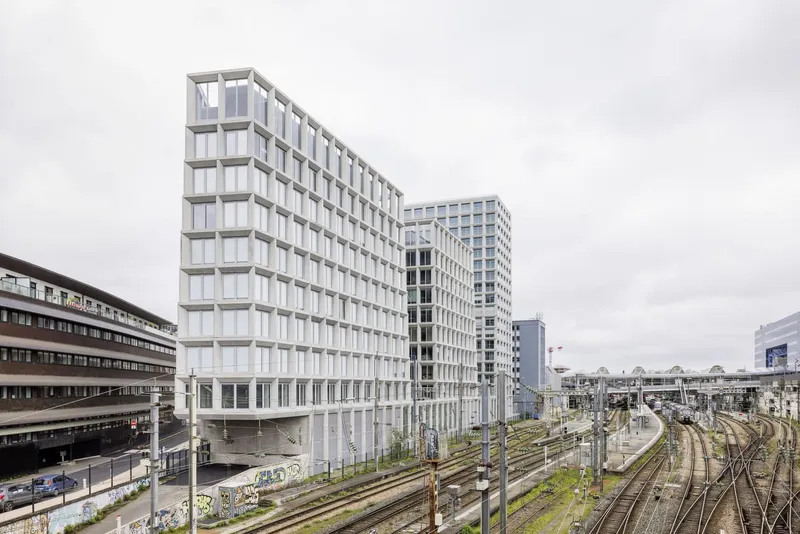
Covering approximately 31,000 square meters of gross floor area, the Beaumont Eurorennes Buildings combine housing, offices, and public amenities in a highly flexible configuration. The development consists of one residential tower and two medium-rise office buildings, unified by an activated ground floor that hosts restaurants, a fitness center, extensive bicycle facilities, and public-oriented services.
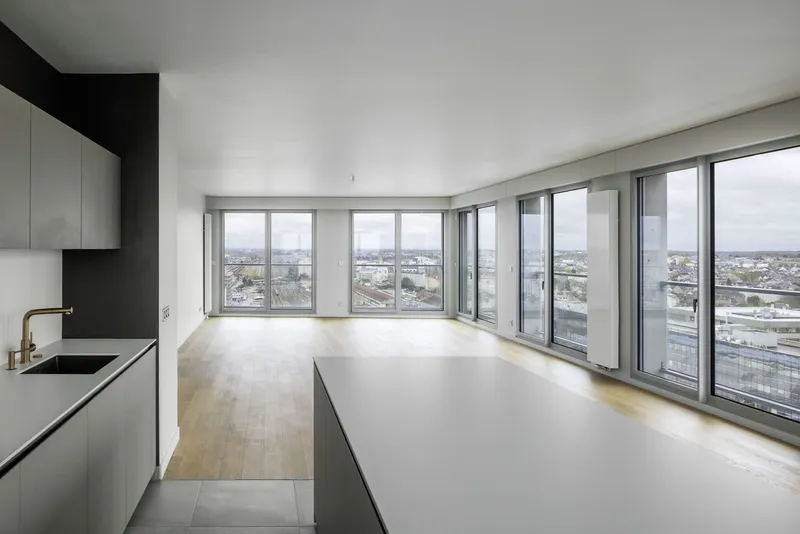
The residential tower accommodates a diverse social and economic mix. Its lower levels house compact studio units designed for medium-term stays, addressing the needs of business travelers and transient urban residents. Above, social housing apartments managed by the local housing association coexist with larger private residences occupying the upper floors. This vertical stratification of living typologies reinforces social diversity while maximizing urban density.
Office floors are designed with neutral, adaptable layouts ranging from approximately 450 to 900 square meters, enabling multiple leasing configurations. Lightweight internal partitions and a structural system based on load-bearing façades and cores ensure long-term flexibility across all building types.


Conical Massing and Daylight Optimization
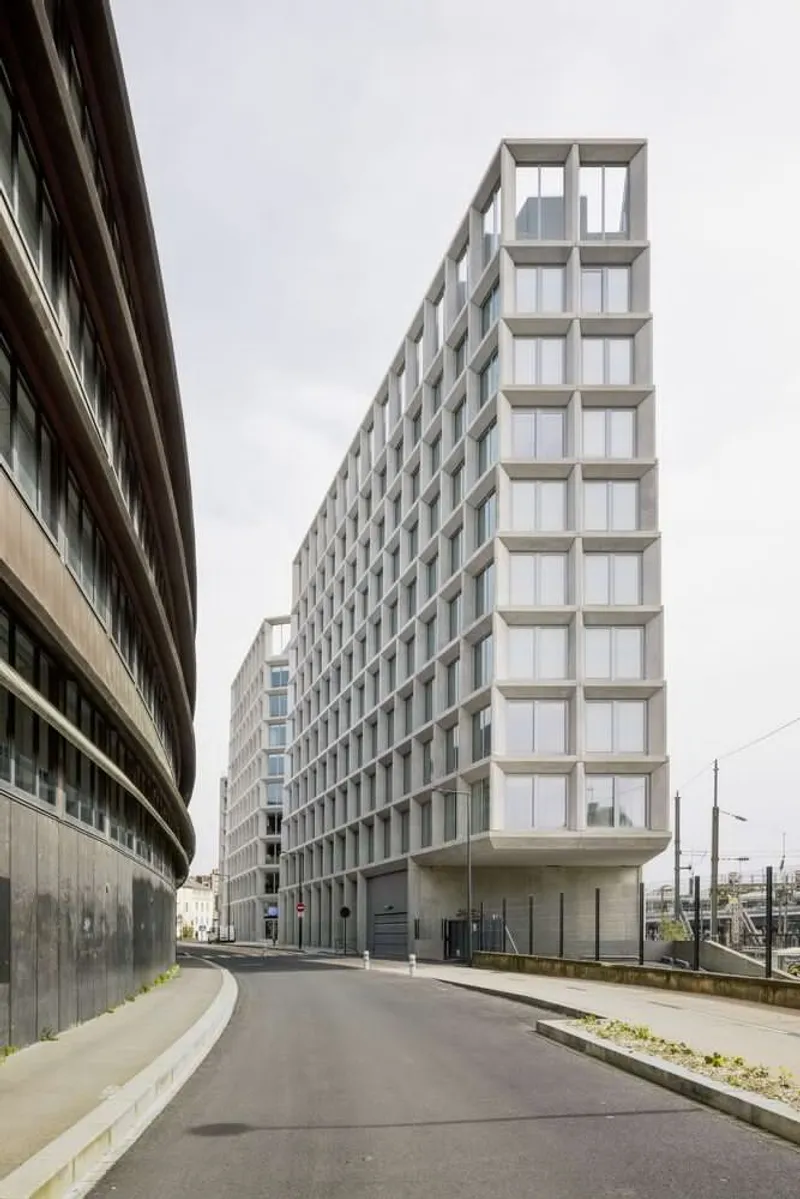
The project’s distinctive conical form directly responds to the master plan’s sloping façade requirement. By tapering both horizontally and vertically, the buildings open up the narrow interstitial spaces between volumes, allowing increased daylight penetration, improved views, and enhanced visual comfort for residents and office users. Subtle façade recesses create a gently pyramidal profile that amplifies sky exposure and reduces the perceived mass of the buildings, contributing to a balanced relationship between density and openness.

Concrete Exoskeleton as Architecture
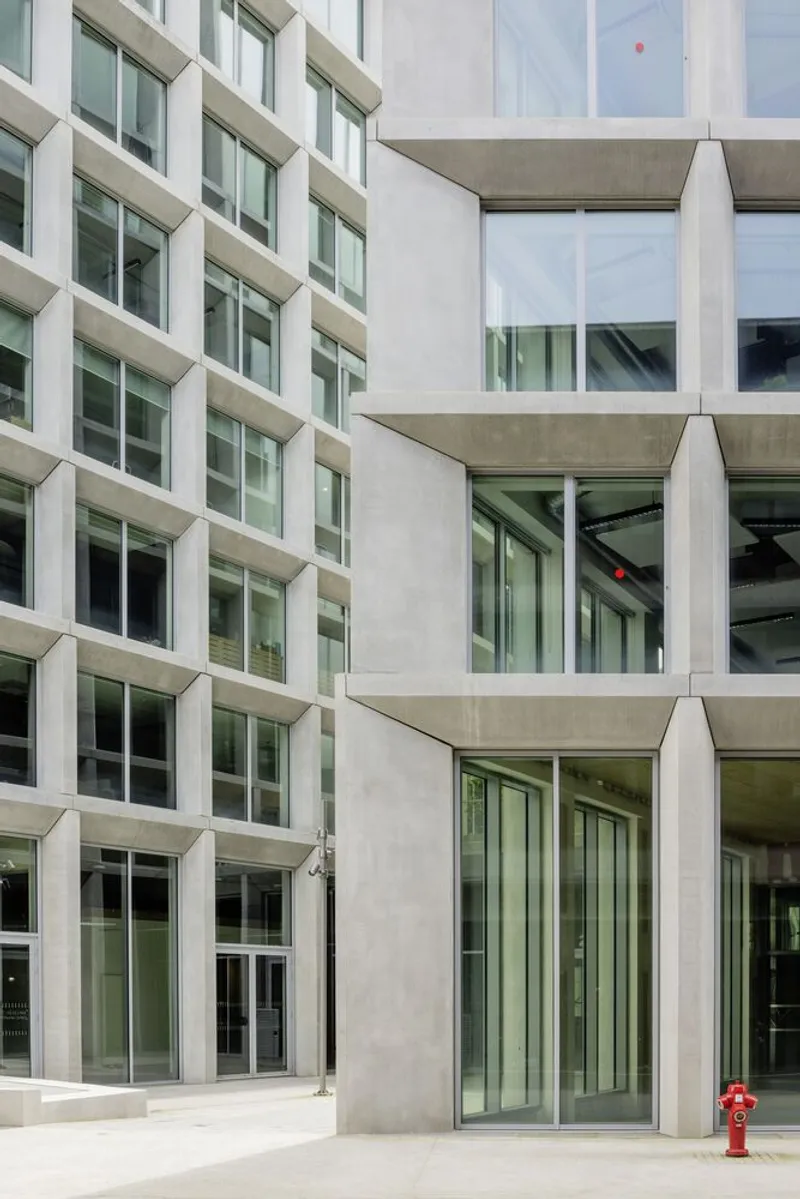
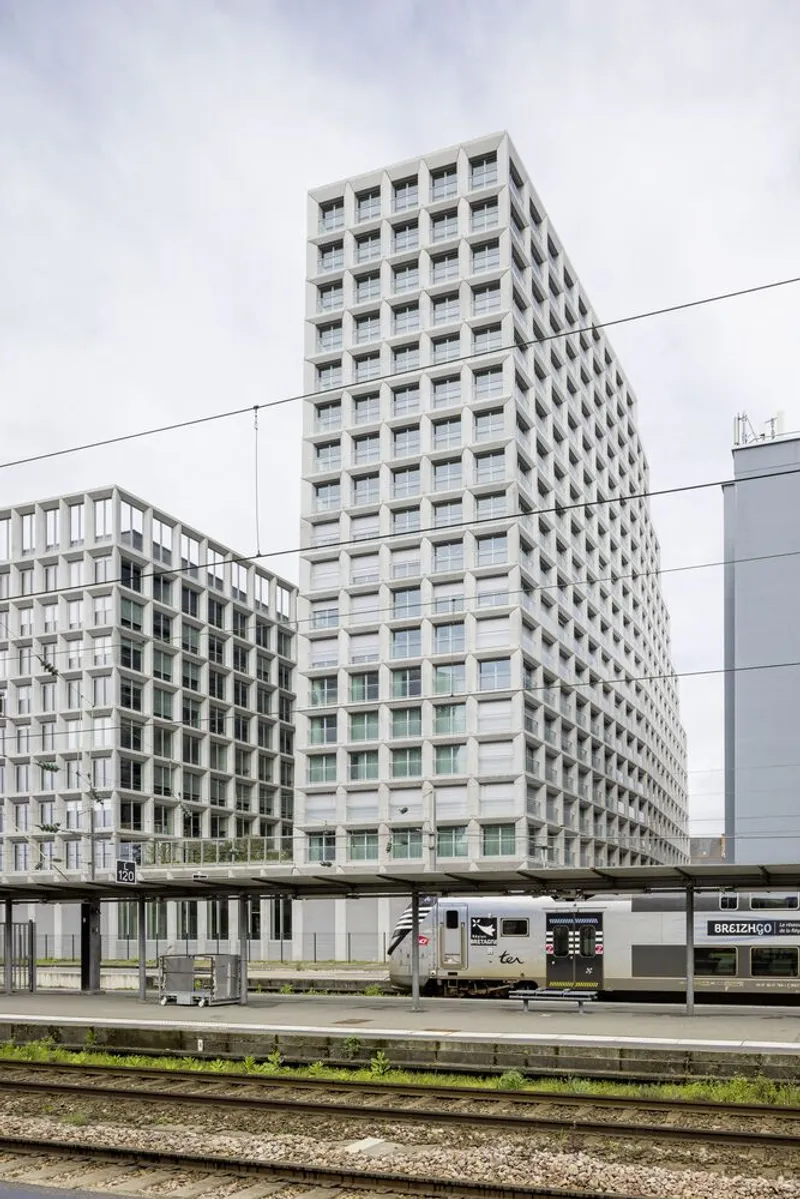
A defining feature of the Beaumont Eurorennes Buildings is their exposed concrete exoskeleton. In France, load-bearing concrete façades remain the most economical and widely used construction method for residential and office buildings. Leveraging this reality, the architects collaborated closely with the developer and contractor to transform a standard structural system into a refined architectural expression.
The façade is composed entirely of precast concrete elements, eliminating the need for additional cladding. Columns and beams are carefully beveled and articulated to enhance light reflection and visual depth while maintaining structural efficiency. This design-build approach, supported by file-to-factory planning and full-scale mock-ups, allowed construction logic to become the primary aesthetic driver.
The untreated concrete surface, protected only by a water-repellent impregnation, emphasizes material honesty and durability. Deep structural elements accommodate variations in window systems and programmatic requirements without compromising architectural coherence, resulting in a robust and timeless urban presence.
Metropolitan Density with Urban Porosity
By merging hybrid programming, rational construction, and sculptural massing, the Beaumont Eurorennes Buildings exemplify contemporary European mixed-use architecture. The project demonstrates how high-density urban development can maintain spatial generosity, social diversity, and architectural clarity, contributing meaningfully to Rennes’ evolving metropolitan identity.

All photographs are works of
Ulrich Schwarz




Popular Articles
Popular articles from the community


Play: Fragments of Their World
Familiar architecture becomes modular playground design, creating safe spaces where displaced children can learn, connect, imagine and play.

Co-Life: Senior Housing Design That Reconnects Older Adults With the City
Co-Life reimagines senior housing design through healing gardens, shared streets, workshops, and a sustainable community across generations.

Riyadh For All: Intergenerational Urban Design for Active Aging in Rabat
Riyadh For All reimagines urban design in Rabat with intergenerational co-living, adaptive courtyards, and Moroccan cultural exchange today.

The Earth Pod: 3D Printed Homes for Resilient Refugee Communities
The Earth Pod reimagines refugee housing through 3D printed homes made from clay, combining resilience, self-sufficiency, and rapid shelter.


Similar Reads
You might also enjoy these articles

Bamboo Housing Challenge 2026: Design Affordable, Sustainable Homes Using Bamboo
An international design competition by Bamboo U and IBUKU inviting architects and designers to reimagine affordable housing using bamboo — with the winning design built full-scale in Bali.
Computational Design & Education: Beegraphy Design Awards Introduces 7th Category (Featuring Jiyun's Innovative Approach)
Dive into Beegraphy’s 7th Design Awards category, where computational design meets education to create immersive, interactive learning tools, inspired by Jiyun’s work.
From Parametric Lighting to Urban Furniture: Join the 2nd Workshop in Beegraphy’s Computational Design Series
Dive into Cutting-Edge Design Techniques and Practical Applications with Industry Experts

Last Call: Unleash Your Architectural Genius in SHAK's Kindergarten Design Competition
Urgent call for architects to join SHAK's kindergarten design competition before the looming deadline

Explore Architecture Competitions
Discover active competitions in this discipline



Challenge to reimagine the Iron Throne


Photograph architecture without architects


Illustrate the lost glory of Angkor Wat - Render Challenge


Design challenge to reuse E-waste
Comments (0)
Please login or sign up to add comments
No comments yet. Be the first to comment!