
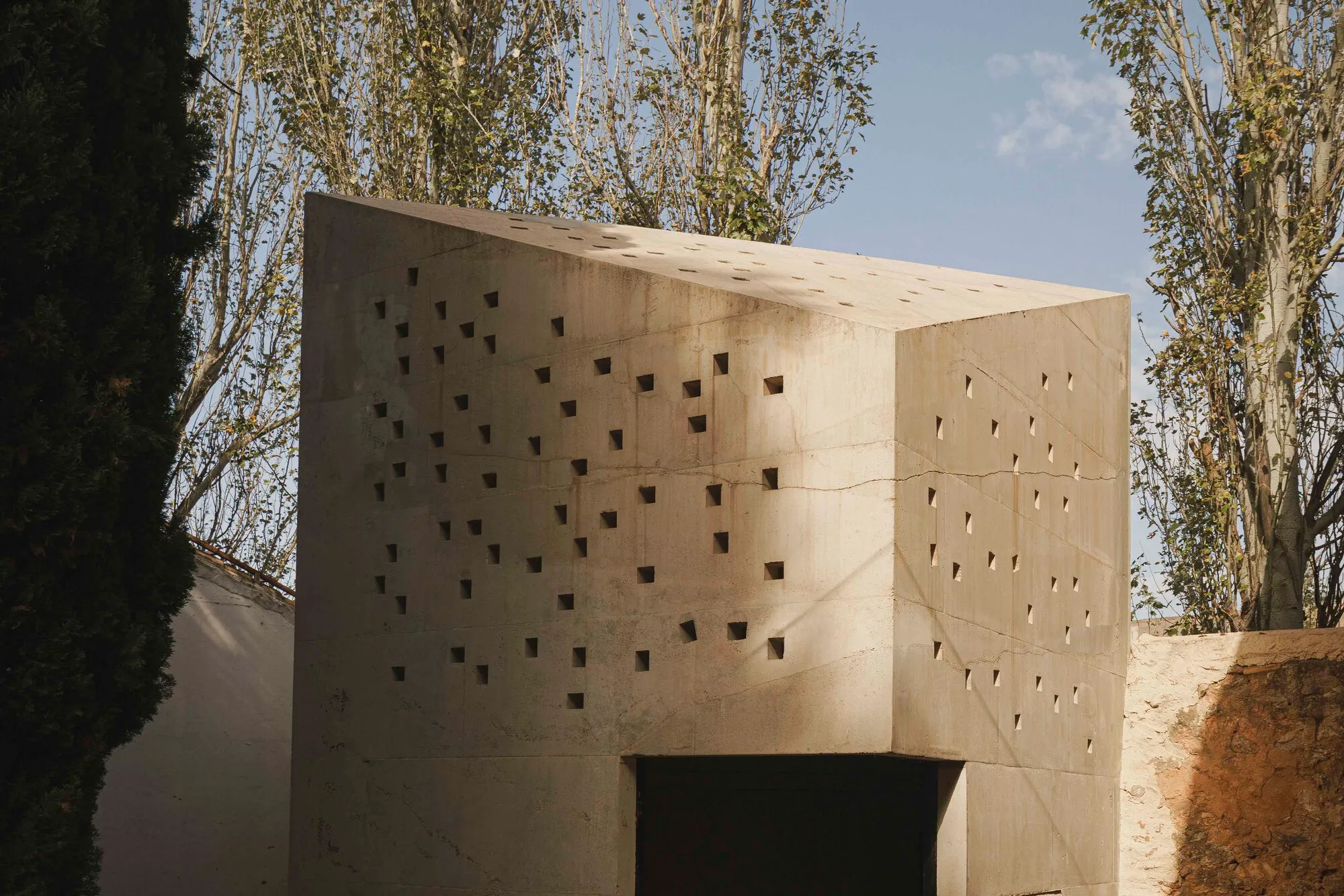
Belén Ilarri Punches Light Through Concrete to Rethink Eternity in a Spanish Pantheon
A 15-square-meter burial chamber in Requena, Spain, replaces monumental solemnity with perforated concrete and filtered daylight.


Pantheons, by tradition, are sealed monuments: heavy, dark, and intended to outlast everything around them. In the cemeteries of Requena, a wine town in Valencia's interior, these structures tend toward familiar archetypes of solid masonry and ornamented facades. Belén Ilarri Studio set out to break from that pattern with a burial chamber that weighs just 15 square meters yet feels genuinely radical in how it treats light, mass, and the relationship between the living and the dead.
The result is a compact concrete volume pierced by a seemingly random constellation of square openings. Rather than sealing its occupants away from the world, the pantheon invites sky, rain, and shifting sunlight into the interior. It is a building that treats death not as an endpoint to be fortified against, but as a condition that can coexist with natural cycles. That inversion of the conventional logic is what makes the project worth studying closely.
A Monolith Among the Old Stones
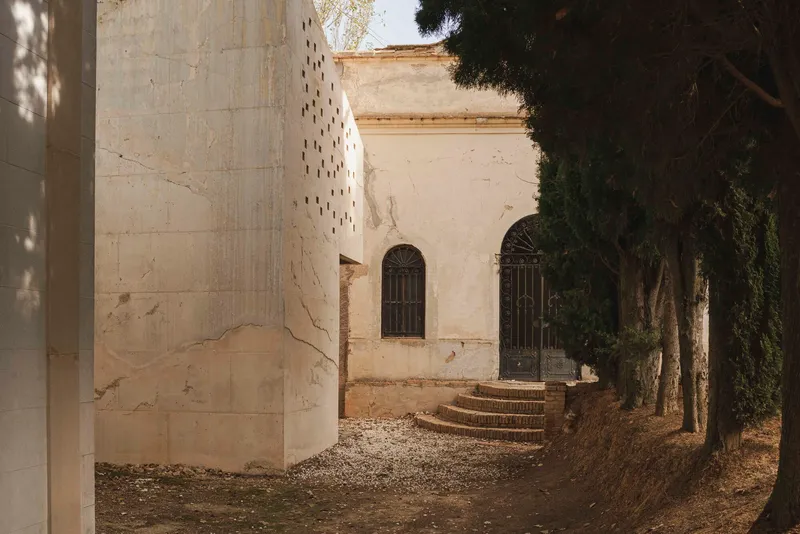


The pantheon sits beside weathered masonry walls and arched doorways that establish the cemetery's historic character. Its raw concrete surface makes no effort to imitate these neighbors. Instead, it holds its ground as a blunt, contemporary insertion. The material contrast is deliberate: poured concrete next to hand-laid stone registers as a clear marker of its era without competing for ornamental attention.
Tall deciduous trees frame the volume and soften the junction between old and new. The gravel base keeps the structure visually separate from the surrounding ground, letting it read as a freestanding object rather than an extension of the existing cemetery fabric. It is a careful act of adjacency: close enough to belong, distinct enough to provoke.
The Perforated Skin

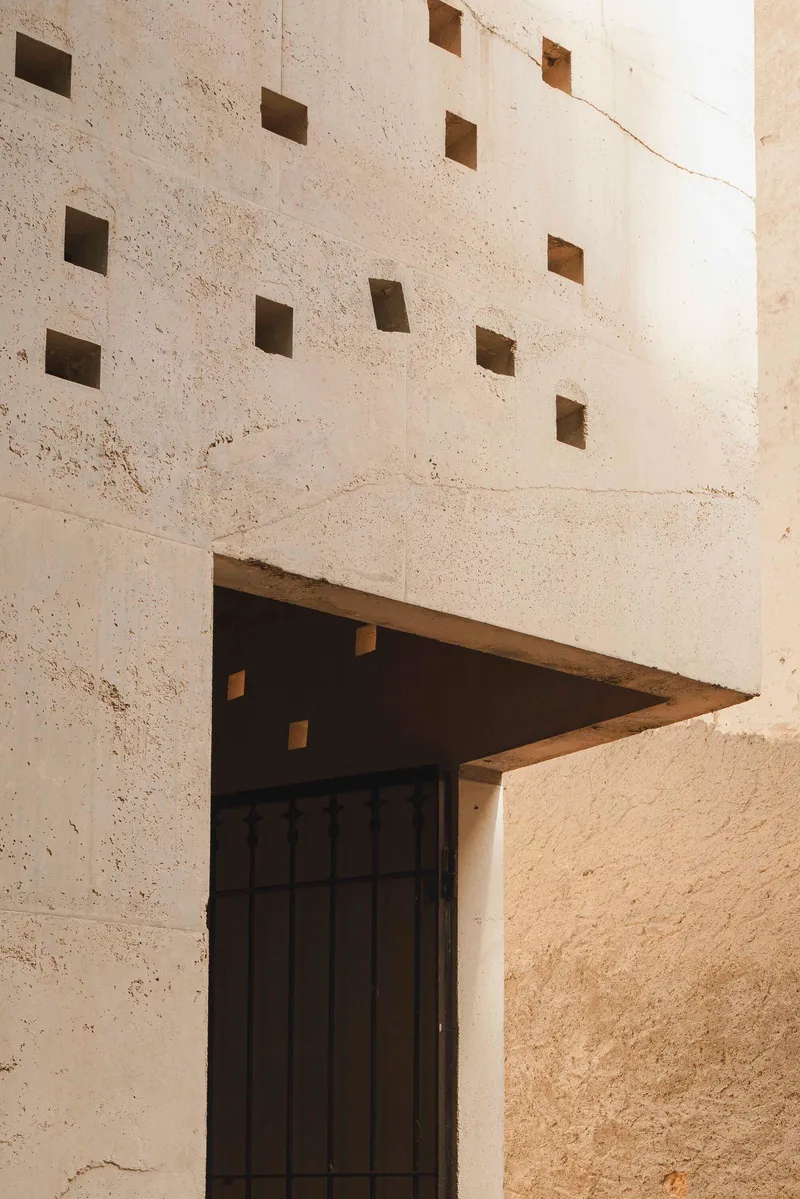
The defining gesture is the grid of square perforations that puncture every face of the concrete envelope. They vary in density and placement, producing what looks from a distance like a textile pattern pressed into stone. Up close, each opening is a viewport: a frame for a branch, a slice of sky, a neighbor's wall. The effect collapses the boundary between inside and outside without dissolving it entirely.
At the entrance, a triangular concrete canopy shelters a timber door, the one warm material in the composition. The canopy acts as a threshold marker, concentrating the visitor's attention before the apertures scatter it again across the wall. It is a smart piece of sequencing for such a small building.
Interior Light as Ritual


From inside, the perforations become something else entirely. Looking up through the ceiling plane, the scattered square openings read like a constellation, each one delivering a controlled beam of daylight that migrates across the interior walls throughout the day. The experience is closer to standing inside a lantern than inside a tomb. There is a deliberate spirituality to this move, one that does not lean on religious iconography but instead lets raw phenomena do the work.
Fallen leaves pooling on the wet concrete floor underscore the building's porosity to the elements. Rain enters. Organic matter accumulates. The pantheon ages visibly, and that aging is a feature, not a flaw. Belén Ilarri is proposing that a memorial space should participate in the same cycles of growth and decay that define life itself.
Plans and Drawings
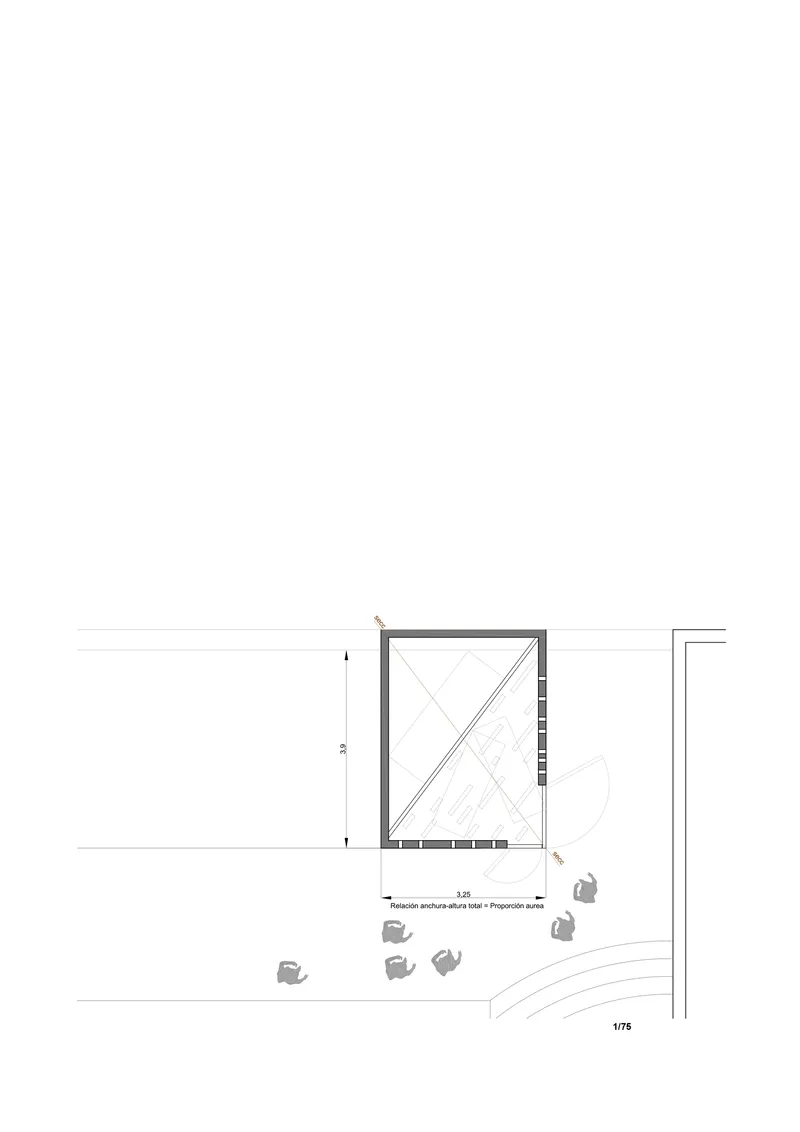
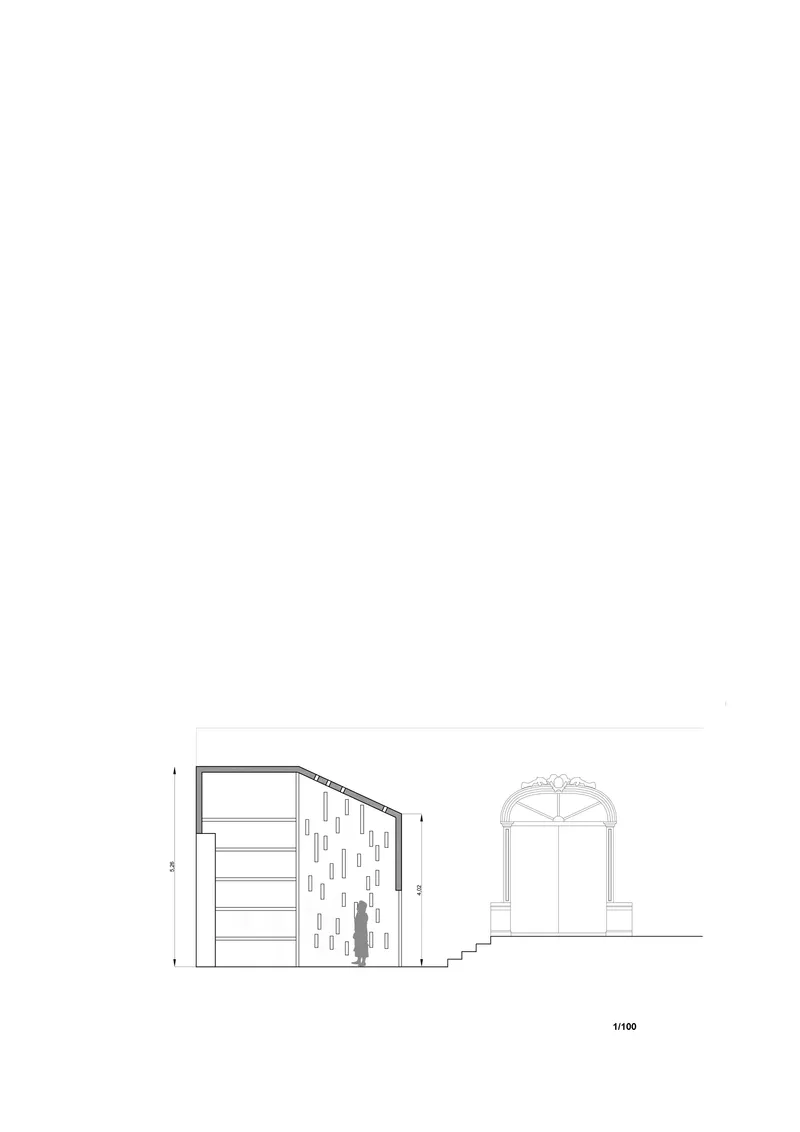

The site plan reveals how the rectangular volume slots into the cemetery's existing geometry, oriented to maintain sightlines between neighboring structures. Diagonal internal bracing appears in plan, suggesting the structural strategy that lets the walls remain thin enough to be perforated so aggressively. The section drawing confirms a stepped interior with different levels, likely corresponding to burial niches, while an arched doorway on the right side ties the composition back to the adjacent historic fabric.
The elevation drawing is perhaps the most telling document. Seen flat, the perforation pattern looks both systematic and intuitive, as if generated by a rule set that was then manually adjusted. Two trees and a human figure give the volume its true scale: barely taller than a person standing on tiptoe. That modesty is the point. Grandeur here comes not from size but from the quality of light and material.
Why This Project Matters
Funerary architecture is one of the oldest building types and, arguably, one of the most resistant to change. Clients want permanence, communities expect decorum, and the emotional stakes make experimentation feel risky. The Requena Pantheon demonstrates that a thoughtful reconsideration of what permanence actually means can produce a building that is more resonant, not less, than its conventional neighbors. Letting the sky into a tomb is a provocation, but here it reads as an act of generosity.
At just 15 square meters, the project also proves that architectural ambition has no minimum footprint. Belén Ilarri Studio has delivered a piece of work that operates at the intersection of craft, symbolism, and material economy, turning a modest budget and program into something genuinely affecting. For anyone designing memorial or sacred spaces, the lesson is clear: trust the phenomena, reduce the gestures, and let the building breathe.
Requena Pantheon by Belén Ilarri Studio. Requena, Spain. 15 m². Completed 2021. Photography by David Zarzoso.
About the Studio
Share Your Own Work on uni.xyz
If projects like this are the kind of work you want to make, uni.xyz is a place to publish your own, find collaborators, and enter design competitions.




Popular Articles
Popular articles from the community


The Musturak Paradise: Senior Living Architecture for a Connected Future in Temara, Morocco
The Musturak Paradise reimagines senior living architecture in Temara via private homes, social spaces, culture, community, and shared care.

Conexión: Biophilic Design Reimagines High-Rise Living in Hong Kong
Conexión reimagines high-rise living in Hong Kong through biophilic design, green facades, shared spaces, daylight, water and nature within.

Co-Life: Senior Housing Design That Reconnects Older Adults With the City
Co-Life reimagines senior housing design through healing gardens, shared streets, workshops, and a sustainable community across generations.

AL-JANNAH: Sustainable Architecture and Permaculture for Afghan Widows
AL-JANNAH uses sustainable architecture and permaculture to create resilient oasis of housing, learning, work and renewal for Afghan widows.


Similar Reads
You might also enjoy these articles

Bao Huynh Watercolor Atelier: A Serene Art Retreat in Hội An
Bao Huynh Watercolor Atelier in Hội An blends multifunctional art spaces, sustainable design, local materials, and family-friendly living in a serene environment.

Atelier Macri Concept Store Interior Design by CASE-REAL
Atelier Macri store features a "ko" counter, walnut wood details, cork displays, blending retail, gallery, and seamless customer experiences.

Manuel Vargas Izquierdo Stadium and High-Performance Sports Center: Architectural Excellence in Jalpa de Méndez
The Manuel Vargas Izquierdo Stadium blends sustainable design, inclusive sports facilities, and cultural-inspired architecture, revitalizing Jalpa de Méndez’s public spaces.
KAKR Buluh Awar Hall: Revitalizing Community and Ecology Through Bamboo Architecture
Community built bamboo hall revitalizes Buluh Awar village, empowering youth, restoring ecology, celebrating vernacular craftsmanship through sustainable architecture and culture.

Explore Architecture Competitions
Discover active competitions in this discipline



Challenge to reimagine the Iron Throne


Photograph architecture without architects


Illustrate the lost glory of Angkor Wat - Render Challenge


Design challenge to reuse E-waste
Comments (0)
Please login or sign up to add comments
No comments yet. Be the first to comment!