
Bercy Fadel Weaves a White Brick House Through the Oaks of Austin's Bouldin Creek
Lantern House trades square footage for courtyards and canopy, proving restraint is the real luxury in a fast-densifying neighborhood.


Bouldin Creek sits just south of the Colorado River in Austin, a neighborhood where old bungalows jostle against increasingly ambitious infill. The temptation on any wooded lot here is to clear, excavate, and build to the maximum allowable envelope. Bercy Fadel, led by Thomas Bercy and Bethany Fadel, went the other direction. Lantern House, completed in 2024, defers to its grove of mature oaks, splitting the program into distinct white brick volumes that slip between trunks rather than replacing them. At 3,841 square feet, the house is not small, but it feels smaller than it is because so much of its footprint is given over to courtyards, decks, and the canopy overhead.
What makes the project worth studying is its insistence that light, not space, is the primary material. Skylights, floor-to-ceiling glazing, and deliberate gaps between volumes mean that every room registers the time of day and the season. The architects call it "a study in light, material, and restraint," and for once the tagline holds up. Filtered daylight and layered transparency genuinely define the rhythm of the house, turning what could be a straightforward modern residence into something closer to a calibrated instrument for living among trees.
A Quiet Face to the Street
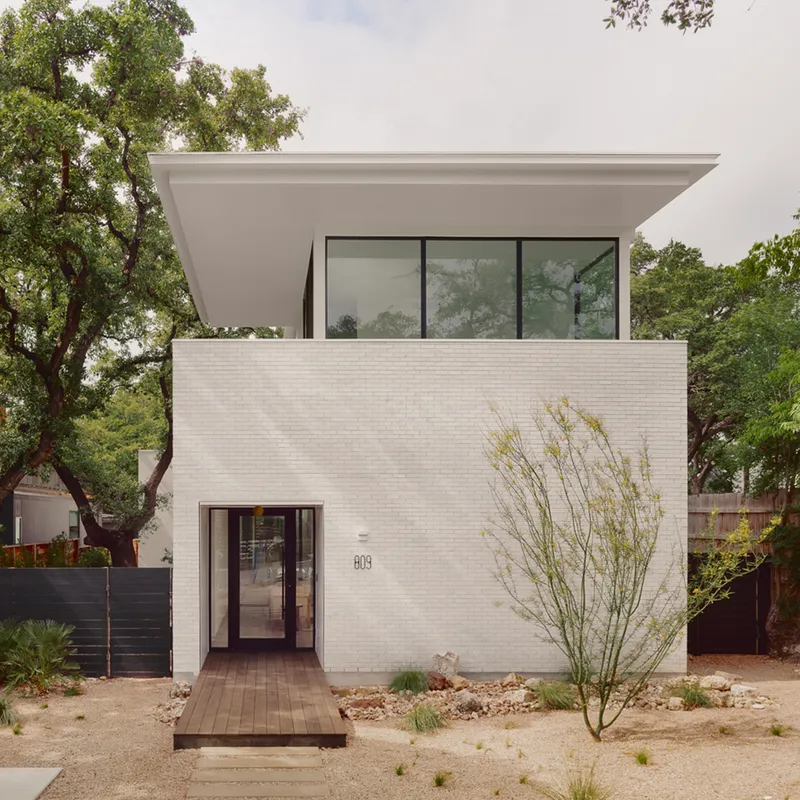
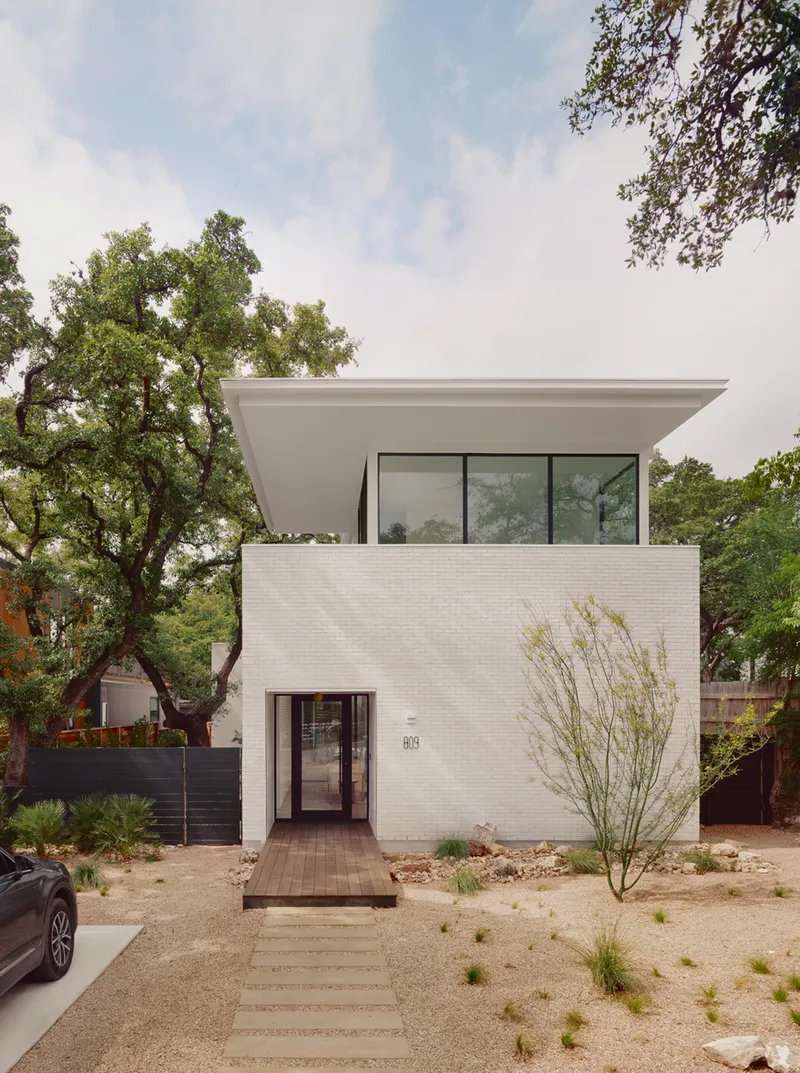
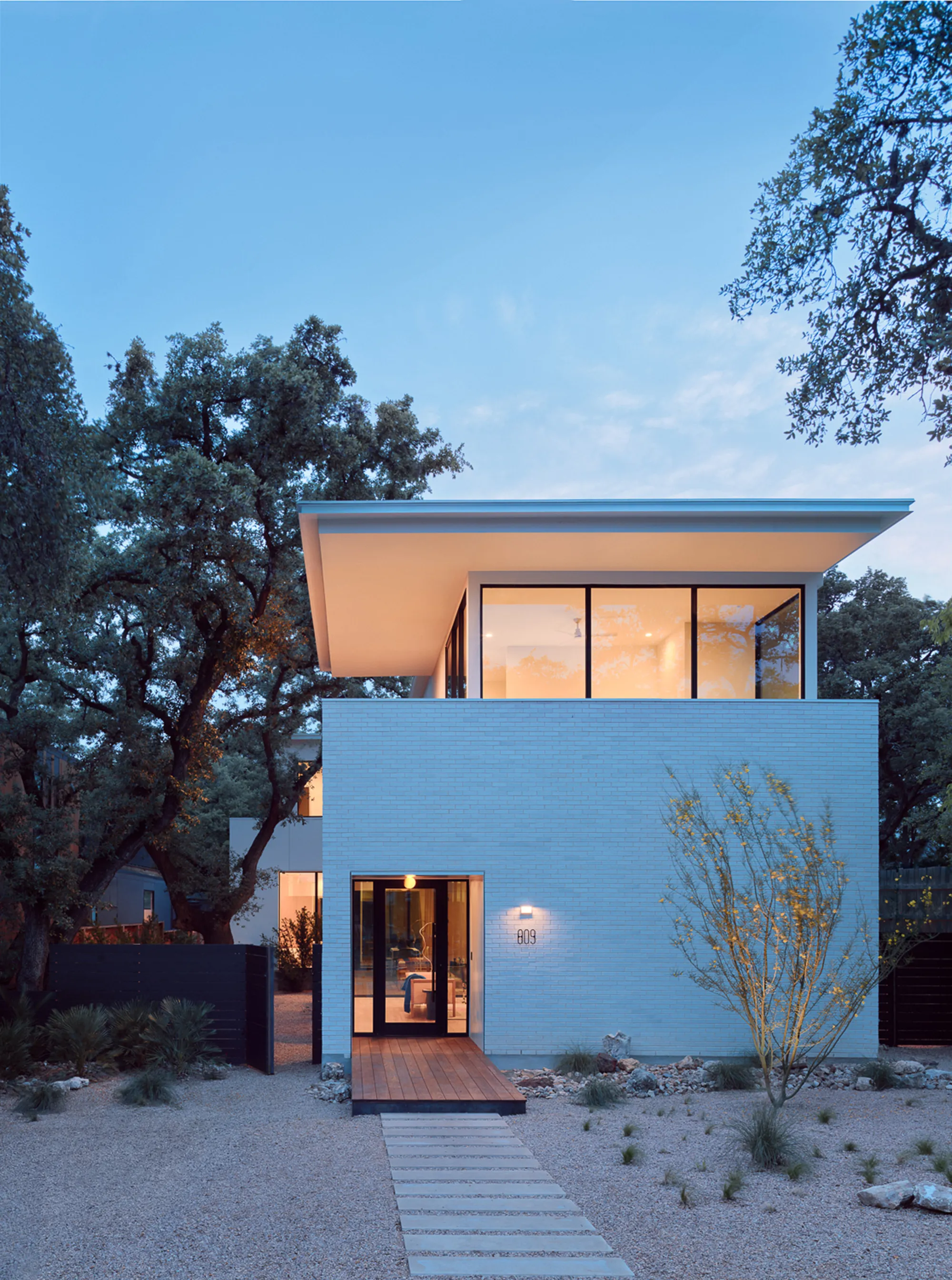
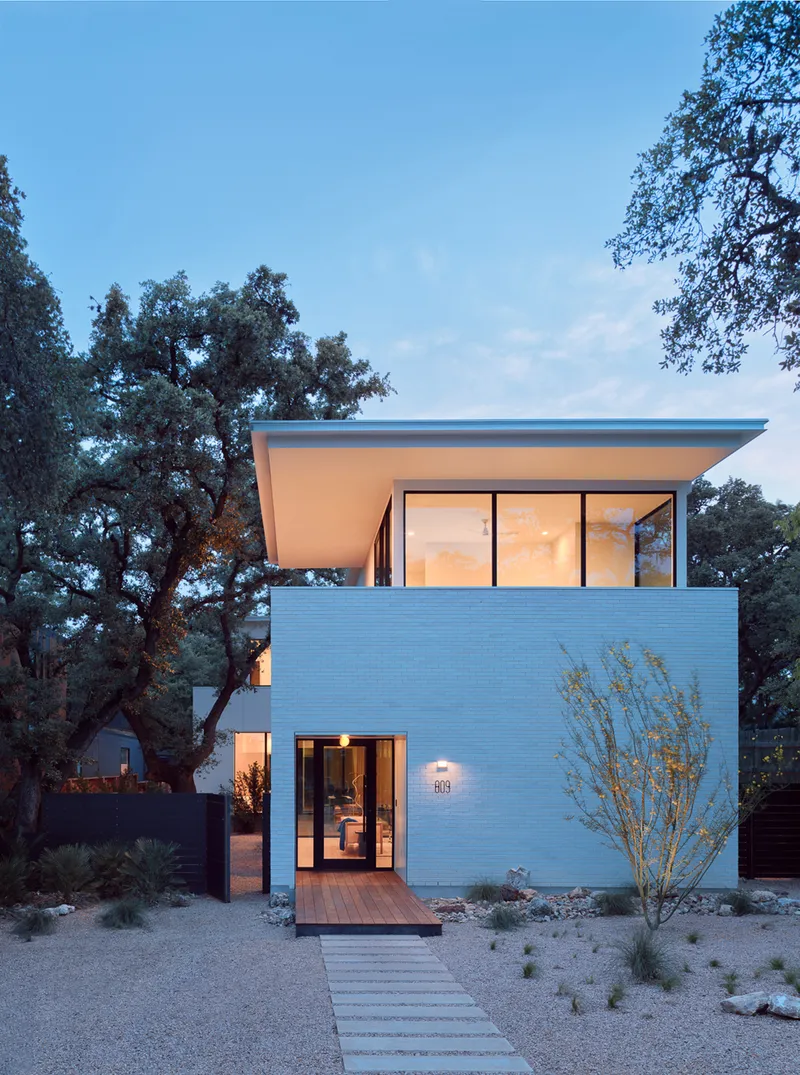
From the sidewalk, Lantern House reads as a series of white brick planes. The upper volume cantilevers forward just enough to create a deep shadow over the recessed entry, and native desert grasses replace the conventional Austin lawn. It is a deliberately muted composition: no oversized pivot door, no exposed steel, none of the signifiers that scream "architect's house." The brick is laid in a clean running bond, and its whiteness reads almost chalky against the deep green canopy. The street facade promises privacy and delivers it.
That restraint is contextual, too. In a neighborhood where the infill houses often try to dominate their lots, this one recedes. The cantilever hints at the spatial ambition happening behind the wall, but you have to be invited in to understand the plan.
Volumes and Voids Among the Oaks
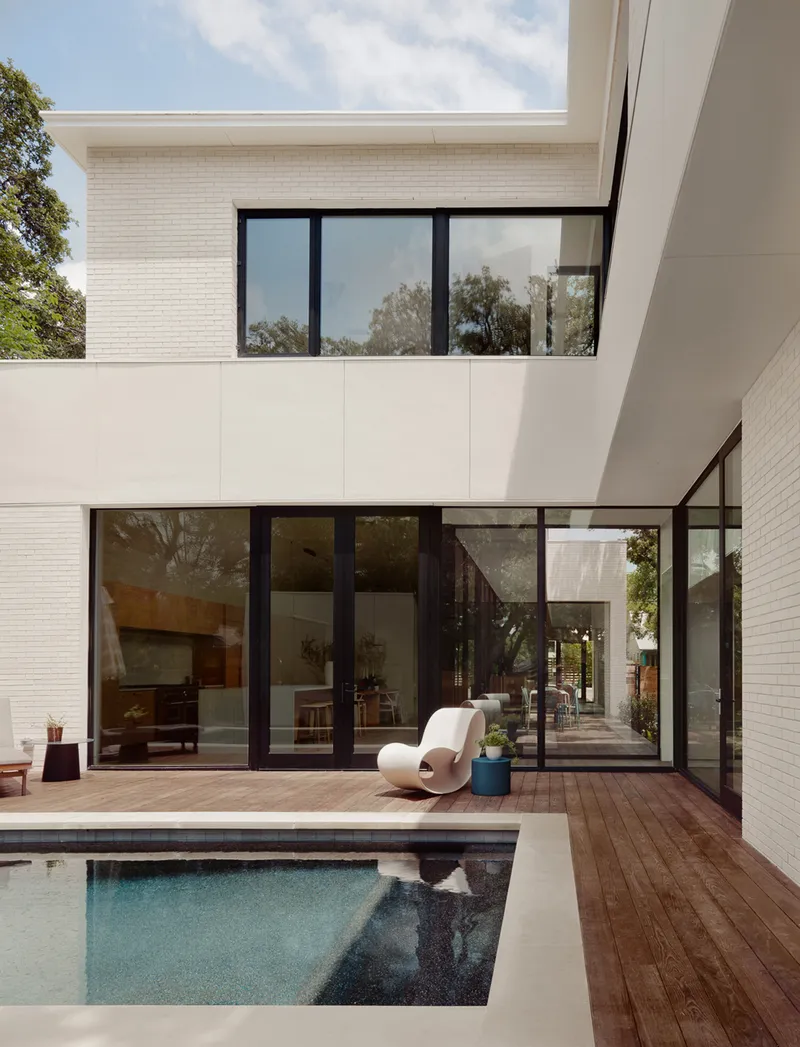
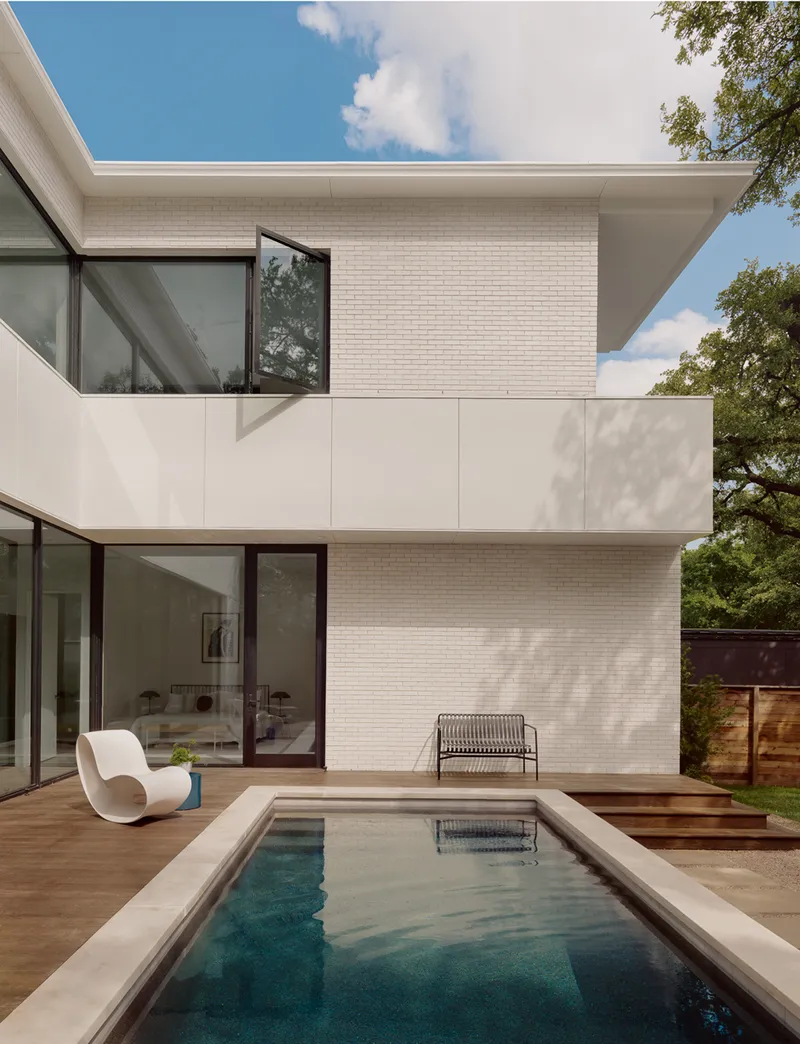
The rear elevation reveals the strategy. Two white brick volumes, each two stories, frame a courtyard anchored by a rectangular pool and a timber deck. Mature oaks penetrate the composition at several points, their canopies shading the upper glazing and casting moving patterns across the water. The decision to preserve these trees was not merely sentimental; it is the organizing principle of the entire plan. Rooms are positioned where the trees are not, and courtyards exist where the trunks are.
At dusk the logic of the name becomes literal. Floor-to-ceiling glass doors on both levels glow from within, and the house reads as a lantern set among dark branches. It is a well-worn metaphor in residential architecture, but it works here because the transparency is structural, not decorative. The glass walls are the primary connection between inside and out, not an accent applied to a solid box.
Living Between Inside and Out
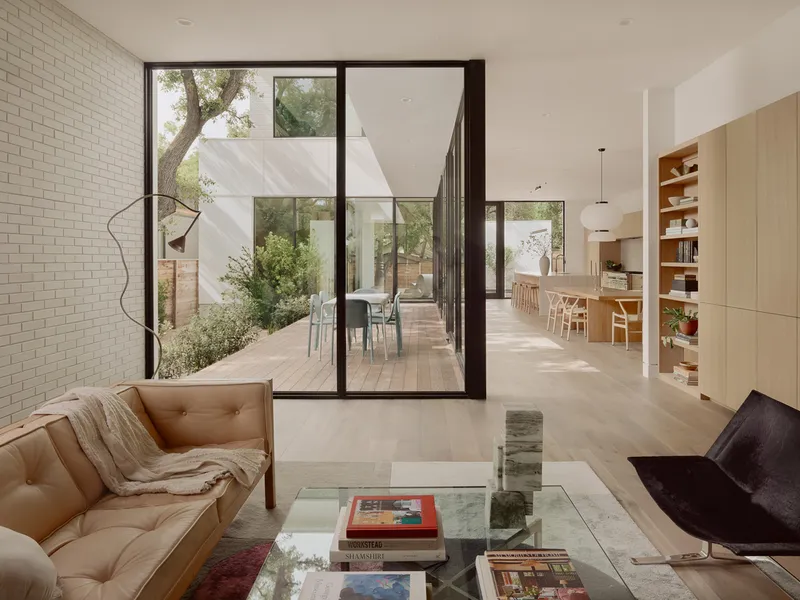
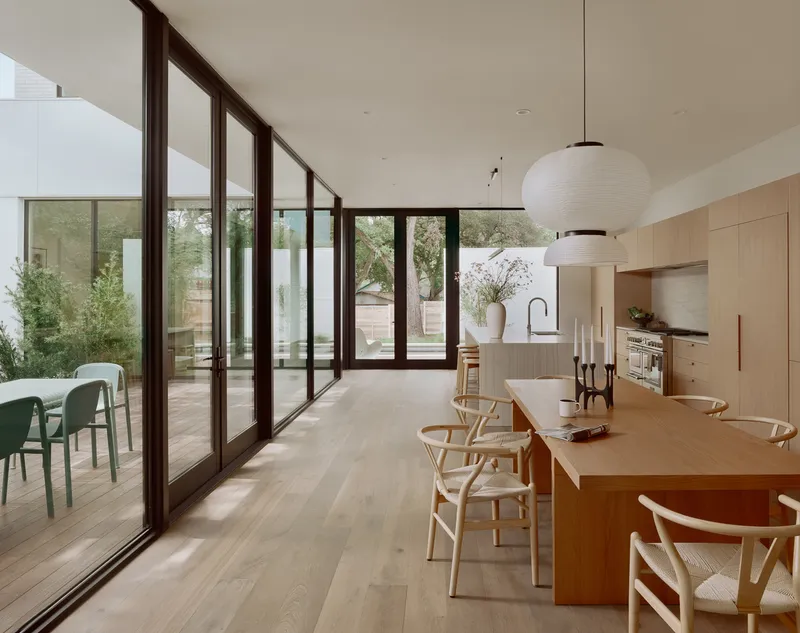
The living area opens directly onto the courtyard through full-height glazed doors, collapsing the boundary between the interior and the planted terrace. A single white brick wall runs through both zones, continuous enough to blur which side you are on. The kitchen and dining area repeat the gesture on the opposite face, with sliding glass panels framing a terrace dense with planting. The result is a ground floor that feels almost like a covered outdoor room on mild days, which in Austin is most of the year.
Bercy Fadel and interior collaborator Holm Design kept the palette neutral: pale wood cabinetry, white stone surfaces, concrete floors. Nothing competes with the landscape outside the glass. The cherry blossoms on the kitchen island in one image are the most saturated color in the room, which tells you everything about the discipline at work.
Framed Views and Private Retreats
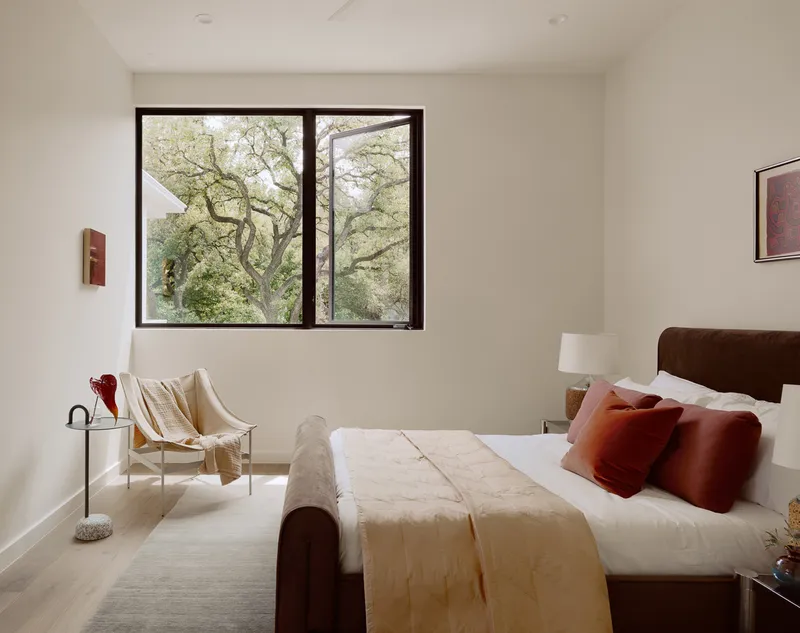
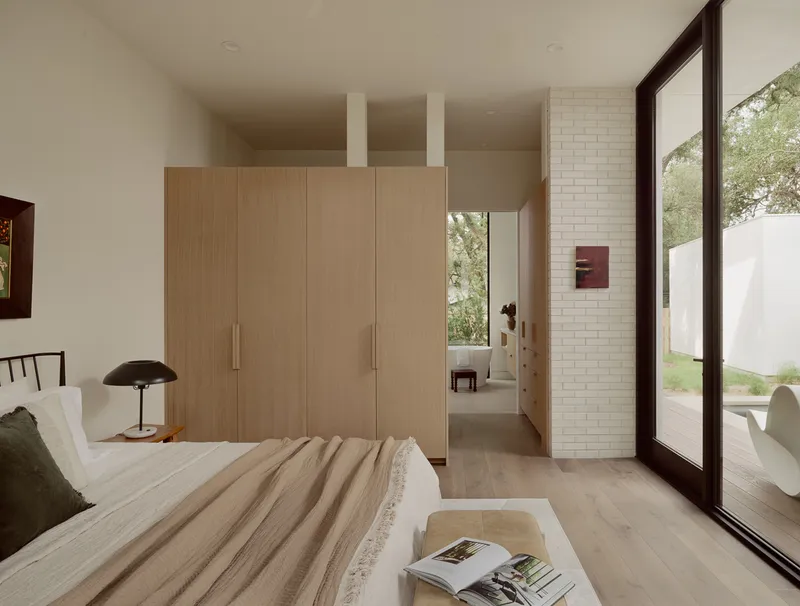
The bedrooms operate differently from the public rooms. Rather than dissolving the wall entirely, the architects use carefully placed corner windows and dark-framed floor-to-ceiling glazing to frame specific views: a tangle of oak branches, a courtyard garden. The effect is cinematic. You are not just looking outside; you are looking at a composed scene. The bedroom on the upper level positions you at canopy height, where the leaves are close enough to touch through the glass.
Privacy is handled through orientation rather than blinds or frosted glass. The rooms face inward toward the courtyards and trees, not outward toward the neighbors. It is a courtyard-house strategy borrowed from much older traditions, executed in a contemporary idiom.
Material Warmth in the Wet Rooms
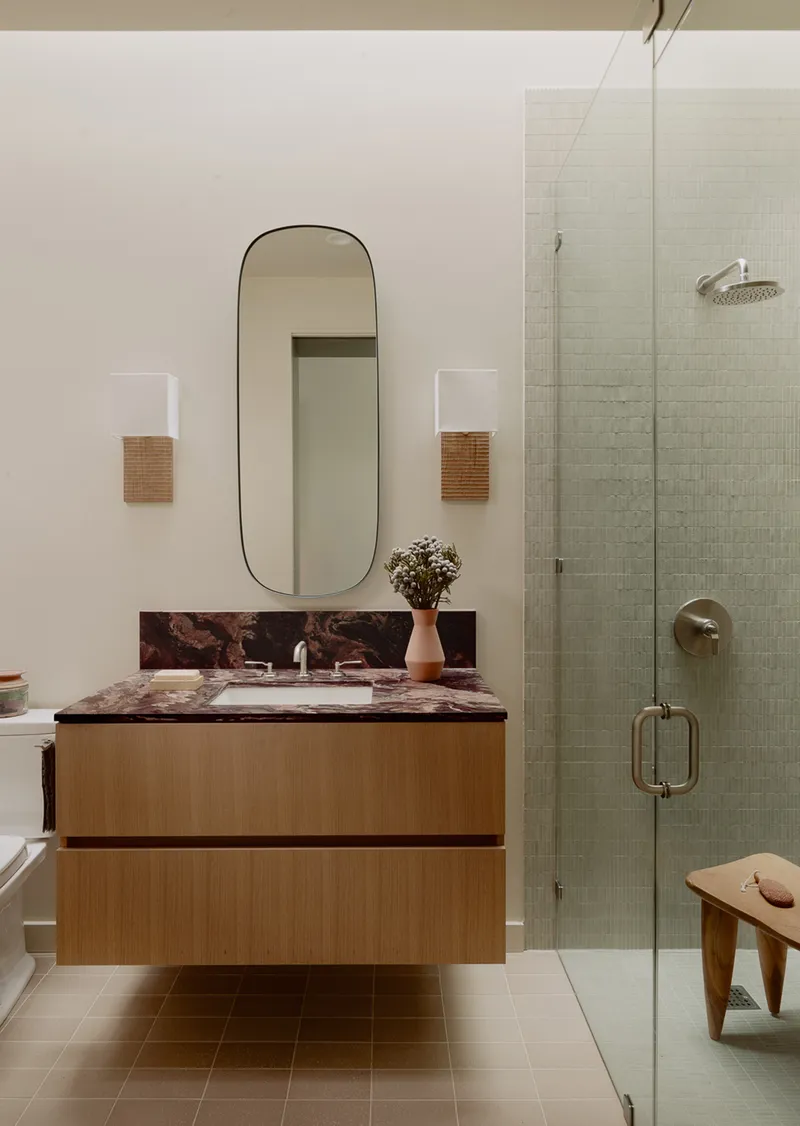
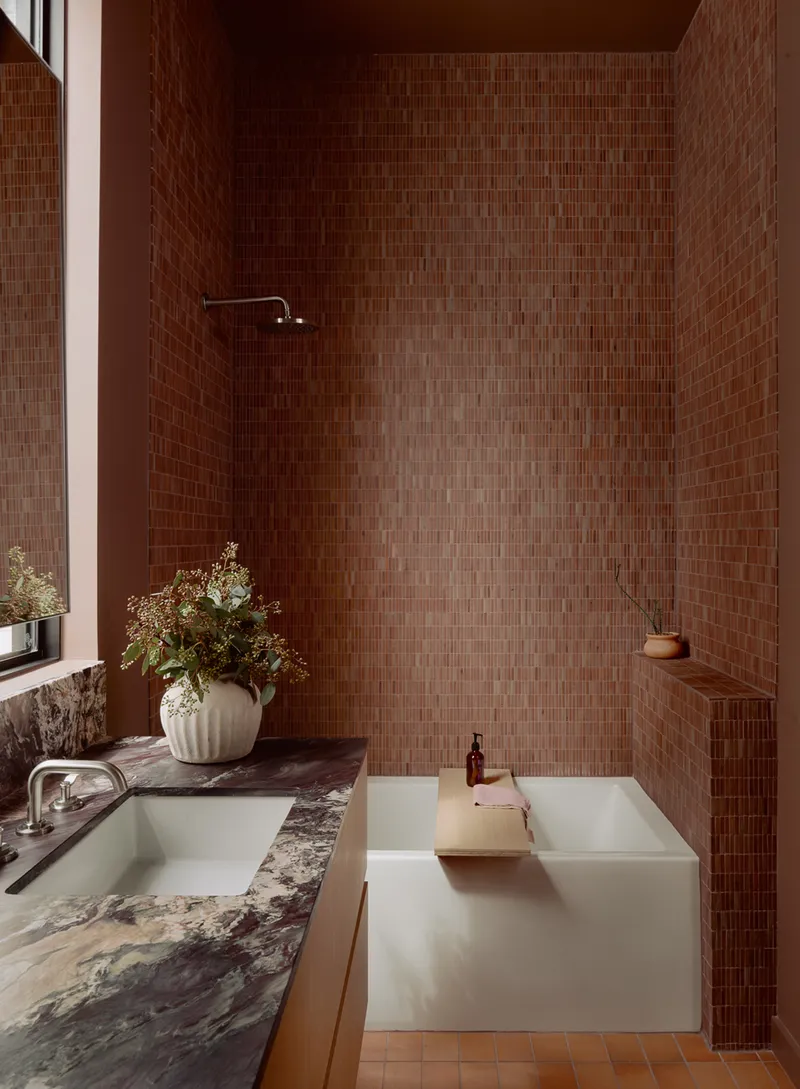
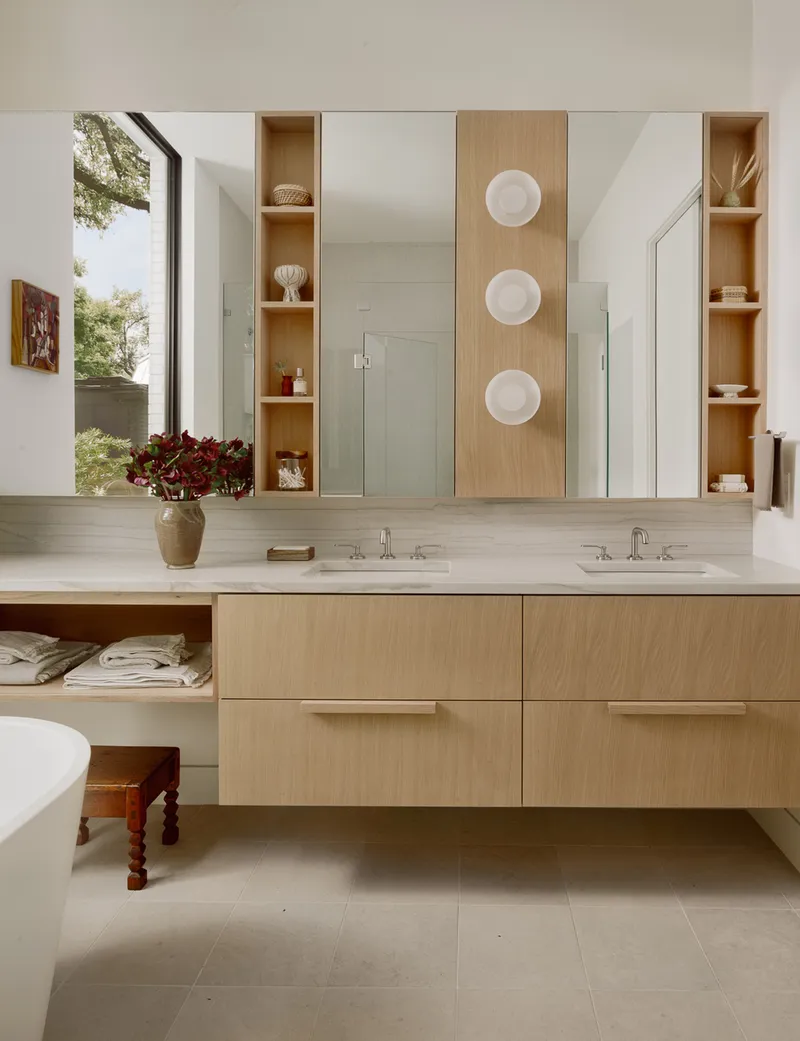
The bathrooms are where Lantern House allows itself a bit more material expression. A freestanding tub sits in an alcove clad entirely in small brown mosaic tiles, turning the space into a warm, cocoon-like enclosure that contrasts sharply with the white and pale wood elsewhere. Another bathroom pairs a floating oak vanity with a marbled countertop and pale green mosaic tile in the shower. These are rooms where the material is the event, not the view.
The primary ensuite on the ground floor and the secondary ensuites upstairs share a language of open shelving, integrated lighting, and frameless glass enclosures. The detailing is precise without being ostentatious. Nothing here photographs better than it performs.
Kitchen Detail
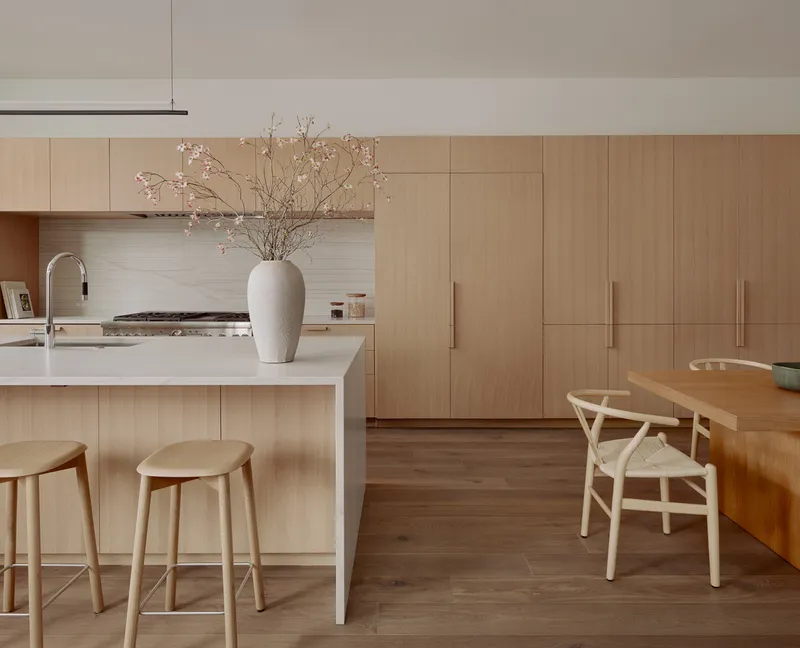
The kitchen deserves a closer look. The island is generous but not monumental, clad in the same pale wood as the surrounding cabinetry. Open shelving and minimal upper storage keep the sightlines clear to the courtyard beyond. The countertops are light stone, consistent with the house's overall commitment to materials that age gracefully in Austin's intense sun and humidity. Builder Matt Sitra Custom Homes executed the joinery with the kind of tight tolerances that let a minimal palette succeed.
Plans and Drawings
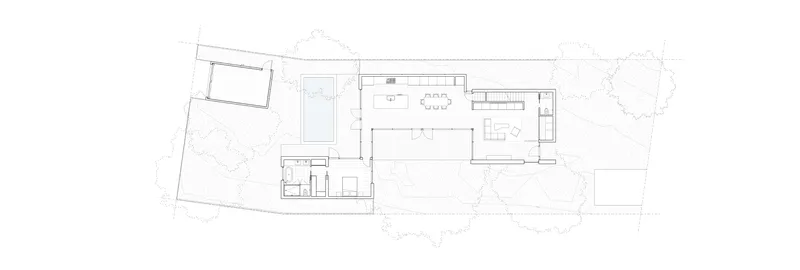
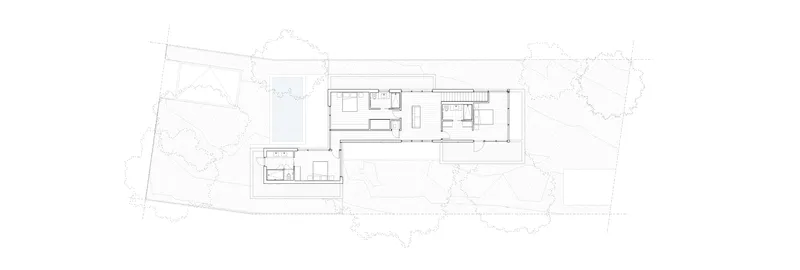
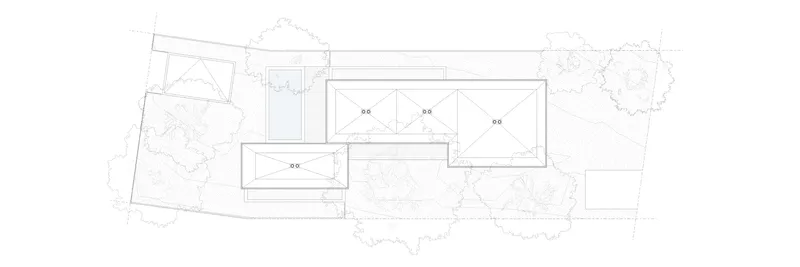
The ground floor plan confirms what the photographs suggest: the house is organized as a series of rooms clustered around two major courtyards, with the pool occupying the larger one. Mature trees are drawn into the plan as fixed elements, not afterthoughts. The upper level stacks bedrooms and a kitchen area above the ground floor volumes, and the staircase acts as a hinge between the two wings. The roof plan is telling: three flat roof sections float independently, separated by the courtyards, reinforcing the reading of the house as a collection of pavilions rather than a single mass.
What the plans reveal most clearly is how much of the lot is unbuildable by choice. The architects left significant area between the house and the property lines, and the courtyards consume a large share of the building footprint. In a market where every square foot has a dollar value, that generosity toward landscape is a genuine design stance.
Why This Project Matters
Austin's housing stock is being remade at speed, and the default mode for new construction in neighborhoods like Bouldin Creek is to maximize lot coverage and interior volume. Lantern House offers a counter-argument: that a house can be more livable precisely because it gives ground to the landscape. The courtyard strategy is ancient, but Bercy Fadel applies it with a material palette and environmental awareness specific to Central Texas. White brick reflects heat, mature canopy shades glazing, and the multiple courtyards create cross-ventilation paths that reduce mechanical cooling loads.
More broadly, the project demonstrates that residential restraint does not require austerity. The bathrooms are luxurious. The pool is generous. The kitchen is beautifully detailed. But none of these elements dominate the experience. What dominates is the oak canopy, the shifting light, and the sense that the house was made for this particular piece of ground. That specificity is what separates architecture from real estate.
Lantern House by Bercy Fadel (Thomas Bercy, Bethany Fadel). Located in Austin, Texas, United States. 3,841 sq ft. Completed in 2024. Interior design by Holm Design; built by Matt Sitra Custom Homes.
About the Studio
Share Your Own Work on uni.xyz
If projects like this are the kind of work you want to make, uni.xyz is a place to publish your own, find collaborators, and enter design competitions.




Popular Articles
Popular articles from the community


Co-Life: Senior Housing Design That Reconnects Older Adults With the City
Co-Life reimagines senior housing design through healing gardens, shared streets, workshops, and a sustainable community across generations.

Play: Fragments of Their World
Familiar architecture becomes modular playground design, creating safe spaces where displaced children can learn, connect, imagine and play.

The Musturak Paradise: Senior Living Architecture for a Connected Future in Temara, Morocco
The Musturak Paradise reimagines senior living architecture in Temara via private homes, social spaces, culture, community, and shared care.

Co-life: Sustainable Architecture for Age-Friendly Community Living
Co-life reimagines sustainable architecture for seniors through courtyards, rammed earth, shared gardens, and spaces designed for belonging.


Similar Reads
You might also enjoy these articles

Bao Huynh Watercolor Atelier: A Serene Art Retreat in Hội An
Bao Huynh Watercolor Atelier in Hội An blends multifunctional art spaces, sustainable design, local materials, and family-friendly living in a serene environment.

Atelier Macri Concept Store Interior Design by CASE-REAL
Atelier Macri store features a "ko" counter, walnut wood details, cork displays, blending retail, gallery, and seamless customer experiences.

Manuel Vargas Izquierdo Stadium and High-Performance Sports Center: Architectural Excellence in Jalpa de Méndez
The Manuel Vargas Izquierdo Stadium blends sustainable design, inclusive sports facilities, and cultural-inspired architecture, revitalizing Jalpa de Méndez’s public spaces.

KAKR Buluh Awar Hall: Revitalizing Community and Ecology Through Bamboo Architecture
Community built bamboo hall revitalizes Buluh Awar village, empowering youth, restoring ecology, celebrating vernacular craftsmanship through sustainable architecture and culture.




Comments (0)
Please login or sign up to add comments
No comments yet. Be the first to comment!