
Bernard Tschumi Inscribes a Five-Story Science Center into a 250-Foot Circle for Institut Le Rosey
On the shores of Lake Geneva in Rolle, Switzerland, a circular atrium building redefines how elite students learn, build, and pitch ideas.


Institut Le Rosey, often cited as the most expensive boarding school on the planet, already has a Zaha Hadid concert hall on its 70-acre campus along Lake Geneva. Now Bernard Tschumi Architects has added a building that is just as formally ambitious but aimed squarely at science, fabrication, and entrepreneurship. Philo, a 16,222-square-meter teaching facility completed in 2025, packs classrooms, labs, a startup incubator, and a 350-seat presentation hall into a single cylindrical volume inscribed within a 250-foot-diameter circle. It is the kind of building where the plan geometry is not ornamental: the circle eliminates front and back, forces continuous circulation, and gives every room an equal relationship to a central, top-lit atrium.
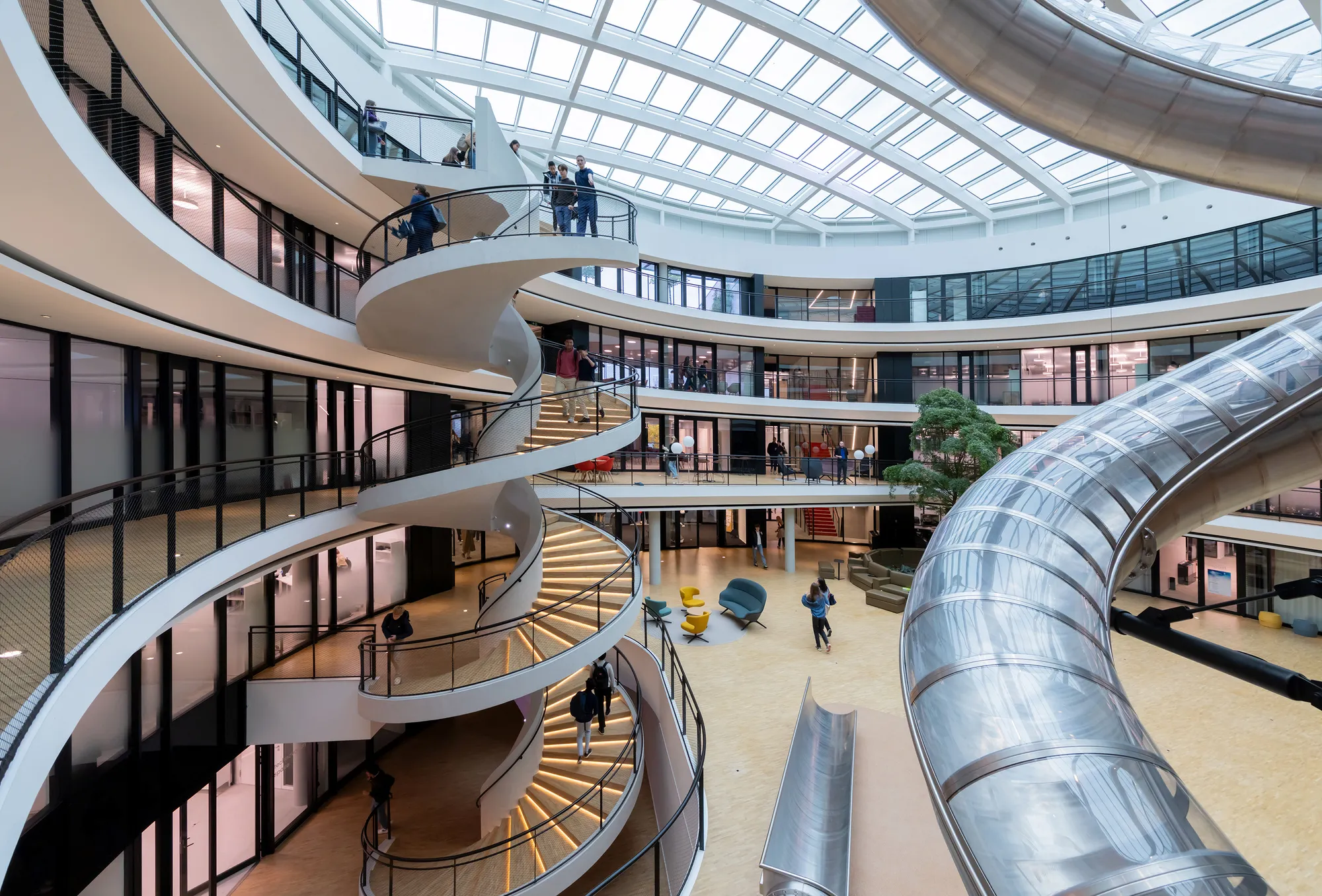
What makes Philo genuinely interesting is the way Tschumi treats movement as program. Three concentric walkways orbit the atrium at each level, a spiraling concrete stair threads from top to bottom, and, in an unsubtle nod to the Silicon Valley culture the school wants to channel, two tubular slides offer an alternative to the elevator. Pie-shaped wedges are carved out of the fourth and fifth floors to create outdoor terraces, puncturing the cylinder and letting daylight penetrate deep into the plan. The result is a building that reads as a diagram of its own circulation, a Tschumi signature dating back decades, now executed at a scale and budget few academic clients can match.
A Circle on the Campus
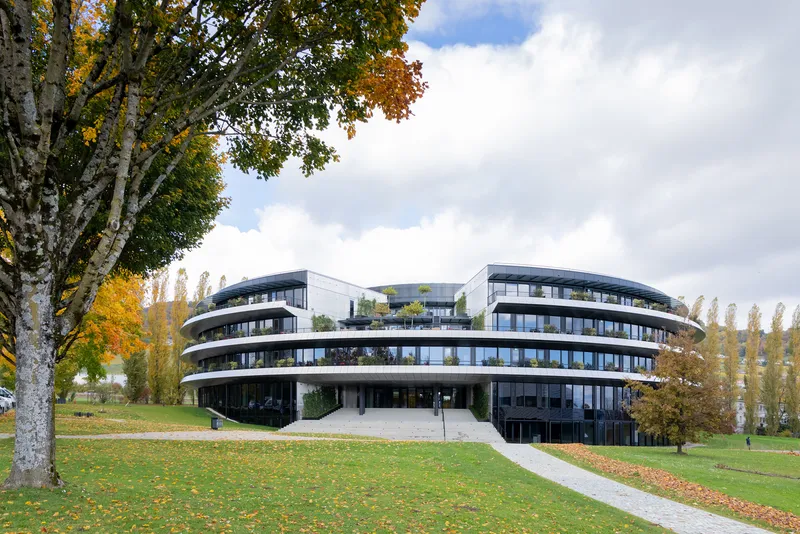


Seen from the air, Philo sits northwest of the existing Carnal Hall, a second circular form that turns the campus into a dialogue between discs. The brushed-stainless-steel facade panels and black-lacquered aluminum window frames give the building a taut, industrial skin that contrasts sharply with the rolling Swiss pastureland and the historic Château du Rosey at the campus core. Continuous balconies wrap the exterior, functioning as extensions of the classrooms in good weather and softening the mass of the cylinder with horizontal shadow lines.
The terrain drops away from the main entrance, so the lowest floor is actually a semi-basement housing fabrication labs and technical spaces, while a monumental flight of steps lifts visitors to the second-level entrance. It is a theatrical gesture, but it also solves a real grading problem on the uneven site. On the upper floors, the carved-out terraces are planted, creating rooftop gardens that face across the lawn toward the disc-shaped Carnal Hall.
The Atrium as Engine


The central atrium is the organizing element of the entire building. Five stories tall and crowned by a glazed skylight fitted with photosensitive glass that darkens automatically under direct sunlight, it pulls natural light into the deepest part of the plan without overheating the interior. A spiraling concrete stair wraps the void, doubling as a social space where students can pause, sit, and watch the activity below. At the base, a large black olive tree, an exotic species for Switzerland, anchors the composition and gives the atrium the slightly surreal quality of an indoor plaza.
The two stainless-steel slides that wind through the void are the detail everyone will photograph, but they serve a real purpose: they compress vertical travel time and reinforce the idea that moving through the building should feel spontaneous rather than bureaucratic. Large exposed ductwork is left visible overhead, treated as part of the architectural expression rather than hidden behind a ceiling. Tschumi has always been drawn to the mechanics of buildings, and here the infrastructure becomes ornament.
Pitch Room and Assembly

The entrance level houses the Pitch Room, a 350-seat assembly hall where students present startup concepts and research findings. Acoustically treated with red-and-yellow panels, the room looks out through a fully glazed wall onto the surrounding forest, a deliberate contrast to the inward focus of the atrium. Adjacent startup and incubator spaces are designed to be reconfigured quickly, with Lindner metal partition walls that double as whiteboards and projection surfaces. The message is clear: this is a school building that wants to function like a tech campus.
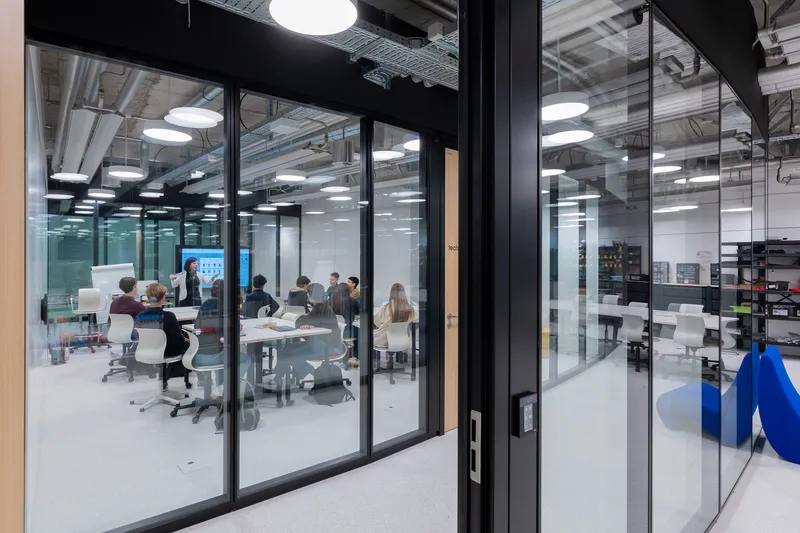
Glass-walled conference rooms visible from the corridors reinforce transparency as both a design strategy and a pedagogical philosophy. Meetings and critiques are on display, turning everyday academic work into a kind of performance. High sound insulation between classrooms, achieved through the metal and glass partition systems, ensures that the visual openness does not compromise acoustic privacy.
Labs, Classrooms, and the Concentric Logic

The three concentric walkways that ring each floor create a gradient from public to focused. The innermost walkway borders the atrium and functions as the social spine. The middle ring distributes students to classrooms and laboratories. The outer ring, essentially a continuous balcony, provides a decompression zone and an extension of the teaching spaces when doors are opened. The plan reads like a target, and the concentric logic means no classroom is more than a few steps from daylight on one side and the atrium on the other.
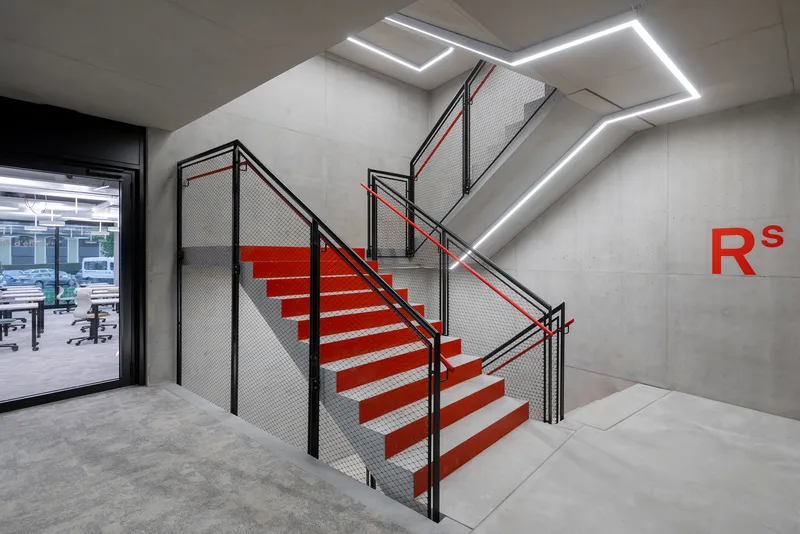
Open laboratory spaces on the lower floors feature white workstations under circular pendant lights, organized in clusters rather than rows. The red metal staircase with mesh guardrails and linear lighting recessed into concrete walls connects the semi-basement fabrication labs to the floors above, adding a secondary circulation path that is deliberately raw in its materiality. Where the atrium is polished and spectacular, these service stairs are muscular and industrial, reinforcing the idea that Philo is a building where things get made.
Plans and Drawings
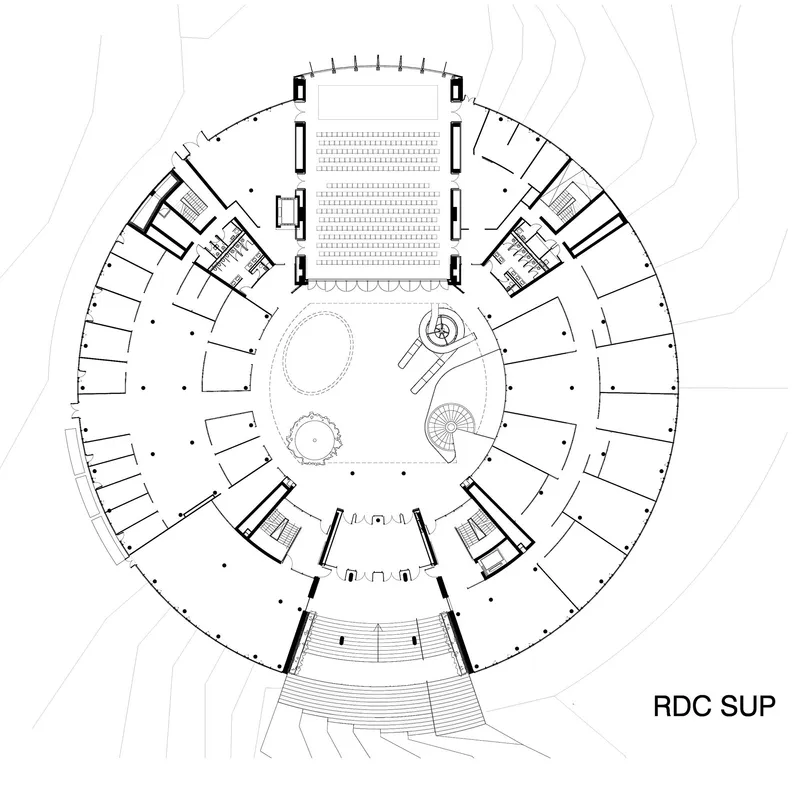


The floor plans reveal the clarity of the concentric strategy: classrooms radiate outward like slices of a pie, while the central core houses the atrium, stairs, and slides. At the upper levels, the removed wedges are clearly legible as voids that break the circle and introduce outdoor terraces. The sections show how the semi-basement sits into the sloping terrain and how the arched skylight crowns the atrium, creating a dome-like volume at the top of the building.
The exploded axonometric is particularly instructive. It isolates each floor plate as a stacked disc and overlays red airflow diagrams that trace ventilation paths through the building. The drawing makes visible what the photographs cannot: the mechanical systems that manage climate within a fully glazed atrium in a Swiss context, where summer overheating and winter heat loss are both serious concerns. The photosensitive skylight glass, the natural stack effect of the tall atrium, and the balcony shading devices all work together in a passive strategy that the axonometric documents with unusual precision.
Why This Project Matters
Tschumi has spent a career arguing that architecture is defined by the events that occur within it, not by the forms that contain them. Philo is a late-career test of that thesis at full scale. The slides, the spiraling stair, the concentric walkways, and the carved-out terraces are all choreographic devices intended to produce collisions, encounters, and improvised collaboration. Whether a building can truly manufacture serendipity is debatable, but few educational buildings commit to the idea as completely as this one does.
There is also a question of audience. Le Rosey's student body is tiny and extraordinarily privileged. A 16,000-square-meter science center for a school of roughly 400 students is a resource density that no public institution could replicate. But the architectural ideas at work here, the concentric plan, the atrium as social condenser, the integration of fabrication labs with humanities classrooms, are transferable. Philo is an experiment conducted under ideal conditions. The interesting challenge is whether the lessons it produces can survive the constraints of a less gilded reality.
Philo Science Center at Institut Le Rosey by Bernard Tschumi Architects, with associate architect Fehlmann Architectes SA and structural engineering by Alberti and Arup. Located in Rolle, Switzerland. 16,222 m². Completed 2025. Photography by Iwan Baan.
About the Studio
Share Your Own Work on uni.xyz
If projects like this are the kind of work you want to make, uni.xyz is a place to publish your own, find collaborators, and enter design competitions.




Popular Articles
Popular articles from the community


Riyadh For All: Intergenerational Urban Design for Active Aging in Rabat
Riyadh For All reimagines urban design in Rabat with intergenerational co-living, adaptive courtyards, and Moroccan cultural exchange today.

The Ocean Hive: Sustainable Architecture for a Self-Sufficient Civilization at Sea
The Ocean Hive imagines sustainable architecture at sea, where modular habitats, algae, wave power and ocean waste sustain a growing colony.

The Musturak Paradise: Senior Living Architecture for a Connected Future in Temara, Morocco
The Musturak Paradise reimagines senior living architecture in Temara via private homes, social spaces, culture, community, and shared care.

Hill & Cross Opera: Sculptural Opera House Architecture Shaped by Tallinn’s Landscape and Identity
Hill & Cross Opera reimagines opera house architecture in Tallinn through its sculptural hill, civic plaza, glass wave and a luminous cross.


Similar Reads
You might also enjoy these articles

Bao Huynh Watercolor Atelier: A Serene Art Retreat in Hội An
Bao Huynh Watercolor Atelier in Hội An blends multifunctional art spaces, sustainable design, local materials, and family-friendly living in a serene environment.

Atelier Macri Concept Store Interior Design by CASE-REAL
Atelier Macri store features a "ko" counter, walnut wood details, cork displays, blending retail, gallery, and seamless customer experiences.

Manuel Vargas Izquierdo Stadium and High-Performance Sports Center: Architectural Excellence in Jalpa de Méndez
The Manuel Vargas Izquierdo Stadium blends sustainable design, inclusive sports facilities, and cultural-inspired architecture, revitalizing Jalpa de Méndez’s public spaces.

KAKR Buluh Awar Hall: Revitalizing Community and Ecology Through Bamboo Architecture
Community built bamboo hall revitalizes Buluh Awar village, empowering youth, restoring ecology, celebrating vernacular craftsmanship through sustainable architecture and culture.


Explore Educational Building Competitions
Discover active competitions in this discipline



Challenge to design public laboratory


Bring back Drive In's
Comments (0)
Please login or sign up to add comments
No comments yet. Be the first to comment!