

Bernardes Arquitetura Wraps a São Paulo Tower in Wood, Polycarbonate, and Radical Greenery
On a tight trapezoidal corner lot in Vila Beatriz, a 28-meter residential building dissolves its mass behind layers of landscape and warm materiality.


A 28-meter residential tower on a 525-square-meter trapezoidal plot sounds like a recipe for brute verticality. Yet the Pascoal Vita Building, completed in 2023 by Bernardes Arquitetura under the direction of Thiago Bernardes, Dante Furlan, and Fausto Sombra, reads as something closer to a vertical garden pavilion: a dark gray exoskeleton stacked with planted balconies, cumaru and freijó wood surfaces, translucent polycarbonate panels, and automated sunshades that ripple across its west-facing facade like a living membrane. The building occupies a corner between Rua Pascoal Vita and the narrower Rua Napoleão Laureano in Vila Beatriz, a predominantly low-rise residential neighborhood near Alto de Pinheiros. Because surrounding zoning keeps neighboring buildings short, every apartment opens west to unobstructed sky.
What makes this project worth studying is not its program (12 luxury apartments ranging from 319 to 443 square meters) but the discipline with which Bernardes manages the transition between public sidewalk and private living across every scale. A donated land strip along Napoleão Laureano widens the pedestrian path and enables new planting. Thin, curving vertical steel bars replace the high masonry walls typical of São Paulo's residential enclaves, functioning simultaneously as security perimeter and brise-soleil. Inside the lobby, timber soffits flow overhead, planters blur the threshold between corridor and courtyard, and by the time you reach the 25-meter lap pool on the ground floor, lit by a generous skylight, the street feels very far away. The ambition here is to make a 7,930-square-meter building feel like a house.
A Corner Lot, a Neighborhood Scale
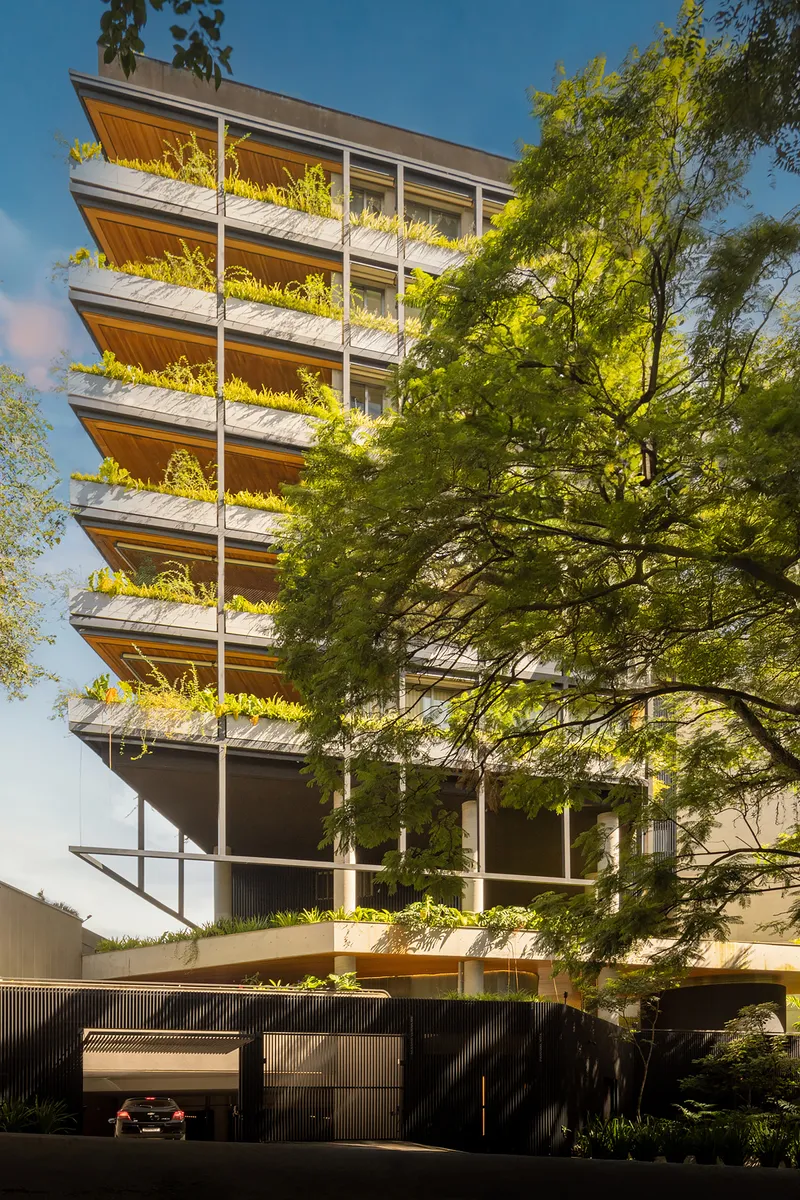
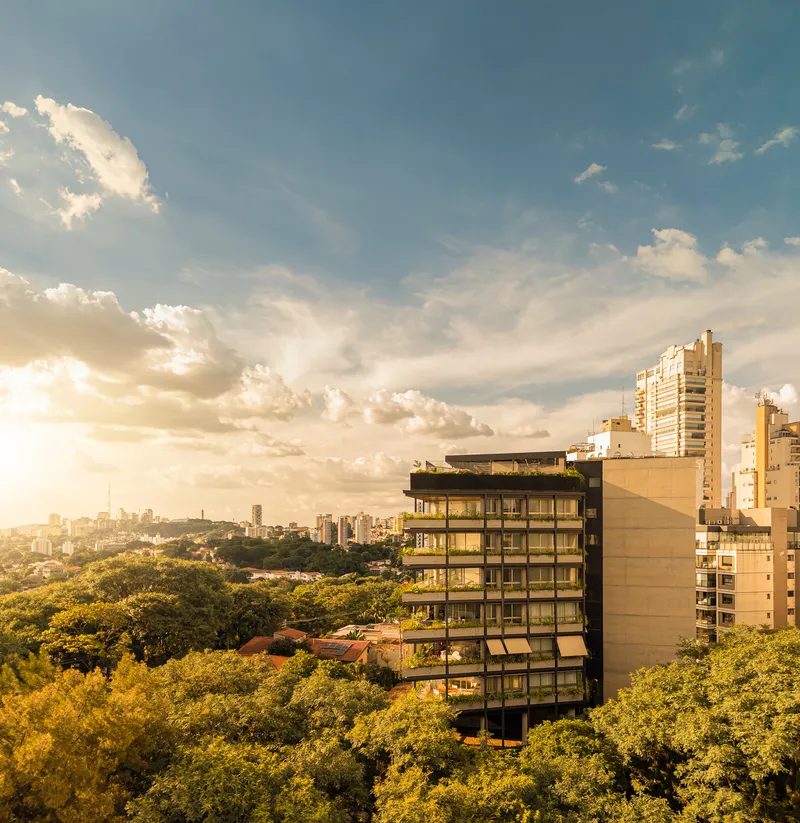
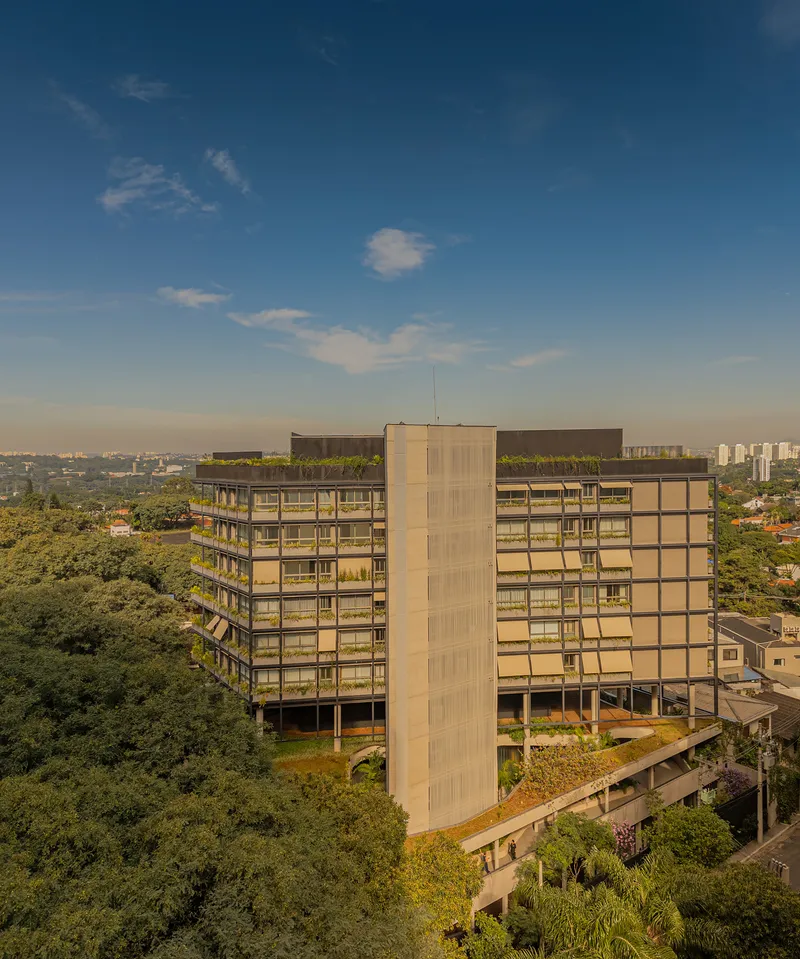
Seen from street level, the building presents a layered composition: a horizontal base of two floors above grade, topped by a seven-story tower with a planted terrace crown. The stacking is deliberate. The base absorbs the pedestrian scale of the tree-lined streets, while the tower steps back just enough to let mature canopy trees mediate the transition upward. Six existing trees on the site were preserved (two transplanted within the lot), and 16 new native species were added, including the Corticeira, whose red flowers punctuate the facade from September through December.
From above, the building's relationship with its surroundings becomes clearer. Dense treetops nearly engulf the lower floors, and the planted balconies continue the green vertically so that the tower appears to emerge from, rather than sit atop, the canopy. The western views across low-rise rooftops to the horizon at golden hour are the payoff for every resident, but the decision to donate sidewalk space and dissolve the ground-plane boundary is the payoff for the neighborhood.
Threshold as Architecture
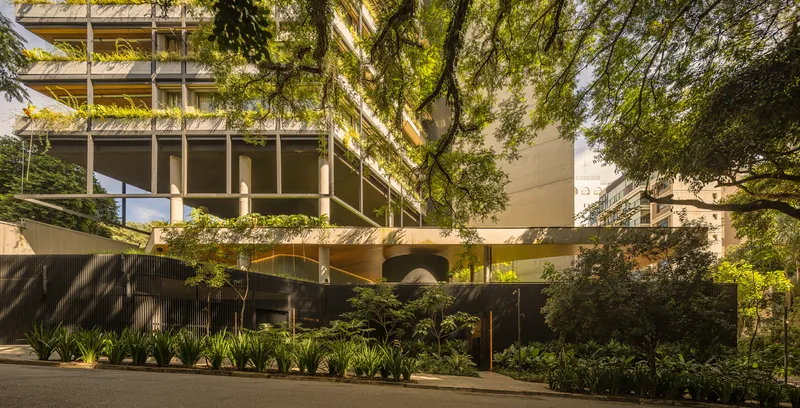
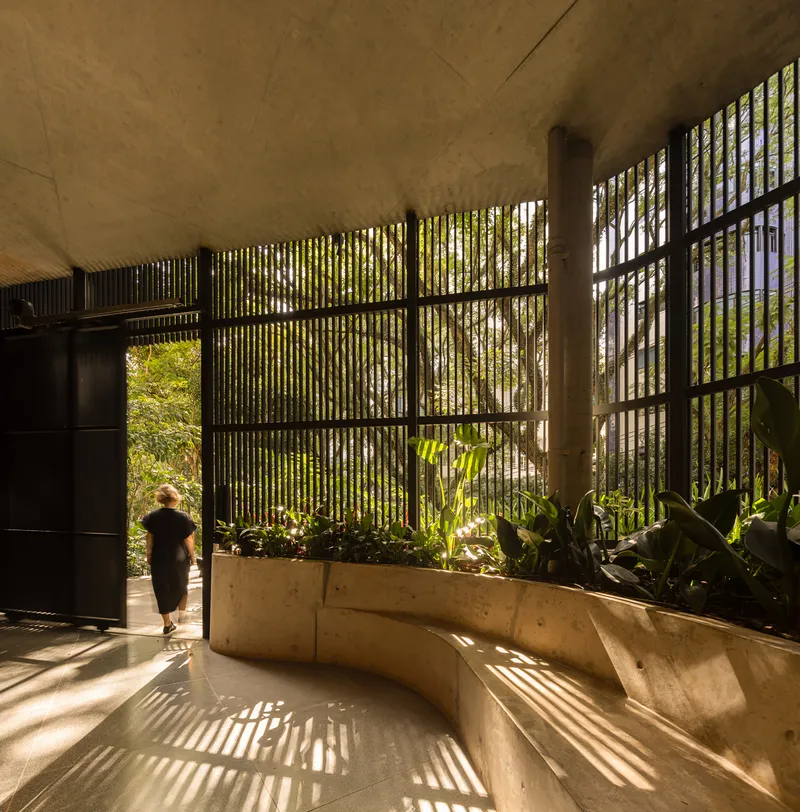
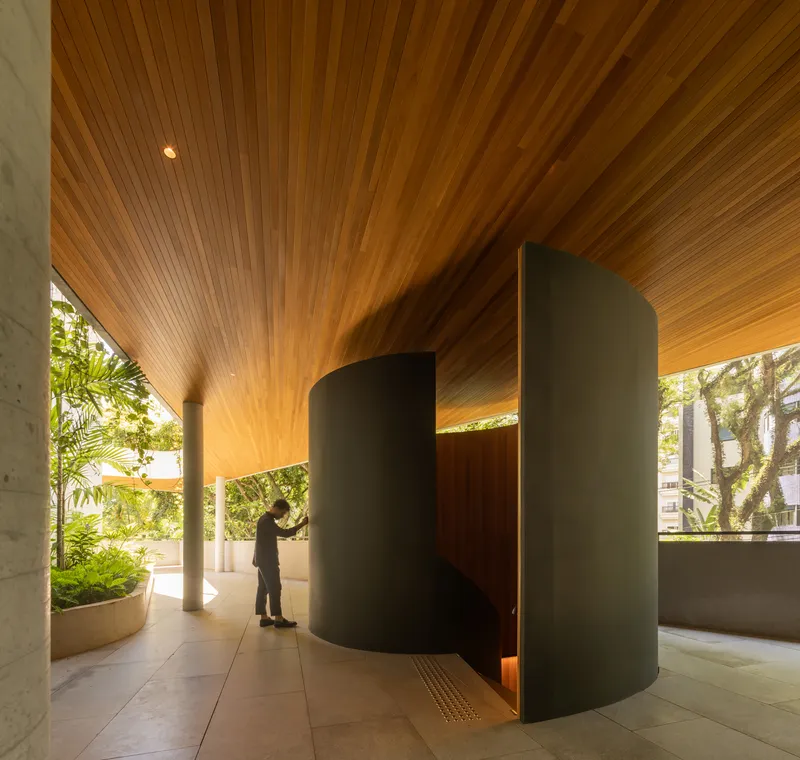
Bernardes treats arrival as a sequence of compression and release rather than a single gesture. From the street, you pass through the curvilinear steel-bar fence, which casts striped shadows across the stone paving and planted beds. Ground-level cumaru wood slats wrap closed service blocks, their warm tone contrasting the dark gray structure. A cylindrical partition element in the lobby guides circulation without closing it off, and the timber-slat ceiling overhead introduces a domestic cadence that contradicts the scale of the building above.
The vertical brise-soleil at ground level does double duty. It controls western sun penetration into the common areas while maintaining visual porosity between lobby and garden. The effect is a middle ground between public and private that São Paulo's gated residential architecture almost never attempts: you can see in, you can see out, but the space still feels protected.
Wood and Light in the Common Spaces
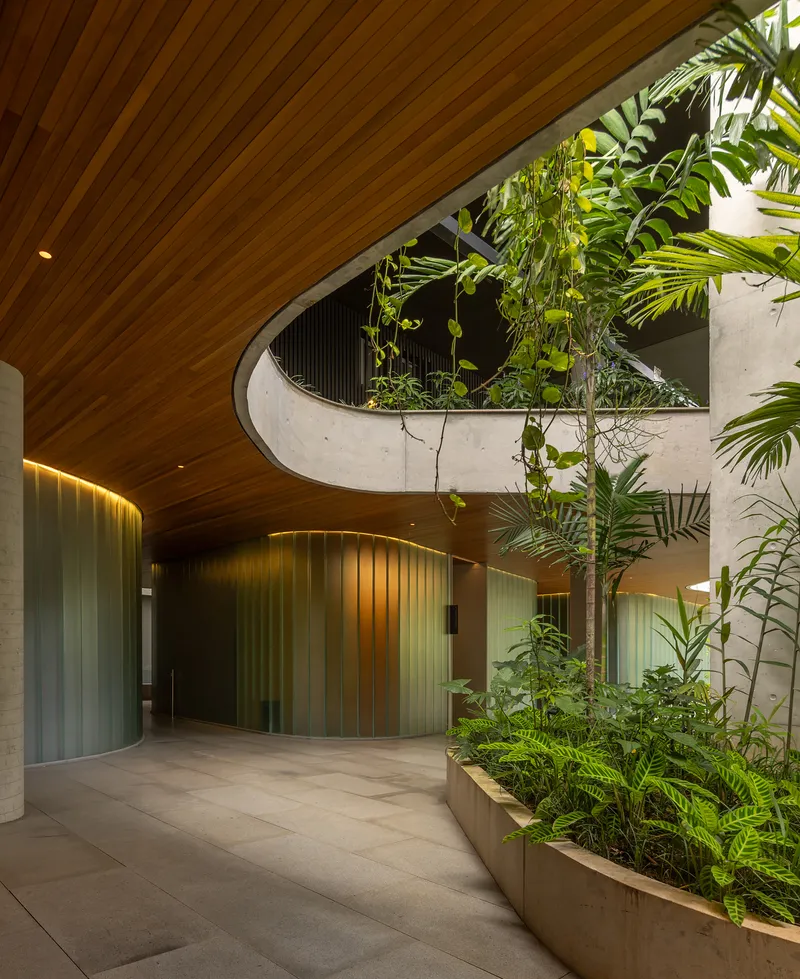
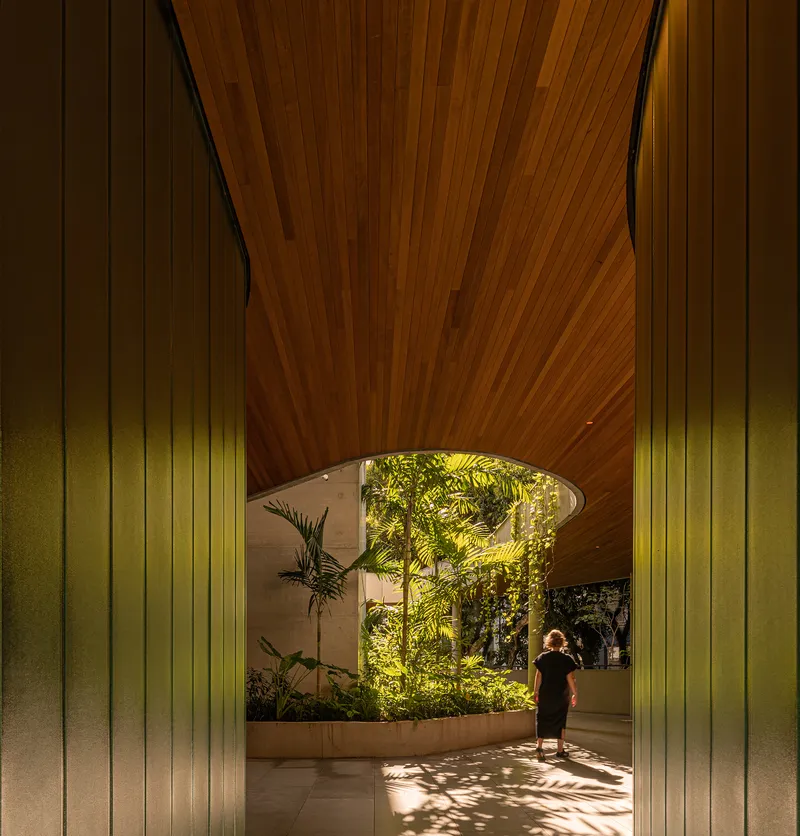
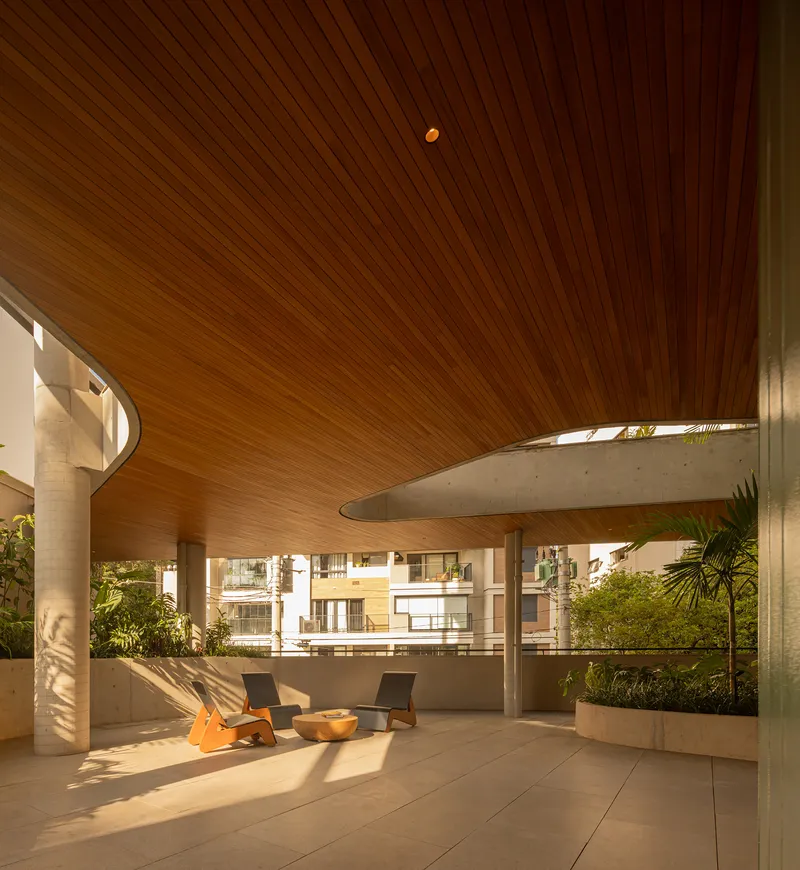
The interiors of the shared floors draw heavily on the residential houses Bernardes Arquitetura is known for. Freijó and cumaru wood line ceilings, walls, and custom millwork, producing a warmth that you almost never associate with a condominium lobby. The flowing timber soffit in the entry corridor is sculptural without being theatrical; it bends and rises to frame planted courtyards visible through translucent green polycarbonate panels, collapsing the distinction between interior finish and landscape element.
The covered terrace on the first floor continues this logic. Concrete columns stand in filtered afternoon light, and the sculptural ceiling overhead channels views upward through layered planting to the tower floors above. The landscape design, with its fluid curvilinear beds opposing the building's orthogonal lines, introduces a deliberate tension. Flowerbeds and palms soften what could otherwise read as a parking podium.
A Pool Below, a Terrace Above
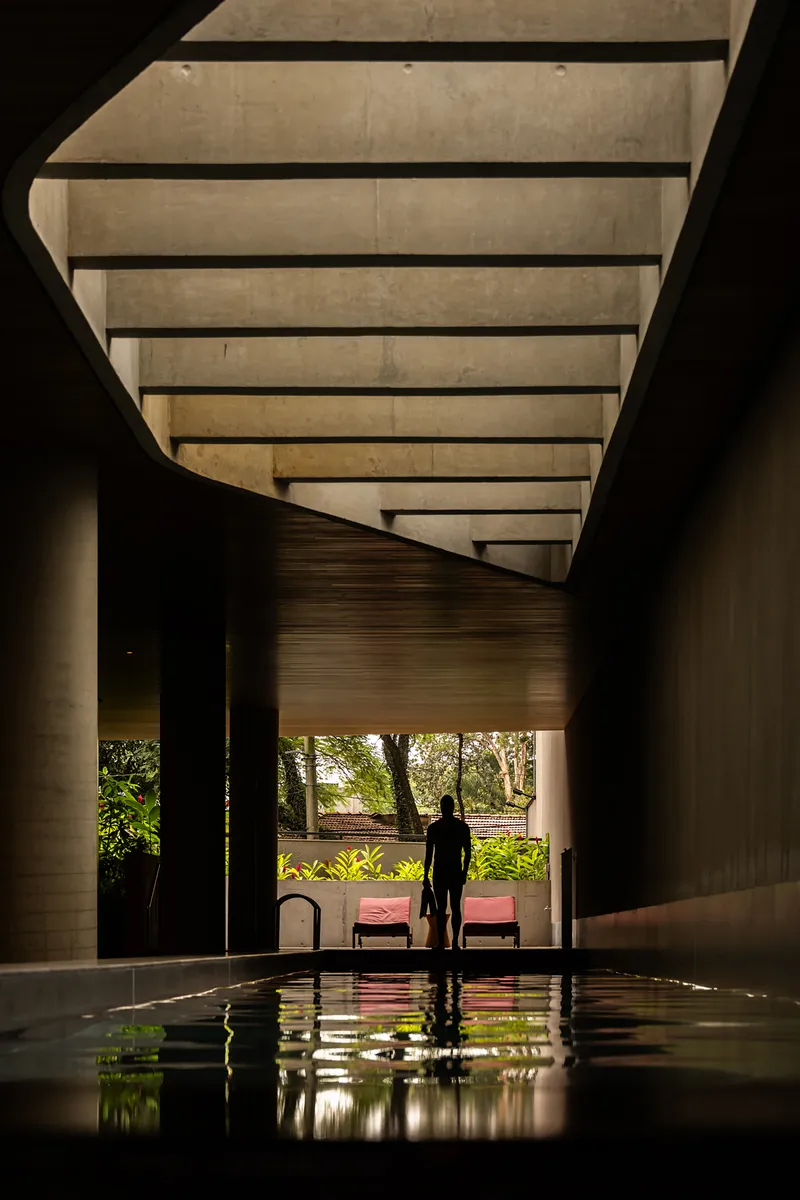
The ground-floor amenity program packs a gym with custom millwork, a sauna, a spa, and a 25-meter lap pool into the horizontal base. The pool sits beneath a concrete soffit penetrated by a skylight that washes the water surface with zenithal light, a move that transforms what could be a dark basement lane into something almost meditative. A silhouetted figure beside the pool edge, with the outdoor landscape visible beyond, captures the porosity Bernardes insists on throughout.
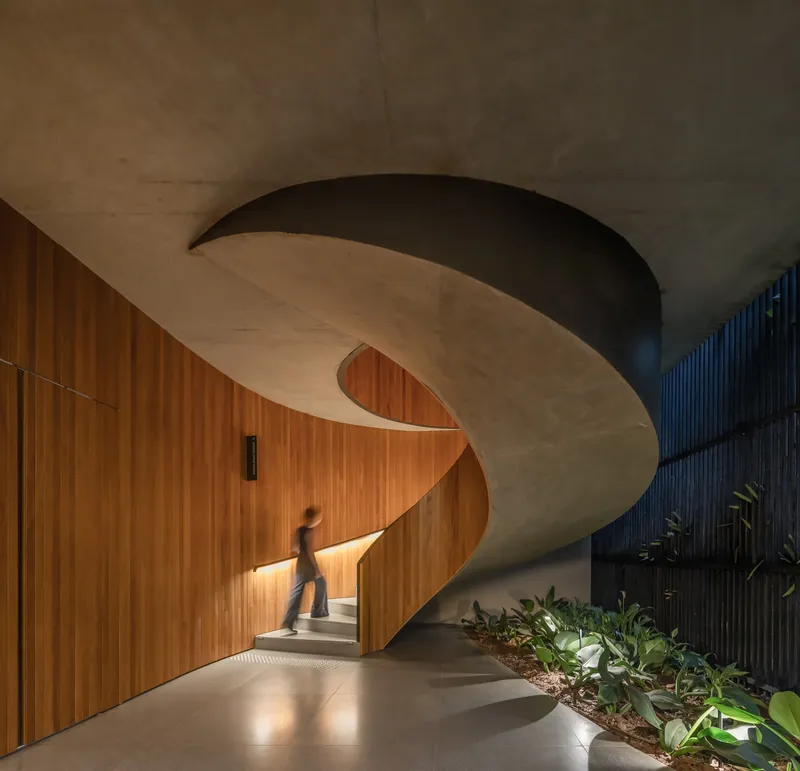
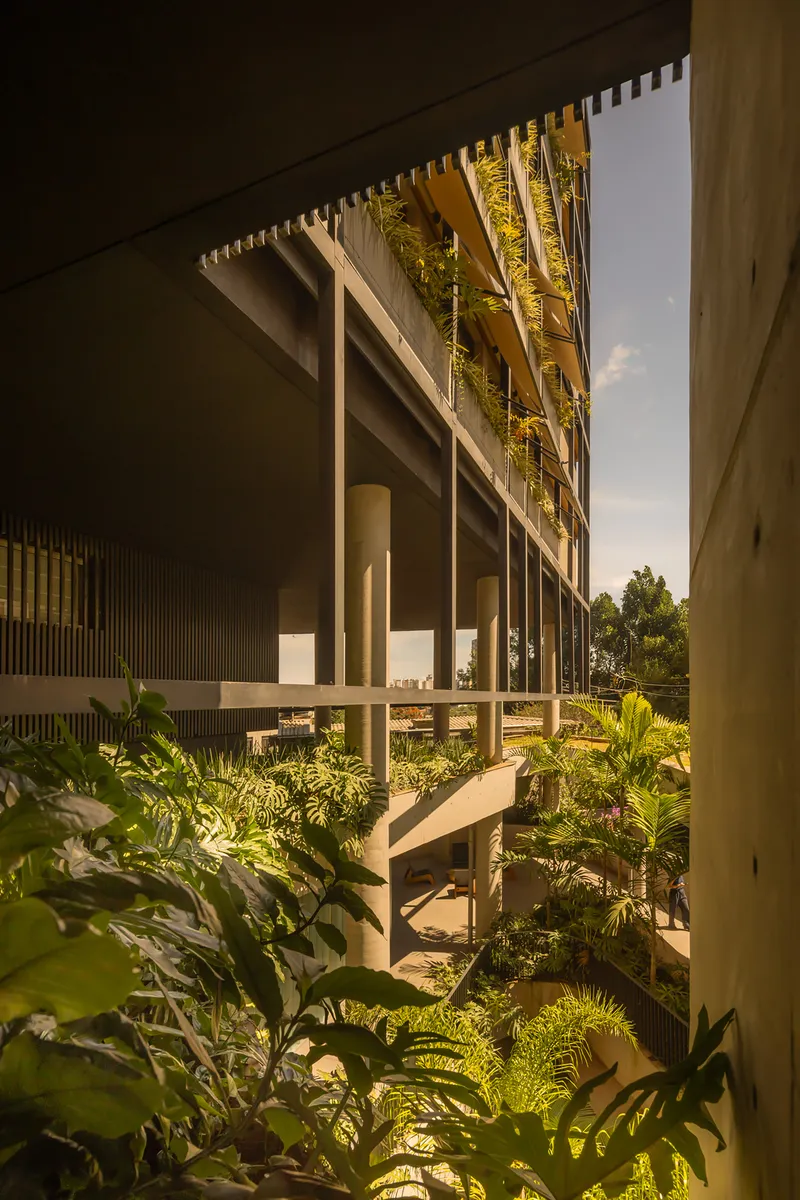
The curved concrete stair with timber-clad walls connects these common levels vertically, its planted beds turning the circulation itself into landscape. Above, the courtyard view at dusk reveals the tower's facade glowing warmly against layered greenery: metal planters with light gray finish, embedded in the window modulation, carry automatic irrigation and drainage systems that sustain the vegetation without visible infrastructure. The engineering is invisible, but the effect is immediate.
The Facade as Climate Device
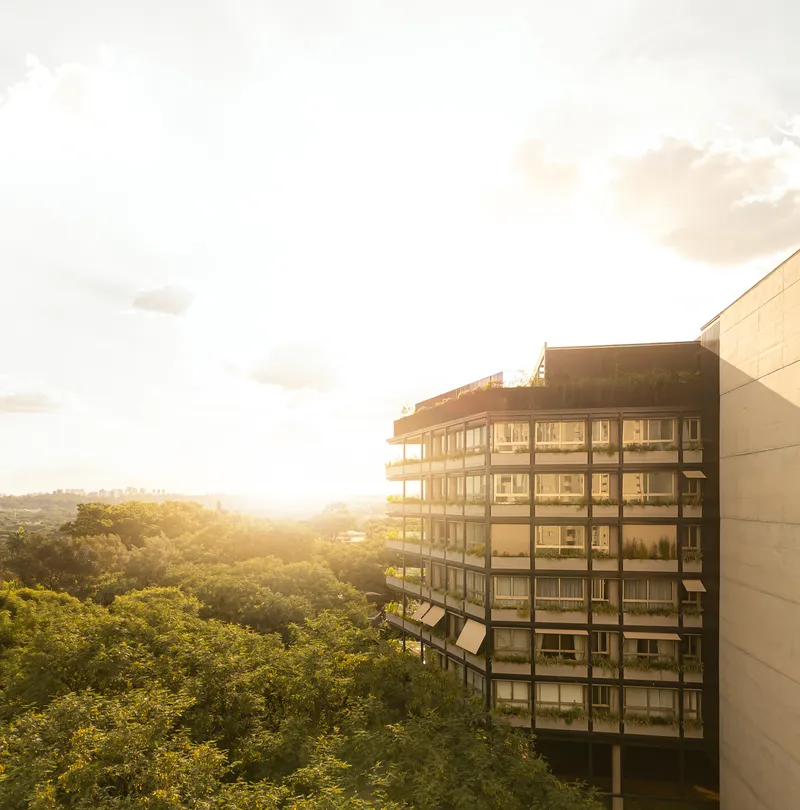
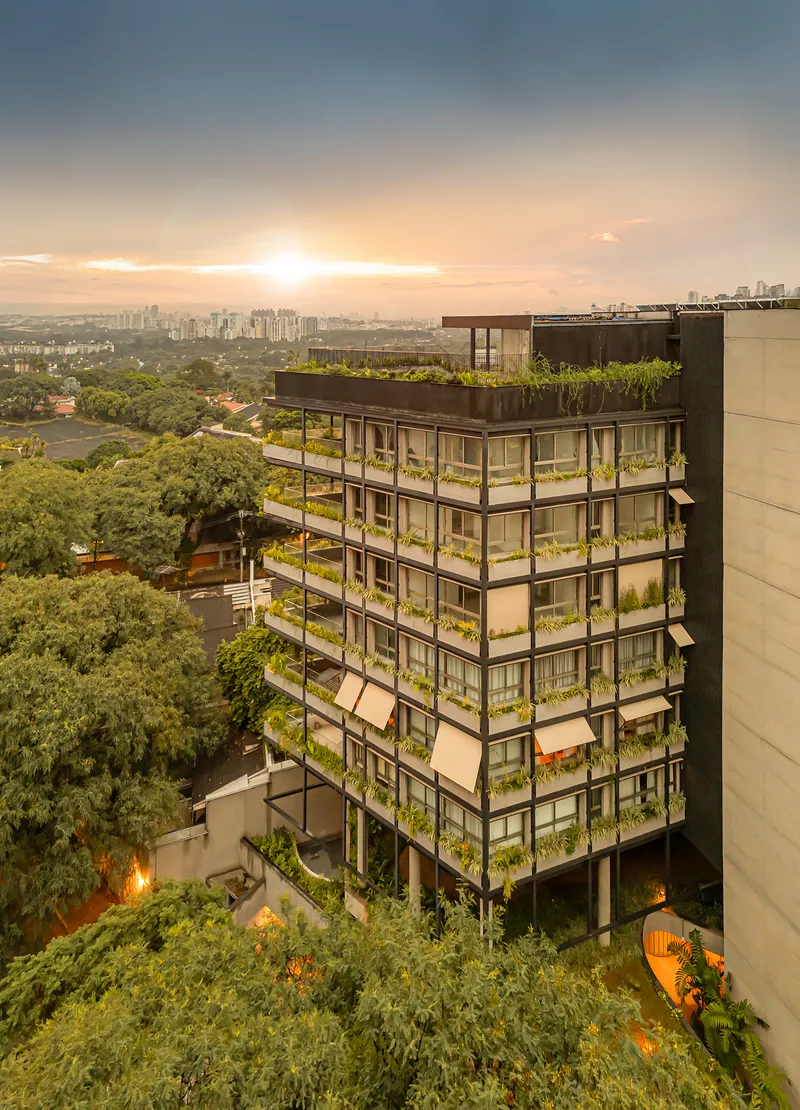
The west-facing elevation is the building's most consequential design decision. São Paulo's afternoon sun is relentless, and the entire balcony extension is fitted with automated translucent gray sunshades equipped with wind sensors. Residents can open or close them individually, but the system also responds autonomously to gusts, protecting the fabric and the planting behind it. The result is a facade that changes configuration throughout the day, sometimes opaque, sometimes transparent, always in motion.
The C-shaped balconies that wrap each apartment create a continuous outdoor room on every floor. Social areas (living, dining, kitchen, terrace) are arranged linearly along the western edge and mirrored per floor, maximizing the unobstructed views while the service and bedroom zones occupy the more protected east side. Penthouse duplexes take this further, with private roof terraces featuring barbecue, gourmet areas, and individual pools. The building is 28 meters tall, but every unit lives horizontally.
Plans and Drawings
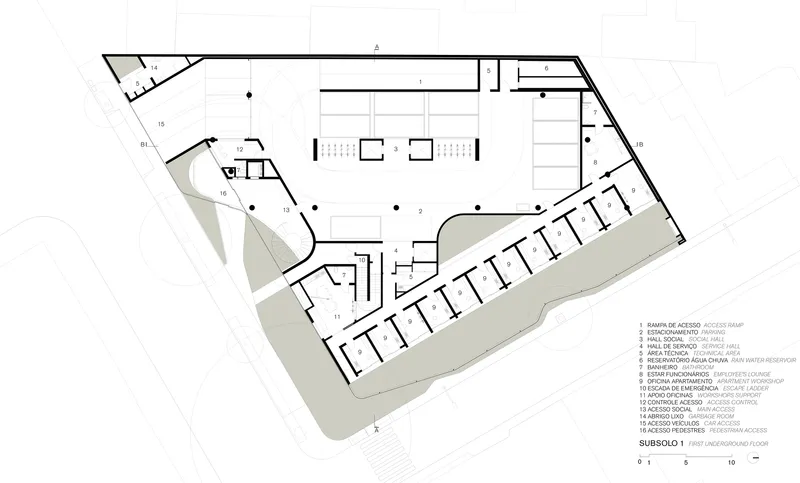
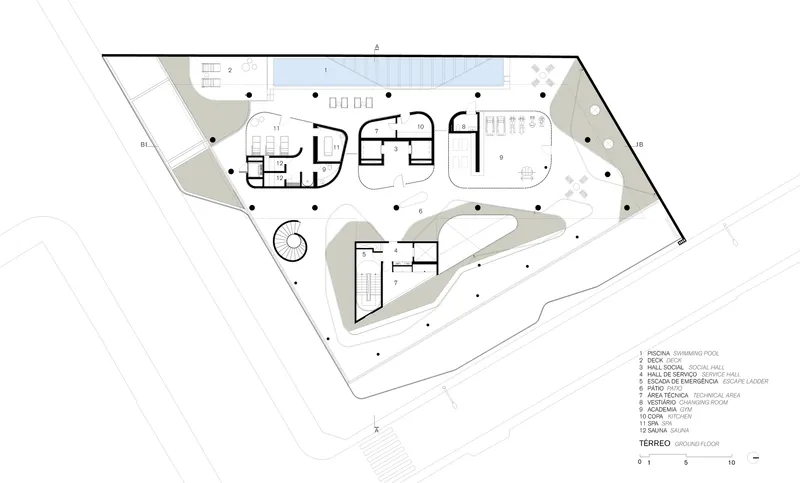
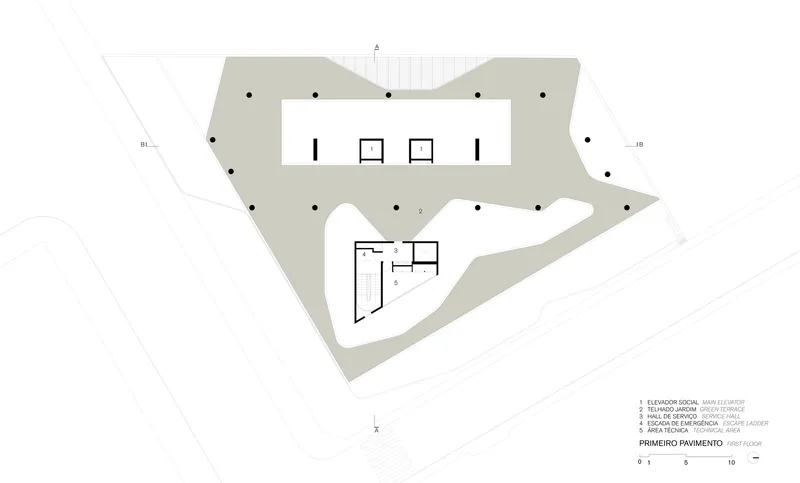
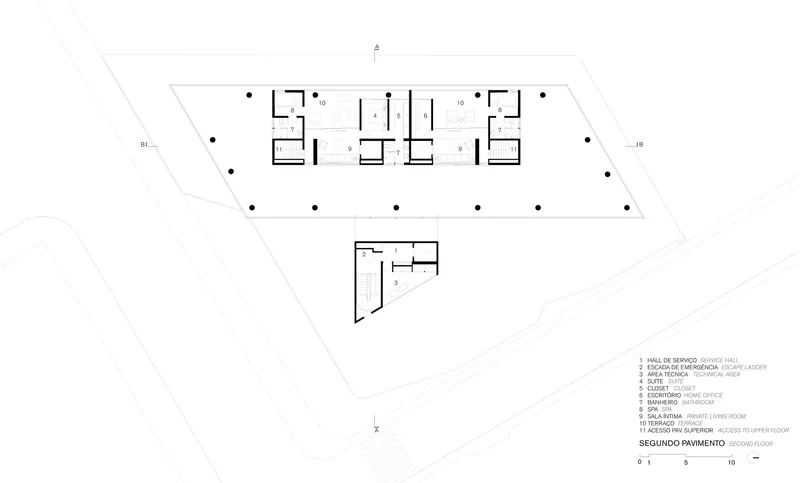
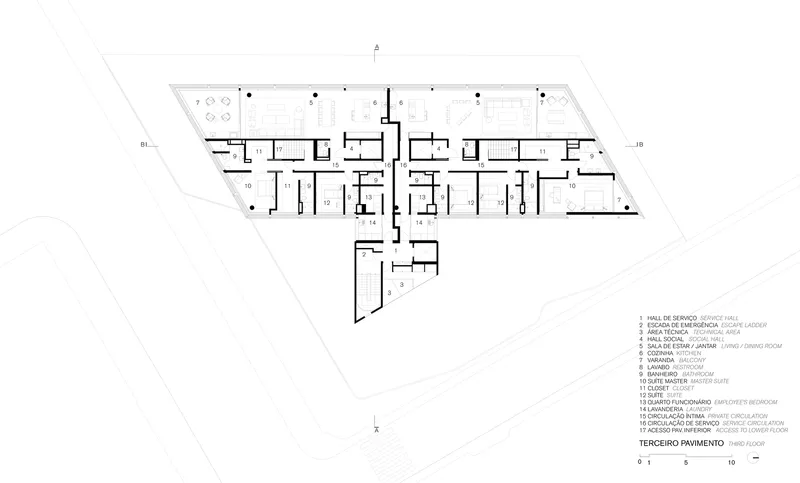
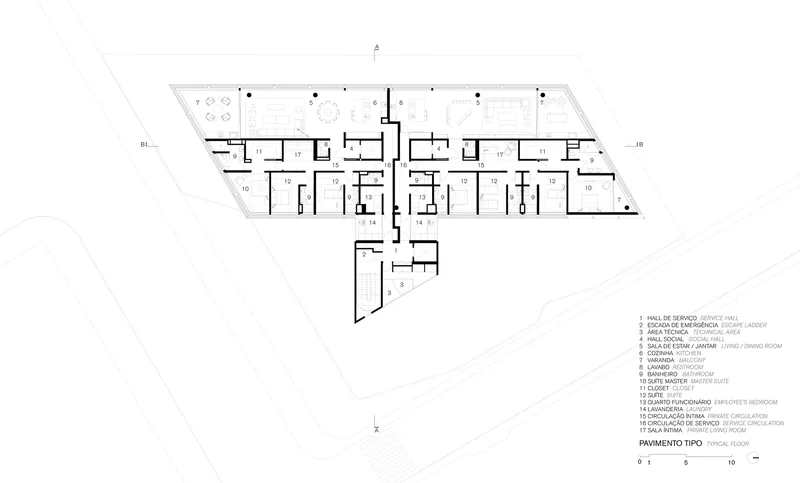
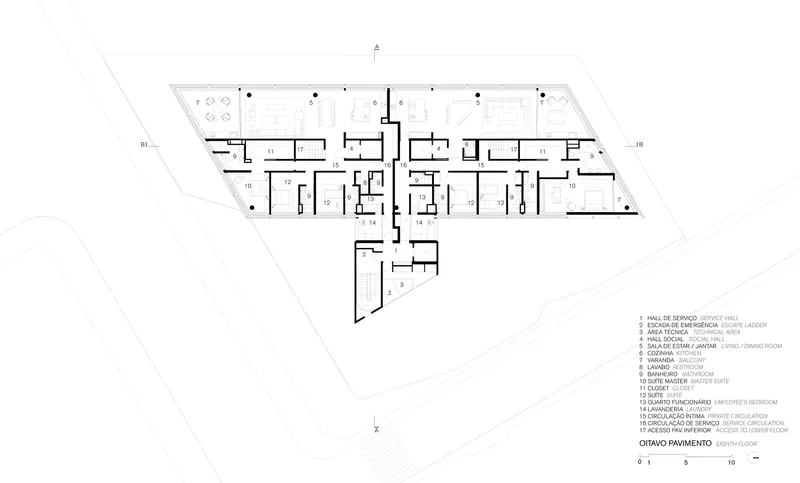
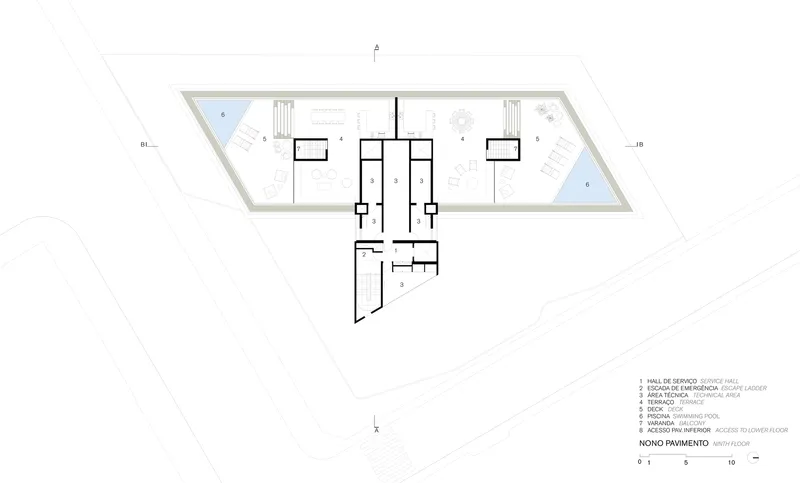
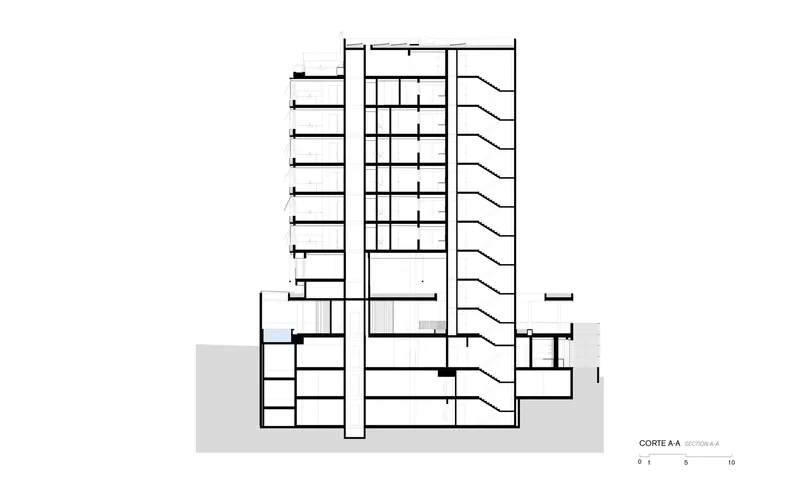
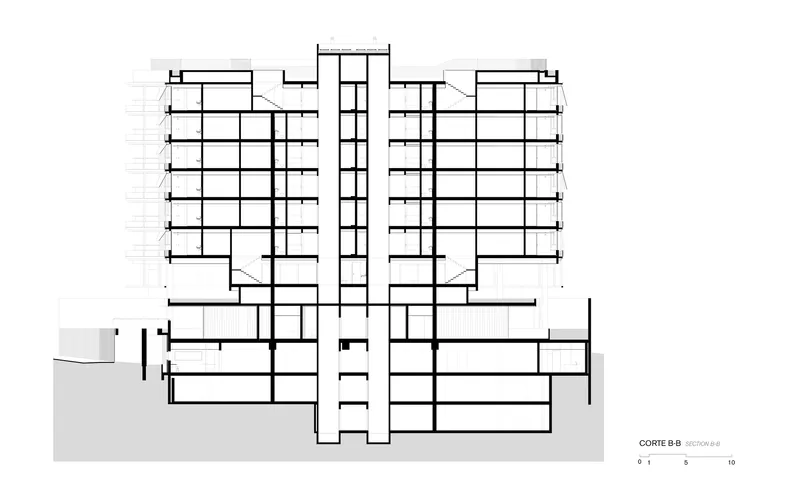
The plans reveal the trapezoidal geometry of the lot and its consequences. Three basement levels absorb parking (42 spaces total) and twelve individual workshops, one per apartment. The ground-floor plan shows how the pool lane, deck, and curved landscape paths are choreographed around the structural grid. Upper floor plans demonstrate the mirrored apartment strategy: two units per floor, each with its C-shaped balcony and a service suite separated from the main bedroom wing. The sections are especially instructive, showing the horizontal base (two above-grade floors plus three basements) as a distinct mass from the tower, connected by the central vertical circulation core.
The eighth-floor plan and the ninth-level terrace plan reveal the penthouse duplexes and their rooftop amenities. Corner pools on the terrace level sit directly above the apartments below, demanding serious waterproofing and structural coordination, a level of ambition that the clean drawings make look deceptively simple. Throughout, the plans confirm what the photographs suggest: every decision, from planter depth to corridor width, has been dimensioned to sustain the illusion that this is a house, not a tower.
Why This Project Matters
São Paulo's luxury residential market has no shortage of towers with planted terraces. What sets the Pascoal Vita Building apart is the coherence of its argument across scales: from the donated sidewalk strip and the porous steel-bar perimeter at the urban level, through the wood-lined common spaces that blur the line between house and condominium, to the climate-responsive automated sunshades that make the west facade a genuinely adaptive surface. Bernardes Arquitetura has built a 28-meter building that treats height as something to be earned through the quality of its ground-level generosity, not as a given.
The project also offers a material lesson. The palette of cumaru, freijó, polycarbonate, and dark gray concrete is small, but it is deployed with enough variation to produce warmth, translucency, and gravity in the right places. Nothing here is decorative; every surface has a climatic or spatial justification. In a city where residential buildings routinely default to high walls and hermetic lobbies, the Pascoal Vita Building proposes a more porous, planted, and ultimately more generous model. Whether that model can survive contact with the realities of São Paulo's security culture is a fair question, but the architecture, at least, has made its case.
Pascoal Vita Building by Bernardes Arquitetura (lead architects: Thiago Bernardes, Dante Furlan, Fausto Sombra). Vila Beatriz, São Paulo, Brazil. 7,930 m². Completed 2023. Photography by Fernando Guerra | FG+SG.
About the Studio
Share Your Own Work on uni.xyz
If projects like this are the kind of work you want to make, uni.xyz is a place to publish your own, find collaborators, and enter design competitions.


Popular Articles
Popular articles from the community


Architekt Andreas Gruber Scatters 23 Dark Timber Chalets Across a South Tyrolean Forest Edge
In Molini di Tures, Amonti Chalets breaks a resort into a hamlet of gabled timber houses, with parking, storage and services pushed into the slope.

David Macias Steps a Doorless Stone and Plaster House Down a Tropical Colombian Hillside
In the humid hills of Colombia, Threshold House replaces the front door with an open void and terraces its 850 m² down the slope instead of fighting it.

David Ortega Stacks a Two-Story Mexico City Penthouse Around a Steel Stair and a Pergola-Shaded Roof Terrace
In Colonia Roma, a 300 m² penthouse uses oak joinery, a planted steel stair and a slatted roof pergola to make a new-build apartment feel like a house.

Cube Design Draws an Ecological Corridor Between Two Shenzhen Hills with the Nankai Building
Beside Shenzhen's container docks, the Nankai Building pairs stacked balconies with a climbing green screen to connect two hillsides across its height.

Similar Reads
You might also enjoy these articles


LAVA Architecten Gives Vocational Education a Sawtooth-Roofed Face on a Mechelen School Campus
In Mechelen, Belgium, a 2,053 m² STEM school on a 6×6 m grid turns workshops and classrooms into rooms that can be rearranged as teaching changes.

KEMA Studio Turns a Derelict Marvila Attic into a 60 m² Lighthouse Apartment Above Lisbon
In Lisbon's Marvila district, a rebuilt roof, four skylights and two plywood volumes turn an unlivable attic into a bright home facing the Tagus.

Pixel Gardens: One Repeated Module Stacked Into a Terraced Social Housing Tower for Famagusta
Salem Bader's shortlisted housing tower builds a vertical neighbourhood from one repeated module, offsetting units to carve terraces, light and air.

Bao Huynh Watercolor Atelier: A Serene Art Retreat in Hội An
Bao Huynh Watercolor Atelier in Hội An blends multifunctional art spaces, sustainable design, local materials, and family-friendly living in a serene environment.

Explore Power Station Competitions
Discover active competitions in this discipline

Challenge to design a portable theatre

Challenge to design a portable music platform

Challenge to design an open learning module for the elderly
Comments (0)
Please login or sign up to add comments
No comments yet. Be the first to comment!