
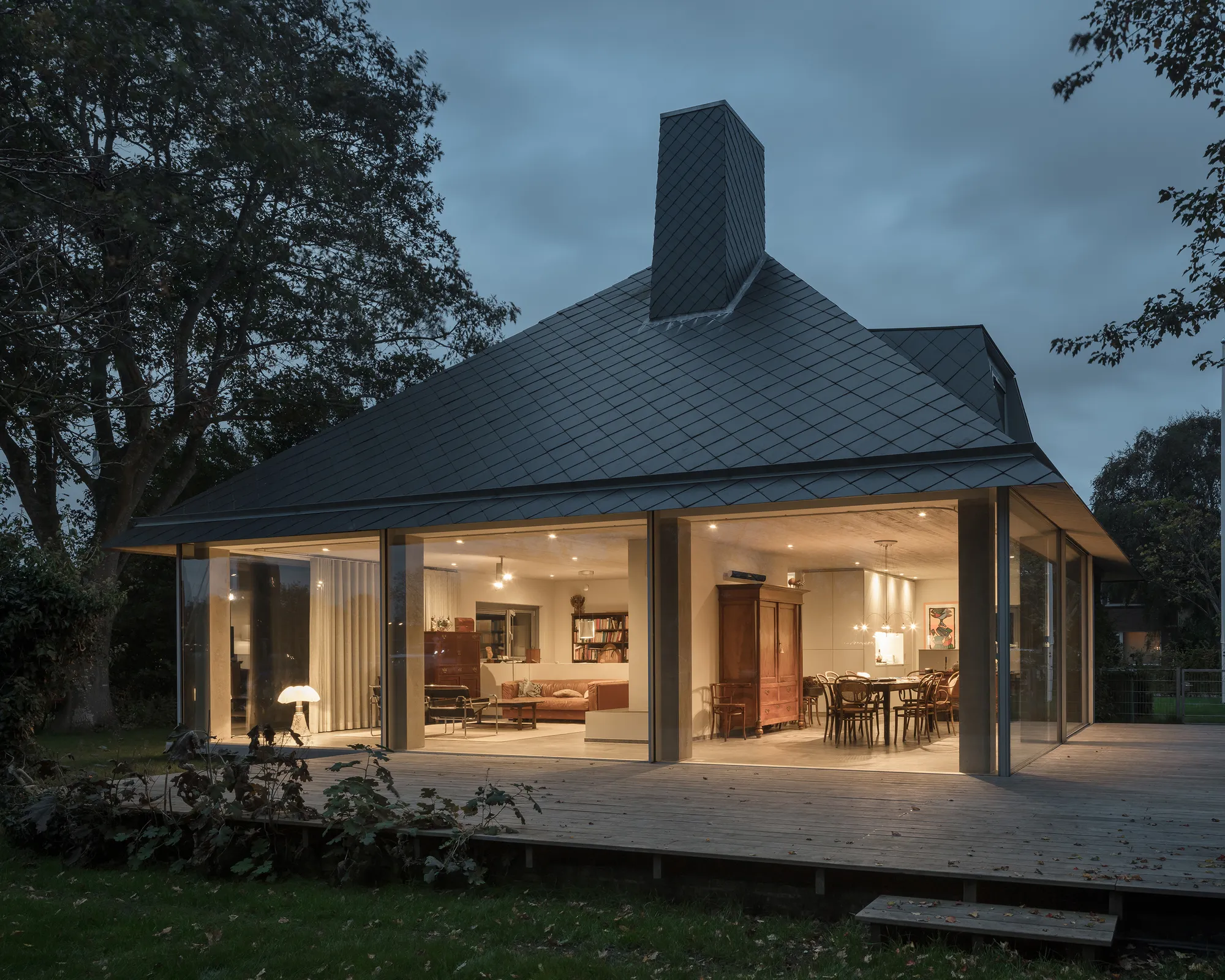
BETA Office Reveals a 1970s Doctor's House as a Light-Filled Pavilion on a Frisian Canal
In the village of Workum, a pyramidal slate roof floats on concrete columns and glass, turning a scruffy renovation into an energy-positive home.


There is a particular species of 1970s house that everyone writes off. Boxy plan, overgrown lot, a roof that feels slightly too heavy for its proportions. House TC in Workum, a small Frisian village connected by canal to the IJsselmeer and the UNESCO-protected Waddenzee, was exactly that kind of building: a former doctor's residence whose original architectural ambitions had been buried under decades of careless additions and neglect. BETA office for architecture and the city chose not to demolish but to excavate, stripping the structure back to its underlying logic and finding, beneath the clutter, a scheme based on two interlocking squares that could be amplified into something genuinely generous.
What makes House TC worth studying is less the renovation itself and more the attitude behind it: a refusal to sentimentalize the existing fabric or to treat it as a blank canvas. BETA kept the pyramidal roof but rebuilt the structural scheme beneath it with concrete columns, then dissolved the facades into floor-to-ceiling glass that slides open completely. The result is a house that reads as a covered outdoor room, a pavilion hovering between garden and canal, while remaining energy-positive year-round. For an elderly couple in a northern Dutch village, that combination of openness and self-sufficiency is a serious achievement.
Two Squares and a Terrace
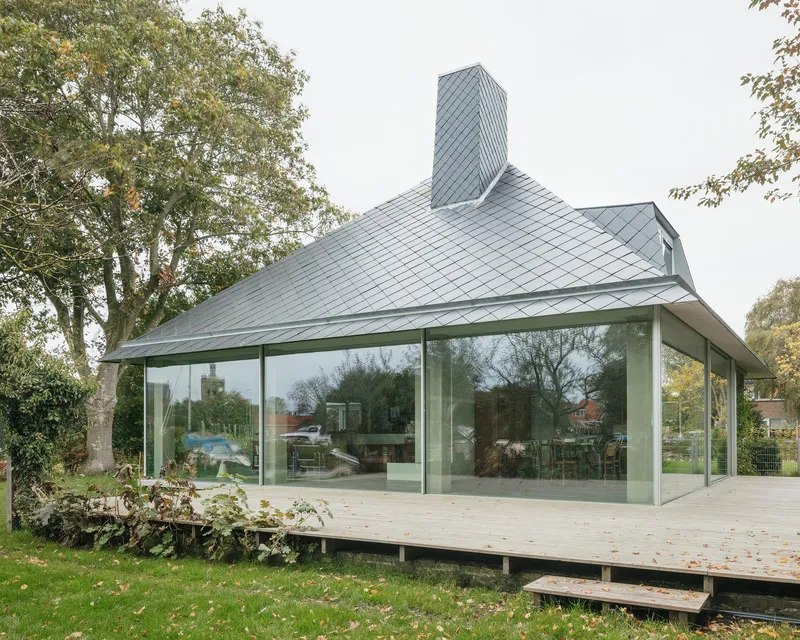
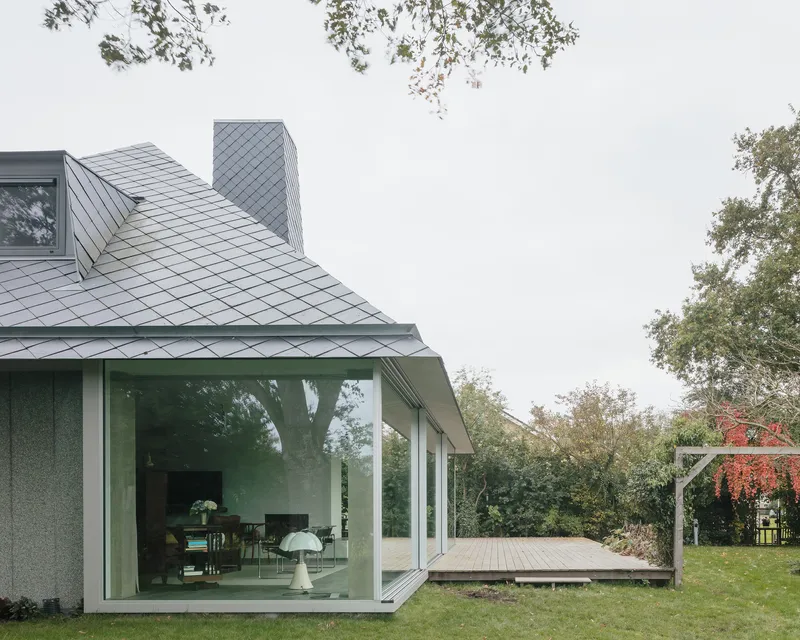
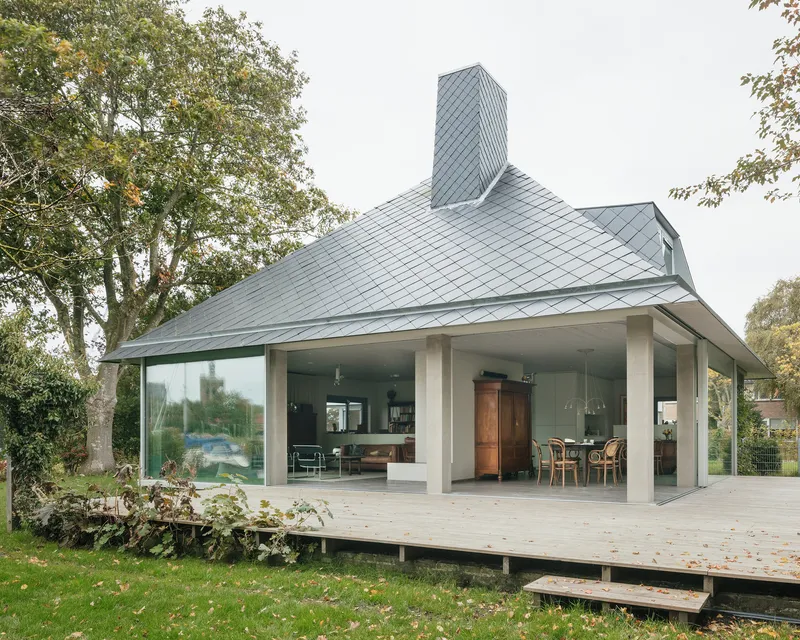
The original plan hinged on two interlocking squares, one housing the doctor's practice and the other the living quarters. BETA retained this geometric DNA but reassigned its program entirely. The former practice wing now accommodates sleeping quarters and a private office, all at ground level for accessibility. The main volume opens up under the pyramidal roof as a continuous living space. A third square of similar proportions extends into the garden as a raised timber deck, locking the house into a clear, almost classical sequence of enclosed room, sheltered threshold, and open landscape.
From the canal side, the building reads as a glass pavilion set within an overgrown garden that screens it from the neighborhood. The proportional discipline is quiet but essential: it keeps the renovation from feeling arbitrary and gives each zone, sleeping, living, outdoor, a sense of measured equivalence.
The Floating Roof
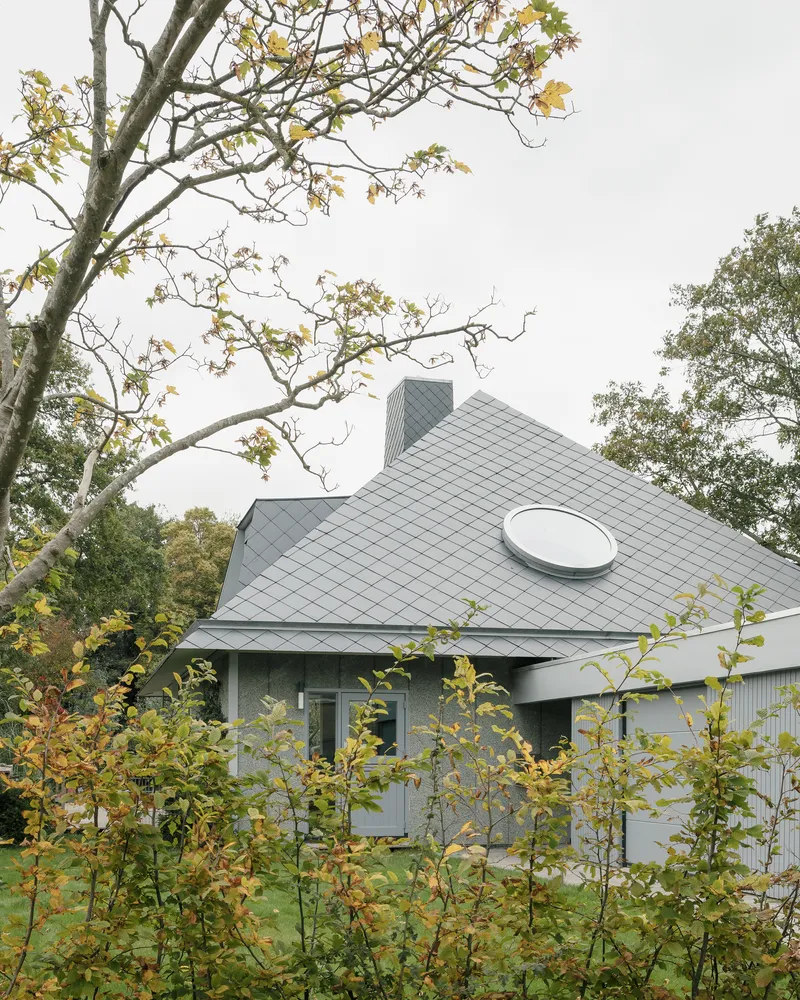
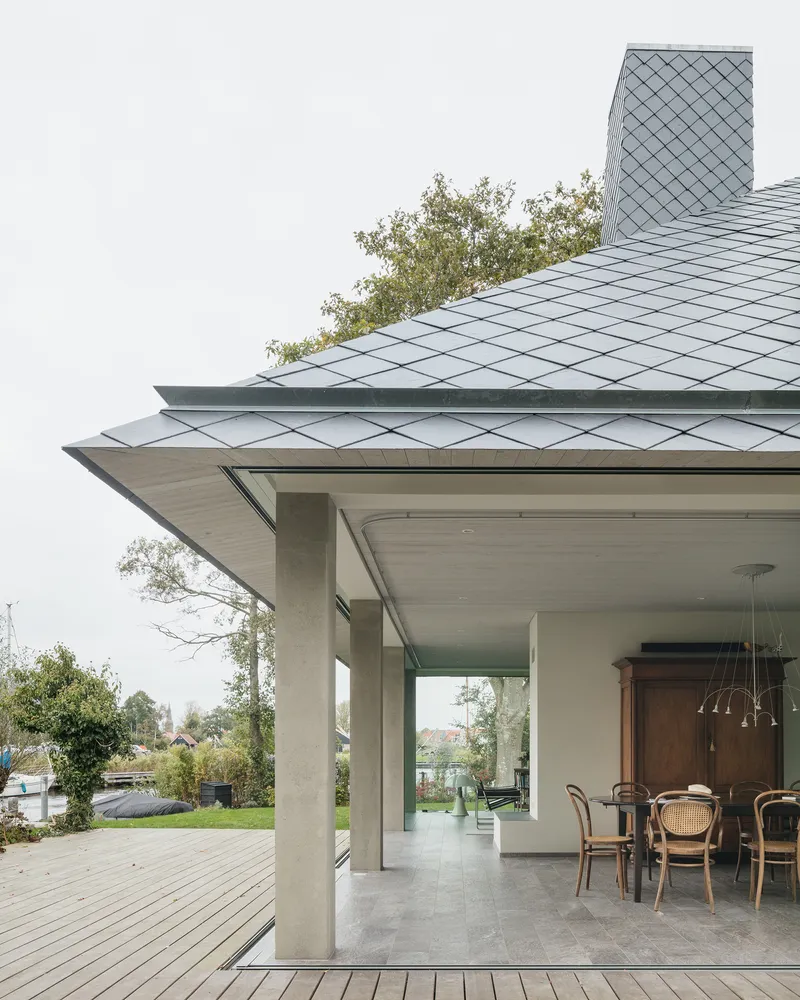
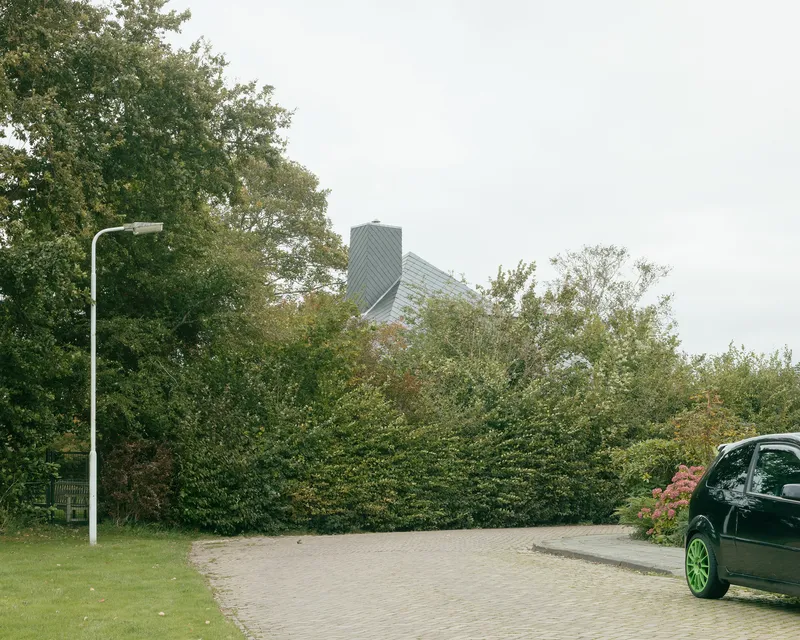
The diamond-patterned slate roof is the single element that survived the renovation most intact, and BETA used it as a kind of fifth facade. From the street, the roof rises above a dense hedge, its shingled surface punctuated only by a chimney and a circular skylight. It is the most visible sign that this is not a new building but an older one that has been surgically reworked. Up close, the detailing is deliberately minimal: an unorthodox gutter line, thin eave overhangs supported on exposed concrete columns, no fascia boards or trim to interrupt the edge where slate meets air.
The effect is that the roof appears to float. With the walls dematerialized into glass below, the heavy pyramidal form loses its weight and becomes a hovering canopy. It is a neat trick, achieved not through formal gymnastics but through careful calibration of where mass ends and transparency begins.
Dissolving the Edge
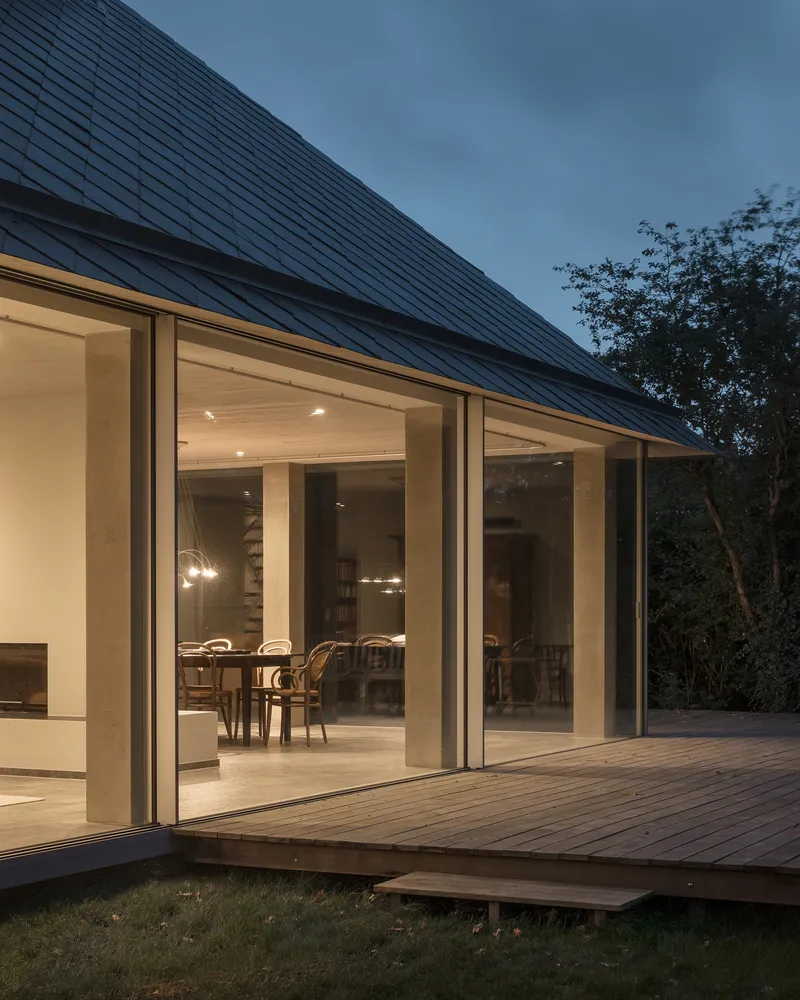
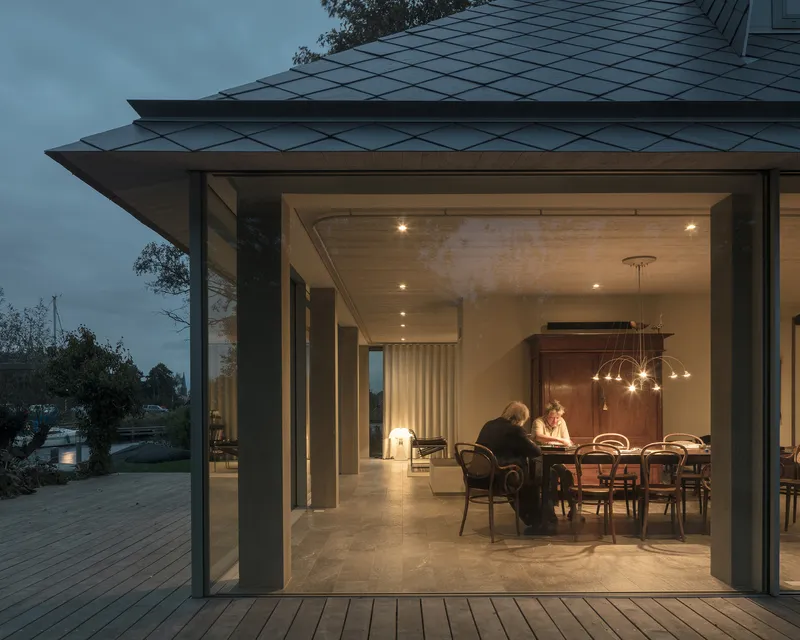
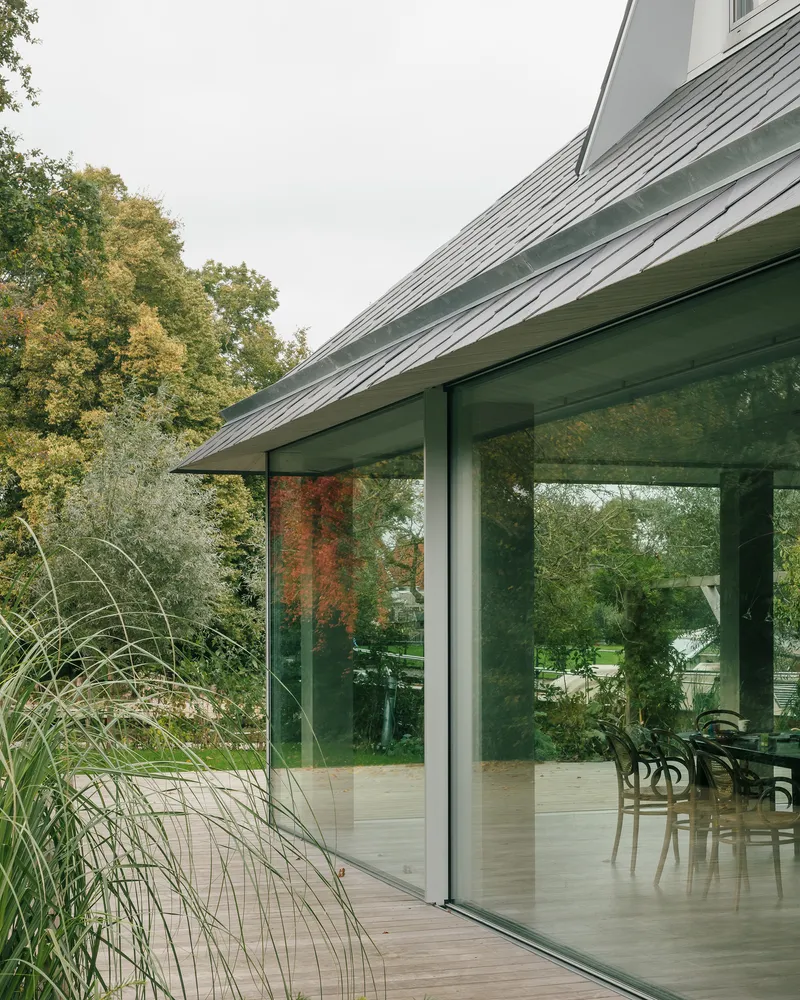
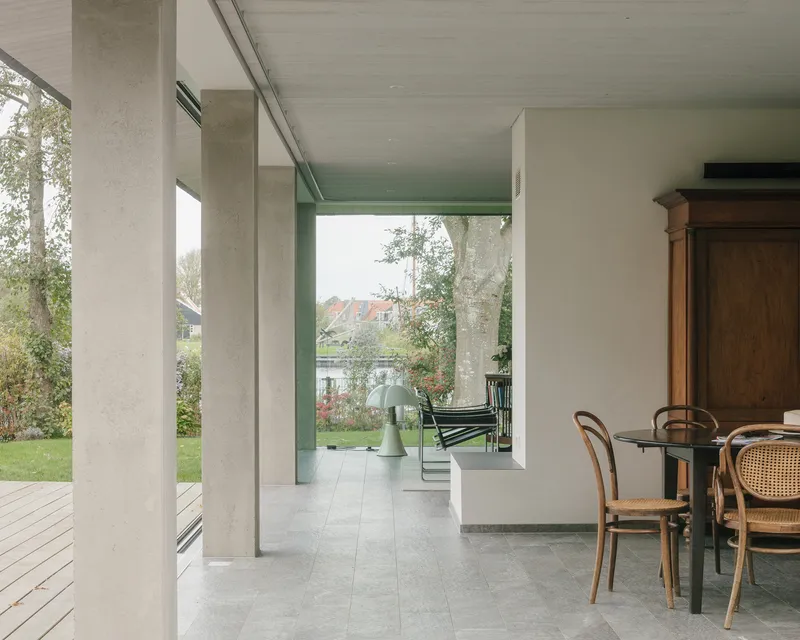
The sliding aluminum window frames deserve close attention. When fully retracted, they eliminate the facade entirely, turning the living room and dining area into a covered terrace. The Norwegian quartz flooring runs from inside to the threshold of the timber deck, and the concrete columns maintain a consistent rhythm regardless of whether glass is present or absent. At dusk, the house becomes a lantern: the illuminated interior is visible from the garden in every direction, and the boundary between domestic space and landscape dissolves into a warm glow.
For a house in Friesland, where winters are long and winds come off the water, this degree of openness is not a given. It only works because the energy strategy is robust enough to compensate for the thermal exposure. The glass is a commitment, not a conceit.
Interior Clarity
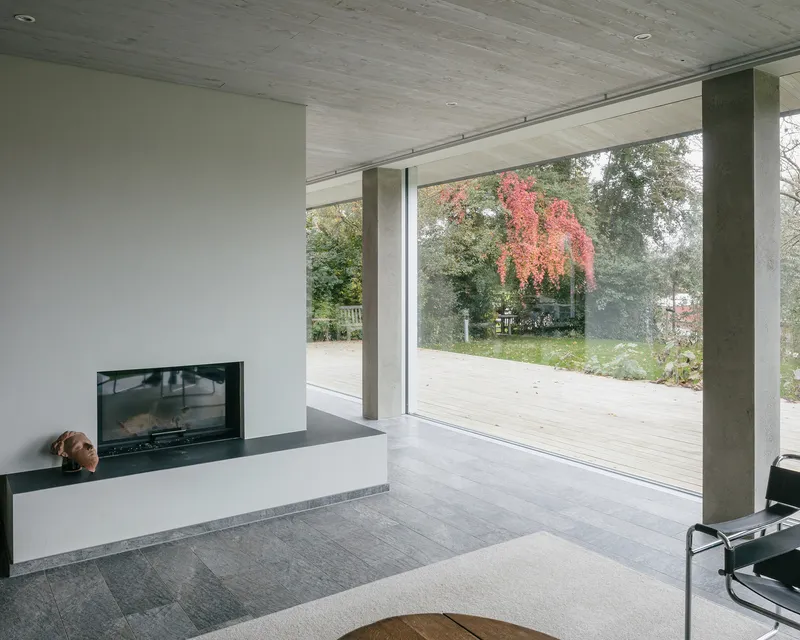
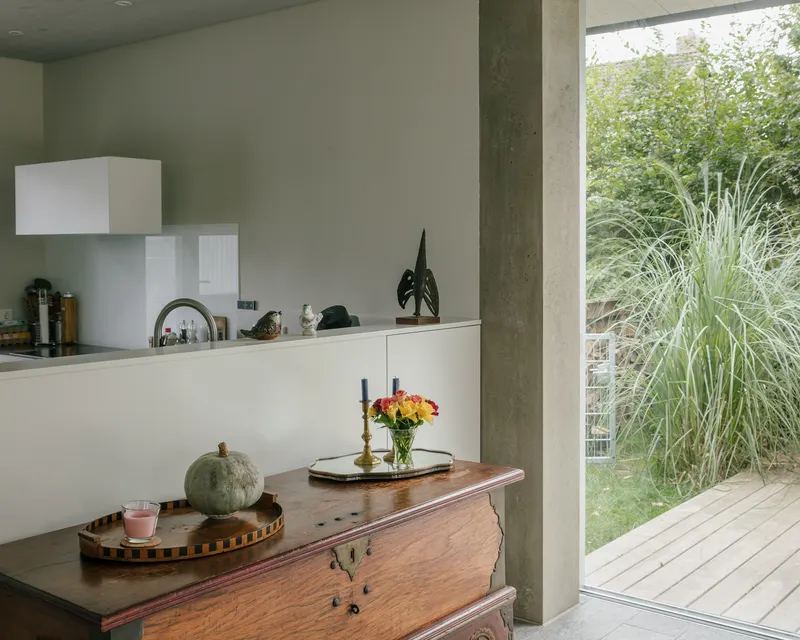
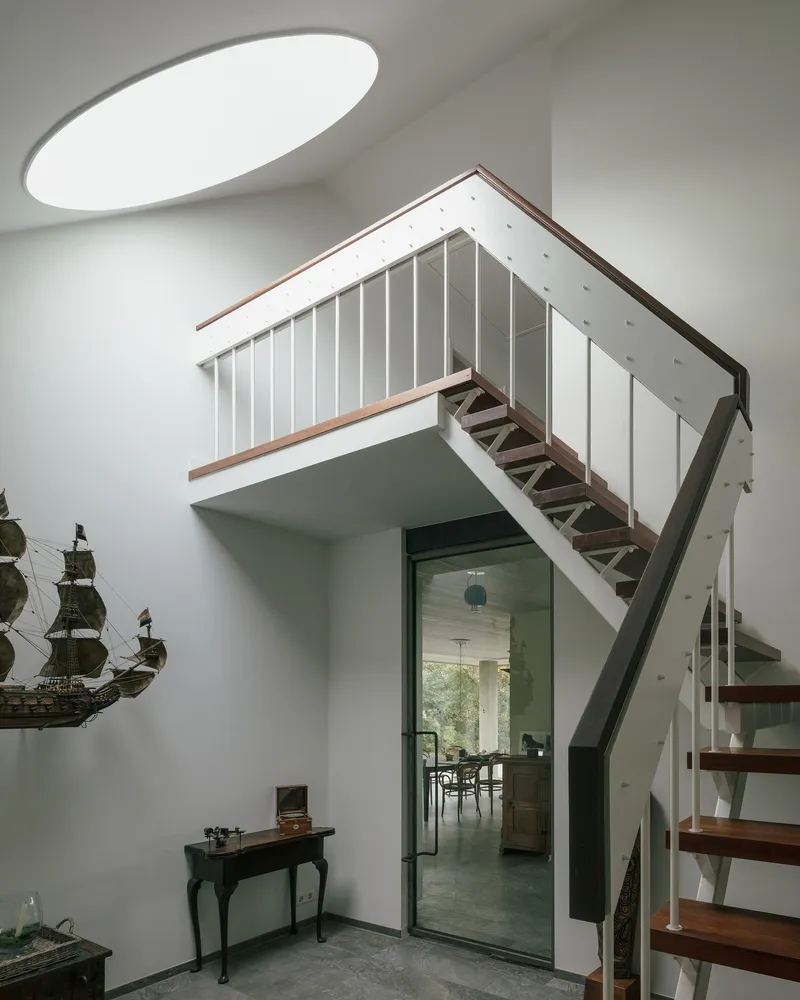
Inside, the material palette is restrained to the point of austerity. Norwegian quartz on the floor, white walls, exposed concrete columns, and timber stair treads form the entire vocabulary. The fireplace anchors the living space without dominating it, and the kitchen opens directly onto the garden terrace through a door framed by a single cast concrete column. Every element does double duty: the columns are structural and spatial dividers, the stair is a light well via the oval skylight above, and the floor is both finish and thermal mass.
The circular roof light that appears in the entry ceiling is the interior counterpart to the one visible from outside. It pulls daylight into the deepest part of the plan, the transition zone between the sleeping wing and the living volume, preventing any dead spots in what is essentially a single-story layout wrapped under a tall roof.
An Energy-Positive Machine
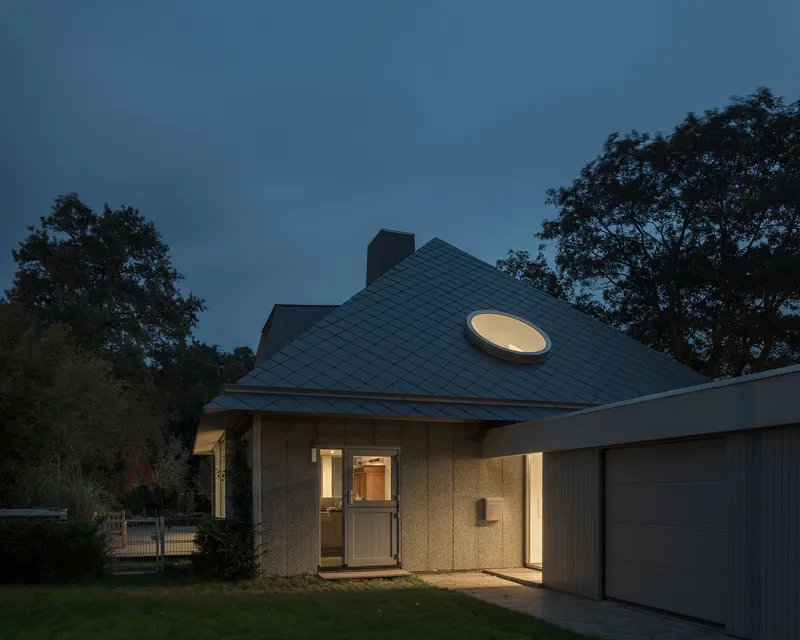
The garage is the unsung hero of House TC. Behind its modest door sits a mini power plant: a hybrid heat pump that draws from both outside air and a seasonal thermal storage well drilled 150 meters into the Frisian soil, a large thermal buffer tank, an electrical hub, and an EV charging station. On the roof above, 36 solar panels generate 10.8 MWh per year, enough to make the house energy self-sufficient across all four seasons. For a 339-square-meter residence with walls made almost entirely of glass, that is a remarkable figure.
BETA does not treat sustainability as a separate chapter appended to the design. The deep geothermal well, the solar array, and the thermal mass of the quartz floors are integrated into the architectural logic rather than displayed as green credentials. The house is quiet about its performance, which is the right approach when the performance is this convincing.
Plans and Drawings
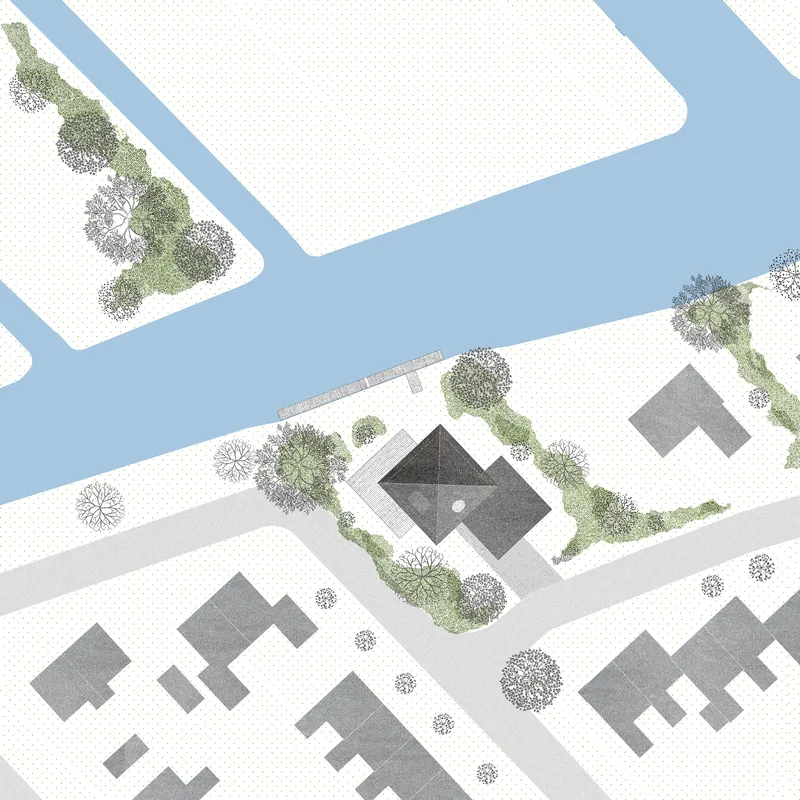
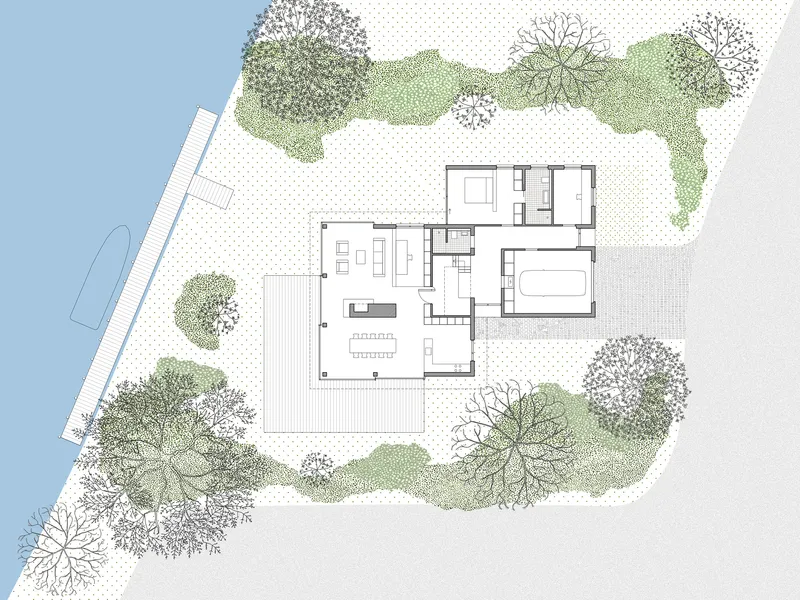
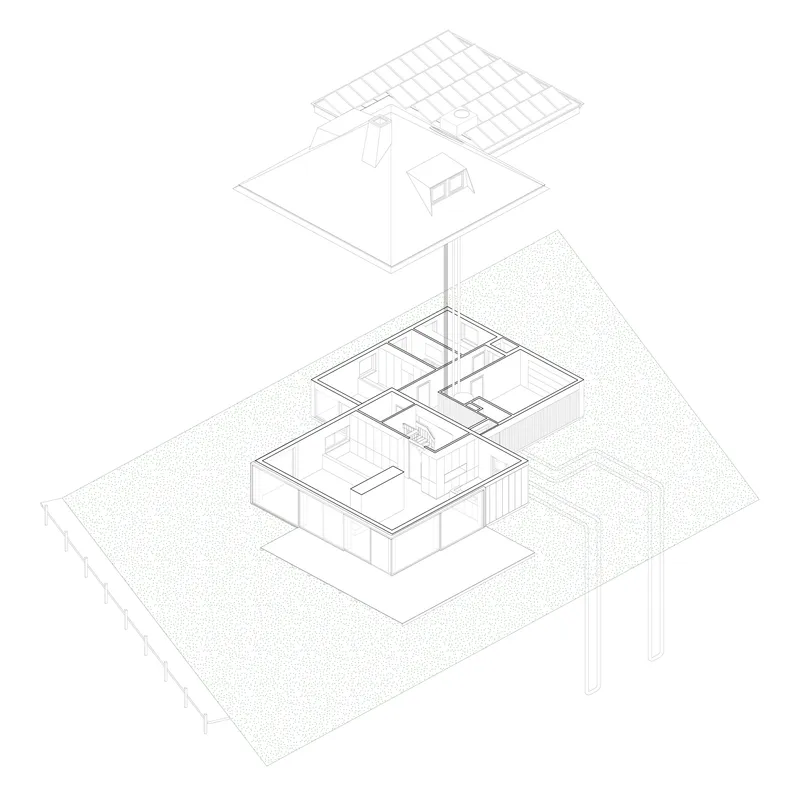
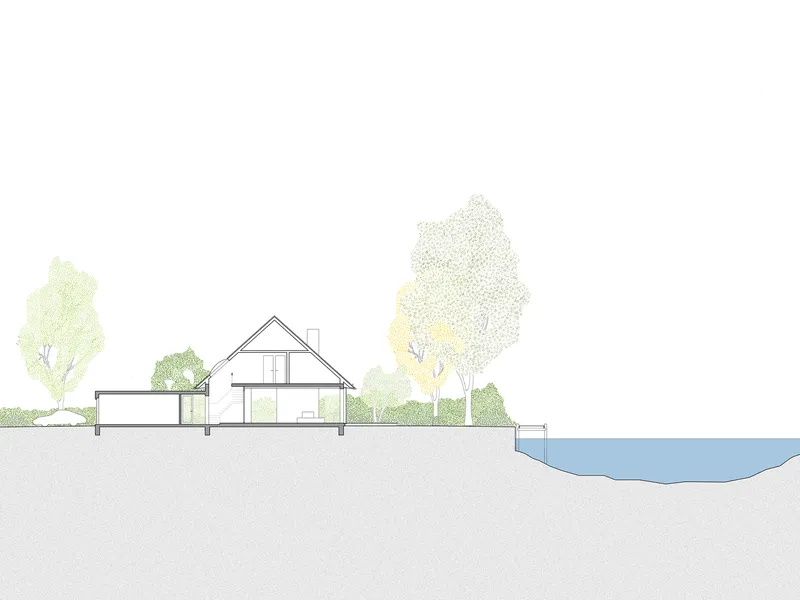
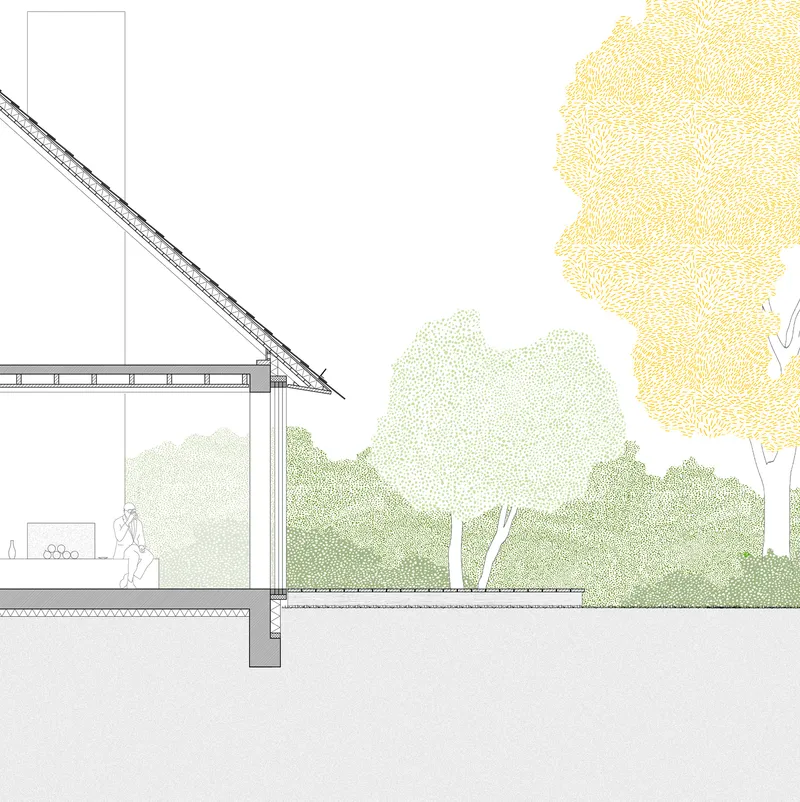
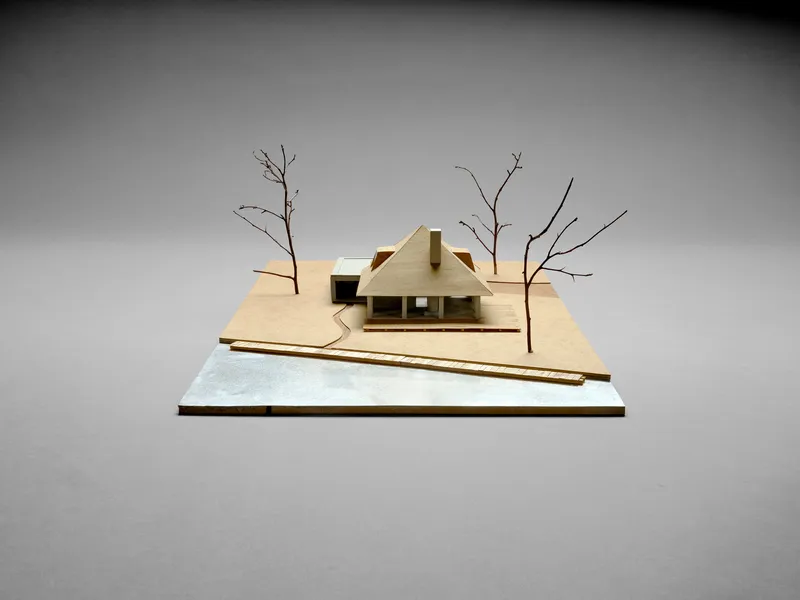
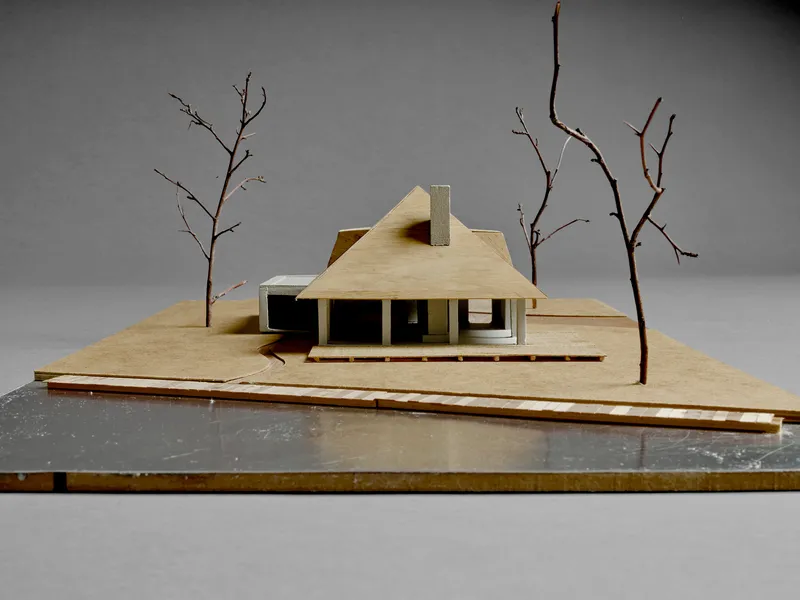
The site plans confirm what the photographs suggest: the house sits on a narrow plot between a canal and a residential street, with the garden acting as a thick green buffer on all sides. The exploded axonometric is especially useful, showing how the solar array on the garage roof relates to the main volume and how the roof structure lifts clear of the ground-floor plan. The section drawings reveal the eave detail and the way the slate cladding wraps continuously from ridge to gutter edge, interrupted only by the circular skylight. The physical models, with their bare branch stand-ins for trees, give a sense of the design at its earliest stage, when the pyramidal form was still being tested against the landscape.
Why This Project Matters
House TC is a case study in renovation as amplification. BETA did not restore the original 1970s house or replace it with something unrecognizable. They identified what was already latent in the plan, the interlocking squares, the tall roof, the relationship to the canal, and turned the volume up. The result is a house that is more itself than it ever was: more open, more connected to its site, more structurally legible, and vastly more energy-efficient.
In a culture that increasingly defaults to demolition and new construction, this project argues persuasively for looking harder at what is already there. A scruffy doctor's house on a Frisian canal had no obvious architectural merit. BETA found its hidden geometry, rebuilt its bones, and turned it into one of the most convincing residential renovations in the Netherlands in recent years. That willingness to see potential where others see only liability is the real lesson here.
House TC, designed by BETA office for architecture and the city. Located in Workum, The Netherlands. 339 m². Completed in 2021. Structural engineering by Linek. Construction by Agricola Bouw. Photography by Stijn Bollaert.
About the Studio
Share Your Own Work on uni.xyz
If projects like this are the kind of work you want to make, uni.xyz is a place to publish your own, find collaborators, and enter design competitions.




Popular Articles
Popular articles from the community


Co-Life: Senior Housing Design That Reconnects Older Adults With the City
Co-Life reimagines senior housing design through healing gardens, shared streets, workshops, and a sustainable community across generations.

Conexión: Biophilic Design Reimagines High-Rise Living in Hong Kong
Conexión reimagines high-rise living in Hong Kong through biophilic design, green facades, shared spaces, daylight, water and nature within.

Hill & Cross Opera: Sculptural Opera House Architecture Shaped by Tallinn’s Landscape and Identity
Hill & Cross Opera reimagines opera house architecture in Tallinn through its sculptural hill, civic plaza, glass wave and a luminous cross.

Riyadh For All: Intergenerational Urban Design for Active Aging in Rabat
Riyadh For All reimagines urban design in Rabat with intergenerational co-living, adaptive courtyards, and Moroccan cultural exchange today.
Similar Reads
You might also enjoy these articles

Bao Huynh Watercolor Atelier: A Serene Art Retreat in Hội An
Bao Huynh Watercolor Atelier in Hội An blends multifunctional art spaces, sustainable design, local materials, and family-friendly living in a serene environment.

Atelier Macri Concept Store Interior Design by CASE-REAL
Atelier Macri store features a "ko" counter, walnut wood details, cork displays, blending retail, gallery, and seamless customer experiences.

Manuel Vargas Izquierdo Stadium and High-Performance Sports Center: Architectural Excellence in Jalpa de Méndez
The Manuel Vargas Izquierdo Stadium blends sustainable design, inclusive sports facilities, and cultural-inspired architecture, revitalizing Jalpa de Méndez’s public spaces.
KAKR Buluh Awar Hall: Revitalizing Community and Ecology Through Bamboo Architecture
Community built bamboo hall revitalizes Buluh Awar village, empowering youth, restoring ecology, celebrating vernacular craftsmanship through sustainable architecture and culture.

Explore Office Building Competitions
Discover active competitions in this discipline


Challenge to design a portable theatre

Challenge to design a portable music platform

Challenge to design an open learning module for the elderly
Comments (0)
Please login or sign up to add comments
No comments yet. Be the first to comment!