

Between Water & Time: Istanbul's Shoreline Reimagined as Cultural Infrastructure
A layered waterfront park in Istanbul weaves Roman and Muslim spatial axes into a flood-resilient landscape of memory and ecology.


What happens when the very element that built a city begins to threaten it? Istanbul's shoreline has absorbed empires, trade routes, and prayers for centuries, and now it must absorb rising seas. "Between Water & Time" confronts that paradox head-on, proposing a waterfront park where historical memory and climate resilience are not competing agendas but a single design strategy. Two cultural axes, Roman and Muslim, structure the entire site, producing a landscape that reads as both archaeological diagram and adaptive infrastructure.
Designed by Jason Prudencio and Don Ramon, this shortlisted entry for the Ripple competition reimagines Istanbul's relationship with water through a multi-level park of sedimentary infills, artificial mounds, ecological ponds, and flood-resilient infrastructure. The project's guiding premise is deceptively simple: time is a mirror, and water its reflection. From that poetic foundation, the designers build a choreographed sequence of mythological gardens, submerged bridges, tensile canopies, and elevated viewing platforms that move visitors through spatial transitions echoing the city's layered past.
Shell Canopies and Curvilinear Flows Along the Shoreline
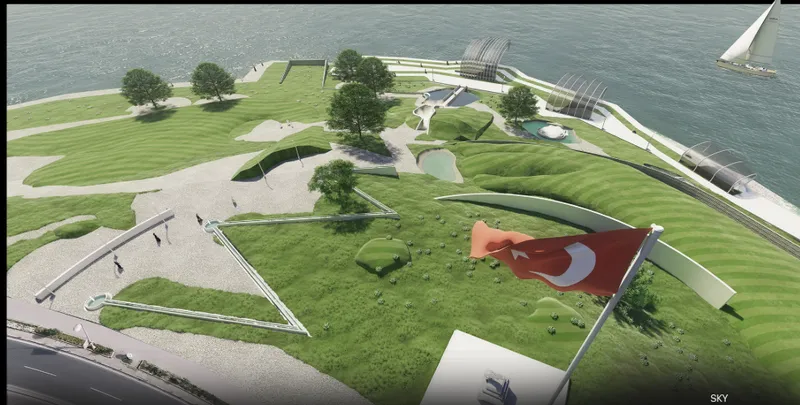

The aerial view reveals the park's dominant formal language: curving pathways that pull visitors from the urban fabric toward the water's edge, punctuated by shell-like canopy structures that hover above promenades and gathering spaces. These canopies are not decorative. Their curvilinear geometry references both Islamic patterning and the fluid dynamics of water, creating a visual continuity between structure and site. At the promenade level, the sweeping white canopy frames the Bosphorus like a lens, establishing an intimate threshold between the built park and the open water beyond.
The sailboat visible in the promenade view is a quiet but deliberate reminder that this is still a working waterfront. The design does not seal off the shore; it opens it. Pedestrian experience takes priority, but the project keeps its gaze on the horizon, acknowledging Istanbul's maritime identity rather than burying it beneath recreational programming.
Terraced Ground: Where Infrastructure Meets Collective Life
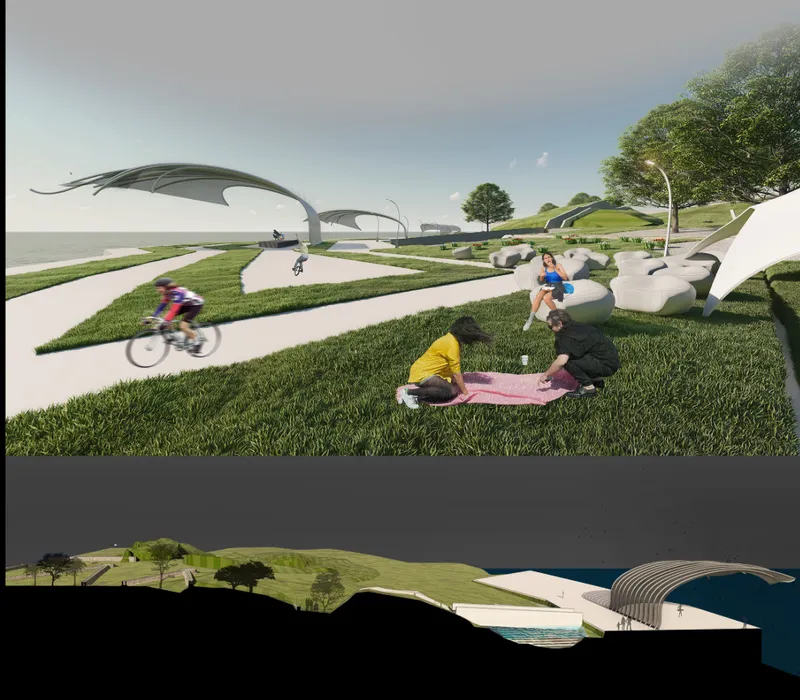
The sloping lawn with embedded seating shows how the designers handle grade change as social architecture. Cyclists, walkers, and seated visitors share a continuous topography that rises gently toward the arching shell canopies. There is no hard boundary between circulation and rest; the ground itself negotiates that transition. The embedded seating doubles as a retention strategy: the mounded landscape absorbs stormwater while providing informal amphitheater conditions for everyday occupation.
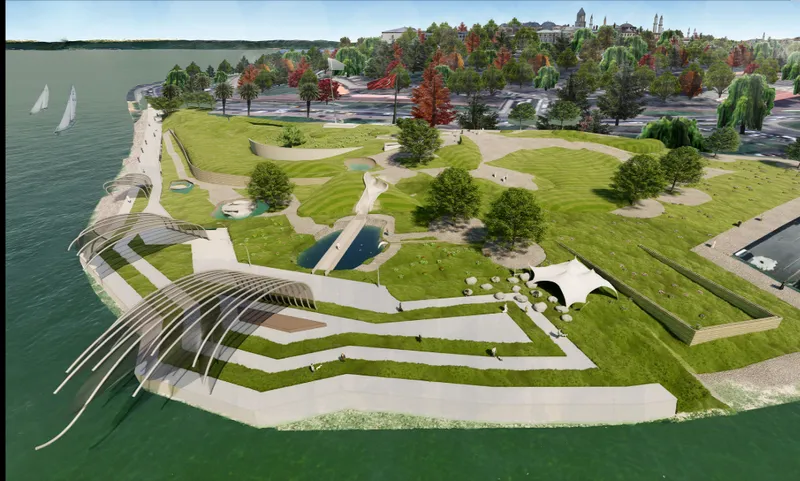
From above, the ribbed canopy structure and terraced plaza reveal the project's structural ambition more clearly. The ribs extend outward from a central spine, creating sheltered zones beneath while allowing daylight and breeze to pass through. The terraces step down toward the water, a gesture that recalls the layered excavation of archaeological sites. Sedimentary infills and commercial port seawalls merge here, demonstrating how infrastructure can carry narrative weight. This is where the Roman and Muslim axes intersect most legibly, producing a spatial framework that organizes program without flattening the site's historical complexity.
A Timber Boardwalk Between Reflection and Resilience

The timber boardwalk alongside a reflecting pool with a central fountain offers perhaps the project's most contemplative moment. Rolling grassy hills frame the far edge, while the still water surface literalizes the project's central metaphor: time as mirror. This is not ornamental water. The ecological ponds throughout the site serve as retention basins, slowing runoff while creating habitat. The boardwalk invites lingering, encouraging visitors to stand at the seam between constructed landscape and natural process.
Material choices reinforce the project's temporal layering. Timber underfoot speaks to a human scale of construction and decay. The fountain's vertical jet punctuates the horizontal calm, a small disruption that echoes the larger tension the project negotiates: water as sustainer and water as threat. It is a detail that rewards close attention, which is exactly what this park asks of its visitors.
Why This Project Matters
"Between Water & Time" refuses to treat waterfront design as a purely engineering problem. By grounding its spatial organization in two historical cultural axes, the project demonstrates that resilience and memory are not separate disciplines. Flood infrastructure becomes legible as archaeological stratigraphy; canopy structures perform as both shelter and cultural signifier. The result is a public landscape that does not choose between protecting the shore and honoring it.
For a city like Istanbul, where every meter of coastline carries centuries of accumulated meaning, this approach feels both urgent and overdue. Prudencio and Ramon have proposed a park where visitors do not simply pass through green space but actively traverse layers of time, encountering mythological gardens, submerged bridges, and elevated platforms that make the city's precarious relationship with water visible, tangible, and ultimately navigable. It is a cultural statement dressed as a park, and a resilient infrastructure project dressed as a cultural statement.
View the Full Project
About the Designers
Designers: Jason Prudencio, Don Ramon
Enter a Design Competition on uni.xyz
uni.xyz runs architecture and design competitions year-round that reward proposals with spatial conviction and real site intelligence.
Project credits: Between Water & Time by Jason Prudencio, Don Ramon Ripple (uni.xyz).


Popular Articles
Popular articles from the community


Manzana Morphosis: Stretching Barcelona's Grid into a Living Landscape for 2050
A radical reworking of the Eixample manzana turns density into a tool for generous public space, vertical ecology, and environmental performance.

Cloaked Colonization: A Mobile Underwater Habitat That Moves Like a Fish
Micah Abaya's shortlisted EHC Pacific entry reimagines ocean settlement as a dispersed network of self-sustaining architectural organisms.

Extended Shell: Retrofitting Kolkata's Balconies as Living Urban Thresholds
A modular retrofit system recovers the social and environmental intelligence of Kolkata's historic verandas for contemporary Park Street residents.

Singing Woman: Contemporary Architecture Inspired by Estonia’s Voice and the Sea
Singing Woman turns Estonia’s song culture into flowing opera house architecture, blending public life, landscape, sea, and national memory.

Similar Reads
You might also enjoy these articles

Day and Night Park: A Time-Based Urban Newsstand in Beijing
A temporary urban newsstand in Beijing blending travel, light, and reading through poetic colors, compact form, and community-focused design.

Modernist Patio Renovation in El Masnou, Barcelona by Oliver Segura Arquitectura + Cebrià Arquitectura
Modernist patio renovation blending tradition and innovation with a movable pool, leveled floors, and Catalan materials in El Masnou.

Alto Residencial Coop: Cooperative Housing Development in Santiago de Compostela by Carbajo Barrios Arquitectos
A linear cooperative housing complex blending white volumes and perforated metal façades, enhancing community living, natural light, privacy, and urban integration.
Vil Genis School by BPA ARCHITECTURE – Massy, France
Vil Genis School in Massy, France, features sustainable design, south-facing classrooms, community integration, accessible spaces, and modern educational architecture.


Comments (0)
Please login or sign up to add comments
No comments yet. Be the first to comment!