

Beyond the Border: An Inhabitable Bridge That Turns the Border Wall into Infrastructure for Care
Ayman Rouhani fuses bridge and wall into a linear, modular structure where a public promenade distributes relief and homes sit above the border line.


A border wall is a structure built to say no. Beyond the Border keeps the wall's length and density but changes what it means. Instead of a barrier, the project proposes a linear, inhabitable building that runs parallel to existing crossings and behaves like a bridge. It moves people, distributes resources and houses those caught in transition. The provocation is simple: if a nation is going to build a long structure along its edge, that structure could hold clinics, classrooms and bedrooms rather than razor wire.
Designed by Ayman Rouhani, the proposal received an Honorable Mention in the No Man’s Land competition. It is placed conceptually along the US-Mexico border, but Rouhani resists tying it to a single coordinate. The building is framed as a replicable architectural condition that could be adapted to border contexts worldwide. In this reading the border is a spatial and infrastructural continuum, a place where migration, exchange and coexistence can be organised, rather than a line on a map.
A Room With a Window, Where a Checkpoint Used to Be
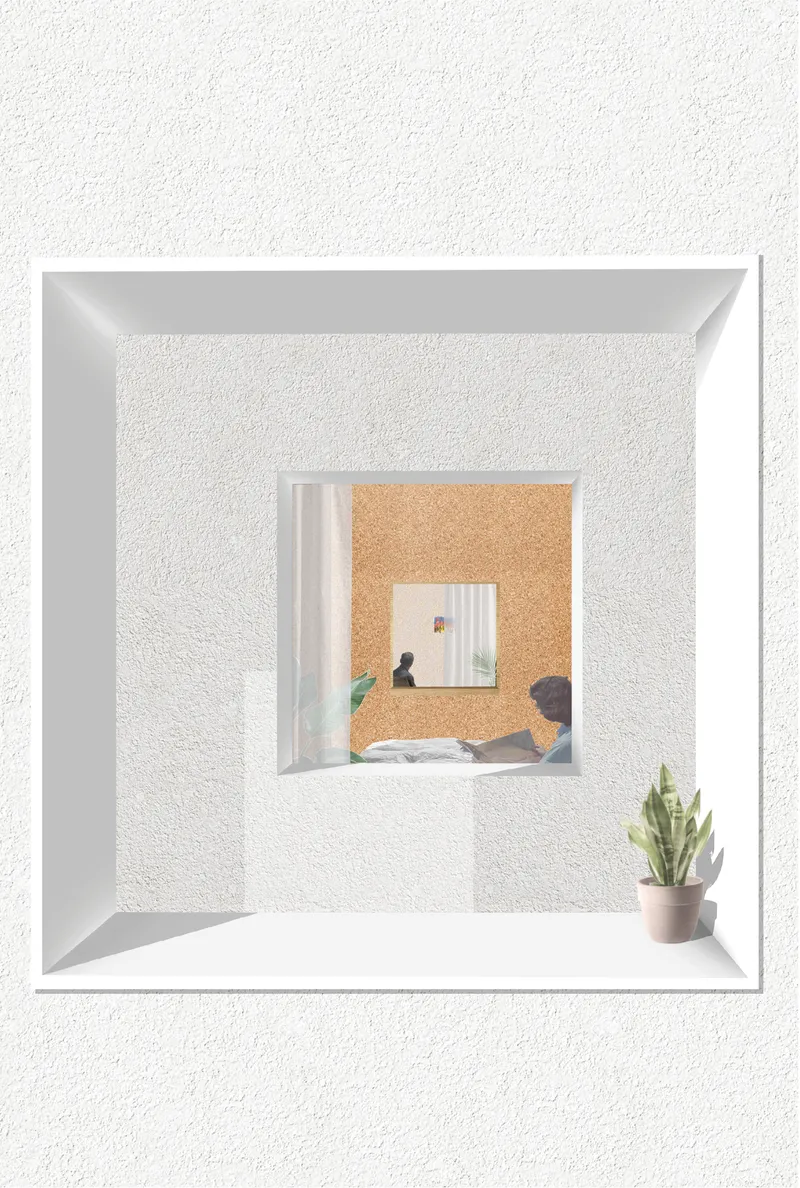
The first image is not a sweeping aerial. It is an intimate one: a deep white frame opens onto a small window, with a figure reading on a bed against a cork wall beside a potted snake plant. Starting at this scale is a deliberate argument. The project's central concern is dignified living for migrants and asylum seekers, and the render insists that the unit of measure is a person at rest, not a flow of bodies through a gate.
These residential units sit above the public, infrastructural layer and house individuals and families while they wait. Placing relief and long-term habitation in the same structure treats social sustainability as seriously as material performance. The thick window reveal does more than look good. It gives occupants a framed, private relationship to the outside, which matters in a building that is otherwise defined by its exposure along a political edge.
Bridge Meets Wall: Horizontality as a Slower Crossing
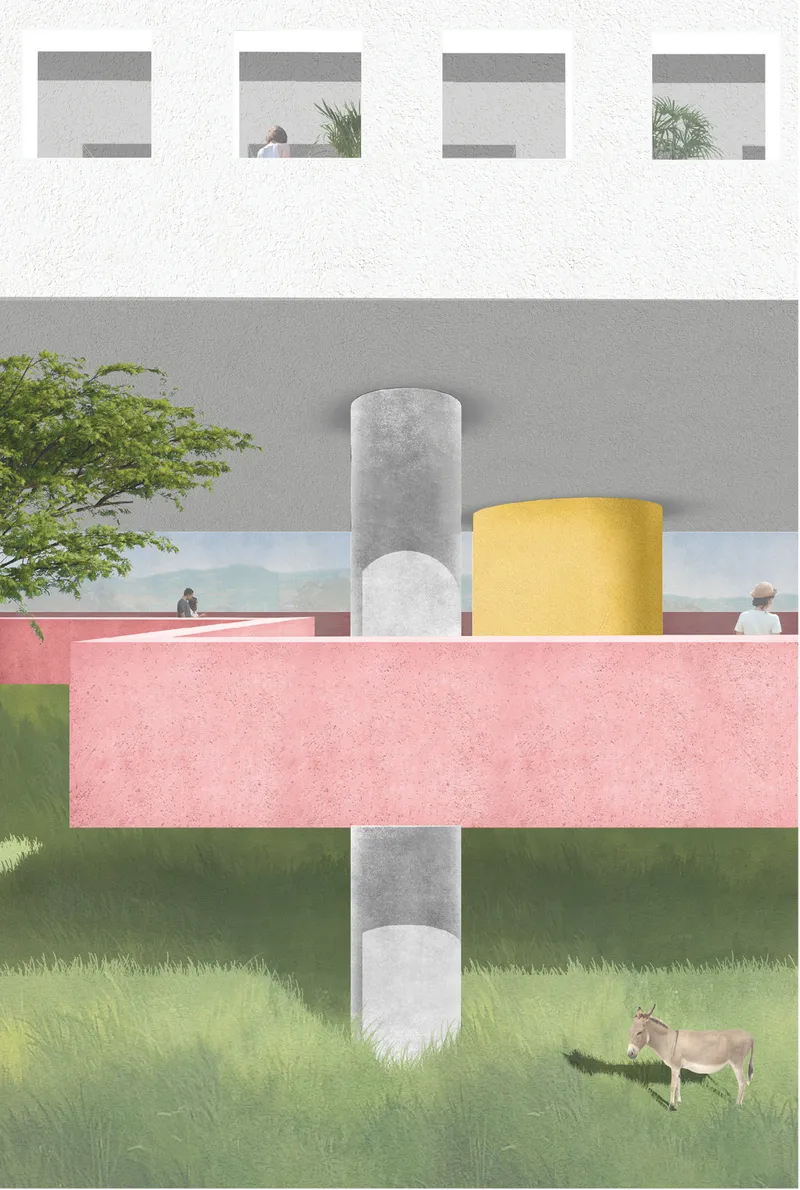
Here the structural vocabulary comes into focus. A pink concrete beam threads through a round column, a yellow volume rests above, and a donkey grazes in the tall grass below. The pastoral detail is pointed, because the ground stays open and the building touches down only lightly. The image shows the hybrid that drives the scheme: the horizontal reach of a bridge combined with the stacked density of a wall.
Each typology does specific work. Horizontality lets crossings happen gradually and in moderated stages, easing the psychological and logistical strain of a single high-stakes threshold. The wall's density lets a growing population fit within a compact footprint. The result is neither fully open nor sealed. Rouhani describes it as dynamically adaptive, and the threaded beam-and-column joint reads as a physical diagram of that negotiation.
The Promenade as a Distributed Civic Spine

Beneath the concrete slab, among yellow columns, the promenade looks like ordinary city life: a glazed pavilion, a pink wall, a bicycle, a dog, people walking in daylight. This is the organising element of the whole project. Food distribution, healthcare, sanitation, counselling and information centres are spread along its length instead of being concentrated at one checkpoint.
Dispersal is the key spatial decision. A linear system reduces congestion and gives more equal access to services, and it relieves pressure on adjacent border towns by spreading activity more evenly. The render's casual tone is the point. A space usually charged with surveillance becomes a place of interaction, negotiation and community formation, where the act of crossing starts to resemble a walk down a street.
A Kit of Parts on Round Piers
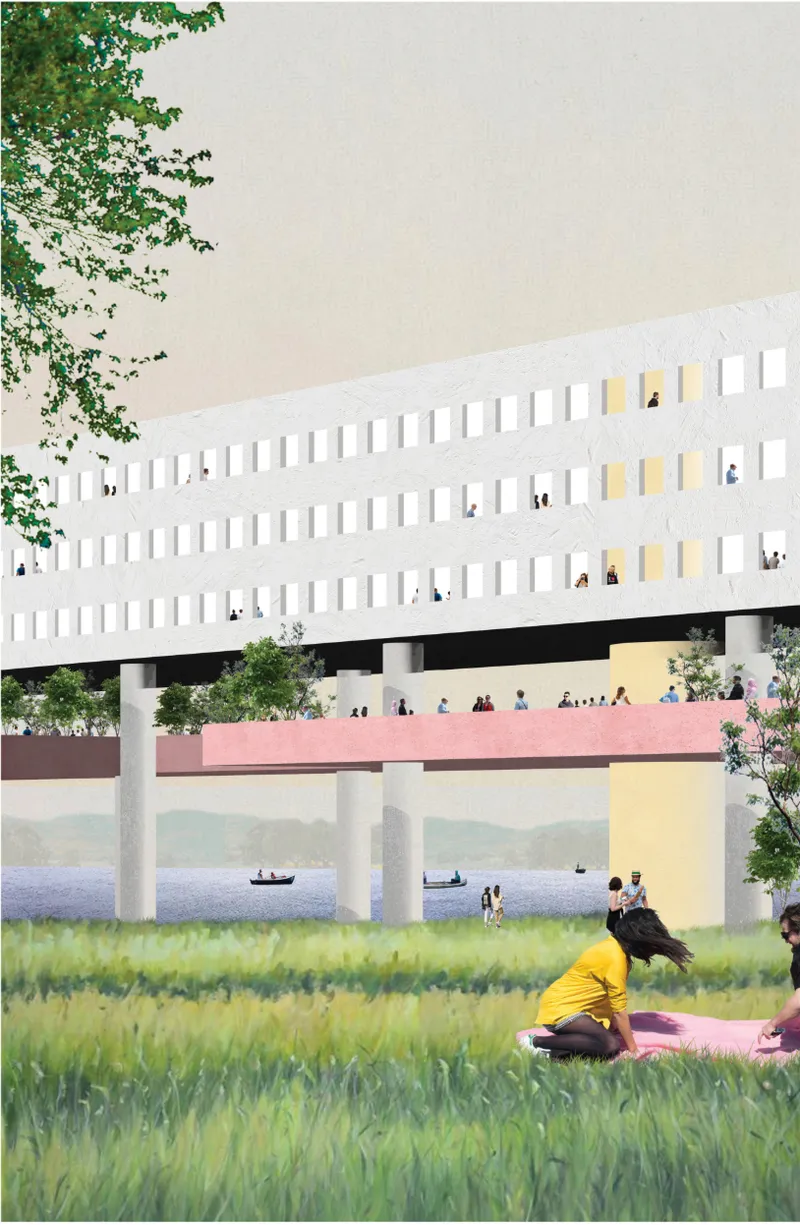
Pulling back, the building appears as a long white elevated block punctured by square windows and raised on round piers, with a pink bridge nearby and someone picnicking by a lake. The repetition of openings along the facade suggests the logic behind it: a kit of parts in which clinics, classrooms, marketplaces and living units are modular components arranged along the promenade.
Modularity is how the proposal earns its claim to replicability. The system can expand or contract with shifting migration patterns, adjust to varying resource demands and adapt to different geographic conditions, and it allows construction to happen in phases. Lifting the volume on piers keeps the landscape continuous underneath, so the structure reads as an addition to the terrain rather than a cut through it.
Plywood, Concrete and the Texture of Waiting
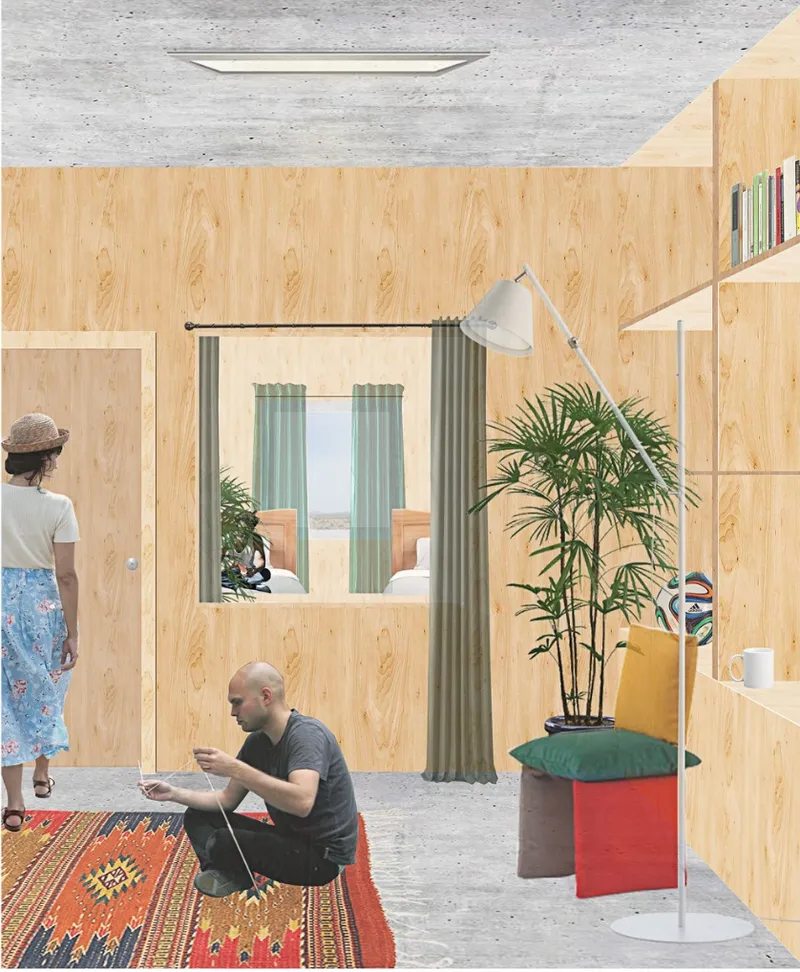
The final render returns indoors: a plywood-lined room under a concrete ceiling, a man seated on a patterned rug, a woman at the door, a potted palm in the corner. The warm timber lining against the raw structural slab marks a clear division between the permanent frame and the softer, personal layer inside it. The occupants have made the space their own, with the rug and the plant signalling a life being lived, not a sentence being served.
This is where the project's ambitions become tangible. Transitional housing is often designed as if it will be forgotten. Rouhani's interiors suggest that time spent in limbo deserves the same domestic care as any other dwelling, and that infrastructure can be built with room for people to host, rest and gather.
Why This Project Matters
Beyond the Border broadens what sustainable architecture can address. Its sustainability goes beyond carbon and materials to the social systems that form at contested edges. By fusing bridge and wall, the project reuses the very typology most associated with exclusion and redirects it toward care, a strategy more persuasive than simply calling for walls to disappear.
The renders deserve credit too. They depict donkeys, dogs, bicycles, picnics and people reading in bed, deliberately refusing the visual language of crisis. That choice makes an argument architects rarely put forward about borders: these sites can be ordinary, inhabited and humane. Whether or not a structure like this is ever built, the proposal shifts the question from how to stop people to how to receive them.
View the Full Project
About the Designers
Designer: Ayman Rouhani
Enter a Design Competition on uni.xyz
uni.xyz runs architecture and design competitions year-round that reward proposals with spatial conviction and real site intelligence.
Project credits: Beyond the Border, by Ayman Rouhani No Man’s Land (uni.xyz).


Popular Articles
Popular articles from the community


GROUP A Strips a 1969 Rotterdam Harbor Headquarters to Its Frame and Wraps It in Timber Louvers
In Rotterdam's M4H harbor district, Ferro Offices reuses a 1969 frame, adds one timber storey and reaches BREEAM-NL Outstanding.

David Ortega Stacks a Two-Story Mexico City Penthouse Around a Steel Stair and a Pergola-Shaded Roof Terrace
In Colonia Roma, a 300 m² penthouse uses oak joinery, a planted steel stair and a slatted roof pergola to make a new-build apartment feel like a house.

LT2A and OPEN Architectes Thread a Brick and Glass High School Through a Wooded Belgian Campus
In Braine-l'Alleud, a 3,000 m² wing for Collège Cardinal Mercier pairs pale brick with a glazed colonnade, deferring to a small chapel and a dense wood.

U.GA Architects Wraps an Oval Rooftop Pool in Curved Board-Formed Concrete on Busan's Jeollidan-gil
In Busan's Jeonpo-dong, a 454 m² mixed-use block stacks a neighborhood facility, guest rooms and an oval rooftop pool inside spiraling concrete walls.

Similar Reads
You might also enjoy these articles
Healing Façade: A Modular Chapel System That Restores Ethiopia's Sacred Forests
Winner of the Eco-Chapel competition, this circular timber façade collects water from air to rebuild soil and reforest degraded Ethiopian landscapes.
Kaffeebühnen: Where Coffee Shop Architecture Becomes a Civic Stage in Vienna
A linear sequence of timber boxes, transparent shells, and open yards turns the Viennese café tradition into a public performance space.
Eco Chapel: A Modular Forest Pavilion That Grows Like the Landscape It Protects
Hexagonal timber modules weave through existing trees, turning a chapel into a living system for prayer, education, and reforestation.


Urban Forest: A Vertical Ecosystem for 5,000 Workers in Singapore's Changi Business Park
Radially stacked pods and layered green decks turn a 7-acre plot into 47 acres of ecological workspace projected for 2040.


Comments (0)
Please login or sign up to add comments
No comments yet. Be the first to comment!