

Beyond the Wall: A Post-Work Commune That Turns Architecture into a Productive Landscape
A shortlisted speculative proposal reimagines communal living within stone walls, stacking zones of labor, craft, and domesticity against automation's adva


What happens to architecture when work disappears? By 2050, automation is projected to displace millions from the economic engine that currently gives structure to daily life. Rather than mourn that loss, Beyond the Wall proposes a blunt spatial answer: build a boundary, elevate the ground, and fill the interior with a vertically stacked commune where growing food, generating energy, manufacturing goods, and sharing meals replace the paycheck as the organizing principle of human purpose.
Shortlisted in the Breaking Work - Singularity competition, the project was developed by Ecrin Akkaya, Cagilsu Kardes, and Semaye Efe. Their premise is direct: if machines take the jobs, architecture must provide something jobs once did. Not just shelter, but participation, rhythm, and shared benefit. The result is a speculative commune wrapped in a literal wall, a closed-loop settlement designed to reject technological exclusion while embracing self-sufficiency.
Stacking Life: From Sleeping to Making in a Single Section
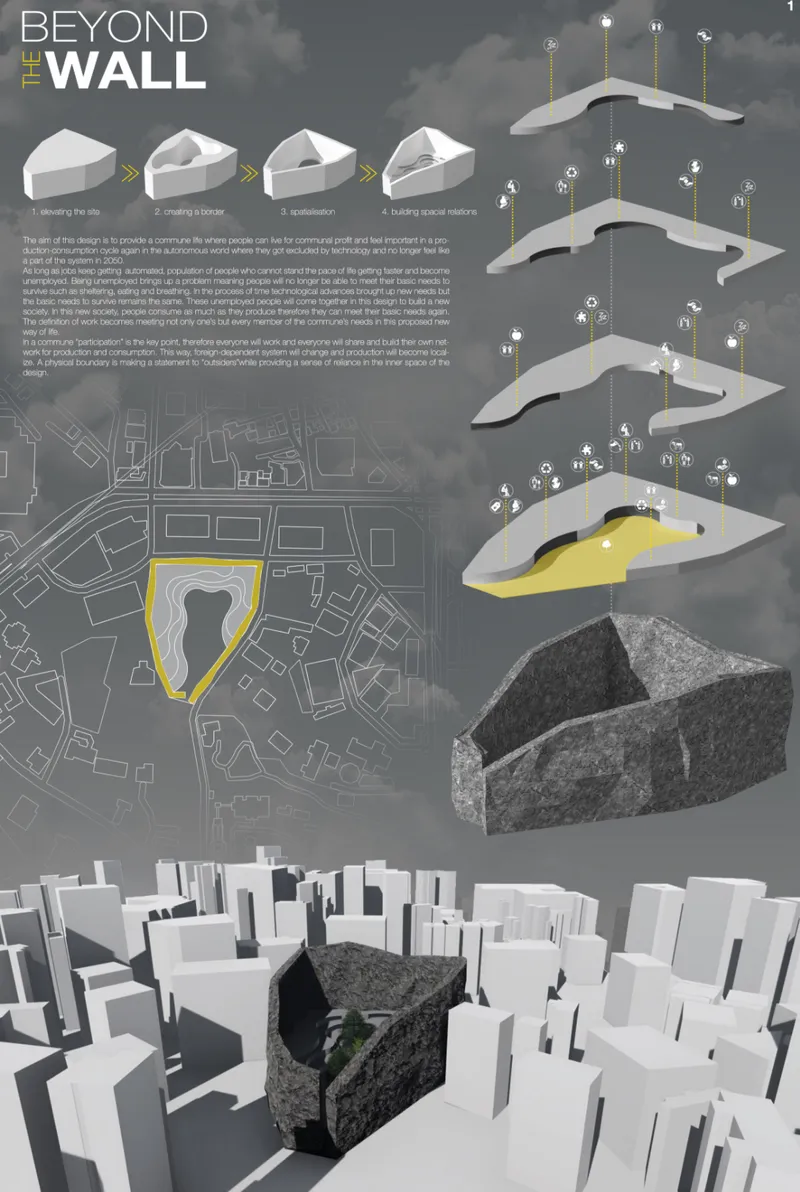
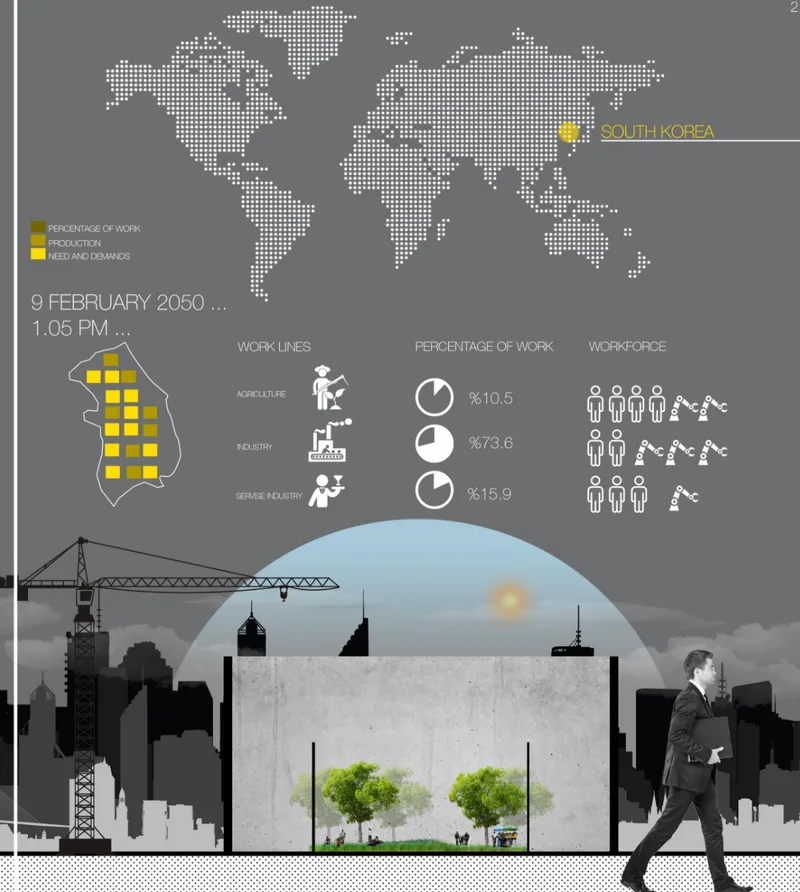
The presentation boards lay out the design's core logic with diagrammatic clarity. Axonometric iterations and sectional diagrams show how zones for sleeping, working, recycling, eating, sharing, and making are layered vertically, stacked like interwoven strata rather than spread across a conventional campus plan. The massing model reveals a deliberately thick, terraced form that reads more as topography than building. Infographics and a world map situate the project within global displacement patterns, arguing that this is not a local problem but a planetary one requiring a fundamentally different spatial model.
The sectional elevation on the second board is particularly telling. A massive concrete wall frames the enclosure, with trees growing at multiple levels and a pedestrian figure dwarfed by the structure's scale. The transition from an external dependency model to a locally driven, participatory one is made legible in a single drawing: everything the inhabitants need is produced, processed, and consumed within the section.
Stone Against Glass: Material Honesty as Resistance
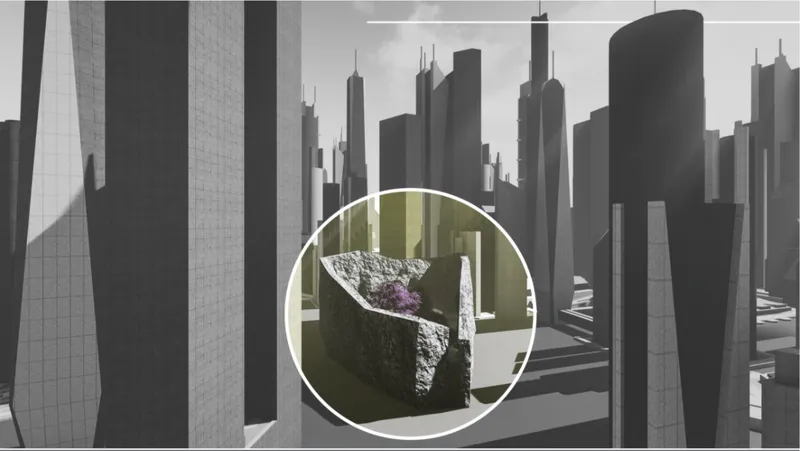
The rendered cityscape makes the project's ideological position unmistakable. Surrounded by sleek, impersonal high-rise towers, the commune registers as a rough, textured stone volume, circled in the image as if to say: find the anomaly. While the city defaults to reflective glass and corporate repetition, Beyond the Wall opts for material honesty, a raw, earthen presence that reads as a symbolic return to the essential. The contrast is not subtle, and it is not meant to be. The designers position the commune as an act of architectural resistance, a refusal to participate in the visual language of the economy that displaced its inhabitants.
Terraced Ground Between Vertical Cores

Floor plans and a longitudinal section reveal how the commune's interior is organized around vertical circulation cores connected by terraced landscape. Trees grow between these cores, and the ground itself becomes a productive surface, rising and falling to create distinct zones without relying on corridor-and-room typologies. The section drawing shows how the elevated site creates a topographic buffer from the surrounding city, reinforcing the boundary concept while still allowing internal landscapes to feel open, generous, and tied to natural systems.
The Courtyard as the Centre of Communal Life

A rendered courtyard scene captures the atmosphere the designers are after. Stone walls rise on all sides, a flowering tree anchors the space, and pedestrians with umbrellas move through rain at dusk. The mood is neither utopian nor dystopian; it is simply lived-in, quiet, and collective. There is no signage, no branding, no indication that this space belongs to a market. It belongs to the people within it.
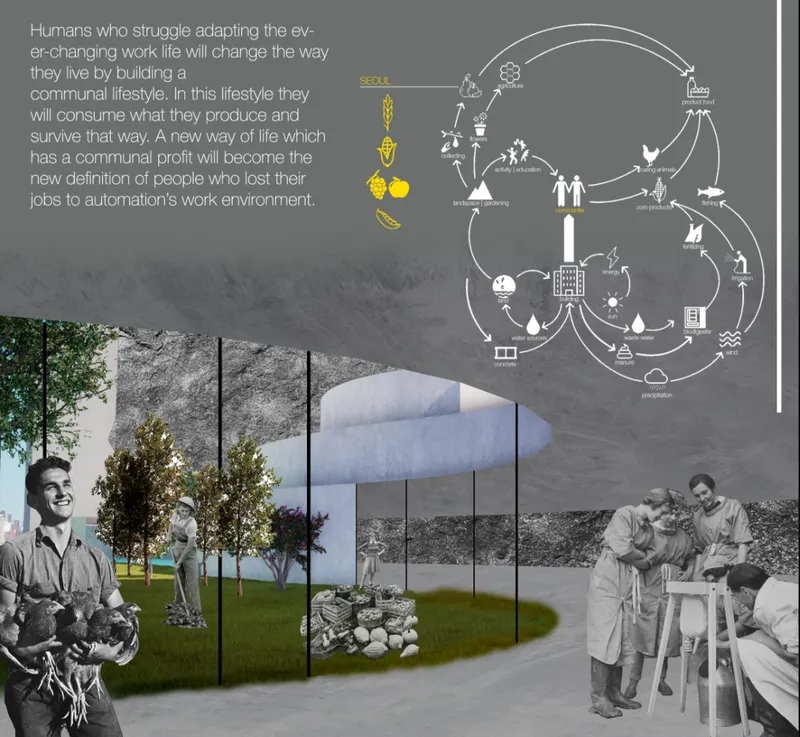
The final presentation collage reinforces this reading. A communal lifestyle diagram maps the daily rhythms of inhabitants alongside archival photographs of real residents, grounding the speculation in something tangible. Stone walls, lawns, and trees appear again, not as decoration but as the fundamental infrastructure of a post-work society. The collage argues that dignity is not found in productivity metrics but in growing something, building something, and eating together.
Why This Project Matters
Beyond the Wall succeeds because it refuses the two most common responses to automation: techno-optimism that assumes innovation will simply create new jobs, and techno-pessimism that offers no spatial alternative. Instead, the project builds an argument in section. It literally stacks the activities that give human life meaning, wraps them in a protective boundary, and challenges the assumption that architecture must serve an economy rather than a community. The closed-loop system of food production, energy generation, and goods manufacturing is not just sustainable design; it is a political statement about who architecture is for.
For students and young designers watching the labor landscape shift beneath their feet, this project offers a productive provocation. The wall is not a retreat. It is a declaration that the built environment can be redesigned around purpose, craft, and collective ownership, even when, perhaps especially when, the old economic structures no longer hold.
View the Full Project
About the Designers
Designers: Ecrin Akkaya, Cagilsu Kardes, Semaye Efe
Enter a Design Competition on uni.xyz
uni.xyz runs architecture and design competitions year-round that reward proposals with spatial conviction and real site intelligence.
Project credits: Beyond the Wall by Ecrin Akkaya, Cagilsu Kardes, Semaye Efe Breaking Work - Singularity (uni.xyz).


Popular Articles
Popular articles from the community

AL-JANNAH: Sustainable Architecture and Permaculture for Afghan Widows
AL-JANNAH uses sustainable architecture and permaculture to create resilient oasis of housing, learning, work and renewal for Afghan widows.
EW PARK: Sustainable Architecture Reimagines the Future of Urban Parking
EW PARK reimagines city parking as a modular wooden tower combining automation, solar energy, electric mobility, and adaptable urban design.

The Ocean Hive: Sustainable Architecture for a Self-Sufficient Civilization at Sea
The Ocean Hive imagines sustainable architecture at sea, where modular habitats, algae, wave power and ocean waste sustain a growing colony.

The Earth Pod: 3D Printed Homes for Resilient Refugee Communities
The Earth Pod reimagines refugee housing through 3D printed homes made from clay, combining resilience, self-sufficiency, and rapid shelter.

Similar Reads
You might also enjoy these articles

Day and Night Park: A Time-Based Urban Newsstand in Beijing
A temporary urban newsstand in Beijing blending travel, light, and reading through poetic colors, compact form, and community-focused design.

Modernist Patio Renovation in El Masnou, Barcelona by Oliver Segura Arquitectura + Cebrià Arquitectura
Modernist patio renovation blending tradition and innovation with a movable pool, leveled floors, and Catalan materials in El Masnou.

Alto Residencial Coop: Cooperative Housing Development in Santiago de Compostela by Carbajo Barrios Arquitectos
A linear cooperative housing complex blending white volumes and perforated metal façades, enhancing community living, natural light, privacy, and urban integration.
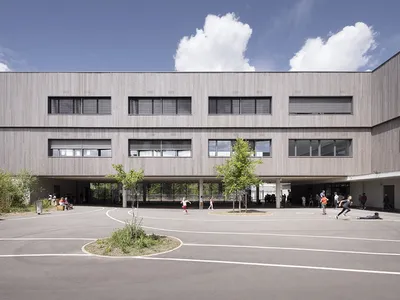
Vil Genis School by BPA ARCHITECTURE – Massy, France
Vil Genis School in Massy, France, features sustainable design, south-facing classrooms, community integration, accessible spaces, and modern educational architecture.
Comments (0)
Please login or sign up to add comments
No comments yet. Be the first to comment!